
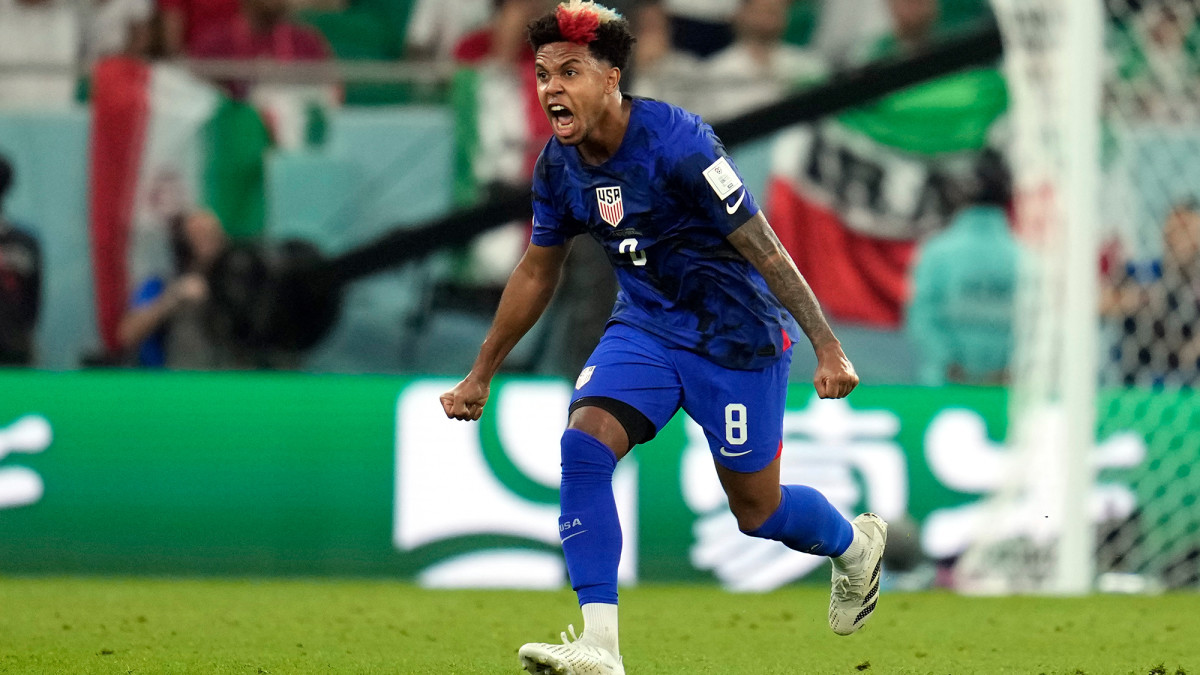
USMNT Comin’
This week, The U.S. Men’s National Team finished second in its World Cup group, advancing to the Round of 16. This was, for most observers, what was expected. Although it was by no means a guarantee, anything less would have been seen as a failure. Is this fair? I don’t know. Lots of very good teams have suffered a worse fate this World Cup (Germany chief among them). But the U.S. has advanced out of its group in 3 of the last 4 World Cups it played in, so we have come to expect it. And while this is a very young U.S. team (average age approximately 24), it’s also the most talented U.S. team ever. So they met the expectation. But what’s most exciting is how they did it.
In their first game, they dominated Wales in the first half. The goal they scored was brilliant, with a great through ball from Christian Pulisic to Timothy Weah, ending in a calm and smooth finish for the 1-0 lead.
Wales was desperate in the second half, but the U.S. still largely controlled…until the U.S. committed a dumb foul in the box in stopped time, allowing Gareth Bale to bury his penalty. The U.S. had what felt like a sure victory turn into a bitter draw.
Four days later, the U.S. played England. England is considered far deeper and more talented than the U.S. But you wouldn’t have known that watching the game. The U.S. controlled the game, particularly in the midfield, with Weston McKennie, Tyler Adams, and Yunus Musah flying all over the field. Pulisic had a shot hit the crossbar and England had a couple near goals, but the game ended 0-0. This time, the draw felt like a win. Here’s what the Ringer’s Brian Phillips said to sum that game up:
I don’t care all that much that they didn’t win the game. (I do care that the U.S. remains undefeated against England at the World Cup.) I care that they played their hearts out and looked their best on the biggest possible stage. What’s the secret to happiness that particle physicists are hiding from the rest of the world? Maybe the answer lies in the nature of the particles themselves. Maybe some particles are just fun. Maybe some particles are simply a thrill to look at. Maybe one glance at these joyful particles is enough to put anyone in a happy frame of mind.
Isn’t it the same, after all, when you watch a soccer game? Sometimes you watch two evenly matched teams and one of them somehow has an extra dash of energy, flair, pizzazz, boldness. They’re not better, exactly, but they’re freer. They’re more fun. They’re carbonated water and the other team is tap. They’re a hot air balloon and the other team is a Toyota Celica. They’re Wario and the other team is Toad. These are the joyful particles, and when you watch them, you get to experience, for 90 minutes, the bone-deep happiness that particle physicists apparently feel all the time.
Did the match change anything? Well, yes and no. No, in the sense that the U.S. will, more or less as expected, have to beat Iran on Tuesday to qualify for the knockout rounds. England, meanwhile, just has to avoid a four-goal loss to Wales. I’ve been seeing reports that non-soccer fans were bored and disappointed by this game, which is understandable —it’s tough to turn on a heavily hyped sporting event the day after Thanksgiving, see a scoreless draw that doesn’t dramatically alter the larger competitive landscape, and not feel a little let down. You probably have to be a longtime fan-slash-nerd to be deep enough in the context to get it.
And if you were, then you could see that yes, the match did change something—or at least had the potential to do so. It had the potential to change the identity of this team. We’ve been an untested, inconsistent, ambiguous proposition for a long time. Now we’re a team that can hang with England at the World Cup. Maybe we lose to Iran on Tuesday and the England game turns out to be an anomaly. But maybe it’s the start of something.
The U.S. had two points, trailing England (4) and Iran (3) heading into its finale against Iran on Tuesday. The U.S. was in an unenviable position – needing a win against a team that only needed a draw. Iran could sit back on defense, crowding the box and frustrating the Americans, knowing that they didn’t need to score to advance out of the group and send the U.S. home (again). The game began much like the Wales game. Here’s Defector’s Billy Haisley:
Probably the first step to being a great team is believing you are a great team, and the U.S. came into Tuesday’s match dripping with self-belief. Once again the Americans put together an excellent first half. The U.S. played confident, domineering soccer, zipping the ball around the pitch, gashing Iran down the flanks with scything runs from fullbacks Sergiño Dest and Antonee Robinson, and all around playing like a team that knew it would win. Pressure on the Iran goal built steadily, almost inevitably, throughout the first half hour.
If the U.S. seemed energized by the prospect of achieving the victory it needed to advance to the knockout rounds, then Iran seemed nervous about losing the draw it needed to go through. The Iranians defended decently but couldn’t plug all the holes the Americans were constantly ripping into their defense from all sides. Even when they had the ball themselves, Iran hardly ventured forward in the first period of play, and they didn’t take a single shot compared to the U.S.’s nine first-half attempts on goal.
When the game started, I badly wanted an early goal. At the 11 minute mark I said to myself, “It’s early. There’s still time.” At the 25 minute mark I said, “It’s early, there’s still time.” At the 35 minute mark I began to panic internally: “We cannot be scoreless at the half I can’t take it. I can’t take Algeria 2010 again.” And then, magic:
Watch that play slowly. Pulisic begins his run before McKennie has even lofted the ball across to Dest. Then, as he sees Dest rushing onto the ball, he turns on the friggin afterburners, beats two defenders, and finishes. What a run by Pulisic. What a ball by McKennie. What a pass by Dest.
The second half was excruciating, as Iran was desperate for a goal. Though they had a few chances that had me gasping, they never got it. The U.S. held on and advanced.
The U.S. was the better team in all three games it played, which is something we are not used to saying. Here’s Haisley:
Rooting for a national team of the U.S.’s caliber is sort of a funny thing. The team isn’t (yet . . . ?) good enough that fans can rightly demand passage into the World Cup knockout rounds and expect a win or two there, nor is the team bad enough that any old performance at a World Cup is good enough. Where you place expectations, then, and what constitutes success or failure, isn’t always clear.
The only thing you can really ask of a team like this is progress. Markers of progress aren’t always found simply in the team’s record in big tournaments, and to accurately assess the USMNT’s status, it’s important to have a holistic view that takes into account things like the number of European-grade players the country is producing, the leagues and clubs the players play at, the roles they have there, the national team’s performances outside World Cup play, and, yes, granular things like a gorgeous technique on a shot or neat passing and pressing sequences within important, maximally competitive matches.
That’s the great thing about this USMNT. The progress of these players is right there before your eyes, in the clubs that sign them and the transfer fees they command and the in-game gestures and actions they’re capable of and even the draws and wins they earn in the World Cup. The USMNT has grown so much that it’s already manifested in the results the team gets where it matters most. American fans can trust that now, and can enjoy the ride watching how far they can take it. Because if you thought this team was good, you’ve just been proven right.
So, what’s next? The Netherlands. A big name with some very good players. But this is not the Netherlands of 2010, with Robben, Sneijder, and Van Persie. They are beatable. And this U.S. team can do it. -TOB
Source: “U.S. Soccer Matched English Football on the Biggest Possible Stage,” Brian Phillips, The Ringer (11/26/2022); “USA Handled the Challenge Against Iran in More Ways Than One,” Brian Phillips, The Ringer (11/29/2022); “The USMNT Is What We Thought It Was,” Billy Haisley, Defector (11/29/2022)
PAL: Damn, I wish this team had a finisher up top. I think it was on the Bill Simmons pod that I heard them analyzing the team, and one of the points stuck out: having young legs in a tournament played in the desert is not a bad deal, especially against an older team like The Netherlands. I takin TOB’s angle from the Iran and applying it here – we need a first half goal, because I think we have tendency to run out of gas at that 60-70 minute mark (before the subs come in). And yes – I used “we” multiple times this response. Let’s go!
Beam Team Comin’
The Sacramento Kings have wandered through the desert for most of their existence. The team arrived in Sactown in 1985-86 and made the playoffs just twice in its first 13 seasons, losing in the first round both times. There was then an 8 season Renaissance of sorts, with the team peaking from about 2001-2004, where they finished 3rd, 1st, 2nd, and 4th in the Western Conference, the apex being the 2002 season, where they were robbed of an NBA title by crooked officiating.
Since the 2006 season, though, it’s been all desert. 16 seasons. Zero playoff appearances. Only twice in those sixteen seasons did they even finish 10th in the Western Conference. They’ve had terrible owners, terrible management, and twelve mostly terrible head coaches (12 in 16 seasons!). They’ve had a few good players, but not enough to make the team competitive or even entertaining.
Last year, the team was kinda fun, with point guards DeAaron Fox and Tyrese Haliburton leading the way. But the team still stunk and Fox and Haliburton, as good as they were, didn’t seem to mesh. The team made a deadline deal sending Haliburton and Buddy Hield to Indiana for Domantas Sabonis. I was PISSED. Haliburton was looking and continues to look like a superstar.
But something funny has happened over the last month of this early season. Everything is clicking in Sacramento. After an 0-4 start, the Kings righted the ship and then reeled off a 7-game win streak. It was their longest since 2004. And they didn’t just beat up on cream puffs. Victims included the Lakers, Nets, Spurs, Grizzlies and oh yeah – the Warriors. They put up 153 (!!) on Brooklyn.
And it wasn’t just the wins. The team was fun. They still aren’t defending a ton, though they’re better than last season. But the offense is electric. Fox and Sabonis are unleashed. Kevin Huerter, Malik Monk, and Terrence Davis are bombing 3s. By the end of their streak, their offense for the season was the most efficient in the entire NBA, and in fact the most efficient ever.
Kings fans, who have been wandering the desert in search of a cup of water for 16 years suddenly felt as though they’d been dropped into a 5-star hotel’s pool. Text messages among my friends are flying back and forth nightly. We friggin deserve this and we’re enjoying every minute. The fans are bananas.
I mean, look at the crowd in this sequence from Wednesday night’s game. They are going off:
Perhaps the best part of it all is The Beam. After every Kings win, a purple beam from atop the Golden1 Center is ignited and it is friggin sick.
And look at this fan’s Christmas Tree:
I WANT THAT.
My buddy Murph lives about 4-5 miles away from the arena and can see the beam from his house. It’s the coolest thing. Check Kings Twitter after a win and you will see the beam memes out in force. It’s cool as hell and it’s really fun again to be a Kings fan, which is hella tight. -TOB
Assessing a World Cup
I had to write about this article separate from my other USMNT story, because it didn’t really fit into it as a narrative. But I really enjoyed the article and in particular this passage about how thin the margins for error are in a World Cup and why those razor-thin margins make it difficult to assess a World Cup performance:
The trouble with assessing a World Cup campaign, whether in real time or in hindsight, is that four years of work boil down to the smallest margins: a bounce here, a runner not tracked there, a foul not spotted, a sprint started a fraction too early or too late, a ball that does or doesn’t cross the line by an inch.
If Clint Dempsey’s shot doesn’t squeak through Rob Green’s arms and trickle over the line against England in 2010, it’s entirely possible the U.S. doesn’t survive the group stage. It certainly wouldn’t have if Donovan had not summoned his last reserves of energy and made a trailing run in extra time against Algeria. Donovan’s goal produced an iconic moment in USMNT history, something of an inflection point for the sport stateside.
If John Brooks doesn’t head home one of his three national team goals late on against Ghana in the USMNT’s opener four years later in Brazil, the Yanks never make it out of the group. Conversely, if Chris Wondolowski gets just a little bit more of his right foot around a ball dropped into his path by Jermaine Jones’s header and gets the shot on target, the Americans likely beat Belgium to reach the quarterfinal.
If a referee’s whistle rings out in Ulsan, South Korea, when Torsten Frings clearly blocks Berhalter’s close-range effort from going into the goal with his hand, the Americans surely reach the semifinals at the 2002 World Cup. Then again, if the USA doesn’t eke out a win over Portugal and a tie with South Korea in the group stage, it would have exited early.
If. If. If.
Those three World Cup campaigns were all remembered as successes. They very nearly weren’t. But they also could have yielded more glory still. These are the margins at this unforgiving tournament, at this fickle and cruel mega-event.
This young United States men’s national team learned this lesson the hard way the past 10 days. They had their chances for a win against Wales. Against England, too. They could have had this thing sewn up before playing Iran but had to settle for ties instead. Their vulnerability felt acute during several moments against Iran as the USMNT desperately defended a 1-0 lead.
If—that word again—any of Iran’s chances make it into the American net, this golden generation is suddenly a disappointment. Instead, they have been certified as 48-carat.
This is a really great point. I often think about that Wondo miss against Belgium. What is the present of American men’s soccer if he buries that easy goal and the U.S. makes the quarterfinal by beating a then-Soccer World super power?
Anyways, there’s more great stuff on the present and future of the USMNT in this article. -TOB
Source: “The USMNT Passed Their World Cup Test. Now the Fun Part Begins,” Leander Schaerlaeckens, The Ringer (12/1/2022)
Videos of the Week
Me, Friday morning at my desk, as South Korea picked me up points in the pool:
LOL, Cuban. What a pathetic loser.
-Classic Hockey guy
Tweets of the Week
Song of the Week
Like what you’ve read? Follow us for weekly updates:
Email: 123sportslist@gmail.com
Twitter: @123sportsdigest
Two hundred, but I’ll tell him it’s fifty. He doesn’t care about the gift; he gets excited about the deal.
Jerry Seinfeld
 1-2-3 SPORTS!