
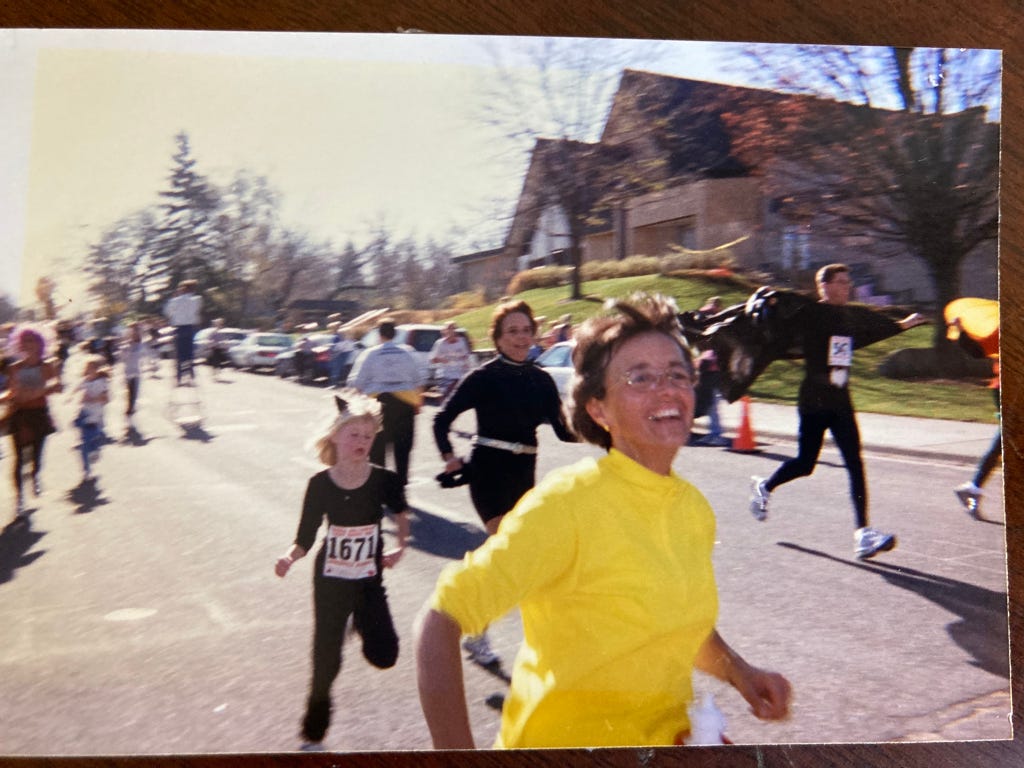
Week of August 26, 2023

My mom died last week. She was my soulmate. I don’t have many of those, but a lot of people felt she was one of theirs. 

Going home was sadder than I could’ve imagined, and way more loving than I ever expected. There’s nothing like being around your family in a time like that – a complete and impenetrable togetherness. 

Here’s a story I wrote a couple years back about my mom taking up running in her fifties. It’s far from perfect, but captures her spirit, her love for life. That’s what I want to share with everyone. 

If you want to show a little love, please consider making a small donation to The Hendrickson Foundation. When asked why you are supporting, please include “The Boundary Waters Sled Hockey Combine,” which was started at my mom and dad’s cabin several years ago.

Like Mom said, stick together. – PAL

Running In Corduroy

Mom was in her fifties when she took her first run. On a winter night in Minnesota she ran to the snow pile at the end of Farrington Circle beneath the yellow streetlight. 500 feet, give or take a few. She walked back home.

Mom’s workout attire for the run: business casual. Corduroys, a sweater over a white blouse, winter boots, and a parka.

I think of her first run regularly, often while I’m running through Oakland in the early morning. The story has long been a part of the family canon. Any forgotten details have been covered by the senses of memory undetected by chronology. For one, there’s little doubt her pre-run snack was a sip from a can of warm Diet Coke and a few chocolate chips from the yellow Tollhouse bag forever ripped open on the counter just to the left of the kitchen sink. Her corduroy strides zipped out in the cold as she passed our neighbors homes — first the Henches, then Bergersons, then Collettis and all of the rest. I can scribble a picture of every house and every bare tree.

I’ve been a runner since college, nearly 20 years. Most of my five siblings are runners, too (respect for always holding out, Tony). I’ve got the sibling marathon count around 45. Mom and Dad were at many of those races. She’d be on her tiptoes at mile 21 of the Twin Cities Marathon, straining to spot one of us coming up Summit Avenue. We’d get in the Suburban after the race, and she’d be energized, thinking aloud about why she was on the curb cheering, not running. Eventually, she gave it a shot.

Recently, Mom told me that, long before any of us ran, she would be introduced as Monica, mother of six. The number of her children was the most recognizable part of her, and she would have to convince herself that she was still Monica, separate from us. And then there was the part that had been unsaid in Mom’s presence but no doubt discussed — that she was the mom of six who’d had been really sick. Throat cancer.

Both distinctions — the one said in front of her and the one discussed when she out of earshot — pestered her for years. Two mosquitos in a tent. No one has ever loved being a mom more than she’s loved it, but goddamn, she was more than a mom, and certainly more than a mom who almost died. More than a wife, too. First, she was Monica.

Another certainty regarding the night of her first run: Mom visited Grandma and Grandpa on the way home from teaching at the very elementary school she attended. Their home, where Mom grew up with two younger sisters (both of whom began running later in life, too), was halfway between where Mom taught and our house.

Grandma and Grandpa have been gone for years now, but Mom checks in with them daily. I was shocked when Mom told me only a short time ago that Grandma had not been on board with Mom having so many kids. They did not send her to college to be a housewife, to be introduced as the mom of six.

Something in me, the bad writer still tempted to make all the pieces fit, wants to say all of those factors — her kids running, the housewife identity, the cancer survivor story she’d grown tired of, or even her hero, Grandpa, taking the time to exercise — pulled on the same end of the rope and finally got her out there to give running a shot.

That all might be, but not even Mom could know for certain. The real explanation is a mystery, or maybe even so mundane that it was lost as soon as she got to the snowpile. Instead of jury-rigging an explanation, it feels true to let the mystery be. Epiphany has the tendency to be assembled from the evidence that survived long after the happening has passed.

Mom kept running. Cue the montage music (she would request “Diamonds On The Soles of Her Shoes”). Runs to the end of the cul-de-sac became runs around the block. Around the block became around the neighborhood. The routes expanded to much of Roseville, many of the same paths Grandpa walked.

She ran down the streets and through the parks and around the lakes and through the yards that were the backdrop of nearly all of her life.

A police officer once stopped her on Highway 36. Mom had veered left down Minnesota Ave over behind Concordia Academy and found herself on the quarter-mile off-ramp. It’s that little stretch of Highway 36 that was part off-ramp, part frontage road across from the Vietnamese Buddist temple on the other side of the high school football field. I doubt she even noticed she was technically on the highway, and I promise she never thought it was cause for police concern.

To her, the fact that she was on a highway mattered less than the proximity of that particular stretch of pavement to so much of her life. How could that officer possibly take issue? She knew more about where she was than his finger knew about the inside of his nose.

Mom loved running for what it did to her mind. Aside from a Discman that rarely worked, accessories were absent from her runs. So too were gadgets used to count ultimately meaningless units of time and distance. Instead, she took a special joy in cutting through yards. As odd as it sounds, she would go out of her way to cut through a yard. To this day, she gets a kick out of it.

One time she complained to my brother, Matt, that her knees hurt. He suggested that it was probably time for a new pair of running shoes. A common issue with regular runners, which Mom had become. That didn’t make sense to her. She was still running in boots in the winter.

She loved it, and watching a parent find something they love other than you is life-affirming. To see another part of them come to form, to witness them alive in the most childlike way: experiencing something new.

After her runs, we’d talk. Mostly on the phone, but we would sit on the front porch when I was home in the summer. She’d still be sweating in the white wicker rocking chair, I’d be on the front step, and we’d stare down Farrington Circle. That runner’s gaze — exhausted contentment. I saw it in her, knowing its perfection myself. I loved to see her lost in the gaze.

In many ways, I think like her. We drift on a similar current. Running gave space to think. A tempo for her to meditate on the people she loved and the ideas that she couldn’t untangle or set aside. She could stride through all of the thoughts with the power of synchronicity, of breath and stride. The idea of faith vs. organized religion, grandpa flying missions as a navigator in WWII, dinner that night, the latest from The White House, a lesson plan, the reading for next week’s mass, and her book club book — all of these thoughts connected within the rhythm of breath and footfalls, and Mom didn’t have to wait for anyone to keep up.

Mom stopped running maybe seven years ago. She slipped a couple times and hit her head. She’s had seizures in her past, though not as a result from falling while running. Also, the radiation from the throat cancer 30 years prior caused many of the muscles in her neck to begin atrophy. Her neck bends forward, resulting in neck, back, and shoulder pain. There have been spinal fusion surgeries, physical therapy, botox, speech therapy, and more. Recently, the flap in her throat — the epiglottis — doesn’t work too well anymore, so it became hard for her to get certain foods down. Some would go down the wrong pipe, causing her to aspirate. Pneumonia followed at least two times.

Mom has always been a petite woman, but the swallowing issues had left her much too thin by my wedding in 2019. She’d always plow through any discomfort. Still, I was scared. She was frail, exhausted, but it was more than that. Mentally, she was loose.

She was malnourished. A feeding tube was put in, which makes it sound like she’s now incapacitated, and that’s far from the truth. The tube has brought her back, in weight, sharpness, and wit. She doesn’t have to rely on swallowing food to get her nutrition. She still eats, orally, but just can’t rely on it for her nutrition. At night, Dad attaches a packet of her daily dose of nutrients and calories to a tube right into her stomach. She has more energy than she’s had in years, and she puts it to use.

I don’t put my mom’s health challenges out there for dramatics; I share to underscore just how much it took to merely slow her gait from a run to a walk. She is, without a hesitation, the most resilient person I know. She doesn’t know how to quit.

She walks most every day, probably as fast as she ran to be honest, but her spirit is not that of a walker. She’s in it, but Mom isn’t ready for a walking life, especially after finding running so late.

Mom’s a fucking runner. I thought she’d hate that I put it that way, but it’s the truth. Turns out, she kinda liked that line.

There’s absolute strength in knowing that I come from her, the lady that took her first run after 50 on a cold winter night. I’m not foolish enough to presume I have all of her resilience in me, but some of that made it to me. It must have. All of those 45 Lang sibling marathons — the ones before and after — come from the same place inside of Mom that convinced her to run up the cul-de-sac.

OK, I admit it; I can’t be completely certain on the specifics of her work clothes on that first run, but that’s the story that survived, and there’s much truth in it. And that lady defaults to corduroys in the winter, always has. She definitely was not wearing jeans to teach the kids at Maternity of Mary. Of course there was a sweater, and what mom owns any less than 40 white blouses?

I often recreate Mom on that run. Her breath finds a pace. Her boots crunch the snow-ice with each petite stride venturing out into the night.

Phil Lang, 02/02/21

Song of the Week

Week of August 18, 2023

We’re back.


A Dark Day in College Sports

Two weeks ago, the Pac-12, which has been in existence since 1915, fell apart. A quick recap:

  • UCLA and USC announced last year that 2023 would be their last season. They did so because they would be paid a LOT more money. 
  • The conference opened its TV contract negotiations a year early, and spent the next 13 months trying to negotiate a deal that would at least beat the Big-12 in annual payout per school.
  • The conference kept telling people a deal was coming soon.
  • Finally, a deal was ready to be signed. An exclusive deal with Apple TV with a base of around $25M per school with significant incentives for people signing up for the Pac-12 package. 
  • The night before the deal was to be signed, Oregon and Washington were invited to the Big-10. They accepted.
  • Arizona immediately left to the Big-12. Utah and Arizona State followed.
  • Only Cal, Stanford, Washington State, and Oregon State remain.

Man, I really don’t want to write about this. It sucks and I am pissed. So I’ll start with something I read from Rodger Sherman, of the Ringer:

Evolution turns everything into crabs. For whatever reason, a handful of unrelated crustacean species all wound up looking exactly the same, because flat and pinchy is apparently the optimal body structure for survival. The same has happened with North American pro sports even though every league was founded under entirely different circumstances, in different regions of the country, across different eras with different business models. The NFL was founded in midsize Rust Belt cities with hopes of leeching off the massive popularity of college football; the American and National Leagues used to be competitors, with their own commissioners and rules; the Stanley Cup was originally given out to amateur Canadian clubs who had to challenge one another for the title. Now these leagues are essentially all the same with 30 to 32 teams, spread across the continent, playing in most of the same cities. Same with the NBA, and MLS, all having evolved into the same pro sports crab.

Next up is college football, a sport built on the strength of regional rivalries which is now rapidly evolving into a national sport with just a few massive coast-to-coast conferences. Unfortunately, the Pac-12 will not be one of the lucky crustaceans. The 108-year-old regional league is doomed to die after losing most of its marquee members to the formerly Midwestern Big Ten now up to 18 teams, spread coast-to-coast.

Conference realignment is not new. Teams have been switching leagues for decades. But this latest round is exceptionally bleak. Historically, the most important thing about college athletic conferences was their geography. Part of this was about convenience: It’s easier to schedule games against the team down the road. But it also fostered the environment that made college sports special. It’s about road-tripping to watch your squad play and having neighbors or coworkers or in-laws who root for That Other Team in your state and will spend 364 days telling you about it if your team loses that one rivalry game every year.

Pro sports, on the other hand, are inherently national, not regional. It is rare for cities to have two teams in the same league. A crosstown rivalry is nice, and might even be feasible in metropoles like New York or Los Angeles. But everywhere else, it’s a bad strategy. Why split one city’s fans between two teams when you could spread out into new territories? Although there are geographic rivalries in pro sports, they’re less personal. A Yankees fan in New York doesn’t have to see Red Sox fans most days. It’s a hate you bust out a few times a year, instead of the simmering hate that powers college athletics.

The Pac-12 was a regional league. It was named after a region, and basically every team in the league had a clear and obvious rival. USC and UCLA played in the most aesthetically pleasing game of the year, red-and-gold against powder blue in the Rose Bowl or the Coliseum. Stanford and Cal played in the Big Game, a contest matching up some of the greatest, and nerdiest, players in football history. Oregon and Oregon State played for the perfect Platypus Trophy half-Duck, half-Beaver, get it? The Apple Cup between Washington and Wazzu always seemed drunk, and Arizona and Arizona State waged football war in the desert.

The Oregon-Washington move to the Big Ten permanently kills two of those iconic rivalriesOregon and Washington are leaving behind their natural rivalsand relegates Cal-Stanford to third-tier status in a left-behind league. It follows a trend, as by joining the SEC, Oklahoma is leaving Oklahoma State behind in the Big 12, killing off a game so chaotic it earned the nickname “Bedlam.”

In doing so, these teams that are leaving for bigger leagues or more TV money are permanently winning their rivalries, officially announcing themselves as bigger and better than the teams they share a state with. They will crowd out their ex-rivals, soaking up resources and talent and fans. Their pockets will be richer and their experience will be poorer: Instead of bragging about beating their rivals from down the road, they will play schools from the other side of the country and have nobody to talk to about it.

People bemoaning the modern state of college athletics (including many of the people who actively run universities, conferences, or the NCAA) have repeatedly harped on the growing professionalization of college athletics and when they say this, they’re talking about how college athletes can now switch schools with more ease through the transfer portal or receive money for appearing in commercials. But the thing about college sports which reminds me most of the pros is the way the most powerful schools and conferences have reshaped the sport. The Big Ten and the SEC are locked in a battle to become the Junior NFL, they know the form they need to take, and they are clearly putting in the steps to get there. Evolution turns everything into crabs, and it’s shaped every pro league into the same creature. The Pac-12 is one of the species that didn’t survive.

So who is to blame?

A lot of people are mad at Fox and ESPN – they control the purse strings, so they called the shots here. Fox wanted to air big games, so they poached USC and UCLA – ending 100+ years of tradition for a few marquee matchups (which they could have contracted for without pulling USC and UCLA out of the Pac-12). Then they did the same with Oregon and Washington. They don’t care about anything but their bottom line – damn all the hundreds or thousands of athletes in small sports who will now be forced to travel across the country to play a mid-week softball series, for example, in Maryland. As The Athletic’s Chris Vannini wrote:

College sports long ago hitched its entire wagon to the money train. It wasn’t any one move that led us to this realignment round, in which a second major conference is collapsing in the span of a decade. Everyone has played a domino since the Supreme Court’s landmark 1984 decision in NCAA vs. Board of Regents, which opened the door to school and conference TV deals. It was the resulting all-out drive for every last dollar that sent us down the path to end college sports as we know it (while keeping money away from the players, of course).

But college sports is about to learn, if it hasn’t already, that when you’ve sacrificed everything at the altar of money, you no longer control where things go, and you might not like where it ends. The big brands will be fine, but a lot of fans will be left behind, and this isn’t the end of it.

A lot of people are mad at Oregon and Washington for turning their backs on their conference mates at the last minute.

But for my money, the blame here is on USC and UCLA. Their decision to leave was shocking. It makes no sense on so many levels and I think it will backfire on them. Their Athletic Directors are outsiders (both USC Athletic Director Mike Bohn and UCLA’s Athletic Director Martin Jarmond did their undergrad far from the West Coast and neither had worked in the Pac-12 before their current jobs, with the minor exception of Bohn’s final year at Colorado, which was Colorado’s first in the Pac-12). Bohn and Jarmond have no care for traditions and no care for the schools’ long term health (hell, it was reported last week that Jarmond had interviewed for USC’s athletic director job). These outsiders made decisions that are not in the schools’ long term interest. Hell, it’s not even in the schools’ short term interest, other than money. It’s going to be a disaster for the current athletes and will likely kill recruiting for every sport other than football and men’s basketball. They have been played by TV execs.

Last week on KNBR, UCLA honk Brian Murphy argued in an interview with Sports Illustrated’s Pete Thamel that UCLA “had to get that money.” Thamel’s response was spot on. He asked, “Do they?” And then to paraphrase, Thamel argued that these football programs spend gobs of money – on bad coaching contracts that they then buy out and have to keep paying, on opulent facilities, on who knows what else, and then argue that they have to get more money to keep spending, traditions be damned. 

Fuck USC and UCLA forever. -TOB

Source: The Imminent Death of the Pac-12 Marks the Point of No Return for College Sports,” Rodger Sherman, The Ringer (08/04/2023); College Sports May Not Like What Lies at the End of the Path Paved with TV Money,” Chris Vannini, The Athletic (08/07/2023)

PAL: The crustacean analogy is absolutely perfect. First off, I’ve never considered the evolution of crustaceans. The idea that all leagues are morphing into the same thing makes sense in the way that people in charge can justify inside impressive boardrooms, but it’s just so boring. The homogeny of sports is making it all only kinda matter to me, a person who’s devoured sports most of my life. I’m a sports nut writing about sports to handful of friends. If I lose interest, then who’s left, and for how long? Those TV contracts are a reflection of ad buy and subscription projections, and those are based on fan interest. I don’t think bigger leagues will equal more interest; I think it will dilute the interest of fanbases from the majority of programs that won’t compete for championships.


What’s Next for Cal and Stanford

So what’s next for Cal (and Stanford, OSU, Wazzu)? No one knows for sure. Many fans hope the Big-10 invites the Bay Area schools (or all 4 of the unconferenced schools) to form a “west coast pod” – gee, imagine that: a conference comprised of schools on the Pacific Coast. What a novel idea. There are also rumors that the ACC is considering adding Cal and Stanford, which is worse for travel than even the Big Ten. Others have suggested a merger with the MWC, which I think will kill my interest – I am not excited to go see Cal play Colorado State or Air Force every week, ya know? And there’s a non-zero chance that Cal football just dies, which was previously unthinkable.

The Mercury-News’ Jon Wilner argues the Big-10 makes the most sense, and it’s hard to argue:

Membership in the Big Ten makes far more sense for Cal and Stanford — and for USC, UCLA, Oregon and Washington.

A six-team western division would create a heavy load of regional conference games, limiting the number of cross-country trips for athletes in the Olympic sports. It would reduce West Coast travel for the Big Ten’s 14 current members, as well.

The additions of Stanford and Cal would create first-rate academic alignment, always a consideration for university presidents, and provide the Big Ten with access to the Bay Area tech scene and its immense alumni base in the region.

The prospect of Stanford and Cal ever joining the Big Ten made zero sense until last summer. Now, it makes too much sense.

But only one vote matters: Will Fox, the Big Ten’s media overlord — and the puppet master behind the USC, UCLA, Oregon and Washington moves — agree to pay for it?

Big Ten schools won’t approve any expansion that depletes their media revenue stream. Fox would need to front the cash earmarked for Stanford and Cal.

How much?

USC, UCLA and the 14 continuing Big Ten members are expected to receive an average of $65 million annually (approximately) from the conference’s broadcast contract.

Washington and Oregon agreed to enter the conference at reduced shares and will receive about $32.5 million per year. That’s more than $350 million for the Pacific Northwest powers over the term of the Big Ten’s media contract cycle.

For Stanford and Cal, entry into the Big Ten would carry greatly reduced revenue shares — perhaps as low as 25 percent for the bulk of the contract term.

But does Fox see enough value in the Stanford and Cal football brands, and in the Bay Area media market, to muster another $200 million (or more)?

The second hurdle is equally daunting: What happens when the Big Ten’s broadcast contract expires in 2030? We’re deeply skeptical that Ohio State, Michigan and Penn State would approve splitting that windfall equally with the Bay Area duo.

Would the Cardinal and Bears agree now to take reduced revenue shares deep into the 2030s?

If that’s their only path into the Big Ten and the ACC door is closed, there’s no decision to make. They sign on the bottom line, breathe a deep sigh of relief and start booking flights to Bloomington and Iowa City.

Cal and Stanford find themselves in a bad pickle: take, as Wilner suggests, as low as 25% of what their opponents are getting, or perish. Is it better to compete with your arms tied behind your back or not at all? I don’t know. This sucks.

What I don’t understand is why Cal and Stanford aren’t more sought after. Stanford was a Top-10 team for a decade. Cal was a Top-15ish team for almost a decade before that. In recent years, Cal has swept home-and-homes with Texas, Ole Miss, and North Carolina. They haven’t won the Pac-12 in more than a decade, but they currently have 3 players in the NFL’s Top 100 list and have put a roster of big names into the NFL over the last twenty years, including Rodgers, Marshawn, and DeSean. They’re in a big market.  When Cal was good, Memorial Stadium was packed and rocking. 

Fox would rather pay Rutgers? Indiana? Illinois? C’mon.

The upside is that the rumors are that by the time you read this, and after some hesitancy, the ACC may have already voted to add Cal and Stanford. At first, I was opposed to this. As noted, the travel demands will be bad. But as a fan? It’s pretty exciting. The idea of Duke and North Carolina playing basketball at Haas Pavilion each year is enough to make me want to get season tickets again. The same goes for football, with teams like FSU and Clemson coming every other year.  

Still. Fuck USC and UCLA forever. -TOB

Source: Desperate for Homes after the Pac-12 Implosion, Stanford and Cal Scramble for Invitations From ACC, Big Ten,” Jon Wilner, San Jose Mercury News (08/08/2023)


MLB Players and Their Autographs

This week, The Athletic ran a fun, breezy story about MLB players and how they develop their signatures. They had quite a few anecdotes, and it’s worth your time. But I particularly loved this story about Harmon Killebrew, as relayed by Torii Hunter:

When he was still just a rookie, Mike Trout was signing autographs down the foul line in another ballpark or along the fenceline at spring training. Torii Hunter, the Gold Glove outfielder in the latter stages of his career with the Angels, walked by more than once.

“Hey man,” Hunter said. “You better take your time.”

It was a message Trout had never really considered before. Beyond his on-field accomplishments, Trout is also known for signing legions of autographs, and sometimes the best way to sign for everybody is to sign your name quickly. Many young players learn that the second they get a massive stack of trading cards put in front of them.

“When you sign a Topps deal, or whatever deal you sign, they put 1,500 cards in front of you, 2,000 cards in front of you,” Trout said. “Over time your signature gets a little short.”

Hunter, though, was telling Trout to slow down for a reason.

“I was always like, ‘Trout, you can do better than that!” Hunter said.

As much as baseball has changed, some lessons are still passed down between generations. Hunter was a young, little-known player with the Twins when he was signing autographs for a line of fans during a winter caravan event in Detroit Lakes, Minnesota. Twins legend Harmon Killebrew glanced over and noticed how Hunter was signing his name: basically a T and a line, then an H and some scribbles.

Killebrew stopped the line of autograph seekers. He leaned close to Hunter’s ear. Let me tell you a story.

Imagine it’s 100 years from now, Killebrew told Hunter. A kid hits a ball out in the trees, and a group of children goes looking for it. They don’t find it, but they do find another one. They notice it is signed with scribbles. They shrug their shoulders, pick up the ball and keep playing.

“Now,” Hunter remembers Killebrew saying, “let me rewind that.”

The kids pick up the ball. They see it is clearly signed with a name. T-O-R-I-I H-U-N-T-E-R. Interested, they look up the name, learn this guy Torii Hunter had a long and successful career.

“Then they put it over the fireplace, on the mantle, and they say, ‘Hey, This guy was good,’ and they cherish it,” Hunter said.

You can be one of those two, Killebrew told him. You choose.

“I was like, ‘Oh man,’” Hunter said. “It made sense to me.”

That’s a great story, and a good lesson for all of us. -TOB

Source: Different Strokes: How Modern MLB Players Develop Their Autographs,” Cody Stavenhagen (08/08/2023)

PAL: Good times: practicing my signature in notebooks in preparation for signing baseballs. Really put some thought to the overall shape of the signature and how it would present on a pearl. Swooping “P,” matched by the big, swirling capital cursive “L,” punctuated with that flourish of “g”…I had locked. I’m sure you, too.


Videos of the Week


Tweets of the Week


Song of the Week


Like what you’ve read? Follow us for weekly updates:

Email: 123sportslist@gmail.com

Twitter: @123sportsdigest

Facebook


We passed a gas station every 10 yards for 1000 miles, but when you really need one, you end up walking your ass off! This is no way to run a desert!

Clark Griswold