Week of August 9, 2019


So Long, Joey Baseball

In sports, there are guys whose contributions in big moments far outweigh their lack of performance in others. No, I don’t mean clutch. But sometimes a guy has a couple moments so important to a team and a fanbase, that other fans look at the numbers and don’t understand. When the Giants honored Ryan Vogelsong a couple years back, opposing fans said, “Ryan Vogelsong?” Then they looked at his numbers and said, “Huh?” But they don’t remember the times Vogey stepped up and saved a playoff series. They don’t remember the times it looked like the opposing team was about to hang a big number on the Giants in the postseason, and Vogey got a strikeout and a double play to escape a jam.

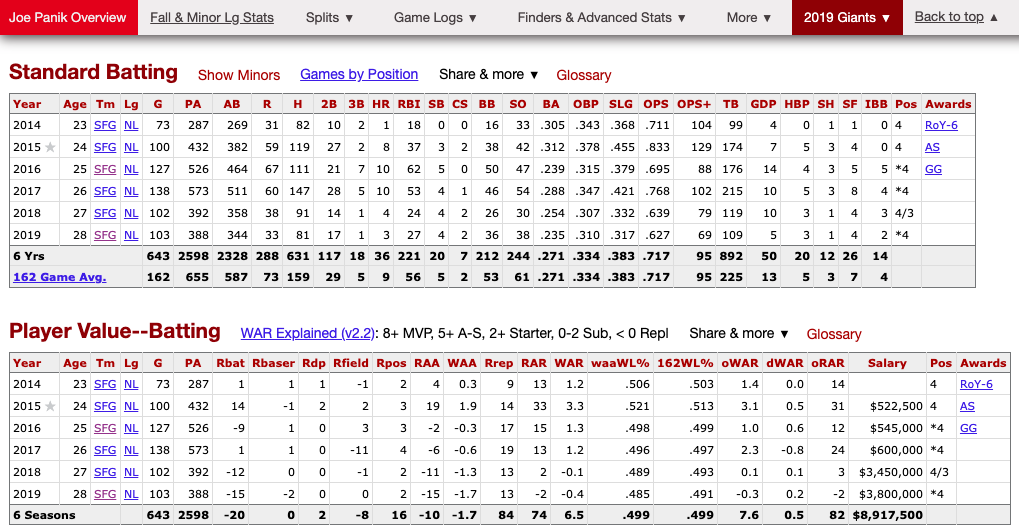
Joe Panik is probably another guy like that. His numbers are…fine. 
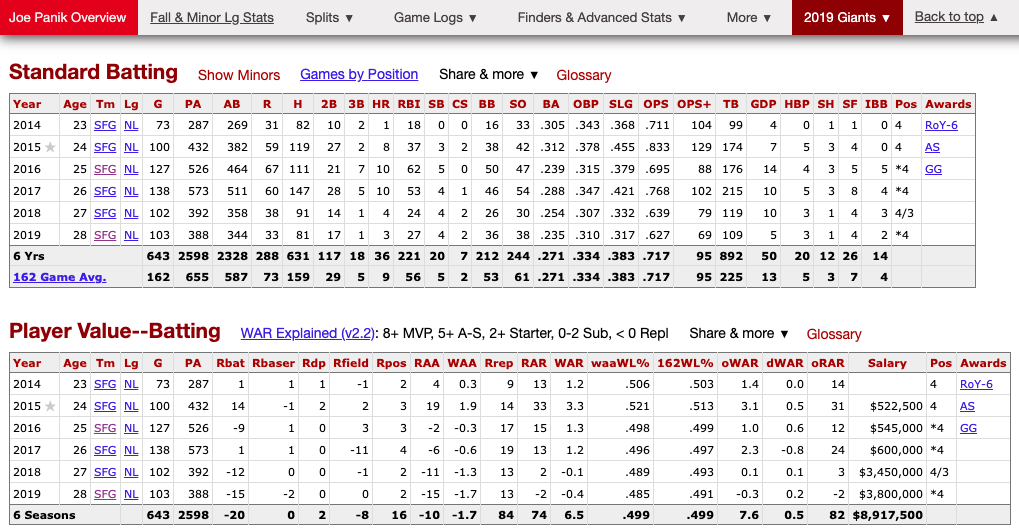
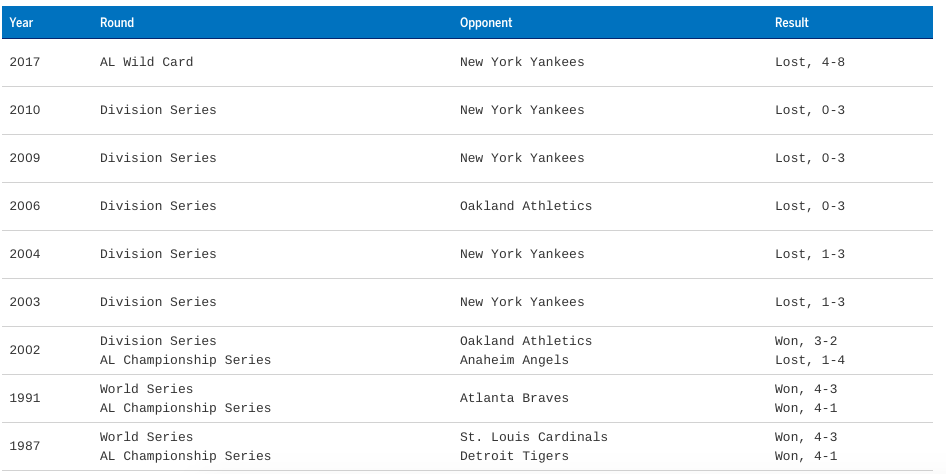
That’s one very good season (2015, his second in the league), two average ones, and three bad ones. There’s a Gold Glove (we’ll get to that) and an All Star appearance. All in all, a very average six seasons. 

But to Giants fans, he’s beloved. The Giants absolutely do not win the 2014 World Series without him. He was not a highly rated prospect headed into the 2014 season. Hell, they brought in Brandon Hicks (the near-all Brandon infield was kinda cool, though) and Dan Uggla at the start of the year. Those two sucked. Uggla batted .000. Hicks just .162. So they decided to give Joe Panik a shot. He was still in AA when they called him up. He struggled immediately, hitting just .211 heading into the trade deadline. But the Giants didn’t panic (sorry, sorry!), and it paid off: Panik went 2012 Scutaro, hitting .338/.367/.414 over the final two months of the season. They finished six games clear of the third place Wild Card team, sure, but who knows – without Panik’s hot bat and sweet glove, maybe they tailspin and miss the playoffs entirely.

As it was, they made the playoffs and Panik made perhaps the biggest contribution outside of Bumgarner, on the way to the World Series title: The Double Play. Many have called it among the best defensive plays in World Series history, and I’ve never seen anyone argue against that position. Given the stakes, the point in the game, the difficulty of the play…it’s hard to beat.

As Brisbee points out, if Panik doesn’t get to that ball, it’s first and third with out out. In a game where every single base mattered, Panik saved four in one play. Here’s what I wrote about Panik in our World Series recap:

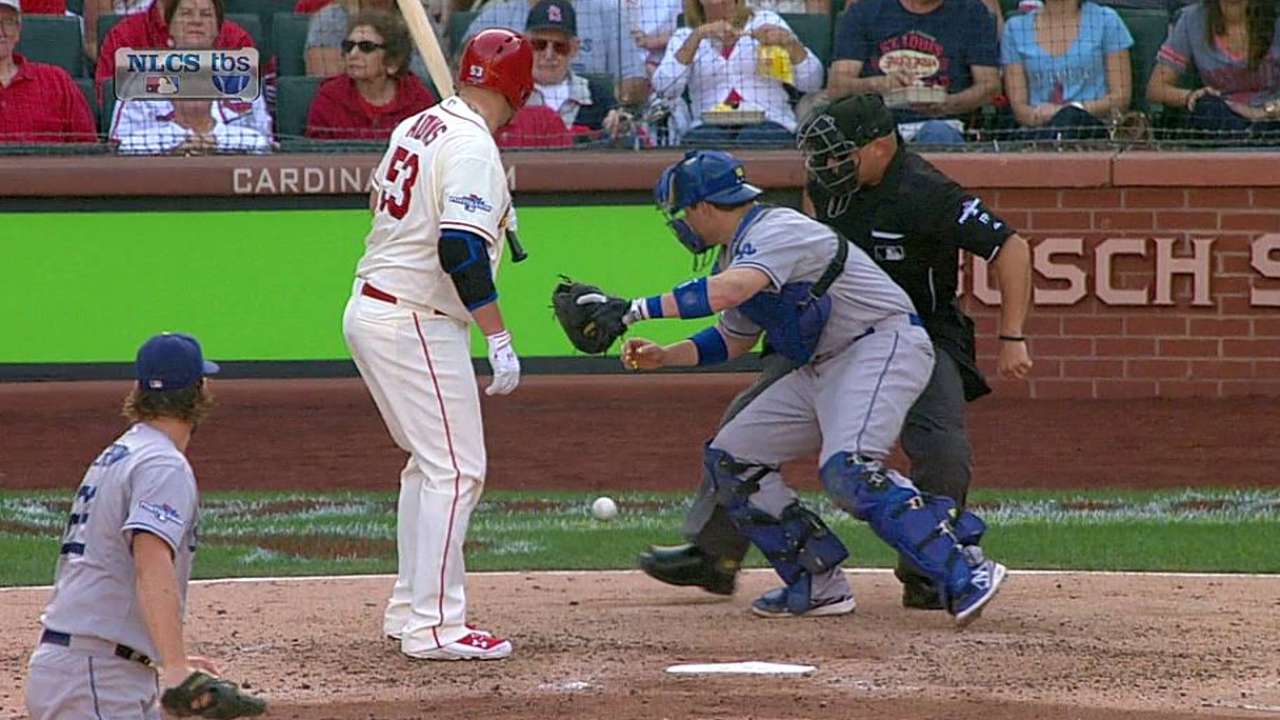
Joe Panik deserves mention. I have been watching the World Series since 1988. That is a total of 27. And while I don’t have total recall, I can’t recall a better and more important defensive play than the double play he turned in the third. It was only the bottom of the third, but until Gordon’s hit in the 9th, it was the last time the Royals would threaten. Cain led off with a single, and the Royals’ best hitter, Eric Hosmer, came up. He ripped a ground ball up the middle, and Panik came out of nowhere to glove it. Cain is fast, and he didn’t have much time, so before he even stopped sliding, Panik flipped the ball directly from his glove to Crawford, and Crawford threw an absolute bullet to get Hosmer at first. If that ball gets through, I think the game does not end well for the Giants.

After Game 5, my mom sent me a very cute and funny e-mail. After talking about how much she and my dad love Hunter Pence, with his “Marty Feldman eyes” and his high socks and pants pushed above his knees, she said, “Of course, Dad also has his other favorite, Panik. He loves him. He thinks he’s Mr. Baseball.” That nickname is official. Joe Panik is Mr. Baseball.

We started to actually call him Joey Baseball, and the nickname fit. The dude just knew how to play. He followed up that 2014 postseason run with an incredible 2015 season, hitting .312 with an OPS+ of 129, and made the All Star team. He continued to make plays like the one in the World Series, and won the Gold Glove in 2016. At age 25, it seemed the Giants had their second baseman for the next 7 years. KNBR’s Derek Jeter even declared him a “mini Wade Boggs.”

But sports are weird, and not always linear. 2016 saw Panik’s batting average drop almost 100 points, to .239 with an OPS+ of just 88. 2017 was better, but 2018 and 2019 were very bad. He’s still only 28, when players should be peaking. But when the Giants traded for two second basemen this trade deadline, the writing was on the wall. Sure enough, Panik was gone in less than a week.

By all accounts, Panik is a good guy and a great teammate. He made one of the most memorable baseball plays I’ve ever seen in my life, and I’m sad to see him go, even while recognizing it had to be done. I highly recommend you check out the Grant Brisbee article below, which chronicles the ten best moments of Panik’s Giants career. It’s awesome. So long, Joe – and thanks! -TOB

Source: The 10 Best Moments of Joe Panik’s Glorious Giants Career”, Grant Brisbee, The Athletic (08/07/2019)


Just How Bad Are MLB Umpires?

If you read this blog, you know I am ready for so-called RoboUmps. It’s frustrating to watch a game and see umpires inconsistently call balls and strikes. To see an obvious strike three called a ball, and then see the next pitch hit over the fence (Phil knows that feeling all too well). Or to see a 9th inning rally stopped short by a strike three call on a pitch way out of the zone. Umpiring is hard, and how we do it is imperfect. Have you ever umpired? It’s so hard. When I was umpiring a few years back, I realized I had a blind spot low in the zone. If it’s in the dirt, it’s obvious. But on any pitch close, your eyes are up at the batter’s chest and you are staring down at the ball – you don’t have the perspective to make the call correctly every time. But, I’m just an amateur, umpiring for 12-year olds. Do MLB umpires have the same problems? And just how often do they get calls wrong?

A team of graduate students at the Boston University School of Business decided to answer those questions, and more. To do so, they analyzed data on every single pitch thrown in MLB for 11 seasons – from 2008 through 2018. That’s over 4 million pitches, and they noticed a few trends worth noting.

First, umpires make an incorrect strike call on pitches out of the zone at a far higher rate when there are two strikes in the count (29% of all called strike threes were incorrect) as opposed to when there are less than two strikes in the count (just 15%). This suggests a two-strike bias – umpires loooooove to punch somebody out.

Second, like me, MLB umpires have blind spots – areas where they have trouble making the correct call. Check out this chart – the numbers represents the number of incorrect calls:
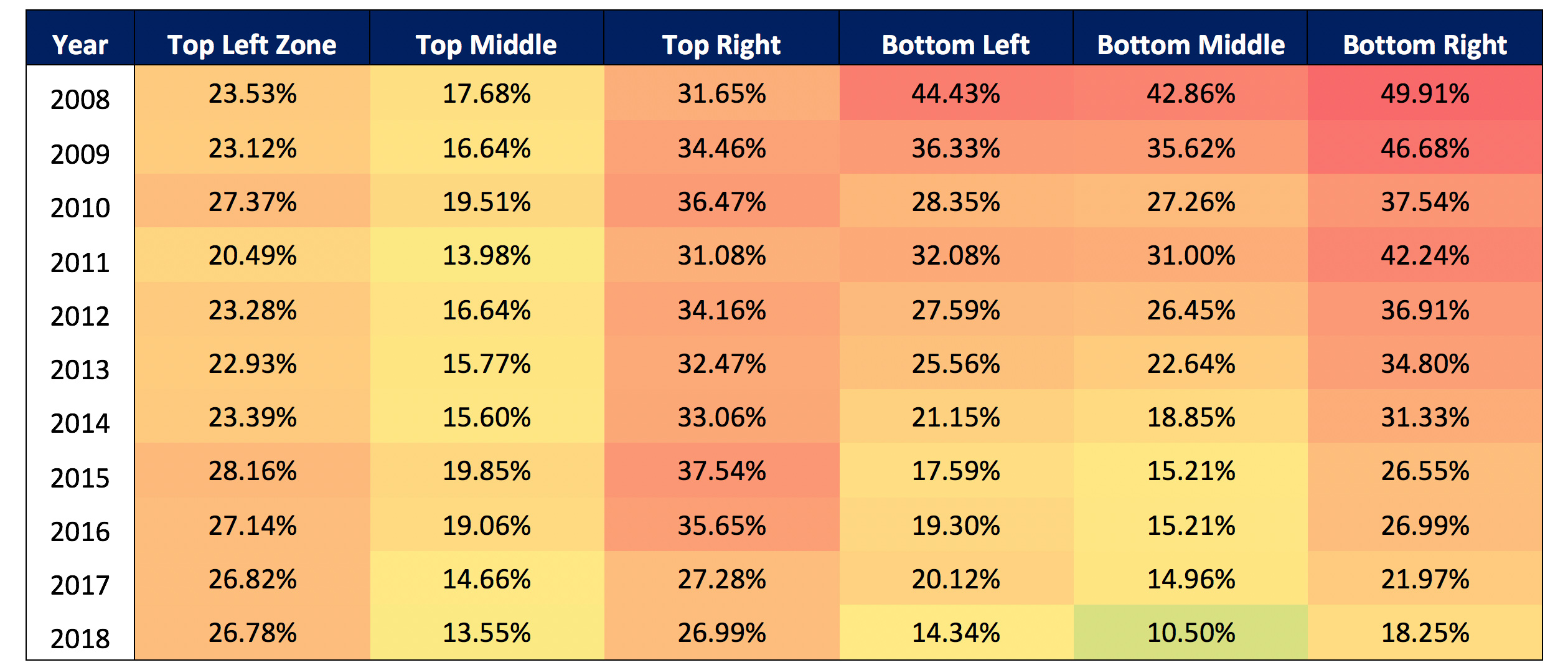
I find it fascinating how umpires have improved at calling low pitches, especially with how putrid they were in 2008 (49% incorrect in the lower right zone!!). My guess is MLB recognized this issue and educated umpires on it. Still, pitches in the upper corners remain absurdly incorrect (27%).

Third, umpires, get worse as they age, just like athletes. The ten best umpires from each year 2008-2018 had an average of 2.7 years of experience, and averaged 33 years of age. Those umpires got under 9% of their calls incorrect. None of those umpires had more than 5 years experience or were older than 37. Compare that to the ten worst umpires each year from 2008-2018, who had an average of 20.6 years experience and averaged 56 years of age. Those umpires got 56% more calls incorrect than the ten best umpires, or 13.96% of all their calls.

It’s this last point I find the most intriguing, because it’s very easy to fix. Usually, if you know an umpire’s name, it’s not a good thing. Sure enough, the data shows the big names like Angel Hernandez, Joe West, Mike Winters, and Laz Diaz all stink. Now, it could be that there aren’t better umpires in the minor leagues ready to take their spots. But it seems MLB would be wise to move these guys out from behind the plate once they hit a certain age – vision and reaction times slow as we age, for umpires just as for players, and we could significantly improve umpire performance by culling the herd, so to speak.

The article makes a strong case for allowing the existing radar systems to call balls and strikes. At this point, with MLB testing it in the Atlantic League, it seems inevitable. Thanks to my dad for sending along the article! -TOB

Source: MLB Umpires Missed 34,294 Ball-Strike Calls in 2018. Bring on Robo-Umps?”, Mark T. Williams, BU Today (04/08/2019)


You Didn’t Do Anything Wrong, Twins…

I haven’t been keeping up with sports much on the honeymoon (you have to see the Dolomites if ever possible). Scanning your phone for stories isn’t a good use of time when your day is filled with croissants and cappuccinos, hikes and aperitivos, wine and pasta and strolls around the hamlet. 

But I have been keeping an eye on my Twins. I’m aware that, as of 7:15 AM local time on Friday, the team now clings to a single game lead over the scorching hot Indians after losing the opening game in a big series between the two teams. 

This was destined to happen months ago. It started when I looked up the team’s percent chance of winning the AL Central six weeks ago (it was 93.6% as of 6/1/19, and it’s now 68%). I further tempted fate when I spoke dismissively about another team. I wrote on our wedding website that people interested in joining us for a Wednesday afternoon Giants should have no problem getting tickets cheaply when they arrive because “the Giants aren’t very good this year, so there should be seats aplenty right before the game.”

And so here we are, the Twins double-digit lead on the Indians is down to one game, and sphincters across Minnesota are clinched pretty tight this weekend. Here’s the odd thing: The Twins haven’t cratered as the Indians have made its run over the last month or so. As Michael Baumann points out, since June 2 the Twins have been 4 games over .500 (as of 8/5/19…so now the team is right at .500). In that same time, the Indians have been on a tear. 

So, with all this in mind, you think the Twins would’ve been eager to make a big move at last week’s trade deadline. Their big moves? Two relievers. They simply wouldn’t part with top prospects (or young MLB roster guys) to land a top of the rotation pitcher, and their offense is on pace to break the single-season home run record, so we’re fine offensively. 

Meanwhile, the Indians made bold moves at the deadline. They got creative and, through a three-team trade – moved a top of the rotation pitcher in Trevor Bauer for Yaseil Puig and Franmil Reyes – two power-hitting outfielders. 

The Indians were creative and bold, and the Twins hesitated. It seemed odd. As Baumann points out, just last offseason it was the Twins that had been creative and bold in assembling what is now the most dinger-crazy lineup in baseball history. The team was aggressive in trying to catch the Indians (the presumed division favorite before the season started). Now that Twins have something to lose, they elected the “hold on for dear life” approach. 

Minnesota didn’t do anything that disruptive at the deadline—no other contender did—but adding Dyson and Romo is a finger in the dike, not a counterpunch to Cleveland’s late-July additions. Given the Twins’ head start, and how good their offseason acquisitions have been, that stop gap might be enough. Minnesota closed the gap on Cleveland by being aggressive this offseason, and through their relative inactivity at the deadline, allowed Cleveland to get back on level footing. If Minnesota does cough up its division lead and falls into the bingo cage of the AL wild-card race, the team’s relatively quiet deadline will stick out more than any untimely strikeout or blown save. Inaction carries its own flavor of risk.

No one knows if the Indians gamble will pay off. Bauer is having an off year, but he’s proven to be a top of the rotation pitcher on a good team. Puig is Puig and will no doubt do Puig things, which is to say he’ll have moments of awesome punctuated by bonehead and distracting crap. Franmil Reyes hits a lot of dingers and not much else (his WAR is -0.2). 

Who knows how it will play out, but one thing’s for certain: I find it difficult to be stressed about it as we set off for Lago Maggiore to continue the trip:

-PAL 

Source: Minnesota’s Historic Season Still Might Not Be Enough to Best Cleveland”, Michael Baumann, The Ringer (08/05/19)


Video of the Week


Tweet of the Week


PAL Song of the Week

Tom Petty & The Heartbreakers – “American Girl”


Like what you’ve read? Let us know by following this blog (on the right side, up near the top), or:

Email: 123sportslist@gmail.com

Twitter: @123sportsdigest

Facebook

Instagram: @123__sports


“If this is about what happened in the bathroom, there was no place to cuddle…”

– Michael Scott

Week of July 26, 2019

It’s a TOB Only Week: Exactly one year after this amazing photo was taken, these two lovebirds are tying the knot this weekend. Congrats PAL and NML!


Why Are We Still Discussing This? MLB Needs to Mandate Immediate Extension of Protective Netting to the Foul Poles

Last weekend, a 3-year old was struck by a foul line drive off the bat of Francisco Lindor of the Cleveland Indians. At this time, the extent of the child’s injuries are unknown, but he was seen rushed up from the stands in the arms of an adult, presumably his father. This incident came on the heels of a similar incident in May, where the Chicago Cubs’ Albert Almora, Jr. fouled a ball off that struck a toddler in the head. That child, we now know, suffered a fractured skull, subdural bleeding, brain contusions, and brain edema. The child was lucky to survive. After these incidents, Lindor and Almora were each visibly upset. After their respective incidents, Almora and Lindor joined the growing chorus of people calling for MLB to expand protective netting all the way to the foul pole. 

Last season, MLB mandated protective netting to the ends of the dugouts. It was a good move, but it was not enough. Since then, injuries have continued to occur. In a story that did not get much press, a woman was killed after she was struck in the head by a foul ball at Dodger Stadium last year. Countless others have been injured, some severely.

The hesitancy doesn’t even make sense to me. Why? Is it because MLB is worried that high paying customers will object? It would appear so. In June, after the Almora incident, MLB Commissioner Rob Manfred said:

“We do have fans that are vocal about the fact that they don’t want to sit behind nets. I think that we have struck the balance in favor of fan safety so far, and I think we will continue to do that going forward.”

But that doesn’t fly when they already have protective netting for the highest paying customers. And has anyone heard fans raising a stink about the extension of netting to the ends of the dugouts? No. Have fans stopped paying for seats there? No. Why? Because if you’ve ever sat behind home plate, you know that you don’t notice the netting after just a few seconds in your seat. 

In defense of his defenseless inaction, Manfred also blamed “structural issues”:

“It’s very difficult given how far the clubs have gone with the netting to make changes during the year because they really are structural issues.”

Whatever that means. This year, season, two teams made the decision and completed and then completed installation of netting to the foul poles, so we know it’s not impossible. One of those teams is the Chicago White Sox, and White Sox pitcher Lucas Giolito applauded the move:

“I think it’s great. I see the counter-arguments like, ‘Don’t sit there’ or ‘Just pay attention to the game.’ Dude, no matter how much you’re paying attention to the game, if that thing’s coming in 115 miles an hour with tail, no matter if you have a glove this big, it could hit you right in the forehead.

Well put, Lucas. I recently sat in the lower bowl behind the dugout at a Giants game, solo-parenting with my two boys, ages 5 and 2. We were behind the netting, but high enough that foul balls can loop over the net. I can tell you that while I paid attention to the game, and I was on very high alert for foul balls, throughout the game there were many times where the boys were distracting me and my eyes were not on the field; and there were two instances where that occurred when a ball was hit in our general vicinity. That split second when I could sense (by crowd reaction) that a ball was on its way toward us but couldn’t locate it was terrifying. In those instances, I jumped out of my seat to block the kids, having no idea where the ball was. Does that sound like fun?

So I ask: WHY ARE WE STILL DISCUSSING THIS? Extend the netting! -TOB


Does a Purpose Pitch Serve Its Purpose?

I’ve said it before and I’ll say it again: Eno Sarris has quickly become one of my very favorite sportswriters. In addition to answering my emails asking for fantasy baseball advice (seriously) his writing blends analytics with scouting to explore some of the most previously opaque concepts in baseball. This week, he tackled the “purpose pitch”.

His jump-off was about a recent spat between the Pirates and Cubs. Cubs manager Joe Maddon got angry when a Pirates pitcher threw a ball high and inside to Cubs’ star Javier Baez:

“[W]hen your guys keep getting thrown at their head, that’s another thing, too. It’s not just us. It’s an industry-wide concept that we know that they’re into, and I have it from really good sources.”

What is this industry-wide concept? The purpose pitch. And what is it and why does everyone know the Pirates are “into” it? Here’s an explanation from Travis Sawchick’s 2015 book, Big Data Baseball:

“[P]rior to the 2013 season [the Pirates] found that pitching inside would indeed have a psychological effect on batters that would create even more ground balls and further enhance the plan. The numbers showed that opponents were more likely to pull outside pitches on the ground after being pitched inside earlier. … After being pitched inside, players were less willing to aggressively lunge at outside pitches. Now the coaching staff had the data they needed to get their pitchers to pitch inside, but would the pitchers execute the plan?”

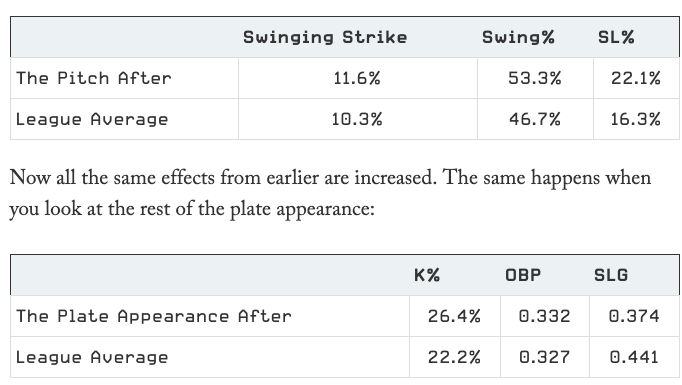
So Eno sets out to answer the question of whether pitching high and inside is worth it. First, he isolates every pitch thrown by the Pirates that was 6″ above the strike zone and 6″ inside. The Pirates threw 3,409 such pitches since 2015 – 1,113 hit the batter, 106 were ball four, and on seven the batter struck out. Of the 2,000 or so pitches left, Eno analyzed what happened on the next pitch: swings and misses were up. But he wasn’t satisfied, because a lot of that was due to the fact that slider-usage was also way up, a pitch that induces more swings and more misses. So he kept going, and he found that the purpose pitch set up weak contact:

Now you’re seeing that Pirates effect. Slugging percentage goes way down. On-base percentage goes up, of course, since you gave away a ball and got closer to a walk, and it’s even understated by this OBP since a third of these pitches resulted in walks — but it does look like players don’t slug very well once a pitcher throws them a purpose pitch high and tight.

But then Eno talked to players, and they told him that it’s not likely a purpose pitch if the pitcher is behind in the count – they can’t waste that pitch.

Aha! The purpose pitch does work! But, Eno astutely points out that if you add back in the 687 hit by pitches, the OBP soars to .511, and the OPS also rises to above league average. In other words: the purpose pitch doesn’t work unless you are sure you won’t hit the batter. Good stuff, Eno! -TOB

Source: Do ‘Purpose Pitches’ Actually Work?“, Eno Sarris, The Athletic (07/23/2019)


Why Team USA Will Not Be Sending Its Best to the Basketball World Cup

The FIBA World Cup is this summer, and the U.S. team should dominate – in theory. But in reality, we may lose. We may lose badly. Why? We aren’t sending our best players. In recent weeks, every elite American NBA player has dropped out. From last year’s All NBA teams, only Kemba Walker remains; Harden, LeBron, Paul George, Curry, Durant, Kawhi, Lillard, Irving, Blake Griffin, and Russell Westbrook have all dropped out. Invites have been extended to guys like PJ Tucker and Marcus Smart. Woof! So why is this happening: 

First, the NBA season is long, and competing in the Olympics/World Cup removes a large portion of a player’s rest and recovery time each year. Plus, superstars are now paid over $40M a year, and if you’re looking at an upcoming deal in that range, do you want to risk it by playing for free? By winning the Olympics/World Cup, you receive a sense of pride, sure. But how much is that pride worth? Historically, NBA players have seemed to value an Olympic Gold enough to take these risks, but do not value the World Cup in the same way. And why is that?

For whatever reason, as a country we place more value on Olympic basketball than the basketball World Cup (this is not true in many other countries around the world). Compared to the Olympics, there is less media coverage of the World Cup, and thus less praise and less glory for the players. The games are a Sportscenter footnote if you win, and you are ridiculed if you lose. There’s no upside, and a lot of downside. Historically, it has thus been difficult for USA Basketball to convince our best players to attend. To illustrate: 

Team USA has lost five Olympic basketball games in history. The 1972 Gold Medal game, the 1988 Semifinals, and the 2004 team, which lost three times en route to a Bronze medal. They have won 15 of the 16 other Olympic Gold Medals (the lone missing Gold due to the 1980 boycott). In contrast, Team USA’s results at the FIBA World Cup (nee World Championships) are much more spotty: 5 gold, 3 silver, 4 bronze, and five times they did not medal, finishing as low as 6th in 2002.

But in his article this week, The Ringer’s Rodger Sherman sounds an alarm for next summer’s Olympics. Sherman notes a pattern we see in Team USA Basketball: (1) A starless Team USA loses in the Olympics; (2) Every superstar comes out the next Olympics and dominates the world en route to Gold; (3) A few superstars stay home in the following Olympics, having already won a Gold previously, but the team still wins Gold, though less impressively; (4) Team USA’s talent level is way down, but they eek out the Gold; (5) A starless Team USA loses in the Olympics. Repeat.

So where on that cycle will we be in 2020? At this point, it appears either 4 or 5. If we sent this year’s World Cup roster to the 2020 Olympics, we will be lucky to medal. It will be up to Team USA to convince the NBA’s top stars, almost all of whom have won one or two or even three Gold Medals to come back out in 2020. Given what’s at stake for the players, though, it will not be an easy sell. -TOB

Source: The Life Cycle of Team USA Basketball”, Rodger Sherman, The Ringer (07/24/2019)


Video of the Week

-Tour de France rider signs his autobiography for a fan. Haaah


Tweet of the Week


Like what you’ve read? Let us know by following this blog (on the right side, up near the top), or:

Email: 123sportslist@gmail.com

Twitter: @123sportsdigest

Facebook

Instagram: @123__sports


“I’m not going for bulk, I’m going for tone.”

-Michael Scott

Week of July 19, 2019

Maxine Fischer


20 Years Later: I Feel You, Jean

This week marks the twenty year anniversary of the following. Don’t scroll past it. Watch the entire comedy. Peter Alliss’ commentary on the video is absolute poetry: 

We just remember the highlight. We rarely remember the leadup. Elizabeth Nelson writes the hell out of this retrospective on Jean Van de Velde’s collapse at the (British) Open. On the topic of meltdowns, she sets the stage and efficiently calls out why this one has legs. 

Many of the most famous meltdowns in golf happened to great players—Phil Mickelson at Winged Foot or Rory McIlroy at the Masters in 2012. Whereas, Jean Van de Velde was not reaching his potential, he was dramatically overachieving for 71 holes, and then he regressed to the mean after that.

And later: 

All week, Carnoustie had proved a miserable challenge. At the start of the final round, Van de Velde was the only player at level par—everyone else was over. Two-way winds, punitive rough, and a diabolical setup made the course veritably unplayable for many of the world’s best. Sergio Garcia wept after shooting an 89 in the first round. Tiger Woods entered Sunday tied for fourth, but at seven shots over par. 

And yet Jean Van de Velde, of all the field—which included nearly every highly ranked player in the world—had forged a path. The first 17 holes of his final round were a roller coaster: He had lost a five-shot lead to Craig Parry by the 11th, regained a two-stroke advantage on the 12th and then managed to be three strokes clear when he stepped up to the tee box at the last. And he’d had his share of good fortune—even his far-flung tee shot had come up just short of the water hazard. “Some golfing god is with him,” Alliss intoned gravely. But golfing gods are notoriously mercurial.

“His first shot was way out near the 17th hole, and it nearly went in the water,” Murray says. ”And so after that you figure he’s just going to wedge his second into play, get it up near the hole and win in extremely boring fashion. Instead, he takes out his 2-iron.”

For professionals and weekend hackers alike, the 1- and 2-iron are clubs incredibly difficult to control—so much so that they have largely been replaced by hybrid woods. Former pro Lee Trevino once famously said that if you find yourself caught on a golf course during a lightning storm, “Hold up a 1-iron. Not even God can hit a 1-iron.” Van de Velde had simple options and three strokes to play with. He could have essentially taken a knee and run out the clock. But where’s the fun in that? Instead he called a hook-and-ladder play.

The collapse is all but complete, but because this ain’t a movie, he makes the damn putt to force the playoff. “Please give him one good putt. Please” the Alliss pleads. Van de Velde not only holes it, he drills the S.O.B. center cut with plenty of pace. It’s as gutsy a putt as you’ll ever see. 

Of course, it was all for not. Jean Van de Velde did not prevail in the playoff. Some other guy won. A guy we will never remember and whose name is worth no more than a meager parenthetical (Paul Laurie).  

I liked this story because it gave me reason to review something that held as a blurry polaroid in my sports memory. It taught me something new about an event of which I thought I had the gist, and it did so with compelling language, fun anecdotes, and it reminded me that this was not an icon melting down; this was a guy who maybe knew this was is one shot and wanted to win it with style. In Nelson’s words, “Epic in scale and preordained to end badly, it is hubris and catharsis and all of the elements of Greek tragedy mainlined into one par four.”

Goddamn, that’s a hell of a line. – PAL 

Source: Sink or … Swim? Remembering Jean Van de Velde’s British Open Meltdown, 20 Years Later”Elizabeth Nelson, The Ringer (07/17/2019)

TOB: Loved this, too – and if you want to see more of Van de Velde’s collapse, including some great stuff from him in the present offering his perspective on it, check out his episode of “Losers” on Netflix (I also highly recommend the curling episode).


Strike Three, You’re…Not Out.

Last week, we posted a story about MLB experimenting with wacky rule changes in the independent Atlantic League; specifically – allowing batters to steal first base on a dropped pitch at any point in the count, not just on strike three. As Phil and I discussed the rule, I wondered aloud as to why the dropped third strike rule even exists. 

To the non-baseball fans, a primer: If a catcher does not cleanly catch a pitch that results in strike three, and first base is open or there are two outs, the runner can try to “steal” first by running to first base before he is either tagged or a defensive player touches first base while in possession of the ball. Interestingly, the player is not out BUT the pitcher is still credited with a strikeout. So, if you’d like some good bar trivia to keep in your back pocket: the maximum number of strikeouts in an inning is not three (or 27 in a 9-inning game), but is in fact infinite.

Now that we’re all on the same page, back to the question of why this rule exists. Baseball has some weird rules, but you can usually figure out why the rule exists by playing the alternative out to its extreme conclusion: It’s usually trying to prevent something from happening that people decided was unfair. For example, the infield fly rule exists because defenders intentionally let routine fly balls drop to the ground in order to get a double play, instead of taking the out. And why is a foul bunt with two strikes an automatic out? To prevent batters from just holding their bat out to waste pitches. But why the dropped strike three rule?Here are the official MLB rules covering the topic:

6.05 A batter is out when— … (b) A third strike is legally caught by the catcher…

6.09 The batter becomes a runner when— … (b) The third strike called by the umpire is not caught, providing (1) first base is unoccupied, or (2) first base is occupied with two out…

I asked Phil if he had any idea what the rule is trying to prevent. He did not. I racked my brain and could not for the life of me understand the rationale. So I did what any curious person does in the 21st Century: I went to Google. You will not be shocked to hear I’m not the first person to wonder this, but I am happy to report I found the answer. As the writer, Richard Hershberger, asks: 

Why is this? What purpose does it serve? If it is a penalty for wild pitching or poor catching, why only on the third strike? The rule seems inexplicably random.” 

But Herhberger answers the question, and I gotta say – it’s a fascinating one. Here’s Hershberger:

The answers to these questions lie in the very early days of baseball.… The story begins in an unexpected source: a German book of children’s games published in 1796 titled Spiele zur Uebung und Erholung des Körpers und Geistes für die Jugend, ihre Erzieher und alle Freunde Unschuldiger Jugendfreuden (“Games for the exercise and recreation and body and spirit for the youth and his educator and all friends in innocent joys of youth”) by Johann Christoph Friedrich Gutsmuths

The game described by Gutsmuths is an early form of baseball, with some notable differences:

Prominent among them is that there are only swinging strikes. Called strikes are as yet far in the future….Less obvious is that there was no strikeout in the modern sense. …The pitcher in Gutsmuths stands close to the batter, five or six steps (fünf bis sechs Schrit) away. He tosses the ball to the batter in a high arc (in einem gestrecken Bogen: literally “in a stretched bow”). There are no called strikes or balls. The pitcher is not required to deliver the ball to any particular spot, nor the batter to swing at any given pitch, but neither is there any incentive for the pitcher to toss a purposely ill-placed ball, or the batter to refuse to swing at a well-placed ball.

This presents a problem. If the pitcher proves so inept that he cannot make a good toss, he can be replaced by a more capable teammate. But what about an inept batter? The game can be brought to a halt by a sufficiently incompetent batter, unable to hit even these soft tosses. The solution is to add a special rule. The batter is given three tries to hit the ball (Der Schläger hat im Mal drei Schläge.) On his third try, the ball is in play whether he manages to hit it or not. He has to run toward the first base once he hits the ball, or he has missed three times (oder hat er dreimal durchgeschlagen). Either way, any fielder, including the pitcher, can retrieve the ball and attempt to put the batter out by throwing it at him. Thus a missed third swing is equivalent to hitting the ball.

And…now I get the rationale, and as usual it did stem from trying to prevent something. As explained by Herberger:

This solution is very inclusive. It allows even the hapless batter to join in the fun of running the bases and having the ball thrown at him, which a harsher penalty of an automatic out would deny him. Gutsmuths points out that the batter is at a disadvantage with a missed third swing, since the pitcher is close at hand to pick up the ball and throw it at him (und da der Aufwerfer den Ball gleich bei der Hand hat, so wirft er gewöhnlich nach ihm), so the batter’s ineptitude is penalized, but the fielding side still has to work for the out.

Hershberger goes on to explain how the rule was incorporated into American baseball in the 19th Century (it’s also fascinating). I’m so happy I know this now, and I hope you also put this in your back pocket for a rainy bar trivia day. As we said last week:

-TOB

Source: The Dropped Third Strike: The Life and Times of a Rule”, Richard Hershberger, Society for American Baseball Research (Spring 2015)

PAL: Is this our first 1-2-3 post in subtitles? Goddamn, TOB; become a P.I. already. Impressive


Get A Dog Already

Maxine Fischer will likely be gone by the time you read this. I’m not entirely sure why I’m compelled to share this with you. Chances are, seeing as we have a blog here in 2019, I over-share. Could be, as my wedding inches closer by the day, that I’m in a stock-taking mode. One thing’s for sure: this isn’t an update about putting her down.

This is a note to twenty-somethings out there considering whether or not to get a dog, written by a guy who just spent 12+ years caring for and living with a stubborn, persistent, trying, needy, ill-trained, cavalier, loving, patient, large, strong, and – in the end – ill friend. 

So, to those twenty-somethings out there: just do it. Go to the pound or rescue and say yes. That’s it. 

Set the pup on the passenger seat and drive home. You don’t need to know anything else. I promise you’ll figure out the rest. 

It will be expensive at a time when you really don’t have any money. It will make finding an apartment that much more difficult at a time when you shouldn’t be too picky. Friends will be super enthusiastic about watching the dog before you get a dog, but – through no fault of their own – friends are busy a lot, too (and the ones that do: shower them with beers and dinners out). It will mean leaving happy hour before you want to sometimes, and it will mean picking up about 7500 poops (2 a day for 10 years, with a little extra added for diarrhea days). You will get frustrated, angry, flabbergasted with that dog. It will destroy something important. And, at the end of the night, just as you’re about to slide into bed, that GD dog will have to go to the bathroom once more. 

Also, you’ll learn that a reason to come home is better than a reason to stay out. A reason to get up is better than a reason to sleep in. A walk with the dog is the best way to get to know your neighbors and neighborhood. Playing fetch is the anecdote to a shit day at work. The parks around you are beautiful and thoughtfully designed. You will talk to your family more, because you will call them while you walk the dog. You will feel loved in a way you’ve never felt before. 

Maybe it’s because we don’t have kids yet. It’s probably that. Max was just the first life I was responsible for, and at the risk of sounding melodramatic to all the parents out there, that’s something that will stick with me. 

Yep, I know this is a sports blog, but we’ve been doing this for over five years now, and I like to think people read because they want to hear want we have to say, to hear what we think is good and worth sharing. More than sports, I think it’s about a small group of people interested in what TOB and I have to share. I’m putting my dog down. She made me a more loving person. That’s a story I want to share this week.

Things are gonna be off without you, buddy. Natalie and I are really going to miss you. – PAL

TOB: Nice tribute to a great dog, Phil. I’ll miss getting into your car as she slowly and begrudgingly vacated her spot in the front seat, I’ll miss her god awful farts, and I’ll miss her relentless pursuit of a belly rub.


Video of the Week

https://twitter.com/Jomboy_/status/1151971547147583488


Tweet of the Week


PAL Song of the Week – Starship – “Nothing’s Gonna Stop Us Now”


Like what you’ve read? Let us know by following this blog (on the right side, up near the top), or:

Email: 123sportslist@gmail.com
Twitter: @123sportsdigest

Facebook

Instagram: @123__sports


People will never be replaced by machines. In the end, life and business are about human connections. And computers are about trying to murder you in a lake. And to me the choice is easy.

-M.G. Scott

Week of July 12, 2019

NFL player Josh Norman leaping over a bull at Pamplona.


A Bum and His Boch 

The Giants may be on the verge of trading Madison Bumgarner, a pitcher who helped win three World Series titles, and practically won the third all on his own. Some fans are practical: He’ll be a free agent, he’ll cost a lot, the team needs to rebuild by replenishing the farm system, and he’s one of the few marketable assets. Other fans are emotional: It’s Bummy! Don’t you remember the 2014 World Series? He’s still only 28. If we can turn this around in 2-3 years, he’ll still be young enough to contribute.

I’m in the middle. I absolutely want to restock the farm system, and realize that trading Bum, and 

not re-signing him, is our best option to continue doing so. But damn, I will be sad when it happens. Here’s what Phil wrote about him after the 2014 World Series:

Have you heard the theory about how the indigenous people couldn’t see the ships when Columbus hit landfall on the Americas? The theory is that the ships were so out of their realm of reality that they couldn’t process what was taking place before them. They couldn’t see the ships! Whether or not that’s true (I don’t buy it), that’s how I felt watching Madbum last night. I knew it was exceptional, but I couldn’t process it. Even when you tell me the numbers (.25 ERA in 36 WS innings…what the hell?), it still doesn’t process. I really don’t think we’ll ever, ever see a WS pitching performance like that again.

I just can’t let that go. And if we let him go and the prospects don’t amount to much, which is a very real possibility! (My headline there: Why You Should Temper Your Excitement If Your Team Trades a Star For a Few Top Prospects”), I will be pretty god damn upset.

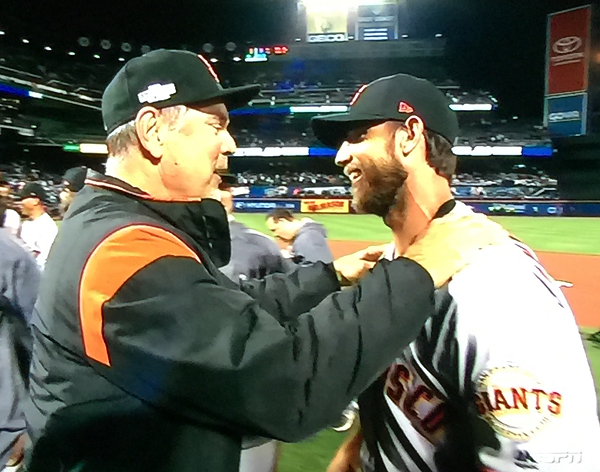
But if I feel that way, as do so many other Giants fans, imagine how the guy who has managed him feels: Bruce Bochy. Bochy is retiring after this season, so it probably lessens the sting of Bumgarner leaving. But he also probably would prefer to finish his career with Bum on the bump, ya know? Bochy is not shy about expressing his love for the guy he managed from a 20-year old rookie to a World Series hero:

“With Madison, it’s a desire to be the best he can be,” Bochy said. “I love this man so much and I’ll never forget what he did for me, for us. Nah, he’s special, man. This is one … I’m really going to miss.”

I love this article by Baggarly, because he gets two stoic men to open up. But he also tells us things that we can’t know, because we don’t spend every day at the park:

It is an everyday sight whenever the Giants take batting practice: Bumgarner spends so much time at Bochy’s side, the two of them leaning against the back of the cage, that you might assume the man with No. 40 stretching across his broad back and the bristle of hair poking out from his hat is the hitting coach and not the No. 1 starting pitcher.

They might be talking about the hitter in the cage. They might be talking about last night’s game or how they should pitch an opponent on a hot streak. They might be talking about hunting or fishing or whether Bochy should build on that family farmland he inherited in North Carolina, just outside a sleepy little town called Wade.

“What’s talked about the most,” said Bumgarner, “is baseball.

As you read, you start to realize – this isn’t just manager/player. It’s not quite father/son, either. It’s two dear friends who share a love for the game they play. It’s one of the things I miss most as an adult – being able to compete and play the games I love with my friends. For their sake, and my own, I hope the Giants hold onto Bum, and he and Boch get to compete together for a couple more months. -TOB

Source: “‘He’s All We’ve Ever Known’: Madison Bumgarner and Bruce Bochy Near the End of Their Working Relationship, But Their Friendship Will Endure”, Andrew Baggarly, The Athletic (06/24/2019)

PAL: You nail it, TOB. This right here is the fan experience: “It’s one of the things I miss most as an adult – being able to compete and play the games I love with my friends. For their sake, and my own, I hope the Giants hold onto Bum, and he and Boch get to compete together for a couple more months.”

When you have “A Guy” – and each franchise can only hope to have a few in the entire existence of a franchise – it’s hard to let go of seeing him on the mound in a Giants jersey for some prospects. And you’re right; there’s no guarantee any of the prospects will amount to much beyond serving as an asset. 

Bumgarner represents the absolute apex of what a fan hopes to get out of a player. Home-grown talent. The young buck at the beginning of the dynasty. A career defining ‘moment’ (he’s so good that his moment lasted an entire postseason in 2014). Add to it that SF and Bum are an unlikely combination: a country-strong, lift-kit Ford truck driving red-ass in the land of scooters. And all of this while the more heralded talent for the rival down south – Clayton Kershaw – won nothing but individual awards. 

So yeah, I say keep him. He’s not old. Rebuild this thing, and let him be the bridge to the next era. 

Or…

THE GIANTS SHOULD DEFINITELY TRADE HIM TO THE TWINS FOR MIGUEL SANO. GREAT DEAL FOR BOTH TEAMS.


I Don’t Hate This: Stealing First 

I’m usually the curmudgeon when it comes to changing baseball. Don’t change a thing. RBI is a meaningful stat. If I’m being honest, when I see someone hitting over .300 I all but concede that he’s a good hitter. 

But this idea is a radical one, and I friggin’ love it. MLB is using the Atlantic League (an independent league) as its lab, testing out rule changes and seeing their impact. In last week’s Atlantic League All-Star Game, the home plate ump had an AirPod on and ball and strike calls were made by a software. 

But that’s not even close to the most interesting rule change. Starting in the second half of the season, players will be allowed to steal first base. What the hell does that mean, you ask?

“Any pitch on any count not caught in flight will be considered a live ball, and a batter may run to first base, similar to a dropped third strike”

It doesn’t take much to see how this could really add an action-packed wrinkle to a largely stationary game. Per Yahoo’s Chris Cwik:

The rule would drastically alter the game if it is adopted in MLB. Players like Billy Hamilton might suddenly gain extra value. If a ball gets away, he can easily make it to first base. Given his speed, he’ll probably steal second base too.

Not only that, but players like Hamilton might see fewer breaking balls as a result of the new rule. If pitchers fear wild pitches or passed balls, they might serve up more fastballs to players with elite speed. In Hamilton’s case, that would be a good thing. He hits fastballs and sinkers much better than breaking stuff.

I love this. I love the idea of speed becoming much more valuable in a game dictated by power (pitching and hitting). I also love the late-game situations this would create.

Let’s say, I don’t know, the Twins are down by 2 in the ninth with 1 runner on base, and the old, slow, definitely-not-on-something Nelson Cruz is up. Cruz has 16 home runs, and he’s looking go boom. That’s why he’s still in the league – to hit home runs and to sport a haircut that he’s 17 years too old to sport. The pitcher throws one that gets away from the catcher early in the count. Does Cruz take first or stay put to try go boom on the next pitch? Does the pitcher, knowing that Cruz gets paid to hit for power, try to entice him to take first base? 

These are fun scenarios to think about, and this is such a no-brainer for the Atlantic League to be the lab rats for MLB. Let them steal first! Thanks for the tip, Pep! – PAL

Source: MLB will experiment with stealing first base in Atlantic League”, Chris Cwik, Yahoo Sports (07/10/2019) 

TOB:

It’s Freaky Friday, y’all. While I’m ready for RoboUmps, this rule change has me spooked. It’s such a big change. I’ll need to see it.

Also, if you’re like me – this article had me wondering: why even do we have the dropped third strike rule? Well, I did some sleuthing, and I’ll write about it next week.


From Fields to Stadiums: Babe Ruth, Frank Osborn, and Steel

Really enjoyed this one. It digs into how steel, along with a guy named Babe Ruth and an engineer named Frank Osborn, ushered in a new era of professional baseball. An unlikely grouping is alys a sturdy foundation for a good read. 

I’ve understood Babe Ruth’s greatness in terms of numbers, especially when compared to players of his day, but it wasn’t until I read this that I understood how massive his role was in brining baseball to the masses. He put butts in the seats. He sold papers. He’s why the Yankees stopped renting at the Polo Grounds and build their own field. And, in fact, it wasn’t a field; it was a stadium. 

Vince Guerrieri calibrates the reader to the time in question, a time when the Yankees were far from the “Evil Empire”:

Before the 1920 season, the Yankees bought the contract of Babe Ruth from the Red Sox for $125,000, the largest price ever for the purchase of a single player in a move regarded as folly at the time. At that price, the Yankees would have to draw a million fans to break even—unheard of at that point. As it turned out, Ruth’s prodigious home runs revolutionized the sport—and drew crowds. In his first year with the Yankees, the team became the first in major league history to draw more than one million fans, relegating the Giants to second fiddle in their own park. The Yankees needed a bigger place of their own—and the Giants were only too happy to have them leave, going so far as to serve them an eviction notice (later rescinded).

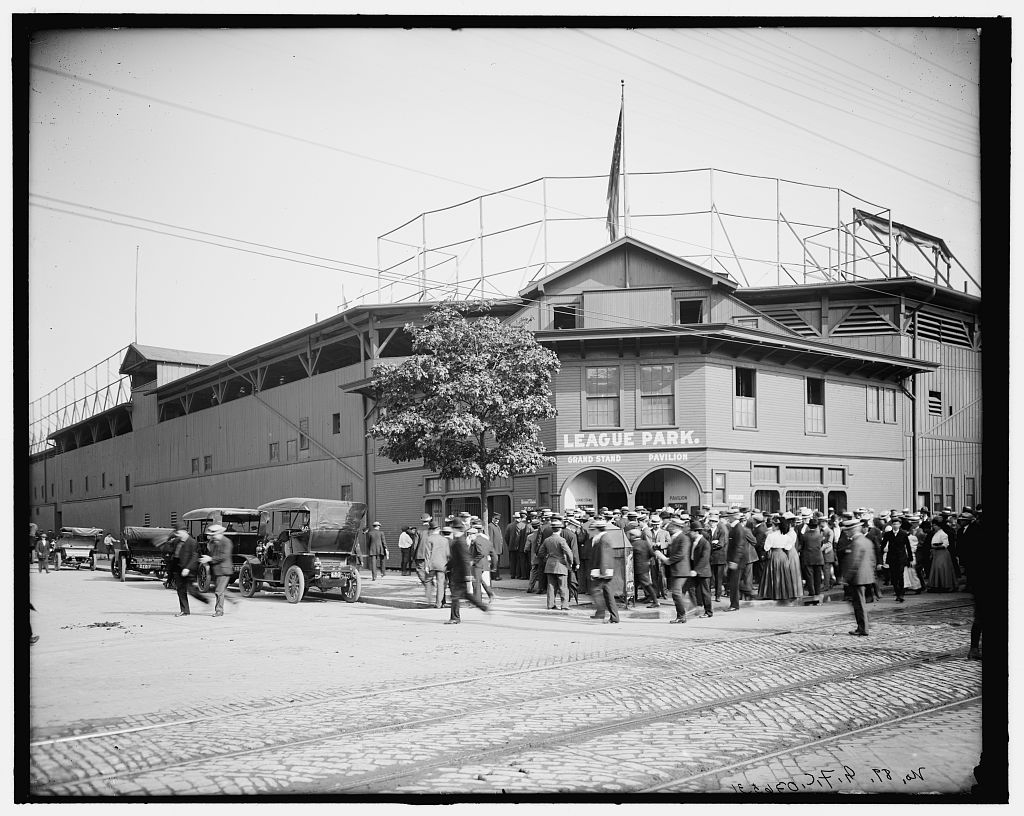
Before this time, most fields (they were called fields or parks, but not yet stadiums) were made of wood. A cheap material, readily available. They were small, far from permanent (much like the game itself) and pretty dangerous. Not only did wooden bleachers “fail”, but fires – big, killer fires – were far more of a regular threat in those days than they are now. Fires and wood – not a good combo. 

Also Baseball was far from a stable industry, and thus lacked the infrastructure. Never mind teams calling it quits – full leagues would fold over night. That volatility started fade when the masses to the fields. The Yankees attendance exceeded one million in Ruth’s first year, the first team to eclipse that mark. Two years later the team was building a stadium that could hold over 60K fans.

As the games popularity grew, thanks in large part to Ruth, the owners saw that they needed to accommodate (and charge) more fans. Baseball was becoming a viable business. And that’s when they called Frank Osborn in Cleveland, Ohio. Osborn earned his stripes as an engineer for a firm that specialized in steel bridges made for railroads. He understood how to build structures that could withstand a tremendous amount of moving weight in a relatively small space. 

While the steel reinforced concrete was a larger expense upfront, owners were no longer worried about leagues folding year to year. They were thinking long term. Frank Osborn’s steel and concrete stadiums in Cleveland, Detroit, and the Brox literally helped cemented baseball’s future. From 1903 – 1953, not a single team relocated.

The article goes on to describe the terrible detour of the multi-purpose,’doughnut’ stadiums that replaced so many of the original ‘stadiums’, as well as how the new stadiums have reverted back to the vintage aesthetic. Best of all, Osborn Engineering is still in operation today. 

What an enjoyable read, and the old photos are so fun to pour over. – PAL 

Source: How Concrete And Steel Built Baseball”, Vince Guerrieri, Deadspin (07/08/2019)


Little Big League: Still Holds Up!

If you asked me to choose my favorite baseball movie, I am torn. I love the Sandlot. I love Field of Dreams. But my top two are Major League, and Little Big League. We covered Major League back in April, as this year is its 30th anniversary. But Little Big League is 25 years old this year, and The Athletic did a fantastic look at what is an unbelievably underrated movie (just 31% on Rotten Tomatoes, which – GFTOH!). 

If you don’t remember Little Big League, the premise is simple: 12-year old Billy Heywood inherits the Minnesota Twins from his grandpa, who passes away near the beginning of the film. The team is slumping, and Billy fires the manager (Dennis Farina playing a Billy Martin-type character). Unable to find a replacement, Billy names himself the manager, and teaches the players to remember why they love playing baseball and in the process they begin to win games.

A lot of things stick out for me in this movie, much of it covered by the article. For example, the baseball scenes are very realistic, and the article gets into how they did that. There are some great cameos, and I get a kick out of watching them now just as I did as a 12-year old. It’s also a genuinely funny movie, even as an adult. It’s just a fun-watch. 

But it’s also a smart-watch. For example, this scene, where Billy convinces the GM and the bench coach that he’s qualified to coach the team (and the line from Billy’s friend who comes up with the idea that he manage the team still kills me: “It’s the American League! They’ve got the DH. How hard could it be?”):

For mainstream baseball, that argument against the sacrifice bunt is twenty years ahead of its time. I also love this scene where Billy enlists the entire team to help him with his homework before they play a one-game playoff to determine whether they make the postseason.

Or how about the fact that, in the climactic scene, the Mariners’ Randy Johnson comes out of the bullpen in the 9th to close the door. Using your best pitcher in relief in a playoff game is almost a decade ahead of its time! 

If you haven’t seen the movie, or if it’s been a while, I highly recommend it! -TOB

Source: Little Big League’ at 25: The Inside Story of an Unlikely Baseball Classic”, Rustin Dodd, The Athletic (06/28/2019)

PAL: TOB made we watch this movie a year or so ago. Watching him watch it and make the case for its greatness was more entertaining than the movie. 

As a Twins fan, I have a couple issues with this movie. 

Timothy Busfield? Really? That’s the best we can do for our first baseman and lead actor in a movie about the Twins? Kevin Costner’s brother-in-law from Field of Dreams, that’s what we get? 

This quote from Dave Magaden, former big leaguer and actor in the movie, about Busfleid’s assessment of his own talents had me dying: 

“He played a little high school baseball, so he had that mindset that if he’d kept working at it, he would have made it to the pros. He was a decent hitter, I guess.” 

HAHAHAHAHAHA! Some hollywood guy played a little in high school and thinks he could have made it to the pros. Of course, Busfield. 

Oh, and let’s not have a friggin’ extra wearing #34 for the Twins. You wouldn’t have an extra wearing #23 for the Bulls in a basketball movie, would you?

Also, the Rawling Pump glove is heavily featured in this movie:

Most important, TOOTBLAN, as demonstrated by Ken Griffey, Jr. in this movie, is a first grade, world class, phenomenal concept. I will be using it the next time I coach.  

TOB: I will give Busfield this: his swing is decent and he throws like a ballplayer.

PAL: His swing is a bad Griffey impression. Nah. A guy like that has to have more of a grinder swing. He should swing more like Brian Giles.


Video of the Week

^World Cup champion Ashlyn Harris channeling PAL and TOB, every Friday morning.


Tweet of the Week


PAL Song of the Week: Sam & Dave: “Hold On, I’m Comin'”


Like what you’ve read? Let us know by following this blog (on the right side, up near the top), or:

Email: 123sportslist@gmail.com

Twitter: @123sportsdigest

Facebook

Instagram: @123__sports


How hard is a luau? All you need are some grass skirts, pineapple, poi, tiki torches, suckling pig, some fire dancers. That’s all you need.

-M.G. Scott

Week of July 5, 2019

PAL and TOB enjoyed this long holiday weekend watching sports and sipping tea. We hope you did the same. We’ll be back next week. Go USWNT!


Two Days In a Gorgeous Hellscape: The U.S. Open at Pebble Beach

We attended last week’s U.S. Open, and TOB had some thoughts.

Two Days In a Gorgeous Hellscape: What It’s Like to Attend the U.S. Open at Pebble Beach

While watching last year’s U.S. Open, I saw an ad for this year’s tournament, played at the relatively close Pebble Beach Golf Course. Phil and I decided to attend, and purchased tickets a year in advance. Neither of us had ever been to a golf tournament before, nor had we been to Pebble Beach. We decided attending both Saturday and Sunday was the perfect plan. We could try a few spots and vantage points on Saturday, and use that to inform our plan of attack on Sunday.

The night before we left, the reality of the fact I was going to leave my wife with two kids for two days while I watched golf seemed to set in for her. She peppered me with questions. What are you going to do? Watch golf. Isn’t that boring? Yeah, I had to admit, maybe. This is so stupid. Is that a question? She was not thrilled.

The next morning, Phil picked me up at 5:30am, and we hit the road. With her questions fresh in my mind, and Phil’s fiance’s similar questions fresh in his mind, we asked ourselves: What kind of person attends these things? What’s it like to attend a golf tournament? What’s the best way to watch a golf tournament in person? We’d soon find out the answers to these questions and many more.

Who Attends the U.S. Open?

Let’s get this out of the way: Lots and lots of white people. More specifically, though, white people who really love golf. If you think you love golf, you are probably wrong. A person who attends the U.S. Open, many of them flying across the country to do so, love golf in a way I can’t get my head around. They love to watch it. They love to talk about it. They love to analyze it. They love to crack jokes about how much better the pros are than they are. Lots of old white guys leaned over to us after a big shot and made some variation of the following joke: “Heh heh, you don’t want to see me try to get up and down from there.”

So, obviously, golfers attend the U.S. Open. But not your once-a-year duffers like your hosts, here. Golfers who take it really seriously. So seriously that they wear their golfing gear to the U.S. Open. I’m talking performance golf pants and golf shoes – hand to God we saw people in golf spikes! It’d be like going to a football game as a fan in full uniform. They dress like they dress when they play, but they aren’t playing. It’s wild. This was a big topic of conversation for us all weekend.

The U.S. Open is also a great place, apparently, to show off your bonafides as a golf fan. Before we even got on the shuttle Saturday, I saw three Masters-branded clothing items. We decided to count them, hoping to find 100 such items on the day. We barely got there, finding #100 in the line to board the shuttle home, but by God we did it.

The Masters-branded clothing item is a very specific statement: I Have Been to the Masters, Thus I Am a Very True and Devoted Golf fan. Some people were wearing two and three Masters-branded clothing items. We saw many groups where they were all wearing Masters-branded clothing items. During one trip to the concessions, Phil saw a Masters-branded braided belt and I almost cried when he told me about it, because I was so mad to have not seen it myself. Phil and I had a lot of laughs imagining these old guys packing for their trip, panicking as they couldn’t find their Masters shirt. “HONEY! WHERE’S MY MASTERS SHIRT!!! I TOLD YOU TO MAKE SURE IT WAS WASHED AND READY!”

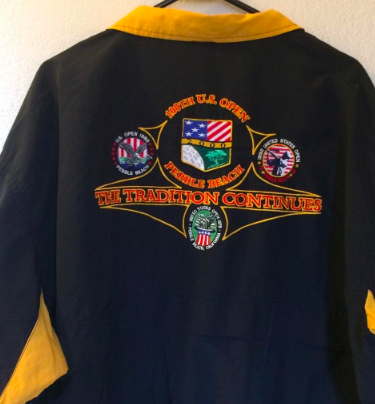
On top of Masters-gear, there were an incalculable number of 2019 U.S. Open at Pebble Beach-branded clothing items. Hats, jackets, shirts, windbreakers, sweaters, sweater vests, t-shirts, sunglasses. You name it, they sold it, and thousands of fans bought it. We saw people with huge bags of 2019 U.S. Open at Pebble Beach-branded clothing items, and we saw thousands that threw those items on top of whatever it was they arrived wearing. Then you had a decent number of guys busting out their 2010 U.S. Open at Pebble Beach-branded clothing items. We even saw two guys with 2000 U.S. Open at Pebble Beach-branded clothing items, and boy was golf fashion in 2000 awful. By the way, those two items were in pristine condition, so you know those guys kept those jackets protected carefully the last two decades, only busting them out for special occasions.

More obscure but equally as bonafides-signaling were the other U.S. Open-branded clothing items. Shinnecock, Erin Hills, Oakmont, Pinehurst, Congressional, Bethpage, Torrey Pines, Oakmont, Winged Foot, and the Olympic: All have hosted the Open over the last twenty years, and I saw hats and pins and shirts from each.

Another thing that can’t be ignored is that U.S. Open attendees are, or seem to be, overwhelmingly pro-Trump. Given that I live in San Francisco and enjoy my liberal bubble, this was a bit disorienting. We saw less MAGA hats than I expected, but we saw a LOT of MAGA-adjacent hats. By that I mean, a U.S. Open 2019-branded hat in a very specific shade of red, that when viewed from more than a few feet away causes most observers to think it IS a MAGA hat.

Given the political climate, in my opinion, wearing such a hat is a very specific choice to make a political statement. But there’s more. Personally, I think war is bad. I find military flyovers to be distasteful, especially as the current administration seems to be sounding the drums of a war against Iran. But shortly after the tournament ended Sunday, two military jets performed a flyover. It was crazy loud. The crowd cheered in approval, and a U-S-A- chant broke out. Phil and I muttered quietly. 

But the funniest moment occurred when we first got to Pebble Beach on Saturday. Just as the free shuttle (again more on that later) got to the gates, we saw a small handful of protesters holding signs about global warming. The loud and talkative man with a thick southern accent who was sitting in the seat directly behind us could not let this go without comment.

“Protesters, hah. They probably went to Berkeley.

I, a proud Cal grad, whipped around in my seat.

“And what’s wrong with that?”

He stammered. “Uh..nothing. I hear it’s a good school.”

“Yeah. Ok.”

I sat back down. He continued, “They’re probably taking time off from their job at the EPA.” A joke so dumb I didn’t even respond. But yeah, preserving our environment, what a stupid friggin liberal idea, huh, Bubba?

Not two minutes later, as we approached the course, emerging from the forest as the ocean and landscape of Pebble Beach came into view, this dude remarked, “Sure is beautiful here.” I thought Phil and I were going to self-combust. But like good adults we bit our tongues and then griped about that idiot on and off for the next two days.

So, who attends the U.S. Open? Mostly white guys, from climates where golf is very popular (ahem), and all of the political leanings that come with that (ahem ahem).

What’s it like to Attend the U.S. Open as a “Sporting Event”?

I grappled with the answer to this question throughout the experience, and in the days since. As we left on Sunday, right as I was asking myself whether I would ever do it again, Phil asked me that very same question. I had to pause. Would I do this over again knowing what I know now? Yes. Would I ever come back again, though? To answer that question, I must explain a few things.

Golf is a deeply weird sport to attend. It’s unnervingly quiet. The players and officials demand silence as players begin to line up their shot, and that culture is also self-policed by attendees. Even when players are 250 yards away and can’t possibly hear you, the fans shush each other as a player begins to shoot. And there’s little ambient noise. There’s no music. There’s no announcer. There’s nothing but long stretches of silence, interrupted by brief and relatively tepid applause, with an occasional mild cheer. If you are used to attending baseball, basketball, or football games, it’s a bewildering experience.

The lack of announcers, particularly, makes it hard to follow the action, because as you sit in any single place watching two golfers take a couple shots, there are 34 other golfers on the course that you can’t see, and you have no idea what’s going on with them. They did hand out these dorky looking radio earpieces, but even trying to follow all the action on there is difficult, as the broadcast focuses on the leaders. So you’re left to scoreboard watching, with scores posted for each player’s hole after it’s completed. I will say that is a thrilling moment. “Oh boy, they’re posting Koepka’s score on 6 – did he get that eagle he needed. … … … NO!”

Also, the food sucks. Every single concession stand had these exact food options, with no variation: Hamburger. Grilled chicken sandwich. Bratwurst. Chicken caesar wrap. Turkey cheddar sub. Lay’s original potato chips. THAT IS IT. And none of those hot items were any good. Ok, the brat wasn’t bad, because that’s almost impossible to screw up. But it also wasn’t particularly good. And each concession had the exact same beer options: Budweiser (in a delightful Yosemite branded aluminum bottle). Michelob Ultra aluminum bottle. Sculpin can. I realize that the club does not normally need to produce food for 40,000 people so they don’t have permanent kitchens that can feed that many people, but it seems like they could have provided a bit more variety, and a bit higher quality.

Golf is also weird to attend because everyone roots for all the players. Basically, the fans root for good shots, no matter who makes the shot. Yes, there are favorites. Phil astutely pointed out that the fan favorites seem to be the guys with a nickname that fans can shout. Dustin Johnson is peppered with calls to “DJ!” Matt Kuchar, Stiffer of Caddies, is showered with drones of KUUUUUUUUUUUUCH!” Tiger is of course Tiger, and Mickelson is a cheesedick though beloved. But for the most part, fans cheer good shots and groan in solidarity with bad ones. Most of the fans golf, and they seem to empathize with the players, both good and bad. So when I openly root against the amateur from Stanford like I absolutely did, and cheer when he misses a short putt on 18 Sunday like I absolutely did, the eyerolls and anger are palpable.

Golf is also weird because your glimpse of both the players and the action is incredibly brief. On Sunday we sat, all day long, in the grandstand on the 18th green. We saw every single player come through: Tiger. Mickelson. Spieth. McIlroy. Koepka. But we saw each guy for what feels like 30 seconds. They appear as tiny specks on the horizon, take just a couple shots when you can actually make out their faces, and then they disappear. If you’re a huge Tiger fan, unless you brave the crowds and try to follow him for the entire day, you see him for about a minute, at best. It’s like if your favorite baseball player is Buster Posey, and you wait all year for him to come to town – then he sits on the bench all day and comes out for a single, one-pitch at bat, and disappears back into the dugout.

And even when you do see the players, they are not superhuman specimens like you see in other sports. I thought Brooks Koepka would look like a linebacker. But when we saw him tee off on the 6th on Saturday, Phil and I could not get over how he’s actually kinda skinny: chicken legs and skinny forearms – and he’s one of the bigger guys!

The fact that players look like normal people has an interesting effect, especially in concert with all of the above: the U.S. Open doesn’t feel important or dramatic or special. I’ve attended big sporting events, and it always feels so exciting. But at the U.S. Open, for most of the day you’re with a relatively sparse crowd watching some normal-looking people play golf, with no announcers giving you context in hushed tones.  It feels so incredibly normal, and far less exciting than I expected.

What’s the Best Way to Attend a Golf Tournament

Ahead of the tournament, I was very excited to answer this question. And I’ll give golf this: there are practically infinite ways to watch a golf tournament. Some people follow their favorite golfer from hole to hole. Some people camp out at one spot. Some people are there to get drunk and enjoy the scenery. Some people want to show off their golf gear. Some people are there for the pure sport – to see some great golf shots.

On Saturday, we went in with almost no plan. In the morning, we first stopped by the driving range (don’t do that) and then we walked almost the entire course, just to get the lay of the land. We scouted positions, watched some golf, scouted some more positions, watched some more golf. Then, in the afternoon, we found a relatively small and empty grandstand on the 6th hole, and we parked it. We didn’t intend to stay long, but suddenly the big names were on their way and we had a front row view of the tee box. The 6th is a par-5, so we were going to see some bombs, and it was good. We saw all the big names from very close, and it was neat. We even got on TV making fun of Phil Mickelson’s personal logo, which commemorates his unathletic yet mildly iconic jump after he won his first Masters.

The problem with being on the 6th hole though is that when the last group goes through, there are still 2+ hours of golf left on the course, but no more golf where you are. So as the last group approached, we left the grandstand to beat the exiting crowd and tried to find a new spot. After some more meandering, we found ourselves in the grandstand at 18, and we realized that this was the best spot to be, something I did not expect myself to conclude.

So on Sunday, we considered getting a spot in the grandstand for the iconic 7th hole (a very short par 3 right on the ocean) for a little bit before heading over to 18 before it got too crazy. But the lines at 7 were long and not moving because people don’t leave.

So we popped over to the 5th for a minute, another par 3, but it was kinda boring and I started to get antsy about getting into the 18th grandstand, which is far bigger than the others, but is also very popular. From 5, we had a solid view of the 18th grandstand and could see it was already almost half full, at least two hours before the first group would even arrive.

So we elected to head over, and we did just in time. We got great seats, and camped out the rest of the day. Once the grandstands fill, there’s basically a one in, one out policy. Except! They understand people need to use the restroom and eat and whatnot, so if you are already in and plan on returning they give you a card with a time on it – you have thirty minutes to get back without having to wait in line. So we spent the rest of the day alternating trips to the bathroom or concessions, marveling each time at the length of the unmoving line to get into the special place we’d staked out, and patting ourselves on the back for having such foresight.

We of course also had the grouping schedule, so we could plan those breaks accordingly. When the big names and the final groups came through to finish their tournament, there we were, in our seats that we occupied for approximately nine hours.

The nice thing about that setup is that because the 18th is a par 5, there was almost never a lull in the action. Group 1 would tee off and then walk to their shots in the middle of the fairway. They’d take their second shot and head up to the green. Before they got to their ball, Group 2 behind them would tee off and walk to their shots in the middle of the fairway. Then, as soon as Group 1 completed the hole, Group 2 would take its second shot to the green. Compared to our day at the tee on 6, where we awaited players finishing the par-3 5th hole where only one group can play at a time, there was very little sitting around without anything going on. Plus, we got to see the end of the tournament, from great seats, as the other 40,000 people in attendance crowded 10-people deep along the fairways.

So, the best way to watch a golf tournament is in the grandstand at the green on a par-5, preferably the 18th hole so you can see the end.

So, Would I Go Again?

Well..I wouldn’t say attending the U.S. Open is a purely fun activity, though I did have fun hanging out with Phil for two days, talking about life, cracking jokes at the things we were seeing, and analyzing the experience while living it. But…

The U.S. Open returns to Pebble in 2027. At that time, my kids would be nearly 13 and 11 (geeeeezus). If they wanted to go, I’d go. I certainly wouldn’t be champing at the bit, but I’d go. I’d spend a little more money to get a hotel closer to Pebble. I might only go Sunday, and I’d probably take the following Monday off work, to avoid having to drive home so late. And if the Open ever returns to the Olympic Club, a place I could get to on a short bus ride from my house? I would definitely go.

In the end, the people watching is too magnificent to pass up. Also, now that I have a taste for attending an event like this, I really want to go to a major tennis tournament. Or an obscure event at the Olympics. Or maybe the X-Games? Luckily, I have a wonderful and understanding wife. -TOB

Week of May 31, 2019

He…caught that?


Is “Post-Access Journalism” Coming to American Sports?

In the U.S., we are accustomed to a couple scenes after a game: the first, players/coaches at a podium, often bored out of their minds, answering questions that are rarely interesting and even more rarely results in an interesting answer. The second, players, often half naked and surly, sitting or standing at their locker, microphones stuffed in their faces, while they answer even less interesting questions and give even less interested answers. I have never understood the value of this, personally, because of how rarely we learn anything worth knowing, but the leagues mandate this media access in order to promote the league, its teams, and its players.

As the Ringer’s Bryan Curtis writes, the same is not true in Europe. Soccer leagues and teams do not mandate media availability. Because player discussion with media are not mandated, they are rare, and the results are rather unexpected. When a soccer player or coach does speak to the media, the media companies and reporters realized it was in their collective best interest not to run straight to Twitter with any quotes they might get. Instead they voluntarily agreed to embargo such information. Here’s an example:

After a Saturday soccer match, a club’s manager gives a press conference in front of the TV cameras in the same manner Steve Kerr will this week. What the manager says can be used immediately, on TV or on Twitter. Then, the manager may hold a separate meeting with newspaper writers and answer more questions. What the manager says in that interview is embargoed, by agreement of the writers, until 10:30 p.m. that night. No tweets, no early posts allowed.

Sometimes, the various press conferences contradict one another. As ESPN soccer writer Mark Ogden told me: “The gray area comes when [José] Mourinho says in the open press conference, ‘Paul Pogba isn’t trying hard enough.’ And then in the embargoed section he would go further, saying, ‘Paul Pogba’s not trying hard enough because we’ve had a big row. He hates me.’”

When that happens, a soccer writer has a choice: tell half the story immediately or tell the whole thing at 10:30 p.m. “Embargoes don’t really do any massive harm,” Smith said. “But there are times when you think, ‘Actually, I am almost going to write something that I now know is either incomplete or runs contrary to the full picture, because I have more of the picture.’ That’s a weird thing to do.”

The reasons for the embargoes are many, but the main two are these:

[H]olding news till 10:30 p.m. helps keep the print product alive. If a reader finds a fresh story on the back page of the morning paper, the thinking goes, they’ll be more tempted to buy it. “We willfully function as analog rather than as digital,” Smith said. “But we’re British and we’re a very traditional people.”

Another reason to have embargoes is the idea that readers will drown in the amount of content created by an all-timer like Liverpool-Barcelona. The news and quotes are more likely to be savored if they’re doled out in installments. Yet another reason, Burrows noted, is that holding news gives reporters a chance to write a proper piece instead of a glorified tweet.

As a consumer, some of this I find refreshing. If you check Twitter after a baseball game, the same 4-6 writers all report the same quote from the same players or coaches within seconds of each other. It’s sorta wild. And it makes me wonder if all the Giants beat writers, for example, wouldn’t be better off dividing up the work, so to speak.

But there’s a dark side to all this.

First, the lack of access to players causes reporters to ask questions well ahead of when they normally might, and then ration information they receive. They might not get to speak to that player again for weeks, so they have to get all the answers they can when they can, and then hold that information and slowly divvy it out until the next time they speak.

Second, it has given rise to bad journalism. Players never have to speak to the media, and so they can leverage that power into granting softball interviews, where they (read: their agents/advisors) get to review and edit answers, and where they even get multiple plugs for some god awful product they are endorsing. Instead of an interview, you end up with sponsored content, like this:

First, they might ask for a branded photo to run with the article. Over coffee, Liew pulled out his phone to show me a Daily Telegraph profile he’d written of Manchester United (then Cardiff City) manager Ole Gunnar Solskjaer in 2014. The interview had been organized by Barclays, a Premier League sponsor. In the photo, Solskjaer was holding a soccer ball with Barclays’ #YouAreFootball hashtag helpfully pointed at the camera. “This is nice and subtle, isn’t it?” Liew said.

Here’s that photo:

LOLOLOLOL. And the plugs continue:

That’s one plug. Players or manager representatives may also ask for a mention in the text of the story. (“Solskjaer seems relaxed now, having taken some time out to field questions from grassroots coaches as part of a Barclays community event.”) Finally, they ask for the coup de grace: another mention of the product right at the end of the article.

“That’s called a credit,” Liew said.

“A credit?” I said.

“A credit, yeah,” Liew said. “Almost like a shout-out to mom and dad.”

And here’s the “credit”:

Ole Gunnar Solskjaer was speaking at a Barclays community event. This season Barclays is thanking fans, community heroes, players and managers for making the game what it is. Join the conversation using #YouAreFootball.

Yikes, that’s gross. But what choice do they have?

“That’s why the whole access game is so corrupt, in a way,” said Liew. “It’s vested interests flogging bad copy to extremely pliant sportswriters.”

And I was talking to good writers, who were queasy about these trade-offs, rather than tabloid scufflers, who might accept them without thinking twice. But even the good writers said a level of branding had crept into the paper.

“We would still resist that complete takeover of the copy,” said Northcroft of The Sunday Times. “But realistically we would bend, and certainly articles would have some kind of … branded photo and maybe a mention, either in the copy or at the end.”

Liew said: “If you get an exclusive interview with Messi, and his agents say, ‘Can we look at the quotes before?’—I know we talk about principles, but we’re going to say yes to that. And most people are—and try and keep it quiet. That’s the reality of it.”

So, as little value I had seen in post-game interview, this does sound waaaaaay worse. Curtis writes this as a cautionary tale for American sports, especially as a few NBA players have recently take more agency with regard to that mandated media “availability”. But I’m not so sure, so long as the league mandates remain in place. Still, this was a fascinating read. -TOB

Source: “‘The Bane of My Existence’: U.K. Sportswriting’s Access Crisis”, Bryan Curtis, The Ringer (05/29/2019)

PAL: This was a depressing read. With so many rules and embargoes, what the hell is the point of covering a team?


The Last 50

Loved this story. In 2012, the Major League draft shrunk from an almost unfathomable 50 rounds down to a still astounding 40 rounds. By comparison, the NFL has 7 rounds, and the NBA only has 2 rounds. A hell of a lot of players are needed to to fill the rosters of all the minor league affiliates. The San Francisco Giants have 8 – count them 8 – minor league teams.

This reduction from 50 to 40 eight years ago might seem insignificant, but for Jarrod Dyson. Giants fans remember him as a Royal, but Dyson is now a bench player for the Diamondbacks. More historically significant, Jarrod Dyson is the last standing active MLB player drafted in the 50th round or later. More than a number, as The Athletic’s Zach Buchanan underscores in his story, Dyson represents a bygone era of scouting (and hiding) a gem.

Brian Rhees was a first year scout in Mississippi. Like a hell of a lot of late-rounders, Dyson was noticed by accident. Once Rhees graded Dyson with 80 speed (scouts rate on a 20-80 scale, which I don’t understand), and once he realized no one else was onto Dyson, Rhees kept his discovery a secret. Dyson really couldn’t hit or really throw all that well, but he could run.

So the 2006 draft begins. In the late rounds of the draft – the real late rounds – where the chances of a player actually making it to the bigs is so slim, teams are really trying to fill roster spots on their various minor league squads. Rhees, who was following along on the computer, noticed the Royals had gone into the roster-filling mode and still hadn’t picked Dyson, his late round sleeper.

What follows is what some folks describe as fate. I describe it as my favorite writing from the story. It just zooms.

Deric Ladnier was going to give the last pick of the 2006 draft to scout Johnny Ramos.

It was going to be some high school pitcher from Puerto Rico, as far as the former Royals and current Diamondbacks amateur scouting director can remember. Named Pérez, maybe? The exact details elude him. After all, there’s not much at stake that late in the draft. “The 50th-round pick in the draft never plays in the big leagues,” Ladnier says. “So, I’m going to do a favor.”

Ladnier had that pitcher’s draft file in his hand, ready to give to Stewart to announce the final pick, when Rhees called into the draft room. The scout was worked up, sounding like a man frantically trying to wake someone asleep inside a burning building. All draft, his nerves had been fraying.

Rhees was following the progress of the draft at home on his computer. With about five rounds to go, Dyson’s name still hadn’t been called. “It just kind of appeared to me that we were drafting for the sake of pulling names out of a hat,” Rhees says. “I know we weren’t, but that was the feeling you got. There were times when you’d hear a name and go, ‘I saw that guy! He’s terrible! What are we doing?’” He bemoaned to his wife what he predicted would be the premature death of his scouting career. “She’s a bench player, so she knows how to rag,” Rhees says. “She just shrugged her shoulders and looked at me and said, ‘There’s always Home Depot.’”

He wouldn’t go so quietly. He picked up the phone and dialed the draft room, alerting them to the fact that Dyson remained on the board. He was given the brush-off. The selections ticked by, the 47th round, the 48th, the 49th. “At this point, I’m mad,” he says. “I’m like, ‘C’mon, that’s the groundkeeper’s nephew. What are we doing here?’” Once again, he dialed the draft room in Kansas City. Vizcaino picked up. “I had a unique relationship with Junior because I could just kind of yell,” Rhees says. “Like, ‘Junior, what the hell are we doing? Dyson! Dyson!’ Then I heard him go, ‘Deric! Eighty tool! Eighty tool!’”

An 80-grade tool was never available that late. Dyson’s speed was special, and it made sense to take a flyer on special. But what also stood out was how much Rhees cared about the pick. Who gets worked up over a 50th-rounder? “Nobody is fighting for their player in the 50th round,” Ladnier says. “Nobody. We’re looking for warm bodies.” So, Ladnier put down the file of that Puerto Rican pitcher, whoever he was, and handed Dyson’s to Stewart.

There are so many reasons why Dyson shouldn’t have made it, including three failed drug tests (it’s not that cut-and-dry, trust me), yet he’s won a World Series and earned nearly $15MM to date. In today’s world, the idea of a guy with an 80-grade skill still being available in the last round is preposterous. Any cursory ‘prospect’ search of Instagram will kick up a wide range of skill levels.

A treat of a story to read. Cheers, to Jarrod Dyson! – PAL

Source:The Unlikely – But Maybe Destined – Career of Jarrod Dyson, the Last 50th-rounder Standing”, Zach Buchanan, The Athletic (05/29/19)

TOB: Really good article, and loved Phil how pulled it all together.


Break the NCAA Wheel

RJ Hampton is ESPN’s #5 ranked basketball recruit in the country. He had offers to just about everywhere, including Duke, Kentucky and Kansas. But when he weighed whether to play for an “education” or go and get paid, my dude chose wisely. Hampton opted out of the NCAA’s ridiculous system and instead chose to sign a one-year contract with the New Zealand Breakers of the Australian pro league, the NBL. I loved that Hampton decided to announce this decision live on ESPN, under the guise of choosing between three colleges. Hah. What a bad ass.

The NBL has wisely positioned itself as an NCAA alternative for would-be-one-and-done players. They recently launched the Next Stars Program, allowing teams to invite top caliber American high school seniors and “sign them to a short-term contract without counting against the team’s quota of three international players.” Players in the Next Stars Program get paid $100,000, and are eligible to enter the NBA Draft after one year.

If the NCAA won’t pay players, or at least allow players to cash in on endorsements, it deserves to die, and I hope this is the first of many players who tells the NCAA to pound sand.

As an aside: it came out Thursday that Hampton knew of his decision for a month, but didn’t tell the coaches recruiting him. I would presume this was to allow the contract to be hammered out with his NBL team. But ESPN’s Doug Gottlieb decided this was the height of offense, and (in a tweet he deleted hours later) called Hampton “classless” and what he did a “DB maneuver”. WHICH IS FUNNY, DOUG. Because I recall when YOU were in college and you stole a teammate’s credit card, racked up a thousand dollars in charges, which is CREDIT CARD FRAUD, DOUG, and got kicked out of school.

Thought we forgot about that one, DOUG? And as I tweeted Thursday to someone who said “it was 20 years ago and it was only $1,000” (LOL): If there’s anyone in college basketball who should be driving the “Kids make mistakes!” train, it’s Doug Friggin Gottlieb. Instead he calls a guy classless and a douchebag.”

You suck, Doug Gottlieb. -TOB

Source: Top Recruit Stiff-Arms the NCAA”, Tom Ley, Deadspin (05/28/2019)

PAL: Yeah, I love how an adult ripped a teenager for being classless while also calling the teenager a douchebag. Also, one does not drive a train.

Also, and completely related to NCAA stuff, did you know the Twins are 19 friggin’ games over .500?

TOB: First of all:

And second of all, don’t go suckin your popsicle just yet. The NL Standings on July 10, 2016:

Giants went 30-42 the rest of the season.


Everest’s Graveyard

The traffic jam at the peak of Mount Everest, captured in what looks like a doctored photograph, has been quite the story this week. A cocktail of a corrupt government handing out permits willy nilly, opportunistic expedition companies, and irrational people thick with cash and thin on mountaineering experience has created a Disney-like line of people waiting to summit Everest. In other words, do the thing they will slip into at every bar, graduation party, and wedding reception encounter for the rest of their respective lives.

While there is altogether too many folks trying to summit during the short, May window when the weather breaks enough for the best chance at the summit; increasingly warm temperatures have also revealed reminders of the risk involved for even the most experienced mountaineers. Several dead bodies from previous failed expeditions are being uncovered. They serve both as landmarks and perhaps ominous indicators of global warming at one of the most extreme places on earth.

In the last few seasons, climbers say they have seen more bodies lying on the icy slopes of Everest than ever before. Both the climbers and the Nepalese government believe this is a grim result of global warming, which is rapidly melting the mountain’s glaciers and in the process exposing bones, old boots and full corpses from doomed missions decades ago.

The Nepalese government is struggling with what to do. More than 100 bodies may be lying on Everest, and there is an open debate about whether to remove them or leave them be. Some climbers believe that fallen comrades have become a part of the mountain and should remain so. A number of the bodies are remarkably well-preserved: Sun-bleached parkas outline faces frozen into the color of charcoal.

Jon Krakauer’s Into Thin Air was my first exposure to the business end of Everest.  As enthralling as the objective is, it seems the purity of this pursuit was lost long ago, if it existed much at all (I mean, shouldn’t we be remembering the sherpas?). I can’t think of a more appropriate symbol of that commercializing of an ambition than a traffic jam at the top of the world stepping amongst the frozen dead. – PAL

Source: As Everest Melts, Bodies Are Emerging From the Ice”, Bhadra Sharma and Kai Schultz, The New York Times (05/30/19)


The State of the NBA

I’m generally not a fan of the Ringer’s Chris Ryan. He’s grates on every Ringer podcast he appears on – always yes-man-ing Simmons, interrupting people who are far smarter than he is, even while they make an interesting point, and he tried waaaaaaaaay too hard to sound like he know what he’s talking about when discussing basketball by using dumb initials or some other crap.

BUT. This was a really interesting piece by Chris Ryan and Justin Verrier, where the two discuss the state of the NBA, how free agency discussions have taken over the entire league’s discourse and rendered the play on the court an almost after thought, how players over the last decade are treating their careers more like European-based soccer players, and what teams face and how they should react to players taking greater agency over their place of employ (sensing a trend here?). Here’s one passage I especially liked from Verrier:

I feel for Giannis….He and the Bucks smashed preseason expectations, earning the league’s best record and him a spot on the MVP ballot along the way, yet a loss in May 2019 is instantly warped into a footnote for his decision in July 2021. Everything moves too damn fast. But the accelerated timeline is as much a product of his peers’ decisions as it is today’s media culture. Davis can’t become a free agent until July 2020, yet he orchestrated his exit strategy in January 2019; Irving asked out of Cleveland two years before he could enter free agency; and so on. It’s in teams’ best interest to get some sort of payout for their damages, so the process of trading a disgruntled star starts way earlier than you’d think. Next season is the Bucks’ proving grounds, whether they want to admit it or not, and they’re heading into an offseason when almost every helpful player is a free agent. There is a good chance that Milwaukee’s window has closed, just days after we coronated them as the NBA’s next dynasty.

It’s a really good read. -TOB

Source: A Rational Conversation About What Happens When NBA Titles Are Not Enough”, Justin Verrier and Chris Ryan, The Ringer (05/29/2019)


ACHTUNG! NO FUN SHALL BE HAD IN THE NBA FINALS!

During the Eastern Conference Finals, Drake, the rapper (not Drake, the kid from my son’s soccer team who my son and I once saw on BART and tricked my wife into thinking we had seen Drake, the rapper), a Toronto native and Raptors Super Fan, had a lot of fun.

Listen to the announcers enjoy that. It’s fun! What’s wrong with fun! But there will be no joy in the Finals, as Drake has been called to the principal’s office and threatened with suspension for being a very bad boy who has too much fun, young man. Per NBA Commish and hater of fun, Adam Silver:

I think there’s a line too in terms of sitting right on the floor, in terms of engagement whether it’s with the referees and players on other teams. It’s hard to calibrate sometimes exactly where that line is and I think he has a better understanding now of where that line is.

And his manager Future [Adel Nur] who sits with him too, we’ve all talked, all of us together, since then. There’s been conversations that’s taken place. It’s more just, let’s find where that right line is.

Boo. As MLB says: Let the kids play! -TOB

Source: Drake And The Raptors Both Got A Talking-To From The NBA”, Giri Nathan, Deadspin (05/30/2019)


Video of the Week

https://twitter.com/SeanKilby1/status/1131913100528148481?ref_src=twsrc%5Etfw%7Ctwcamp%5Etweetembed%7Ctwterm%5E1131913100528148481


Tweet of the Week


PAL Song of the Week: Old Crow Medicine Show – “Temporary Like Achilles (Live)”


Like what you’ve read? Let us know by following this blog (on the right side, up near the top), or:

Email: 123sportslist@gmail.com
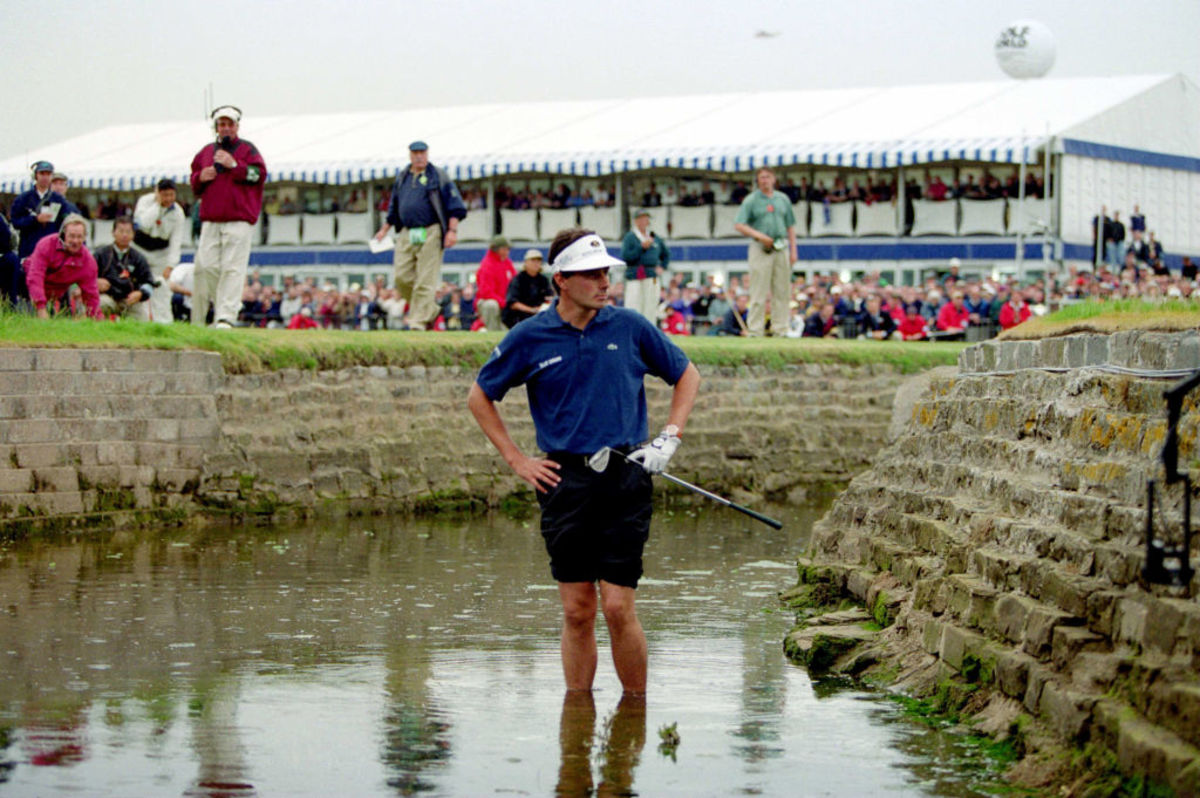
Twitter: @123sportsdigest

Facebook

Instagram: @123__sports


“You know? I may have underestimated you. You’re not a total ass.”

-Dwight K. Schrute

Week of May 17, 2019


Bounce, Bounce, Bounce, Bounce.

Every so often you read something so great you think, “Man, I wish I had written this.” Deadspin’s Barry Petchesky is a favorite ‘round here, and for good reason, but this might be my favorite article he’s ever written.

First a little background: You probably know that the Raptors beat the Sixers in Game 7 on Sunday, on one the craziest buzzer beaters you may ever see, by Kawhi Leonard.  Note: It is NOT the greatest series winning buzzer beater (as I detailed a few weeks back, there haven’t been many), as I have seen many argue this week. I still give that to Lillard’s step back 37-footer just last round. It’s not the greatest because the shot was kinda terrible – he shot it short, and really had no business making it. But Lillard’s shot was pure, a straight swish – thus the greater shot. But it was the craziest series winning buzzer beater, hitting the front (relative to Leonard) iron, bouncing practically straight up while picking up a top spin, and then slowly bouncing its way down and into the net, hitting the rim a total of four times along the way.

Here’s another cool ass angle:

A lot was written about the game and the shot, as you can imagine, but Petchesky’s stands out for the way he told the story of the shot as it unfolded, bounce by bounce, weaving in images, video, player quotes.

Bounce.

It wasn’t going in. A basketball, at least in the scheme of sports, is relatively predictable. Not like a baseball, which has seams that, in a pitcher’s hand or when deflecting off some imperfection on the infield dirt, can do some pretty wild stuff; not like a football, which is designed to be aerodynamic but when on the ground will bounce maddeningly at random; certainly not like a puck, which when on edge can get weird. A basketball is straightforward. This doesn’t make it any easier for a player to make it do what he wants it to do, but from decades of playing or watching the sport, you generally know where the ball is going. And all that accumulated life evidence was clear: A ball that hits the front of the rim, with that much velocity, bounces out. History and physics overwhelmingly promise it.

“Ah, it doesn’t look too good,” Danny Green remembered thinking from his vantage point on the bench.

So Raptors-Sixers Game 7 was going to head to overtime, and it would have been a fascinating one. The Sixers offense had stalled— they scored five points and just one field goal in the final 5:47 of the game—and Joel Embiid was visibly gassed. Kawhi Leonard had taken 39 shots, the most any player had ever taken in regulation of a Game 7, and for much of the fourth quarter, he was Toronto’s offense. But in the game’s final minute, he had missed a free throw and now looked like he was going to miss a second contested jumper. Overtime would’ve meant redemption for someone, and it would’ve been the second-most dramatic way to wrap up a close game in a close series. The first-most would have been if Leonard’s shot, an attempt at the first Game 7 buzzer-beater in NBA history, would have gone in. But that didn’t look likely.

Except…

Bounce.

It continues from there, and I highly recommend you read the whole thing. -TOB

Source: Kawhi Leonard And A Story Of Four Bounces”, Barry Petchesky, Deadspin (05/13/2019)

PAL: It was a sport moment writers drool over (1). All the clichés are on the table (2): time stood still (3), the game hung in the balance (4), a game of inches (5), sometimes it’s better to be lucky than good(6). Petchesky described exactly what happened to the ball, why it’s was so incredible (the way the ball bounced, not the circumstance). He smartly kept it very literal, because he knows enough to know that the one thing he doesn’t need to write was the emotion of the moment or the stakes – it was baked in (7).

TOB: Great point, Phil.


Robberies On The Rise

When I think of an outfielder ‘robbing’ a homerun,  I always see Kirby Puckett first. That was his thing back in the 80s and 90s. The fact that one player – even in my biased memory – represented a type of play says a lot about how uncommon the play has been within my lifetime. Now, Ben Lindbergh explains, home run robberies are increasingly more common.

Through Monday’s games, or almost exactly a quarter of the regular season, outfielders had already robbed 21 home runs. That put them on pace for 84 robberies, which would be by far the most since SIS started tracking the event in 2004. A larger sample may slow that pace, but this isn’t a 2019-only phenomenon: Last year’s 65 robberies broke the previous record of 60, which was set in 2017. The first two years of the current high-homer era, 2015 and 2016, featured 50 and 48 robberies, respectively, which were themselves the highest totals of any season since 2004, a high-homer year at the tail end of the somewhat misleadingly labeled steroid era.

The obvious question is why, right? Lindbergh is one of my favorite baseball writers when it comes to explaining cause in an accessible way. Without ruining the article, which is a hell of a fun read with a bunch of links to robberies (this will lead you down a youtube wormhole), here are a handful of factors:

More home runs = more home run robberies

Ballparks have become more homogeneous in terms of dimensions and fence/wall height.

Outfielders play deeper now. I also wonder about the power of familiarity. Most of these centerfielders (yes, centerfielders account for the the most robberies) have grown up seeing guys reaching over the wall to bring one back. They want want to have one, too. Hell, they believe they can do it, and probably practice it.

OK, so with all of this, Lindbergh has done his job in writing an insightful baseball story that feels fresh, but he doesn’t end on the cause. Instead, with the info he’s shared, he brings it back to why robbing a home run matters on an emotional level. He refers to robberies as a kind of alchemy, taking something and turning it into the opposite at the last possible moment.

That’s pretty good stuff, but I prefer the quote Lindbergh pulled from a Sam Miller 2017 article about the problem with the increase in home runs and applied it to home run robberies.

Baseball is best when it sets up an expectation and subverts it: The nasty slider that jags suddenly out of the strike zone, the shortstop who fields a grounder on a dive and flips it to second base with his glove, the three-run comeback against the dominant closer, and now, the home run that doesn’t happen.

Fantastic read. – PAL

Source: Watcher on the Wall: Welcome to the Golden Age of the Home Run Robbery”,Ben Lindbergh, The Ringer (05/14/2019)


Two Bad Qualities For a Coach: Thick Headed and Thin Skinned

If you live in a cave: the Warriors closed out the Rockets in Houston last Friday. After scoring zero points in the first half of Game 6, Curry came back in the second half to score 33, including 23 in a supernova 4th, to ice the game. Then, on Sunday, the Blazers overcame a 17-point second quarter deficit and hung on to beat the Nuggets in Denver, in Game 7.

With just one day’s rest, the Blazers opened the Western Conference Finals in Oakland against the Warriors. Things did not go well for Portland, as Steph Curry continued to cook, hitting nine three-pointers and scoring 38 points in the Warriors 22-point win.

But, for Portland, it didn’t have to be that way. For the better part of 5 ½ games the Rockets made Curry look old, slow, and unconfident by crowding him at every opportunity. He had so few open looks that when he did get one, he still rushed the shot and never got into a rhythm. The second half outburst in Game 6 was vintage Curry, where he created the tiniest slivers of space and was able to get his shot up and in.

So, did Portland follow suit in Game 1? Did they press and crowd Steph and Klay? Um, no. Instead, the Blazers let Curry cook. When the Warriors ran the high pick and roll with Curry and the Warriors center, the Blazers did not switch and didn’t even have their big show on the screen in an attempt to crowd Curry or get him to give up the ball.

I counted: of his nine made threes, seven came off high pick and rolls where the screener’s man, usually Kanter or Collins, sagged off the screen and allowed Steph Curry, the greatest shooter of all time, to step into a wiiiiiiide open three pointer. Here are a few examples (I’ve helpfully circled the screener’s defender and drawn a line between him and Curry at or near the point of release):

I probably don’t need to say this: but this is not ideal for a defense. #analysis

After the third or fourth time the Blazers did this in the first half, I thought maybe Kanter was just being lazy. He’s known as a terrible defender, especially against the pick and roll – perhaps he was tired from the short turnaround after Game 7. Surely they’d make a halftime adjustment! But then it continued in the second half.

Asked about it after the game, Blazers head coach Terry Stotts was defiant and, frankly, rude in response to a reasonable question:

WHOA! So, ignoring the fact they held Steph in check for 5 ½ games by being in his pocket, Stotts is basing his suicidal strategy on the fact that Steph scored 33 points in the second half of Game 6 against Houston. BUDDY! He did that because he’s the greatest shooter of all-time, and no defense is going to hold him down forever! If Steph scores 33 points against tight defense the answer is not to go the other way and let him step into wide open 3s!

Maybe Stotts is feeling sheepish and didn’t want to admit he made a mistake. But he also said during that press conference that they were within 6 at the end of the third quarter. Which, fine. Let’s ignore the fact that the small deficit was in large part due to a run the Blazers made in the 3rd quarter when Steph was on the bench. And let’s ignore the fact that the Warriors ended up winning by 22. Let’s give him his six point deficit. Imagine what the score might have been if Curry had shot something like 2 for 9 from 3 instead of 8 for 13 in the first three quarters.

Personally, I doubt they will try this strategy again. Blazers players, like Lillard and McCollum, openly questioned the strategy. Lillard said after the game, “That was very poor execution defensively on our part. Having our bigs back that far…We gotta bring our guys up…they were shooting practice shots.” If they don’t do what Lillard suggests, it’s going to be a short series.

Update: The next day, Stotts apologized for being a jerk to the reporter, and also admitted that they may rethink their strategy:

-TOB

Game 2 Update: Steph got 37. The Blazers did try to run him off the three point line, and he responded by breaking down the defense by giving up the ball quickly and working to get it back in a place he could do damage. Silver lining (I guess) is he shot on 4-14 from three. He did a lot more work at the line last night. This kid just might turn out to be pretty good. -PAL


Hockey Expert Offers Critique of Hockey

There is probably nothing worse in sports than when new fans or non-fans tune into a sport and then immediately offer rule changes that they think would improve the game or make the game more watchable, despite the immense popularity of the sport. This happens every World Cup, when fans complain about and offer “solutions” to things like the offsides rule, despite the fact soccer is the most popular sport in the world and does not need fixing. It’s annoying and arrogant and needs to stop. BUT! I’m slightly caught up in the Sharks’ Stanley Cup playoff run right now. Plus, if you read last week’s blog you are aware that I played roller hockey in high school. I am thus highly qualified to opine on what the NHL does, and I have a beef with how hockey does something, so I’m going to rant about it here.

In hockey, as in most American sports, the clock counts down to 00:00. Hockey has three twenty-minute periods, so each period the clock begins at 20:00 and ticks down. Pretty simple. However, when you look at a box score or other record of the game, they mark events (e.g., goals scored, penalties taken) not by the time showing on the clock, but by the time elapsed in the period. IT’S SO STUPID. Let me illustrate. Here’s the scoring summary from Wednesday’s Sharks/Blues game, as taken from NHL.com.

Any normal person looking at that would think the Sharks scored first when the clock read 13:37. But then you notice that listed after that is a goal by Thornton at 16:58. What you will soon realize is that actually Karlsson’s goal came 13:37 INTO the 1st period, when the clock read 6:23, and that Thornton’s goal came 16:58 INTO the 1st period, when the clock read 3:02. Indeed, you can see it in the play by play side by side on the very same website.

This inconsistency is SO STUPID, I cannot stand it. At all! It must be fixed. Without bothering to research, I am guessing the inconsistency arose because at some point in time they used a watch counting up to keep score, and thus it made sense to record the time of goals as the amount of time into the period. When they changed to counting down, they wanted to be consistent with prior records and didn’t want to go back through old game logs and flip every goal ever scored. Well, I don’t care! This is dumb and must be fixed, hockey!

Please, if you like hockey and like how they do this, offer me a counter argument in the comments. And as the late Charlie Murphy said – make sure your people are around to see it – because you might get embarrassed! -TOB


The Making of a Modern Day Legend  

On Tuesday, The New Orleans Pelicans defied odds and won the NBA Lottery. This is a good year to win the lottery, probably the best year since the Pelicans last won the lottery and selected Anthony Davis with the top pick in 2012. Seven years later, Davis is top 10 player in the NBA (many would say top 5) and is trying to force his way out of New Orleans. A mess for any small market franchize New Orleans; however, there is relief in Zion Williamson.

This story is not about Davis, the draft, or the Pelicans; it’s about the making of a teenage sports legend. In series of short, let’s call them vignettes, various NY Times journalists sit down with the people who were there (or, in LeBron’s case not allowed in) and played a minor role in the his YouTube filmography of highlights.

I’d seen all but one of the videos featured in this story, but to hear the accounts from those on the court or in the gym gives it another layer, because their disbelief is a first-hand account. Two of my favorites:

Zion’s high school teammate, Bishop Richardson, describing the windmill alley-oop that started with a bad lob from Richardson.

On this occasion, Richardson’s toss arrived well below the rim. But that enabled Williamson to do something outrageous: He rose into the air, reached out with two hands to grab the incoming pass at about shoulder height, and — still rising, now high enough to peer inside the rim he was about to shake — used one sweeping, circular motion to bring the ball down to his waist and then back up to the left side of his body before ramming it through the basket with his left hand.

The crowd erupted.

“I remember thinking, ‘Holy cow, I’ve never seen anyone do anything like that, let alone be a part of it,’” Richardson said. “People were falling out of the bleachers.”

The dunk made it onto highlight reels and national sports shows within hours, but Richardson did not see a replay until the next day, when he and teammates sneaked a peek in a study hall.

Check-out the teammate, number 24, at 1:24 of the video below. His reaction pretty much sums it up. 

Zion’s Duke teammate describing when the team measured verticals.

Williamson, who went last, was off the charts. On his first attempt, he casually swatted aside the highest measurement. A staff member adjusted the pole to its highest setting and reset the tabs, and Williamson repeated the feat. They put weights under the contraption to lift it a few more inches into the air. Williamson batted the highest measurements aside again.

We are now well into an era where every play – literally every play – of any prospect of note is captured on video. Legends don’t grown by word of mouth; they grow on YouTube channels and IG accounts created specifically to share highlights of prospects. Basketball fans across the world knew Zion before he played a game at Duke as a freshman.

The story of youth, power, and seemingly limitless athleticism never gets old, because we always do. – PAL

Source: The Legend of Zion”, The New York Times (various contributors) (03/31/2019)

TOB: I think Zion will be very good, but people also need to pump the brakes a bit. Isn’t he just pre-injury Larry Johnson, with more hops? An All-Star but not a Hall of Fame player. Is he really a superstar? Can he go get a bucket when you need it? I’m not sure.


Are the Twins For Real?

Lookout! The Twins have the best record in baseball. But are they really good – or are they winning with some smoke and mirrors?

Overall, the Twins rank first in the majors with a 141 OPS+ against sub-.500 teams, but they’re tied for 20th with a 90 OPS+ against teams with a neutral or winning record. That gap is the largest in the majors by a huge margin, and even though it’s still a bit too early to be slicing slivers of batting splits, this detail indicates that Minnesota’s offense might not be as formidable as its surface stats suggest.”

Hmm. Only time will tell! -TOB

Source: “Are the MLB-Leading Minnesota Twins for Real?”, Zach Kram, The Ringer (05/13/2019)

PAL: I hate this goddamn article. I hate the construction of it. Are the Twins for real????? Here are 5,000 stats, some of which indicate the team is for real, and some of which point to the another hot start. Some of the info is good (they have pitchers who can actually strike some dudes out now), and some if it is amusing (they have a catcher off to a Bond-like start at the plate). 

I also hate that it calls attention to the Twins hot start. Everyone be quiet about it! Nothing to see here.

So, if the Twins do surprise folks and win the division about 120 games from now, then this article will be right on. If the Twins come back to earth, finish a respectable .500, then this article will be right.

Most importantly, I hate that TOB is trolling me in our own effin blog. This is the second Twins-related story TOB’s posted in the last three weeks. I know what you’re up to, fella.

TOB:


Video of the Week


Tweet of the Week

https://twitter.com/pickuphoop/status/1129260936995508224


PAL Song of the Week: The Velvet Underground – “Oh Sweet Nuthin’


Like what you’ve read? Let us know by following this blog (on the right side, up near the top), or:

Email: 123sportslist@gmail.com

Twitter: @123sportsdigest

Facebook

Instagram: @123__sports


You cannot learn from books. Replace these pages with life lessons, and then you will have a book that’s worth its weight in gold.

-Michael Scott

Week of May 3, 2019

Cheers to Five More Years

We hatched the plan almost on a whim, sitting at a bar near Phil’s house in San Francisco, and sent the first post just a couple days later, on May 4, 2014. We set a goal to do it every week for six months, which seemed impossible. Five years later, I can count the weeks we’ve missed on one hand.

A lot has changed for us in those five years. Phil started a new job, moved to Oakland, met a girl, and is getting married this July. I couldn’t be happier for him. I insanely took on this project about six weeks before my oldest son was born (special shoutout to my wife, who has allowed me to devote so much time to this vanity project) – and I’ve since had two kids, bought a house, changed jobs, and even started my own law practice. Somehow, 1-2-3 Sports is older than all of those things.

At times it is exhausting and frustrating to do this every week. We put a lot of energy into it. But it’s worth it. In the past five years, Phil has gone from a good but relatively new friend to my best friend, and 1-2-3 Sports is a big part of that.

We’re proud of what we’ve made, and we hope you enjoy it, too. We’re planning a 5 year anniversary whiffle ball game followed by McCovey Cove float day. Stay tuned for details, and thanks for reading. -TOB


An Explanation of Testosterone in Elite Athletes

For years, Olympic champion Caster Semenya has been the face of a heated debate about gender and sports. It’s likely you’ve heard her story.  Semenya has naturally high levels of testosterone for a woman. She represents 1 in 20,000 women whose testosterone levels are similar to that of the male range. This week a court in Switzerland ruled that she and others like her would have to reduce their naturally high testosterone in order to compete in certain races at major competitions.

I don’t need to tell you that this is an emotional debate, but I do need to tell you to read Gina Kolata’s accessible explanation as to the science behind the debate.

Amongst other purposes, testosterone builds muscle. It’s not just another physical advantage like, say, height in a basketball player. It’s directly linked to improved performance.  

In one study, Dr. Levine put sedentary young men and young women through a year of athletic training. At the start, the men and women had similarly sized hearts. A year later, the men’s hearts were much larger, the result of muscle-building directed by the hormone.

The hormone’s effects are amplified among elite athletes, altering the body in ways that can make a huge difference in performance. Male champions in every sport are always much faster and stronger than women who set world records.

The gap can be quite wide. Elite female runners would never win races if they competed against elite men, according to Doriane Coleman, a former middle-distance runner who is now a law professor at Duke University.

Ms. Coleman has reviewed the best performances of three female athletes who were the fastest 400-meter runners in history (and were not injecting testosterone).

In 2017 alone, she found, more than 10,000 men and boys running 400-meter races beat the best times these women ever ran.

This is the science behind the ruling, but it’s also worth noting that the ruling is only for races between 400 meters and one mile, which is based on evidence. As I noted earlier, naturally abnormal testosterone levels can be found in 1 out of every 20,000 women; however:

The rule is consistent with a requirement that it be narrowly tailored to the evidence. Athletes who identify as women but who have testosterone levels in the male range are overrepresented in women’s middle-distance running events, a recent study found…

These athletes won 30 medals in Olympic and world championship races at distances ranging from 400 to 1,500 meters. Their incidence in the general population is just 1 in 20,000, meaning they were overrepresented by about 1,700-fold on the podium, the study concluded.

How gender is defined and gender fluidity is a very real issue of this generation. I believe gender is an extremely complex issue. Of course it’s about more than testosterone levels, but oftentimes the facts can get overlooked on an emotional topic. And, so, when we’re talking about athletes and gender, it’s helpful to start with the science before we shout at one another. – PAL

Source: Does Testosterone Really Give Caster Semenya an Edge on the Track?”, Gina Kolata, The New York Times (05/01/19)

TOB: You’re telling me that a naturally occurring physical trait makes a person more successful as an athlete and so we’re going to not let them compete unless they reduce the effects of that physical trait? I love it. As a 5’10 basketball player, I think anyone over 6 feet should have to have a portion of their shins removed to reduce their height to 6’0 or lower. I’d have made the NBA, for sure!


Somehow, Steph Curry Is Still Underrated

Kevin Durant has been on fire this postseason – averaging 38 points per game over his last 6. His offense is predicated on the fact that he can shoot over the top of just about anyone, and so he’s extremely difficult to defend, especially when he’s on. You can stay in front of him, get a hand in his face, and he just shoots it right over you. Swish. But as I’ve said before, I find his game boring. It’s not graceful, it’s not fun to watch. He’s talented as hell and does things no one else can do, but he’s a ball stopper and seems to be getting as many isos this year as he did when he was in OKC.

By contrast, KD’s teammate Steph Curry has been a little quiet so far this postseason. Over his last 6 games, as KD has heated up, Curry has scored just 19.8 points per game, on 44% FG and 35% 3PT. In many corners of the internet, this has lead to questions about – what’s wrong with Steph? Is Steph hurt? Is Steph on the backside of his career? Is this KD’s team now?

People ask these questions because they still don’t understand how Steph Curry completely changes the game of basketball. Here’s a series of videos from Game 1 against the Rockets, where the threat of Curry’s shooting leads to a dunk for the Warriors (click through to see the videos):

That is six plays in one game where Curry does not look to shoot and doesn’t even get the assist, but the threat of his abilities to pull from anywhere means the defense is stretched and morphed so badly that Curry’s teammates get easy dunks (and assists). Here’s a similar thread from last year’s Finals, created by the same guy (again, click through to see the videos):

Try to find a play where the defense treats KD like that as he backs his way into the mid-post. When defenses stop respecting Curry like that, you can tell me it’s KD’s team. For now? Nah. -TOB – special thanks to Twitter user Bobby Flaiben for the videos


A Banner Year Year’s In WHL Bantam Draft Names

One of my favorite times of the year – the WHL Bantam Draft, where we get to see what dumbass names white parents were giving their kids 14-15 years ago. This year’s highlights:

My thoughts:

  • Carter is fine, but there are NINE of them.
  • What’s with J and K names that make white people go bananas?
    • Jace, Jaeger (yes, like the booze), Jagger, Jakin, Jhett, Joah (like Noah but with a J!), Kalem, Karson, Kassius, Koehn, Kylynn (good lord), Kyren (NO).
  • Merik. Like…’Merica?
  • Mesele. I’m not even sure how that’s pronounced.
  • Ridge.
  • Rieger, Rilen, Rylen.
  • And, my personal favorite…OASIZ. Don’t look back in anger at your parents for naming you that, kid.

I hope even one person enjoys this as much as I do. -TOB

Source: The Best Names Of The WHL Draft”, Barry Petchesky, Deadspin (05/02/2019)

PAL: People are so bored. Not a lot of Catholics up in Canada, eh?


The Twins Show How to Make a Killing in Free Agency

The last two baseball offseasons have been interesting. As many teams tank, an opportunity has emerged for teams to get better quickly. Last year, the Brewers traded for Christian Yelich, who would go on to win the 2018 NL MVP. And a few weeks after getting Yelich, Milwaukee signed Lorenzo Cain for a relatively low amount of money. In a year in which many teams elected to begin a rebuild, the Brewers took advantage and got some good players for cheap, and went on to win the division title.

This year, news during baseball’s offseason was dominated by three themes: Bryce, Manny, and the Slow Free Agent Market. That’s all anyone could talk about. But like the Brewers last year, there was one team that kept popping up on the transaction ticker that made me keep saying, “Oh, solid pick up,” – the Minnesota Twins. The Twins had an even less splashy offseason than the Brewers last year, signing guys like CJ Cron, Nelson Cruz, Jonathan Schoop, and Marwin Gonzalez – solid players, all flawed, some perceived as over the hill. But as Jonah Keri points out, these were really good pickups:

Coming off a 30-homer season in the power-squashing environment of Tropicana Field, C.J. Cron could only manage a one-year, $4.8 million deal, landing in Minnesota. After hitting 53 homers over the previous two seasons — while playing a premium defensive position —  Jonathan Schoop cost the Twins a scant $7.5 million on a one-year contract. No hitter in all of baseball cranked more dingers from 2014 through 2018 than Nelson Cruz … and he too could manage only one year guaranteed, a $14.3 million pact with the Twins.

A funny thing happens when you sign a bunch of guys who can hit the ball out of the ballpark — your team hits more home runs. The Twins ranked 23rd in the majors last season in taters. This year, despite playing in one of the least homer-friendly parks in the league, they rank fourth.

But more importantly, the homegrown guys have grown up – with players like Eddie Rosario (11 dingers), Max Kepler (.277, 7 dingers), Jorge Polanco (.327/.393/.606), Mitch Garver (.333/.396/.729 – whoa), and Willins Astudillo (.327/.340/.531) all destroying opposing pitching staffs.

I didn’t realize until last week that things had been going so well for the Twins, when Phil and fellow-St. Paul native/Twins fan/friend of the blog Al both independently remarked to me about how well the team was playing. But until I read this article, I figured it was like the 2017 Twins run to the Wild Card game – a bit of smoke and mirrors, with a lot of luck hiding bad peripheral stats. Not so! The Twins are fourth in the AL in run differential, leading to the second best record in the majors.

The Twins have followed a blueprint that I hope the Giants can take advantage of soon – scout/draft well, build around cheaper, homegrown talent, and look for good value in free agency. -TOB

Source: The Twins Are For Real: How Are They Doing This?”, Jonah Keri, The Athletic (05/02/2019)

PAL: Of course I enjoyed the hell out of this article. The idea that the Twins got power for a bargain is both exciting and nearly foreign to this franchise. Three players in the history of the Minnesota Twins have hit 40 or more home runs in a season. In the last twenty years, their best team (2006) had a middle of the lineup that at least presented a long ball threat: MVP Justin Morneau (34HR), Torii Hunter (31HR), Cuddyer (24HR), and Mauer (13HR).

It’s great to have them off to a good start; but I’m holding my excitement for when they win one postseason game, which hasn’t happened in the team’s last four trips:


A Brief Lesson in Baseball’s Newest Stats

Experiencing Twitter is largely an exercise in a self-selected echo chamber. As such, it is easy for me at times to forget that not all baseball fans like “advanced stats” or even understand what they mean.

For example. ESPN’s Tim Keown, who has been a favorite of mine since his headshot contained a lot less grey, relays this story of the new Giants’ President of Baseball Operations Farhan Zaidi’s first meeting with Giants season ticket holders:

FARHAN ZAIDI’S FIRST face-to-face confrontation as the baseball boss of the San Francisco Giants came from a stranger. Zaidi stood in front of a group of season-ticket holders at a January event and listened to one of his customers ask if he was serious about occasionally using a one-inning opener instead of a conventional starting pitcher. The slightly accusatory tone exposed the questioner’s view on the matter, but Zaidi knew the topic was bound to arise after he had suggested to local reporters during the winter meetings that using an opener was a possibility. 

And so he decided to answer the season-ticket holder’s question with a question of his own:

“If I told you using an opener would definitely improve your chances of winning on a certain day, how many of you would still not want to use it?”

His premise was inarguable, genius: Whatever you think of me, and regardless of who pitches and for how long, who says no to winning? Who among you, men and women who have shelled out thousands and thousands of dollars for ballgames, cannot unite behind the shared joy of victory?

The group was too big to canvass individually, so Zaidi said: “Let me hear you boo.”

And these men and women, the corporate networkers and the lifelong fans alike, cupped their hands around their mouths, aimed them at the smiling man at the front of the room, and booed.

First of all, great writing. Keown set it up perfectly, and it made me LOL. But more importantly it shocked me – there are fans who would rather their teams lose by playing the way they always played over winning by using new tactics? What I forget when I’m in my Twitter bubble is that there are fans who do not care about analytics and in fact resent their existence.

Which is why I really loved Grant Brisbee’s article this week, on how the last three months of the Giants’ offense (August and September 2018, April 2019), were among the seven worst offensive seasons in Giants history, dating back to 1905. WHICH IS INSANE, but can be addressed another day. For the moment I’d like to highlight how Brisbee, understanding he’s speaking in large part to fans like the ones who booed Zaidi, breaks down a couple of advanced stats in a way that is easy to understand. I wanted to share this with those of you who don’t get them or don’t want to get them:

The first stat you’ll need to understand is OPS, which is on-base percentage plus slugging percentage. It’s an imperfect stat, and you really shouldn’t add decimal points like that … but danged if it doesn’t give you an idea of how a team is performing offensively. It takes into account how good a team is at avoiding outs, and it also takes into account how many extra-base hits they’re getting. It’s safe to assume that a team with an .800 OPS is probably hitting the snot out of the ball.

The next stat to understand is OPS+. In 2006, the Giants had an OPS of .746. In 2012, the Giants had an OPS of .724. So that means the 2006 Giants were better, right?

It does not. The National League scored a lot more runs back in 2006, so we need to adjust for that. OPS+ takes this into account, and it also takes the team’s home ballpark into account. Then it crams everything into one number and sets 100 as the league average. So if a team has a 90 OPS+, like the 2006 Giants, that means they were worse than the league average. If a team has a 106 OPS+, like the 2012 Giants, that means they have an above-average offense. The kind that can win the World Series with some strong pitching.

I love OPS+, and I’ll use it a lot. It’s not perfect, but it’s still good, very useful and searchable on Baseball-Reference.com. Which brings us to the last stat you’ll need to know: sOPS+.

What sOPS+ does is look for OPS+ within a particular split. Let’s say that you wanted to find out which team in baseball history was the best at hitting at their home park. Seems like a mess. That would mean comparing the Astrodome to Coors Field and the steroid era to a pitcher-dominated season like 1968. But sOPS+ does all that work for you, and gives us an answer. (It was the Rockies in 2014, even after accounting for park. The Coors effect is real, and it’s scary as heck.)

So when looking for the best or worst offensive months in a team’s history, use sOPS+. That way April isn’t unfairly docked because it’s colder than July, when the ball is likely to travel farther. It also compares Septembers with other Septembers, which are months besotted with rookie call-ups. And most important, sOPS+ takes into account what the rest of the league was doing that month.

Makes sense, right? OPS+ and ERA+ are really good stats to help you put numbers in context, and they’re simple to understand. I wish they were more widely understood and used. -TOB

Source: From a Ph.D. to RBIs: How Farhan Zaidi Left Berkeley and Became a Baseball Pioneer“, Tim Keown, ESPN (05/02/2019); “Here’s a Stat About the Giants Offensive Struggles That Will Melt Your Brain“, Grant Brisbee, The Athletic (05/01/2019)


Video(s) of the Week

SVP with all you need to know on the Rockets’ close out “controversy”

I’M NOT CRYING. I WAS CHOPPING ONIONS.


Tweet(s) of the Week


PAL Song of the Week: Richard Swift – ‘Lady Luck’


Like what you’ve read? Let us know by following this blog (on the right side, up near the top), or:

Email: 123sportslist@gmail.com

Twitter: @123sportsdigest

Facebook

Instagram: @123__sports


“Webster’s Dictionary defines “wedding” as “the fusing of two metals with a hot torch.”

-Michael Scott

Week of May 3, 2019

Cheers to Five More Years

We hatched the plan almost on a whim, sitting at a bar near Phil’s house in San Francisco, and sent the first post just a couple days later. We set a goal to do it every week for six months, which seemed impossible. Five years later, I can count the weeks we’ve missed on one hand.

A lot has changed for us in those five years. Phil started a new job, moved to Oakland, met a girl, and is getting married this July. I couldn’t be happier for him. I insanely took on this project about six weeks before my oldest son was born (special shoutout to my wife, who has allowed me to devote so much time to this vanity project) – and I’ve since had two kids, bought a house, changed jobs, and even started my own law practice. Somehow, 1-2-3 Sports is older than all of those things.

At times it is exhausting and frustrating to do this every week. We put a lot of energy into it. But it’s worth it. In the past five years, Phil has gone from a good but relatively new friend to my best friend, and 1-2-3 Sports is a big part of that.
We’re proud of what we’ve made, and we hope you enjoy it, too. We’re planning a 5 year anniversary whiffle ball game followed by McCovey Cove float day. Stay tuned for details, and thanks for reading. -TOB


An Explanation of Testosterone in Elite Athletes

For years, Olympic champion Caster Semenya has been the face of a heated debate about gender and sports. It’s likely you’ve heard her story.  Semenya has naturally high levels of testosterone for a woman. She represents 1 in 20,000 women whose testosterone levels are similar to that of the male range. This week a court in Switzerland ruled that she and others like her would have to reduce their naturally high testosterone in order to compete in certain races at major competitions.

I don’t need to tell you that this is an emotional debate, but I do need to tell you to read Gina Kolata’s accessible explanation as to the science behind the debate.

Amongst other purposes, testosterone builds muscle. It’s not just another physical advantage like, say, height in a basketball player. It’s directly linked to improved performance.  

In one study, Dr. Levine put sedentary young men and young women through a year of athletic training. At the start, the men and women had similarly sized hearts. A year later, the men’s hearts were much larger, the result of muscle-building directed by the hormone.

The hormone’s effects are amplified among elite athletes, altering the body in ways that can make a huge difference in performance. Male champions in every sport are always much faster and stronger than women who set world records.

The gap can be quite wide. Elite female runners would never win races if they competed against elite men, according to Doriane Coleman, a former middle-distance runner who is now a law professor at Duke University.

Ms. Coleman has reviewed the best performances of three female athletes who were the fastest 400-meter runners in history (and were not injecting testosterone).

In 2017 alone, she found, more than 10,000 men and boys running 400-meter races beat the best times these women ever ran.

This is the science behind the ruling, but it’s also worth noting that the ruling is only for races between 400 meters and one mile, which is based on evidence. As I noted earlier, naturally abnormal testosterone levels can be found in 1 out of every 20,000 women; however:

The rule is consistent with a requirement that it be narrowly tailored to the evidence. Athletes who identify as women but who have testosterone levels in the male range are overrepresented in women’s middle-distance running events, a recent study found…

These athletes won 30 medals in Olympic and world championship races at distances ranging from 400 to 1,500 meters. Their incidence in the general population is just 1 in 20,000, meaning they were overrepresented by about 1,700-fold on the podium, the study concluded.
How gender is defined and gender fluidity is a very real issue of this generation. I believe gender is an extremely complex issue. Of course it’s about more than testosterone levels, but oftentimes the facts can get overlooked on an emotional topic. And, so, when we’re talking about athletes and gender, it’s helpful to start with the science before we shout at one another. – PAL

Source: Does Testosterone Really Give Caster Semenya an Edge on the Track?”, Gina Kolata, The New York Times (05/01/19)

TOB: You’re telling me that a naturally occurring physical trait makes a person more successful as an athlete and so we’re going to not let them compete unless they reduce the effects of that physical trait? I love it. As a 5’10 basketball player, I think anyone over 6 feet should have to have a portion of their shins removed to reduce their height to 6’0 or lower. I’d have made the NBA, for sure!


Somehow, Steph Curry Is Still Underrated

Kevin Durant has been on fire this postseason – averaging 38 points per game over his last 6. His offense is predicated on the fact that he can shoot over the top of just about anyone, and so he’s extremely difficult to defend, especially when he’s on. You can stay in front of him, get a hand in his face, and he just shoots it right over you. Swish. But as I’ve said before, I find his game boring. It’s not graceful, it’s not fun to watch. He’s talented as hell and does things no one else can do, but he’s a ball stopper and seems to be getting as many isos this year as he did when he was in OKC.

By contrast, KD’s teammate Steph Curry has been a little quiet so far this postseason. Over his last 6 games, as KD has heated up, Curry has scored just 19.8 points per game, on 44% FG and 35% 3PT. In many corners of the internet, this has lead to questions about – what’s wrong with Steph? Is Steph hurt? Is Steph on the backside of his career? Is this KD’s team now?

People ask these questions because they still don’t understand how Steph Curry completely changes the game of basketball. Here’s a series of videos from Game 1 against the Rockets, where the threat of Curry’s shooting leads to a dunk for the Warriors (click through to see the videos):

That is six plays in one game where Curry does not look to shoot and doesn’t even get the assist, but the threat of his abilities to pull from anywhere means the defense is stretched and morphed so badly that Curry’s teammates get easy dunks (and assists). Here’s a similar thread from last year’s Finals, created by the same guy (again, click through to see the videos):

Try to find a play where the defense treats KD like that as he backs his way into the mid-post. When defenses stop respecting Curry like that, you can tell me it’s KD’s team. For now? Nah. -TOB – special thanks to Twitter user Bobby Flaiben for the videos


A Banner Year Year’s In WHL Bantam Draft Names

One of my favorite times of the year – the WHL Bantam Draft, where we get to see what dumbass names white parents were giving their kids 14-15 years ago. This year’s highlights:

My thoughts:

  • Carter is fine, but there are NINE of them.
  • What’s with J and K names that make white people go bananas?
    • Jace, Jaeger (yes, like the booze), Jagger, Jakin, Jhett, Joah (like Noah but with a J!), Kalem, Karson, Kassius, Koehn, Kylynn (good lord), Kyren (NO).
  • Merik. Like…’Merica?
  • Mesele. I’m not even sure how that’s pronounced.
  • Ridge.
  • Rieger, Rilen, Rylen.
  • And, my personal favorite…OASIZ. Don’t look back in anger at your parents for naming you that, kid.

I hope even one person enjoys this as much as I do. -TOB

Source: The Best Names Of The WHL Draft”, Barry Petchesky, Deadspin (05/02/2019)

PAL: People are so bored. Not a lot of Catholics up in Canada, eh?


The Twins Show How to Make a Killing in Free Agency

The last two baseball offseasons have been interesting. As many teams tank, an opportunity has emerged for teams to get better quickly. Last year, the Brewers traded for Christian Yelich, who would go on to win the 2018 NL MVP. And a few weeks after getting Yelich, Milwaukee signed Lorenzo Cain for a relatively low amount of money. In a year in which many teams elected to begin a rebuild, the Brewers took advantage and got some good players for cheap, and went on to win the division title.

This year, news during baseball’s offseason was dominated by three themes: Bryce, Manny, and the Slow Free Agent Market. That’s all anyone could talk about. But like the Brewers last year, there was one team that kept popping up on the transaction ticker that made me keep saying, “Oh, solid pick up,” – the Minnesota Twins. The Twins had an even less splashy offseason than the Brewers last year, signing guys like CJ Cron, Nelson Cruz, Jonathan Schoop, and Marwin Gonzalez – solid players, all flawed, some perceived as over the hill. But as Jonah Keri points out, these were really good pickups:

Coming off a 30-homer season in the power-squashing environment of Tropicana Field, C.J. Cron could only manage a one-year, $4.8 million deal, landing in Minnesota. After hitting 53 homers over the previous two seasons — while playing a premium defensive position —  Jonathan Schoop cost the Twins a scant $7.5 million on a one-year contract. No hitter in all of baseball cranked more dingers from 2014 through 2018 than Nelson Cruz … and he too could manage only one year guaranteed, a $14.3 million pact with the Twins.

A funny thing happens when you sign a bunch of guys who can hit the ball out of the ballpark — your team hits more home runs. The Twins ranked 23rd in the majors last season in taters. This year, despite playing in one of the least homer-friendly parks in the league, they rank fourth.

But more importantly, the homegrown guys have grown up – with players like Eddie Rosario (11 dingers), Max Kepler (.277, 7 dingers), Jorge Polanco (.327/.393/.606), Mitch Garver (.333/.396/.729 – whoa), and Willins Astudillo (.327/.340/.531) all destroying opposing pitching staffs.

I didn’t realize until last week that things had been going so well for the Twins, when Phil and fellow-St. Paul native/Twins fan/friend of the blog Al both independently remarked to me about how well the team was playing. But until I read this article, I figured it was like the 2017 Twins run to the Wild Card game – a bit of smoke and mirrors, with a lot of luck hiding bad peripheral stats. Not so! The Twins are fourth in the AL in run differential, leading to the second best record in the majors.

The Twins have followed a blueprint that I hope the Giants can take advantage of soon – scout/draft well, build around cheaper, homegrown talent, and look for good value in free agency. -TOB

Source: The Twins Are For Real: How Are They Doing This?”, Jonah Keri, The Athletic (05/02/2019)

PAL: Of course I enjoyed the hell out of this article. The idea that the Twins got power for a bargain is both exciting and nearly foreign to this franchise. Three players in the history of the Minnesota Twins have hit 40 or more home runs in a season. In the last twenty years, their best team (2006) had a middle of the lineup that at least presented a long ball threat: MVP Justin Morneau (34HR), Torii Hunter (31HR), Cuddyer (24HR), and Mauer (13HR).

It’s great to have them off to a good start; but I’m holding my excitement for when they win one postseason game, which hasn’t happened in the team’s last four trips:


A Brief Lesson in Baseball’s Newest Stats

Experiencing Twitter is largely an exercise in a self-selected echo chamber. As such, it is easy for me at times to forget that not all baseball fans like “advanced stats” or even understand what they mean.

For example. ESPN’s Tim Keown, who has been a favorite of mine since his headshot contained a lot less grey, relays this story of the new Giants’ President of Baseball Operations Farhan Zaidi’s first meeting with Giants season ticket holders:

FARHAN ZAIDI’S FIRST face-to-face confrontation as the baseball boss of the San Francisco Giants came from a stranger. Zaidi stood in front of a group of season-ticket holders at a January event and listened to one of his customers ask if he was serious about occasionally using a one-inning opener instead of a conventional starting pitcher. The slightly accusatory tone exposed the questioner’s view on the matter, but Zaidi knew the topic was bound to arise after he had suggested to local reporters during the winter meetings that using an opener was a possibility. 

And so he decided to answer the season-ticket holder’s question with a question of his own:

“If I told you using an opener would definitely improve your chances of winning on a certain day, how many of you would still not want to use it?”

His premise was inarguable, genius: Whatever you think of me, and regardless of who pitches and for how long, who says no to winning? Who among you, men and women who have shelled out thousands and thousands of dollars for ballgames, cannot unite behind the shared joy of victory?

The group was too big to canvass individually, so Zaidi said: “Let me hear you boo.”

And these men and women, the corporate networkers and the lifelong fans alike, cupped their hands around their mouths, aimed them at the smiling man at the front of the room, and booed.

First of all, great writing. Keown set it up perfectly, and it made me LOL. But more importantly it shocked me – there are fans who would rather their teams lose by playing the way they always played over winning by using new tactics? What I forget when I’m in my Twitter bubble is that there are fans who do not care about analytics and in fact resent their existence.

Which is why I really loved Grant Brisbee’s article this week, on how the last three months of the Giants’ offense (August and September 2018, April 2019), were among the seven worst offensive seasons in Giants history, dating back to 1905. WHICH IS INSANE, but can be addressed another day. For the moment I’d like to highlight how Brisbee, understanding he’s speaking in large part to fans like the ones who booed Zaidi, breaks down a couple of advanced stats in a way that is easy to understand. I wanted to share this with those of you who don’t get them or don’t want to get them:

The first stat you’ll need to understand is OPS, which is on-base percentage plus slugging percentage. It’s an imperfect stat, and you really shouldn’t add decimal points like that … but danged if it doesn’t give you an idea of how a team is performing offensively. It takes into account how good a team is at avoiding outs, and it also takes into account how many extra-base hits they’re getting. It’s safe to assume that a team with an .800 OPS is probably hitting the snot out of the ball.

The next stat to understand is OPS+. In 2006, the Giants had an OPS of .746. In 2012, the Giants had an OPS of .724. So that means the 2006 Giants were better, right?

It does not. The National League scored a lot more runs back in 2006, so we need to adjust for that. OPS+ takes this into account, and it also takes the team’s home ballpark into account. Then it crams everything into one number and sets 100 as the league average. So if a team has a 90 OPS+, like the 2006 Giants, that means they were worse than the league average. If a team has a 106 OPS+, like the 2012 Giants, that means they have an above-average offense. The kind that can win the World Series with some strong pitching.

I love OPS+, and I’ll use it a lot. It’s not perfect, but it’s still good, very useful and searchable on Baseball-Reference.com. Which brings us to the last stat you’ll need to know: sOPS+.

What sOPS+ does is look for OPS+ within a particular split. Let’s say that you wanted to find out which team in baseball history was the best at hitting at their home park. Seems like a mess. That would mean comparing the Astrodome to Coors Field and the steroid era to a pitcher-dominated season like 1968. But sOPS+ does all that work for you, and gives us an answer. (It was the Rockies in 2014, even after accounting for park. The Coors effect is real, and it’s scary as heck.)

So when looking for the best or worst offensive months in a team’s history, use sOPS+. That way April isn’t unfairly docked because it’s colder than July, when the ball is likely to travel farther. It also compares Septembers with other Septembers, which are months besotted with rookie call-ups. And most important, sOPS+ takes into account what the rest of the league was doing that month.

Makes sense, right? OPS+ and ERA+ are really good stats to help you put numbers in context, and they’re simple to understand. I wish they were more widely understood and used. -TOB

Source: From a Ph.D. to RBIs: How Farhan Zaidi Left Berkeley and Became a Baseball Pioneer“, Tim Keown, ESPN (05/02/2019); “Here’s a Stat About the Giants Offensive Struggles That Will Melt Your Brain“, Grant Brisbee, The Athletic (05/01/2019)


Video(s) of the Week

SVP with all you need to know on the Rockets’ close out “controversy”

I’M NOT CRYING. I WAS CHOPPING ONIONS.


Tweet(s) of the Week


PAL Song of the Week: Richard Swift – ‘Lady Luck’


Like what you’ve read? Let us know by following this blog (on the right side, up near the top), or:

Email: 123sportslist@gmail.com