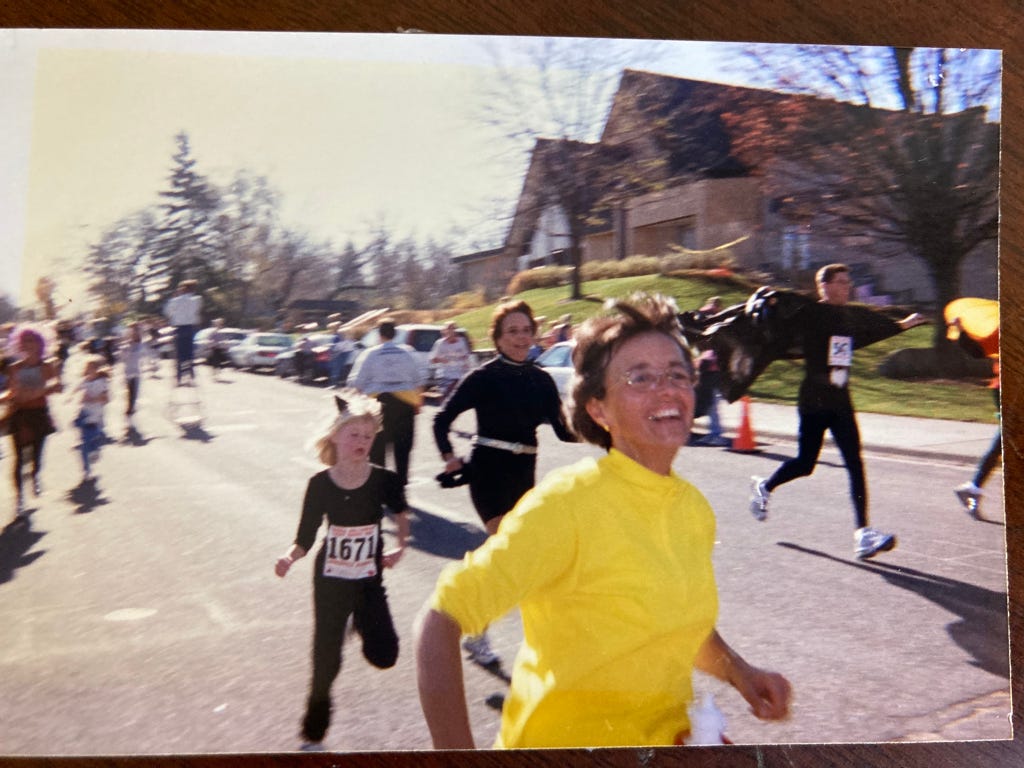
Week of August 26, 2023

My mom died last week. She was my soulmate. I don’t have many of those, but a lot of people felt she was one of theirs. 

Going home was sadder than I could’ve imagined, and way more loving than I ever expected. There’s nothing like being around your family in a time like that – a complete and impenetrable togetherness. 

Here’s a story I wrote a couple years back about my mom taking up running in her fifties. It’s far from perfect, but captures her spirit, her love for life. That’s what I want to share with everyone. 

If you want to show a little love, please consider making a small donation to The Hendrickson Foundation. When asked why you are supporting, please include “The Boundary Waters Sled Hockey Combine,” which was started at my mom and dad’s cabin several years ago.

Like Mom said, stick together. – PAL

Running In Corduroy

Mom was in her fifties when she took her first run. On a winter night in Minnesota she ran to the snow pile at the end of Farrington Circle beneath the yellow streetlight. 500 feet, give or take a few. She walked back home.

Mom’s workout attire for the run: business casual. Corduroys, a sweater over a white blouse, winter boots, and a parka.

I think of her first run regularly, often while I’m running through Oakland in the early morning. The story has long been a part of the family canon. Any forgotten details have been covered by the senses of memory undetected by chronology. For one, there’s little doubt her pre-run snack was a sip from a can of warm Diet Coke and a few chocolate chips from the yellow Tollhouse bag forever ripped open on the counter just to the left of the kitchen sink. Her corduroy strides zipped out in the cold as she passed our neighbors homes — first the Henches, then Bergersons, then Collettis and all of the rest. I can scribble a picture of every house and every bare tree.

I’ve been a runner since college, nearly 20 years. Most of my five siblings are runners, too (respect for always holding out, Tony). I’ve got the sibling marathon count around 45. Mom and Dad were at many of those races. She’d be on her tiptoes at mile 21 of the Twin Cities Marathon, straining to spot one of us coming up Summit Avenue. We’d get in the Suburban after the race, and she’d be energized, thinking aloud about why she was on the curb cheering, not running. Eventually, she gave it a shot.

Recently, Mom told me that, long before any of us ran, she would be introduced as Monica, mother of six. The number of her children was the most recognizable part of her, and she would have to convince herself that she was still Monica, separate from us. And then there was the part that had been unsaid in Mom’s presence but no doubt discussed — that she was the mom of six who’d had been really sick. Throat cancer.

Both distinctions — the one said in front of her and the one discussed when she out of earshot — pestered her for years. Two mosquitos in a tent. No one has ever loved being a mom more than she’s loved it, but goddamn, she was more than a mom, and certainly more than a mom who almost died. More than a wife, too. First, she was Monica.

Another certainty regarding the night of her first run: Mom visited Grandma and Grandpa on the way home from teaching at the very elementary school she attended. Their home, where Mom grew up with two younger sisters (both of whom began running later in life, too), was halfway between where Mom taught and our house.

Grandma and Grandpa have been gone for years now, but Mom checks in with them daily. I was shocked when Mom told me only a short time ago that Grandma had not been on board with Mom having so many kids. They did not send her to college to be a housewife, to be introduced as the mom of six.

Something in me, the bad writer still tempted to make all the pieces fit, wants to say all of those factors — her kids running, the housewife identity, the cancer survivor story she’d grown tired of, or even her hero, Grandpa, taking the time to exercise — pulled on the same end of the rope and finally got her out there to give running a shot.

That all might be, but not even Mom could know for certain. The real explanation is a mystery, or maybe even so mundane that it was lost as soon as she got to the snowpile. Instead of jury-rigging an explanation, it feels true to let the mystery be. Epiphany has the tendency to be assembled from the evidence that survived long after the happening has passed.

Mom kept running. Cue the montage music (she would request “Diamonds On The Soles of Her Shoes”). Runs to the end of the cul-de-sac became runs around the block. Around the block became around the neighborhood. The routes expanded to much of Roseville, many of the same paths Grandpa walked.

She ran down the streets and through the parks and around the lakes and through the yards that were the backdrop of nearly all of her life.

A police officer once stopped her on Highway 36. Mom had veered left down Minnesota Ave over behind Concordia Academy and found herself on the quarter-mile off-ramp. It’s that little stretch of Highway 36 that was part off-ramp, part frontage road across from the Vietnamese Buddist temple on the other side of the high school football field. I doubt she even noticed she was technically on the highway, and I promise she never thought it was cause for police concern.

To her, the fact that she was on a highway mattered less than the proximity of that particular stretch of pavement to so much of her life. How could that officer possibly take issue? She knew more about where she was than his finger knew about the inside of his nose.

Mom loved running for what it did to her mind. Aside from a Discman that rarely worked, accessories were absent from her runs. So too were gadgets used to count ultimately meaningless units of time and distance. Instead, she took a special joy in cutting through yards. As odd as it sounds, she would go out of her way to cut through a yard. To this day, she gets a kick out of it.

One time she complained to my brother, Matt, that her knees hurt. He suggested that it was probably time for a new pair of running shoes. A common issue with regular runners, which Mom had become. That didn’t make sense to her. She was still running in boots in the winter.

She loved it, and watching a parent find something they love other than you is life-affirming. To see another part of them come to form, to witness them alive in the most childlike way: experiencing something new.

After her runs, we’d talk. Mostly on the phone, but we would sit on the front porch when I was home in the summer. She’d still be sweating in the white wicker rocking chair, I’d be on the front step, and we’d stare down Farrington Circle. That runner’s gaze — exhausted contentment. I saw it in her, knowing its perfection myself. I loved to see her lost in the gaze.

In many ways, I think like her. We drift on a similar current. Running gave space to think. A tempo for her to meditate on the people she loved and the ideas that she couldn’t untangle or set aside. She could stride through all of the thoughts with the power of synchronicity, of breath and stride. The idea of faith vs. organized religion, grandpa flying missions as a navigator in WWII, dinner that night, the latest from The White House, a lesson plan, the reading for next week’s mass, and her book club book — all of these thoughts connected within the rhythm of breath and footfalls, and Mom didn’t have to wait for anyone to keep up.

Mom stopped running maybe seven years ago. She slipped a couple times and hit her head. She’s had seizures in her past, though not as a result from falling while running. Also, the radiation from the throat cancer 30 years prior caused many of the muscles in her neck to begin atrophy. Her neck bends forward, resulting in neck, back, and shoulder pain. There have been spinal fusion surgeries, physical therapy, botox, speech therapy, and more. Recently, the flap in her throat — the epiglottis — doesn’t work too well anymore, so it became hard for her to get certain foods down. Some would go down the wrong pipe, causing her to aspirate. Pneumonia followed at least two times.

Mom has always been a petite woman, but the swallowing issues had left her much too thin by my wedding in 2019. She’d always plow through any discomfort. Still, I was scared. She was frail, exhausted, but it was more than that. Mentally, she was loose.

She was malnourished. A feeding tube was put in, which makes it sound like she’s now incapacitated, and that’s far from the truth. The tube has brought her back, in weight, sharpness, and wit. She doesn’t have to rely on swallowing food to get her nutrition. She still eats, orally, but just can’t rely on it for her nutrition. At night, Dad attaches a packet of her daily dose of nutrients and calories to a tube right into her stomach. She has more energy than she’s had in years, and she puts it to use.

I don’t put my mom’s health challenges out there for dramatics; I share to underscore just how much it took to merely slow her gait from a run to a walk. She is, without a hesitation, the most resilient person I know. She doesn’t know how to quit.

She walks most every day, probably as fast as she ran to be honest, but her spirit is not that of a walker. She’s in it, but Mom isn’t ready for a walking life, especially after finding running so late.

Mom’s a fucking runner. I thought she’d hate that I put it that way, but it’s the truth. Turns out, she kinda liked that line.

There’s absolute strength in knowing that I come from her, the lady that took her first run after 50 on a cold winter night. I’m not foolish enough to presume I have all of her resilience in me, but some of that made it to me. It must have. All of those 45 Lang sibling marathons — the ones before and after — come from the same place inside of Mom that convinced her to run up the cul-de-sac.

OK, I admit it; I can’t be completely certain on the specifics of her work clothes on that first run, but that’s the story that survived, and there’s much truth in it. And that lady defaults to corduroys in the winter, always has. She definitely was not wearing jeans to teach the kids at Maternity of Mary. Of course there was a sweater, and what mom owns any less than 40 white blouses?

I often recreate Mom on that run. Her breath finds a pace. Her boots crunch the snow-ice with each petite stride venturing out into the night.

Phil Lang, 02/02/21

Song of the Week

Week of January 6, 2023

January 6, 1980: Flyers set NHL record with a 35-game unbeaten streak. Had no idea.

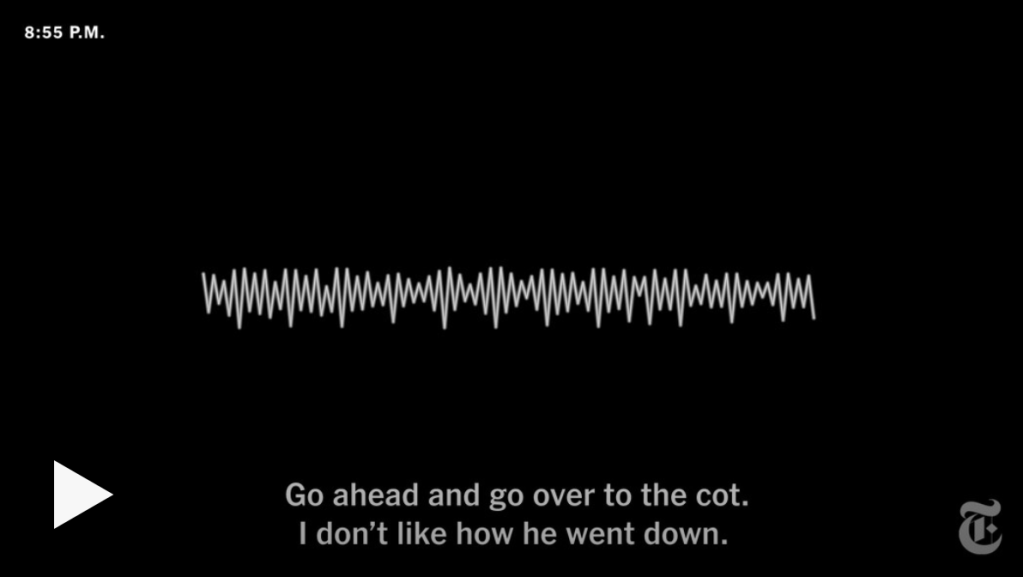
How They Saved Hamlin’s Life

Much has been made about the Bills’ Damar Hamlin collapsing in cardiac arrest in Monday’s NFL game between the Bills and Bengals, and much has been said about the dangers of football. Somewhere in the middle of this story was what appears to be a pretty excellent example of medical professionals being prepared for the worst at an NFL game. This account walks us through the incident from the POV of the emergency response team onsite. After reading—and hearing—the story, you’ll understand why there’s an old joke about the best places to have cardiac arrest is either at the airport or football stadium. 

While it appears Hamlin is heading in the right direction towards recovery, this story makes it very clear just how precarious the situation was and how quickly a team of medical personnel jumped into action.

Cool story to shine a light on the folks that brought Hamlin back to life. – PAL 

Source: ‘We’re Going to Need Everybody’: Recordings Captured Response to N.F.L. Crisis,Ken Belson, Alan Blinder and Robin Stein, The New York Times (01/05/23) 


Sports Hate Is So Funny

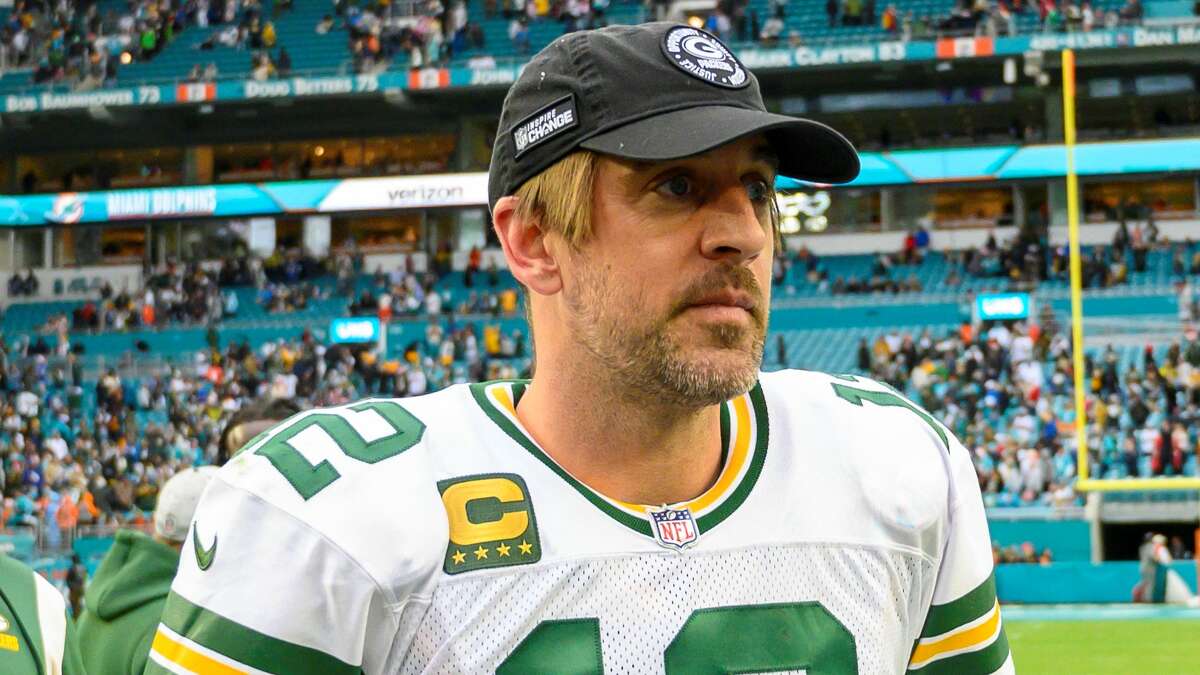
God bless Drew Magary. He’s a longtime Vikings fan, a pretty solid writer, and he hates Aaron Rodgers so, so, so much. After the Packers demolished the pretend-good Vikings to get one win away from the playoffs in a season that was toast in November (4-8), Magary’s sports hate just flows so perfectly in this column. 

To whit: 

The Packers haven’t lost since November. Once December hit, Packers head coach Matt LaFleur — who looks like a sniveling Frenchman up to no good — said to his team, “Hey, maybe we should have meetings together as an offense instead of trying to hash everything out by bitching to sweaty podcasters.” That was apparently all that a hateful God needed to let Rodgers and the Packers rip off four straight wins, capped with a 41-17 demolition of my team, the Minnesota Vikings, just a few days ago. I’d tell God that he owes me, but I just know he’d end up letting me down anyway. He always does. Least reliable god there is.

The only thing better than the Packers losing next week, thereby teasing its wretched fans with hope, would be for them to actually make the playoffs, then get pulverized by the Niners. I’m not the biggest Vikings fan, but I’m right there with Magary on this sports hate for Rodgers. – PAL 

Source: Please, God, Let This be the End of Aaron Rodgers,” Drew Magary, SFGate (01/04/23)

TOB: Magary obviously comes to his Aaron Rodgers feelings from the opposite direction as I do. Magary is a Vikings fan, and Rodgers has played for his team’s rival for his entire career – and most of Magary’s adult life. That’s easy sports hate.

My sports hate is very conflicted. Until recently, Rodgers was my favorite player of all time. Top 3, at least. The first time I saw him throw a pass I predicted he would win the Heisman (didn’t happen, but 4 NFL MVPs is a pretty nice consolation for my prediction).

For me, Rodgers is like that local band you saw at Battle of the Bands. You recognized the talent and star power immediately, and admired them as they rose to the top. Sure, along the way the lead singer said some things and did some things that you weren’t thrilled about. But it was fine! It was nothing major. And god damn did they kick ass. And then it wasn’t fine. Rodgers is an anti-vaxxer. He intentionally misled the public about his vaccination status. He has turned into a complete embarrassment for me. I no longer claim him as my own.

Even sports hate is too strong, though. I’m like a disappointed father, waiting for his kid to apologize and right his wrongs. Come back, Aaron!


The World Cup Was Awesome

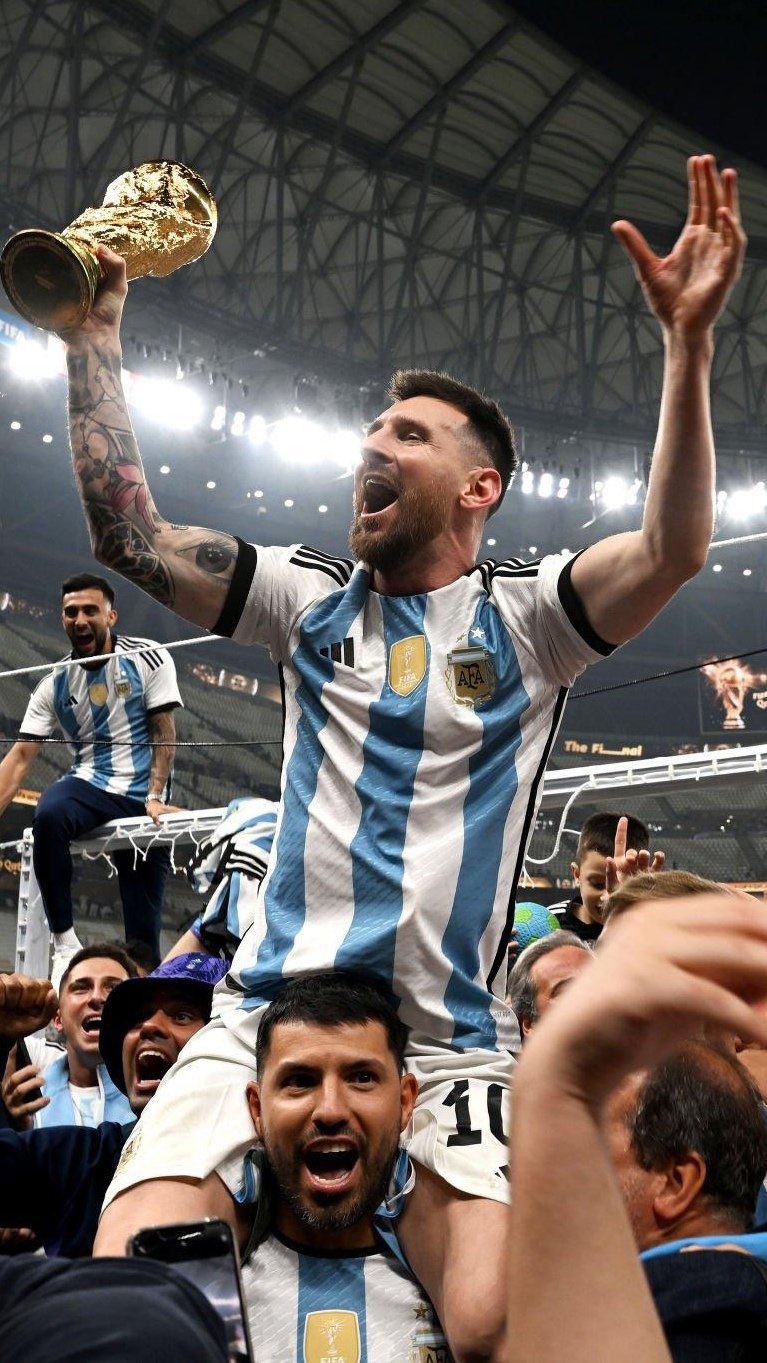
A little late here, due to holiday travel. But the World Cup was freakin awesome, right? And it was capped off by the best soccer game I’ve ever seen, and one of the best games of any sport, I’ve ever seen. Here’s Brian Phillips, quickly rising up the ranks of my favorite writers, on how incredible this game was:

But I need you to know exactly what you are getting, as Joan Didion once wrote, and what you are getting is a man who cannot feel his face. My hands are still shaking. There are tears in my eyes. I’m writing this less than 10 minutes after the end of the greatest World Cup final ever, which Lionel Messi’s Argentina won on penalties over Kylian Mbappé’s France, and I do not believe it is recency bias that makes me think that this match was the single most thrilling sporting event I have ever witnessed. Every game is a story. And when you consider the stakes, the performances, the history in the balance, the refusal of either side to lose, the moments of astonishing play, the sudden reversals and wild swings of momentum, the knife’s-edge uncertainty of the outcome, and the epochal significance of a result that brought the career of the world’s best player to an almost magically perfect climax, it is hard to imagine a story more overwhelming or more satisfying than this one.

There’s something so pure—I want to say so innocent—about a story like this. It’s a story that feels lifted from a children’s book, a story unblemished by the disappointments and compromises and hypocrisies inescapable in adult life. This is, in a way, the essence of sport’s appeal to us. It lets us escape, for a few hours at a time, into a better world.

Phillips nails it. Particularly when considering all the stakes. It was not just a World Cup final. Think about what this meant for Messi.

Messi, the greatest player of his generation trying to cement his legacy by finally winning the big one.

Messi, trying to get the ghost of Maradona off his back.

Messi, facing his own club teammate and his heir apparent, Kylian Mbappe, trying to keep Mbappe from winning his second World Cup.

And he did it. It was an incredible performance by Messi, and by Mbappe.

Maybe it was that undisguised emotion that made this story feel so childlike. I’ve been writing about Lionel Messi, in one form or another, since he was 20 years old and practically a child. I’ve been writing about Kylian Mbappé since he was even younger than that. Watching them today, with Messi at 35 and Mbappé at 23, I found myself thinking about what it means to grow up, what it means to confront all those compromises and disappointments from which soccer gives us a temporary escape.

Look at Messi now. He’s no longer the wide-eyed elf who danced through defenses for Barcelona. He carries some marks of time on him. Not many—not after his singularly blessed and idolized life—but some. You can see in his eyes that he’s taken some knocks, that he’s aware of the possibility of failure, that he knows life is not always going to give him exactly what he wants. He looks at the ball, before running up to take a penalty, not with blithe confidence but with a sort of chastened determination. Everyone, even Leo Messi, has to learn that reality doesn’t revolve around him all the time.

Mbappé, by contrast, looks utterly convinced of his own destiny. He looks certain, the way a child is certain, that he is the hero of the story. He glares fearlessly at every challenge, because being young is like holding a magic feather; it means believing that you are the chosen child of the universe, and if you do your best, you will inevitably be rewarded with a win.

What a game. And man, Phillips is so good. -TOB

Source: We Are All Witnesses,” Brian Phillips, The Ringer (12/18/2022)


What Happens in an NFL Halftime

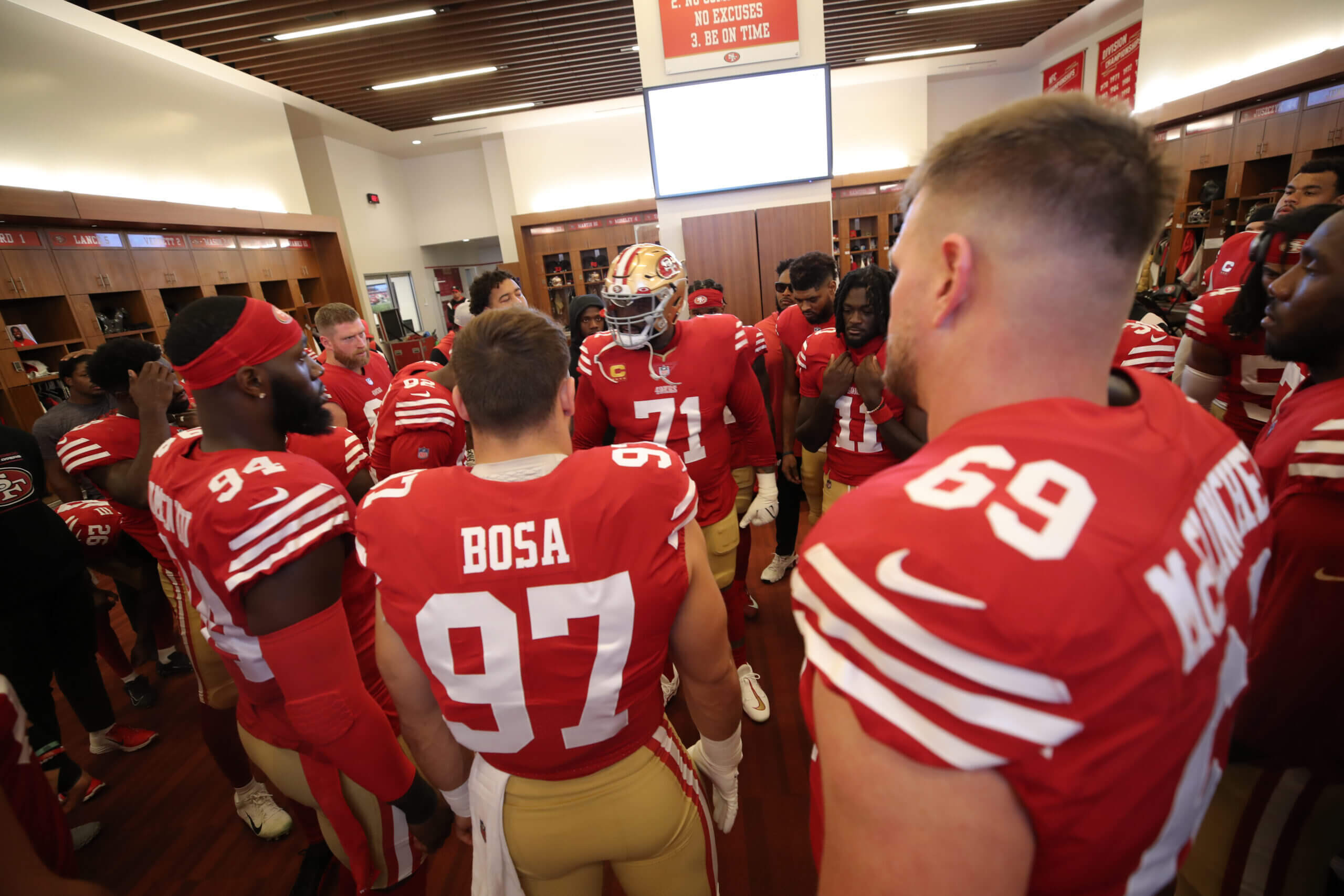
49ers beat writer Matt Barrows set out to answer a question I’ve long had – what exactly happens in an NFL halftime. Luckily, 49ers head coach Kyle Shanahan let him be a fly on the wall. It’s a really fascinating read.

So what is an NFL halftime like? Well, surprisingly quiet, at least for the 49ers offense:

It’s like an advanced-level math seminar condensed to six minutes. Shanahan is on the left side of the whiteboard, scribbling down the eight or so pass plays he likes for the second half. On the right side of the board, run game coordinator Chris Foerster and tight ends coach Brian Fleury do the same for the run plays.

The players silently look on as the coaches write. There’s not much discussion on that side of the room. Shanahan expects everyone to concentrate on the board. None studies it more closely than quarterback Brock Purdy, who is making his first NFL start that day.

There’s more, and it’s worth a read. -TOB

Source: “Inside the 49ers’ halftime locker room: Bananas, bathroom trips and study time for Brock Purdy,” Matt Barrows, The Athletic (12/30/2022)


The Rising Cost of Youth Sports

Recently, the Washington Post had an article about the rising costs of youth sports. As a parent of a young athlete, I can tell you first-hand that it is a lot of money. 

One of the families featured in the story stuck with me – the family of Kamiya Vasquez, a 12-year old basketball player from Michigan.

Kamiya is talented, but her family cannot afford to put her on a travel team:

Kamiya often asks her father if she can try out for local travel teams, some of which charge more than $1,200 just for registration. He explains that the family can’t afford it right now but that he and his wife, Summer, are saving as much as they can, putting away $20 or $30 each month from their paychecks.

“We could pay, but we would be hurting,” Juoquin said. “It’s like, ‘We’ll pay the fee, but can we attach the car payment to it?’ ”

It’s tough to read. I feel for this dad. But if a parent’s reason for spending this much money to get your kid a college scholarship, I can’t help but wonder if the return on investment is there. 

Kamiya wants to play basketball at Michigan State. The average cost of attendance at Michigan State, after aid, for a family at their income level, is $6,927 per year, according tothe U.S. Dept. of Education. That’s about $28,000 over 4 years. If Kamiya’s family spends $3,000 a year on various sports (this could easily be higher) for 8 years (from age 10-18), then they’ve spent $24,000 – not including all the hidden costs, travel, hotels, etc. I get wanting the best for your kid. But a college scholarship is not a golden ticket and parents should consider how much they’re getting out of that investment. -TOB

Source: In Youth Sports, Talent Helps But Money Rules,” Roman Stubbs, Washington Post (12/12/2022)


Videos of the Week

Tweets of the Week

Song of the Week

: Blaze Foley – “Rainbows and Ridges”


Like what you’ve read? Follow us for weekly updates:

Email: 123sportslist@gmail.com

Twitter: @123sportsdigest

Facebook


No, I’m not. I was bald.

George Costanza

Week of December 9, 2022

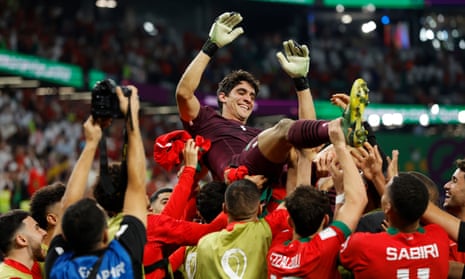
Will never buy another meal or in Morocco again.

Cornered Identity 

Last week I shared a story about the globalization of soccer on display in the World Cup. In short, the professional leagues in Europe are so rich and powerful, that their preferred style of play has influenced coaching and soccer instruction across the globe, all the way down youth academies. Additionally, the best youth players leave their homes at younger and younger ages to develop and play in Europe. Big picture countries have less and less of a stylistic identity to how they play the game. 

With perhaps one exception, per Rory Smith and Allison McCann’s interactive story in The NY Times (Smith and teams World Cup coverage has been excellent throughout): Corner kicks. 

Stuart Reid has been tracking corner kick strategies for some time now, and he’s found that countries have trends when it comes to corners. 

Per Smith: 

The more corners he has dissected, though, the more he realized something. Soccer is now a resolutely globalized game. Ideas spread around the world in the blink of an eye, transmitted almost instantaneously along well-worn trade routes. And yet one area remains relatively untouched, and still proudly, defiantly local. Reid can, sometimes, tell where a team is from just from the way it attacks or defends its corner kicks. 

There are practical explanations for quite a lot of soccer’s most enduring clichés. Northern European teams, for example, may well traditionally play a more direct style than those from the south of the continent because their fields tended to be wetter, muddier and generally less suited to an artful passing game. 

Climate, average height of players, offensive and defensive philosophy (zone vs. man), and more: when it comes to corner kicks, a national soccer identity can be found. 

There’s much more to the story, with really excellent graphics to show the different approaches. Excellent read! – PAL

Source: “Can You Tell a Country by Its Corner Kicks?” Rory Smith and Allison McCann, The New York Times (12/5/22)


716 Feet

The first time I read this story, I thought, “Wow, talk about bad luck.” 

Camille Herron broke a record for a 100-mile run. Months later, it was revealed that the course wasn’t quite 100 miles in length. It was 716 feet short. A race director made a slight change to the course made three years prior for safety reasons. After Herron broke the record, the course was re-measured, and that’s when they found it coming up short. 

Tough break. And that’s where I was going to leave it, but then I re-read the story, and I think this story – and how it’s told – is a good example of how we consume stories much of the time. A crazy tidbit and not much more. A quick nugget we can pass along in conversation. 

But George Ramsay didn’t give us the basics beyond the headline (or maybe his editor cut it): 

  • What world record did Herron break? A women’s record for 100-mile, the overall world record. What record? I assume it’s the overall world record, but it’s never flat-out written. 
  • What was the safety hazard that caused the change to the course 3 years ago, and why in the hell wouldn’t race coordinators re-measure the distance after making a change to the course? 
  • (To a lesser degree) Would her pace have been enough to break the record even with the extra 716 feet (don’t know – 200+ yards in a minute after 99+ miles of running is a pretty good clip)

Big picture: this lady ran 100 miles to break a record, only to have someone make it all for not because they didn’t measure the course. But the story stops short on several basic points that would flesh out this story beyond a headline. We got the who and the what, but it’s pretty light by way of the why, and how.  Interesting story to share in terms of how we write about news, very little in the – PAL 

Source:Camille Herron put her ‘heart and soul’ into breaking the 100-mile world record. But officials now say the course was too short,George Ramsay, CNN (12/7/22)


Duh, UFC

What the hell? On November 5, Darrick Minner fought Shayilan Nuerdanbieke. Anyone close, knew Minner had a knee injury leading into the fight. Bets came flooding in on Nuerdanbieke winning in the first round, which he did. 

It was clear folks had inside info. A bunch of betting sites stopped taking bets on the fight, the line swung pretty wildly within hours, and investigations were launched pretty quickly. 

Minner’s trainor for the fight was James Krause. Krause used to fight, and bets on a lot of fights, which was somehow OK in the UFC until now. Krause also had a UFC gambling podcast, and said that he bets on every fight.

If it seems like a blatant contradiction that someone with such a direct hand in manufacturing the outcome of fights would be allowed to bet on the results of those fights, well, the UFC finally agrees with you. After the promotion allowed this sort of thing for years—a loophole that led to grim headlines like “UFC Fighter Who Bet and Lost on Himself Gets Cut on His Birthday”—UFC Chief Business Officer Hunter Campbell sent a memo to the roster in October announcing that “fighters, training teams, family members, and others that have access to inside information” would no longer be allowed to gamble on fights.

I can’t believe something so stupid was going on in the UFC. Of course, as Patrick Redford points out, finally banning such practices won’t stop trainers and fighter from betting on fights, especially when the fighters earn such a small percentage of the cut. 

UFC fighters are not unionized, get only a 16 percent revenue cut as of 2019, and don’t have real healthcare. If a fighter on the fringes of the roster only makes $22,000 for appearing in a fight, that is not nearly enough to stop them from taking a dive and earning more money doing so.

We all know that a league can get into trouble real quick as soon as viewers question the validity of the outcome. We’ll see how a relatively young professional league handles it. – PAL 

Source: “The UFC’s Treatment Of Its Fighters Created The Conditions For The James Krause Scandal,Patrick Redford, Defector (12/7/22) 


Videos of the Week

Song of the Week

Like what you’ve read? Follow us for weekly updates:

Email: 123sportslist@gmail.com

Twitter: @123sportsdigest

Facebook


Week of November 12, 2022

Say it’s so.

How ‘Bout Them Superteams

Great story here from Justin Verrier on how the NBA superteams put together in 2019 are struggling mightily. LeBron James’ Lakers (2-9) is one of those teams and I couldn’t help but think about how his Decision still looms large in the NBA, but in a way you might not expect.

The league changed when LeBron James decided to form a super team with Dwyane Wade and Chris Bosh in Miami, and the impact is rippling out, even today. Although it seemed so at the time for many, it’s not outlandish for an all-time great player to want to play with great players to increase his likelihood of winning titles. And that’s what LeBron did. He was a free agent, and went to the best basketball situation. LeBron, Wade, and Bosh won two titles in four years in Miami, and went to The Finals each year. 

When it was clear Wade was past his prime, LeBron went back to Cleveland. Cool that it was home, but as Bill Simmons has pointed many times, Cleveland was the best situation for him to win right away. They got (or would get) Kevin Love, then had a young Kyrie, and the Eastern Conference was there for the taking. He went to four more Finals. James making the NBA FInals 8 consecutive years is pretty impressive. During that second stint with the Cavs, James signed one-year contracts as a way to assert more pressure on the team to win now. Leverage the future for the present. And if the front office didn’t do that, well then maybe LeBron wouldn’t stick around. After the talent dried up in Cleveland, he went to the Lakers, eventually joining forces with Anthony Davis. 

It wasn’t long before other stars wanted the same, and teams had to leverage the future to attract the big stars. KD and Kyrie in Brooklyn. Kawhi Leonard and Paul George on the Clippers. 

Per Verrier: 

For more than a decade, the NBA operated under the assumption that aggregating superstars was the key to success, to the point that even a 73-win team (the Warriors) had to enlist a former MVP for reinforcement. But it’s jarring watching the league these days and seeing a team led by James and Davis—still ranked among the league’s 20 best players despite recent setbacks—look downright feckless against a no-star, all-vibes outfit like the Jazz. It’s early, shooting luck will even out, etc., etc., yet it’s hard not to wonder whether the three teams expected to dominate the league just three calendar years ago are already drawing dead—and if the blueprint that built those and other recent superteams has suddenly become outdated. 

That’s not to say that the lure of star power has somehow diminished. The Cavs, lest we forget, just forked over a half decade of future draft picks to add Mitchell, whose blistering start has been the engine of Cleveland’s early success. But there’s a big difference between adding a star to an existing core, as the Hawks and Timberwolves also did this past offseason, and starting from scratch with a newly acquired superstar (or two or three) as the center of your franchise’s universe. One augments a team and its culture; the other replaces them. And by the summer of 2019, the latter was the cost of doing business with the very best players in the league.

Also, the superstars who can command this type of treatment and win-now approach from a franchise aren’t the healthiest bunch…that, or they are just getting old in basketball terms.  

Since 2019: 

Durant has missed 57% of the Nets games. Kyrie: 53%. Kawhi and Paul George: 53% and 40%. LeBron and Anthony Davis: 25% and 37%

A ton of draft picks and prospects were traded to put those superteams together, and none of them won a single playoff game last year. As a result of the trades made in order to get the superstar players, they have diminished assets to make any more moves.

The rest of the league took notice, too. 

But the Davis and George trades, while boons for the L.A. teams, were also clear warnings to any team (and perhaps more importantly, owner) in a less glamorous market: If you want to keep the stars you have, you need to pay the exorbitant price to win now. In other words, LeBron’s and Kawhi’s power plays galvanized their competition into making similar moves, creating superish teams with younger stars and deeper rosters on the same timeline as the Lakers, Clippers, and Nets.

Verrier’s story is about positing the idea that death of the last wave of superteams assembled through free agency and trading away the future. I also see it as this odd homage to The Decision. It worked out pretty spectacularly for LeBron: 4 rings, 10 trips to the Finals (one before his move to Miami), a just about every playoff record out there. It also helped normalize the most understandable idea out there in the professional world (I would like to decide where I want to work in order to be most successful). LeBron changed the game to such a degree that he’s made winning more difficult for himself.  – PAL 

Source: “Is the NBA’s Superteam Era Already Over?” Justin Verrier, The Ringer (11/10/22)


RIP, Jane Gross

Obituaries fascinate me. I never heard of Jane Gross until reading this Richard Sandomir obituary, but I feel privileged to have read the summary of her life today. She’s no superstar. Far from a household name, but today I learned about a lady who led a meaningful, impactful life. 

Gross was a sports reporter. In 1975, she became the first female sports reporter known to enter a professional basketball locker room while covering the Knicks for the Long Island paper, Newsday. A few years later, it became NBA policy to allow women writers in the locker room, which was essential to covering a team in the same fashion as a male counterpart. 

She was scared, but Gross later said, “But I began to realize what a fellow sportswriter at Newsday had told me,” she was quoted as saying in a 1976 profile by the Newspaper Enterprise Association, “that you really can’t get the flavor of the players without seeing them in the locker room and the camaraderie they share.”

Richard Sandomir

She added: “It’s a beautiful thing, the closeness and lack of inhibition after great physical exertion. Most women rarely experience it.”

In addition to sports, she wrote about abortion, the AIDS crisis, Alzheimers and the San Francisco earthquake in 1989. Later, when her mother’s health declined, she started writing about caring for aging parents. That became her beat.

“People tended to underestimate her, and she welcomed it,” Jonathan Landman, a former Times editor who worked with Ms. Gross on the National desk, said in a phone interview. “She played the role of someone emotional, and not too tough, but she was as rigorous and tough-minded a reporter as anyone.”

Sandomir

Gross’s dad was a sports columnist, and she loved it. She followed in his footsteps, then trailblazed her own path. RIP, Jane Gross. – PAL 

 Source: Jane Gross, Sportswriter Who Opened Locker Room Doors, Dies at 75,” Richard Sandomir, The New York Times (11/10/22) 


Video of the Week

Song of the Week

Like what you’ve read? Follow us for weekly updates:

Email: 123sportslist@gmail.com

Twitter: @123sportsdigest

Facebook

Week of October 21, 2022

My god, man.

The Warriors’ Future

Whew, the Warriors. What a ride. A quick recap of where thing stood a couple weeks ago: 

Draymond Green is 32. He has one year left on his contract after this year, but he can opt out and become a free agent at 33, or play that final year for $27.5M and then become a free agent at 34. Almost everyone expects him to opt out to hit free agency a year younger and to get a raise in that first year. He is the heartbeat of the team and the anchor of the defense.

Andrew Wiggins is 27. He is in the last year of his deal and will be paid $33.6M this year. He disappeared for long stretches last year, but came up big during the playoffs. He is an essential two-way player for the Warriors.

Jordan Poole is 22. This is the last year on his rookie deal. He was eligible for an extension of up to 25% of the salary cap, beginning next year. Or, if he didn’t sign an extension, he’d become a restricted free agent next year (the Warriors would have the opportunity to match any deal he signed). He is a young, talented and proven offensive talent.

Steph Curry is Steph Curry. He is 34. He is signed through 2025-26, with his contract reaching just shy of $60M (sixty. million.) in the last year of his deal. He is the face of the franchise and IMO, a top ten all time player. Everything the Warriors do offensively revolves around his skills.

Klay Thompson is 32. He is signed through 23-24. He will be paid $84M over the next two seasons. He does not yet appear to have be 100% back to his pre-achilles/ACL injuries self. 

Two weeks ago, the Warriors had some tough decisions to make – both in the short-term and the medium term. Their cap number and luxury tax bill are both extremely high. Here’s their salary cap situation, as broken down by the Chronicle’s Connor Letournau:

If the team stayed its current course and kept Green on the roster beyond this season, it would stare down a 2023-24 total payroll — salaries and luxury taxes — of around $500 million. That’s simply not feasible. The Warriors might be one of the NBA’s most profitable franchises, but even they aren’t willing to spend a half-billion dollars on a basketball team.

Myers has said that majority owner Joe Lacob would have to fire him if Golden State had a roster costing north of $400 million and didn’t win a championship. Even after the Warriors won their fourth NBA title in eight years this past June with a total payroll of around $362 million, Myers showed just how serious he remains about keeping costs manageable when he declined to match Portland’s three-year, $28 million offer sheet for Gary Payton II.

The problem for the Warriors is they don’t have any easy ways to push that projected 2023-24 payroll down around $400 million. Aside from Poole, Wiggins and Stephen Curry, Golden State’s only major contracts next season are Green at $27.6 million — assuming he exercises his player option — and Klay Thompson at $43.2 million.

If Myers keeps both Green and Thompson around, he might have no choice other than to cut costs through the rest of the rotation. That would mean jettisoning Kevon Looney ($8.5 million in 2023-24), Donte DiVincenzo ($4.7 million player option) and perhaps even James Wiseman ($12.1 million team option) or Kuminga ($6 million team option). Doing that would crater the Warriors’ depth, disbanding the young core they’ve worked so hard to develop, and set the team back for years to come.

That’s not really an option.

So, two weeks ago – the question was who would the Warriors hang onto assuming 1 or 2 of these 4 must leave over the next two seasons? 

It would be hard for me to let Draymond go as long as Curry is still an elite player. He brings so much to the table and allows Curry to do what Curry does. At the same time, with his body type and style of play, most expect a quick drop-off once he is past his peak. He’s also going to want a very big raise, and it feels like the Warriors would be paying for past performance. 

Poole was an interesting one to me. The youngest and the highest ceiling at this point. You can squint and see Poole becoming the next Curry (or maybe just the next Nick Young). He disappeared a bit during the playoffs, but also had big moments. 

Klay is old and still recovering from two devastating injuries. His offensive game has never relied on athleticism, although his previously excellent defense did. He could certainly become a spot-up shooter, but what are the Warriors willing to pay for that? 

Wiggins to me was the easiest release. Not a homegrown guy like Poole, and older, too. Not a face of the franchise like Draymond and Klay. A history of being a little soft. But a good defender and talented offensive player. 

And that’s kinda how I thought things might play out. Extend Draymond 3 years, extend Poole, let Klay gracefully retire or take a massive paycut to become a Korver-type player, and let  Wiggins walk (or trade him for picks). But then Draymond went and blew the whole thing up:

Yeeeeesh. That is not a good look, obviously. The team was pissed at Draymond and there was immediate speculation about how this would affect Draymond’s hope for a big extension. Within a week, the news dropped like a 1-2 punch:

And a few hours later:

Had Draymond’s punch changed the landscape that much? Or was this always the plan? It’s hard to know, but the Warriors have made their choice. And now the question is: Draymond or Klay?

The Poole and Wiggins extensions ensured that this choice must be between Green and Thompson. And Green is the far likelier of the two to go.

Even before Green punched Poole in practice two weeks ago, he figured to be the odd man out in any scenario in which Poole and Wiggins had been locked down long-term. In addition to his contract being much more tradeable than Thompson’s, Green only amplified concerns during the Finals that he could be headed for a steep drop-off.

Then there are the temper-control issues that have long gotten Green in trouble. Green’s violent strike of Poole — and the public backlash brought on by a viral video of it — did irreparable harm to his locker-room standing. Though his teammates might move past that incident to contend for another title, they are unlikely to ever forget Green attacked the much-smaller, much-younger Poole.

When making such a seismic decision about the Warriors’ future, Myers must consider Curry’s perspective. It was clear during his news conference the day after Green’s punch that Curry is growing tired of Green’s antics. If Curry were given the option of keeping Thompson — a model teammate fresh off an inspiring comeback — or Green, it doesn’t take a mind-reader to guess who he would choose.

The question is not so much whether a Green divorce looms, but rather how and when it will come.

It’s hard to imagine, honestly. He does so much for that team and if I could have one of them for 2-3 more years, I’d take Draymond. Then again, I don’t have to work with him. -TOB

Source: Fixing the Warriors’ Budget Crunch: Draymond Green Won’t Like This,” Connor Leatourneau, SF Chronicle (10/17/2022)


Headmaster’s Son Gets Hit With Basketball

This is one of the more bizarre sports stories you’ll ever come across, and perhaps one of the more profound ideas that you’ll find in a sports story. At the center of it all: an old clip from America’s Funniest Home Videos.

The clip is from a high school basketball game at Shipley in Bryn Mawr, Pennsylvania. A ¾ court buzzer beater is chucked into the air, and the airball absolutely de-cleats a young child running behind the basket on the other end of the court. 

What makes the story perfect: the kid who gets smacked, Matthew Piltch, is the headmaster’s son.

The clip, which aired on AVF in 1995, was one of the first viral videos on the internet that has been uploaded and re-uploaded so many times that the origins disappeared from its online existence. Back in July, Brian Feldman set out to find its origins.

In July, he wrote, 

By and large, people want the internet to be an inexplicable machine of random stuff, entertaining them with funny videos of basketball games that could have taken place in Anytown, USA.

A seemingly infinite array of no-context funny videos—scraped from archival footage, newscasts, and increasingly, other users—gets recycled online every day for the sake of likes and shares and attention. “Basketball (so funny you’ll pee your pants).avi” could well be the very first one, a watershed moment in the history of the internet.

The lack of additional information elevates the viewing experience. But every so often, if you dig into a piece of internet ephemera, the context—the who, what, when, where, and why—have the potential to dramatically enhance your understanding of the freak accident that you just witnessed.

In the original story, Feldman concluded that the clip must’ve first aired on the show in the spring of 1995, but that’s as close to the origin as he could reliably get. 

After posting the story, people from the Delco community (Delco Christian is the opposing team in the video) reached out to Feldman to give him more info. They told him the video was submitted to AFV by the team’s coach after a kid working with the team recorded the game. 

Then the big break: Feldman found a DVD of an AFV special “Guide To Parenting” DVD. There it was: the original clip, complete with Bob Saget interviewing the kid who got walloped and his mom.  

Turns out, context is pretty important, because the kid getting laughs with Bob Saget is not Matthew Piltch, son of the headmaster. It’s Kris Jackson. Piltch had never seen the full segment – just the clip of a kid getting smacked. He always believed he was that kid. So did his parents, and so did everyone else in town.  

Feldman didn’t even have the right kid in the first story. How?

It’s not that Feldman was outright lazy in the first story. He corroborated the events of the game with several people who told the same story. The bulk of Feldman’s second story has him dissecting how he could’ve possibly had the wrong subject at the center of the original story. The truth is much harder to figure out when everyone remembers the lore. 

Fascinating story. – PAL

Source:The Misremembered History Of The Internet’s Funniest Buzzer-Beater,” Brian Feldman, Defector (10/19/22)

TOB: I loved this story when I read it in July and the update floored me. Memories are such strange things. How is it that dozens of people (hundreds even – an entire community) could collectively misremember something so memorable? How did Pilch’s parents remember that they had to check on their son after he was hit with a basketball, when in fact he didn’t? The last few paragraphs Feldman writes, about memory and about journalism, were really fantastic:

Piltch said that he has no clue how the idea started that it was him in the video, or where it came from. We talked it over together for a long time and came no closer to the truth. “It seems plausible that when the video popped up,” Piltch said, “someone just decided it was me. Like, what other towhead kid was running around Shipley basketball games? It must’ve been Matt.” (Piltch’s hair has darkened, but he did provide an old photo of him from around that age. His hair was indeed very blond, though not quite the level of Kris Jackson’s.) That’s certainly what his father thought.

Over the next hour, as we worked through the possibilities, Piltch came around to the idea that he’d been living with bad info for the majority of his life. “Our memories are not meant to be perfect,” he said. “This is an amazing instance of collective mis-memory.” He later noted that “it makes you wonder how much other stuff is out there like this.”

Later in our conversation, Piltch turned the focus on me. “How does this affect your perception of journalism?” he asked. Largely, I said, it had made me think about precision. I thought that I had done a diligent job buttoning up that first story—at the time, it even felt like I was engaging in a bit of overkill for such a low-stakes story about a funny viral video. Looking back, what I had actually done is uncover evidence of the video’s supposed legacy, rather than evidence of the inciting incident. I assumed that because multiple people independently told me the same thing, that thing was true. Should I have tried harder to find the provenance of the video, which would have alerted me to my glaring error? Possibly, but measuring what I was missing against what I’d already uncovered (along with the resources available to me; I didn’t have the budget to head down to Delco and ask for the yearbooks missing from Classmates.com), I felt there was enough there for a good story.

Kris Jackson might have been knocked into next week by a flying basketball, but I also got to watch Matthew Piltch get knocked senseless by something unexpected. You know, in a figurative sense. In the end, my attitude is fairly similar to his: This giant mistake of mine managed to uncover something even weirder, wilder, funnier, and—to be corny—deeply human. It was worth getting knocked on my ass.


When Does a Team Bat Around/A Round?

Last Saturday night, the Padres scored 5 runs in the bottom of the 7th to take a 5-3 lead against the Dodgers in Game 4 of their division series. The Padres would not give up that lead, and the Dodgers’ 111-win season went up in smoke. It was delightful

During that 7th inning, the Padres sent ten players to the plate. But as usual, a debate raged on twitter: had the Padres batted around when they sent their 9th hitter up, or not until the 10th? I see this debate on Twitter almost every time a team has a big inning in an important game. Here’s one example, of a pretty evenly split poll on the topic:

I googled, and found articles discussing this same debate. The Wall Street Journal tackled this topic in 2015. They asked a handful of players and others around the game where they stand and here’s what they found:

The day that article published, McCarthy expanded on his opinion:

But I am here to finally resolve this debate: it comes down to linguistics. Here’s what I tweeted during the game:

If you say a team “batted around” then they must send at least ten hitters to the plate. That is because the lineup has come back around to the beginning. However, if you say a team has “batted a round” then they need only send nine hitters to the plate. That is because a “round” occurs when each player has a turn (like buying a round of drinks, for example). They are different terms, but I think most people use “around.” Accordingly, it takes ten. 

Let’s all get on the same page here. -TOB


Videos of the Week


Tweets of the Week


Song of the Week


Like what you’ve read? Follow us for weekly updates:

Email: 123sportslist@gmail.com

Twitter: @123sportsdigest

Facebook

And if you’ve missed our last few posts, find them here:


“So, finally, I wanna thank God, because God gave me this Dundie and I feel God in this Chili’s tonight.” –

-Pam Beesly

Week of September 17, 2022

“Fun, not funny.”

By now, you’ve likely enjoyed the great work of Jomboy. We regularly post breakdown videos from its founder, Jimmy O’Brien (sadly, no relation to TOB). The most famous one – the video that is credited for turning something O’Brien did in his spare time while working as a wedding videographer to a company with 64 employees and a latest funding round of $5M – was the Astros cheating scandal. You know, the garbage bins. 

O’Brien’s unique skillset is on full display in the video. He wasn’t breaking news – The Athletic had the story before Jomboy…and Jmboy isn’t a sports news website anyway…it still doesn’t even have a website! – but he walked the viewer through it so they could see it with their own eyes instead of imagining the cheating while reading along. In the video, O’Brien is funny and extremely insightful, but he never even has a whiff of that self-aggrandizement that seems so common in sports talk tv and radio (the hot take). 

It’s the tone that has come to define the company. In his own words, “Fun, not funny.” 

Per Zach Schonbrun:

O’Brien says, “The easiest way to get laughs sometimes is to knock other people down or go negative. That isn’t really our vibe.”

This can be construed as an attempt at virtuousness, but he insists it is nothing out of character for them. He and Storiale just generally don’t like confrontation.

“We’ve both been diagnosed as conflict averse because we have older sisters who fought their moms,” O’Brien joked. “We were the peacemakers.”

It’s also likely a big reason why Jomboy has been welcomed by MLB. Chicago Cubs outfielder Ian Haap hosts a weekly podcast for Jomboy, and the company recently signed a partnership with the YES Network to produce content and simulcast shows. 

As Schonbrun’s story lays out, “Fun, not funny” is also a pretty savvy place to plant a flag in this current landscape of sport content.

Joe Favorito, a sports industry analyst and lecturer in Columbia University’s sports management program, contrasted Jomboy’s goofier, more inviting approach to the path forged by Barstool Sports, the insurgent media group now worth more than half a billion dollars.

“They’re the less edgy premise of what Barstool is overall,” Favorito said. “They’ve taken that unique, irreverent position while also being respectful of baseball — with some really good insight.”

Jomboy’s escape from the toxicity and polarization on social media is what attracted some big-name investors, including Alexis Ohanian of Reddit and Seven Seven Six, who joined in its latest funding round.

“The pendulum has swung back,” Ohanian wrote in an email. “People crave the good vibes.”

TOB and I started this hobby of 1-2-3 while sitting at a bar on the corner of Geary and Masonic in San Francisco, and it sounds like Jomboy was started in the same spirit of a regular dude who just loves sports. It’s really cool to see Jomboy take off like it has. O’Brien had a clear niche, he executes it perfectly, and I love it. – PAL 

Source:A Sports Media Empire Runs on ‘Good Vibes Only’”, Zach Schonbrun, The New York Times (09/14/22) 


R.I.P. Jonathan Tjarks

Tjarks, a basketball writer for The Ringer, died this week after a long battle with cancer. I was not a big follower of his work, but I wanted to re-post a story he wrote after learning the first round of chemotherapy didn’t take, and his mindset shifted. It’s an incredible, beautiful piece of writing. 

I have already told some of my friends: When I see you in heaven, there’s only one thing I’m going to ask—Were you good to my son and my wife? Were you there for them? Does my son know you? 

Read it. – PAL

Source: Does My Son Know You?” Jonathan Tjarks, The Ringer (03.10.22)


Video of the Week

Anyone who’s a fan of Russ…boy, I don’t know.

Song of the Week

Like what you’ve read? Follow us for weekly updates:

Email: 123sportslist@gmail.com

Twitter: @123sportsdigest

Facebook


 If Relationship George walks through this door, he will kill Independent George! A George, divided
against itself, cannot stand!

George Costanza

Week of August 26, 2022

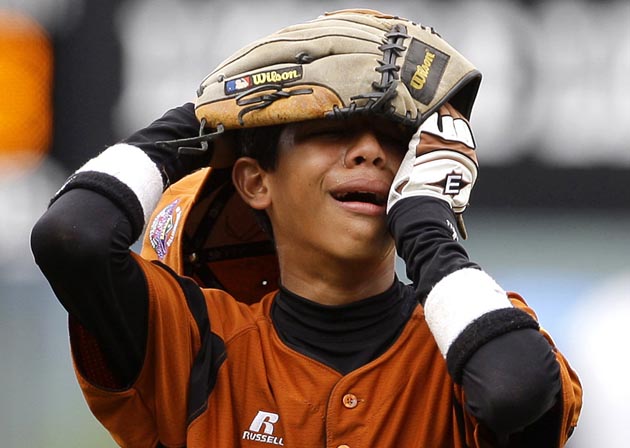
It’s that time of year again…the tears flow in Williamsport.

The New Professional Athlete

The New York Times has a fascinating series going on right now. It’s an examination of sports and fame in today’s world. One of the stories really stuck out to me: Jamad Fiin. She’s a fascinating example of a trend in sports. As Andrew Keh describes it, Fiin is one of the growing number of influencers who are  “professional athletes without competing in professional sports.”

Fiin is a Somali American and Muslim who lives in the Boston area. She wears a hijab, and she balls. Something that combination connected with the masses, and a clip of her finishing with a buttery smooth left amongst a bunch of boys on a playground court went viral. 

The followers grew— including Drake — and so did the opportunities.

Per Keh: 

Today, she has more Instagram followers than all but two Celtics players.

“Kids now, their top career choice is not rock star, athlete or actor,” said Dan Levitt, the founder of Long Haul Management, which represents Fiin and other sports influencers. “It’s digital creator on one of these platforms.”

Levitt is one of many people waiting to see what Fiin does next. Fiin said her managers had gently prodded her to make more content. They have other clients making seven figures a year, monetizing their personal brands with advertisements, sponsorships and merchandise.

So what is Fiin doing with this? She’s almost finished up grad school (M.B.A). She’s playing on the Somali national team, and she’s also putting on basketball camps for Somali and Muslim girls. Reading that made me happy. Not that I begrudge anyone for making the most out of an opportunity and earning off of your name, but it’s cool that she wants to give back, too. 

Before this — before the fame, before the camps, before Drake — Fiin had to fight to play the game. Other parents in the Boston Somali community used to call her mother and ask why her daughter was playing sports and running with boys. It was not until the eighth grade that her mother let her play on a team.

That old tension is what propels everything today. Fiin is shy by nature, but she wants to be more famous, wants even more eyeballs on her, because she wants to embody something she never saw as a child.

She wants people to keep being surprised by her — until the sight of a girl in a hijab swishing a step-back 3 isn’t surprising anymore.

That’s the good stuff. – PAL

Source: “What Will Jamad Fiin Do With Her Influence?Andrew Keh, The New York Times (08/17/22)


Baserunning Wins

Loved this article from the legend Peter Gammons on the importance of base running and the nutjobs in baseball who obsess over it (Moises Alou, the Alomar family, Mookie Betts, Ron Washington, Terry Francona. Think baserunning isn’t’ a big deal? Consider this gem from Gammons: 

In the 2022 season, through August 20, 22.2 percent of nine-inning major league games were decided by one run, and another 8.5 percent were decided in extra innings, which means around 30 percent were essentially one-run games. “How many of those games can be decided by running down the line on a groundball at sprint speed?” asks Sandy Alomar Jr., who Francona has in charge of the Guardians’ baserunning.

I am shocked by that number. 30 percent! Are you shocked? That’s about 48 games in a 162-game season. Maybe I’m crazy, but I can’t get over that stat. 

Dodgers manager Dave Roberts describes baserunning as “the measure of a great teammate.” Of course he would, considering his 2004 moment. 

Or, Giants fans, consider this from Gammons:

There are Royals people who believe that when Alex Gordon hit that fateful line drive off Madison Bumgarner with two out in the bottom of the ninth inning in Game 7 of the 2014 World Series — the single that went past Giants center fielder Gregor Blanco and rolled to the fence, allowing Gordon to reach third — that Gordon might have tried for an inside-the-parker if it hadn’t been for the presence of shortstop Brandon Crawford. Crawford is one of the best infielders at relays because he worked so hard at the craft and once said “I love practicing relays” — a reason he was so good at the art. All that practice might have kept the Royals from tying that Game 7 and secured the championship for the Giants.

This was a refreshing story about a part of the game that gets overlooked. Hopefully we are moving out of the darkness that is the three true outcomes in baseball (homers, strikeouts, walks). – PAL 

Source: Mookie Betts’ baserunning helped win a World Series; why don’t more teams stress it?Peter Gammons, The Athletic (08/25/22)


Video of the Week

Nope:

Tweet of the Week

Song of the Week

Like what you’ve read? Follow us for weekly updates:

Email: 123sportslist@gmail.com

Twitter: @123sportsdigest

Facebook


Nobody was laughing out loud that day in Grenada! But many people were saying OMG. Me, I was saying TTYL to my innocence.

Tony

Week of July 23, 2022

Who Gets A Statue?

TOB and I were walking past Oracle Park with our families just last week. As we passed the Gaylor Perry statue near the left field entrance, I asked TOB, a lifelong Giants fan, what the qualifications were for a statue outside the park. For the Giants, any player that goes into the Hall of Fame as a San Francisco Giant (sorry old players from NY) gets a statue. 

Perry played for the Giants for a decade and was inducted into the Hall of Fame in 1991, but TOB was pretty insistent that he shouldn’t have a statue outside the park. His main reason: Perry played for seven other teams after his time for the Giants. 

Tyler Kepner must’ve been within earshot, because his story is about just that: who gets a statue and who doesn’t. Nearly every Hall of Fame member has a statue somewhere. As Kepner points out, Dave Winfield, a no-doubter Hall-of-Famer, doesn’t have a statue, and his fellow Hall members don’t let him forget it. 

Because statue isn’t just about greatness. Winfield played for too many teams, splitting his best years with the Padres and Angels, winning a World Series with the Blue Jays before collecting his 3,000 hit and 400th home run with his hometown MN Twins. 

To George Brett, a teammate of Winfield’s on eight American League All-Star teams in the 1980s, that only stands to reason. Brett has a statue on the outfield concourse in Kansas City, where he played for 21 seasons and is synonymous with the Royals franchise.

“A lot of these guys played in so many cities,” Brett said. “Who’s going to have a statue of Winfield? He played on eight different teams.”

Six, actually, but that raises an interesting point: Teams are more active now in celebrating their pasts, but many great players, especially over the last few decades, were only passing through on their way to better contracts elsewhere.

Kepner notes that the baseball statue boom is also due to most every team playing in a baseball-only stadium, creating space outside the park to celebrate the team’s history. Older fields like Wrigley and Dodger Stadium have made renovations outside the stadium to create nicer gathering places and plazas. That’s where you’ll find Fergie Jenkins’ statute (Cubs) and Sandy Koufax rocking back (Dodgers)

Kepner also has a cool tangent with sculptor William Behrends about how the surrounding space can dictate dimensions to the sculpture.  

Fellow Minnesotan, Kent Hrbek wasn’t the player Winfield was. In fact, he’s only received 5 Hall of Fame votes the only time he showed up on the ballot, but he’s got a great statue outside Target field, as he should, and right there is the intangible quality that is fun to think about when it comes to which players deserve a sculpture. While Tim Lincecum was freakishly great for only a few seasons for the Giants, TOB didn’t miss a beat to say yes  when I asked Timmy should have one. 

Says Hrbek: 

My daughter will go to the ballpark and take her friends or her children or her cousins and say, ‘That’s Dad; that was his favorite part of playing the game, winning the world championship, catching the ball and jumping off first base. Hopefully that memory will go on for a long time — and give the pigeons someplace to sit for a while and let them do their thing.

Classic Hrbek. Fun read! – PAL 

Source: “You Might Be a Hall of Famer, but Do You Have a Statue?Tyler Kepner, The New York Times (07/22/22)


Let Ratto Eat

There are few writers out there who savor calling bullshit as much as Ray Ratto. He takes his time, tucks that napkin into his shirt, chooses his phrases carefully, and cleans his plate with a cynical panache. A couple weeks ago, his meal of choice was Tiger Woods’ take on the LIV golf tour – the Saudi-backed competitor to the PGA. 

First, here’s what Woods, who had been silent on the topic, said before the (British) Open last week.

What these players are doing for guaranteed money, what is the incentive to practice? What is the incentive to go out there and earn it in the dirt? You’re just getting paid a lot of money up front and playing a few events and playing 54 holes. They’re playing blaring music and have all these atmospheres that are different.

And here’s Ratto just getting started. 

He sounds like just the kind of middle-aged scold every extraordinary cultural figure becomes when the audience has moved on and abandoned him or her to the dustbin of their parents’ history. In a moment where he could explode the LIV tour as doing business with dirty money in defense of even more untrammeled greed that they already exhibit, he goes for the politically safer yet far less compelling argument that successful golfers should be more grateful to the tired old boys than hyper-acquisitive and ethically indifferent in service to the morally compromised new ones.

And Later:

One suspects that he (Woods) would be in equally staunch opposition if the Saudi billionaires were replaced by the guys who gave us the raucous Waste Management Open, which means that while he may be on the right side on the human decency, he’s doing it mostly because he hates change.

You don’t need to read too deeply into this to find Woods’ ultimate incentive. Spoiler alert: it’s not about the young guys going “out there and earn[ing] it in the dirt”. To him, this is about his legacy, because it’s only ever about his legacy. His singular obsession to be the greatest golfer makes him utterly uninteresting when he doesn’t have a club in his hands (or when he’s not being chased by someone with a club in their hands). Calling out changes to the game, changes that make it easier for future generations of golfers to win, which could then makes it even the smallest bit easier for some golf-obsessed fan in 2122 to forget the greatness of Tiger Woods. And in that way, as Ratto points out, Woods is like every other aging sports icon that’s come before him. 

While Woods’ best golf is decades in the rearview, he is still the skeleton key for golf to the mainstream, at least for another year or so. He still matters more than all of the young guys who’ve surpassed his game. His last Masters win had the casual sports fan tuning in to watch his back nine. As incredible as Cam Smith’s back nine at the Open (12 putts on the back nine on a Sunday of a major), the mulleted Aussie is not sending a casual golf fan to the TV. Which is to say, if Tiger did leave the PGA for the LIV, it would be far and away the biggest blow to the PGA. 

But I don’t think the PGA has to worry about that. Not yet, at least. I can’t imagine the amount of money that would sway Tiger Woods to dilute the organization that’s woven into the infrastructure of his greatness. Maybe I am yet again failing to appreciate that every single person has a price, even a billionaire who’s built his entire empire on winning golf tournaments while playing in the PGA Tour.

Because above it all, even Woods, is the money and our ability to digest what lies beneath our viewing entertainment. As Ratto so perfectly calls it, “gradations of manic greed”. 

That there’s prize money as defined by corporate sponsors, there’s obscene prize money as defined by objectionable corporate sponsors, and there’s dirty obscene prize money as defined by governments who are comfortable with attitude adjusters like murder and oppression. You know, tiny subtleties you normal folk could pilot a cruise ship through sideways while irretrievably drunk.

Classic Ratto.  – PAL

Source: Tiger Woods Lit Up The Saudi Golf League For All The Wrong Reasons,” Ray Ratto, Defector (July 12, 2022) 


Video of the Week

Tweet of the Week

Song of the Week

Like what you’ve read? Follow us for weekly updates:

Email: 123sportslist@gmail.com

Twitter: @123sportsdigest

Facebook

I don’t care if Ryan murdered his entire family. He’s like a son to me.

Michael Scott

Week of July 8,2022

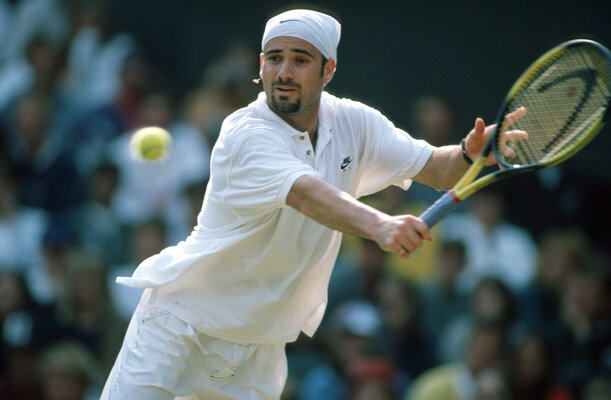
We all remember mullet Agassi at Wimbledon, but let’s not forget to appreciate the goatee + bald-anna Agassi at Wimbledon.

We took a few weeks off. But in the words of Pat O’Brien and the O’Briens, we’re back you motherf…

Let’s go!

Brittney Griner Story Cheat Sheet

Who is she?

Griner is one of the most well-known female basketball players in the world. A high school phenom out of Houston, she’s also the first openly gay athlete endorsed by Nike (2013). She won an NCAA championship at Baylor and two Olympic gold medals. 

Why does she play basketball in Russia?

She’s played for UMMC Ekaterinburg, which is a team located in a town 1,100 miles east of Moscow. A lot of the best American women hoopers play overseas during the offseason. The pay is much better than what they earn in the WNBA. According to her wife, Griner makes $1M a season overseas, compared to $220K she makes playing for Phoenix. 

What did she do?

According to Griner when she entered a guilty plea, she was in a hurry to pack for her return to Russia, and forgot about .7g of cannabis oil in her bag. Vape cartridges. She’s been detained since early March. 

What is Cannabis oil?

Cannabis oil is legal in 45 states. Griner had vape cartridges containing it in her bag. THC and CBD are found in hemp and cannabis plants. There’s more THC in cannabis, and more CBD in hemp. Sounds like Griner had some vape cartridges with cannabis oil.

How much is .7g

.02 ounces…so not a lot. Based on the size, we’re talking 1 or 2 vape cartridges. Russian officials categorized it as “traces”.

What kind of punishment is Griner looking at? 

She’s facing up to 10 years in a Russian prison in what’s called a penal colony. That sounds ominous, especially for a gay person in a country that does not take too kindly to the L.G.B.T.Q community, and it’s not like she would’ve had a fair shake in a Russian court. Griner pleaded guilty, which makes sense. By way of Defector,  the Associated Press reported that fewer than 1 percent of Russian criminal cases result in acquittals. They aren’t super lenient to foreigners who break laws, especially considering the climate between the U.S. and Russia, and the war in Ukraine. 

Experts think that what’s really at stake here is more than likely an attempt by Russia for a prisoner exchange with the United States, and the reports are that Russia has its eye on one person in particular.

Per the NY Times:

With a guilty verdict an all but a foregone conclusion in a Russian legal system that heavily favors the prosecution, her best hope, experts say, is that the Biden administration secure her freedom by releasing a Russian held in the United States. The name of one prisoner in particular has emerged: Viktor Bout, a Russian arms dealer serving a 25-year prison sentence. 

As Defector’s Laura Wagner points out, it is worth noting reports that Bout had clients other than U.S. enemies. In fact, one of Bout’s customers was the U.S. military. 

But even a prisoner swap could take years, and the optics sure don’t look great for Biden if we were to trade Griner for an arms dealer with the nickname “The Merchant of Death“ with Russia as it wages war on Ukraine and faces widespread sanctions. A previous prisoner swap, a former U.S. Marine named Trevor Reed, took more than two years after the original arrest.

Per NY Times:

Griner’s detention comes at the most dangerous moment in U.S.-Russia relations since the Cuban missile crisis, as the Biden administration leads dozens of nations in imposing crushing sanctions on Russia’s economy and its political elites. President Vladimir V. Putin of Russia said on Saturday that the sanctions were “akin to a declaration of war” against his country.

A vape cartridge. This all starts with a vape cartridge. I can’t imagine how scared Griner must be right now. And if you’re wondering how big of a story this is, then consider the following: The NY Times byline names three journalists. Small stories don’t have three names in a byline. – PAL

Sources:

Brittney Griner Pleads Guilty to Drug Charges in Russian Court,” Anton Troianovski, Ivan Nechepurenko and Tania Ganguli, The New York Times (07/07/22); “Swapping Brittney Griner For Viktor Bout Should Be An Easy Call,” Laura Wagner, Defector (06/28/22)


The Death of the Pac-12 Portends the Death of College Football

Last week, news broke that USC and UCLA were leaving the Pac-12 conference and headed (in 2024) for the Big-10. Geographically, this makes little sense. Historically, this makes little sense. But financially? It makes sense. And so the move was made.

The Pac-12 can trace its beginnings to the Pacific Coast Conference, founded in 1915, comprised originally of Cal, Washington, Oregon, and Oregon State. Washington State joined in 1916, followed by Stanford in 19818. USC joined in 1922, and UCLA followed in 1928. The conference disbanded and re-formed in the early 1960s, naming itself the Pac-8 in 1968. The Arizona schools joined in 1977, and the conference was renamed the Pac-10. Utah and Colorado were added in the early 2010, and the conference was re-named the Pac-12.

So USC and UCLA’s decision upends 100 years of tradition and rivalry. How much money did it take for them to do so? Well, a lot.

The Pac-12’s TV media rights expire in 2024, and early rumors suggested the total deal would be worth $500M a year. The Pac-12’s teams divide those numbers evenly (reports suggest this had long rankled USC). After conference expenses, the Pac-12 schools could likely expect $35 million or so per year. Not a bad haul.

However, reports are that with the Big-10 expanding with USC and UCLA, Big-10 payouts will be around $100 million. $100M! And this follows the last few years where conference payouts of the SEC and Big-10 dwarfed the Pac-12’s payout (particularly in 2020, when the Pac-12 played a truncated season due to COVID, while the other conferences pressed on).

And, don’t forget, Oklahoma and Texas are leaving the Big-12 for the SEC soon, too.

So, fine. The Pac-12 is dead. The Big-12 likely is, too. Cal desperately wants to follow UCLA and USC to the Big-10. UW and Oregon reportedly applied and were turned down, at least for now. Most speculate that the Big-10 wants to add Notre Dame and three other schools. Many assume that is three out of the four: UW, Oregon, Cal, and Stanford. But no one knows if Notre Dame wants to go, or Stanford, for that matter. No one knows if the Big-10 might look eastward, and try to get UNC or Clemson, or even Miami and Florida State.

But where is this all headed? In the medium term, it seems we are heading toward two super conferences of about 25 teams each. Then, eventually, one pared down premiere league with 40-50 teams. But it’s so short-sighted, it’s hard to fathom these schools don’t see the downside.

Consider this.

The top dogs are accustomed to playing 2-4 tough games per year and then beating up on patsies the rest of the season. What happens when there are no patsies? What will happen when fanbases accustomed to winning ten games or more per year are suddenly faced with .500 seasons, year after year? Will those fans remain engaged?

What is college football if it’s a small group of schools with parity? What about those crazy fall Saturdays when a bunch of top ranked teams are upset by unranked teams? Those days will be gone. At that point, it’s the NFL Lite, isn’t it? The football is worse and more boring?

And what happens to those teams on the outside looking in? Reportedly, UCLA and USC’s defections will halve the per school payout for the remaining Pac-10 schools. Imagine if UW and Oregon go, too. And imagine schools like Cal, Oregon State, and Washington State are left with a choice of getting almost nothing for TV rights by joining the MWC or folding? Are they going to keep playing in what amounts to D-1AA football? Or are they going to make the cost/benefit analysis and determine they can no longer afford football?

Which begs a question: if these left behind teams fold, who is going to watch this new college football? The fans of the 50 teams in the super conferences, sure. But what about the fans of the other 80 current D1 teams? Are they going to adopt new teams? Are they going to care? I think a lot of them won’t. And when the ratings plummet and the TV networks decide that college football isn’t worth paying what they are paying, what happens then?

All of this is to say: college football is cannibalizing itself, taking short term gains and ignoring the long term losses they are running head first into.

The sad thing is, it’s probably too late to save it. -TOB


Video of the Week

Tweet of the Week

Song of the Week

Pink Sweat$ – PINK CITY

What’s missing? The turtles. Where are the turtles? Where are the turtles? Where are the turtles! Where are they!

Michael Gary Scott

Week of May 20, 2022


U.S.A.! U.S.A.! 

Last week was a very big week for women’s sports (and, I would argue, sports in general). On Wednesday, the US Soccer Federation announced that, under a new collective bargaining agreement, the men’s and women’s teams would be compensated the same. More than that, both teams agreed to the exact same terms with the federation. Hell yes!

But it’s more impressive than the same salaries. As Claire Watkins breaks down in this story, other national teams are tracking towards equal pay for the men and women. In 2019, the Netherlands agreed to a gradual increase in pay until the women are paid the same in 2023. Same goes for Australia, New Zealand, and Norway. In the agreement reached between teh US Soccer Federation and the men’s and women’s national teams, the pay will be the same immediately. 

The other major factor in this comes by way of FIFA, and its World Cups (incredibly, the 1991 was the first Women’s World Cup…in the 90s people!) …and the prize money that comes with it. For the men, teams divided up $400M in 2018, with $30M going to France for winning it. The women’ purse, although growing, totaled $30M, with $4M going to the victorious U.S. team.

While the World Cup money is increasing for women, the prize money gap is widening. And FIFA, a non-profit that at least on paper exists to grow the sport, doesn’t give a shit about equal pay. Which led to something pretty remarkable from our USNT and USWNT players. 

Per Watkins: 

It should be noted that FIFA, like U.S. Soccer, is a non-profit organization ostensibly dedicated to the growth of the sport of football for everyone. Revenue arguments, as tantalizing as they may be, aren’t relevant to these organizations per their own internal logic. If you have a mission statement that your job is to grow the game in all corners of the world, subsidization comes with the territory until we live in a society of equal opportunity. If your organization isn’t committed to making equal opportunity a reality, then subsidization will be around for a while.

But with FIFA’s financial reluctance towards the women’s game being what it is, U.S. Soccer made it very clear that they could not shoulder the burden of replicating the eight-figure gap, and that the solution had to come from the players themselves. That part of Wednesday’s agreement is truly historic, and progressive in a way that clearly still makes some people uncomfortable.

The men and the women will pool their prize money, meaning that whatever is earned in Qatar in 2022 and Australia in 2023 will become one (hopefully large) sum of money shared equally. Perhaps even more significantly, the same approach applies to the 2026 and 2027 tournaments, the first of which will be hosted in North America,with the hope that the USMNT might make their deepest World Cup run yet.

To see how this is good for everybody takes a little faith and vision, and the USMNT do deserve credit for having both. Rather than focusing on the men giving something up, one has to see this as the financial burden of sexism now equally affecting both teams. With solidarity achieved in writing, further pressure will hopefully be placed squarely on FIFA to address the gap they’ve created, and encourage other federations to take the same step. If everyone gets on board, and the USWNT keeps winning, the men don’t stand to lose much at all.

The solidarity goes both ways, as the USWNT pushed to add paternal leave and other parental privileges into the men’s contract, with the understanding that men deserve non-gendered treatment too. It’s also an important step toward a relationship between the men and women’s teams that has historically been slightly strained, as the men’s failures became cannon fodder for arguments against the federation’s treatment of women.

How badass is that? That’s a reason to be patriotic. Watkins does an excellent job breaking down this landmark moment and all that led up to it. Excellent story – PAL 

Source: Why Equal Pay For Equal Work Finally Became A Reality For The USWNT,” Claire Watkins, Defector (05/19/22)


Where College Sports Stands, One Year into the NIL Era

Last year, in response to a series of lawsuits and court decisions forcing their hand, the NCAA limited its prior restriction on college athletes being compensated for license of their names, images, and likeness (commonly referred to as “NIL”).

The result has been something of a wild west atmosphere – anything goes. It’s hard to know exactly what is going on and how much money players are making. From the information we do know, it seems like there is a small group of elite earners earning the most money: the biggest stars, and shall we say photogenic female athletes. For the rest of the players, word trickles about a few grand here and there, but not huge deals.

The most interesting development has been the formation of so-called “collectives” – program boosters are pooling their money to pay for recruits, retain current players, and lure transfers from other schools (oh yeah – players are now allowed to transfer one time in their career without sitting a year, as before). The collectives are supposed to be divorced from the school – it’s like a Political Action Committee, in that way. The school is not supposed to organize or direct the funds. Yeah, good luck with that.

Well, we are one year in and the fun is really starting to begin.

This week, Alabama head coach Nick Saban, in my opinion the most successful college football coach of all time, spoke at a public event and called out Texas A&M, coached by Saban’s former assistant Jimbo Fisher, for “buying” players on A&M’s way to the #1 ranked recruiting class in the country. Alabama’s class was ranked #2, and Saban claims they bought no recruits. Instead, Saban said Alabama “did it the right way” – with their current players getting paid $3 million based on their accomplishments and popularity.

Now, Jimbo Fisher lost his mind at this, even suggesting Saban has some skeletons in this closet.

“It’s despicable that a reputable head coach can come out and say this when he doesn’t get his way,” Fisher said. “The narcissist in him doesn’t allow those things to happen. It’s ridiculous when he’s not on top.”

“Some people think they’re God,” Fisher said. “Go dig into how God did his deal. You may find out … a lot of things you don’t want to know. We build him up to be the czar of football. Go dig into his past, or anybody’s that’s ever coached with him. You can find out anything you want to find out, what he does and how he does it. It’s despicable.”

But Jimbo’s reaction suggests to me Jimbo is not very bright. Saban wasn’t accusing Jimbo and A&M of paying recruits directly. He was stating the well known fact that A&M’s booster collective paid those players.

And Saban wasn’t criticizing A&M. Saban also said that Alabama is not going to be “able to sustain [a high level or recruiting] in the future [without paying recruits].” People, like Jimbo, seem to have overlooked that comment, but that’s Saban’s tell. He was not criticizing Jimbo, but instead telling Alabama boosters to form a collective and help him recruit by offering that money to high school players. Notably, Jackson State head coach Deion Sanders (who Saban also singled out for paying a recruit $1 million) did pick up on this, noting in a statement that Saban’s comments were directed at Alabama boosters.

But the coaches do seem, overall, worried about this situation. After all, there is a finite amount of money available from any booster base. If they are paying players, who is going to pay the coaches’ salaries? Who is going to build the lavish facilities? Who is going to donate the money that funds women’s sports and keeps the school in compliance with Title IX?

The first two questions threaten a coach’s comfort. As Jason Gay writes:

Imagine a frustrated college football coach talking to someone in another business.

COACH: I’m so mad.

BUSINESS OWNER: Why?

COACH: We changed the rules so that employees are seeking compensation. If they don’t get it, they might go somewhere else. 

(long pause)

BUSINESS OWNER: You’re kidding, right? 

But the third question is a serious one facing all college athletic programs. If you start to pay football and basketball players, whose efforts rake in cash that the colleges use to fund the revenue-negative sports, what does that mean for women’s college sports? Or for smaller men’s college sports? No one really knows. And that’s pretty interesting. -TOB

Source: Nick Saban, Jimbo Fisher and the Comedy of College Football’s ‘Chaos’,” Jason Gay, Wall Street Journal (05/20/2022)


Move Over, Wordle

We’ve all heard it, so let’s start the eyeroll together: the hardest thing to do in sports is hit a baseball. First of all, what a ridiculous statement, Ted Williams. How the hell would you know, Splendid Splinter? If you were comparing it to fishing, or even flying, then I’d listen, as it sounds like you were outstanding in those areas as well. 

But the hardest thing to do in sports? Dunno…playing QB in the NFL looks pretty challenging. Driving a race car has some high stakes. Judging by the amount of times the kids fall skateboarding in the parking lot at the Rockridge BART parking lot, skateboarding seems like a higher fail rate than .300. 

So who knows if hitting baseball is the hardest, but Kathryn Xu shared something this week that helps us regular folks get a taste of how hard it might be to just recognize a big league pitch. Forget hitting it, just identify what pitch is thrown. I can’t stop playing this game. 

Before you give it a go, some insight from Xu: 

Some information is constant: pitch speed, pitch location, etc. But without knowing the pitcher’s repertoire, the variety of different pitch profiles across the league renders creating a firm set of characteristics a futile task. A curveball can have straight 12-to-6 drop, or it can have some horizontal movement, like a slider. A four-seamer is a straight, occasionally rising fastball if you’re a spin warrior, unless it happens to have lateral run—shout out to Brusdar Graterol. A four-seamer can range anywhere from 88-105 mph. On the other hand, some people throw changeups at 88 mph or, in the extreme case of Gerrit Cole freakery last season, throw a 95-mph change immediately following a 102-mph fastball.

You ready? play here

I challenge TOB: 20 pitches. Whoever correctly identifies the more gets a brat and a beer. Readers: share your score with us! – PAL 

Source: By God, I Will Get A Good Grade On Statcast’s Pitch Type Guessing Game,” Kathryn Xu, Defector (05/19/22)

TOB: I got 13 out of 20, and 8 of my last 10 as I got the hang of it. Pretty happy with that score!

PAL: I got a string of sinkers…hard to ID those…I also had one view from behind the plate…didn’t help. 7 out of 20…YIKES.


The Packers’ President’s Fan Mailbag Column is Hilarious

Mark Murphy, president of the Green Bay Packers writes a weekly fan mailbag column, called Murphy Takes 5 (aka MT5). In a recent column, the “question” was a Packer fan complaining that the Packers didn’t draft enough white players. Hooooo boy. The woman then counted all the white players drafted in the first two rounds (11) and claimed it wasn’t enough, and accused the NFL of being racist against whites. Hooooooooooooooooo boy. Murphy’s response, surprisingly, is pointed but polite. Per Anantharaman:

In response, Murphy offered an answer far more polite than Marilyn’s email warranted, assuring her that the Packers make draft decisions based on ability and reminding her that “Vince Lombardi, who was discriminated against because he was Italian, helped change things when he came to Green Bay and built the Packers into a dynasty by focusing on bringing in Black players

What’s interesting here, as Anantharaman points out, is not only that Murphy answers her earnestly but that he answers her at all:

I was curious: If you’re not going to roast the hell out of Marilyn in your answer, why bother accepting this question at all? Marilyn’s seems like precisely the kind of email the MT5 screener makes it three words through before smashing the delete key and moving on to Audrey’s request to “please bring Paul McCartney back to LAMBEAU, it was the best concert ever. Please please please!” At the very least, don’t the team president and people in charge of the team website have some interest in concealing the fans’ true horrible nature?

So Anantharaman dove into the archives and found that Murphy does this often. He answered a question about the Davante Adams trade that began, “What the f… are you and your sidekick doing?” In response, Murphy provided a thoughtful answer. I kinda have to hand it to Murphy – most mail bag columnists are not answering a question that opens with WTF. 

But it’s the other two answers from Murphy, as highlighted by Anantharaman, that I really enjoyed.

A question from Sam, The Real Big Packer Fan

Hey Murphy, why don’t you ever answer me? I think I know the answer to that, you’re a joke you know I’m right. The offense is starting to look good but this defensive unit once again stinks and why? Because every year you pass up really good defensive linemen and inside linebackers in the first round in the draft. Gary was the only player you picked, he’s a decent player but there were plenty of better players still on the board. Two years ago I was excited when I saw you guys moved up in the draft, I was thinking we’re going to get one of the best LBs still on the board, but what did you do? You drafted Love as you can tell we don’t need a QB yet you ass…! Well because of you and Gutekunst our offense is going to have to carry this team once again, pitiful!

Because you never ask questions, Sam. MT5 is based on answering five questions from fans, not responding to five complaints about our team. Thanks for understanding.

A question from Duane

Murphy! Get that jerk Gutekunst to get off his butt and make a play to get Julio Jones on the Packers!

Thanks for the email, Duane. Thanks as well for the 20 previous emails you’ve sent MT5 in recent months. Interestingly, there is not a single question among the 20 emails. 

The answer to Duane continues, but I just love how Murphy is scolding these guys for sending complaints, not questions. Hilarious. -TOB

Source: The Dark Heart Of The NFL Beats Within The Packers Mailbag Column,” Maitreyi Anantharaman, Defector.com (05/13/2022)


Video of the Week

Tweet of the Week

Feels like scientists will study John Daly’s body for decades.

Song of the Week

Arcade Fire – “Unconditional I (Lookout Kid)”


Like what you’ve read? Follow us for weekly updates:

Email: 123sportslist@gmail.com

Twitter: @123sportsdigest

Facebook


There’s something about the underdog that really inspires the unexceptional.

“Robert California”