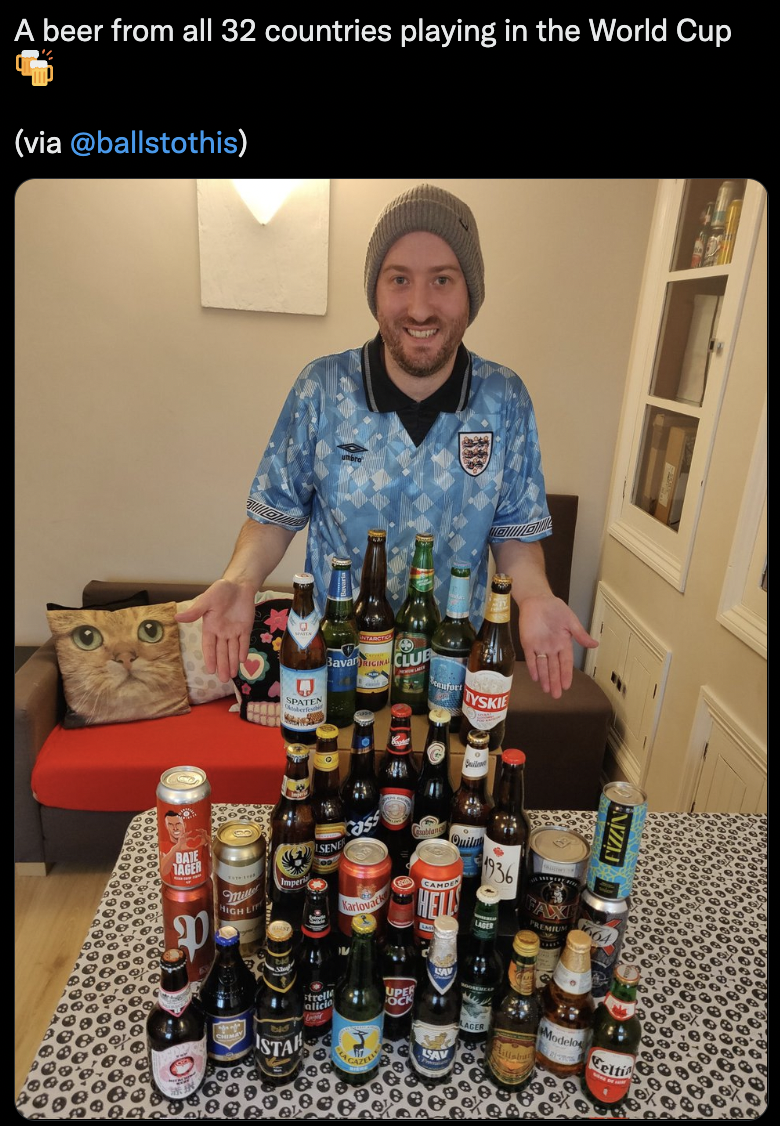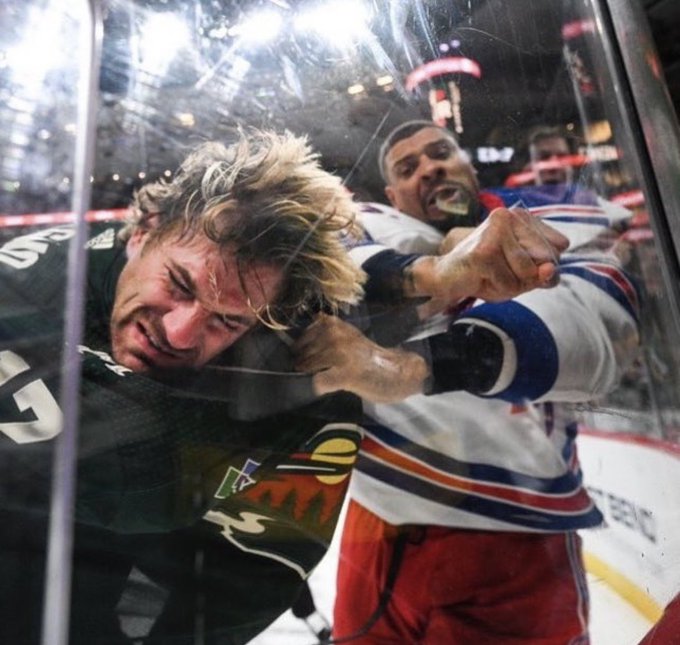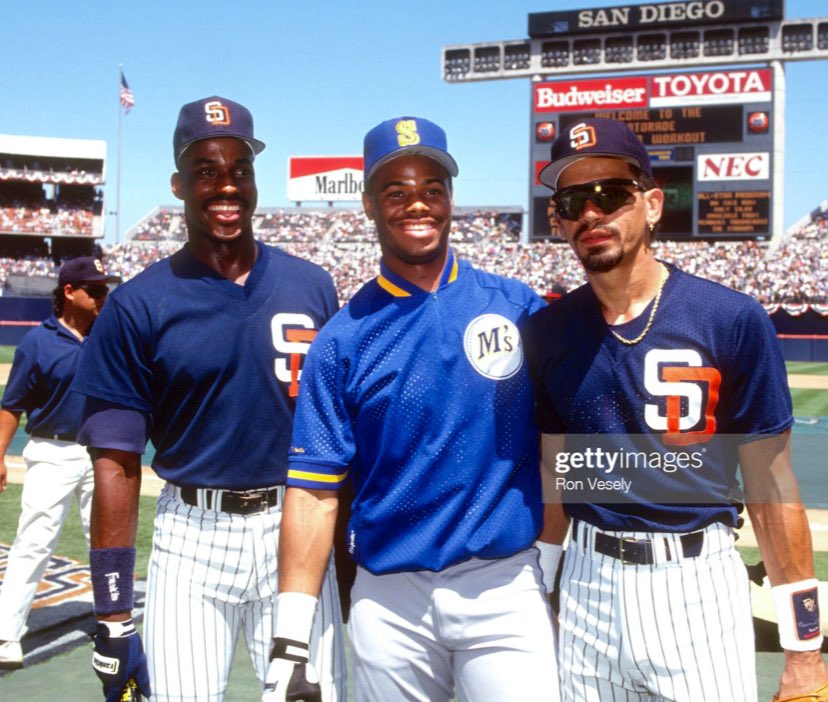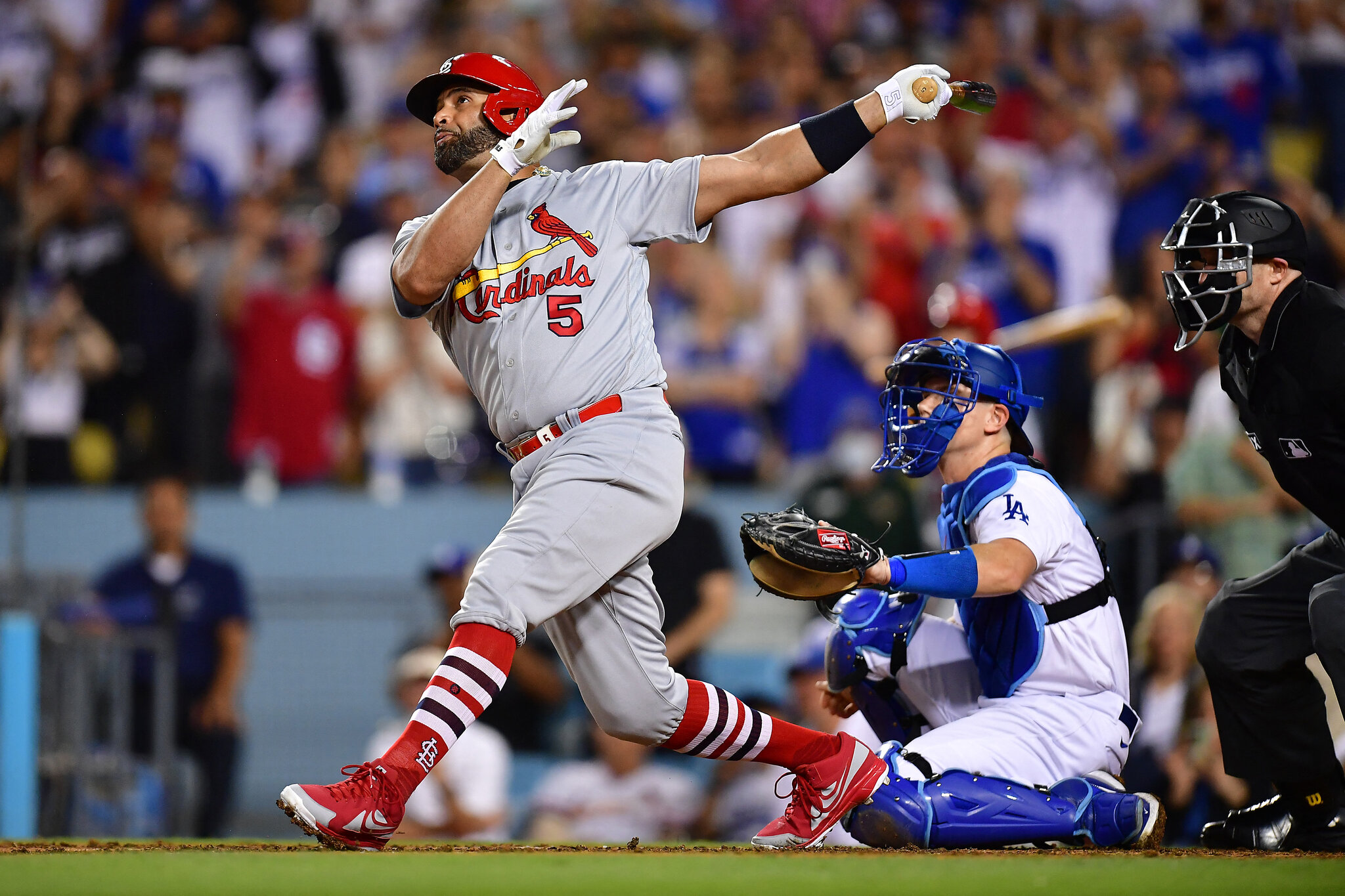
Week of August 18, 2023

We’re back.


A Dark Day in College Sports

Two weeks ago, the Pac-12, which has been in existence since 1915, fell apart. A quick recap:

  • UCLA and USC announced last year that 2023 would be their last season. They did so because they would be paid a LOT more money. 
  • The conference opened its TV contract negotiations a year early, and spent the next 13 months trying to negotiate a deal that would at least beat the Big-12 in annual payout per school.
  • The conference kept telling people a deal was coming soon.
  • Finally, a deal was ready to be signed. An exclusive deal with Apple TV with a base of around $25M per school with significant incentives for people signing up for the Pac-12 package. 
  • The night before the deal was to be signed, Oregon and Washington were invited to the Big-10. They accepted.
  • Arizona immediately left to the Big-12. Utah and Arizona State followed.
  • Only Cal, Stanford, Washington State, and Oregon State remain.

Man, I really don’t want to write about this. It sucks and I am pissed. So I’ll start with something I read from Rodger Sherman, of the Ringer:

Evolution turns everything into crabs. For whatever reason, a handful of unrelated crustacean species all wound up looking exactly the same, because flat and pinchy is apparently the optimal body structure for survival. The same has happened with North American pro sports even though every league was founded under entirely different circumstances, in different regions of the country, across different eras with different business models. The NFL was founded in midsize Rust Belt cities with hopes of leeching off the massive popularity of college football; the American and National Leagues used to be competitors, with their own commissioners and rules; the Stanley Cup was originally given out to amateur Canadian clubs who had to challenge one another for the title. Now these leagues are essentially all the same with 30 to 32 teams, spread across the continent, playing in most of the same cities. Same with the NBA, and MLS, all having evolved into the same pro sports crab.

Next up is college football, a sport built on the strength of regional rivalries which is now rapidly evolving into a national sport with just a few massive coast-to-coast conferences. Unfortunately, the Pac-12 will not be one of the lucky crustaceans. The 108-year-old regional league is doomed to die after losing most of its marquee members to the formerly Midwestern Big Ten now up to 18 teams, spread coast-to-coast.

Conference realignment is not new. Teams have been switching leagues for decades. But this latest round is exceptionally bleak. Historically, the most important thing about college athletic conferences was their geography. Part of this was about convenience: It’s easier to schedule games against the team down the road. But it also fostered the environment that made college sports special. It’s about road-tripping to watch your squad play and having neighbors or coworkers or in-laws who root for That Other Team in your state and will spend 364 days telling you about it if your team loses that one rivalry game every year.

Pro sports, on the other hand, are inherently national, not regional. It is rare for cities to have two teams in the same league. A crosstown rivalry is nice, and might even be feasible in metropoles like New York or Los Angeles. But everywhere else, it’s a bad strategy. Why split one city’s fans between two teams when you could spread out into new territories? Although there are geographic rivalries in pro sports, they’re less personal. A Yankees fan in New York doesn’t have to see Red Sox fans most days. It’s a hate you bust out a few times a year, instead of the simmering hate that powers college athletics.

The Pac-12 was a regional league. It was named after a region, and basically every team in the league had a clear and obvious rival. USC and UCLA played in the most aesthetically pleasing game of the year, red-and-gold against powder blue in the Rose Bowl or the Coliseum. Stanford and Cal played in the Big Game, a contest matching up some of the greatest, and nerdiest, players in football history. Oregon and Oregon State played for the perfect Platypus Trophy half-Duck, half-Beaver, get it? The Apple Cup between Washington and Wazzu always seemed drunk, and Arizona and Arizona State waged football war in the desert.

The Oregon-Washington move to the Big Ten permanently kills two of those iconic rivalriesOregon and Washington are leaving behind their natural rivalsand relegates Cal-Stanford to third-tier status in a left-behind league. It follows a trend, as by joining the SEC, Oklahoma is leaving Oklahoma State behind in the Big 12, killing off a game so chaotic it earned the nickname “Bedlam.”

In doing so, these teams that are leaving for bigger leagues or more TV money are permanently winning their rivalries, officially announcing themselves as bigger and better than the teams they share a state with. They will crowd out their ex-rivals, soaking up resources and talent and fans. Their pockets will be richer and their experience will be poorer: Instead of bragging about beating their rivals from down the road, they will play schools from the other side of the country and have nobody to talk to about it.

People bemoaning the modern state of college athletics (including many of the people who actively run universities, conferences, or the NCAA) have repeatedly harped on the growing professionalization of college athletics and when they say this, they’re talking about how college athletes can now switch schools with more ease through the transfer portal or receive money for appearing in commercials. But the thing about college sports which reminds me most of the pros is the way the most powerful schools and conferences have reshaped the sport. The Big Ten and the SEC are locked in a battle to become the Junior NFL, they know the form they need to take, and they are clearly putting in the steps to get there. Evolution turns everything into crabs, and it’s shaped every pro league into the same creature. The Pac-12 is one of the species that didn’t survive.

So who is to blame?

A lot of people are mad at Fox and ESPN – they control the purse strings, so they called the shots here. Fox wanted to air big games, so they poached USC and UCLA – ending 100+ years of tradition for a few marquee matchups (which they could have contracted for without pulling USC and UCLA out of the Pac-12). Then they did the same with Oregon and Washington. They don’t care about anything but their bottom line – damn all the hundreds or thousands of athletes in small sports who will now be forced to travel across the country to play a mid-week softball series, for example, in Maryland. As The Athletic’s Chris Vannini wrote:

College sports long ago hitched its entire wagon to the money train. It wasn’t any one move that led us to this realignment round, in which a second major conference is collapsing in the span of a decade. Everyone has played a domino since the Supreme Court’s landmark 1984 decision in NCAA vs. Board of Regents, which opened the door to school and conference TV deals. It was the resulting all-out drive for every last dollar that sent us down the path to end college sports as we know it (while keeping money away from the players, of course).

But college sports is about to learn, if it hasn’t already, that when you’ve sacrificed everything at the altar of money, you no longer control where things go, and you might not like where it ends. The big brands will be fine, but a lot of fans will be left behind, and this isn’t the end of it.

A lot of people are mad at Oregon and Washington for turning their backs on their conference mates at the last minute.

But for my money, the blame here is on USC and UCLA. Their decision to leave was shocking. It makes no sense on so many levels and I think it will backfire on them. Their Athletic Directors are outsiders (both USC Athletic Director Mike Bohn and UCLA’s Athletic Director Martin Jarmond did their undergrad far from the West Coast and neither had worked in the Pac-12 before their current jobs, with the minor exception of Bohn’s final year at Colorado, which was Colorado’s first in the Pac-12). Bohn and Jarmond have no care for traditions and no care for the schools’ long term health (hell, it was reported last week that Jarmond had interviewed for USC’s athletic director job). These outsiders made decisions that are not in the schools’ long term interest. Hell, it’s not even in the schools’ short term interest, other than money. It’s going to be a disaster for the current athletes and will likely kill recruiting for every sport other than football and men’s basketball. They have been played by TV execs.

Last week on KNBR, UCLA honk Brian Murphy argued in an interview with Sports Illustrated’s Pete Thamel that UCLA “had to get that money.” Thamel’s response was spot on. He asked, “Do they?” And then to paraphrase, Thamel argued that these football programs spend gobs of money – on bad coaching contracts that they then buy out and have to keep paying, on opulent facilities, on who knows what else, and then argue that they have to get more money to keep spending, traditions be damned. 

Fuck USC and UCLA forever. -TOB

Source: The Imminent Death of the Pac-12 Marks the Point of No Return for College Sports,” Rodger Sherman, The Ringer (08/04/2023); College Sports May Not Like What Lies at the End of the Path Paved with TV Money,” Chris Vannini, The Athletic (08/07/2023)

PAL: The crustacean analogy is absolutely perfect. First off, I’ve never considered the evolution of crustaceans. The idea that all leagues are morphing into the same thing makes sense in the way that people in charge can justify inside impressive boardrooms, but it’s just so boring. The homogeny of sports is making it all only kinda matter to me, a person who’s devoured sports most of my life. I’m a sports nut writing about sports to handful of friends. If I lose interest, then who’s left, and for how long? Those TV contracts are a reflection of ad buy and subscription projections, and those are based on fan interest. I don’t think bigger leagues will equal more interest; I think it will dilute the interest of fanbases from the majority of programs that won’t compete for championships.


What’s Next for Cal and Stanford

So what’s next for Cal (and Stanford, OSU, Wazzu)? No one knows for sure. Many fans hope the Big-10 invites the Bay Area schools (or all 4 of the unconferenced schools) to form a “west coast pod” – gee, imagine that: a conference comprised of schools on the Pacific Coast. What a novel idea. There are also rumors that the ACC is considering adding Cal and Stanford, which is worse for travel than even the Big Ten. Others have suggested a merger with the MWC, which I think will kill my interest – I am not excited to go see Cal play Colorado State or Air Force every week, ya know? And there’s a non-zero chance that Cal football just dies, which was previously unthinkable.

The Mercury-News’ Jon Wilner argues the Big-10 makes the most sense, and it’s hard to argue:

Membership in the Big Ten makes far more sense for Cal and Stanford — and for USC, UCLA, Oregon and Washington.

A six-team western division would create a heavy load of regional conference games, limiting the number of cross-country trips for athletes in the Olympic sports. It would reduce West Coast travel for the Big Ten’s 14 current members, as well.

The additions of Stanford and Cal would create first-rate academic alignment, always a consideration for university presidents, and provide the Big Ten with access to the Bay Area tech scene and its immense alumni base in the region.

The prospect of Stanford and Cal ever joining the Big Ten made zero sense until last summer. Now, it makes too much sense.

But only one vote matters: Will Fox, the Big Ten’s media overlord — and the puppet master behind the USC, UCLA, Oregon and Washington moves — agree to pay for it?

Big Ten schools won’t approve any expansion that depletes their media revenue stream. Fox would need to front the cash earmarked for Stanford and Cal.

How much?

USC, UCLA and the 14 continuing Big Ten members are expected to receive an average of $65 million annually (approximately) from the conference’s broadcast contract.

Washington and Oregon agreed to enter the conference at reduced shares and will receive about $32.5 million per year. That’s more than $350 million for the Pacific Northwest powers over the term of the Big Ten’s media contract cycle.

For Stanford and Cal, entry into the Big Ten would carry greatly reduced revenue shares — perhaps as low as 25 percent for the bulk of the contract term.

But does Fox see enough value in the Stanford and Cal football brands, and in the Bay Area media market, to muster another $200 million (or more)?

The second hurdle is equally daunting: What happens when the Big Ten’s broadcast contract expires in 2030? We’re deeply skeptical that Ohio State, Michigan and Penn State would approve splitting that windfall equally with the Bay Area duo.

Would the Cardinal and Bears agree now to take reduced revenue shares deep into the 2030s?

If that’s their only path into the Big Ten and the ACC door is closed, there’s no decision to make. They sign on the bottom line, breathe a deep sigh of relief and start booking flights to Bloomington and Iowa City.

Cal and Stanford find themselves in a bad pickle: take, as Wilner suggests, as low as 25% of what their opponents are getting, or perish. Is it better to compete with your arms tied behind your back or not at all? I don’t know. This sucks.

What I don’t understand is why Cal and Stanford aren’t more sought after. Stanford was a Top-10 team for a decade. Cal was a Top-15ish team for almost a decade before that. In recent years, Cal has swept home-and-homes with Texas, Ole Miss, and North Carolina. They haven’t won the Pac-12 in more than a decade, but they currently have 3 players in the NFL’s Top 100 list and have put a roster of big names into the NFL over the last twenty years, including Rodgers, Marshawn, and DeSean. They’re in a big market.  When Cal was good, Memorial Stadium was packed and rocking. 

Fox would rather pay Rutgers? Indiana? Illinois? C’mon.

The upside is that the rumors are that by the time you read this, and after some hesitancy, the ACC may have already voted to add Cal and Stanford. At first, I was opposed to this. As noted, the travel demands will be bad. But as a fan? It’s pretty exciting. The idea of Duke and North Carolina playing basketball at Haas Pavilion each year is enough to make me want to get season tickets again. The same goes for football, with teams like FSU and Clemson coming every other year.  

Still. Fuck USC and UCLA forever. -TOB

Source: Desperate for Homes after the Pac-12 Implosion, Stanford and Cal Scramble for Invitations From ACC, Big Ten,” Jon Wilner, San Jose Mercury News (08/08/2023)


MLB Players and Their Autographs

This week, The Athletic ran a fun, breezy story about MLB players and how they develop their signatures. They had quite a few anecdotes, and it’s worth your time. But I particularly loved this story about Harmon Killebrew, as relayed by Torii Hunter:

When he was still just a rookie, Mike Trout was signing autographs down the foul line in another ballpark or along the fenceline at spring training. Torii Hunter, the Gold Glove outfielder in the latter stages of his career with the Angels, walked by more than once.

“Hey man,” Hunter said. “You better take your time.”

It was a message Trout had never really considered before. Beyond his on-field accomplishments, Trout is also known for signing legions of autographs, and sometimes the best way to sign for everybody is to sign your name quickly. Many young players learn that the second they get a massive stack of trading cards put in front of them.

“When you sign a Topps deal, or whatever deal you sign, they put 1,500 cards in front of you, 2,000 cards in front of you,” Trout said. “Over time your signature gets a little short.”

Hunter, though, was telling Trout to slow down for a reason.

“I was always like, ‘Trout, you can do better than that!” Hunter said.

As much as baseball has changed, some lessons are still passed down between generations. Hunter was a young, little-known player with the Twins when he was signing autographs for a line of fans during a winter caravan event in Detroit Lakes, Minnesota. Twins legend Harmon Killebrew glanced over and noticed how Hunter was signing his name: basically a T and a line, then an H and some scribbles.

Killebrew stopped the line of autograph seekers. He leaned close to Hunter’s ear. Let me tell you a story.

Imagine it’s 100 years from now, Killebrew told Hunter. A kid hits a ball out in the trees, and a group of children goes looking for it. They don’t find it, but they do find another one. They notice it is signed with scribbles. They shrug their shoulders, pick up the ball and keep playing.

“Now,” Hunter remembers Killebrew saying, “let me rewind that.”

The kids pick up the ball. They see it is clearly signed with a name. T-O-R-I-I H-U-N-T-E-R. Interested, they look up the name, learn this guy Torii Hunter had a long and successful career.

“Then they put it over the fireplace, on the mantle, and they say, ‘Hey, This guy was good,’ and they cherish it,” Hunter said.

You can be one of those two, Killebrew told him. You choose.

“I was like, ‘Oh man,’” Hunter said. “It made sense to me.”

That’s a great story, and a good lesson for all of us. -TOB

Source: Different Strokes: How Modern MLB Players Develop Their Autographs,” Cody Stavenhagen (08/08/2023)

PAL: Good times: practicing my signature in notebooks in preparation for signing baseballs. Really put some thought to the overall shape of the signature and how it would present on a pearl. Swooping “P,” matched by the big, swirling capital cursive “L,” punctuated with that flourish of “g”…I had locked. I’m sure you, too.


Videos of the Week


Tweets of the Week


Song of the Week


Like what you’ve read? Follow us for weekly updates:

Email: 123sportslist@gmail.com

Twitter: @123sportsdigest

Facebook


We passed a gas station every 10 yards for 1000 miles, but when you really need one, you end up walking your ass off! This is no way to run a desert!

Clark Griswold
Week of January 27, 2023


Grown-ups Win in the NBA

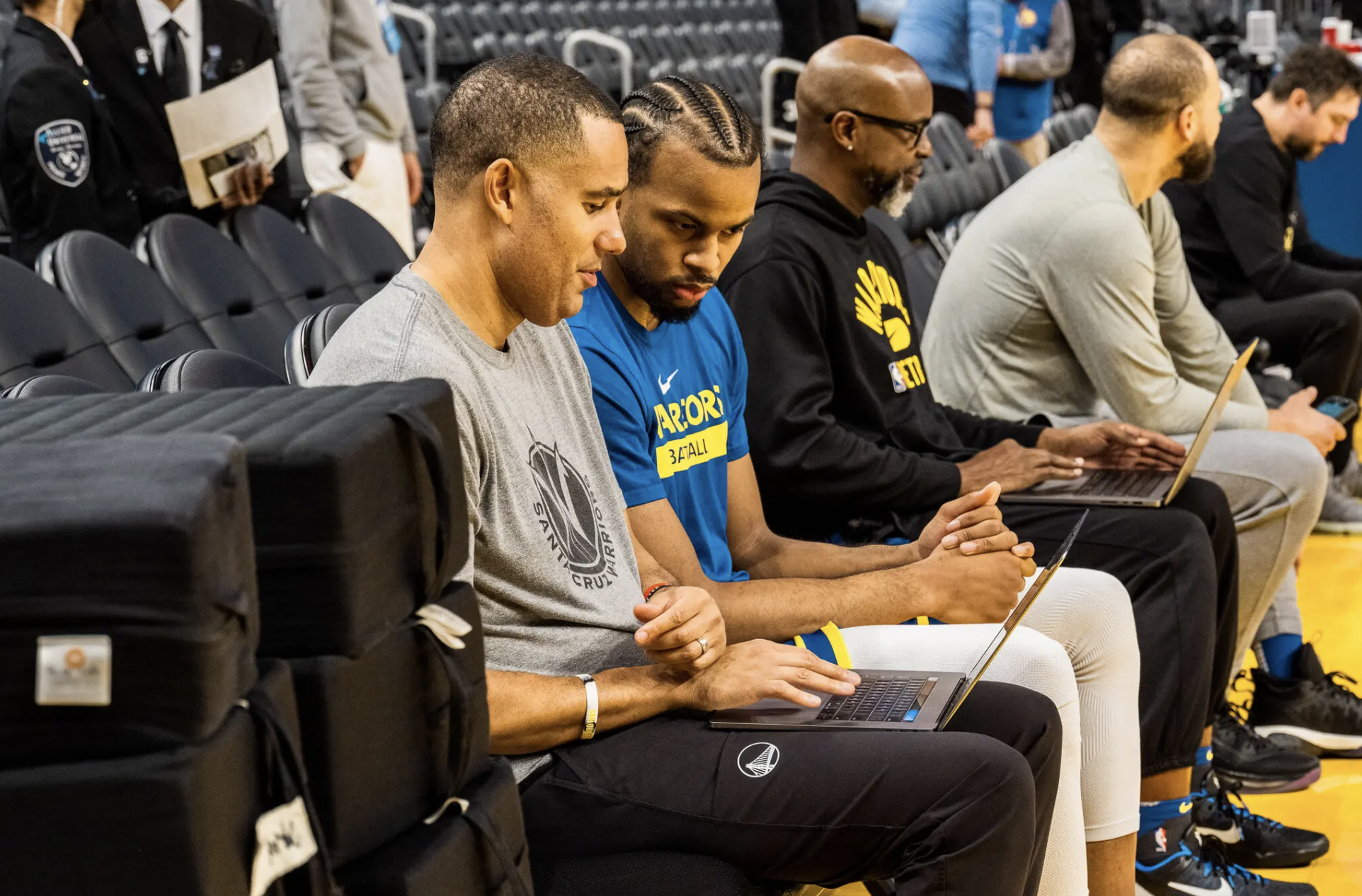
The Warriors have a team led by veterans who’ve won NBA titles – Curry, Draymond, Klay, Iguadala – and a handful of talented young players. Really young players. James Wiseman (21, second overall draft pick), Jonathan Kuminga (20, seventh overall draft pick), and Moses Moody (20, 14th overall draft pick). This story is about the challenge of developing young players while still in the window of the established players leading the team to another championship. 

From the young guys’ perspective, the challenge is being a team player while also resisting the urge to get comfortable as a role player. As Moody puts it, per Scott Cacciola:

“It’s hard to keep the right head space. But I also don’t want to hide those emotions from myself, saying that I’m OK with staying on the bench. I don’t want to be OK with it because I’m not OK with it. I want to play. I always want to play.”

While the young guys have the priceless opportunity to be a part of an organization that wins, and have the incredible resources to develop, there’s nothing that takes the place of NBA minutes, and those are limited on a team trying to make another run. 

This anecdote from Steve Kerr was pretty fascinating, especially considering the respective ages of Moody, Kuminga, and Wiseman. The team was in New Orleans and Kerr rested a bunch of the older guys, which freed up minutes for the young dudes. The Warriors lost by 45. After the game, Kerr had dinner with Curry and Green. He asked them how long they had been in the league before they felt comfortable winning games in the NBA. 

“Draymond said it was his third year, and Steph said it was his fourth year,” Kerr recalled. “And you’re talking about two guys who had a lot of college experience, who played deep into the N.C.A.A. tournament and played games that mattered.”

Kerr crunched the numbers. Curry spent three seasons at Davidson, while Green played four seasons at Michigan State. So, from the time they left high school, it took both about seven years before they understood the ins and outs of the N.B.A., seven years before they were experienced enough to win when it mattered.

Moody played one season of college basketball. Wiseman played three games at Memphis, and Kuminga played zero college ball. The paths to the NBA are more varied now, but staying there takes further development and experience. Easier said than done on a winning team. Kids don’t win very often in the NBA. 

So what’s the solution? The only reason Jordan Poole was able to develop for the Warriors and get a season of real NBA minutes was because Klay and Steph were hurt Poole’s rookie year, allowing him the leash to learn and make mistakes on a team going nowhere (just for that year). Barring more injuries to the championship core, Moody, Wiseman, and Kuminga are going to get minutes by earning them. Plus, the Warriors might need to make a trade to get some more momentum going in a season that’s seen them sputter in a totally getable Western Conference. Wiseman, Moody, and Kuminga – at least some combo of them – would be in any trade for a vet. It’s damn near impossible to develop and win at the same time.

Solid read. -PAL


Source: “In the Shadow of Superstars, Golden State’s Young Players Try to Bloom,” Scott Cacciola, The New York Times (01/19/2023)


California Moving Toward Paying College Athletes

Last week, California Assemblymember Chris Holden introduced a bill that sent quiet shockwaves through college athletics. The bill, if passed, would require California universities, private and public, to pay 50% of team revenue to its players in each sport that brings in twice as much revenue as it spends on athletic scholarships. Folks, college sports fans are freaking out. But I think they are wrong to do so.

In 2018 or 2019, when California first began moving toward legislation to allow for NIL payments to college athletes, a lot of people said it wouldn’t work. People said the California legislature would kill college sports in California because the NCAA would declare players ineligible. We saw the same arguments we are seeing today; essentially, the legislature is stupid. I disagreed, arguing that California passing a law like this would do the opposite – it would push other states to follow suit and the NCAA would be forced to change its rule. Ultimately, I was correct.

As for this bill, keep in mind it was just introduced. We have no idea what it will look like if and when it passes. More importantly, a similar bill was introduced last year and failed. People should keep those two thoughts in mind before getting worked up.

That said, I think a very interesting discussion could be had about this bill. Fans are instead declaring that it won’t work, or can’t work, or would kill college football.

Why can’t it work, though?

First, reading the bill and not tweets or even media reports about it are important. For example, it’s not exactly 50% of “revenue” as being reported. It’s 50% of revenue after subtracting the team’s “aggregate athletic grants.” That is, the amount it spends on scholarships (I said above that there could be changes. I could very easily see the “revenue” figure being further reduced by subtracting out other costs in future revisions; e.g., student meals ($895,932 in FY 2021) and medical expenses and insurance ($230,958 in FY 2021), cost of housing, etc.).

Using Cal’s FY 2021 financials, this works out to $115,575 per year, per football player*. $25,000 of that $115,575 per year would be paid to the player each year. The remainder would be put into a fund to be paid to the player upon graduation. That’s $90,575.29 per player, per year. Over a 4-year playing career, that is $362,301.15. At $115,575 per player per year, Cal would be spending $9,823,899.50 on its 85 scholarship football players.

So where would the money come from? I have one idea. Cal spent $8,860,768 in football coaching salaries and a further $1,964,425 on support football staff/admin compensation. Combined, Cal spends 55% of its football revenue (after subtracting scholarships) on football coaching and staff/admin salaries. Does that seem fair? It doesn’t to me. Coaches get 55% of revenue and players get zero? And that doesn’t include all the AD bloat, too. In FY 2021, Cal paid $19,667,444 to “non-program specific” support/admin. Does that seem fair? It doesn’t to me. Texas A&M has guaranteed Jimbo Fisher almost $100 million dollars, even if he’s rired, while his players get zero. Does that seem fair? It doesn’t to me.

Keep in mind: 50% of revenue, or close to it, is shared to players in the NBA (49-51%), NFL (48.5%), and MLB (48.5-51.5%). So, why would this be impossible in college football or college basketball?

To all those claiming this would kill the non-revenue sports…I don’t agree. To those claiming it will mean schools will de-emphasize revenue sports…I don’t agree. To those claiming the funds aren’t there…I don’t agree. The answer to the question of where this money can come from is pretty obvious, and it’s not by killing non-revenue sports. It’s from coaching and admin salaries. The money is there – it’s just going to the wrong place.

The coaching salary arms race has gotten completely out of control. Some coordinators now get paid over two million dollars per year. Position coaches now routinely make over one million per year. Contrary to those who claim the drafter of this bill is an idiot, it should be noted that he played basketball at San Diego state. I think he knows exactly what he’s doing. Just like in 2018, I think this is a bill designed to effectuate widespread change. I think it will lead to team’s necessarily reducing coaching salaries and likely will lead to player unionization and a collective bargaining agreement. I could easily see the NCAA codifying these same provisions, or something similar. The coaching arms race will stop and I think college football will be better off because of it.

That being said, I doubt this bill passes. But as I said at the outset, I think it sparks an interesting and much-needed conversation. The current model is not sustainable or fair. I think it’s good that the California legislature is discussing ways to fix it. -TOB

*Here’s the math:

Cal FY 2021 Football Revenue: $23,335,758.00
Cal FY 2021 Football Scholarship Cost: $3,687,959.00
Difference: $19,647,799.00
Divided in Half: $9,823,899.50
Divided by 85 Scholarship Players: $115,575.29

Source: California Could Lead Another Charge in College Athlete Pay with its Latest Proposed Bill,” Dan Wetzel, Yahoo! Sports (01/19/2023)


The Baseball Hall of Fame No Longer Sparks Joy, Which Sucks

Every winter, baseball fans prepare to hear who the Baseball Writers Association of America (BBWAA) has elected to the National Baseball Hall of Fame. When I was a kid, I would get very excited for that day – most of the players were before my time, but I enjoyed learning about them. Most years, the writers elected two to three players and everyone had fun. Here’s a list of players elected by the BWBWAA from 1990-2005:

1989: Johnny Bench, Carl Yastrzemski
1990: Joe Morgan, Jim Palmer
1991: Rod Carew, Fergie Jenkins, Gaylord Perry
1992: Rollie Fingers, Tom Seaver
1993: Reggie Jackson
1994: Steve Carlton
1995: Mike Schmidt
1997: Phil Niekro
1998: Don Sutton
1999: George Brett, Nolan Ryan, Robin Yount
2000: Carlton Fisk,Tony Perez
2001: Kirby Puckett, Dave Winfield
2002: Ozzie Smith
2003: Gary Carter, Eddie Murray
2004: Dennis Eckersley, Paul Molitor
2005: Wade Boggs, Ryne Sandberg
2006: Bruce Sutter
2007: Tony Gwynn, Cal Ripken Jr.
2008: Rich Gossage
2009: Rickey Henderson

Some of those names are huge, sure-thing Hall of Famers that made it in the first year or two of their eligibility. Others were more borderline and made it in on later ballots. But those debates were fun: Are Bruce Sutter and Goose Gossage Hall of Famers? If not, how can a reliever be a Hall of Famer? What about Harold Baines and the DH? What does it mean to be a Hall of Famer?

But 2009 or so is about the cut-off of when the Hall of Fame debates went from fun to good-lord-stab-me-in-the-eye. I won’t rehash the Steroid/Hall of Fame debate for like the tenth time in this website’s nearly-nine-years of existence (my position is well known). But I will say that the debate around the Hall has gone from fun to awful. I see these debates all the time, some steroid-related, others not.

For example, how can writers keep out some obvious HOF candidate players (most notoriously Bonds and Clemens) because they are suspected of steroid use, but vote for guys who failed steroid tests (David Ortiz)? Wherever you stand on the steroid/HOF debate, anyone being honest should agree that this was dumb.

And there’s the very-much related debate: how much does personality play into voting (Bonds and Clemens were not well-liked by the media, but David Ortiz was)? For example, Jeff Kent just failed to make the Hall of Fame in his final year on the ballot. He got only 46.5% of the vote, well shy of the 75% needed.

Kent is arguably a top three best hitting second baseman of all-time: most career home runs (by a wide margin), most career extra base hits, second in career SLG, third in career OPS, fifth in career WRC+. He even won an MVP. If a former MVP, top three all-time hitting second baseman can’t get to the Hall, how can any second baseman?

In contrast to Kent, the writers this year elected Scott Rolen. Rolen was a very good player and I am ok with him being in the HOF. But his career offensive numbers are nearly identical to Kent’s, and in most cases Kent’s were noticeably better. For example, Kent had 377 HRs to Rolen’s 317; Kent had 123 OPS+, Rolen had 122; Kent had a career batting average of .290, Rolen had .281; Kent had an .855 OPS, Rolen had the exact same. Kent had 60.1 offensive WAR, to Rolen’s 52.8.

So, if Rolen is in, why isn’t Kent? Rolen was a much better defenders than Kent – arguably the best third baseman of his generation, with eight Gold Gloves. But Gold Gloves awards are notoriously flawed and defense has rarely put someone over the top in voting – especially by such a wide margin over an otherwise equal player. Still, Rolen had 21.2 career defensive WAR, to Kent’s -0.1, although that number was a respectable 3.8 before the last four seasons of Kent’s career, from ages 37-40. Rolen retired after age 37 so didn’t have the opportunity for those numbers to tumble a bit as he got old.

So other than defense, what separates these two? How can we account for such a wide vote total spread between the two? Well, Rolen was very well liked by the media. Kent was a notorious red ass who was not well liked. In fact, the media seemed to like Barry Bonds, who they loathed, more than they liked Kent. Is that fair? I don’t think so.

Which makes the whole thing very frustrating as a fan. Too much importance is placed on the Hall of Fame, particularly by those voting. Voters are not keepers of a sacred order. They should take a hard look at who got in during the Hall’s early years and realize their standards are way too high. They need to ignore personal feelings and just pick the best players. Most of all, they need to lighten up and make this fun again. Please. I will lose my mind if Buster Posey doesn’t get into the HOF on the first or second ballot and I really don’t want to lose my mind. Please. -TOB


Golf Round-Up

There were two amusing stories in golf this week, neither of which struck me as needing a full write-up, but both of which made me laugh very hard. First, the funniest one involving Donald Effin Trump.

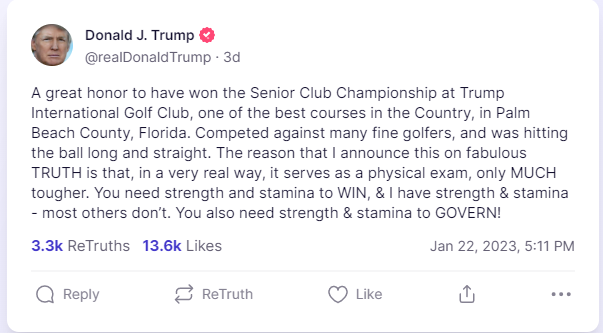
Trump hosted a Senior Club Championship at Trump International Golf Club in Palm Beach last week. It was a two day tournament – Saturday and Sunday. Trump missed the tournament Saturday, as he was attending a funeral. But Trump refused to be left out:

Trump told tournament organizers he played a strong round on the course Thursday, two days before the tournament started, and decided that would count as his Saturday score for the club championship. That score was five points better than any competitor posted during Saturday’s first round.”

LOLLLLLLLLLLLLLLLLLLLLLLLLLLLLLLLLLLLLLLLLLLLLLLLLLLLLLLLLLLLLLL. “No problem,” said the guy who tried to execute a coup and declare himself President. “After all, I played a practice round on Thursday that no one saw and I played really well, so I’ll just use that *finger quotes* score.” He then said this:

Just imagining some MAGA idiot refreshing his Truth Social feed, reading that, and getting fired up for Trump is so funny.

The second story is also funny but a little more complicated. All you need to know is that last year, pro golfer Patrick Reed joined the Saudi-backed LIV Tour, along with a lot of other golfers. Reed later filed suit against the Golf Channel, alleging defamation. Apparently, Reed (through his attorneys) served fellow golfer Rory McIlroy with a deposition subpoena. This is pretty standard, but Reed’s subpoena was hand-delivered to Rory on Christmas Eve, at Rory’s house, as he celebrated with his family.

As a lawyer, I can see why this would be annoying. It may also not have been Reed’s fault, or even his attorneys. Generally you send your documents to a process server and tell them you want them to serve it. At that point they usually have carte blanche to serve it any way they can. Sometimes, the person they are looking to serve isn’t home the first time they arrive and they have to come back. But not everyone knows all this and assumes it was done strategically (which is possible). Rory particularly seems to have taken offense.

This week, Reed approached Rory at the driving range and appeared to try to be friendly. Real fugazi stuff. Rory wasn’t having it and ignored him. And then Reed showed his true colors, gently tossing a tee in Rory’s general direction:

So stupid and childish. Not harmful, just dumb. It’s perfectly Patrick Reed. -TOB


Netflix’s Break Point Has Me Appreciating Roger, Rafa, and Novak Even More

Last year, I wrote about Roger Federer’s tennis retirement:

I’m not a tennis fan, really. I like tennis a lot. I enjoy it. I follow it via ESPN and news articles. But I rarely ever sit down and watch a tennis match. But when I do, it sure is a great sport. Relatedly, Roger Federer is the only tennis player I ever really loved. He’s the only guy that I ever set an early morning alarm for (it happened three times, but still).

As I recall, those three matches I saw were all against Rafa Nadal. I know I’ve also seen Novak Djokovich play. But that is really the extent of the tennis I have watched, outside of a few minutes here and there, or Sportscenter highlights.

But last week Netflix released the first five episodes of Break Point. It’s like Netflix’s Drive to Survive (F1 racing) or Last Chance U (college football and basketball), or HBO’s Hard Knocks (NFL). Each of the five episodes follows 2-3 different players over the course of the early part of the 2022 season. I love those types of shows, so I watched. 

It was good! I enjoyed it. And I enjoyed getting to know the next generation of tennis players, including Taylor Fritz, Felix Auger-Aliassime, and Matteo Berrettini on men’s side, and Ons Jabeur, Paula Badosa, and Maria Sakkari on women’s side.

I finished up the first five episodes this week and then on Tuesday night I saw that the Australian Open was on. And who was playing? Matteo Berrettini! Well, hell, I had to check it out. I was rooting for Berrettini against aging former star Andy Murray. And the match was…SO FRUSTRATING. Berrettini is ranked #14 in the world. But he sure didn’t look like it! So many frustrating shots, where he had the whole court open for an easy smash, and he hit it right at Murray or missed the court completely instead. At one point Berrettini was serving for match point and had an easy shot to win. Instead, he did this:

You can see Murray move the wrong way. Berrettini had the entire court to drop in a little backhand and win the match. Instead he choked, hit it into the net, and went on to lose the match. 

The next night I watched Taylor Fritz, who is the highest ranked American male player, at #9. Fritz won three titles last year, including a win over Nadal in the finals at Indian Wells, featured on Break Point. Fritz took on unranked Alexei Popyrin, an Australian. Popyrin had the home crowd behind him, but Fritz…kinda sucked! Just like Berrettini, Fritz blew so many chances and had so many bad hits. 

I was thinking about how Fritz and Berrettini had such similar matches when it struck me: I have never sat down and watched an entire tennis match that didn’t involve Federer and either Nadal or Djokovich. What if Berrettini and Fritz didn’t suck this week? What if Roger, Rafa, and Novak had so thoroughly spoiled me that I expected too much from mere mortals like Berrettini and Fritz? That’s what I’m going with, anyhow.

So, check out Break Point if you like sports documentaries, but be prepared to be frustrated when you watch actual tennis. -TOB

PAL: It’s so easy to brush off how we’ve been (kinda, sometimes) watching the best tennis ever played for over a decade with Roger Federer, Nadal, and Djokovich. To really understand it – yeah – watch someone not named Federer, Nadal, or Djokovich. 


Video of the Week

PAL, age 33.
Oh my.
Good teammate.
LeBron really a freak of nature.

Tweet of the Week

Song of the Week


Like what you’ve read? Follow us for weekly updates:

Email: 123sportslist@gmail.com

Twitter: @123sportsdigest

Facebook


I don’t like to be out of my comfort zone, which is about a half an inch wide.”

-Larry David

Week of January 13, 2023


NCAA and NIL: The Wild, Wild West

If you are not a college football fan, you are likely not aware (or only vaguely aware) of what is going on in college football right now. A variety of issues, spurred in part by lawsuits in recent years, have conspired to create an absolute shitshow in college football and basketball right now.

First, the NCAA lifted its ban on an athlete’s ability to profit off their own “Name, Image, and Likeness” (“NIL”). The NCAA did this because, first California and then other states, began passing laws affirming that athletes attending colleges in those states could profit off their NIL. The NCAA, seeing which way the wind was blowing, opened up NIL in Summer 2021.

Next, the NCAA granted all athletes an extra year of eligibility due to the COVID-19 pandemic. 

Concurrently, the NCAA eliminated the one-year mandatory sit-out when a player transfers colleges. Previously, a player looking to transfer had to sit for one full school year before playing for their new team. A player can now transfer twice with no penalty – once as an undergrad and again after receiving their degree, as a grad transfer, if they still have college athletics eligibility. To do so, players enter their names into a “Transfer Portal.” Once they do, opposing coaches are free to recruit them. The portal is open for a few weeks, twice a year: from December 5 through January 18 and May 1 through May 15.

Mix these things together and you have a college sports molotov cocktail. Recruiting season generally has only involved high school, and to a lesser extent junior college, athletes. Recruiting has been the lifeblood of a program. Coaches had to recruit high school seniors who could contribute to their teams two, three, and four years down the road. There were a lot of “misses” but generally the teams that recruit the best also play the best. And once a player got to campus, transfers were pretty rare. No player wanted to sit a year.

But now, coaches don’t have to only recruit for the future of their roster. They also now have to recruit college athletes who have entered the portal. And on top of that, they have to recruit their entire roster, every single year to keep their players happy and prevent them from entering the portal. This is particularly helpful to a new coach taking over a program. For example, USC and new coach Lincoln Riley had twenty players transfer in and twenty six players transfer out. 

So how do they recruit established players from other teams and retain their own team? Enter: NIL.

Note: NIL cannot be paid directly by the school. NIL is not supposed to be “pay for play” (“P4P”), even if I think the distinction is practically non-existent. Instead, NIL has been weaponized by school through the creation of so-called “collectives.” Groups of boosters pool their money and use those funds to pay players for their NIL.

Cal football has one such collective, created in conjunction with Marshawn Lynch’s Beast Mode line. It is called California Legends Collective. There, fans can donate to the collective. Or they can donate directly to a sport. Or a position group. Or a specific player. Fans can pay even for services, like a “shout out” (think: Cameo) from a Cal athlete, or even pay for a live video chat. You can buy merchandise, too. 

The collective then takes the money and distributes it to the players. As you might imagine, bidding wars have been sparked. One of Cal’s best players, redshirt freshman J. Michael Sturdivant, a very good wide receiver, received word through back channels that his services were greatly desired by other schools. Cal reportedly made its best effort, but UCLA doubled the offer. JMike entered the portal, and a larger bidding war broke out. Ultimately he chose UCLA, for what some estimate is $500,000. For a frosh wide receiver who caught 65 passes for 755 yards last year. Again, he’s very good! But if a WR with those numbers is getting that kind of money, what are the best players getting? What did USC give Caleb Williams to get him to leave Oklahoma and join his coach, Lincoln Riley, in L.A.? Well, consider the story of Jaden Rashada.

Rashada is a 5* QB. Last fall, he was a senior at Pittsburgh High in the East Bay. He had offers from almost every program in the country. He initially committed to Miami but flipped to Florida. The estimates were that Florida offered him $8 million dollars. That’s an 8 with six zeroes after it. But that estimate is now now believed to be low. Rashada went to Florida this week, prepared to enroll in school. But he hasn’t done so. Why? The proverbial check bounced. And the reported amount of that check, per the Orlando Sentinel? THIRTEEN MILLION DOLLARS. But the collective didn’t have the money. Rashada, though, signed his National Letter of Intent, meaning that either he has to use his one free portal transfer or he has to convince Florida to release him from his letter of intent. 

I’m telling you. It’s a shitshow. So what needs to be done? 

First, the portal needs to be adjusted. A six week window over the holidays, in the middle of bowl season, makes very little sense. Shorten it to three weeks and have it start in February, finishing up before spring ball begins. 

Second, yes, he can file a lawsuit against the collective that he signed his contract with. But there needs to be recourse for a player like Rashada. If the collective signs a contract to pay a player an amount certain for going to a specific school, and the player relies on that promise in signing with the school, but then the collective reneges on the deal, the player should be able to transfer without penalty. Let’s stop pretending this isn’t pay-for-play and stop acting like the schools don’t know what’s going on and aren’t part of the deal. 

Those two changes wouldn’t be a perfect system, but it’d be a lot better than it is now. -TOB

Source: How the $13 Million Recruitment of Jaden Rashada for Florida Fell Apart,” G. Allen Taylor, The Athletic (01/13/2023)


Videos of the Week

Tweets of the Week

Song of the Week

The National – Mr. November


Like what you’ve read? Follow us for weekly updates:

Email: 123sportslist@gmail.com

Twitter: @123sportsdigest

Facebook


“Trying on pants is one of the most humiliating things a man can suffer that doesn’t involve a woman.”

-Larry David

Week of December 24

Here we go…

More ‘Screw It‘ Please

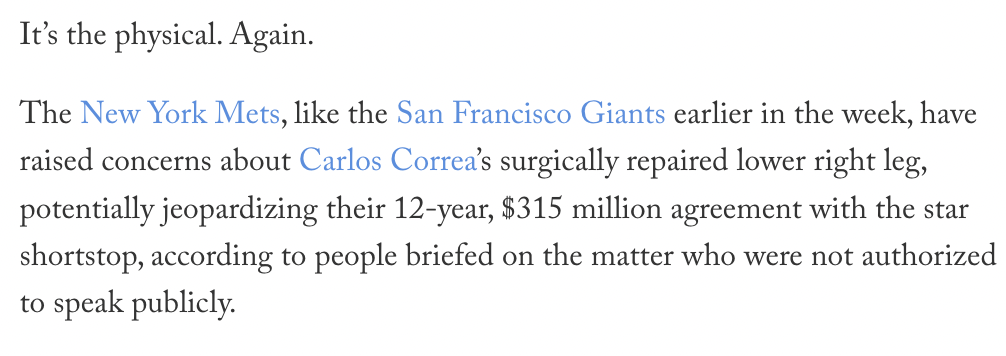
I read a lot of stories about the Giants getting cold feet about Carlos Correa and the free agent stud shortstop bolting to the Mets in a somewhat unprecedented fashion, but I think our local fav, Grant Brisbee had the best piece about it. 

First of all, and despite the group text, the Giants backing out at the 11th hour on a Scott Boras player does NOT mean the Giants will never sign a Boras-represented stud player…just ask the Mets about that. Something very similar happened recently, or – as Brisbee points out – about as similar as you’ll find to the Correa/Giants ordeal. 

The Mets had a stud represented by Boras, got nervous about the medicals very late and backed out from signing him. Granted, Kumar Rocker was a draft pick (not a free agent) who couldn’t just sign with another team – a very key difference, one that comes with compensatory picks – there are a lot of pertinent similarities. 

Per Brisbee: 

This is relevant to your interests because of the obvious connections. It’s not just a Boras client; it’s a Boras client and the Mets. And it’s not just a draft pick gone wrong; it’s an exciting player getting yanked away from the fans because of a physical. The team couldn’t really respond how it wanted to, which made for asymmetric warfare with the most talented agent in the history of the game. The fans were alienated and bitter.

It’s not a completely identical situation, but it’s as close as you can possibly get, and it happened about 16 months ago. It’s both amusing and uncanny how similar these stories are.

But it’s more relevant to your interests because the long-term effects didn’t include an inability by the Mets to work with Boras. It didn’t affect the Mets’ ability to attract future free agents. Whatever negative vibes they irradiated their fans with went away as soon as the team started winning and spending money. Agents have a short memory. Players have a short memory. And while it doesn’t feel like it right now, fans have a short memory.

I needed that, Brisbee! 

But Brisbee doesn’t let the Giants off the hook that easily. They may be taking a measured approach to major investments, but a measured approach won’t pan out with the big-time free agents. The market is set by illogical spenders. 

Makes sense in a world without irrational actors. Except that’s not the world we live in. In this world, Steve Cohen takes the X-ray of Correa’s ankle and eats it, piece by piece, before swinging away on a vine and screaming, “Let’s Go Mets!” The Giants will always lose to someone like that. And Boras isn’t going to hold their hand while they figure it out.

And later:

This is a team that needs Screw It, and it needs it in abundance. This is a $3 billion franchise that’s being run like it’s a ward of McKinsey & Company. Hey, it might mean better short-term profit margins for the ownership group, and that kind of reasonable, sensible approach is pretty safe for the owners. But that doesn’t mean it will be entertaining for the fans, and baseball happens to be an entertainment business. Bryce Harper would sure be entertaining, but there wasn’t enough Screw It to get him here.

A-effin’-men, Grant. – PAL 

Source: The Giants were willing to take a risk on Carlos Correa, until they weren’t,” Grant Brisbee, The Athletic (12/22/2022)

TOB: Phil wrote this prior to the morning of Christmas Eve. That is significant because another bomb in this story dropped just before we were set to publish:

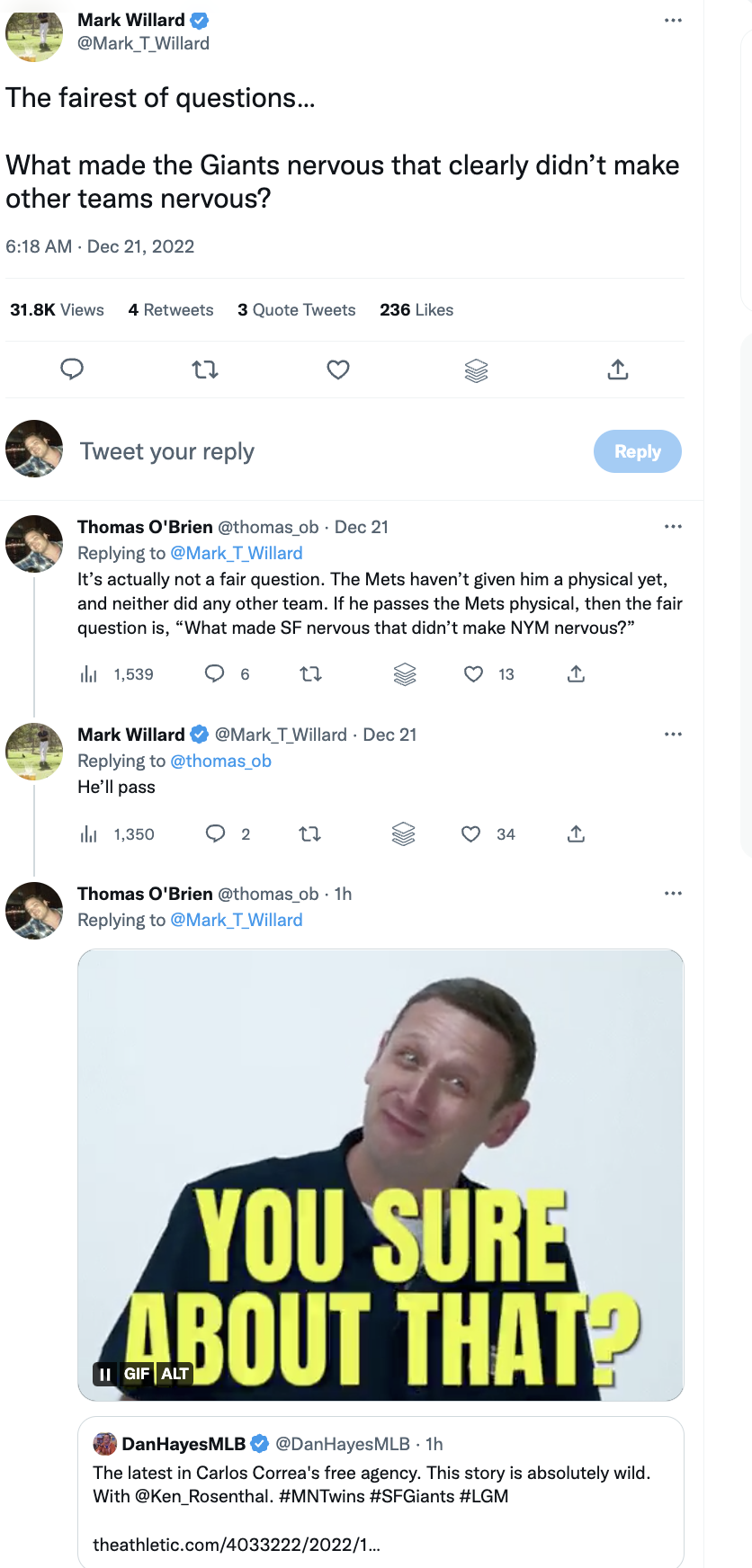
This news certainly puts the Giants’ decision in a new light, doesn’t it? I can’t exactly say I told you so, but while I was pretty upset about losing Correa, I did want to see how the Mets’ physical went. Here’s an exchange on Twitter between 95.7 The Game host Mark Willard and me. The first three are right after the Correa to Mets news broke and the last was after the Mets’ physical news broke:

I get that everyone needs to react. Everyone needs a take. And privately I was pretty angry. But publicly, before going on the record ripping a team for something like this, don’t you think someone like Willard (and so many others like him; he’s not unique in this regard) should wait until they have full information?

I also saw insane questions like this, after the Giants signed outfielder Michael Conforto to a 2 year, $36M contract (which he can opt out of after 1 year):

Like, come on. This is so stupid and reactionary. These deals aren’t remotely the same. There is very little risk in the Conforto deal. There’s a ton of risk in the Correa deal. People need to chill.


Why Sign ANYONE to a 10+ Year Contract?

I thought baseball learned its lesson about super long contracts. Do we not remember how this went for the Angels with Albert Puljos? What about Cabrera with the Tigers? The second half of those long-term deals did not go well, the franchise players did not bring with them a World Series title, and they became a milestone attraction (as in, “come see Albert Puljos chase 3,000 hits”). And yet, per ESPN, super long contracts are all the rage. What happened? 

Alden Gonzalez and Jesse Rogers do a nice job dissecting the trend. 

(1) Luxury tax is based off of the A.A.V. of player contract (average annual value), so teams can limit a contract’s impact on the books by stretching it out over a longer period of time. “The contracts for Correa, Turner and Bogaerts all rank within the top 15 all-time in total value — but none are within the top 25 in AAV.”

(2) Great players get to free agency at a younger  age. Players are eligible for free agency after 6 years of MLB service time. For a long time, that meant almost all the players entered free agency in their 30s, after rising through the minor league. That’s no longer the case. 10-year contracts aren’t as scary when the guys signing them are in their twenties. 

“The past three offseasons have seen a total of 581 players become free agents before turning 30, according to research by ESPN Stats & Information. If you go back nearly a decade, to the three-year span from 2012 to 2014, that number was only 182. The game, in essence, keeps getting younger.”

(3) The universal DH doesn’t hurt either when teams consider the back end of these contracts for position players (and only position players are signing long-term deals). 

(4) Crazy rich owners going crazy. Plus, they think they are close. That’s why the Padres, Phillies, and Mets are spending money like drunken sailors, and whether they are smart or not, that crazy sets the market price for free agents. 

As you read about these recent FA signings, whether your team got or lost guys, this is an interesting breakdown of why these  crazy long-term deals for hundreds of millions of dollars are not as scary to some teams. – PAL 

Source:The winter of the epic contract: How decade-plus MLB megadeals suddenly became a thing,” Alden Gonzalez & Jesse Rogers, ESPN (12/23/2022)


Video of the Week

Tweets of the Week

Song of the Week


Like what you’ve read? Follow us for weekly updates:

Email: 123sportslist@gmail.com

Twitter: @123sportsdigest

Facebook


Oh, the silent majesty of a winter’s morn… the clean, cool chill of the holiday air… and an asshole in his bathrobe, emptying a chemical toilet into my sewer…

Clark W. Griswold

Week of December 2, 2022


USMNT Comin’

This week, The U.S. Men’s National Team finished second in its World Cup group, advancing to the Round of 16. This was, for most observers, what was expected. Although it was by no means a guarantee, anything less would have been seen as a failure. Is this fair? I don’t know. Lots of very good teams have suffered a worse fate this World Cup (Germany chief among them). But the U.S. has advanced out of its group in 3 of the last 4 World Cups it played in, so we have come to expect it. And while this is a very young U.S. team (average age approximately 24), it’s also the most talented U.S. team ever. So they met the expectation. But what’s most exciting is how they did it.

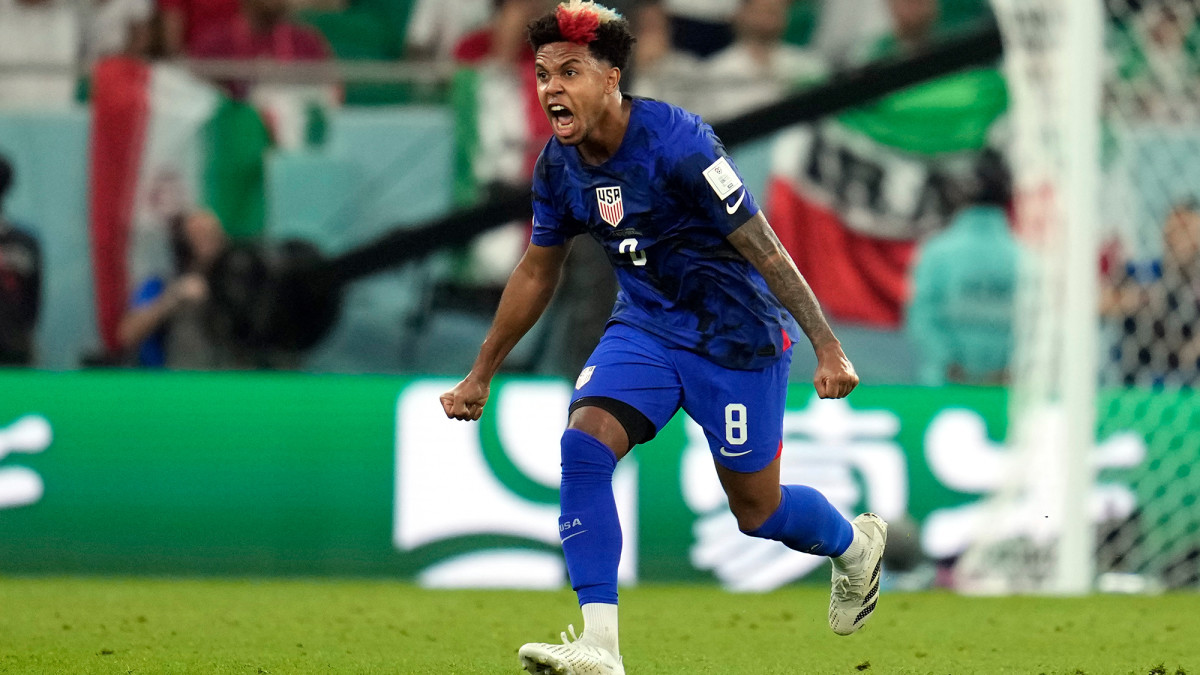
In their first game, they dominated Wales in the first half. The goal they scored was brilliant, with a great through ball from Christian Pulisic to Timothy Weah, ending in a calm and smooth finish for the 1-0 lead.

Wales was desperate in the second half, but the U.S. still largely controlled…until the U.S. committed a dumb foul in the box in stopped time, allowing Gareth Bale to bury his penalty. The U.S. had what felt like a sure victory turn into a bitter draw. 

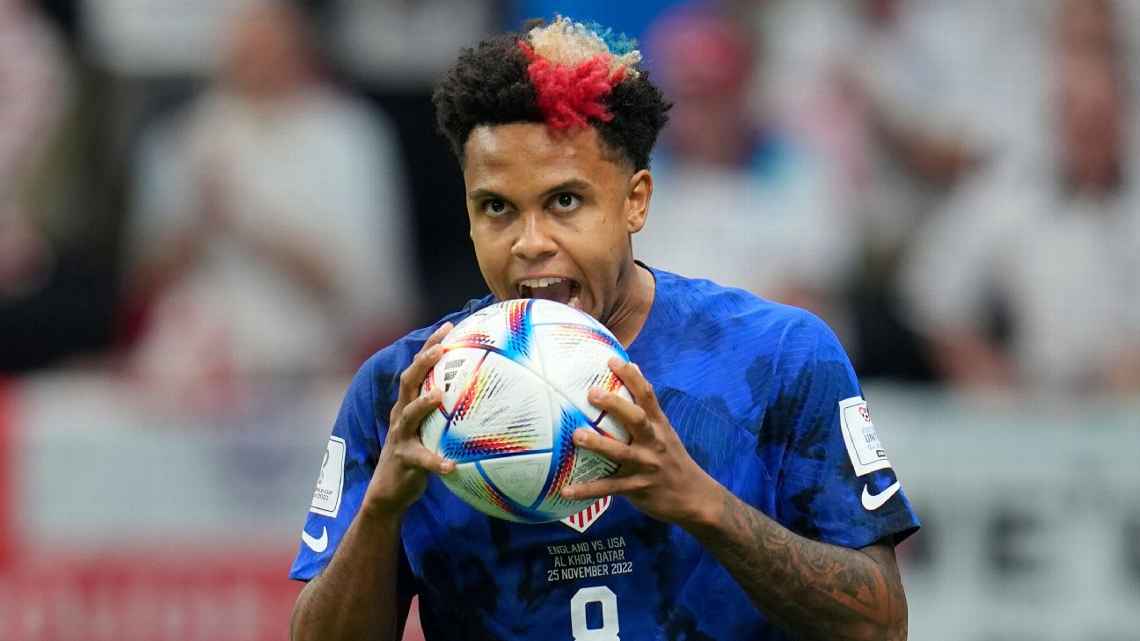
Four days later, the U.S. played England. England is considered far deeper and more talented than the U.S. But you wouldn’t have known that watching the game. The U.S. controlled the game, particularly in the midfield, with Weston McKennie, Tyler Adams, and Yunus Musah flying all over the field. Pulisic had a shot hit the crossbar and England had a couple near goals, but the game ended 0-0. This time, the draw felt like a win. Here’s what the Ringer’s Brian Phillips said to sum that game up:

I don’t care all that much that they didn’t win the game. (I do care that the U.S. remains undefeated against England at the World Cup.) I care that they played their hearts out and looked their best on the biggest possible stage. What’s the secret to happiness that particle physicists are hiding from the rest of the world? Maybe the answer lies in the nature of the particles themselves. Maybe some particles are just fun. Maybe some particles are simply a thrill to look at. Maybe one glance at these joyful particles is enough to put anyone in a happy frame of mind.

Isn’t it the same, after all, when you watch a soccer game? Sometimes you watch two evenly matched teams and one of them somehow has an extra dash of energy, flair, pizzazz, boldness. They’re not better, exactly, but they’re freer. They’re more fun. They’re carbonated water and the other team is tap. They’re a hot air balloon and the other team is a Toyota Celica. They’re Wario and the other team is Toad. These are the joyful particles, and when you watch them, you get to experience, for 90 minutes, the bone-deep happiness that particle physicists apparently feel all the time.

Did the match change anything? Well, yes and no. No, in the sense that the U.S. will, more or less as expected, have to beat Iran on Tuesday to qualify for the knockout rounds. England, meanwhile, just has to avoid a four-goal loss to Wales. I’ve been seeing reports that non-soccer fans were bored and disappointed by this game, which is understandable —it’s tough to turn on a heavily hyped sporting event the day after Thanksgiving, see a scoreless draw that doesn’t dramatically alter the larger competitive landscape, and not feel a little let down. You probably have to be a longtime fan-slash-nerd to be deep enough in the context to get it.

And if you were, then you could see that yes, the match did change something—or at least had the potential to do so. It had the potential to change the identity of this team. We’ve been an untested, inconsistent, ambiguous proposition for a long time. Now we’re a team that can hang with England at the World Cup. Maybe we lose to Iran on Tuesday and the England game turns out to be an anomaly. But maybe it’s the start of something.

The U.S. had two points, trailing England (4) and Iran (3) heading into its finale against Iran on Tuesday. The U.S. was in an unenviable position – needing a win against a team that only needed a draw. Iran could sit back on defense, crowding the box and frustrating the Americans, knowing that they didn’t need to score to advance out of the group and send the U.S. home (again). The game began much like the Wales game. Here’s Defector’s Billy Haisley:

Probably the first step to being a great team is believing you are a great team, and the U.S. came into Tuesday’s match dripping with self-belief. Once again the Americans put together an excellent first half. The U.S. played confident, domineering soccer, zipping the ball around the pitch, gashing Iran down the flanks with scything runs from fullbacks Sergiño Dest and Antonee Robinson, and all around playing like a team that knew it would win. Pressure on the Iran goal built steadily, almost inevitably, throughout the first half hour.

If the U.S. seemed energized by the prospect of achieving the victory it needed to advance to the knockout rounds, then Iran seemed nervous about losing the draw it needed to go through. The Iranians defended decently but couldn’t plug all the holes the Americans were constantly ripping into their defense from all sides. Even when they had the ball themselves, Iran hardly ventured forward in the first period of play, and they didn’t take a single shot compared to the U.S.’s nine first-half attempts on goal.

When the game started, I badly wanted an early goal. At the 11 minute mark I said to myself, “It’s early. There’s still time.” At the 25 minute mark I said, “It’s early, there’s still time.” At the 35 minute mark I began to panic internally: “We cannot be scoreless at the half I can’t take it. I can’t take Algeria 2010 again.” And then, magic:

Watch that play slowly. Pulisic begins his run before McKennie has even lofted the ball across to Dest. Then, as he sees Dest rushing onto the ball, he turns on the friggin afterburners, beats two defenders, and finishes. What a run by Pulisic. What a ball by McKennie. What a pass by Dest. 

The second half was excruciating, as Iran was desperate for a goal. Though they had a few chances that had me gasping, they never got it. The U.S. held on and advanced. 

The U.S. was the better team in all three games it played, which is something we are not used to saying. Here’s Haisley:

Rooting for a national team of the U.S.’s caliber is sort of a funny thing. The team isn’t (yet . . . ?) good enough that fans can rightly demand passage into the World Cup knockout rounds and expect a win or two there, nor is the team bad enough that any old performance at a World Cup is good enough. Where you place expectations, then, and what constitutes success or failure, isn’t always clear.

The only thing you can really ask of a team like this is progress. Markers of progress aren’t always found simply in the team’s record in big tournaments, and to accurately assess the USMNT’s status, it’s important to have a holistic view that takes into account things like the number of European-grade players the country is producing, the leagues and clubs the players play at, the roles they have there, the national team’s performances outside World Cup play, and, yes, granular things like a gorgeous technique on a shot or neat passing and pressing sequences within important, maximally competitive matches.

That’s the great thing about this USMNT. The progress of these players is right there before your eyes, in the clubs that sign them and the transfer fees they command and the in-game gestures and actions they’re capable of and even the draws and wins they earn in the World Cup. The USMNT has grown so much that it’s already manifested in the results the team gets where it matters most. American fans can trust that now, and can enjoy the ride watching how far they can take it. Because if you thought this team was good, you’ve just been proven right.

So, what’s next? The Netherlands. A big name with some very good players. But this is not the Netherlands of 2010, with Robben, Sneijder, and Van Persie. They are beatable. And this U.S. team can do it. -TOB

Source: U.S. Soccer Matched English Football on the Biggest Possible Stage,” Brian Phillips, The Ringer (11/26/2022); USA Handled the Challenge Against Iran in More Ways Than One,” Brian Phillips, The Ringer (11/29/2022); The USMNT Is What We Thought It Was,” Billy Haisley, Defector (11/29/2022)

PAL: Damn, I wish this team had a finisher up top. I think it was on the Bill Simmons pod that I heard them analyzing the team, and one of the points stuck out: having young legs in a tournament played in the desert is not a bad deal, especially against an older team like The Netherlands. I takin TOB’s angle from the Iran and applying it here – we need a first half goal, because I think we have tendency to run out of gas at that 60-70 minute mark (before the subs come in). And yes – I used “we” multiple times this response. Let’s go!


Beam Team Comin’

The Sacramento Kings have wandered through the desert for most of their existence. The team arrived in Sactown in 1985-86 and made the playoffs just twice in its first 13 seasons, losing in the first round both times. There was then an 8 season Renaissance of sorts, with the team peaking from about 2001-2004, where they finished 3rd, 1st, 2nd, and 4th in the Western Conference, the apex being the 2002 season, where they were robbed of an NBA title by crooked officiating.

Since the 2006 season, though, it’s been all desert. 16 seasons. Zero playoff appearances. Only twice in those sixteen seasons did they even finish 10th in the Western Conference. They’ve had terrible owners, terrible management, and twelve mostly terrible head coaches (12 in 16 seasons!). They’ve had a few good players, but not enough to make the team competitive or even entertaining.

Last year, the team was kinda fun, with point guards DeAaron Fox and Tyrese Haliburton leading the way. But the team still stunk and Fox and Haliburton, as good as they were, didn’t seem to mesh. The team made a deadline deal sending Haliburton and Buddy Hield to Indiana for Domantas Sabonis. I was PISSED. Haliburton was looking and continues to look like a superstar.

But something funny has happened over the last month of this early season. Everything is clicking in Sacramento. After an 0-4 start, the Kings righted the ship and then reeled off a 7-game win streak. It was their longest since 2004. And they didn’t just beat up on cream puffs. Victims included the Lakers, Nets, Spurs, Grizzlies and oh yeah – the Warriors. They put up 153 (!!) on Brooklyn. 

And it wasn’t just the wins. The team was fun. They still aren’t defending a ton, though they’re better than last season. But the offense is electric. Fox and Sabonis are unleashed. Kevin Huerter, Malik Monk, and Terrence Davis are bombing 3s. By the end of their streak, their offense for the season was the most efficient in the entire NBA, and in fact the most efficient ever. 

Kings fans, who have been wandering the desert in search of a cup of water for 16 years suddenly felt as though they’d been dropped into a 5-star hotel’s pool. Text messages among my friends are flying back and forth nightly. We friggin deserve this and we’re enjoying every minute. The fans are bananas.

I mean, look at the crowd in this sequence from Wednesday night’s game. They are going off:

Perhaps the best part of it all is The Beam. After every Kings win, a purple beam from atop the Golden1 Center is ignited and it is friggin sick. 

And look at this fan’s Christmas Tree:

I WANT THAT.

My buddy Murph lives about 4-5 miles away from the arena and can see the beam from his house. It’s the coolest thing. Check Kings Twitter after a win and you will see the beam memes out in force. It’s cool as hell and it’s really fun again to be a Kings fan, which is hella tight. -TOB


Assessing a World Cup

I had to write about this article separate from my other USMNT story, because it didn’t really fit into it as a narrative. But I really enjoyed the article and in particular this passage about how thin the margins for error are in a World Cup and why those razor-thin margins make it difficult to assess a World Cup performance:

The trouble with assessing a World Cup campaign, whether in real time or in hindsight, is that four years of work boil down to the smallest margins: a bounce here, a runner not tracked there, a foul not spotted, a sprint started a fraction too early or too late, a ball that does or doesn’t cross the line by an inch.

If Clint Dempsey’s shot doesn’t squeak through Rob Green’s arms and trickle over the line against England in 2010, it’s entirely possible the U.S. doesn’t survive the group stage. It certainly wouldn’t have if Donovan had not summoned his last reserves of energy and made a trailing run in extra time against Algeria. Donovan’s goal produced an iconic moment in USMNT history, something of an inflection point for the sport stateside.

If John Brooks doesn’t head home one of his three national team goals late on against Ghana in the USMNT’s opener four years later in Brazil, the Yanks never make it out of the group. Conversely, if Chris Wondolowski gets just a little bit more of his right foot around a ball dropped into his path by Jermaine Jones’s header and gets the shot on target, the Americans likely beat Belgium to reach the quarterfinal.

If a referee’s whistle rings out in Ulsan, South Korea, when Torsten Frings clearly blocks Berhalter’s close-range effort from going into the goal with his hand, the Americans surely reach the semifinals at the 2002 World Cup. Then again, if the USA doesn’t eke out a win over Portugal and a tie with South Korea in the group stage, it would have exited early.

If. If. If.

Those three World Cup campaigns were all remembered as successes. They very nearly weren’t. But they also could have yielded more glory still. These are the margins at this unforgiving tournament, at this fickle and cruel mega-event.

This young United States men’s national team learned this lesson the hard way the past 10 days. They had their chances for a win against Wales. Against England, too. They could have had this thing sewn up before playing Iran but had to settle for ties instead. Their vulnerability felt acute during several moments against Iran as the USMNT desperately defended a 1-0 lead.

If—that word again—any of Iran’s chances make it into the American net, this golden generation is suddenly a disappointment. Instead, they have been certified as 48-carat.

This is a really great point. I often think about that Wondo miss against Belgium. What is the present of American men’s soccer if he buries that easy goal and the U.S. makes the quarterfinal by beating a then-Soccer World super power? 

Anyways, there’s more great stuff on the present and future of the USMNT in this article. -TOB
Source: The USMNT Passed Their World Cup Test. Now the Fun Part Begins,” Leander Schaerlaeckens, The Ringer (12/1/2022)


Videos of the Week

Me, Friday morning at my desk, as South Korea picked me up points in the pool:

LOL, Cuban. What a pathetic loser.

-Classic Hockey guy


Tweets of the Week


Song of the Week


Like what you’ve read? Follow us for weekly updates:

Email: 123sportslist@gmail.com

Twitter: @123sportsdigest

Facebook


Two hundred, but I’ll tell him it’s fifty. He doesn’t care about the gift; he gets excited about the deal.

Jerry Seinfeld

Week of November 25, 2022


A World Cup Without Beer

Right before this World Cup began, host country Qatar pulled the ol’ switcheroo: after ensuring FIFA for years that they would permit beer sales in and around the stadiums, Qatar announced that they had change their minds. Fans were mad, none more so than English fans. The New York Times wrote a fun story about how English fans, for many of whom beer is an essential part of the soccer experience. It’s worth a read but I particularly liked this part:

“To deny an Englishman a beer is to starve an Englishman,” said Kenny, who mentioned (several times) that he had turned 50 that very day.

To paraphrase Patrick Henry, give me beer or give me death.

Also, this was funny:

As he left, he began to sing an expletive-enhanced chorus of “There’ll be no drinking in Qatar,” to the tune of “She’ll Be Coming ’Round the Mountain.”

The English fans then left the bar to head to the stadium, only to be replaced by a new batch: Welsh fans, resplendent in their dragon insignia, and the Dutch, all in orange.

“We always drink before the game, but we don’t go out to get hammered,” said Thomas Bowen, 27, from Wales.

He said while he respected the English approach, his countrymen had their own traditions. “They get quite rowdy,” he said. “We just like to sing.”

-TOB

Source: England Had a Game, but First Its Fans Had a Quest. For Beer,” Sarah Lyall, New York Times (11/22/2022)


This is Maybe the Least Timely Story We’ve Ever Covered, But It’s Also Thanksgiving, So…

I saw a random tweet this week that sounded so unbelievable to me I had to look it up:

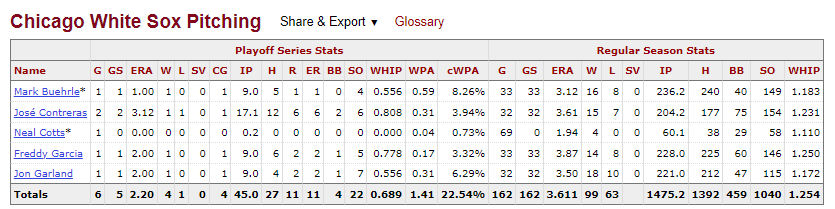
No friggin way. What? TWO outs from their bullpen in a 5-game series win? In today’s game, that’s absolutely inconceivable. Even in 2005, that would have been outrageous. So I looked it up. It’s true. It’s actually true. Here’s the White Sox pitching line for the series:

C’mon. Look at that thing. It’s friggin incredible. The White Sox lost Game 1 to the Angels, 3-2. Contreras was pulled with 1 out in the Top of the 9th, down 3-2, after a single by Bengie Molina. The Angels held on in the 9th to win. The White Sox then won the series on 4 straight complete games.

I have absolutely no recollection of this, which is odd because in 2005 I still followed the Angels fairly closely. But it was also my first semester of law school and I was pretty busy, so it makes some sense. 

Has a staff had a better series in modern baseball history? Seems hard to believe. Anyways, thanks for coming to 1-2-3 Sports!, where we do things like ponder the incredible events of a baseball series from 17 years ago. -TOB


Checking in on Big Game

Toldja.

Also, on Friday night I got some beers with some neighborhood dads. I mentioned that I went to Big Game last weekend with my oldest and one of the dads, who I don’t know that well, asked me who won. I said Cal. “Damn,” he said. And if that doesn’t encapsulate Stanford fans perfectly, I don’t know what does: he has no idea who won, a full week after the game, but pretends to care. Go Bears Forever. -TOB


Video(s) of the Week

(I laughed so hard at the first answer by Tim Robinson)


Tweets of the Week


Song of the Week

Happy Thanksgiving:


Like what you’ve read? Follow us for weekly updates:

Email: 123sportslist@gmail.com

Twitter: @123sportsdigest

Facebook


“What’s so great about a mom and pop store? Let me tell you something, if my mom and pop ran a store I wouldn’t shop there.”

-George Costanza

Week of November 18, 2022


Yes, Stanford Sucks; Here’s How

Cal has beaten Stanford two out of the last three years and god damnit they are winning again this weekend JUST LOOK at these uniforms.

FIRE. It is literally impossible to lose when you look that good.

And it doesn’t hurt that while Cal has had a disappointing season, Stanford REALLY sucks. It wasn’t long ago that Stanford was one of the best teams in the country, so what happened? The Chronicle’s Connor LeTourneau answers that question and buddy let me tell you I enjoyed every word. Here’s Connor on the sorry state of Stanford football:

As Stanford prepares for Saturday afternoon’s Big Game at Cal, it already has assured its third straight full season without a bowl appearance. A barrage of injuries to key players couldn’t keep Shaw from becoming the subject of recent “hot seat” chatter — a development that would have seemed unfathomable a half-decade ago.

In his first six years leading the Cardinal, he guided his alma mater to five 10-win seasons, including three Pac-12 titles and two Rose Bowl victories. But as the transfer portal, NIL deals and Air Raid offenses altered the paradigm of college football, Stanford devolved from powerhouse to punchline.

A program once revered for its toughness and smarts is flirting with its second consecutive three-win season. For the fourth year in a row, Stanford ranks among the bottom fifth of FBS teams in yards per play allowed. Its offensive line, which not long ago was an NFL pipeline and the envy of college football, is routinely bullied.

Yes, yes. More, more. 

Over the past 13½ months, Stanford has gone 1-14 in Pac-12 play. Its predictable offense and shaky defense have some opponents viewing it as an easy win. In a bigger-picture breakdown of the program published in April, the Athletic quoted an anonymous Pac-12 assistant as saying, “You used to fear playing Stanford. … Nobody fears playing them anymore.”

MORE.

Instead of being asked about the rivalry with Cal, the first question he received during Tuesday’s news conference was about his job status. Shaw kept his answer brief: “Our focus is on the 125th Big Game, and that’s what our focus is. Thanks.” Later asked whether Saturday could mark his final time coaching the Big Game, he appeared visibly annoyed as he told the reporter, “I like how you asked that question with a smirk because you know I’m not going to answer it. Next question.”

LOL, YES.

A quarterback under head coach John Ralston in the mid-1960s, Cook has not attended a Stanford home game this season for the first time in more than 20 years as a form of protesting Shaw.

“By giving up our tickets, we spend our Saturdays doing something else rather than being frustrated with the team,” Cook said. “The Big Game is up at Berkeley this ye

Hahaha, hell yeah. GO BEARS! -TOB

Source: Stanford’s David Shaw Faces ‘Hot-Seat’ Chatter, Donor Frustrations as Losses Mount,” Connor LeTourneau, SF Chronicle (11/16/2022)


World Cup Goals and What They Mean

The Ringer’s Brian Phillips has been putting out a really great series in the lead up to the World Cup – long, entertaining, poetic essays on 22 of the greatest and most important goals in World Cup history. 

Like the best sportswriting, Phillip’s stories are about more than the goals, though. Like this one, about Lucien Laurent, the Frenchman who sailed across the globe to Uruguay for the very first World Cup and scored the first goal in the tournament’s history. In that article, Phillips lays out why a coffee fungus in Sri Lanka in the 19th Century led, arguably, to the modern World Cup. I learned about Thomas Lipton (as in the tea) and his role in the World Cup. I learned about steam ship trips across the Atlantic. I saw this incredible picture of the French national team on that steam ship.

Then there was this article about Johann Cruyff, the Dutch soccer great. In this one, Phillips weaves in and out of the story a funny observation about Bob Dylan and whether he can drive a car. It sounds weird, but it works. I learned about “Total Football,” I saw cool clips of a soccer legend I’ve heard of but never really seen before. For example, this is just sick:

I also loved this one which asked the question – which kind of goal do you like best: one involving incredible teamwork or one involving sparking individual effort and skill:

But the question of teamwork versus talent. Of the group versus the individual. Of the successful English boy band versus the ex-boy band member now recording as a solo artist whom everyone tries to pretend is more sophisticated than the boy band even though really, he just wears weirder pants.

These questions are central to the appreciation of soccer goals. And therefore central to this time that you and I are spending together as an excuse not to do any real work.

Here are the contenders:

Argentina’s 24-pass build up to a goal in 2006:

 Or James’ incredible volley strike in 2014:

Phillips takes James’ goal, as he explains here:

Since the systems in play have such a powerful determining influence on the game, I often find it more thrilling, more moving, when one player manages to stand out from the system. When one player rises above it or epitomizes it.

I want to watch that person do amazing things. I want to know what that person means to the game. Or means outside the game. I like stars.

Of course I would not ever say no to a 24-pass move culminating in a goal following a no-look back-heel pass. I will have that goal seven days a week, no ketchup. But if it comes down to a choice, I’ll take Diego Maradona running through the English defense over just about anything else in the game.

Well, thank goodness we don’t have to choose. Soccer gives us both these possibilities, and it gives every possibility between them. Every nuance on the continuum. It’s a surprisingly nuanced game, soccer, for a sport that once prominently featured John Terry.

And finally, I want to talk about this article about Landon Donovan’s incredible, tournament saving goal against Algeria in 2010

My god, what a moment. Phillips discusses the goal, yes. But he really discusses the history of soccer in America which is, ya know, complicated. Phillips writes this excellent paragraph about the waning moments of that game, right before Donovan’s goal:

It’s a strange thing about hope that in the long term, hope makes life easier. But in the short term, when you’re hoping from one second to the next, when you’re hoping for something right now, hope is a labor.

Hope is work.

You’re waiting for the phone to ring. You’re waiting for the flight to land. You’re waiting for the last seven to spin up on the slot machine. It’s work. American fans are exhausted from years of accumulated short-term hope.

I also really liked what he wrote about what that goal changed for American soccer:

Does the goal change soccer in the United States?

I think the answer is yes, in the following way. It gave us all a moment when we could just be in the moment. When we could be united in the moment.

What I mean by that is that American soccer has carried this structural uncertainty about its own status for so long that if you were an American fan, you were always a little bit trapped in big-picture thinking.

You were always aware of the state of the game. The development of the game. Where’s the game going? What’s your responsibility to help get it there?

It was always partly about a process. Probably even this year, heading into Qatar, we still feel some of that.

But not in that moment in Pretoria. When joy finally comes, it gives you the present. It gives you radiance with no future and no past. And it felt to me like a lot of things fell away from American men’s soccer as we all passed through that moment. A weight lifted. I don’t know how to explain it.

Men’s soccer did not get to be bigger than the NFL, but the concern over whether it would just … never seemed as pressing after that. Because of that moment. The game didn’t get bigger so much as it got freer. It got less pressured. It got more fun.

Because of that moment, I think MLS games started to seem more like a great time, less burdened by the question of where the league is going.

Because of that moment, I think Landon Donovan was more able to open up about his struggles with anxiety and burnout—hardly anyone talks about this now, but Landon was way ahead of the discourse on athletes and mental health.

Because of that moment, when a young American player goes to Europe, I no longer think the fate of the universe is riding on the outcome. I just think, for Christ’s sake, Chelsea, get him off the bench.

It’s a really good point. We never hear, “Will soccer ever make it in the U.S.?” Man, it’s made it and that goal is a big reason why. It proved that American fans love soccer and will go bananas for it. 

Anyways, great series by Phillips. It got me so pumped for World Cup. -TOB


Source: Landon Donovan, 2010, and a Breakthrough Moment for American Soccer,” Brian Phillips, The Ringer (11/16/2022)

PAL: I love the tone and tempo to Phillips’ writing in this story. It reads fast and loose – like he’s telling you this story at a bar. He’s so much more focused on the feelings and tempo of the story than a perfectly constructed sentence in its leanest, fittest form. 

Weaving a history into (or up to) a moment can read like work, but he sums up American soccer so well. Decades of details about how professional soccer couldn’t take hold leading up to an unlikely goal against Algeria. Why didn’t America embrace professional soccer, especially when all of us were playing it growing up? I loved this insight from Phillips: “When you’re the world’s most confident superpower and you’re bad at something, you can’t be bad at it just because you’re bad at it.”

While I’m not the biggest World Cup fan out there, I know exactly where I was when Donovan scored – Ireland’s 32 on Geary Blvd drinking morning Guinness in a packed bar. Phillips is right – that moment was electric – for a moment we all got a taste of the joy of a World Cup moment. 

Fun read!

TOB: Man, that must have been a dope spot to see that goal. I was at home, lol.


How Europe Decides Who Wins the World Cup

At the heart of this story, and what’s at stake in a Europe-driven globalization of the game, is best captured in one Portuguese word: ginga (pronounced jee-en-gah).

Ginga is a style of dribbling and feinting at the core of the way soccer is played in Brazil, especially in the favelas. Pelé was one of the first. And that’s where this story from Tariq Panja, Elian Peltier and Rory Smith starts: in the favelas. Every week, the kids from a premier youth soccer academy take a bus ride to the favelas and play there. It’s the only place left where their play, preparation, and approach to the game isn’t impacted by Europe. 

Per Panja, Peltier and Smith

The demands and desires of Europe have shaped not only the way almost every country will play at this World Cup, but also which teams have had the talent and resources to qualify for it and which team has the ability to win it.

In other words, all of the best players in the world end up in Europe at around 17, 18, 19. That means all of the academies around the world teach and train based on what will give its program the best chance to send more players to Europe. It’s not just happening in Brazil. The same is taking place in Western Africa 

At the same time, those choices locked out a whole region of the continent, seemingly for good. It is not that there is less talent in Kenya and the Central African Republic than in Tunisia or Senegal; it is that there is less investment, less opportunity. Which nations can hope to reach the World Cup is determined, in effect, by Europe. And so, too, is the question of which countries can win it.

It is becoming increasingly rare for national teams to feature players who play in their home country. I mean, look at this chart! 

Such an interesting read, and a bit sad, too. There’s something really cool to a country having a style of play – an identity that’s unique. Really fascinating read. – PAL

Source: “How Europe Decides Who Wins the World Cup,” Tariq Panja, Elian Peltier and Rory Smith, The New York Times (11/18/2022) 


Videos of the Week

Tweets of the Week

Song of the Week


Like what you’ve read? Follow us for weekly updates:

Email: 123sportslist@gmail.com

Twitter: @123sportsdigest

Facebook


“Just remember, it’s not a lie if you believe it.”

-George Costanza

October 14, 2022


Twitter Can Be Good, Sometimes

Weighing the impact of a website like Twitter is difficult. It has brought a lot of good to the world, and a lot of bad. But as a sports fan one thing I love is the ability to connect directly with professional athletes. I think players really underutilize it, actually. If players used it to do more than build their brand or shill for Corporate America, they could do a lot of cool things, like Brewers All-Star Christian Yelich did this week. 

In Wednesday night’s Game 2 of the NLDS, the Dodgers’ Clayton Kershaw got San Diego’s Jurickson Profar to swing at a curveball that bounced about ten feet before the plate.  

I mean, that is honestly one of the worst swings I’ve ever seen. Look at this picture:

I think it might actually be the worst. It’s so terrible it’s hard to believe. I know that a lot of guys go up there guessing, but Kershaw doesn’t throw that hard anymore – barely cracking 90 MPH this season, on average. That’s slow enough, relatively speaking, that a professional hitter should be able to avoid looking as bad as Profar did there. But then I saw this Yelich tweet.

I’ve never seen a curveball like Kershaw’s obviously. I’ve never stood in the box for 90 MPH, either. So that’s pretty interesting – a spiked curveball starts out so much lower than a normal curveball that it starts at the same plane as a fastball. Makes sense, is simple. But without Yelich to explain it, I can’t understand how Profar can swing at that pitch. Thanks, Yelly! -TOB


Does Anything Beat a Proud Grandpa?

I love this video, lol.


Players Love Postseason Swag

This is a short article, and kinda goofy, too. But I still enjoyed it. Here’s the lede:

Francisco Lindor will make $341 million over 10 years with the Mets, but he cannot buy the thing he most covets. A World Series ring, sure. But also a World Series sweatshirt.

That’s pretty funny, but as various Mets players explain it, I get it:

Brandon Nimmo:

“It’s like if you’ve ever had a cup of coffee in a really beautiful place. You’re like, ‘Oh my gosh, this cup of coffee is so amazing!’ If I had it back home it might be the same old coffee, but because of the circumstances that are around it, it’s awesome.”

Pete Alonso:

To be able to earn that patch that says postseason, earning that postseason patch on your hat—that’s sick. It’s awesome getting new stuff, but to be a part of something that you earned even though it’s as simple as having a postseason patch or whatever—we earned that. We earned that privilege to have that on our jersey. We earned [the chance] to be able to have that new stuff that not everyone’s getting. It’s almost like a rite of passage.”

This makes perfect sense. Plus, as Lindor says – they’re human. New stuff is fun. And so was this article. -TOB
Source: Baseball Players LOVE Their Playoff Merch,” Stephanie Apstein, Sports Illustrated (10/06/2022)


2 Percent

Some of you might remember Myron Rolle. He was the Rhodes Scholar and a 3rd team All American safety at Florida State. He was a late-round daft pick, but never got into an NFL game. After being let go by the Steelers, his was having a hard time coming to terms with where he was in his career and pursuit of a dream. That’s when his mom stepped in.

Per Elena Bergeron:

Showing him his grade school notebook, where he had written both goals, “she looked me straight in the eyes and pointed at the first one,” he recalled. “She said, ‘This one’s done.’ And she looked at the second one and said, ‘Now, we need to do this.’”

Today, he is Dr. Rolle, and at 35, he is in the sixth year of his neurosurgery residency at Harvard Medical School and Massachusetts General Hospital. “Those words of encouragement, her belief in me, her thoughtfulness, her disposition during that moment was just what I needed, just what I needed to move forward to the next chapter in my life,” he said.

Good work, Mom Rolle.

There’s another bit from Rolle that I found inspiring. It’s nothing earth-shattering, but I like the idea of it. He was taught the 2 percent philosophy from a college coach, which he still applies to his all aspects in his life. As Rolle explains it:

Can you be 2 percent better than you were yesterday? You can if you take small steps every single day toward a larger goal. It helps me make more sense of the challenges, the tasks, responsibilities that I have.

Learning how to open up a craniotomy, learning how to put diapers on your newborn kids and be a better attentive husband, all these were tasks that I wanted to accomplish. Any goal, short or long term, doesn’t feel daunting or debilitating. They feel manageable. I appreciate and I pat myself on the back for the small gains, the small wins that I get every single day. It’s a rush of dopamine in my limbic lobe that says: “You’re doing right. This is a reward for doing well.”

Rolle’s story is another chapter in the “It’s Never Too Late” interview collection from The New York Times. I encourage you to peruse all of the essays.

2 percent? We can all do 2 percent better today, right? Let’s go! – PAL

Source: “It’s Never Too Late to Pivot From N.F.L. Safety to Neurosurgeon,” Elena Bergeron, The New York Times (10/11/22)

TOB: I have often wondered what happened to him. Great read!


Video(s) of the Week

Tweet(s) of the Week

Song of the Week


Like what you’ve read? Follow us for weekly updates:

Email: 123sportslist@gmail.com

Twitter: @123sportsdigest

Facebook

And if you’ve missed our last few posts, find them here:


Kramer: Boy, I really miss the Bermuda Triangle.
Newman: I guess there’s not much action down there these days.
Kramer: Oh, there’s action. There’s plenty of action. It’s that damn alien autopsy stealing all the headlines.
Newman: Yeah, tell me about it.
Kramer: See, what they gotta do is lose a plane or a Greenpeace boat. See, that would get the Triangle going again.
Newman: What keeps the water in there? I mean, why doesn’t that disappear?
Kramer: Now, what would be the point of taking the water?
Newman: It’s gorgeous water. Do we own Bermuda?
Kramer: No, it belongs to the British.
Newman: Lucky Krauts.
Kramer: So what do you think of that alien autopsy?
Newman: Oh, that’s real.
Kramer: I think so too.

Week of October 7, 2022


Pujols Hits 700

Two Fridays ago, Phil and I wrote a lot of words about Aaron Judge’s chase for 61 and why that chase still means something to a lot of people, despite the fact that it was passed six times in a four year span (three times by Sammy Sosa). Somehow, in writing all that, we forgot to mention Albert Pujols’ chase for 700. Pujols must have felt our snub, because that very night he went out and hit two dingers – numbers 699 and 700 for his career. It was a cool moment. I think our neglect is partly for the same reason that 61 still means something, but on the other side of the coin: 700 is a round number and a big number, but it’s not a magic number. 714 is that number. 755 is that number, too (And 762? Let’s wait a bit). So while Pujols hit a milestone by reaching 700, he’s still chasing the next magic number: 714. 

But what I want to think about here is how Pujols got to 700 and wonder if he’s coming back next year for 715.

The latter question is easier. If Pujols wants it, he should absolutely come back next season. He has played in ⅔ of his team’s games this year and has hit 21 home runs. If he plays in the remaining 8 games, he can expect to be sitting at 702 (Editor: I wrote this right after he hit 700; he actually hit two in his final three games and ended up with 703) or so when the season ends. If he hits home runs at 80% of the pace he’s done this year (accounting for his ever-advancing age), he would expect to hit 715 somewhere around the team’s 110th game of the season, in early August. 715 would be awesome, while 756 or 763 seem out of reach. 

The more interesting question is how is Pujols doing this? The resurgence is real. You are not imagining it. And it’s not a result of moving back to St. Louis and that being an easier park to hit in. He went from the strongly hitter friendly Angel (4th friendliest to hitters) and Dodger Stadiums (7th friendliest) last year to Busch Stadium (27th friendliest to hitters) this year. And his home rates are way up. So something is going on.

Here are his home run rates since leaving St. Louis after the 2011 season:

After a steady decline since 2015, suddenly last year and this year he has jumped to a huge peak. In fact, his home run rate this year (7.18%) rivals his career peak – it’s his fifth best ever, even surpassing some of his very best seasons. He’s 42! He underwent a natural decline, beginning at age 35, that mostly stayed steady through the end of his 30s, and then suddenly he turned 41 and he found the fountain of youth. 

And it’s even more interesting if you get a little more granular. On July 8, Pujols went homerless in one at bat. It dropped his home run rate to a season low 3.17% (4 home runs in 126 at bats). He hit a home run during the next game he had an at bat (July 10) and his home run rate climbed slowly from there the rest of the month. On August 1, he was sitting at 4.22%. And then he went on an absolute tear. For the month of August, he hit 8 home runs in 61 at bats (a home run rate of 13.11%), raising his season home run rate to 6.61%. He slowed down in September, just a little, hitting 6 home runs in 65 at bats (9.23%) to raise his season rate to a season high 7.32% on September 23. 

So…what the hell is going on here? I have no idea but I do have a theory. No, “theory” is too strong. A “thought” is a better term for it. If Pujols decided he really wanted to get to 700 this year, and if he decided to get some “help” to get there and then retire before he could be tested again, could he get away with it? 

I reviewed the MLB’s Testing Policy and could not find anything suggesting a player has a maximum number of tests per season. So Pujols can’t know he won’t be tested again. The policy simply says, “All Players shall be subject to random, unannounced testing for the use of Prohibited Substances at all times during the season, including, but not limited to, at any point in Spring Training and before and after all games.” 

So, maybe the better question is this: Would Pujols risk his reputation to get to 700? I find it hard to believe. And that’s why I think he absolutely should come back for 715. And if he doesn’t, well, maybe he knows he’d get busted. -TOB

PAL: He was one of the scariest hitters I’d ever watched during his first decade with the Cardinals, and then he disappeared with the Angels. What a terrible, terrible baseball decision for him to go to Anaheim (though not a bad financial one). He was on a legend trajectory, but that is so incredibly hard to do on an irrelevant, west coast team with no meaningful history. 

The notion that makes the most sense to me is this: 700 home runs is not a possibility in his mind when his time with the Angels ends. He goes to the Dodgers to be on a winning team. Guess what? It’s fun to play on a really good team again. It’s fun to hit in a loaded lineup. It’s fun to play in games that matter. He gets the juice for the game back, and then he comes back to the Cardinals to finish an incredible career, but then he gets hot in August – maybe even just a hot week – just enough to put 700 homers back on the table. And now we’re here. That, or he said screw it before August; one more shot for 700. Why not? 

The sample size is just small enough (hey, he felt great in August; a 60 AB hot streak can happen) for us to consider it a fitting hot streak for one of the greats. But the dude is old and wasn’t hitting homers, then he got older and started hitting homers again. 


Federer Retires

I’m not a tennis fan, really. I like tennis a lot. I enjoy it. I follow it via ESPN and news articles. But I rarely ever sit down and watch a tennis match. But when I do, it sure is a great sport. Relatedly, Roger Federer is the only tennis player I ever really loved. He’s the only guy that I ever set an early morning alarm for (it happened three times, but still). There was something about the way he played – cool and graceful, skilled and calm. There are few athletes in any sport that spoke to me like Federer did – first in his prime, and then in his twilight. 

So I was pretty sad that Federer retired this week. Over the last five or so years, there were a number of times when it seemed like the end for Fed; but he always came back, and with a vengeance. But this time, at age 41, he’s really done. If you like Federer like I do, or just great writing, I must insist you read this great tribute to Federer, by Defector’s Giri Nathan. Here’s my favorite passage:

My favorite memory of Federer will be before all the tears, when both he and Nadal were staging dramatic returns of competition. In the fifth set of their 2017 Australian Open final, Roger’s friend had gone up a break to lead 3-1. I’d stayed up all night watching with some sleepy neutrals and a Nadal-acolyte friend. Over the 3:38 epic, the room grew quieter, the sofa distance between us longer. Somehow Federer began to bend the match in his favor. Winning this 26-shot rally detonated any foregone conclusions.

So much conventional wisdom dissolved here: that major titles couldn’t be won at age 36 coming off a surgery layoff, that Federer couldn’t still eke one out over his rival, that his one-handed backhand couldn’t bear the brutal weight of Nadal’s topspin. He took five straight games and the trophy. I have never been more awake at such an hour, and as I stepped onto the sidewalk, replete with dog crap and rats in retreat, I found myself in a serene mist, sound but sore, as if my own muscles had done something tougher than adjust the volume during commercial breaks or fish ice cubes out of the freezer, as if I’d had to focus on anything more than the careful calibration of caffeine and BAC. Through Federer it was possible to close the gap between sweat-free, daydreamed fantasy and hard-won, racquet-swung reality. A lifetime of playful tinkering in the lab can earn a man a career of pure liberated tennis. It was as true that night as it has been for these 24 years. “I told myself to play free,” Federer said after that victory. “Be free in your head, be free in your shots, go for it. The brave will be rewarded here.” And he was.

Great stuff for a legend who deserves it. -TOB

Source: Roger Federer Knew The Play Was The Thing,” Giri Nathan, Defector (09/28/2022)

PAL: I didn’t watch enough of his career to know anything more than he’s very great and the smooth one (compared to Nadal being the hustler). Most impressive part of his game that I learned from this story: the SABR technique. 

I mean, these opponents are hitting serves pretty hard, and he’s charging the net on them. What an assertion of dominance. As Nathan points out in an earlier portion of the article, the hand-eye coordination is completely off the charts. 

The other detail that stood out – his feet didn’t make a sound on the court. The amount of grace that fact requires on a tennis court – pretty incredible.


The Z Man

I’ve heard Michael Zagaris interviewed on the local sports radio station every now and again, and I knew he was a San Francisco photographer that made a name in both sports and music, but I didn’t know to what degree until reading this piece about Zagaris from David Davis.

Zagaris is a pretty good representation of everything that’s cool and fun about the Bay Area, and a nice reminder when things all feel a little too techie and priced out. 

His life story started out pretty regular – a sports nut kid from central California who also liked photography. He also had a knack for sneaking/fibbing his way into sporting events and concerts. He lied about working on a coffee table book to get press credentials to shoot on the sidelines for the Colts and Redskins while in college at George Washington. When the Beatles were in New York in ‘64, he called the front desk at the Taft Hotel claiming to be on Senator Kennedy’s staff and that he’d like to go to the show. Second row. 

After undergrad, he attended law school at Santa Clara (just like our TOB). He actually worked on Bobby Kennedy’s campaign. He was there at The Ambassador Hotel, and his life changed the night of Kennedy’s assasination. 

The suit and tie were gone. So, too was law school. I took acid for the first time, moved to the Haight, and started documenting what would become a historical moment in music. 

The story gets back to sports, and he’s shot a lot of great stuff, but I love stories about people who just always seem to be in the right place at the right time. 

I constantly asked questions and I kind of evolved. I didn’t much have a plan, and I know that seems crazy. My whole life has kind of been like that, where I walk through life with my eyes open, letting everything just come through me, and the things that really resonate I’ll explore more.”

I’m beginning to understand the bravery it takes to live that kind of mantra. I don’t have it in me, but I really admire it in others. Seems to be a great philosophy for a photographer. Excellent read. – PAL 
Source:Michael Zagaris Had The Backstage Pass Of A Lifetime,” David Davis, Defector (10/05/22)

TOB: There may be no story Phil likes more in this world than a story about a sports photographer.


Pro Sports is Losing the Middle Class

The Chronicle’s Peter Hartlaub is one of my favorite local writers. He’s Hella Bay (with a capital H and B). His roots are deep here, he loves San Francisco and the surrounding areas, and he is loyal as hell to our local teams. Hartlaub’s family has had 49ers season tickets for decades – for 75 years in fact, all the way back to 1947, when the Niners played at Kezar. Every time I am near Kezar I look around and marvel at the fact that pro football was once played there, and this passage by Hartlaub as relayed by his grandmother is awesome:

Kezar was an accurate cross-section of the city, which you could see on game day. There were fans walking from the Sunset, Richmond, Haight and Mission districts, like ants converging on a half-eaten bar of Pink Popcorn. The very poorest residents might have balked at a $1.50 ticket, and the wealthiest San Franciscans might have thought it beneath them. But at least every kid could go. Any child who clipped a coupon from a carton of Christopher Milk in the 1950s could get into 49ers games for free.

But Hartlaub wrote this week about his family’s difficult decision to give up their season tickets. Ultimately, between the ever-rising prices (far outpacing inflation) and the move to Santa Clara, Hartlaub and his family could no longer justify the expense:

But as the ticket prices push higher, it gnaws at me. Including parking or train tickets, a game for two of us costs $400 at the bare minimum. I stopped telling my wife how much they cost, then was stunned when we got single-game upper deck Warriors tickets for the family as a Christmas present; they cost about 60% of one football game.

I bike everywhere now, and appreciate the Chase Center and Oracle Park free bike valet through the San Francisco Bicycle Coalition, which saves at least $50 parking. A few Giants, Warriors and 49ers games a year are in my budget. With two sons going to college soon, 10 football games a year is not. We could move to even cheaper upper-deck seats in the sun with worse views than we’ve had the past 50 years, but after investing in the seat licenses fewer than 10 years ago, we choose not to.

I’ve noticed in my pickup basketball games more of my friends talking about Oakland Roots soccer tickets. I’ve been to a few San Francisco City FC soccer games at old Kezar Stadium where the 49ers started, and realized it’s less expensive to become a part owner of that team than just a fan of the 49ers.

So when my mother suggested this year might be the last, the biggest feeling was relief. My love of the team had been eclipsed by guilt over the cost of being a fan.

He’s absolutely right, of course. Every year I think, “I want to take the boys to a 49ers game.” And then I check the ticket prices online and I almost choke. For the Niners next home game, they are selling nosebleeds for $139. Two tickets in the endzone? $350. Two tickets around the 10-yard line? $800 each. Those prices are insane. Warriors tickets are not much better – for most games, you can’t get in the building for under $150 per ticket.

I’m sure there are a lot of families like Hartlaubs who have recently been forced to abandon their season tickets. It’s sad, and with so much money coming to pro sports teams from TV these days, I wish they’d consider lowering ticket prices a bit. They won’t, of course. But I wish they would. -TOB
Source: Our Family’s had 49ers Tickets Since 1947. Here’s Why This Will be our Final Year,” Peter Hartlaub, San Francisco Chronicle (10/02/2022)


Chess, Cheating, and Anal Beads

You’re still here? Good. Now we can get to the good stuff: chess and anal beads.

The guy on the left above is Magnus Carlsen. On the right is Hans Niemann. 

We’ve written about Carlsen before. He’s the world’s best chess player. At a recent tournament, he lost to Niemann, am American. And Niemann was playing with black, which is extraordinarily hard to do. Niemann has a history of cheating – he admitted to cheating twice in online chess tournaments as a child at ages 12 and 16, but some feel he is still cheating in over-the-board chess. 

After he lost, Carlsen dropped out of the tournament and then seemed to endorse the theories that Niemann had cheated via cryptic Twitter activity. Hilariously, there were theories that Niemann was cheating via vibrating anal beads. Yes, you read that correctly.

More recently, Carlsen and Niemann faced off again. But Carlsen resigned after just one move. Here’s the video.

Carlsen later confirmed what people believed – he resigned in dramatic fashion because he believes Niemann was cheating at their previous match.

Following this episode, Chess.com released a report finding that Niemann had cheated on its platform more recently and much more often than he had previously confessed to.

Chess.com can track whether a player toggles to another browser window during a match and can track how well you do when doing so, including whether your selected move would be recommended by an online chess engine – all of which suggests a player is cheating. Niemann, apparently, had been caught by Chess.com back in 2020:

The report says Chess.com’s chief chess officer Danny Rensch confronted Niemann with proof that he’d cheated in 2020, and that Niemann confessed, in an attempt to get his account back online. When Niemann made a stink about being barred from a $1 million tournament on Chess.com this summer, Rensch sent him a letter explaining that he wasn’t going to allow Niemann to play for such a big pile of money when “there always remained serious concerns about how rampant your cheating was in prize events.” Rensch also laid out a very ominous piece of evidence: “We are prepared to present strong statistical evidence that confirm each of those cases above, as well as clear ‘toggling’ vs ‘non-toggling’ evidence, where you perform much better while toggling to a different screen during your moves.”

Chess.com’s method for catching cheaters involves engine analysis, consulting the expertise of grandmaster “fair-play analysts,” and monitoring whether players opened up other windows on their computer while playing. That last bit is the “toggling” mentioned by Rensch. A player doing significantly better when opening up another window on their computer—even if Chess.com’s software can’t distinguish what is in the window—is extremely suspicious. Doing other stuff on your computer should be a hindrance to a player’s performance in a mentally intensive game like chess, especially in smaller time-control formats like rapid and blitz. If you only have 180 seconds to make an entire chess game’s worth of moves, you should absolutely not perform better in games where you spend 20 seconds doing anything in another window. We should note here that Chess.com is not a neutral body, as they are in the process of buying Magnus Carlsen’s app for $83 million.

And just when you think this story might be over, I have this for you. At a tournament this week, players were screened with a special wand that can detect metal…and silicon. Niemann showed up and yes…they screened his butt.

LOL. -TOB
Source: Report: Hans Niemann Cheated More Often, More Recently Than He Admitted,” Patrick Redford, Defector (10/04/2022)


Videos of the Week


Tweet(s) of the Week


Song of the Week


Like what you’ve read? Follow us for weekly updates:

Email: 123sportslist@gmail.com

Twitter: @123sportsdigest

Facebook

And if you’ve missed our last few posts, find them here:

https://123sportsnews.wordpress.com/2022/09/23/week-of-september-23-2022/

https://123sportsnews.wordpress.com/2022/09/17/week-of-september-17-2022/


“Please, a little respect. For I am Costanza, lord of the idiots.”

-George

Week of September 23, 2022

San Francisco awaits, your Honor.

The Starting Pitcher, Slowly Going the Way of the Buffalo

If you’ve been a baseball fan longer than 10 years, you’ve seen a major evolution in the way teams handle starting pitchers. The starter used to be the star – innings eaters who sold tickets and won games. And they really won them, going deep into games, week after week, year after year. But now that’s all changed. The complete game is nearly extinct. In 1980, 20.3% of starters finished the game they started. This season, that number is down to 0.6%, with just 30 out of 4,470 starts resulting in a complete game.  In 2022, MLB starters average 5.15 innings per start. As Passan notes, in 2022, “only one pitcher, Miami’s Sandy Alcantara, posts more than seven innings a start. Just 20 pitchers are above six. Alcantara and Milwaukee’s Corbin Burnes are the lone two who log at least 100 pitches per game. Alcantara is at 101, Burnes at 100.” 

In this article, Jeff Passan asks why, and focuses on Toronto’s Alek Manoah (big fan of this guy), a dying breed. Manoah hasn’t pitched a complete game this year. He’s young and big and an innings eater, but he’s still wrestling with his team over load management. Here’s Passan:

“The story of the disappearing starter is one in which analytics beat aesthetics. A confluence of factors — small-market teams clawing for survival among their moneyed brethren, the broken youth baseball apparatus, the industry’s general ignorance about arm health — served as accelerants, but at the heart were numbers too compelling for teams to deny.”

Passan is referring here to the “times-through-the-order-penalty” – the more times a batter sees a pitcher, the better he performs. The theory was popularized in a November 5, 2013 article on Baseball Prospectus by Michael Lichtman, who noted that “over the previous 40 years, hitters gained an average of 27 on-base-plus-slugging points between their first and second plate appearances against a starter and 24 more between the second and third.” 

This knowledge has changed the game. As Passan noted:

“Soon after Lichtman’s piece, innings-per-start numbers tumbled, from 5.97 in 2014 to 5.81 to 5.65 to 5.51 to 5.36 to 5.18 in the last season before the COVID-19 pandemic. The figures ran inverse to average fastball velocity, which had continued its steady climb from under 89 mph at the turn of the 21st century to 93 mph by 2019. Teams were pivoting away from pitchers who could pitch deep into games and focusing on other skills: velocity, strength and pitch design. Ultimately, that philosophy birthed a cottage industry that inside pitch labs created a new strain of swing-and-miss pitches.” 

And, some argue, the effects are not good for fans. Here’s former Red Sox and Cubs president Theo Epstein:

“It’s math. It’s real. If you’re looking to just optimize for one game, of course you’d rather have a fresh reliever than a starter third time through. But when every team takes that approach there’s a real cost to the industry. We lose the identity of the starting pitcher as a prominent character in the drama day in and day out.”

Epstein notes, though, that despite fewer innings and fewer pitches we are not seeing fewer pitcher injuries. Why? Here’s Passan:

“Fewer innings leads inevitably to more max-effort pitches, which arm experts agree create more injuries. Teams remain at the mercy of a self-created beast; max effort is more effective, and the system — from youth baseball onward — prioritizes little else. No one seems inclined to interrupt the faulty feedback loop. The average minor league start this season lasts 4.23 innings. Only six of the 120 teams in the minor leagues use their starters for more than five innings per start. One team, the Los Angeles Dodgers’ Single-A affiliate Rancho Cucamonga, leaves its starters in for an average of 2.9 innings. A minor league pitcher reaching 100 pitches is blue lobster rare.”

Epstein sees dire consequences for baseball if the trend continues and suggests limiting pitchers on a roster to 11 and force a team to lose its DH when it pulls its starting pitcher. It’s not a bad idea. -TOB

Source: ‘It’s a Dying Breed. And It Sucks’: The Decline of the Starting Pitcher — and What It Means for Baseball’s Future,” Jeff Passan, ESPN (07/06/2022)

PAL: For “the nerds” to be ignored for so long, to this: one article from Baseball Prospectus, and the starting pitcher is on the outs. This story made me wonder if we’re in the un-fun phase of baseball’s evolution, and yet I had a very unsettled reaction when I heard about the shift rules going into play next year, thereby limiting or diverting a trend.

Also, as a Twins fan I am contractually mandated to bring up Jack Morris’ 10-inning, 1-0 shutout in a game 7 of the friggin’ World Series. You want drama, Theo? That was dramatic. Where does that performance land on a list of things we will never, ever, ever see again?


What is Judge Chasing?

Aaron Judge tied Babe Ruth when he hit his 60th home run the other night. It is not a record-breaking home run; hell, he hasn’t even broken the team record (yet), but 60 still matters, somehow, and that’s what Barry Petchesky lays out with such sharp writing. 

The game’s greatest treasure is its history, and it rarely feels more vital than when that history comes alive again. A slugger putting up an absurd number 95 entire years ago doesn’t feel so distant when a slugger wearing the same uniform chases it down now. The present informs the past, makes it real in a way newsreels and ledgers can’t quite. 

And later, he addresses the fact that, as incredible as Judge’s season has been (a 60+ homer triple crown season is bonkers), he’s not breaking the home run record (14 homers in 12 games isn’t happening). So why are we treating this like a chase?

But I have a theory about 61, and it’s that a home run chase is so much fun that there’s a collective if unspoken agreement to accept that Judge is currently engaged in one. It requires a little targeted forgetfulness, and the making of strange bedfellows with those freaks still hung up on the steroid thing, but it’s worth it. 1998 was a special thing. I genuinely pity people not old enough to remember it. 

We can’t relive the supernova summer of 1998, but with every Judge highlight, every live look-in for his at-bats, every astonishing statistic, we can enjoy something of its reflected warmth. A home run chase is a good time, and it reminds one of previous home run chases, and of a slightly more naive era of fandom (or maybe just of my own life) when it was easy and good to feel things so strongly. So if Judge is not going to chase down Barry Bonds—if a chase for the true home run record is simply not in the cards until and unless the game fundamentally changes—where’s the harm in acting like or believing that 61 is still a mark worth chasing? I promise you it’s more fun to be here counting dingers than to be too savvy to.

Also, not a bad year for Judge to do this. Remember, he said no to the 7 years, $213MM extension that the Yankees offered at Spring Training. Come the offseason, he’ll fetch a hell of a lot more as a free agent. I know the Twins won’t pay the kind of money he’ll get, so I hope the Giants go all-in for Judge.

Petchesky has his heater going on this one. – PAL 

Source: The Chase Is The Thing,” Barry Petchesky, Defector (09/21/22) 

TOB: This is interesting and similar to a thought I had this week. I saw a Tweet wondering if Bonds would have hit 73 in 2011 if not for 9/11 – and it’s a fascinating question on two levels. 

First, Bonds hit 61, 62, and 63 in the same night! On 9/9/2001! He does that on a Sunday, has Monday off, and then on Tuesday two airplanes hit the World Trade Center. And then Bonds, like the rest of the league, got a week off, during which he no doubt rested and recuperated. 

Second, after he hit 63, the nation and world’s attention was elsewhere, obviously, and so maybe there was less pressure. There was certainly less coverage in 2001 and than McGwire and Sosa got in 1998. I had always attributed that to Home Run Chase Fatigue™ and the fact that the media did not like Bonds as much as they liked McGwire and Sosa (at the time). would have been under more pressure in 2001 if not for 9/11. But in response to that tweet about Bonds and 9/11, I added another thought that touches on what Barry says here.

I wondered if, once Bonds passed 60, the pressure was off. Heck, he hit two more that same day! But 61 had been the magic number for 40 years, and 61 for decades before that. 70 was the number for just three. I think for so many people 60/61 is still a magic number – it still means something to baseball fans, no matter their opinion of Bonds or 73 or the steroid era. 62 is gonna be cool, and I am rooting hard for Aaron Judge.

In fact, like Barry Bonds himself, I’m rooting for him to a baker’s dozen more and get to 73, or higher (despite Phil’s rational thought that it isn’t happening) and then sign this offseason with his childhood team, the San Francisco Giants. That way, as a Bonds fan, I can enjoy the memories of 73 in peace, without someone whining about the Cream or the Clear or BALCO. Go Judge!


1975 San Francisco: SFPD vs a Gay Bar Softball Game

This is a cool, photo-forward story by the SF Chronicle on a softball series, played in the 1970s, between the SFPD and a softball team from the Pendulum, a Castro District gay bar. If this lede doesn’t compel you to click the link and read this story, I don’t know what will.

Because I am in. And I’m not the only one. The game was attended by George Moscone, Willie Brown, and Dianne Feinstein. Check out this crowd, part of 5,000 fans (a number larger than the reported attendance at more than a few Giants games that year):

The article tells as great story, and has some great action shots, too. Like this one. NO, JOE. That ball is too damn high!

Check out the story for how the game ended, and the sad reason the series ended just a few years later. They should really bring this back. -TOB

Source: A 1970s Rivalry Between a Gay Bar and and the SFPD Reached Epic Heights (Then Crashed),” Peter Hartlaub, SF Chronicle (09/02/2022)

PAL: This story catches such a fascinating moment in time. There’s so much hope and community in these photos. That it goes away so soon after, and the reason why, is heartbreaking.


Video(s) of the Week

Look, I’ve been busy. I got a lot of videos saved up. So buckle up:

PAL: LET ME GET IN HERE! Give me every GD angle of this turd hitting the rope and whining.

Tweet(s) of the Week

Song of the Week


Like what you’ve read? Follow us for weekly updates:

Email: 123sportslist@gmail.com

Twitter: @123sportsdigest

Facebook


“I gotta focus. I’m shifting into soup mode.”

-George Costanza