Week of February 28, 2020


Sneak Peek: State-Bound

Where the dream begins…
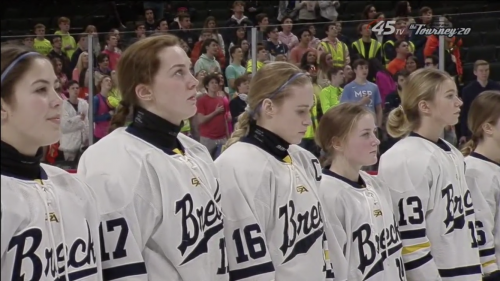
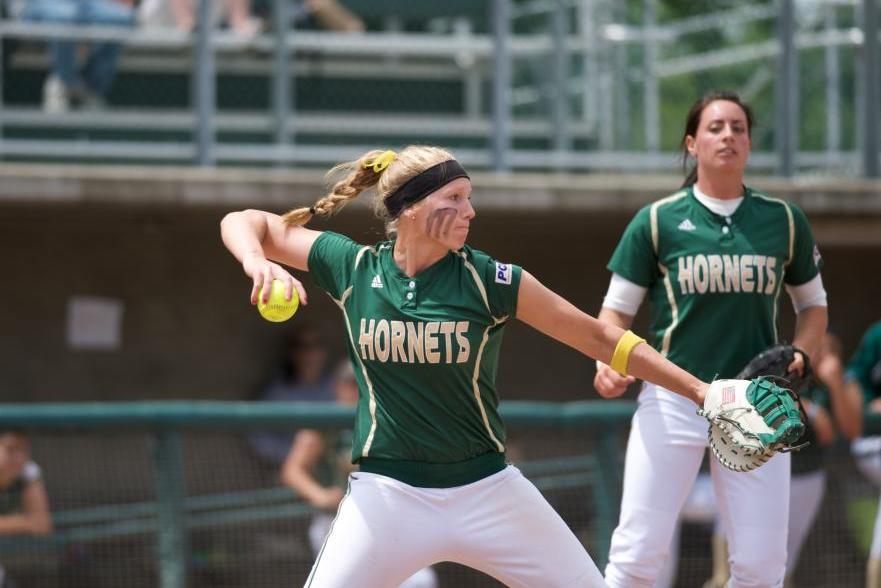
and where the dream is realized. Josie Lang, fourth from the left.

Last week I traveled back to Minnesota to watch my niece become the first person in my family to play in the State High School Hockey Tournament. We’ll be posting the long-form within a couple days, but here’s an excerpt. 


Still, this was the State Tourney and, regardless of how many empty seats there were and how lopsided the victory was, traditions are to be observed. A post-game burger and beer at McGovern’s is one tradition, thanks to Grandpa Malaske. So Mom, Dad, Tony, Matt, Lisa, and I pulled our hoods tight and leaned into the night wind towards W. 7th and Chestnut.

It was a quiet Wednesday night at the bar. We sat framed in the front window talking favorite State Tourney memories. Tony knew his right away: he and Grandpa went to the Apple Valley – Duluth East 5OT semifinal classic in 1996. Dad remembered how he and Grandpa, his father-in-law, would always go to an evening session. Grandpa’s trick was drive over to whatever high school was nearest and that happened to make the tournament to buy tickets. I remembered Ryan Kraft and Matt Cullen on those Moorhead teams. Or Dave Spehar of that same Duluth East Greyhounds team netting hat-tricks in the quarterfinal, semifinal, and championship games. The kid was the talk of the state one weekend in March. Lisa and Matt made it habit to take off work, pull the kids from school for a session and mix in the sliders from The Grill at the hotel.

“You don’t need your whole seat, just the edge of it.”- Perhaps Wally Shaver’s greatest line. 

Sitting there framed in the window and sharing memories with fries, it struck me how cyclical hockey is in Minnesota. That’s what keeps the game ingrained in damn near every neighborhood and backyard rink. A local pee-wee coach near where Matt lives was on those mid-90s Duluth East teams. My sister’s oldest daughter is coached by what must be the only Mr. and Ms. Hockey husband-wife coaching duo in the history of the sport. Johnny Pohl (Mr. Hockey 1998) carried a Red Wing team to the tourney. His wife, Krissy Wendell (Ms. Hockey 2000) did the same for Park Center. She later captained the National Team, winning an Olympic silver medal in 2002 and a bronze in 2006. It wasn’t until days after that I remembered that Steve Sertich, a member of the 1976 Olympic team, coached me! He’s the father of a former teammate of mine and 2005 Mr. Hockey winner, Marty Sertich. Round and round we go.

And because we’re a family obsessed with nostalgia, telling each other the same stories over and over again, I know each of us at McGovern’s at least considered this night – watching Josie earlier and post-gaming at McGovern’s – a new favorite memory as it was still in progress.

The waiter asked if we wanted another round. The only answer was yes. – PAL

The full version of State-Bound will be published shortly!


Johnny Bench Stories Are Very Good Stories

(the throw at the :40 mark is jaw-dropping)

TOB turned me onto Joe Posnanski’s ambitious Top 100 essay series counting down the best 100 players in MLB history. It’s a great way to get excited for Opening Day, and this Johnny Bench essay had me hooked. Stories about catchers are the best. Catchers are to baseball players what Westerns are to movies. Nothing but grit and charm, baby, and nevermind what positioned I played in baseball. 

Also, Johnny Bench was my dad’s favorite player. Also, some of the anecdotes in this essay are absolute gut-busters. 

Let’s start with Bench’s dad, Ted. Ted was quite the player back in the day, and when he’d watch games, he’d like to inform his youngest son, Johnny, that his old man could hit so-and-so pitcher.

Ted watched Bob Gibson throwing on television and he said the same thing: “Hell, I could hit him.” In 1968, Johnny Bench faced Gibson for the first time. The first time up, he struck out looking. The next two times up, he struck out swinging. “Dad,” he said to Ted the next time they spoke, “you couldn’t hit him.” 

And then there are the Bench legends. I mean, I knew he’s considered the best catcher*, but I didn’t know how cocky he was coming up. Hell, they retired his number on a minor league team for which he played a total of 98 games. They didn’t retire the number after he became an MVP – they retired it before he left town. 

You should read the whole essay, but the following is too good to keep from you:

Something happened that rookie year, something so absurd that it’s almost beyond belief. It’s my second-favorite Johnny Bench story. Bench was catching a veteran pitcher named Gerry Arrigo, and on this day, Arrigo didn’t have anything on his fastball. Anyway, that’s how Bench saw it. He kept calling for breaking balls and offspeed stuff instead.

Arrigo didn’t see things at all the same way and he kept shaking off Bench.

They continued this dance for a while until finally Bench went to the mound to make his case. He explained that Arrigo’s fastball was just not popping. Arrigo, in turn, explained that Bench was a rookie and that, considering the circumstances, he should just shut the hell up. This disagreement went on for a few seconds until finally, the two men understood that they were at an impasse and Bench shrugged and went back behind the plate.

And he called for another curveball.

And Arrigo shook him off again. Bench called for the fastball, which Arrigo threw with all the fury he had inside him.

Bench reached out with his right hand and caught it barehanded.

What a goddamn cowboy. I can understand why he’s one of my dad’s favorites. 

*I’ve said it before: I saw Pudge Rodriguez play, and it’s damn near impossible for me to imagine someone being better than Pudge.) – PAL

Source: The Baseball 100: No. 30, Johnny Bench”, Joe Posnanski, The Athletic (02/26/20)

TOB: I have not read all 70+ of these stories so far. But I’ve read a decent number. Early on in the list, it was just the players I wanted to read about. Guys from my childhood that I know a lot about. Guys like Ichiro. Tony Gwynn. Ken Griffey, Jr. Then I read about guys I knew a decent amount about, but who were before my time. Guys like Jackie Robinson. Roberto Clemente. Joe DiMaggio (choice Posnanski line: “Every day, you wake up, and you hope that something good will happen. And during a hitting streak, it does.” – Ugh, I wish I had written that).

As Posnanski got into the Top 40, I started seeing legendary names; names I’ve read about since I was a kid but know nothing or next-to-nothing about. Names like Mel Ott. Jimmy Foxx. (choice Posnanski line: “And, most of all, Dell was happy to play ball with his son, Jimmie. He began throwing balls to Jimmie from their earliest days together. There was, Jimmie always insisted, no pressure attached, no expectations, no deferred dreams to live up to. It was just joy. Father and son would play catch every day after farming, and there was nothing in the world that made both of them happier.”). Christy Mathewson. Cy Young. Eddie Collins (choice Posnanski line: “He was in Vermont on his honeymoon. While we can only guess at the splendor of a honeymoon that ends up at a semi-pro baseball game in Montpelier, Coakley saw the 19-year-old [Eddie Collins] play and was blown away by the experience.”).

Those much older guys have been fascinating to read about. Some of the stories seem apocryphal. For example, Posnanski tells a story about Clement and his time in the minors that was debunked in another story we featured just a couple months ago. But it doesn’t matter because Posnanski is an excellent storyteller. I hope he puts these together and sells them as a book. I would buy and read the hell out of it.

For the record, Johnny Bench’s story is my favorite so far. Phil nailed the highlights. On a very rare occasion, one of us opens the Google Doc we share to prepare this blog each week ready to copy/paste a specific passage from a story only to find that the other has already put the exact same passage on there. It cracks me up every time. That happened this week with that story about Johnny Bench, his dad, and Bob Gibson. Perfect.


Modern Baseball’s Defensive Shift Began at Tiny, Hippie, Oberlin College in the 1990s. Wait, What?

The title is an exaggeration. Baseball’s shift has been around as early as the 1920s. Famously, in the 1946 World Series, the Cardinals used a very modern looking shift to symie Ted Williams.
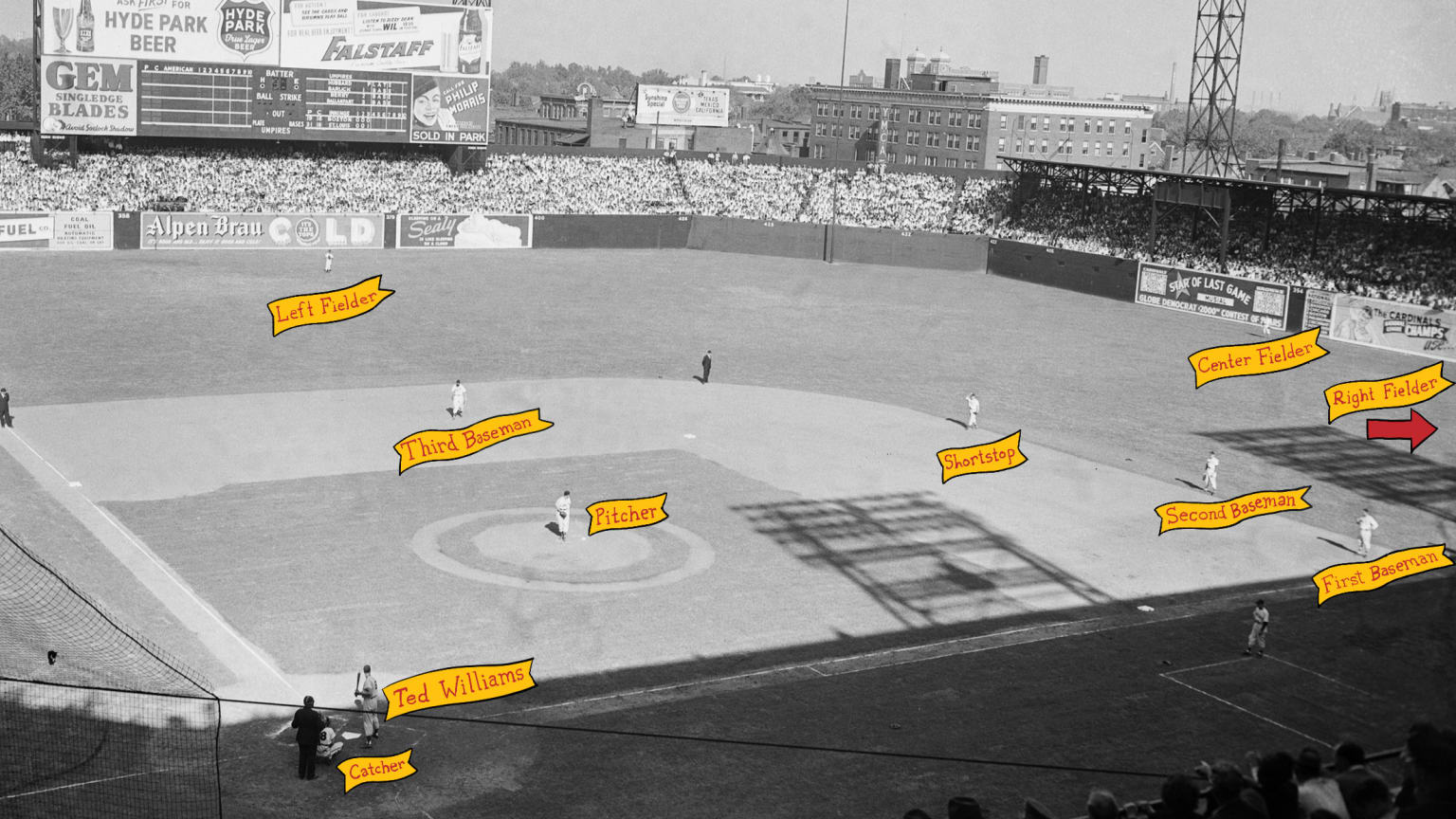
So how did an awful, D-III baseball team in the mid-90s presage baseball’s current defensive shift rage? It starts with the school’s basketball coach. His name is Gene DeLorenzo. Oberlin required coaches to help out in a second sport, so DeLorenzo helped out with baseball. He wondered how he could turn his awful baseball team into something a little more respectable. He looked at his own sport, basketball, and realized his baseball team needed to utilize motion, just like his basketball team did:

At a very basic level, basketball teams alternate between man-to-man and zone systems, and, within the zone, between 1-3-1 and 2-1-2 alignments. Football teams might use the 4-3 front or the 3-4 front. They might go nickel or dime or prevent, depending on the game situation and opponent strength.

In both sports, ultimately, defenses adjust to their opponents, provide multiple looks and cover ground out of practicality, not predestination.

The hard truth faced by the Yeomen was that opponents were pummeling their pitchers, smacking frozen ropes into the outfield gaps and enjoying a Gas House Gorillas-style conga line around the bases. Oberlin’s losses weren’t just routine; they were routinely lopsided.

So, DeLorenzo and Connolly thought, what if Oberlin made the type of adjustment that would be made in basketball or football?

“We wanted,” Connolly says, “to put people where we thought [they’d have] a chance to catch the ball or keep it in front of ‘em.”

So, they went extreme. Although they’d sometimes change things up, their base alignment had five outfielders. They put one infielder on each side of second base. Of course, they had a pitcher and catcher. They called it the flytrap. The idea was to close off the outfield to increase their team’s chance of catching a fly ball, and to limit hitters to a single when they hit a line drive.They even renamed the positions.
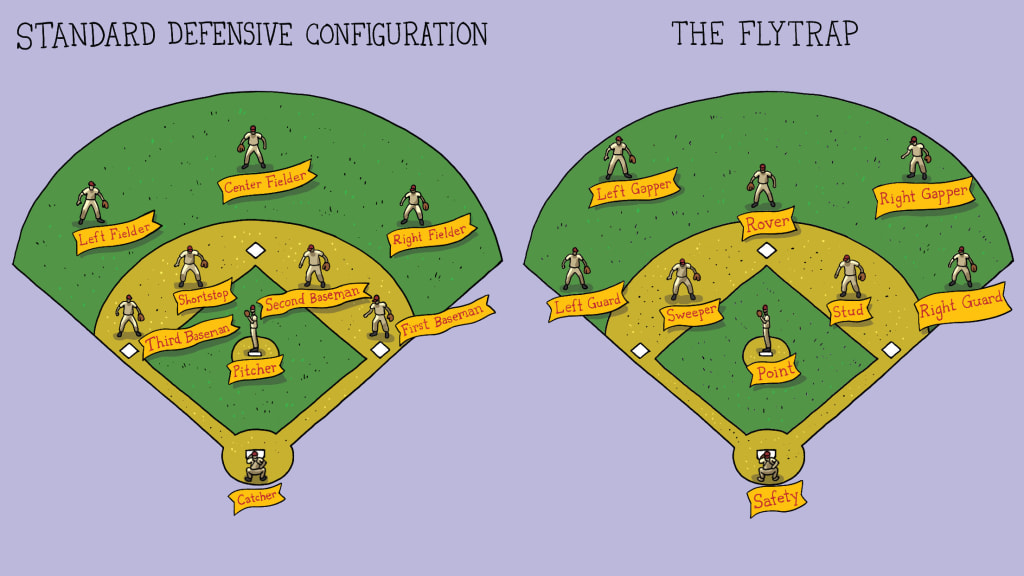
But Oberlin didn’t stop there. No, sir:

Of course, The Flytrap requires fly balls. To generate those, Connolly and DeLorenzo decided that the Oberlin pitchers could lob the ball, Rip Sewell-style, high over the plate to encourage the opposing hitter to swing up.

“We had to talk to the umpires to see if the strike zone included vertical versus just horizontal,” Connolly says. “So if the ball came down from on top of the plate, 10 feet high, is that considered part of the strike zone?”

They got the OK. They were ready to set the trap.

Of course, once they decided to implement it, they needed a little showmanship:

On Wednesday, April 20, 1994, the Oberlin baseball team took the field for the first inning of a doubleheader against conference foe Case Western Reserve University. The players trotted out to their traditional positions. All was calm and placid at Dill Field as left-hander Noah Pressler picked up the ball and put it in his glove.

But then Pressler, who was nicknamed “Moose,” stepped off the mound, turned his back to the batter, took a deep breath, and screamed, “Mooooooose!”

Suddenly, all of the Oberlin fielders sprinted to new spots. There were five outfielders. There were two infielders (Lytle at sweeper, Marbury at stud). The Yeomen had repositioned themselves so swiftly, so unexpectedly and so originally that all the batter could do was stand there, astonished and spellbound.

That is until he — and his entire dugout — started laughing.

Some of the Oberlin players were doing the same.

“I was laughing so hard, I had tears in my eyes,” Marbury says. “It was so ludicrous.”

You’re probably wondering how well the Flytrap worked. Not well, my dude! The other team still found holes because the Oberlin players were just that bad, and worse it was nearly impossible to defend against bunts or stolen bases. Oberlin played their last 4 games that season using the Flytrap. The cumulative score was 56-6, in favor of Oberlin’s opponents. 

Ah, well, nevertheless. 

Oberlin’s Flytrap may not have actually sparked the MLB shift rage. But it was certainly ahead of its time.

“Even in the last five years, we’re seeing so many changes in the game,” Sheehan says. “We’re seeing infielders in the outfield, we’ve seen teams take the pitcher and put him in left field, we’re seeing guys fill multiple roles, we’re seeing real two-way players. There’s definitely more athleticism and flexibility in the game. It’s a cool pendulum swing.”

The pendulum will quite likely never swing far enough for The Flytrap to mount a comeback. But last season, 185 plate appearances in MLB ended with the defense in a four-outfielder arrangement, including 86 instances in which a fifth fielder was positioned in the outfield grass, at least 160 feet from home plate.

To quote the Sandlot: Legends never die. -TOB

Source: This Terrible College Team Invented the Shift … Sort of,” Anthony Castrovince, MLB.com (02/27/2020)


Time for David Ayres to update the ol’ Linkedin profile

I love a good emergency goalie story, and h/t to Alex Denny of Brooklyn, NY for sending this our way. 

The emergency goalie story is a one of one in professional sports (at least that I can think of). A regular dude, plucked out of anonymity to play in a game at the absolute highest level. Where else does that happen? Emergency QBs are old NFL QBs. Baseball has several teams of minor leaguers to call up in a pinch. Basketball has a minor league, too. 

Most fascinating nugget from this story: I didn’t know that the emergency goalie in an NHL game is available to both teams playing. In 2016, the NHL instituted a rule requiring home teams to provide a list of emergency goalies, just in case. Just in case has happened several times in the last 5 years. 

Ayres was actually in the seats watching the game when he got the call. Other instances of emergency goalies have stories of them parking in public lot by Madison Square Garden (sheesh, get the dude a parking pass!) or having their phone blow up while getting a trim at “Mastercuts”. But Ayres was already at the game when Carolina’s starter and the backup were injured. 

Speaking to the tone the regular players set, Ayers said,“These guys were awesome. They said to me, ‘Have fun with it, don’t worry about how many goals go in, this is your moment, have fun with it.’”

After a rough start (he let in the first two shots) he settled in to get the W, not to mention setting a record in the process. At 42, David Ayres became the oldest goalie to win his N.H.L. debut. 

Ayres day job: Zamboni driver. – PAL

Source: A 42-Year-Old Zamboni Driver Wins in His N.H.L. Debut, A.P., 02/23/2020)

TOB: Loved this story. Love this video of the team in the locker room after the game (it’s the video of the week below).


Philly Phanatic Gets Work Done
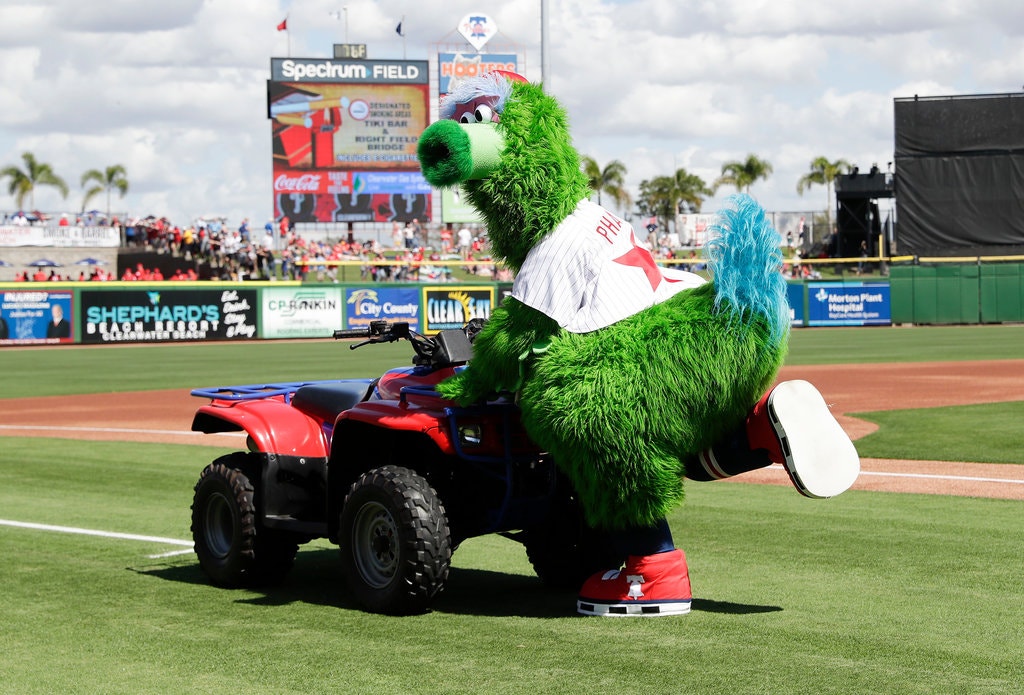
The ass is bigger. Dye job on the hair. And The Philly Phanatic is all-in on the thick eyebrows trend. Yes, the iconic mascot has received a makeover, and it’s because of a lawsuit. 

I’ve never been a mascot guy. They’re dumb. I put up with it at the collegiate level, but we can all agree it’s embarrassing in the pros. And take that “it’s fun for the kids” next door. All I can do is think about the poor sap, Cousin Greg style, in the costume sweating and getting poked. 

Some 40 years ago, the Phillies teamed up with a former Muppets designer in hopes of attracting the kiddos. 

In court papers filed in August, the Phillies said that Harrison/Erickson, the New York-based design and marketing firm that worked on the mascot’s design in 1978, improperly wanted to terminate an agreement over the Phanatic’s copyright.

The team said the firm was threatening to “obtain an injunction against the Phillies’ use of the Phanatic and to ‘make the Phanatic a free agent’” if the team did not pay the firm millions of dollars, according to court papers.

The firm replied in its own court documents that the Phillies did not have a claim to the Phanatic’s copyright and that the team had “no input into the design and creation of the Phanatic.” The firm said it “wanted to negotiate a re-granting of the Phanatic copyright to The Phillies for a fair price, to be negotiated.”

I’ll chip in $20 to have the Phanatic just go away forever. This one made me chuckle. – PAL 

Source: The Phillies Unveil a New Phanatic as  Lawyers Fight Over Mascot Copyright”, Mihir Zaveri, The New York Times (02/26/2020)


Video of the Week


Tweet of the Week


Song of the Week


Like what you’ve read? Let us know by following this blog (on the right side, up near the top), or:

Email: 123sportslist@gmail.com
Twitter: @123sportsdigest

Facebook

Instagram: @123__sports


“I thought your vagina was removed during your hysterectomy.”

-Dwight Schrute


Week of February 21, 2020

Amen.


Hallelujah! Aubrey Not Invited to Giants 2010 Reunion

For the record, I always sensed Aubrey Huff was a tool. His “rally thong” bit during the Giants’ run to the 2010 World Series, and the Zoolander-stolen “joke” at the championship parade that year, was just not funny. Huff did not take long to prove me right. 

His post-playing career descent started slowly. I caught him on his radio show a few times and confirmed what I figured: he’s an unfunny meathead. Which is fine. Plenty of people are that, athletes included. But it confirmed for me that I had no affinity for the guy, despite his contribution to a World Series championship.

It was over the last few years, though, that he really showed his true colors. It’s not the fact he supports Trump. I don’t like that, but I also know many of my very favorite athletes also likely support him. Instead, it’s Huff’s pure nastiness; his utter lack of humanity; his “durrrr, why are you so mad, I’m actually laughing” schtick every time someone calls him out for all of the above.

But Huff hit his nadir recently. He apparently went through a divorce in 2017 and claims that has taken the shackles off of him to be “less inhibited online.” I would never wish marrying Aubrey Huff on any woman, but is there any way we can find some way to put that genie back in the bottle? Because over the last two months Huff has gone completely off the rails. 

In November, he posted a tweet at a shooting range with the caption, “Getting my boys trained up on how to use a gun in the unlikely event @BernieSanders beats @realDonaldTrump in 2020. In which case knowing how to effectively use a gun under socialism will be a must.”

I mean, good lord.

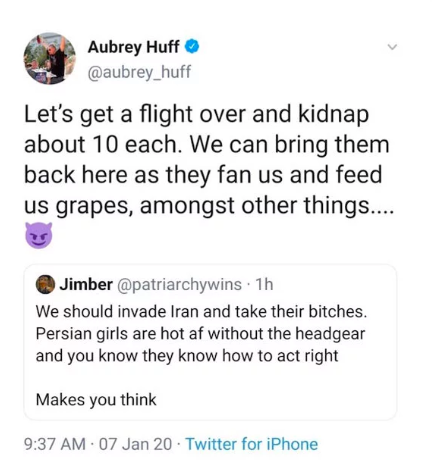
In January, he really hit rock bottom, though. In response to a dreadful tweet that said Americans should invade Iran and “take their bitches,” Huff tweeted, “Let’s get a flight over and kidnap about 10 each. We can bring them back here as they fan us and feed us grapes, amongst other things….” 

For the record, yes, Aubrey Huff joked about kidnapping and raping women.

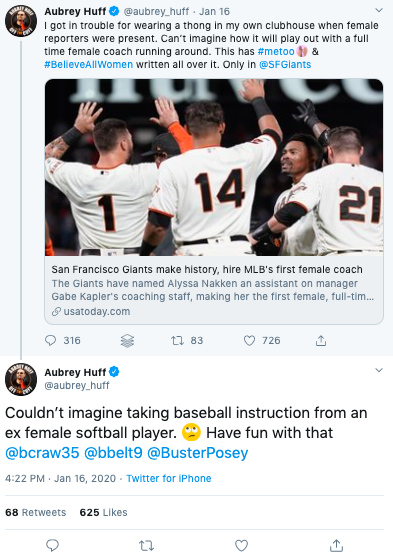
Then, after the Giants hired Alyssa Nakken, the first female coach in MLB history, Huff tweeted that he thought the hiring has “#metoo and #BelieveAllWoman written all over it.” He then tweeted he “couldn’t imagine taking baseball instruction from an ex female softball player,” while tagging Giants players Brandon Crawford, Brandon Belt, and Buster Posey, telling them to “have fun with that.”

I walked you through this recent history of disgusting behavior to set a foundation here: Aubrey Huff is a god awful human being. That’s important, because news leaked this week that the Giants informed Huff he was not invited to their on-field 10-year reunion of the 2010 World Series Championship. Huff responded as you might expect – he incorrectly claimed the Giants don’t support free speech, when this has nothing to do with the First Amendment, and he blamed the move on his support for President Trump (even tagging Trump in the post).

https://twitter.com/aubrey_huff/status/1229686896378499073

Huff, of course, is dead wrong. He’s been a vocal supporter of Trump for years, and the Giants did invite Huff to Bruce Bochy’s retirement ceremony this past September. Huff was there, and I remember because I am pretty certain I booed him (FREE SPEECH!). So what changed, for the Giants, between last September and now? That’s why I set that foundation above – what changed is that Huff crossed so many lines of decency.

Huff’s attempt to blame this on his support for Trump is pathetic. As pointed out by Grant Brisbee, the majority owner of the Giants is also a Trump supporter:

So we’ll first need to dispel the myth that Huff was disinvited because he vocally supports President Trump. This is an exceptionally ridiculous argument and it can be made only through ignorance or bad faith. The principal owner of the Giants is a confirmed Trump donor. Another member of the ownership group, and the widow of a previous principal owner, is holding fundraisers for him. You can be within the Giants’ orbit while still supporting the president.

No Aubrey, this has nothing to do with your political beliefs. You’re a pig, and you suck, and I am so so so glad you’ve had this honor taken away from you. Now, go away. -TOB

Source: The Giants’ Disinvitation of Aubrey Huff is Remarkably Uncomplicated,Grant Brisbee, The Athletic (02/19/2020)

PAL: He misses the attention he got from baseball, and he’s trying to fill the void in his life by saying stupid crap. This should be the last story written about him.


Cake Eaters Center of Hockey Universe


I join you while on assignment from the Minnesota State High School Girls Hockey Tournament (more on that next week), but this article – found on the ESPN homepage no less – was of particular interest while back in the motherland. 

The premise of the story, inspired by the 40th anniversary of the Miracle On Ice, is pretty clear: what are the USA hockey hotbeds today? Back in 1980, the USA Olympic team was made up of 12 Minnesota players (and most of the coaching staff), 4 players from Mass, and a couple from Michigan and Wisconsin. That’s it. No other states were represented. 

So, where are the hotbeds today? Anaheim, Vegas, St. Luis, and Nashville are new-comers. Makes sense. NHL markets with recent success experience bumps in youth signups. Infrastructure is needed, too. In other words, ice. 

We all know the center of the U.S. hockey universe is right here in Minnesota. No surprise. I don’t want a word from the Massachusetts contingent of my family. Not a word.

But then the article got real interesting. 

While there are other contenders for the throne, it’s hard to argue against the Twin Cities as the center of the hockey universe.

“Minnesota is the heartbeat,” Kelleher said.

But can we get even more specific?

Is there a center of the center of the hockey universe?

Consider this: USA Hockey says that the Twin Cities market pulled 10,922 of its total participants in 2018-19 from a region that includes Bloomington (estimated population 85,934), Eden Prairie (64,952) and a little, rather wealthy place ($99,295 median household income, per the U.S. Census Bureau) called Edina (54,791).

No one has captured more Minnesota Tier 1 boys’ state hockey championships than Edina, with 13. They also lost three times in the title game, and finished third three times. Edina also has won the Class AA girls’ hockey title for three straight seasons. 

Among the notable Edina High School alumni: Anders Lee and Kieffer Bellows of the New York Islanders; former Montreal Canadiens player Bill Nyrop; former NHL player Paul Ranheim; and former NHL executive Brian Burke.

“In the Twin Cities, it might be Edina,” said Tom Chorske, a Minneapolis-born former NHL player who’s now an analyst for Fox Sports North. “They win a lot at youth level and produce a lot of college players. A lot of Wild players live in Edina and their little kids are playing there.”

So there you have it: Edina, Minnesota. The center of the center of the hockey universe in the United States.


Edina. You’ve got to be shitting me. The inspiration behind “The Cake Eater Anthem”. On ESPN for the world to see. Maybe we’ve known it to be true in our hearts, but no one would want to admit it. 

It’s true. And I can’t stand it. Michael summed it up perfectly.  – PAL 

Source: “USA hockey hotbed heat check: What’s the center of the American hockey universe?”, Greg Wyshynski, ESPN (02/18/20)


Times Like These, I’m Proud to be a Giants Fan

While I realize the Huff thing is at least in part a business decision, I still like it. It makes me proud to be a fan of a team that will ban a clown like that. This story also makes me proud.

Earlier this year, MLB announced some much-needed though still modest raises for minor leaguers, to take effect in 2021. It’s not enough to give them a living wage, but it’s a start. The Giants, though, didn’t waste time. Instead of waiting until 2021, they announced they’d begin paying minor leaguers that raise now, in 2020. In fact, they gave some levels slightly larger raises. 

That’s all nice, and I am sure the players appreciate it. But more importantly, and as you may have noticed in the graphic, the Giants also announced that minor leaguers in AAA Sacramento and AA Richmond would all receive a $500 per month housing stipend, while players in low-A Augusta would receive free housing (if you’re wondering, high-A San Jose players will not receive the stipend because they are already placed with host families and live rent-free).

This is great! No other team offers a housing stipend, so it’s a big deal. Pretty cool move by the Giants. -TOB

Source: Giants Go Past MLB to Raise Minor-League Pay in 2020, Help With Housing,” Henry Schulman, San Francisco Chronicle (02/18/2020)


BASEBALL AND BEER. THAT’S WHAT ENO DOES.

We’ve featured stories from Eno Sarris many times before. Eno is awesome – he’s smart, loves baseball, and writes about advanced statistical analysis in a way that is easy to digest. But if you follow Eno on Twitter, you know that Eno also loves beer. This week, Eno published what I imagine was a labor of love – a detailed and thoughtful ranking of the beer options at all 30 MLB ballparks. Eno rated each stadium on three factors – top-end offering, average offering, accessibility, and then a compound rating of all three. Highly entertaining! Best in Show? Seattle, followed closely by San Diego, with San Francisco a smidge behind in third.

If you’re headed to a stadium this season, you might want to check Eno’s article first. -TOB

Source: “A Beer Nerd’s Guide to Baseball: Ranking Every Stadium by Craft Beer Offerings,” Eno Sarris, The Athletic (02/19/2020)

PAL: That’s just great reporting. My favorite nugget, from San Diego:

“There’s a beer made for the park. In fact, there are (kind of) two. AleSmith’s .394 Pale Ale — named for Tony Gwynn’s batting average that fated 1994 season — is the original gangster, but you can get that all over San Diego and not just at the park.”

Now that’s a great name for a beer.


Video of the Week


Tweets of the Week


Song of the Week

Harry Styles – “Sunflower, Vol. 6”


Like what you’ve read? Let us know by following this blog (on the right side, up near the top), or:

Email: 123sportslist@gmail.com

Twitter: @123sportsdigest

Facebook

Instagram: @123__sports


“You know, I really would have appreciated a heads up that you’re into dating mothers. I would have introduced you to mine.”

– Dwight Schrute

Week of February 7, 2020

Still got it.


The Red Sox Trade of Mookie Betts is Outrageous

Mookie Betts is 27, one-year removed from an astounding 186 OPS+, 10.9 WAR, MVP-winning season in 2018 (which he followed up with a 6.8 WAR in 2019). The Red Sox traded him this week, to the god damn L.A. Dodgers, for pennies on the dollar. Why? In short, because they are cheap.

Betts will be a free agent after this season. He reportedly turned down a 10 year, $300M offer from Boston. That’s obviously a lot of money, but it’s the same deal Manny Machado signed for, and less than Bryce Harper signed for, and Betts is just…a lot better than both of them. An incredible hitter, a great defensive outfielder, a marketable personality, and a megawatt smile. He’s worth much more than Machado or Harper, and as a market setter for future players, he was right to turn down that money. He’s going to get way more this winter.

So the Red Sox will save upwards of $400M over the next decade by trading him, not to mention the $27M he was set to make this season. In the deal, they also unloaded David Price. Price’s best days are behind him, and he has 3 years and $97 million left on his contract. In return they got Dodgers outfielder Alex Verdugo who is good, but not great, and (probably) Twins pitcher Brusdar Graterol, a dude who throws 103 MPH smoke. Both guys make very little. So that’s roughly $60M they save this season. But that’s not quite right. Amazingly, the Dodgers got the Red Sox to pay fully half of Price’s remaining money. 

To recap, the Red Sox decided they didn’t want to pay a generational, home grown talent like Betts, so they dealt him and Price for two good but not great young players, and kicked $50M in for the Dodgers’ troubles. Swell.

The trade has been the biggest story in baseball this week, and the general consensus is that the Red Sox front office should be ashamed. As Grant Brisbee put it:

The Red Sox agreed to trade Betts to the Dodgers on Tuesday, and they should be embarrassed. They aren’t. But they should be. You’ll read about how this gives the team “financial flexibility” and how it’s important for them to “stay under the luxury-tax threshold.” That’s all crap. The Red Sox print money. The bills have pictures of Lou Merloni on them and they have bags of cash buried under each corner of Fenway Park. So much money.

As Brisbee points out – this is the friggin Red Sox. This isn’t the Rays, or the Tigers, or the Reds, or the Indians. This is a huge market deep with deep pockets that can spent any amount they like. They made their team worse now, and they made their team worse later. It’s hard here to argue they cleared money to spend on free agents later. They had the best free agent, as a homegrown talent, and decided not to pay him his fair market value. The Ringer’s Michael Baumann put it bluntly:

This trade is a disgrace for the Red Sox and for the league. I don’t understand why the owner of such a prestigious ball club—a de facto public institution—would charge his baseball operations department with ridding the team of a once-in-a-generation player when he could keep that player and continue to rake in unspendable profits. It’s such a mind-bogglingly greedy and self-defeating move that I resent being made to try to understand it.

I’m in favor of smart baseball, but if the Red Sox of all teams are going to do this, it does not bode well for the direction of the sport. And if your team tries to do the same, you should be angry. -TOB

Source: If the Giants Ever Do What the Red Sox Just Did With Mookie Betts, You Should Not Be Very Happy,” Grant Brisbee, The Athletic (02/05/2020); The Utter Disgrace of the Mookie Betts Trade,” Michael Baumann, The Ringer (02/05/2020)

PAL: Ryen Rusilllo made a good point about the Betts trade at the top of his podcast this week. That’s the best the Sox could get back for Betts – a friggin’ prospect pitcher with elbow issues and a borderline big league starter in Verdugo? B.S. 

If Betts flatout didn’t want to be there – fine – but wait for a better offer at the trade deadline. Let other teams feeling a little desperate and just close enough to a playoff race get in the mix!

And Brisbee has his fastball going in his article. I especially appreciated the idea of the obligation around keeping the rarest of players: home-grown Hall of Famers. 

Both things can be true. Both things should be true. You buy tickets and shirseys and they keep the 20-somethings on a Hall of Fame path. It’s not complicated. The Giants probably aren’t going to sign their next Brandon to a five- or six-year extension to lock him up deep into his 30s, but they should still do it with the next Buster. Or the next Mookie, if they have one. They probably won’t have one soon. Which is the point.

Now if you’ll excuse me, I need to take a big sip of battery acid and stare at the Dodgers’ projected lineup for next season.


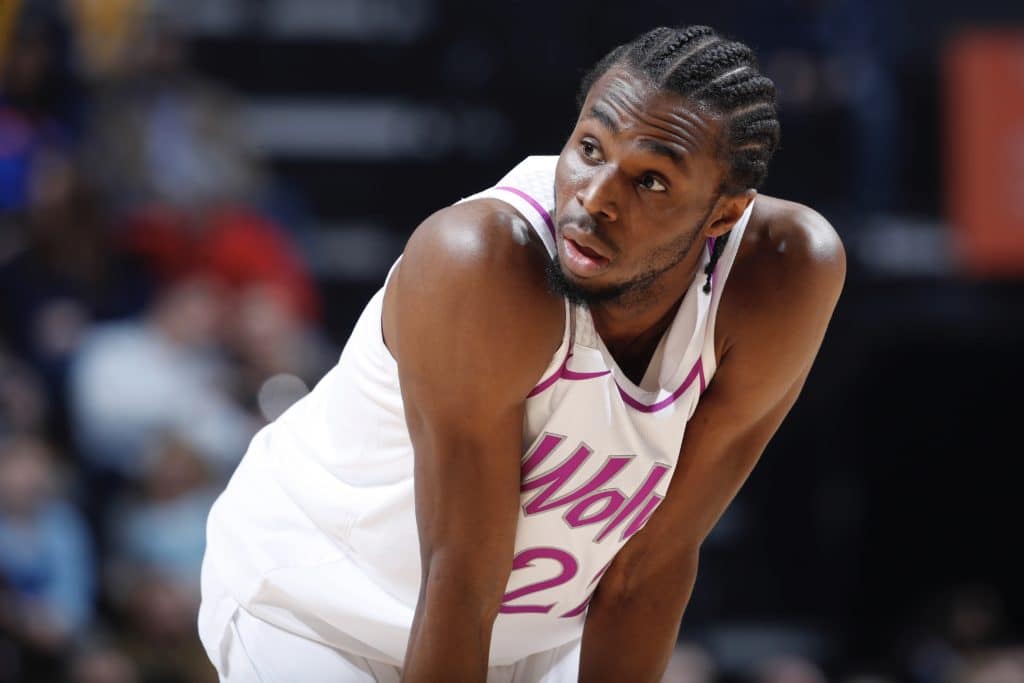
The Warriors suddenly face a vital challenge: Can they awaken Andrew Wiggins?

No. – PAL 

Source: “The Warriors suddenly face a vital challenge: Can they awaken Andrew Wiggins?”, Anthony Slater, The Athletic (02/06/2020)

TOB: First of all, LOL. Phil’s post made me actually laugh out loud. But, second and super seriously – I disagree. Phil may recall that when Jimmy Butler left Minnesota, he more or less called Karl Anthony Towns a soft player and a loser. People thought Jimmy was a jerk, but I sided with him. KAT is soft, and he is a loser. I said within 2 years, history would prove him right, and I think it has. Wiggins was never going to be good playing next to KAT. He might be good playing next to Curry, Klay, and Draymond. I also think this is a smart play by the Warriors if they think their championship window with Steoh and Klay is still open. Wiggins’ game complements those two much more than DLo does. And, if the Wolves continue to suck as much as I think they will, that first round pick they got should be very good.


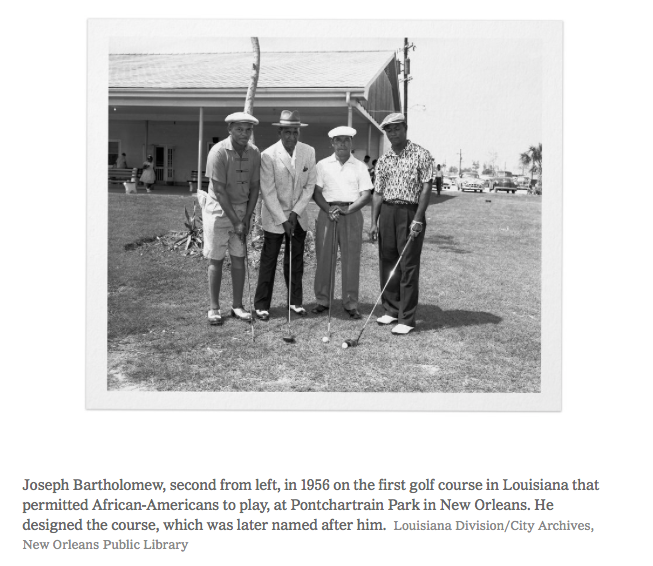
The Golf Course Architect Who Couldn’t Play His Courses

I think this will be the second story I’ve posted from the “Overlooked” series by the NY Times. I can’t help it. Such a great idea. 

A refresher: Overlooked are obituaries (written today) for folks that didn’t receive them at the time of their death. 

Joseph Bartholomew more than earned his NY Times obit honor. He spun a childhood job as a caddie into a career as a golf course architect. He designed many courses throughout the south, and it wasn’t until he built the first municipal course for african americans that he was allowed to play on a course he designed. He was good enough to be the club pro and teach lessons at country clubs, but wasn’t allowed to play the courses. 

What did he do? The same he did as a caddie. He listened and learned. After building courses, he got to know guys from whom he rented the construction equipment. Then he started a construction company, specializing in drainage (a good specialty in Louisiana). He took those profits and turned to life insurance, then real estate – which was smart because he also owned the construction company with the equipment necessary to upgrade the acres. Oh, and he built an ice cream factory, too. 

His key to success: embrace the risk, which was not so simple to follow the Jim Crow south.  “That’s the difference between me and most of the rest of the colored people. They won’t take a chance because they’ve been skinned before. I take ’em all the time.”

Joseph Bartholomew: August 1, 1888 – October 12, 1971. 

I’ll say it again: “Overlooked” is one of the best ideas I’ve come across. – PAL 

Source: Overlooked No More: Joseph Bartholomew, Golf Course Architect”, Roy S. Johnson, The New York Times (02/05/20)


Video(s) of the Week:

https://twitter.com/akkitwts/status/1223961944006119424?s=20


Tweet of the Week:


Song of the Week: Jose Feliciano – “Just A Little Bit Of Rain”


Like what you’ve read? Let us know by following this blog (on the right side, up near the top), or:

Email: 123sportslist@gmail.com
Twitter: @123sportsdigest

Facebook

Instagram: @123__sports


I got away with everything under the last boss and it wasn’t good for me. So I want guidance. I want leadership. Lead me… when I’m in the mood to be led.

-Ryan  ‘Fire Guy’ Howard


Week of January 31, 2020

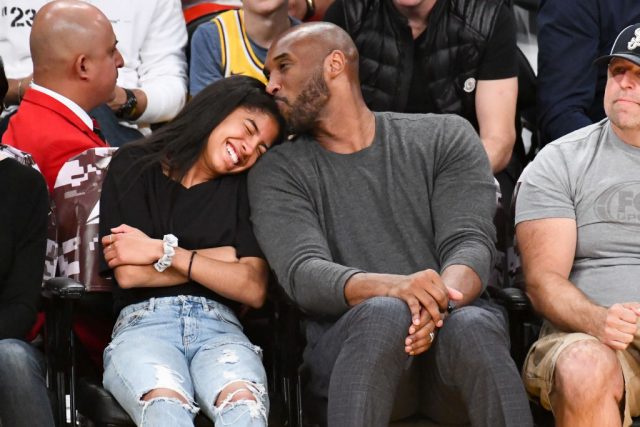
Kobe Bryant’s Death Strikes at a Parent’s Worst Fear

I first learned the news of Kobe Bryant’s death, just minutes after the story first broke, in a text message from my friend Murph. “Is this Kobe news real?” he asked. I had no idea what he meant. I was at a restaurant, with a playground in the back, throwing a football to my sports-obsessed 5-year old. I immediately went to Twitter and typed in Kobe. “Holy shit,” I replied to Murph. “I hadn’t seen.” I threw my son a few more passes and struggled to figure out my reaction.

I was never a Kobe fan. He was a Laker. He was not as good as MJ. I liked T-Mac more, then LeBron more. That “Mamba Mentality” always seemed fake to me – it always struck me that he was not a sports “killer” like MJ, but felt like he needed to be, and it seemed insincere. He gave himself nicknames, for heaven’s sake. He was also credibly accused of rape, and it’s never ceased to amaze me how quickly people chose to ignore that. But upon hearing of his death, I was still in shock. This was Kobe. He wasn’t MJ, but he’s a top-10 player of all-time. He was still so young and vibrant. And now he’s dead? 

Right about that moment my wife walked outside from the restaurant; she and her friends had heard the news from one of the employees while awaiting our food. They asked me if it was reported who else had died. A few seconds later I read that Kobe’s 13-year old daughter, Gianna, was also killed in the crash. It hit me like a ton of bricks.

Over the next 24 hours I read thousands of words on Kobe. Many articles focused on Kobe the basketball player; others on Kobe the person after basketball; others on Kobe the accused rapist; perhaps most were on Kobe the dad. 

By all reports, Kobe was a doting father to his four daughters. When he died, he was taking the helicopter with Gianna, along with her teammate and the teammate’s parents, to Gianna’s basketball tournament. He had become a champion for women’s basketball – encouraged by Gianna’s love of the game, he even said recently that two or three specific WNBA players could play in the NBA right now. It was Gianna’s death, and his death as a father not as a basketball player, that I kept coming back to. 

I was struggling to verbalize my thoughts. And then I found this article by Henry Abbott. Abbott was one of the original basketbloggers. Abbott started True Hoop in 2005, which was later purchased by ESPN. In that role, Abbott covered Kobe quite a bit, including once when he really angered the Kobe stans in 2014.

But Abbott didn’t write about Kobe the basketball player. He didn’t even really write about Kobe the father. He wrote about how for Henry, as a father himself, Kobe’s death helped crystalize how becoming a parent, and the fear of losing your child, changes a person so fundamentally. Coincidentally, that very morning, Henry had read an article about the very subject by Claudia Dey, in the Paris Review. From Dey’s article:

No one had warned me that with a child comes death. Death slinks into your mind. It circles your growing body, and once your child has left it, death circles him too. It would be dangerous to turn your attentions away from your child—this is how the death presence makes you feel. The conversations I had with other new mothers stayed strictly within the bounds of the list: blankets, diapers, creams. Every conversation I had was the wrong conversation. No other mother congratulated me and then said: I’m overcome by the blackest of thoughts. You? This is why mothers don’t sleep, I thought to myself. This is why mothers don’t look away from their children. This is why, even with a broken heart, a mother will bring herself back to life.

I read that excerpt and realized immediately why the Kobe news affected me: not because a famous person died; but because an innocent young girl lost her life, a father lost his life, and three daughters and a wife were left forever changed. The lives of the surviving family will never be the same. As Draymond gets at below, as a parent, this is your worst fear shoved right in your face. 

I have been a dad for 5 years, and three times in those 5 years I’ve thought my oldest son might die. First, in a scary few minutes during labor. Second, when he was two and fell down a few stairs, seemed fine, and then coincidentally had a febrile seizure three hours later, brought on by a mild virus. Third, about eight months later, when he fell head first out of our second story window while chasing a ball, somehow landed in a flower planter barely wider than his body, with bricks and cement on either side. He managed to land on his upper back, but not his head or neck, and on the dirt, not on the cement or bricks.

I’ve seen the video of that last one. We have an outdoor camera that caught it all. The window screen pops off. A ball bounces out. And then a tiny, half naked body tumbles down. It’s disturbing and eerie and I sometimes wish I’d never seen it. But it was immensely helpful for the doctors, who were able to see exactly what happened.

I thought of that day when I heard the news that Kobe’s daughter died with him. I’ll never forget the terror I felt when our nanny called me, as I emerged from the BART station by our house, and she sobbed out what had happened. I’ll never forget wanting to scream at the Uber driver to hurry the hell up because my son had fallen out of a window and I needed to get home. I’ll never forget not being able to get ahold of my wife, who was at a work event, and texting “911” to her. I’ll never forget, when I got home, running across the street, up to the house and looking up at the open window, sprinting over the screen lying across the front entry stairs, terrified about what I was about to walk into. 

But what I walked into was a miracle. He was, somehow, fine. Scared, shaken, but fine. The doctors thought he had a little whiplash, and he had some bruises on his upper back. But he more or less walked away from an incident that would have killed him, if he had fallen an inch or two to the left or right. 

An inch or two to the left or right, and our family is the Bryant family – devastated, forever changed, possibly disintegrated. I live with that thought every day. Every single time I look at that planter, I think about how close we came. As Abbott emphasizes, as a parent, that fear of an inch or two to the left or right never goes away. 

For Abbott, the hours after he heard the Kobe news illustrates that:

The drive home from the rock climbing gym is only a few minutes. We stopped at Lowe’s …. It seemed like all the cars in the parking lot were some mix of dads and moms and daughters and sons and jeans and shopping carts and conversations, all on their way to patching up little broken things. We crammed the new toilet in the hatchback and made our way home. I tried to concentrate on the road as my learning-to-drive daughter drove (more vigilance!), but my mind wasn’t much on cars. It was swirling with helicopters. Circling death.

A few hours earlier, Kobe was a Sunday dad, bopping to a sports thing with his young teenager. Terrible questions emerge about the deadly sequence. Did the helicopter first have trouble? Were there terrifying minutes, when those poor nine people grew increasingly sure they might die? Did father and daughter hold hands? Would you? What would you say? Is it enough to just cry and cry and hug and say I love you? Is there something more momentous?

Or was it all instant? What’s better?

I don’t know what’s better. I don’t know how many times Kobe almost went down in a helicopter. I don’t know how close the pilot was, this time, to preventing this crash; to hitting that inch or two to the left or right that had everyone on that helicopter walking away safely, exhaling deeply, and telling the story for the next few decades of the time they were all worried they were about to die before they didn’t.

But I do know, for all his triumphs, for all his flaws, the news of Kobe’s death hit me hard because it reminded me how fragile life is, and how terrifying that is for a parent. I feel for Vanessa Bryant, who will never be the same, having lost a child and a husband; I feel for their oldest daughter who will forever miss her dad and her sister; I feel for their two youngest daughters, aged 3 and 0, who will never know either. -TOB

Source: This Is Why Mothers Don’t Sleep,” Henry Abbott, True Hoop (01/27/2020); 

PAL: When a public figure dies suddenly, the initial reaction is out of your control. I had no particular interest or fandom of Kobe Bryant, but I will remember where I was, how I found out –  sitting alone on our stoop, stunned. That haze stuck with me into the next day, and then I was wondering why. Again, not a Laker fan, not a Kobe fan. 

And, just as Abbott describes above, I realized I was on the worst of it in the helicopter, and trying to imagine being a father in that moment. I couldn’t help but picture it, and I couldn’t help seeing it. I mentioned it to Natalie, and she stopped me mid-sentence.

It’s the father and daughter dying together in such a scary way. It’s got very little to do with their names. 

And I just want to mention on our little site – and I’m not saying others haven’t mentioned it  – but this is every bit as terrible for the Chester, Altobelli, Mauser, and Zobayan families. Send a little love their way, too.

Over the last day or two, my mind has shifted to Bryant’s wife. Man, Abbott isn’t lying when he says, “It’s Vanessa Bryant who just took the first step in a devastating ultramarathon.”

And one other line from the Shea Serrano’s article referenced later in the post:

Death arrives by generation, I’ve told myself. They go and then we go, I’ve told myself. That’s the order, I’ve told myself. That’s how it’s going to go because that’s how it’s supposed to go, I’ve told myself.

But no. That’s not true either.

TOB: I just wanted to add – shortly after my son’s fall, we installed safety bars on all the windows on our second story. I highly recommend them if you have young children and live in a house with more than one story.


Best Super Bowl Story I Found This Week

A lot of profiles and backstories about players leading in to the Super Bowl this week – Mahomes’ legendary high school pitching duel, George Kittle and his dad’s pre-game letters – but this one is by far my favorite. 

How about this Super Bowl history, per Benjamin Hoffman of the NY Times: 

Super Bowls are typically littered with tales of random connections, but few can match a parallel between this year’s teams: Both the 49ers and the Chiefs have starting left tackles who were first-round picks out of Central Michigan, and both gained more than 75 pounds in college to make that happen. It is just the second time in 54 Super Bowls that both starting left tackles came from the same college, a rarity made especially surprising since Kansas City’s Eric Fisher and San Francisco’s Staley are the only first-round picks in Central Michigan’s long history.

Second time in history, and they come from Central Michigan? Crazy! Or is it?

[I]t was no coincidence that Staley and Fisher had gone through such radical transformations during their years in Mount Pleasant. As a Mid-American Conference program that did not have the recruiting machines of college football’s heavy hitters, Central Michigan had to look for players who had the frame for a position, even if they were still lacking the necessary bulk.

Makes  perfect sense. Out of necessity, an mid-major needs to look for athletes and a frame, not a finished product. Staley was a tight end and sprinter. Fisher was a skinny wide receiver coming out of high school. Add weight to the athlete, and now you’ve got a chance at a special lineman. 

It’s no joke. Staley was a friggin’ sprinter in highs chool (dude ran 200 in 21.9 seconds in high school!). Or how about this: 

It is not all talk. At his pro day in 2007, Staley’s 20-yard split in the 40-yard dash was just 0.01 of a second slower than the one recorded by Kansas City’s Travis Kelce in 2013, and just 0.08 slower than the one recorded by San Francisco’s George Kittle in 2017, despite the 305-pound Staley’s outweighing both All-Pro tight ends by 50 pounds.

I knew none of this, and I find it so impressive. O-line: studs. A fun, light read this week. Needed it. – PAL

Source: “Central Michigan’s Left Tackle Factory (Some Assembly Required)”, Benjamin Hoffman, The New York Times (01/29/2020)


Other Articles on Kobe I Liked

Kobe and Gianna,” Shea Serrano, The Ringer (01/30/2020) – Shea Serrano also wrote beautifully on the topic of how being a parent made the Kobe news hit especially hard. This was my very favorite, but I had already done my story above before I found this.

Kobe Bryant’s Death Hit Me Hard, and Even Worse Because of What We Had in Common,” Marcus Thompson, The Athletic (01/27/2020) – I read this almost immediately after finishing what I wrote about Kobe, and Thompson echoes many of my sentiments.

‘It’s a Loss That You Can’t Replace’: On the Legacy of John Altobelli,” Fabian Ardaya, The Athletic (01/26/2020) – on John Altobelli, the father and baseball coach also killed, along with his daughter and wife, in the crash.

In the Wake of Tragedy, I Turned to Jerry West to try to Make Sense of Kobe Bryant’s Life and Legacy,” Sam Amick, The Athletic (01/26/2020) – Amick, who covered Kobe for years, on Kobe’s life legacy, the mistakes he made, and how he tried to atone for them.

Two Things Can Be True, But One Thing Is Always Mentioned First,Jeremy Gordon, The Outline (01/27/2020) – In the wake of his death, how we talk about Kobe, the 2003 rape accusation against him, and what it all says about us.

Remembering Gigi Bryant,Molly Knight, The Athletic (01/26/2020) – A memoriam for Gianna the person, not the daughter of Kobe Bryant.

A Wake Held in Blissful Ignorance: Appreciating Kobe’s FInal Days,” Bill Oram, The Athletic (01/26/2020) – particularly this passage:

LeBron James passing Kobe Bryant on the NBA’s all-time scoring list in Philadelphia should have been nothing more than a happy coincidence. Now it’s a cruel twist of fate.

Dwight Howard calling on Bryant to assist him in next month’s dunk contest should have just been another delightful chapter in Howard’s Lakers reclamation. Instead, it’s a reminder that not all stories get to come full circle.

Those moments from recent days now feel like the universe was screaming at us. Grabbing us by the hair and pleading: “Remember this man! Take this moment to appreciate him! He won’t be here much longer.”

Bryant’s helicopter crashed into a hillside in the Santa Monica Mountains on Sunday morning, killing all nine people aboard, including his 13-year-old daughter, Gianna. The sudden manner in which Bryant died makes the celebration of his basketball career that played out over the last few days all the more poignant.

Typically, only when a man dies slowly will his final days be filled with eulogies. But it is difficult now not to look back upon the days before Bryant’s death as a wake held in blissful ignorance — a chance to celebrate the man without the burden of grief that will now be impossible to shed.

As James closed in on Bryant’s career scoring total of 33,643 points, clips of Bryant in full poetic motion were dusted off and played on a loop. When James took the court Saturday night, it was with “Mamba 4 Life” scrawled on his sneakers.

In the locker room after the game, James spoke for several minutes uninterrupted about Bryant giving him a pair of shoes when they met for the first time in 2002 at the All-Star Game, also in Philadelphia.

“The story is too much,” James said as he retold it, marveling at the symmetry of their careers.

James idolized Bryant then passed him on the scoring list in a Lakers uniform in Philly. Wow.

“It’s surreal,” James said. “It doesn’t make no sense, but the universe just puts things in your life.”

When Howard, sitting at his own locker, tried to give James his proper due for the achievement, he uttered these chilling words: “We don’t appreciate each other as much as we should as a humanity. And I think something like that should be appreciated. You should appreciate people while they’re alive.”

Oram’s point is a good one – those quotes from LeBron and Howard are from the night before Kobe died, but they sure seem like they came after he died, don’t they? -TOB


Video of the Week

https://twitter.com/ringer/status/1175880603201204225?ref_src=twsrc%5Etfw%7Ctwcamp%5Etweetembed%7Ctwterm%5E1175880603201204225


Tweet of the Week


Song of the Week

Miles Davis – “So What”


Like what you’ve read? Let us know by following this blog (on the right side, up near the top), or:

Email: 123sportslist@gmail.com
Twitter: @123sportsdigest

Facebook

Instagram: @123__sports


“I wanted it to be my Playboy mansion. A temple to wine, revelry, sex, intrigue… this was hot on the heels of Eyes Wide Shut, mind you. Then I met my wife, she moved in, made it her own. Now she’s left me and forced me to sell the place. The ultimate insult? They’re calling my speakeasy lounge a rumpus room.”

-Robert California

Week of January 24, 2020

Larry Walker? Borderline Hall of Fame Baseball Player. Larry Walker’s T-Shirt? First Ballot, Unanimous Inductee.


A Moment for College Nostalgia

Other than this article being written by top-shelf sportswriter Wright Thompson, this story really has nothing to do with sports. I just love the way he writes. This story, posted on the University of Missouri website, is about why we return to our old college haunts, what we’re looking for, and the hold our college days have on us.  

Returning to such places puts us all across a narrow table from our younger selves. Ordering a slice or a burger and sitting knee to knee with me minus 20 years, stripped of my mask and its justification, is a rare gift. We almost never get to get reacquainted with the best version of ourselves, at this place where dreams began, before they got exposed to life and started to decay.

In May of 2018, I joined my college buddies Netter, Shaff, Wiess, Ivy, Barbershop, and O in Sioux Falls to watch our baseball team begin their march to an incredible Division II National Championship. I hadn’t been back on campus for at least 15 years. It was inevitable that we found ourselves at Crow Bar on 41st, and I was giddy – to be back there, back with those guys, back in the rhythm of conversation only found with people who knew me then. While in the moment I didn’t consciously think we were back in the place where dreams began, it resonates indefinitely. 

For Thompson, there was also a special connection between he and his old-timer friends who worked the student newspaper back in the day (Mizzou has a pretty renowned journalism program) and the kids pumping out the stories for the paper/site today: 

Four years ago, a group of us flew back to Columbia in the last week before the original Shakespeare’s closed for demolition. We got a suite at the Tiger Hotel to act as home base, should we need a locale for late-night shenanigans. The first night, we emailed the Missourian sports reporters and invited them to meet us at Booches. They asked questions, we told stories, and all of us imagined a different world that seemed far away. I’m putting words in their mouths, but I suspect they wanted to be us and we wanted to be them.

If this story doesn’t trigger a little college nostalgia, then I don’t know what the hell to tell you. Wonderful read. – PAL

Source: Who Was I In College?”, Wright Thompson, new.missou.edu

TOB: I actually think this is so much more than college nostalgia – it’s about life and aging and death; it’s about pace of life and the not spending the time to enjoy the moments we should be enjoying because we’re too busy thinking about what’s next; it’s about the fleeting nature of memory. Here are my two favorite passages from a great piece:

After running a thousand miles a minute for going on 20 years now, today takes up so much of my energy that it can be a struggle to remember. Maybe that’s why I’m so obsessed with it — and why I love just spending a day at Booches and Shakespeare’s. And yes, I often hit both in the same day. I’m not trying to make new memories as much as I am visiting old friends who grew up and disappeared a long time ago. I want back some of what I’ve forgotten or misplaced.

Sometimes the fragments come in pairs. I’m at Booches with my dad talking over my classes and my future; then he’s been dead 15 years and I can’t remember the sound of his voice. I’m 43 and with my toddler daughter, and, in her eyes, I suddenly see my father and hear his voice again as she tries to find hers. I’m standing in line with friends for Shakespeare’s slices between classes; then it’s nearly two decades later and we are back with our sons and daughters. It’s senior year and we are at the round window table at Booches, wondering if we might ever find success; then we are at that same table as middle-aged adults returning for a speaking engagement, surrounded by students wanting to know how we went from their seats to ours. Time really is a construct, a fragile one at that. One of my Mizzou professors, George Kennedy, is standing at the end of the bar eating a tenderloin sandwich for lunch; then a decade later, he’s still standing there.

He’ll always be standing there.

The bartender at Booches nods at me when I come in, even if it’s been years, and a small, nihilistic part of me knows that the change that’s come to downtown — do you remember coffee at Osama’s or whiskey at Widmans — could one day overtake Shakes and Booches. Columbia is changing. We are all changing. Magazines like this one print class notes in the back, where we get to see who got married, who got promoted and who hit the big time. I’m 43 now, and my friends are all around the same age. Sometimes it feels like we spend 45 percent of our lives trying to be something, 10 percent of our lives being it and 45 percent having been it. We are at the top of the mountain for another decade or so, and then we’ll start the slide down. We rise together, and we fall together. Those class notes will include marriages, children, announcements of retirements, notices of death. But at the two most important restaurants in our old college town, all that is left outside the door. As long as we can go back and wander through the rooms of our past, we can pretend that future will never arrive. It’s pizza time for all of us. There’s time for all of us. There’s always time.

Great find, Phil.


Giants Hire First Uniformed Female Coach

Last week, the Giants announced they had hired Alyssa Nakken to be an assistant coach on manager Gabe Kapler’s staff. Nakken, 29, will throw patting practice and hit fungoes. She will wear a uniform on the field. She is the first woman to ever be hired as a coach to an MLB staff ( there are now a few female assistant coaches in the NBA, and one in the NFL – you may have seen 49ers coach Katie Sowers’ American Express commercials during the NFL playoffs).

If you’re wondering if Nakken is a token hire – I think that’s a fair reaction. But it does not appear she is. Nakken played college softball at Sacramento State and was named all-conference four times. She began a graduate program at USF in sports management, and from there landed an internship with the Giants’ baseball operations department. After her internship, she coordinated the Giant Race program, and continued to work in baseball ops.

Still, a 29-year old with that experience, male or female, is an odd choice for an assistant on a major league coaching staff. But if this is a token hire, Kapler has shown quite the commitment to tokenism:

[Kapler] was seeking to put together a staff that embraced diversity in every aspect.

“Diverse in thought, in background, in ethnicity, in socioeconomic experience,” Kapler said. “We just wanted to create as diverse a staff to the degree we were able so that we can be a reflection of the players in our clubhouse and also in our community.”

Kapler’s staff includes an Bahamian former player (first base coach Antoan Richardson), a 32-year-old native Hawaiian who has never played a professional game in the majors or minors (bench coach Kai Correa), a veteran with 26 years of major-league experience (third base coach Ron Wotus), a native Spanish speaker from Puerto Rico (quality control coach Nick Ortiz), a hitting director whose grounding is in biometrics (Dustin Lind) and a 29-year-old hitting coach who will be younger than Belt, Buster Posey and Brandon Crawford (Justin Viele).

This is anti-cronyism. Whether Kapler ends up being a successful manager for the Giants or not, I will say this: he’s doing it his own way. 

“The really important message is that experience comes in all shapes and sizes,” Kapler said. “You look at our coaching staff and the immediate reaction is that it’s young and somewhat inexperienced, and traditionally, that’s true. But experience is also having a perspective that is wide ranging and diverse, and that includes having taught people at many different levels and ages and many different backgrounds.

“A lot of our coaches have a long history of consistent and diligent coaching. It just isn’t, like, stopping in the Gulf Coast League or Arizona League and then moving to Low-A ball and then to Double A. They just have a more diverse teaching and coaching experience.”

Again, whether he succeeds or not, I think that’s an extremely smart philosophy. Regarding Nakken specifically, Kapler had this to say:

“She’s an elite athlete and can translate those skills to help our players get better,” Kapler said. “She’s resourceful, a good communicator, organized and clear in her thoughts and delivery. Before this job is anything, it’s teaching. She brings a well-rounded skill set that is unusual to find in a coach.

“And she’s extremely equipped to execute initiatives. Part of coaching is managing very large projects, which she’s done in the past. All of those things are important when you’re developing players and developing a culture.”

This makes sense to me. Certainly, some experience with the game is important, but the best teachers and coaches were not always the best players. So many other skills are required in order to teach. And once you come to that conclusion, it’s idiotic to limit your pool of candidates to 50% of the population. Nakken is the first female coach on a major league staff, but she will not be the last.

For her part, Nakken has been quiet – the team is shielding her from interviews as she gets acclimated to her new role. But, I’m excited to hear from her, and I hope her presence and teaching pay off. -TOB

Source: Woman in Uniform: New Giants Coach Alyssa Nakken Makes Major-League History,Andrew Baggarly, The Athletic (01/16/2020)

PAL: Progress isn’t perfection on the first pass. I think her softball experience is less important than her track record while an intern and coordinator with the Giants. And having a diverse staff has been proven valuable by any measure in any workplace. It’s cool to see the glass ceiling in the big four sports leagues, and it’s incredible to know my college friend, Teresa Resch, is a part of this movement.


W.N.B.A. Star Sits Out Another Season 

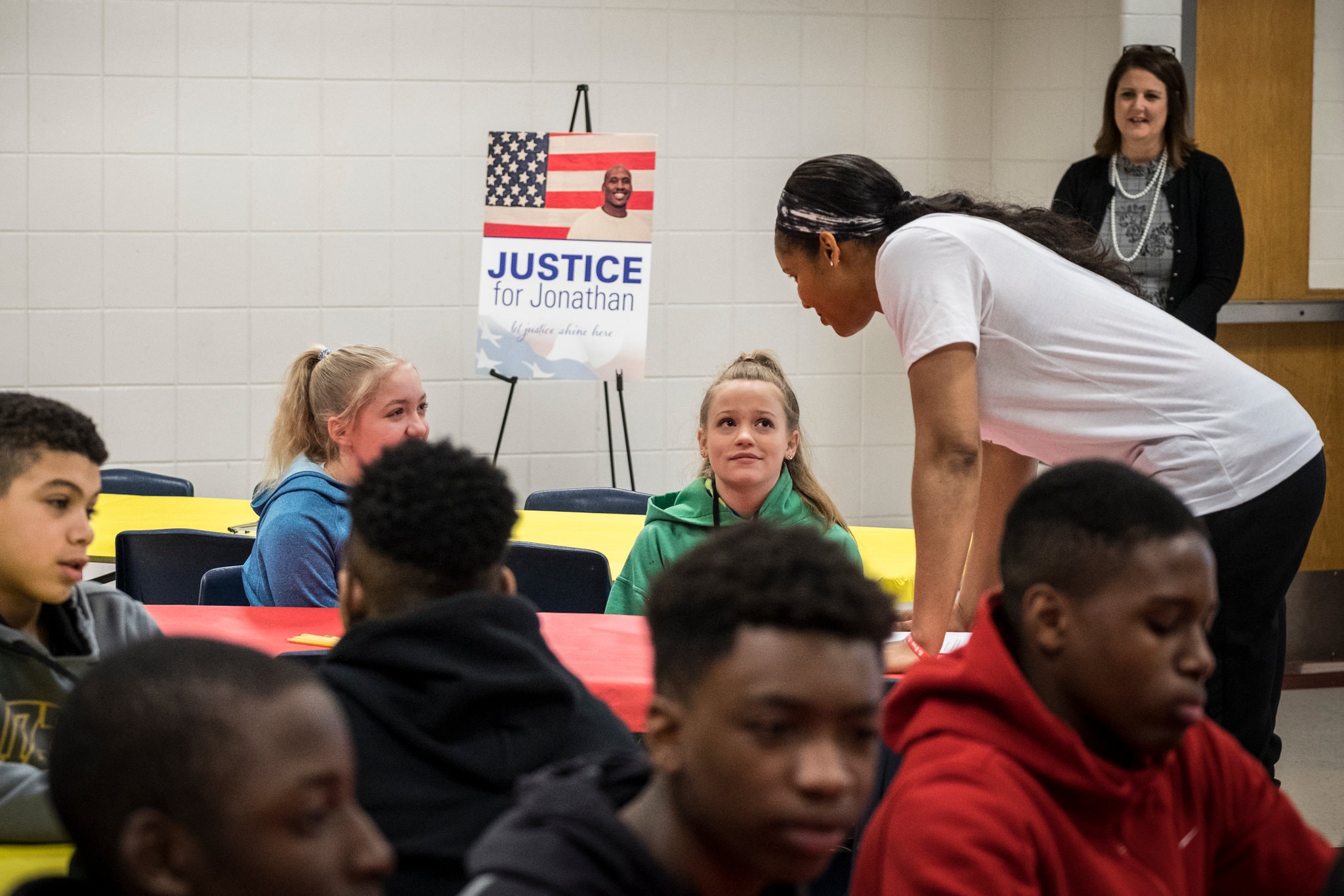
Interesting story here with a Minnesota connection. WNBA star Maya Moore (plays on the MN Lynx) will sit out a second straight season of WNBA basketball to dedicate her time to criminal justice reform and the release of Jonathan Irons.

Per Kurt Streeter of The NY Times:

Irons, now 39, whom she met in 2007 during a visit to the Jefferson City Correctional Center in Missouri, is serving a 50-year sentence after being convicted of burglary and assaulting a homeowner with a gun. Born into severe poverty, Irons was 16 when the incident occurred in a St. Louis suburb. 

The homeowner, who was shot in the head during the assault, testified that Irons was the perpetrator, but there were no corroborating witnesses, fingerprints, footprints, DNA or blood evidence to connect Irons to the crime. Prosecutors said Irons admitted to a police officer that he broke into the victim’s home, a claim Irons and his lawyers have steadfastly denied. The officer had interrogated Irons alone and did not record the conversation.

I had no idea Moore sat out last season, and while she’s made money in leagues around the world (many W.N.B.A. stars make a lot more dough playing overseas in the offseason than they do in the league stateside), it’s not an insignificant amount to turn down for regular people like you and me (Moore would make the league max in in 2019 of a whopping $120K, or ¼ of a regular season game check for LeBron James). She’s passing up the opportunity to play in the Oympics this summer, which is a huge marketing opportunity for athletes in less popular sports like women’s basketball. 

I admire people who aren’t afraid to focus on what’s important to them, especially when it falls outside of the way other people see them. Good on you, Moore. – PAL

Source: W.N.B.A.’s Maya Moore to Skip Another Season to Focus on Prisoner’s Case”, Kurt Streeter, The New York Times (01/22/2020)


More Fallout From the TrashCanSlamCamScam (™) 

As I said last week, I love this story. I cannot get enough of it. Any angle you got, I’m reading it. For example, this take wondering where retired catcher Brian Mccann is, and demanding he offer an explanation. If you don’t know or remember, at the tail end of his career, McCann became famous for “policing” other player behavior. Pimp a home run? He’s gonna get in your face before you even cross home plate.

RESPECT THE GAME, BRO. RESPECT IT! That kind of guy sucks, IMO. And I’m not alone. The writer of this story very openly loathes McCann for that stuff:

And now Sileo wants to know: 

Where was McCann, the self-appointed arbiter of baseball’s unwritten rules, when he was on the 2017 Astros as they flagrantly violated baseball’s written rules? 

It’s a very good question, and I am really hopeful that a baseball writer with some stones and a video camera finds McCann and asks it of him. Because he’ll say something really friggin stupid and it’ll be hilarious. -TOB

Source: MLB Cheating Scandal: Where is Brian McCann?Tom Sileo, The Stream (01/18/2020)

PAL: Two things: 

  1. I am not a fan of McCann, but Gomez is insufferable on a first inning home run. I would’ve told him to get moving, too. 
  2. Whatever the agreement was/is with MLB, A.J. Hinch took the bullet for all of the players. I wonder if he ever manages at the MLB level again. I only hope they send him a nice birthday present this year. 

Ever Asked, “Who Is Monte Irvin?” Me Too.

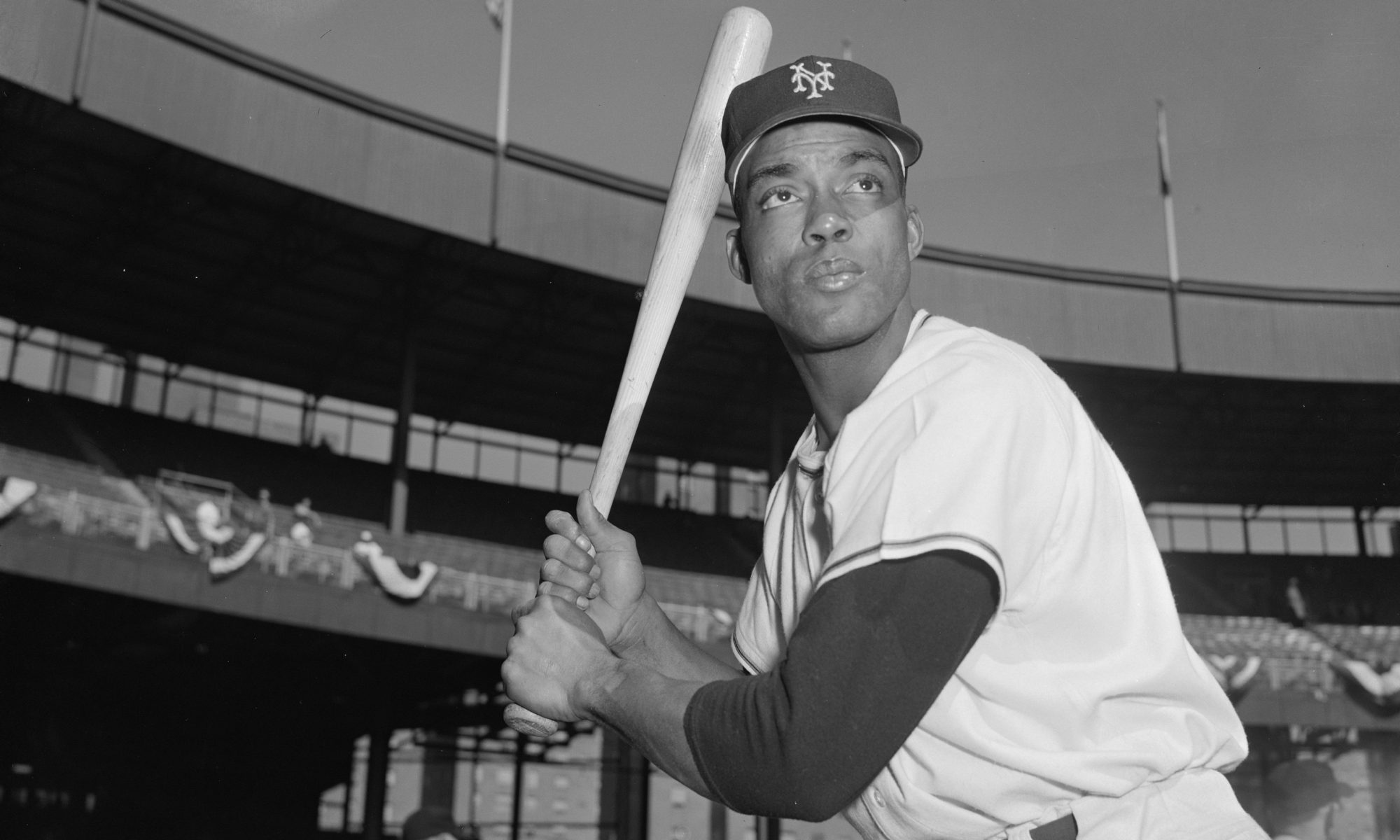
If you’ve ever been to a Giants game, you’ve likely looked at the retired numbers on hanging from the upper deck: 24, 25, 44, 30, among others. Giants fans know those numbers and who wore them. My son sees the numbers every time we got to a game and asks me who the players were (and if they’re still alive). But there’s one name and number I really haven’t known too much about: #20, Monte Irvin.

Thanks to Joe Posnasnki, I now know quite a bit. Per Posnasnki, quoting Irvin himself – Irvin was Mays before Mays. Most of Irvin’s career was lost – some due to his service during World War II, and more because his prime was spent in the Negro Leagues, which did not keep statistics as religiously as MLB always did. So we don’t really know what kind of numbers Irvin put up. But we do know what his peers said about him. Like Hall of Famer Roy Campanella:

“Monte was the best all-around player I have ever seen. As great as he was in 1951, he was twice that good 10 years earlier in the Negro Leagues.”

Or Hall of Famer Cool Papa Bell:

“Monte Irvin should have been the first black in the major leagues. He could hit that long ball. He had a great arm. He could field. He could run. Yes, he could do everything.”

And we also know what he did in MLB once he did arrive, well past his prime. At age 32: .312/.415/.514, 24 homers, 94 runs, 121 RBIs, 147 OPS+. 

So, now you know who Monte Irvin is.

By the way, this is part of Posnasnki’s excellent and ongoing series on the Athletic counting down, daily, his Top 100 baseball players of all-time. Irvin came in at #69, nice. I haven’t read them all, but I encourage you to read it, and any other players in the series thus far that you want to learn more about. -TOB

Source: The Baseball 100: #69 Monte Irvin,” Joe Posnanski, The Athletic (01/18/2020)


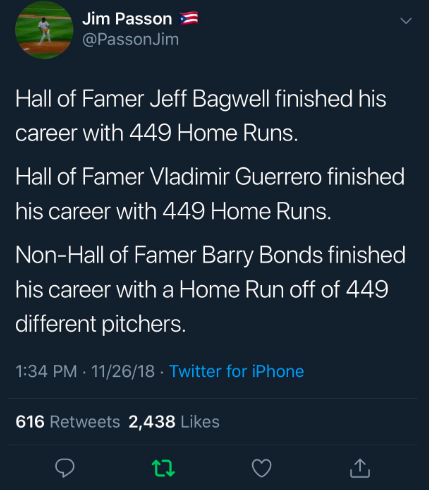
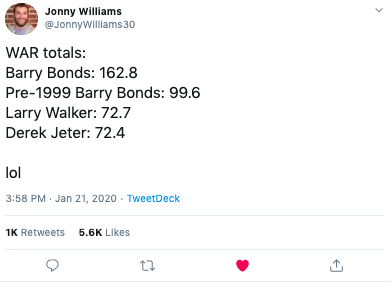
TOB’s Annual Plea to Put Bonds in the Hall of Fame

Exhibit A: 

Exhibit B:

Exhibit C:

See you next year, *sigh*. -TOB

PAL: Keep waiting. Bonds got more than a favorable return on his “investment”. This is the one thing he doesn’t get just because he wants it. This is the punishment.


Video of the Week


Tweet of the Week

https://twitter.com/mtsw/status/1219763225396334592?s=20


Song of the Week: Billy Bragg & Wilco – Airline Plane To Heaven


Like what you’ve read? Let us know by following this blog (on the right side, up near the top), or:

Email: 123sportslist@gmail.com

Twitter: @123sportsdigest

Facebook

Instagram: @123__sports


“Not a woman. Just a cool, great looking, best friend.”

-Michael Scott

Week of January 10, 2020


The History of the Flag in American Sports

This is a story about the United States flag and sports that shouldn’t be impacted by your own political leanings…at least I think so. It details just when we started the tradition of the national anthem, and how far we’ve drifted from the regulations Congress wrote in 1942 with regards to how the flag should be respected. 

The ties between sports and displays of patriotism go back at least a century. Fans first stood to salute the flag while singing the national anthem at the 1918 World Series. In 1942, during World War II, Congress wrote regulations, enshrined in a federal law but without penalties for violations, outlining the significance of the flag and how to properly respect it — regulations that are largely ignored today, especially at sporting events.

According to the code, the flag “should never be carried flat,” “never be used as wearing apparel” and “never be used for advertising.” Additionally, “no part of the flag should ever be used as a costume or athletic uniform.”

A quick rundown of those guidelines: 

  • flags are carried flat regularly at football games and many other sporting events
  • it’s absolutely become a part of athletic uniforms from any number of sports 
  • it has absolutely been used for advertising purposes (by our Department of Defense). 

Again, I would think this is an issue for which the staunchest of conservatives and the most dreadlocked of Berkeley hippie would agree that the flag has no place in sports. Either it means too much or shouldn’t mean that much to be woven into our sporting events and the marketing of leagues. 

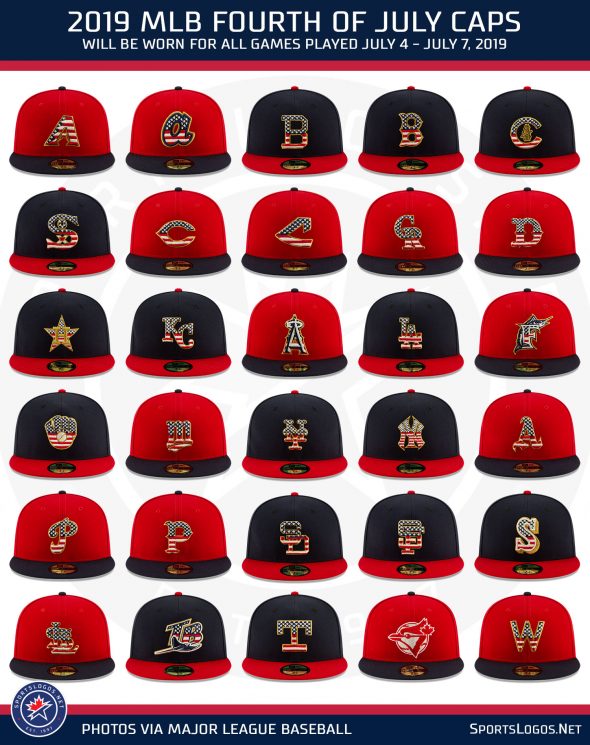
It’s one thing to take a moment to thank those who have served at a game. I think there should be more of that. It doesn’t need to be part of marketing campaign, but of course we should genuine thanks and ‘salute the troops’. It’s quite another thing for sports industries (leagues, teams, owners, not to mention the ancillary partners like beer companies) to profit off of the flag. I know this happens a lot of ways, and it’s not limited to sports (as my mom just noted, just look to any car dealership), but damn. Whether you think the flag means something sacred, something not so pure, a mixture of both, or – I guess – nothing at all; the flag represents a powerful idea (or loss of) in all of those scenarios. It bothers me that we use this idea to sell baseball caps and uniforms. We are being sold an idea that’s already ours, that we get to define.

I would like to understand why this pimping out of the flag is embraced, while other forms of protest – be it kneeling for the anthem or burning the flag – are so fiercely contested and labeled disrespectful. What am I missing? I am genuinely asking. – PAL 

Source: The N.F.L. Wears Patriotism on Its Sleeve. And Its Head. And Its Feet.,” Brittainy Newman, The New York Times (01/03/2020)


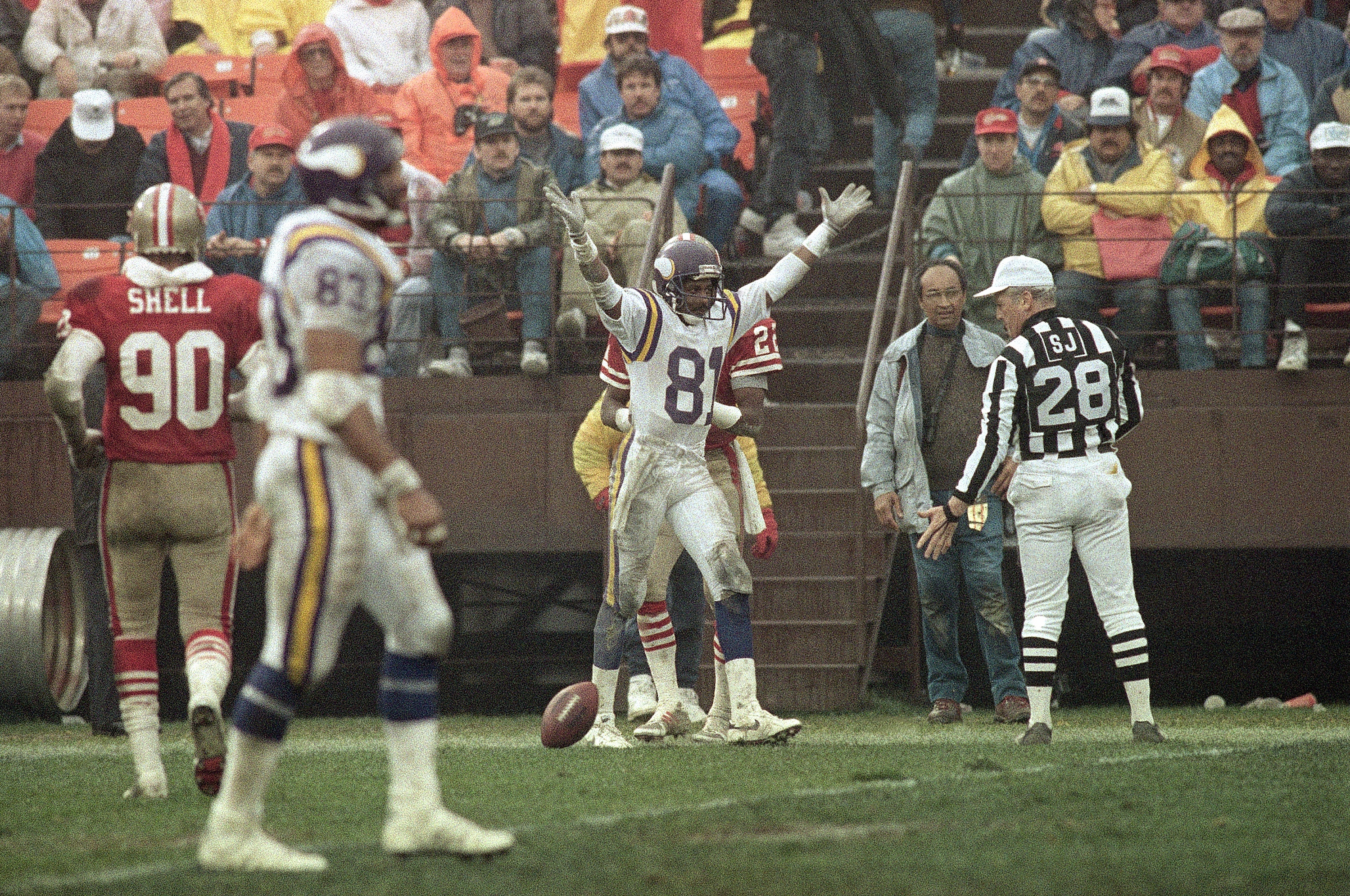
How the VIkings Almost Ended the 49ers Budding Dynasty

The 49ers were the team of the 1980s. They won the Super Bowl after the 1981, 1984, 1988, and 1989 seasons, and made the NFC Championship after 1983. But the mid-80s saw some disappointments. They lost in the Wild Card round after the 1985 season, and the Divisional round after the 1986 season. But they entered the playoffs after the 1987, strike-shortened season as the NFC’s #1 seed, and looked poised to make another deep run. The Niners entered those playoffs as a juggernaut: they ranked No. 1 in total offense, rushing offense, scoring offense, total defense, pass defense and point differential. They had six future Hall of Famers on the field, including Joe Montana, Jerry Rice, Ronnie Lott, Dwight Clark, and friggin Steve Young on the bench. They were expected to win their third Super Bowl of the decade. It didn’t happen. 

Instead, in the Niners’ first playoff game that year, the Minnesota Vikings came into Candlestick and put it on ‘em, 36-24. The Vikings made Joe Montana look so bad that Bill Walsh benched him (though it did give the 49ers their first glimpse at what Steve Young could really do. Vikings wide receiver Anthony Carter looked like, well, Jerry Rice, and set a then-NFL record with 227 yards receiving. 

I don’t remember this game. I was only six years old, and my very earliest football memory is the next season, when the Niners beat the Bengals, and Montana solidified his legacy with The Drive. But as the 49ers and Vikings prepare to play in the NFL playoffs this weekend, it’s interesting as hell to consider that game in January 1988, and this oral history of that game is an interesting way to do so. Any 49ers fan around my age (and maybe older) will be shocked to read some of the things in this article. For example:

49ers President Carmen Policy: Bill [Walsh] wasn’t quite right. His coaching wasn’t the best, and so forth. And we were going through this other combination of Steve Young-Joe Montana. And we didn’t have our feet solidly on the ground in terms of how we felt about ourselves and about the team and about the season.

Yes, that is Carmen Policy saying that legendary coach Bill Walsh’s coaching wasn’t the best, and saying that there was a QB controversy between Montana and Young long before I’d ever heard of one. In fact, shortly after halftime, Walsh benched Montana. Joe Montana! Benched! I had no idea. Here’s 49er Randy Cross on the benching:

Cross: With Joe, we’d won a couple Super Bowls. We’d won a bunch of playoff games. We’d won a bunch of games, period, with him. So it was very, very strange. You knew there was a chance, but not until he really did it, did it really hit you and sink in….That whole dynamic was very unique and kind of uncomfortable, to be honest. (Bill’s) pissed. All the coaches are pissed. We’re pissed. We needed a spark. We needed something different to happen. They were just making plays happen like crazy on offense, and we couldn’t get anything going on defense.

Somewhere, in an alternate universe, Sliders-style, that loss ended the 49ers’ budding dynasty. In this universe, it nearly did. Except, that it didn’t. The Vikings lost the next week to the Washington football team. In San Francisco, things turned around. After the loss to Minnesota, the team damn near fired Bill Walsh. As Policy puts it:

“I’ll never forget (team owner) Eddie (DeBartolo) telling Bill that night: ‘Bill, I don’t want you to lose another playoff game. This is the last one you lose with the 49ers.” 

DeBartolo was right. Walsh would coach just one more season, winning the next Super Bowl (and beating the Vikings 34-9 in the playoffs along the way), and then retiring (before returning to Stanford for three deliciously disappointing seasons). Montana held off Young for a few more seasons, winning the Super Bowl in 1988 and 1989, and then losing to the Giants in 1990. Montana missed most of the next two seasons due to injury, as Young took over, and won a Super Bowl in 1994 after Montana left for Kansas City.

A good oral history tells you a lot about a subject you thought you knew well, but upon reding realize you did not. Good read for any 49ers (or Vikings) fan. -TOB

Source: The Day the Vikings Put Joe Montana on the Bench and Bill Walsh on the Hot Seat,” Jon Krawczynski, David Lombardi and Daniel Brown, The Athletic (01/09/2020)

PAL: You sure do learn some stuff. How about Joe Montana and Roger Craig crossing the picket line during the strike?!? I never knew that. 

Also, the Montana benching did exactly what Walsh had hoped it would do. Young absolutely jump started the offense. Two touchdowns (one rushing, one passing) that kept them within distance of a comeback. The problem was the Niner defense couldn’t stop Anthony Carter. 

One last note on the game this weekend. I haven’t really been a Vikings fan since Gary Anderson missed one field goal all season and ruined the Moss, Carter, Cunningham, John Randle  Vikings 1998 season. But then I found myself planning my day last weekend around getting back to watch the Vikings-Saints game. And for all the terrible, terrible problems with football…damn if it’s not enjoyable to watch on TV. Can’t deny it. 

Go Vikes. This Niners team is awfully talented, but not a whole lot of experience in a playoff game. I’m not a Cousins fan, but he finally delivered last week. Jimmy G hasn’t done it yet. Let’s see how the pretty boy handles the pressure.


Kevin Love Confirm He Sucks

Full disclosure: I’ve never been a Kevin Love fan. 

In his one season at UCLA, Love and future NBA teammates Russell Westbrook, Darren Collison, and Luc Richard Mbah a Moute (seriously how did that team not win a title?), the Bruins beat my favorite Cal team ever on a ludicrous sequence where Love knocked over Ryan Anderson, who was trying to draw the foul to ice the game, and then won on an illegal shot by Josh Shipp that the referees unbelievably allowed to count (I’m still very bitter). 

Then he went to Minnesota and put up big numbers on awful teams.

Then he went to Cleveland, his numbers went down, and he complained about playing in LeBron’s shadow while they won.

But I’ve been mostly alone on this. Love smiles, and seem nice, and people generally like him. So this week has been very vindicating for me. 

After LeBron left Cleveland two years ago, Love was a free agent. He could have left and played for a contender. But Love instead signed a max extension – 4 years, $120M. He got paid. And he did so knowing full well the situation he’d be in – the Cavs were never going to be good post-LeBron.

Last year, he was pretty quiet. The team didn’t win much and his numbers did not return to his Minnesota-levels, suggesting that his numbers didn’t dip in Cleveland because he took a backseat to LeBron; or alternatively suggesting he’d forgotten how to play as the best player on his team; or alternatively suggesting he’d lost a step or two. Whatever the reason, Cleveland’s questionable (IMO) decision to sign him to that extension didn’t look great. But now, it looks awful.

This week, Love threw a couple of on-court tantrums.

What a baby. The quote about having money is obnoxious, but I especially hate how he treats his young teammate in the second video. I’m just very happy that everyone else finally sees what I’ve seen for more than a decade. This guy sucks. -TOB

PAL: Other than the following, I have no feelings about Kevin Love: 

The Beach Boys…meh. 


Videos of the Week


Tweets of the Week

I’m not a huge KD fan but I like Kendrick Perkins far less. So: LOLLLL.


Song of the Week

Nathaniel Rateliff & The Night Sweats – ‘Hey Mama’


Like what you’ve read? Let us know by following this blog (on the right side, up near the top), or:

Email: 123sportslist@gmail.com
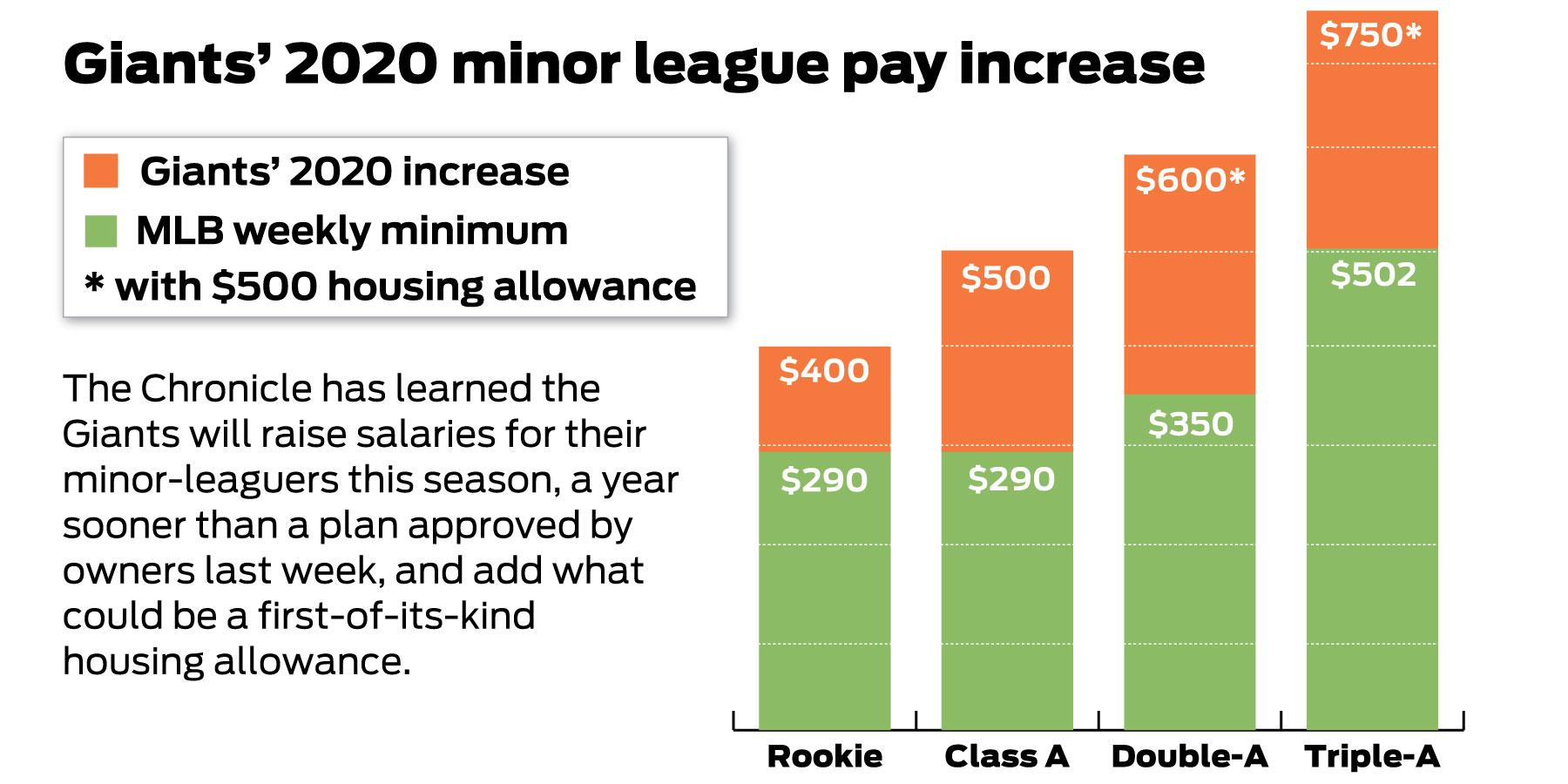
Twitter: @123sportsdigest

Facebook

Instagram: @123__sports


There is a small part of me that is actually very excited about this new company. But 70% of me is water. And the other part, the real part, the part that has feelings, and emotions, and thoughts, and if I can be crass, makes babies, that part thinks that all these changes suck b—.

-Michael Scott

Week of January 3, 2019

RIP, Commish.


One Game Makes All The Difference: Remembering Don Larson 

Readers of this newsletter know I’m a sucker for a sports obit. Don Larsen died this week at the age of 90, and Tyler Kepner of The New York Times centers the obituary on October 8, 1956 when Larson became the only pitcher to ever throw a perfect game in the World Series when he and the Yankee beat the Dodgers 2-0 in game 5. Larson’s perfect game remains a singular achievement in baseball. 

While I’m sure our fathers and uncles know, Larson was an unlikely pitcher to pull off the rarest of feats. In fact, The Star-Ledger (Newark, NJ) ran the headline “Clown Prince ascends the throne”. The “midnight kid who doesn’t like to miss many laughs” had a career record of 81-91. He lost a Game 7 the very next year, and became a journeyman pitcher. He was the greatest for one day, and the details of the day make the achievement even more incredible. 

For one, Larsen didn’t exactly get 10 hours of sleep the night before Game 5. His friend told folks how he begged Larsen to take it easy the night before. To raise the degree of difficulty even more, there was an alimony dispute with his estranged wife. Per Kepner: 

Larsen must have had a lot on his mind. The day of the perfect game, his estranged wife, Vivian, asked the State Supreme Court to hold up his World Series winnings in an alimony dispute. A court order over unpaid child support was said to have been in Larsen’s locker as he pitched; newspapers called him a playboy.

But, as Jim Palmer sums up, there’s poetry in the idea that a below average player can be the greatest for a day. In his words, “That’s what baseball’s all about.”

Solid read. – PAL 

Source:Don Larsen Became an Unlikely Legend in 9 Perfect Innings”, Tyler Kepner, The New York Times (01/02/2020)

TOB: I really love that quote by Palmer. It’s one of my very favorite things about baseball: In one day, an average player can create a legacy. I’ll never forget the all-time leader for RBI in a game is Mark Whiten. He was a quintessential journeyman. But one day in 1993, he hit 12 RBI in a game. Although that one game constituted about 0.1% of his career games, the 12 RBI constituted about 3% of his career RBI.

Or take Brandon Crawford. He’s had his moments and hot streaks at the plate, but he’s known more for his glove. However, in 2016, he had a 7-hit game. In 2019, he had an 8-RBI game. He is the only player in MLB history to do both in his career. How wild is that?


David Stern’s Greatest Act As Commissioner: Compassion  

Former NBA commissioner David Stern died this week after suffering a brain hemorrhage before the holidays. And while he will be remembered as the maestro of growing the NBA into a global sport in a way that no other American sport could dream of, The Athletic’s Bill Oram focused his words on how Stern navigated Magic Johnson’s announcement that he had HIV in 1992. 

I am just old enough to remember how absolutely terrified and uninformed Americans were of and about AIDS and HIV in 1992. And then it comes out that Magic Johnson has HIV. He immediately retires from basketball. When he does want to make a comeback, players are protesting playing on the same court as Johnson. Sponsors threaten to take their business elsewhere. People still think the virus can be contracted by sweat. Throughout all of this, Stern sticks by Johnson. 

Stern admits that he did so to also protect his league. He understood the NBA needed to be about the stardom of its players, and so he stuck by one of the league’s greatest stars. 

“We were in the middle of a complete panic as a nation,” [Stern] said, “and we were losing people left and right. And by just working in a certain way to protect our league, which was (that) we embraced Magic, we didn’t shun him … we changed the debate on AIDS.”

This is another one of those stories I will think about when the familiar chorus, “stick to sports” is barked. In Stern’s words, “the social clout sports can have on important issues” are often the bookmarks we use to return to our history. Good, bad, and all of the above. – PAL

Source ‘Compassion and intelligence’ guided David Stern through aftermath of Magic Johnson’s HIV announcement”, Bill Oram, The Athletic (01/02/20)

TOB: I also liked another write-up on Stern, by the Athletic’s Ethan Strauss. He never met Stern, but they became in recent years, as Strauss puts it, pen-pals. One passage in particular struck a chord with me:

Beyond that reputation, he was frighteningly “high chair famous” to me. People of my generation might know what I mean. The famous people you learned about before you can even remember learning tend to inspire more awe.

This is so true. When you are very young, you don’t realize that famous people – be they athletes, politicians, coaches, media personalities – have not always been around. Sometimes, you find out later, they came to prominence just before you learned about them. But for you, they will always hold a special place. As time passes, for example, it’s nearly impossible to keep track of who the coaches of each team in the four major sports are. At age 9, though, I could have told you all of them, and I figured they’d all been there twenty years.

But they hadn’t. And they moved on. And many have passed away. Still, Stern will always be the NBA Commissioner to me just like Tom Brokaw will always be the face of television news. It’s hard to believe Stern is gone. It just feels…strange.


Colin Kaepernick’s Continued Exile Proves His Point

I highly recommend you read this article about Colin Kaepernick and his continued exile from the NFL. Here’s a great passage that is more or less the thesis:

The demonization of Kaepernick and the distortion of his message have contributed to his NFL exile. It is, as Patterson described, a kind of social death and, in many ways, our shared burden, just as it is Goodell’s and the 32 owners’ who have kept the league’s doors closed to him. The cancer isn’t Colin Kaepernick. It is the scourge of racism in our institutions, and it must be confronted or else the next curious black athlete of another generation will face the same battle: fatigued enough to embrace protest as their weapon of upheaval only to suffer in the same, scripted ways of their predecessors.

Kaepernick protested specifically against police officers not being punished for killing young persons of color. But his exile confirms an even larger point: the system is racist and the system is rigged. Good read. -TOB

Source: “Colin Kaepernick’s NFL Exile Feels Like Forever,” Tyler Tynes, The Ringer (12/23/2019)


Bumgarner Wanted to Leave, So He Left/An Ode to Farhan Zaidi

Madison Bumgarner, who almost single-handedly won a World Series for my favorite baseball team, left that team for a division rival – the Arizona Diamondbacks. A lot of Giants fans are angry – Bumgarner grew up a Giant, helping the team win the World Series in 2010 as a 20-year old rookie. But the anger is directed not at Bumgarner for leaving, but at the team’s front office, led by second-year President of Baseball Operations Farhan Zaidi.

These are the same fans who whined and complained about Farhan constantly shuffling the roster last year; and then when he found a mix that won, those same fans cheered, while giving Farhan little credit.

Farhan’s shuffling found players who were good but underappreciated at their previous stops – guys like Mike Yastremzki and Alex Dickerson. Farhan flipped free agent to be pitchers like Drew Pomeranz and Sam Dyson for young and highly valued prospects who might be part of the next great Giants team, like Mauricio Dubon and Jaylinn Davis.

Back to Bum. He is an above average pitcher, though he never could find the consistency required to be truly great. Still, the Giants rotation next year looks to be a mess, and his innings and leadership would have been welcome for the next few years. In fact, it was reported that the Giants offered him something around 4 years and $75 million, which sounds a bit low until you learn his deal with Arizona was 5 years and $75 million. So, Bumgarner took less money per year and the same money overall to go elsewhere. It’s also been reported other teams offered him deals with much higher money. And what does that tell you?

It tells you Bumgarner did not want to be here. He wanted to be in Arizona. He said at his press conference that Arizona was his preferred destination. I don’t get it, personally; I think Phoenix sucks. And I don’t get why you wouldn’t want to become a legend in a city that reveres its sports heroes. But it’s his choice to make.

So why are fans mad at Farhan when Bumgarner chose to leave? Here are some recent questions to Giants beat writer Alex Pavlovic’s mailbag article:

Do the Giants know how discouraged and worried the fans are? — @romareb

What’s the Giants management reaction to the discontent among their fans? — @woodiewoodf14

Discontent? Worried? Worried about what? First, it’s baseball! Chill out. Second, your team won three World Series titles this decade! Are you kidding me? These fans are spoiled and insufferable. They think there’s no plan because they think the Giants are one big bat away from competing with the Dodgers, who are so deep and so good. But the Giants are so far behind the Dodgers right now, it’s going to take so much more.

Farhan has done and continues to do an incredible job. When he turns this mess around, those fans will probably say they knew all along. But I know. I’m keeping the receipts. -TOB


Baseball in the 2010s

This is a really neat article from Tom Verducci about how baseball changed over the decade. I highly recommend it. -TOB

Source: MLB Changed More Than You Think in the 2010s,” Tom Verducci, Sports Illustrated (12/23/2019)


Video of the Week


Tweet of the Week


PAL Song of the Week: Brittany Howard – Stay High 


Like what you’ve read? Let us know by following this blog (on the right side, up near the top), or:

Email: 123sportslist@gmail.com
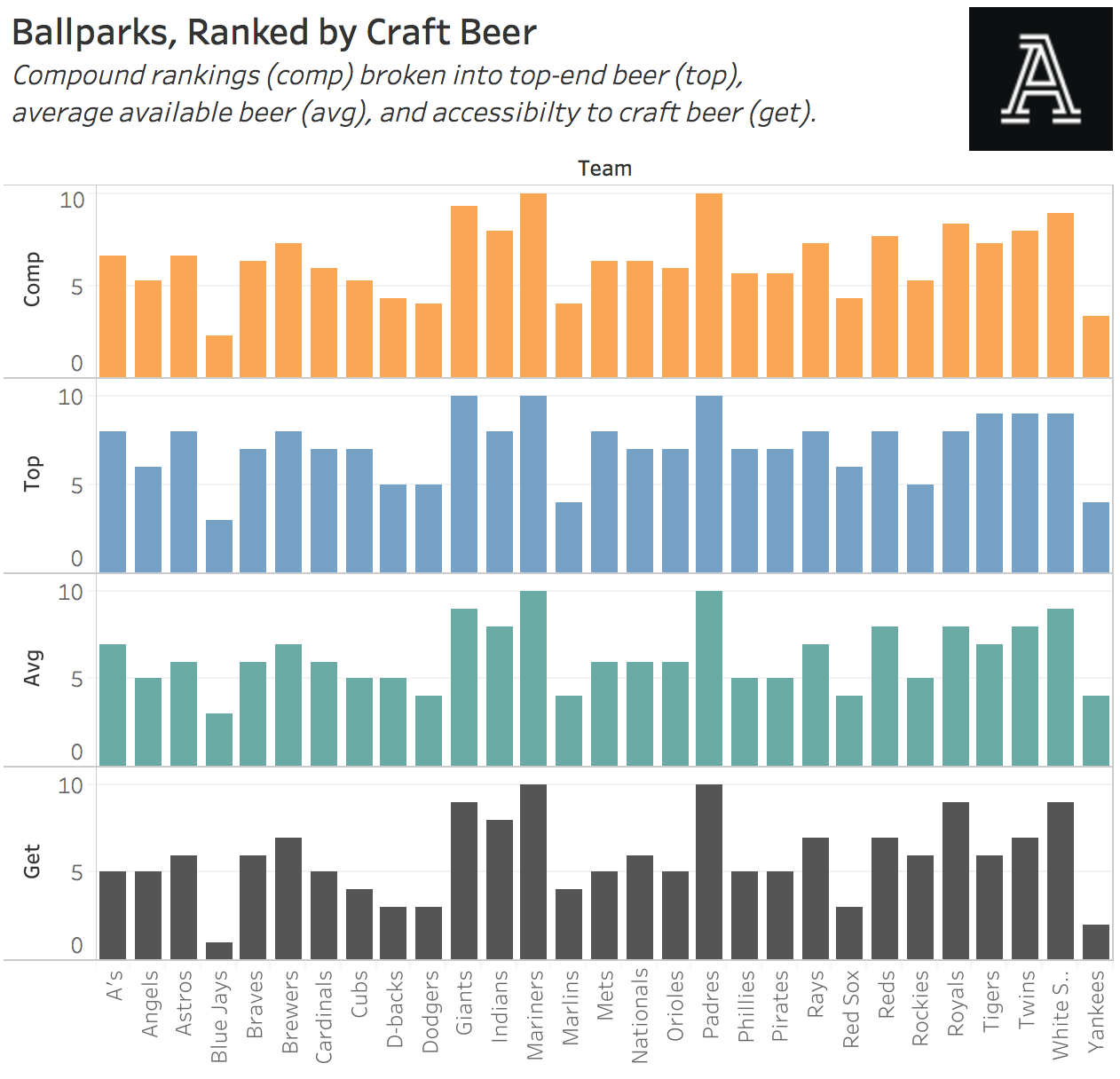
Twitter: @123sportsdigest

Facebook

Instagram: @123__sports


Jim, don’t take this the wrong way. Are you gonna take this the wrong way?

-Michael Scott

Week of December 13, 2019

Yankee Gerrit Cole. For $324 million, you can dictate my facial and head hair choices, too


Taking the Temperature of the Gabe Kapler Hire: Snip, Snap! Snip, Snap! Snip!

The Giants’ hire of Gabe Kapler to replace Bruce Bochy as manager was a polarizing choice. No, polarizing isn’t quite right. Some were outraged about his response, when in the Dodgers system, to two incidents involving Dodger minor leaguers and women. Some of those people, and others, were upset that a guy with a 161-163 record in two seasons as manager of a fairly talented Phillies squad was the pick. Others were in the middle…let’s wait and see. I have been one of those people. But no one that I can find was enthusiastic about the hire, which is why I took back my “polarizing” comment.

So, that’s where we are. Now, Kapler seems like a weird dude (google “Gabe Kapler tan” if you’re feeling adventurous). But, like, who is Gabe Kapler? The Athletic’s Daniel Brown tries to answer that question. And, buddy, this article was giving me some wild swings. Let’s walk through it.

The article opens in Kapler’s office, Bochy’s old office. It’s not yet decorated. But Kapler tells Brown decor is on the way! What has Kapler ordered? 

“So, so glad you asked that question,’’ Kapler replied. “You and I are going to feel much different once (it’s decorated). Environment-building is really important. And I think that design touches make all the difference in conversations like this one. This office needs some life and some plants and some art. I don’t want this to feel like a jail cell.”

Kapler said he was awaiting a shipment of black-and-white photos he’s collected over the years. The images are carefully curated, as are most things with Kapler. There are no frivolities with him, no wasted energy. The photos — like his diet, like what he reads, like the stats he embraces, like the words he chooses, like his umpire-mandated ejections — are selected with a specific purpose in mind.

The pictures, upon arrival, will have an immediate job to do. They will send a message to visitors about what Gabe Kapler believes in.

“So, there are some political figures there. There are some sports figures there,’’ he said. “Muhammad Ali is one, Jackie Robinson is one of them.

“Martin Luther King Jr., Gandhi, Nelson Mandela. They will all have space somewhere in this office. And I’ll find my way to probably choosing a few more.”

I LAUGHED. I CRIED. This guy! What a weird guy! As my buddy Rowe said, “He basically described the ‘smart guy things for meathead jocks’ starter kit.” Black and white photos! Of super famous people! How daring. 

Current Temperature:

Kapler will happily wax on about his about childhood because, at heart, it still defines him. “Everything I am today,’’ he said, “is a result of that upbringing.” His bedroom walls had photos, too. Kapler’s personal décor in those days included images of Ty Cobb, Pete Rose and Charles Barkley.

Beyond the checkered resume, Kapler also comes equipped with a persona that would fit on a poster next to Barkley, Cobb and Rose. One source, who worked with Kapler at a previous stop, declined to comment when reached for this story. “On the record or off?” the source asked. “Because if it’s on the record, I’d have to lie.”

Another former Kapler co-worker also had his reservations: “Kapler is a high-energy guy. And he means well. I think he means well. But he’s not for everybody. The personality isn’t for everybody. He is kind of a my-way-or-the-highway type of guy.”

OHHH NOOOOOOO. This is bad. This is VERY bad. This is SUCH a poor quality for a manager, of any type. A manager should not be polarizing! A manager should adapt to his subordinates to bring out the best in all of them. 

Current temperature:

During the Giants’ interview process, both Bochy and Buster Posey met with Kapler as the team whittled down its finalist list. Both of those mainstays — no-nonsense types with finely honed B.S. detectors — strongly recommended Kapler, according to team sources, which helped solidify the official decision.

Is someone blowing smoke up my ass? Who are your sources, Daniel!? A Bochy endorsement would go a long way with me. It wouldn’t mean Kapler will be great. And it wouldn’t mean Kapler is not weird as hell because he’s definitely weird as hell. But it would mean he’s not a complete asshole, and that’s a start. So I am off panic mode and at very cautiously optimistic.

Current temperature:

“I’m drawn to colorful people,” he said during this interview in his office. “I’m interested in people who are different than me. I loved biographies as a kid. I wasn’t interested in novels. I wasn’t nearly as interested in reading stories. But I loved biographies. I loved digging into people’s psychology — what makes them tick and how they’re motivated.

At first blush, this is cheezy. But I read it a second time and I gotta say – this is a GOOD managerial quality. Assuming this weirdo we have for a manager who is *allegedly* endorsed by Boch and Posey can actually, you know, dig into people’s psychology, this is a really good thing. 

Current temperature: 

Kapler was never more argument-averse than in his first managing gig, for Class-A Greenville (an affiliate of the Boston Red Sox) in 2007, when his team went 58-81.

“I brought a stoicism to the dugout that I don’t think worked very well,’’ he said, looking back. “And it was by design. I would have minor-league players come to me and complain about umpire calls. And I tried to help them put that aside.

“So I’d say something like, ‘How much value is there in you arguing balls and strikes? Like, do you think that there’s ever a strike or ball call changed?’ And I tried to rationalize with our players instead of getting with them on an emotional level.”

Kapler discovered over time that a raw young player who just struck out looking at a borderline slider was rarely of the mind to intellectualize the experience.

When Kapler became a big-league manager with the Phillies in 2018, he figured that his all-calm-and-reasonable act would play better with a mature roster. So he returned to his old ways and went the entirety of his rookie managerial season without getting the heave-ho.

“It was like, ‘I think I can help these players be stronger mentally and not get so spun,’’’ Kapler said. “But it just doesn’t work. They need to see you get upset.”

“I never really lost my cool. I was upset, but I was also under control. I never felt like I couldn’t maintain control of my emotions during that time period,’’ Kapler said.

“But it doesn’t matter, me rationalizing my way through it. What matters is how the players feel and how the staff feels and how the ballpark feels and how the city feels and how the fans feel. And to some degree being responsive to that.”

I don’t exactly agree with his instinct – I think being a jerk about it rarely helps, but pointing out to an umpire that a call was wrong can help your team. However, I really like that Kapler was able  to adjust to his players’ needs. 

Current temperature: 

“And the lesson in all of that is: Sometimes the best strategic advantage — the one that you’ve been thinking about for a really long time — isn’t worth the confidence being stripped away from the dugout, the clubhouse or the player.”

Assuming he can put this into practice: My guy!

Current temperature: 

Mom ran an early childhood center. She is the bulldog of the family, the one who can make life difficult for the airline customer service agent on the wrong end of a disputed charge.

Ugh, his mom is an asshole. Not a good sign!

Current temperature: 

Still, there was a line Gabe and his older brother, Jeremy, could not cross.

“What was a problem was anything derogatory,’’ Kapler said. “And my dad took major issue with it, so much so that if one us brought a joke home from school that was, like, racially charged in any way, homophobic in any way, my dad was like: No.

“And then he would explain why even telling the joke was problematic in society, why even listening to somebody else tell those jokes and not saying ‘That’s not OK with me’ is problematic in society.”

Ooooh. What a good dad! 

Current temperature: 

“[Little League] is the memory of baseball that I cherish the most,’’ he said from his office. “It was the most important part of my upbringing. It’s where I spent my entire day. Saturday mornings were me walking to the park and spending the entire day — no matter what time my game was — at the park, playing over-the-line between the fields and just being a kid.”

Same, buddy!

Current temperature: 

Neander, now the Rays vice president of baseball operations, informed the longtime big-leaguer that he was much more successful against pitches in the bottom of the strike zone. And then Neander handed him all the game-day data that proved it. For the remainder of his career, Kapler took a new approach at the plate, hunting and attacking pitches at the bottom of the strike zone.

“So how analytical is that?” Kapler said. “It’s just reframing my focus as a player. ‘Here’s what you think you did well. It’s not actually true. Here’s what you actually do well. How can we put you in position to attack that pitch going forward?’

“That was the kind of information that I wanted to have.”

This story is representative of Kapler’s belief when it comes to metrics: They are tools that can make a player better. It’s a concept that can be far simpler than some make it out to be. He rejects the notion that there’s been any kind of analytics “revolution” led by nerds with calculators.

“That’s kind of bullshit, right? Analytics are every kids’ baseball card that they grew up with,’’ he said. “If you looked at batting average and home runs and doubles and triples and stolen bases and caught-stealings and all the things that we have on baseball cards as kids, that’s analytics.”

Sure, but baseball cards never had BABIP, FIP or DRC+ on the back.

“It’s only being labeled as different. It’s not different,’’ Kapler said. “We have different numbers, that’s true, but it’s not an ‘analytics revolution’ like we’ve made it out to be. … We just have better tools. We have more information. We have more numbers to use that predict future success.”

Current temperature: 

Though Kapler said he has learned to be better about balancing the stats with feel, his lingering reputation is why one skeptic thinks that Kapler is the perfect cover for a front office that will be a metrics-run operation from the field on up.

“He’s not going to manage the Giants. He’s just going to be the manager. You see what I’m saying?’’ an industry source familiar with Kapler said. “It’s part of the new era. The manager doesn’t make decisions anymore. He is there, really, to keep the personalities together.”

Current temperature:

Not so good, Al.

A woman rose and fearlessly questioned the handling alleged 2015 assaults. She was upset with Kapler, and with Zaidi for hiring him.

“You’re saying character counts, which we’ve always felt has been the heart of this organization. So I need to address this to you: What were you thinking? In the Bay Area, what made you think that this was going to work?” she said. “Because all I’ve heard is PR sound bites. I haven’t heard anything that spoke to character and all the reasons people — women especially — are concerned about the role you’re taking on.”

The room went the kind of silent that’s actually loud.

Zaidi, as he had several times already that evening, talked about the thorough vetting process in hiring Kapler and the personal lessons both of them have learned through the process. Zaidi said he understood the backlash, welcomed the microscope, said the industry needed to be better about this important issue. He pledged that the organization was committed to speaking with actions, not words.

The question was answered, the tension defused. It looked as if the evening had come to a close.

Then Kapler raised his hand asked for a chance to respond, too.

“Can I ask your name please?” he said.

“My name is Pam.”

“Pam, I’m Gabe. Nice to meet you.”

There was some awkward laughter in the crowd.

“Any questions that you want to know about me, if you would give me a chance to prove that I have high character, I would love that opportunity,’’ he continued. “It doesn’t have to happen right now. It can happen whenever you want. But I’d also be more than happy to answer any of your questions without any sound bites — directly from my heart. Give me an opportunity to get to know me a little better.

“And I’ll make that commitment to anybody in this room: You can stay tonight and we’ll have that conversation. Or, if it makes you feel better, another time, I’m totally cool with that. I just want to ask that you give me a chance to prove my character to you before you decide my character.”

The ensuing applause was as loud as it had been all night.

Nailed it.

Current temperature:

(Actually, I’m still really nervous) -TOB

Source: Who is Gabe Kapler, Really? The New Giants Manager Just Wants Everybody to Get to Know Him,” Daniel Brown, The Athletic (12/07/2019)

PAL: In a word, yikes. 

It all comes off like an act. I don’t buy what Gabe’s selling…not at all. Rowe has it right: “smart guy things for meathead jocks”. 

The Giants are going through a transition, and this is the guy they want for this phase (the lose a lot phase) – someone that gets in line with management. Maybe that works, but I’d think young guys developing need as much emotional support from a leader than cold, sterile, logic. Someone who gets ejected – not because his analysis leads him to decide to get tossed – because he wants to win that game, and that moment matters. Be human, dude, and not just on Thanksgiving. 

Most telling nugget from the entire piece: “It’s worth noting here that Kapler, who was born in Hollywood, won a local Shakespeare Festival award for his performance in “The Taming of the Shrew” while in high school.”

On the plus side: coconut oil. 


Her Time

Here are the first three paragraphs of one of the most moving stories I’ve read since we’ve been doing 1-2-3 Sports!: 

DIEST, Belgium — Champagne flutes were hastily unpacked from boxes, filled to their brims and passed around the room. Dozens of people stood around inside Marieke Vervoort’s cramped apartment, unsure of what to say or do. This was a celebration, Vervoort had assured her guests. But it did not feel like one.

Eleven years earlier, Vervoort had obtained the paperwork required to undergo doctor-assisted euthanasia. Since her teenage years she had been battling a degenerative muscle disease that stole away the use of her legs, stripped her of her independence, and caused her agonizing, unrelenting pain. The paperwork had returned some sense of control. Under Belgian law, she was free to end her life anytime she chose.

But instead, she just went on with it — seized it with new vigor, even. Within a few years she reached uncharted heights in her career as a wheelchair sprinter, winning a gold medal at the Paralympics. She became a celebrity at home and abroad, appearing in the pages of international magazines and newspapers, sitting for interviews on television shows. She traveled the world telling her life story, unspooling it as an inspirational narrative.

You must experience this story in full. It’s much more than just Keh’s writing, which is beautiful in its precision. Lynsey Addario’s photography has depth that makes you linger. Again, it’s not just the heavy in the pictures; the everyday photos are just as striking. There are also places in the story where they’ve embedded audio recordings of Vervoort’s interviews. 

Key and Addario met Vervoort after the Rio Paralympics in 2016. For over three years, they recorded her journey to euthenasia, and how that right “allowed her to wrest back some control of her life.” It wasn’t until after she was approved for euthenasia that she became a gold medalist.  

The piece is divided into four sections: The Pain, Taking Control, The Descent, and The End. Every word is worth your time, but there were a couple moments in this story that are looping in my head like a melody. 

The first moment comes in Rio. Her story – that she would someday end her life through euthenasia – got out. The story that funneled down to the tabloids, and soon this incredibly personal contemplation had become bent into headlines like “‘I’ll Go for Gold, Then Kill Myself,’ Says Paralympian Hopeful,”. A moment that should’ve been a triumph of life became about her impending death.

This was her response. Talk about courage and grace: 


The next moment comes when Vervoort asks Keh when she can see the finished article. After “more than one attempt” he explained the plan was to see this through to the end of her life. “She would never read what I would write about her life, never see all the photographs Lynsey was taking of her.”

The last moment is when, at the goodbye party with friends and family, the doctor arrives at her apartment for the final time. He’s there to administer the drugs that will end Vervoort’s suffering. 

“When Dr. Distelmans arrived two hours later, most of the guests were gone. Vervoort was sipping cava and munching on Maltesers chocolates, a guilty pleasure. She offered him one.”

There are beautiful, light moments, too. The weight of the story doesn’t crush those, and what resonates most is Vervoort’s passion for life, for the little things like champagne, sophomoric jokes, and chocolates. 

You must read the full story. – PAL 

Source: The Champion Who Picked a Date to Die”, story by Andrew Keh, photographs and additional reporting by Lynsey Addario, The New York Times (12/09/2019)


WAR? What is it good for? Actually, Something.

How’s this for a lede:

Bryce Harper charged a soft line drive on Sept. 5, fielded it cleanly and fired a strong throw home. The baserunner, Michael Lorenzen, who had started the play on second base, held at third. The trailing baserunner, Jose Peraza, who had started on first base, rounded second and went halfway to third, then backtracked. The catcher, J.T. Realmuto, fielded Harper’s throw and snapped a throw to second, where shortstop Jean Segura caught it and dropped a tag on Peraza. Peraza got back to the base before the tag, but his slide took him off the bag. He initially was called safe, but upon video review, the call was overturned, and Peraza was out.

It all took slightly more than nine seconds, at the end of which one thing had changed — two outs had become three, ending the rally. It can be, like every baseball play, recorded as a simple text description:

Single to RF (Line Drive to Short CF-RF); Lorenzen to 3B; Peraza out at 2B

But those nine seconds, like in many baseball plays, comprise a very complicated story, and converting that complicated story into units of credit is one of the permanent challenges of baseball statistics.

Whose WAR (wins above replacement) goes up on the play? Is it Harper’s, because his strong throw home set everything up? Or Realmuto’s, because his throw to second led to the assist? Or Segura’s, because his acrobatic tag finished the out? Or is it even more nuanced than that?

We’re going to break down this play, which is ordinary enough to pass unmentioned but extraordinary enough to watch 30 or 40 times without wringing it all the way dry. And we’re going to eventually try to answer the central question: Who gets credit for what happened and how much?

Buddy, I am IN on this article. It only gets better from there.

First, there is a second by second account of what almost every player (and even the third base coach and home plate umpire) are doing. Then, it dissects how each players’ actions are treated.

On your traditional stats, this play is treated simply: a hit by the batter, an out for the pitcher, and an outfield assist for Harper (which is odd given what occurred here). But so much went into this play that is not recorded, even in calculating a player’s WAR, both good and bad, including:

  • The Phillies base coach who positioned Harper shallower than normal. Had Harper been at normal depth, the runner from second likely scores and the runner from first likely goes to third.
  • The pitcher for holding the runners and making a quick delivery.
  • The catcher, for simply having a strong-arm reputation, thus helping to hold the runners.
  • The first baseman, who didn’t cut off Harper’s throw, even though he should have, when he would have gotten the runner rounding second out easily. Instead, a close play, originally called safe but overturned on replay, occurred.
  • The pitcher for inducing a swing out of the strike zone.
  • The hitter for swinging out of the zone (bad), but also for making contact (good).

Then there are the ways value stats screw this play up. For example:

Peraza made the out at second, but it is the batter, Blandino, whose win probability added takes the hit, because WPA credits the entire play to the hitter. In that recording of events, Blandino cost the Reds 4% of a win by hitting his single and ending the inning. Irvin gets the corresponding credit to his WPA, 4% of a win he earned the Phillies by allowing the single.

That’s…pretty dumb! The batter hit a single but lowered his team’s odds of winning because of it, so his WPA (WIn Probability Added) goes down, while the runner who screwed up a bases loaded situation by overunning second base takes no hit.

So how does WAR calculate this play? In a variety of ways. First, Lorenzen, the runner who held at third, takes a baserunning knock, because 88% of runners score from second on a hit, even though he would almost for have been out here and thus made the right play, despite being exceptionally fast. Sam Miller then breaks down how the different WAR websites calculated this play, and it illustrates how these things vary and why:

At FanGraphs, Harper gets some credit for Lorenzen holding at third base. Keep in mind, Lorenzen had the stop sign before Harper ever threw the ball. It was Harper’s positioning, his fielding of the ball and the threat of his arm that held Lorenzen. It was his reputation, more than the act itself, that altered the play, and for that he gets credit. Harper could have made a limp throw home that bounced six times and carried 30 feet up the third-base line, but if Lorenzen didn’t try to score — on a play where, in the aggregate, nearly 90% of baserunners do — it goes to the right fielder’s credit.

At Baseball Prospectus, Harper gets some credit for the assist, but most of the play escapes the measures of the site’s defensive metric, fielding runs above average, because the out was so unorthodox. The Phillies’ team baserunning defense is credited with 0.6 runs prevented — about the same as Lorenzen is docked — but not all of that gets distributed to the individual fielders involved.

And at Baseball Reference, where human observers (employed by Sports Info Solutions) credit the defenders on each play, Realmuto gets credit for what SIS labels a good fielding play. That’s worth 0.2 runs to his WAR. Harper gets some credit for Lorenzen holding at third, and some for the outfield assist. It’s worth about 0.33 runs to his WAR.

Segura, across the board, doesn’t get credited by anybody. One could argue he made the most important play in the sequence and the most difficult. One could also argue he stood watching the play for far too long, and his late awareness that he was supposed to be covering second base is what ultimately made the play so difficult for him. Maybe he doesn’t deserve any credit!

Irvin’s WAR improved very slightly at FanGraphs (for the out), improved by a little more at Baseball-Reference (for the runs not scoring) and probably took a slight hit at Baseball Prospectus (for the single). Blandino’s WAR improved everywhere but probably least at Baseball Prospectus, because landing singles on weak flares is one of the least stable skills a hitter can have. Harper’s WAR, among the defenders, improved at all three sites.

Miller closes with an excellent summary of the incredible achievement even creating a stat like WAR really is:

There were more than 100,000 batted-ball plays in major league baseball this year, many of them involving half the players on the field in direct or indirect roles. There were, furthermore, three-quarters of a million pitches, scores of thousands of stolen base opportunities, thousands of pitches in the dirt. To give credit on all of them means building statistical systems that can make assumptions that hold true in as many cases as possible — and that don’t require hours (and that don’t rely on personal opinions) for each of them. The act of assigning value for all these possible plays is a titanic act of research and coding that took years of work, trial and error and ever-more-specific tweaks by generations of analysts — all to be reasonably prepared for an oddity like this play.

Man, what a cool article. -TOB

Source: How is WAR Calculated, Really? Breaking Down a Single Play to Find Out”, Sam Miller, ESPN (12/5/2019)

PAL: This is baseball heaven. The moment-by-moment breakdown of a single play showing the choreography of a play, all which can change when a trailing baserunner watches a throw from right field for a step too long. As Miller describes it, “every actor’s role in the play”. A must read for coaches. 

Some observations: 

  • I have to say, I’ve never noticed how far a third base coach can get down the line in order to read a developing play in the outfield and maximize the amount of time he has to make a decision whether to send a runner home or hold him up at third. 
  • I agree, TOB; the outfield assist to Harper makes no sense in this scenario
  • The credit game is a tough one (as Miller points out); in one sense, we can credit the pitcher for holding the runners on and deliver a psuedo slide step, but maybe he makes a better pitch with a full leg kick than leads to the third out, rendering the baserunners’ secondary leads meaningless
  • This article makes me wonder about qualitative stats. While the centerfielder not backing up the catcher’s throw to second didn’t matter here, we know what would happen if the ball gets past the shortstop: at least one run scores. If the play had gone that way – if the catcher overthrow the shortstop and the centerfielder isn’t there, would that impact the center fielder’s WAR? 
  • Let this stat be written under the bill of every third base coach in youth baseball: “88% of lead baserunners scored from second base on two-out singles to the outfield in 2019.” If that’s the case in MLB, then the answer at lower levers is to just send the runner home on a two-out hit. 
  • Miller says near the end of the article that the trickiest part of this play is deciding who gets credit. I think that answer, on a larger scale, is pretty simple: the team gets credit. This is a team play. Good team plays lead to wins. Yes, baseball is a lot of one-on-one battles within a team games, but plays like this are the moments when the team works in concert with one another. As he mentions later in the story, “There were more than 100,000 batted-ball plays in major league baseball this year, many of them involving half the players on the field in direct or indirect roles.” Those are team plays. A good deal of wins are in those plays.

The NFL Has Always Tried to Get In Its Own Way

There are a lot of bad things about being a football fan. But one of the fun things is attending a game and going absolutely bonkers at a big moment in the game, especially when your team’s defense needs a stop. How less fun would football be if you couldn’t do that? If the referees in fact called delay of game penalties, and charged the home team a timeout, if the fans got louder than the referees thought appropriate? Guess, what. The football powers that be did that in 1970s and 1980s.

 This is a story about the time the people in charge of the league — and those in charge of college football, for that matter — lost their minds and decided fans should not yell, cheer, clap, stomp, roar or do anything else that could make it hard for a visiting team to hear. Basically, the powers that be wanted to turn a football game into a golf tournament.

Or, as 49ers coach George Seifert put it, “Let’s have a football game that doesn’t turn into a rock concert.”

Seifert, you dork!

The NFL adopted the rule, originally started in college in the 70s, in 1989. It did not go well!

With the new rule in place, the NFL tested it out in the preseason. In August of ’89, the Bengals played in New Orleans. When the Bengals had the ball at the Saints’ 2-yard line, the New Orleans crowd went bananas. The refs threw not one, not two, not three but four flags, and the Saints lost all three of their timeouts and were assessed a half-the-distance-to-the-goal penalty. Later, in the third quarter, Bengals quarterback Boomer Esiason antagonized the crowd on the sideline by waving his arms. The referee told Bengals coach Sam Wyche to make Esiason stop. Esiason knelt, hid behind a teammate … and still waved his hand behind his back.

Fans, to their credit, did not abide this crap, and just got rowdier.

After the preseason debacle, the NFL realized its mistake and quietly made the rule go away. But, this is a funny, emblematic article about the NFL, and how it has always tried to suck the fun out of its game. -TOB

Source: Remembering the Time the NFL Tried to Silence Its Fans,” Jayson Jenks, The Athletic (12/11/2019)

PAL: I need a name. I need a photo. What old duff in a pinstripe suit the NFL league office thought this was a good idea and had enough juice to get this into a pre-season game. I bet his name was Glen, or Walter, or Jerry. The commish must’ve owed him big for something, and Glen/Walter/Jerry cashed in on this favor for quiet football stadiums.


Video of the Week


Tweet of the Week


Song of the Week

Vanilla Fudge – “You Keep My Hangin’ On”


Like what you’ve read? Let us know by following this blog (on the right side, up near the top), or:

Email: 123sportslist@gmail.com
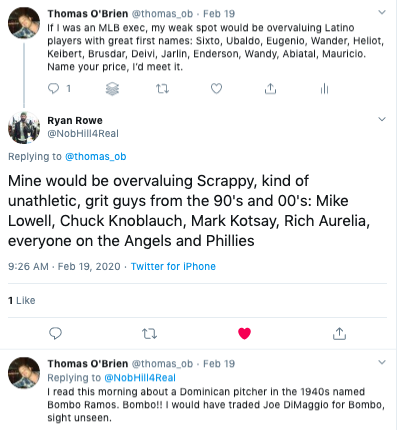
Twitter: @123sportsdigest

Facebook

Instagram: @123__sports


“I want you to rub butter on my foot. I have Country Crock.”

-Michael Scott

Week of December 6, 2019

After a two-week hiatus, we’re back to spike on y’alls’ heads.


What The Hell Happened On Everest? 

This is the story behind a photo that we all saw earlier this year. You know the one: 

We are aware of the general idea: Mount Everest as become a clogged tourist attraction for folks with the funds, ignorance, and arrogance to think they can summit it because the idea is intriguing to them. This idea is nothing new, especially to anyone who read John Krakaur’s Into Thin Air in the last 20+ years. 

What makes this specific story worth your time is the explanation – all of its variables – that led to that photograph. Joshua Hammer describes the image of a snaking line of climbers at 27K+ feet as resembling throngs of folks “queued up for a ski lift in Vail”. It’s not just the blind ambition of inexperienced climbers. It’s the market for guides, especially at a lower rate. It’s complex weather patterns. It’s a real ethical dilemma playing out with the heaviest of consequence. 

Hammer also writes and reports the hell out of this story. What a fantastic opener: 

It was morning and bright, and Reinhard Grubhofer, depleted and dehydrated, hoisted his body over a crest and rose uneasily. There, from the summit of Mount Everest, he could see everything. How the earth curved gorgeously in all direction; how wisps of clouds sailed beneath his boots. The view—out beyond his worries—was beautiful. But closer at hand, he could see trouble taking shape.

It’s obvious, but I have to say it: it continues to shock me how completely inexperienced climbers are allowed on Everest. It’s life and death, and a slew of climbers are held up because a lady is too scared to get on the ladder. As Hammer points out, the same holds true that Krakauer detailed in his book Into Thin Air. This lady on the ladder was yet another “scathing portrait of irresponsible guides catering to wealthy, out-of-their-depth dilettantes…”.

He swiftly identified the problem: a woman in a red climbing suit adorned with the emblems of a Chinese mountaineering group perched just before the drop-off, unwilling to go forward. The woman’s two Sherpa guides were firmly encouraging her to descend the ladder, but she remained paralyzed in apparent fear. For those in the logjam behind her, there was no going around. Everybody was stuck, freezing in the storm. Nearly six miles high in the Himalayas, Grubhofer knew, conditions were unforgiving: Standing still for long periods in the so-called death zone above 26,000 feet dramatically increased the risk of frostbite, heart attack, stroke, pulmonary or cerebral edema—and death. Grubhofer knew that Ernst Landgraf, the member of his climbing party whom he had seen on Everest’s summit, had been exhausted at the top. He could just make out Landgraf—obscured by snowfall, clouds, fog, and people—a few climbers behind him, but Grubhofer didn’t know how the 64-year-old was holding up.

“Move it!” shouted a climber behind Grubhofer.

Oh, shit, Grubhofer thought, this is getting serious.

This Chinese woman, he was sure, had no business being on the mountain. Why hadn’t her guides screened her ahead of time? Thirty minutes crawled by. Forty-five passed. Still she wouldn’t go down the ladder.

That was far from the only example of this. It reads like the mountain is littered with the corpses of nearly 200 bodies left frozen – some are of the most experienced and qualified, and some are folks with no business being on a mountain half the size and danger of Everest –  being stepped over by dozens of people who have no idea what they’re doing, increasing the risk of adding to the growing number of frozen corpses. 

Reading this story, I have the urge to say the very spirit of summiting Everest is gone, replaced by a backdrop for social media posts. Hammer describes it as a “circus-like pageant of stunts and self-promotion” outlining what sounds like a nightmare scene: “In April 2017, DJ Paul Oakenfold outraged mountaineering purists by hosting an EDM concert at the base camp in Nepal”

But the mountaineers are far from the only issue leading to four deaths over 24 hours last May. Year after year, more permits are sold by the Nepalese and Chinese governments. But this past spring, there was also a category 4 cyclone hundreds of miles away that continued to send bad weather up against Everest. This shortened an already tiny window of good weather for summiting down to two days. Everyone had been waiting for weeks for the weather to clear, and when it finally did, well – everyone – all of those customers paying tens of thousands of dollars to stand on top of the world – went for the summit at the same time. 

Hammer writes, “Experienced sherpas knew the mountain had never seen anything like those two days.”

This story is also a good reminder that it’s not as cut-and-dry for the Sherpas either: 

The Sherpa faced a dilemma confronted by many guides on Everest: how to respond to the determination of an apparently ailing or unfit climber. Only rarely, many experts say, will a Sherpa demonstrate the force of will to override a client’s decision to summit; for new recruits trying to make a mark in a competitive business, getting a client to the top often becomes the priority.

More guide agencies are now catering to clients with less money. Less money means less spent on quality sherpas. More people on the mountain, less quality control and less experience – both climbers and guides – and an unwillingness to tell a client no – you can see how disaster can arise as quickly as bad weather. 

In this new adventure theme park, governments need to limit the amount of permits and add some qualifications in order to receive a permit. It will save lives of climbers and guides. It will restore the prestige of Mount Everest. Great read. – PAL 

Source: Chaos at the Top of the World”, Joshua Hammer, GQ (12/04/2019)

TOB: This is an incredible story; so well written. Two points I’d like to make about the main subject, Reinhard Grubhofer.

First, every time I read about Everest I am dumbfounded that anyone takes credit for climbing this thing when they have hired a Sherpa to carry all their gear, including oxygen. Grubhofer’s Sherpa carried three oxygen takes while they climbed, two for himself and one for Grubhofer, while Grubhofer carried only the one he was using.

Second, regarding this passage at the end:

New rules have to be implemented, he says, to weed out the incompetent and the inexperienced, to reduce the crowds, to remove the Disneyland illusion and bring Everest back to something approximating its pristine state. Too many people, he says, have died needlessly because of sliding standards. “Let’s not make it a tourist mountain,” he says. “Let’s not spoil it even more [and] reduce it to dead people and tourists.”

Grubhofer has an incredible amount of nerve to say those things considering the fact (1) a Sherpa saved his life twice, and (2) his experienced climbing partner DID die that day. My man, YOU did not belong up there, either. You want a rule for who can go up there? A Sherpa can be your guide, but if you cannot carry your own gear, including oxygen, you cannot go. This friggin’ guy!


And the Sign Said “Long-Haired Freaky People Need Not Apply”

Signs, signs, everywhere a sign, huh? It’s Hot Effin Stove Season, but if you’re a baseball fan, you’ve probably been reading about signs and how teams steal them for the last few weeks. In particular, the Houston Astros, and how they are pretty obviously using video cameras to steal signs in real-time. Folks, I have a take!

Now, sign stealing in baseball is damn near as old as sign making. Teams have long been accused of trying to steal signs with a runner on second base signaling the pitch selection or location to the hitter. But while that ruffles some feathers, it’s also one of those things that everyone does and no one is sure what benefit it provides, and so it never makes much more than a small ripple.

But over the last few years, the Astros have been accused repeatedly of stealing signs in a much more high tech manner. At one point during the 2019 ALCS, the Yankees accused the Astros of using cameras and a whistle system to signal the pitch to the hitter. At the time, MLB “investigated’ and claimed to find no such evidence. *More on that in a bit.

But last month The Athletic reported that in 2017 the Astros set up an elaborate system with a secret centerfield camera providing a feed to a TV in the private tunnel behind the dugout and leading to the clubhouse. The article said that someone watching that feed would see the sign and immediately signal the pitch selection to the hitter by banging loudly on a trash can. The story was produced largely in part to pitcher Mike Fiers, who was on that Astros team, deciding to speak up about what his former team was up to. 

Now, when I first read this story, it seemed a little preposterous. Would a hitter even hear that? How could they make the signal fast enough to prepare the hitter? So I yawned. It just seemed overblown. And then I saw a series of tweets from our old lip-reading friend Jomboy…and it completely changed my mind. Here’s one, where he shows the whole system at work:

Here’s another, with the Twins facing the Astros. When it’s a fastball, there’s no bang. When it’s an offspeed pitch, there’s a bang.

Once I saw the system at work, I was swayed. As Jomboy says, it’s upsetting. It’s not gamesmanship – it’s cheating. Using technology to steal signs has also been against the rules since at least 2001. And the directive to do so came from the highest levels of the Astros’ front office, as reported by the Athletic.

I thought the Patriots Spygate scandal was overblown because I was skeptical that a team could decode signs and signal them to the team on the field in time in a football game. But watching these videos of the Astros, it’s clear they did have a system, and in hindsight it was stupidly obvious. I would say they deserve to be punished severely, but they beat the Dodgers in the World Series in 2017, and for that I can never be angry at them. Alas. 

One thing I’d like to know, Phil – as a guy who played baseball at a much higher level than I did, how much do you think being told the type of pitch a split second before it arrives actually helps. I’ll take my question off the air, thanks. -TOB

Source: The Astros Stole Signs Electronically in 2017 — Part of a Much Broader Issue For Major League Baseball,” Ken Rosenthal and Evan Drellich, The Athletic (11/12/2019)

PAL: Thanks, Tommy from San Francisco. And a happy holidays to you and yours. Knowing an off-speed or a fastball is coming makes a huge difference. Timing is everything. A batter can adjust to location while the ball is in flight, but knowing there’s a little more time (or less) changes everything. 

TOB: Ok, I lied. Sorta. I’m not gonna take my answer off the air. But this wasn’t a *gotcha* moment. After reading your response, I read this article and want to add it to the conversation.

Sleuthing uncovered that the Astros “bang bang” system seems to have started on May 27, 2017. But after that date, as The Ringer’s Ben Lindbergh reports, the team only got marginally better, and well within a normal in-season variation. More importantly, the Astros hit worse at home, both over the full season and after May 27, than they did on the road, which doesn’t make much sense because the system was only in place at home.

Of course, it seems that the Astros didn’t use the system on every at bat. So Lindbergh isolated “high leverage” at bats. He shows the Astros performed worse in high-leverage situations than they did in low leverage situations. That’s normal. But as the table show, the Astros performed more worse (sorry, but it works here; would you have preferred worser?) than in high vs. low leverage situations relative to the rest of the league. So, we are left wondering – did the cheating help?

Well, the playoffs are an interesting comparison. A smaller sample size, yes. But there is evidence the Astros switched the system – they couldn’t be sure the banging would be heard in a noisy playoff game, and also might have been worried about getting caught with the greater scrutiny the playoffs bring. Here’s what former Minnesota Twin Trevor Plouffe claims they did instead:


So, did it help in the playoffs? Boy, did it. The Astros hit 230 OPS points higher at home than on the road in the 2017 postseason. 

Still, Lindbergh notes that many great hitters over the years have said they don’t want to know the pitch, and he makes a compelling argument:

Major league hitters don’t have superhuman reflexes. What they have is learned perceptual skills, honed through picking up patterns over thousands and thousands of pitches. Simply telling them which pitch is coming, instead of making their brains work for it, sounds like it would simply allow them to skip a step and be even better. But disrupting their regular process might make them worse.

Thad Meeks, an associate professor of cognitive psychology at Southern Illinois University Edwardsville, says, “If a behavior is well-learned, to the point that it is almost automatic, it is very possible that imposing additional thought processes into working memory may interfere with those behaviors. … Thus, it is possible that batters may have more automatized reactions to pitches without knowing what is coming over decades of learning. And it is certainly possible for some that overriding that automatic response with a different approach, even if that approach is on the surface advantageous, may interfere with [their] natural approach.”

Anyways. I’m just glad they beat the Dodgers.


College Football Fans Haven’t Changed, College Football Has

College football attendance continues to drop, and the people in charge do not understand why. Oregon Athletic Director Rob Mullens and SEC Commissioner Greg Sankey 

“I think we have a changing consumer,” Mullens said. “Getting folks to commit to seven college football Saturdays with a season ticket is hard.”

Sankey believes the issue reaches beyond college football. He’s studied professional sports leagues in America and abroad and knows they’re all struggling to attract fans to the stadiums.

When asked why it was becoming harder to sell tickets to college football games Sankey offered, “A sociologist may be a better contributor than me.”

They’re wrong. They are flat out wrong. I spent a little time on a Cal football message board, and I don’t think fans are changing at all. It is college football that is changing.

The issue has many causes but there’s one that comes up again and a again: The conferences gave up control of kickoff times in exchange for more money from the networks. Period. ESPN and FOX in particular control kickoff times for nearly every team in the country. They not only control the kickoff times for the games they air, but they control the kickoff times for the games they don’t select because they want exclusive windows to drive up ratings. This has meant late night games, beginning as late as 8pm. With games that routinely last 4 hours, many fans can’t get home until 1 or 2am. 

To make those late night games worse, they don’t have to announce kick times for until 12 days, and a few times a year until 6 days, before the game. Six days! I have been a college football season ticket holder for 15 years now, and the last few years have been a nightmare trying to plan my Fall Saturdays. My wife will ask if we can go to an event and I have to say, “Uhhh, maybe? There’s a game.” “When will you know?” “Either two weeks or one week before the game.” It’s awful – and I’m local. I can’t imagine what it’s like for people traveling.

Lest you think this is an issue for the the liberal elite coasts, I assure you it is not. The Big Ten posted its lowest average attendance in 25 years (65,376) last season, and this season is going to be lower. Even the SEC was down more than 100,000 in total attendance last year, its third straight season of declining attendance. That picture up top was a ⅓ full Alabama game from 2018. Alabama!

What’s especially galling about all this is that these idiots decided TV money was greater than ticket-buying money, took the big network payday and are now blaming their fans for saying, “I’m fed up with this.” Worse yet, they are killing an entire generation of young fans, jeopardizing the long-term health of the sport for the short-term boost. 

The solution is simple: set game times before the season. If the NFL can do it, so can the NCAA. Maybe late in the season a small number of “flex options” could be made available in order to ensure an unexpectedly blockbuster game gets into primetime. But that’s it. Give gamedays back to the ticket buying fan. -TOB

Source: College Football’s Troubles Will Be Punctuated With More Empty Seats in Pac-12 Title Game,John Canzano, Oregon Live (12/05/2019)


Why NFL Film Analysis Should Be Left to the Pros

As football fans and members of the media, there is so much the average football viewer does not understand about the modern game. We see a long TD on busted coverage, but the vast majority of us have no idea whose responsibility it was to cover the received on that play. We see a QB throw an interception when there’s no receiver in the area, but almost all routes these days have options, wherein the receiver and the QB read the coverage and break differently. As an average fan, we have no idea if it was the receiver or the quarterback who read the defense wrong way. We see a running back get blown up and assume a lineman missed the block, but maybe the running back went the wrong direction. You get the idea.

On Twitter last week I saw the perfect illustration of this from Eliot Shorr-Parks, an Eagles reporter for a Philadelphia radio station. In his Twitter bio, Shorr-Parks states, “A bad take is better than no take at all,” which should give you an idea of what you’re about to read. Shorr-Parks tweeted the following:

When you watch the video, you might think, hm yeah, good point. Wentz missed the receiver completely and that led to the interception. But remember, we don’t know jack. To prove that point, former Cal Bear and Eagle wide receiver Bryce Treggs weighed in:

Boom, roasted. Shorr-Parks is not alone, of course. Plenty of sports “reporters” now consider themselves “experts” or “film-junkies.” But they have no idea what they’re watching. If you’re going to spend any time trying to learn football from a reporter, be sure he knows what the heck he’s talking about first. -TOB


The Mind PED

Interesting topic, albeit terribly written. TOB said it a few weeks ago, and I’ll say it again: we really need to widen our search for good shit with Deadspin gone. I can’t imagine an editor gave this the once over. There’s just no way. 

However, the idea of a PED for the mind is fascinating. I always think of PEDs in terms of the physical – increase in strength, speed, recovery; Anderson’s account underscores the real challenge in baseball – the battle between the ears. With all that time of waiting in a baseball game, punctuated by milliseconds of action, the ability to get out of your own head and think clearly is survival. Former Giant and current loony Aubrey Huff described playing on adderall and feeling “metally invincible”.

Consider the circumstances in which he first tried adderall, and I’ll have a hard time believing more than a few of us wouldn’t have given it a shot, too:

Maybe it was the exhaustion, or the fact that I was 29, five years removed from my last major league appearance, and playing less for the $1,500 a month in a faraway land, but my inner moral reservations about cheating dissolved. It felt more like an experiment.

And then there’s the testing that comes with a player getting a TUE (therapeutic use exemption). For one, these diagnoses are done on an annual basis with an MLB-approved psychiatrist. Once that TUE is given, Anderson describes it as MLB expecting the player to take the medication daily, regardless of how he might be feeling. In order to continue to receive the TUE, then players actually are better off testing positive for adderall whenever they are tested. 

The idea that health professionals employed by teams or the league are making assessments and diagnosis on players is insane. 

As for the terrible writing, here are some examples: 

  • In his hands, the miracle I needed in the form of a little white pill. In his mouth, a question: “You want an Adderall?”
  • Once the first game started, the effects were immediate. Forget the “Miracle on Ice,” it was time for the “Miracle-on-All-Dirt-Japanese-Infields.”
  • When I stood in the on-deck circle, my old friend Performance Anxiety was conspicuously absent, and I marveled at what it felt like to walk to the plate without giving his bloated ass a piggyback ride, too. He managed to stay on vacation for each at-bat. It was just me and the ball. The fielders didn’t exist, and the pitcher had turned from rottweiler to pug.
  • For real – this guy references WebMD in this story to outline the side effects of adderall

These are from the first ⅓ of the story. You get the point. 

Source: Lars Anderson: To Play ‘Mortal,’ or Not? My Experience Trying Adderall as a PED”, Lars Anderson, The Athletic (12/03/19)


Video of the Week


Tweet of the Week


Song of the Week

Ikebe Shakedown – “Pepper”


Like what you’ve read? Let us know by following this blog (on the right side, up near the top), or:

Email: 123sportslist@gmail.com
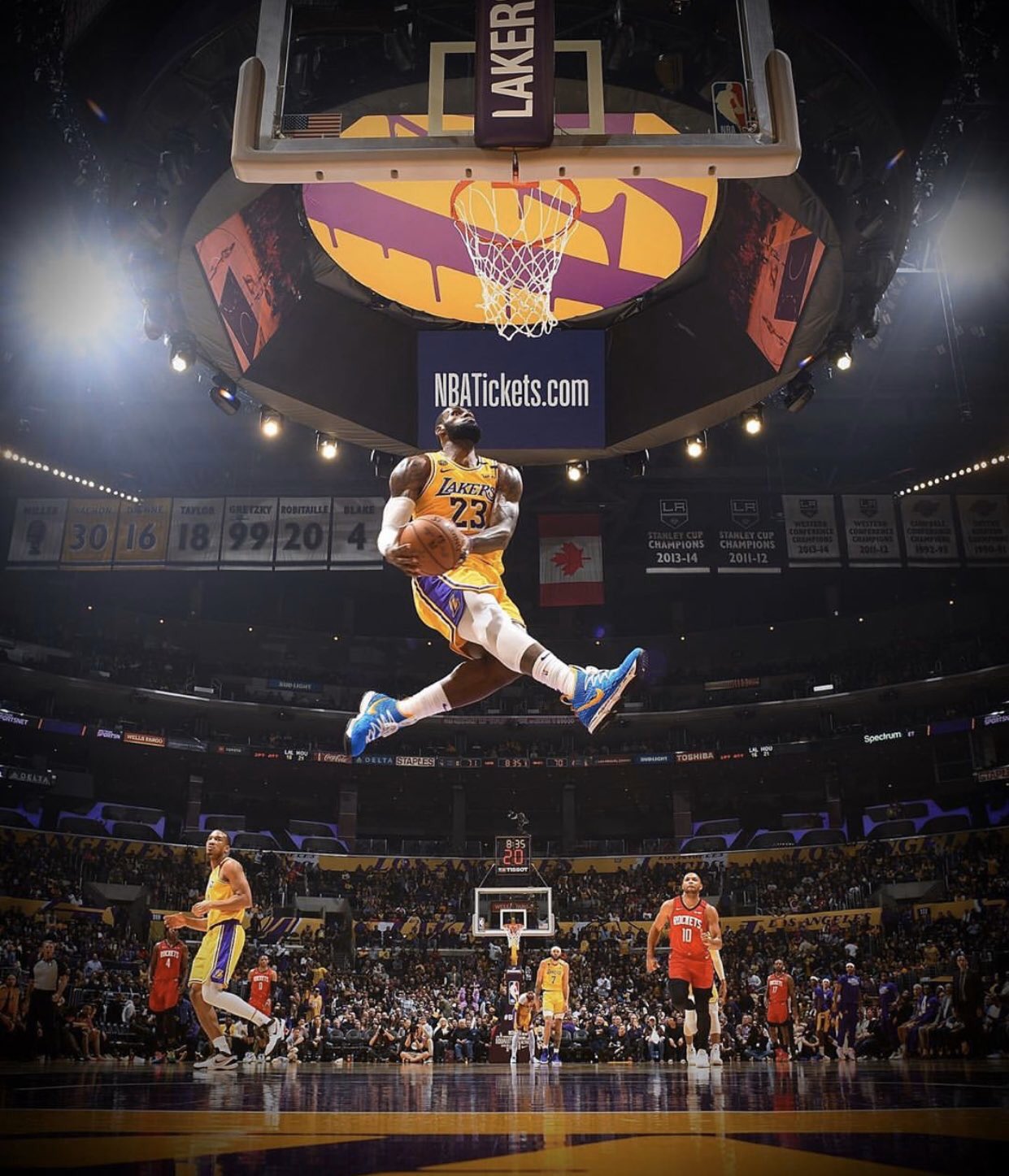
Twitter: @123sportsdigest

Facebook

Instagram: @123__sports


“I like how guys just know stuff. All the time.”

– Erin Hannon

Week of November 1, 2019

Legend.


Farewell, Deadspin

My favorite website, Deadspin, effectively died this week. The website is still up. But the soul is gone, dead and buried, at the hands of corporate stupidity. 

It would not be going out on much of a limb for me to guess that we have featured more stories from Deadspin than any other publication, and I doubt it’s particularly close. And that doesn’t count the stories we first read about on Deadspin but then featured the underlying story Deadspin sent us to. Rare has been the week we didn’t write about a story we read on Deadspin – when I searched “Deadspin” in our WordPress history, there was a hit in 208 of our 294 published posts – over 70%. But that’s all over now.

The end has been a long time coming. The website launched back in 2005. I found it somewhere soon after, and became a regular reader in or around 2009. Back in 2016, Deadspin was sold to Univision after its parent company, Gawker Media, went bankrupt after losing a lawsuit brought by Hulk Hogan (yes, seriously) and funded by billionaire dickhead Peter Thiel. The Univision purchase seemed strange, but for the most part things stayed the same. But then earlier this year Univision sold Deadspin to a private equity firm called Great Hill Partners. Immediately, longtime readers began to notice changes.

Ads became intrusive – shoehorned into the middle of stories. Pop-ups and demands to whitelist the website from ad blockers were constant. I could live with all that, though it was a bit of a canary in a coalmine, in hindsight. The real end, though, began in August with this post by Megan Greenwell, entitled “The Adults in the Room.” Greenwell had been editor in chief for about a year and a half, but this post served as a resignation letter. As Greenwell points out, the employees of Deadspin are not and have not been “idealistic journalists, unconcerned with profit” – on the contrary, they are journalists who are “eager to do work that makes money; [who] are even willing to compromise for it, knowing that [their] jobs and futures rest on it.” 

And, as Greenwell points out, they were good at it. They were profitable. And they did it while doing good work and reporting the hell out of stories. But that wasn’t good enough for their new corporate overlords. Greenwell explains life at Deadspin under Great Hill Partners and its CEO Jim Spanfeller:

Jim Spanfeller, the CEO of this company, meanwhile, is best known for growing Forbes.com in the mid-2000s, around the time this website was born. While he was not responsible for the “contributor network” that made Forbes a journalistic laughingstock, he set the stage by demanding increased output at all costs (up to 5,000 stories a day by the end of his tenure). The clickbait and SEO plays and sleazy monetization schemes rejected by Gawker Media were the entire point. Content mills The Active Times and The Daily Meal, which Spanfeller launched and later sold to the Tribune Company at a trivial price, ran the same playbook, and many of his ideas for growing revenue at this company (implementing slideshows to juice pageviews, clogging story pages with ever-more programmatic ads at the expense of user experience) were taken straight from that era—more than a decade ago, or approximately an eon in internet time. The only idealistic belief at Gawker Media was that a journalistic enterprise could make money without scamming people; the guiding principle at Forbes and sites of its ilk was that scams are good as long as they make money.

The question I hear the most about the owners of this company is “Why did they buy a bunch of publications they seem to hate?” I and my colleagues have asked Spanfeller only slightly more diplomatic variants of that question on several occasions. The answer he has given is that the publications didn’t cost him much and that he liked their high traffic numbers. The unstated, fuller version seems to be that he believed he could simply turn up the traffic (and thus turn a profit), as if adjusting a faucet, not by investing in quality journalism but by tricking people into clicking on more pages. While pageviews are no longer seen as a key performance indicator at most digital publications—time spent on the site is increasingly thought to be a more valuable metric—Spanfeller has focused on pageviews above all else. In his first meeting with editorial leaders, he said he expected us to double pageviews. Several weeks later, without acknowledging a change, he mentioned that the expectation is in fact to quadruple them. Four months in, the vision for getting there seems less clear than ever.

What has in any event been made exceedingly clear is that the owners’ vision involves narrowing the scope of Deadspin’s coverage. During my first real conversation with Spanfeller, he told me he didn’t understand why the site covered other media companies. During my first real conversation with Spanfeller’s hand-picked editorial director, Paul Maidment (another Forbes veteran), he said he didn’t understand why we covered politics. My responses—that we cover those things because our readers like them, a thesis that is supported by traffic figures—have failed to make an impact.

It really saddens me to know that someone saw a place and a community as great as Deadspin and bought it just to blow it up. Deadspin made the world a better place by shining a light on both the good and the bad in the sports world. And, yes, in the sports-adjacent world. Ok, and sometimes way outside the sports world. 

But that’s what made Deadspin great. There are lots of publications that Stick to Sports. And I’m sure they have readers who like that. But there’s also, obviously, a market for a place like Deadspin, where readers can go and read about sports, but also about other things that affect us all. 

This week, the end that began with Greenwell’s resignation finally, well, ended. The corporate higher ups laid down the edict, officially: Stick to Sports. The staff did not do so. Management killed a story, in violation of their collective bargaining agreement with Deadspin employees that gives near-complete editorial control to the staff. Editor Barry Petchesky, a longtime Deadspin writer and one of our favorites here, announced he’d been fired on Tuesday. 

In response, a long list of some of my very favorite writers announced their resignations on Wednesday. The site’s most popular writer, Drew Magary, followed suit on Thursday. The site, which usually has a dozen or more posts per day, had three on Wednesday (and each seemed to be not-so-subtle F-Us to management). 

And just like that, Deadspin, the funny, intelligent, critical, and creative website that inspired me to produce 1-2-3 Sports each week, was gone. Deadspin focused a critical eye on its subject – forcing readers to challenge popular narratives, to think not about what occurred but why, and to consider how an event has been perceived, and why. I will miss it. -TOB

PAL: I found myself instinctively opening Deadspin the last few days, only to realize again and again that it was essentially done. Deadspin achieved the ultimate goal with me – it was a part of my daily routine. Not just once a day. I would check it quick while waiting for BART, as a minute break at work, it has been part of my coffee scroll for years. Let’s be real – part of the bathroom routine, too. 

I appreciated the diversity of tone and ideas, and that it had an edge and reinforced the idea that sports is an intersection of culture, not a lane of it. It didn’t shy away from politics, and it didn’t shy away from funny highlights. It wasn’t afraid of random stories or pulling stuff from the archive. It seemed like a pretty simple formula: is this an interesting story? More times than not, I agreed that the stuff they posted was in fact interesting. Building a news/sports site based on that edict alone seems to be something fewer and fewer brands can do. Deadspin surely wasn’t the first, but it does signify we’re entering a new era. 

Per Bryan Curtis at The Ringer:

This week, as one staffer after another quit, I couldn’t help but think of one of the first Deadspin-induced moments of journalistic anxiety. In 2008, author Buzz Bissinger faced off with Will Leitch, the site’s founder, on HBO. Bissinger freaked out that real, honest-to-god reporters like him were being undercut and replaced by snotty bloggers.

The critique isn’t worth revisiting. But think about this: Now we’ve lost the snotty bloggers. The kind of churn Bissinger feared has decimated two separate categories of sportswriters. And it ain’t over. We are fated to live in a world where certain owners will make sure this process continues apace, until only mavens remain.

Curtis writes about the fate of these brands we associate with sportswriting, or – more broadly speaking – professional writing. Their carcasses are bought out and used as a short-term clickbait strategy. There is no long-term plan or mission other than diverting the masses to click on something, anything. Deadspin joins the likes of Sports Illustrated, Newsweek, Playboy, LA Weekly, and more. Curtis calls it Mavening (named after the company that bought the shell of SI).

Deadspin was my favorite scroll. Yes, some days it sucked, but most days it fell in a hard to find sweet spot. The Ringer skews too heavily on entertainment for my liking. The Athletic relies too much on what I’ve liked (as opposed to what I should read). ESPN is a network and not a news shop and the locals like The Chronicle or Star Tribune don’t have or don’t spend the money any anything more than gamers and local gossip. 

TOB: Ah, yes. I had forgotten. The Buzz Bissinger HBO freak out with Will Leitch is what made Deadspin part of my daily routine. Classic.


The Nats Are All We Can Ever Hope For

Pro tip: When a team wins a title, always read its local paper for the real deal. After the Nationals – major underdogs against the Astros – won four road games en route to the championship, I went to the Washington Post for my recap. 

After my Twins were, again, the suckiest bunch of sucks that ever sucked a suck in the playoffs, I latched onto the Nationals. It’s always easiest to just root for the team playing the Dodgers, but I quickly saw this team had ‘it’ this playoffs. Strasburg was realizing the near impossible potential of his can’t-miss, number one overall draft pick expectations. Max Scherzer was gutting out wins. Juan Soto was becoming a clutch star – at twenty, a better version of former National Bryce Harper. Old guy Howie Kendrick was hitting super-clutch bombs and doing this with Adam Eaton:

This team was on the edge, and playing loose – the most dangerous kind of team. They came back against Josh Hader and the Brewers in the play-in game. They crushed the Dodgers dreams, and they embarrassed the Cardinals. This team was used to it by the playoffs. They rode that right into the World Series and beat a dominant Astros team. That edge – it’s where the Nationals spent the majority of the season. 

Per Dave Sheinin: 

In other words, after a month of exquisite play and narrow escapes, Game 7 had carried the Nationals to a familiar place. They had spent so much of the past five months playing from behind — from the long slog of digging out of May’s 19-31 hole to the win-or-go-home games of early and mid-October — that it almost brought a perverse sense of comfort. They were at their best, they liked to say, when their backs were to the wall.

And it all took us to a Game 7. A baseball fan – hell, a sports fan – can hope for nothing more than a season ending with a Game 7. In that penultimate game, the numbers in the game most defined by numbers don’t matter. Pitch count doesn’t matter. A batting average doesn’t matter. WHIP doesn’t matter. All those numbers got us to this game, and now we get to throw it all out and see who the hell can get a hit with two outs and runners on base. 

In other words: 

By Wednesday night, the Nationals were running on a cocktail of fumes, painkillers, Red Bulls and dwindling supplies of adrenaline. Each player was reduced to his component parts and what each had left in it — how many pitches, how many innings, how many competitive at-bats.

Watching the Nationals make this run, I realized that all you can ever fairly hope for as a sports fan is to get into a situation where you’re one game away. Ain’t that the truth. All we can ever hope for in life is to get one opportunity away from the goal. They playoffs are the best, and Juan Soto is awesome. – PAL

Source: Nationals Win First World Series title, Storming Back on Astros in Game 7, 6-2”, Dave Sheinin, The Washington Post (10/30/2019)


Jumping on a Bandwagon Without Shame

2019 has been a bad year for my sports teams. Cal football has lost 4 straight, the last two in ugly fashion, to fall to 4-4. Cal basketball is unmentionably bad. The Giants were bad, outside of one hot stretch, and Bochy is gone with Bumgarner seeming likely to follow (though I am very bullish on the team going forward). The Kings fell short of a playoff berth, had a strange and unproductive summer, and are 0-4 to start a season many hoped would see their return to the postseason. The Warriors, who aren’t my team but who I root for, look terrible and are 1-3 and Steph Curry just broke his hand. 

And then there are the 49ers. It would not be fair to call the Niners one of “my teams,” though. I loved them as a kid, led by Montana and then Young. But those teams were awesome and easy to love. When the team fell on hard times, I cared less. Then they passed on Aaron Rodgers, took Alex Smith instead, and predictably sucked. So they were dead to me. 

About a decade later the Niners finally recovered from that idiotic mistake, and there I was furiously cheering them on to deep playoff runs with Harbaugh and Kaepernick. They brought me back in. And then they ran Harbaugh out of town, kicked Kaepernick in the teeth, and moved out of San Francisco. So they were dead to me, again.

Now they are 7-0 and look like Super Bowl favorites after blasting the pretty good Carolina Panthers by a score of 51-17. The Niners defense is the story – their defense is so good that if the season ended today it would be the second highest rated defense in the NFL, ever (amazingly, this year’s New England Patriots defense is even better, with the highest rating ever). But the offense is also awesome, with a creative and tricky rushing attack that keeps defenses guessing the entire game. 

So, I’m back, baby! Go Niners! Save me a place to stand on that bandwagon. Yes, I’m a fair weather fan. In fact, I am the fairest of fair weather fans, and I’m ok with that. -TOB


This is a Rant About the Umps, But it is NOT a Robo-Ump Rant

The umpires nearly blew Game 6 of the World Series, which saw the Nats win 7-2 to force a Game 7. But late in the 7th inning, with the Nats up 3-2 and a man on first, the following play occurred:

The play ended with runners on 2nd and 3rd with no outs. But home plate umpire called Trea Turner out for runner interference. The Nats went ballistic; Manager Davey Martinez was eventually tossed. I don’t blame him:

Whose fault is that contact? Either Peacock, who made a bad throw, or Gurriel, who turned with his glove.

So what the hell was the call? As Michael Baumann explains:

The white line that runs parallel to the first base line is supposed to create a runner’s lane, and Turner was technically outside that area. Under rule 5.09(a)(11), which MLB chief baseball officer Joe Torre read aloud from the rulebook at a postgame press conference, a batter is out when he runs outside that lane and interferes with the first baseman taking a throw.

But what would you like Turner to do? It’s idiotic. If the umpires followed the rule, then the rule is stupid and needs to be changed. What’s worse is that the umpires made that call in that situation – on a play where the runner is clearly not trying to interfere with the throw and the batted ball is far enough up the third base line that he shouldn’t have been even close to the ball if the throw wasn’t awful. As Baumann put it:

But Turner was running a straight line from the right-handed batter’s box to the bag, which is entirely within fair territory, and more important than the way the rules are written is how the rules are enforced by umpires, and how their implementation is understood by players. Precedent of enforcement isn’t as binding in baseball as common law in the real world, but it informs players’ actions just the same.

The interference call was like getting pulled over for driving one mile per hour over the speed limit, a showily petty bit of legal literalism that contravenes a lifetime of lived normative experience.

Exactly.

And then none of it mattered because Anthony Rendon stepped up and hit a bomb to make it 5-2. Go Nats! -TOB

PAL: I think simplifying the rule to a something about running a straight line would be better. Bang-bang play, but I think Turner is safe on a good throw. I think Peacock knows it’s going to be a close play, rushes his sidearm throw, causing it to tail. Turner runs a straight line, but he knows exactly where he is in relation to the baseline. Exactly.

Another thing I heard John Smoltz say yesterday on the Dan Patrick Show: he said pitchers in that situation are instructed to throw it in the runner’s back for this reason.


Video of the Week


Tweet of the Week


Song of the Week

Sharon Jones & The Dap-Kings – “Pass Me By”


Like what you’ve read? Let us know by following this blog (on the right side, up near the top), or:

Email: 123sportslist@gmail.com
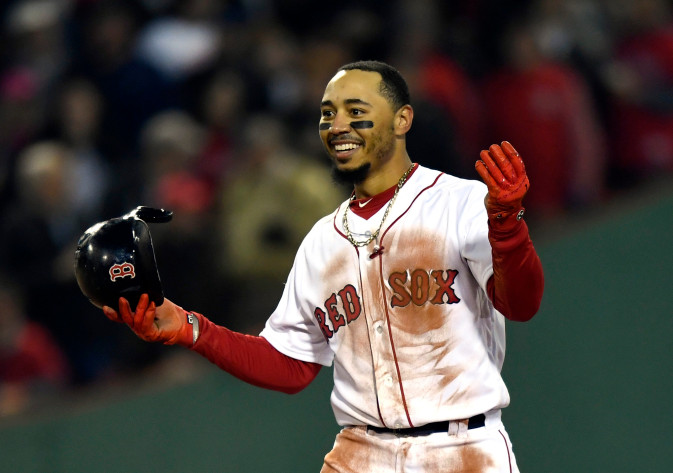
Twitter: @123sportsdigest

Facebook

Instagram: @123__sports


“A real man swallows his vomit when a lady is present.”

-Dwight Schrute