On the Force or the Tag: Part III

On The Force or the Tag is a 5-part series recounting my season as a volunteer baseball coach in a city league to which I had no prior affiliation. Along the way, I’ll connect my coaching experiences this season to memories from the four best coaches I had growing up. Kent Anderson, Tony Lang (my brother), Jay Rabeni (my brother-in-law), and Jeff Holm continue to influence how I approach my day and my life. They represent the best-case scenario of youth sports, from Little League to college. This is my thank you to them.

The names of the players, coaches, and family members from the team I coached have been changed. Read the other sections: 
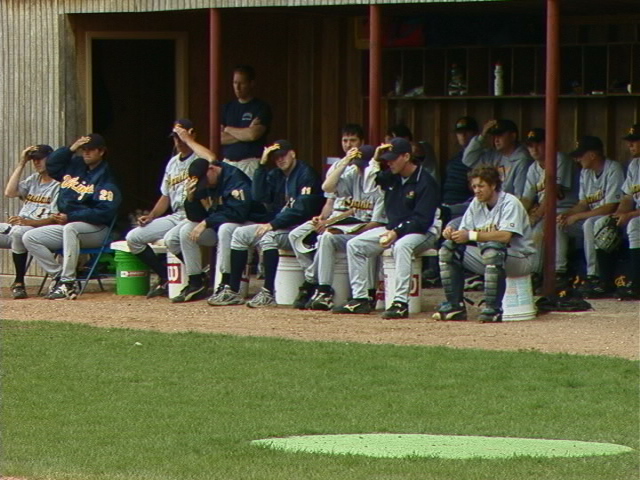


Photo by Brent Hoegh. The dugout can be a funny, odd place. My college team partakes in the 2 out, 2-2 count routine. I’m sitting on the bucket with the catcher’s gear. 

Joe and Ricky, my two left-handed pitchers, were slouched in the dugout chatting during the middle innings of a blowout. Our team was on defense, so the dugout was vacant. I sat at the end of the dugout closest home plate watching our catcher, Larry, frame pitches. If there was one skill set I could coach, it was the catcher position. We were in our second weekend of games, and I had yet to give Larry a single note.

After the lefties tired themselves of guessing what pitch our pitcher would throw next, Joe offered up this nugget of perspective to Ricky.

“Remember when we, like, used to care about every play?”

I turned my entire body sideways to observe the oblivious lefties.

Ricky acquiesced with a nod, but he cared. Joe cared when he pitched, sometimes. But to Ricky, competition was instinctual. On the mound, he would self-diagnose and tweak his delivery. In right field he would remind the first baseman that he could be throwing to first on a sharp single to right. Still, it was easier for Ricky to agree with Joe than admit he cared, which makes sense when you remember these dudes were fifteen.

“I care about every play,” I interjected. “And – not for nothing – this is the dumbest conversation I’ve ever heard in a dugout. Your coach is ten feet from you!”

They chuckled and gave spare tire apologies that were just enough to carry them out of the current predicament.

I laughed a little, too. I wasn’t a robot coaching the team, and this wasn’t military training. If nothing else, it was a genuine moment in a lopsided game. Every exchange a coach has with players can’t be aggressive, binary, win-or-you’re-a-loser coachspeak. For one, that’s b.s., and kids have precise bullshit detectors. Also, a coach can’t demand more from a team without genuinely knowing and caring about the individuals. Kids will tune out a coach that speaks at them, and they will hesitate to give more to a coach who doesn’t know them.

That is all true, but there was another truth jammed between Joe’s words: there is nothing more damaging to a young baseball team than a blowout win. Nothing.

Do you know what happens when you’re leading a game by 10+ runs? Players stop competing. Hitters don’t sprint to first on a dropped third strike. Pitchers have to be told to step off the rubber because they forget to pitch from the stretch with runners on base. Outfielders miss their cutoff man. Players stop competing, and lazy-ass baseball ensues. Lazy baseball is so much more contagious than competitive baseball. Lazy baseball is boring to play, unbearable to watch, and infuriating to coach.

It should come as no surprise that we lost our next game*.

***

Players learn nothing from winning big. In the vast majority of youth games, a blowout only reinforces what everyone at the game knew before the first pitch: one team has more ability and skill than the other team. A blowout fools kids, sometimes coaches as well, into believing their skill is more important to their success than their approach, which is an idiotic interpretation of success in youth sports.

The correlation between skill and success is crap for everyone, in all facets of life, save maybe a hundred true geniuses throughout history. Hell, Malcolm Gladwell’s Outliers is essentially a book about minimizing this 1:1 correlation. The other side effect of skill-first thinking is that it tamps down any possibility for a team to realize its full potential.

Coaching skills isn’t hard. To be able to get players to consistently execute baseball fundamentals is a prerequisite for any coach (I would hope). There are hundreds of drills cleverly designed to correct technique and improve a skill. If a hitter opens up the front shoulder on every pitch, then try reverse soft toss. If a catcher’s throw down to second misses wide, then draw a line in the dirt from the back corner of home plate to between the catcher’s feet and tell him to make sure his lead foot lands on the line when he makes the throw.

Technique doesn’t even have to be explained; if the results change a player’s outcome for the better then he will commit to it immediately.

To coach approach, however, is to change the way a group of players thinks about the game. Results are rarely immediate when coaching approach, and it’s harder to correlate a shift in thinking with a positive change in the individual baseball stats, e.g. batting average, fielding percentage, earned run average**. We’re talking about establishing a team culture here, about maximizing potential, which is how I define success. It’s a much higher degree of difficulty, and a hell of a lot more fulfilling for all involved.

My approach is to “win the inning”. This is not an original concept – the late University of Texas coach Augie Garrido has an entire documentary about it (any baseball nut will love this). Jay, my youth coach, was a big “win the inning” believer, as was Coach Holm in college.

Quite simply, to win the inning asks players to think of the game as one inning – one turn at the plate, and one turn in the field. The seven-inning or nine-inning game the rest of the folks are counting as a game doesn’t matter if your team can focus the inning at hand.

Win the inning is about making a habit out of competing moment to moment. It requires every player on the team to seek out what he can control and contribute in the moment immediately before him. For younger players (under about ten), win the inning is a fun way to get keep the game fresh, but this is a philosophy at its core.

Making a spectacular catch in the outfield. Hustling to backup the player trying to make that spectacular catch in the event he misses it. Hitting a two-out homerun. Beating out a grounder for a hit, which brings the homerun hitter to the plate. All of these are winning plays. While only two of them require talent, a coach has to get players to believe that the hustle plays are valued as much as the spectacular plays. They all more clearly contribute to winning an inning, but the essential, unspectacular plays get forgotten when a team reflects on seven or nine innings as a single entity.

After an inning is over, everyone resets. Start over and forget what just happened, good or bad. By minimizing the scope, you maximize the importance of the details. In those details you will find a team’s potential realized. In those details is where build a culture.

Getting kids to buy into this approach is hard, because – newsflash – we do keep score in seven and nine inning increments, folks keep statistics, and long-term improvement is hard to demonstrate in a short season. Players know when they’re kicking a team’s ass and when they’re getting their ass kicked. It’s right there on the scoreboard. Again, you’re asking them to redefine success, while knowing everyone else in their life – parents, future coaches, baseballreference.com – measures success by how many hits they had or how many innings of shutout ball they pitched.

There’s no guarantee you’ll get a team to buy-in on, but it’s worth trying. Why? Because “win the inning” is the more fun version of baseball. Teams that learn how to compete inning-by inning win against teams that have more skill. Stealing a win feels the best. Teams that expect and value everyone’s contribution create a more inclusive environment. I don’t know about you, but work is more fun when everyone is pumped to be there.

No one wants to play the game where everyone stands around watching the one stud throwing a shutout and driving in a couple runs. That shit is boring for everyone besides the aforementioned stud who will likely flame out before he can legally buy a tin of tobacco.  

Also, the games of our youth we remember are not the blowouts, and we don’t remember our batting average (god, I really hope none of you remember your youth stats); The games we remember are the games we stole.

***

By the second week of the season I was able to get an initial feel for all of the players on the team. These idiots were loveable. I loved how Hank never stopped talking to the pitcher and infielders between every pitch. I loved how the twins Chris and Tyler would track down a sure double in the same way and make it look so casual. I loved how Bill fumed when he missed an opportunity to drive a couple runs in with two outs. These were good kids with a little bullshit to them. Just the way it ought to be.

Watching a game from inside the backstop and interacting with young players was like being home. I belong on a baseball field more so than any place else.

***

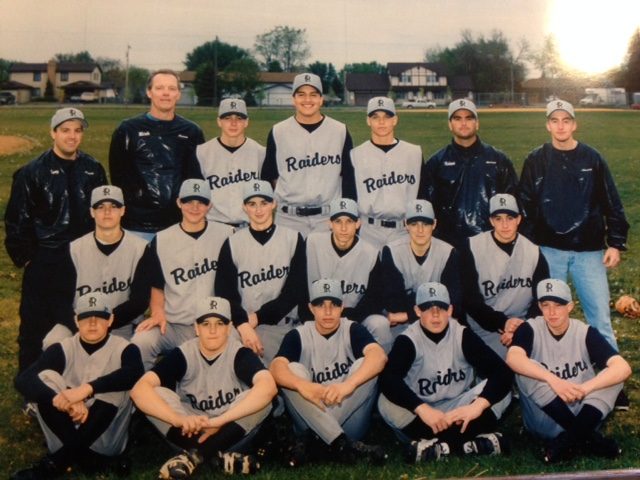
Jeff Holm, Coach, didn’t recruit me to play ball at Augustana (2018 National Champs). I was on the North Shore of Oahu when the coach that had recruited me called and told me he was taking a job at Kansas. My sister and brother-in-law were house-sitting for this big-time lawyer, and I remember looking out at the Pacific Ocean between Pipeline and Sunset Beach from the kitchen of this quintessential beach house and wondering what the hell this meant for me. Then I remembered I was in Hawaii for the summer learning how to surf the small summer waves and resolved to worry about the whole baseball thing when I returned to Sioux Falls, South Dakota.

Back row, L-R: Al Shaffer Kevin Wiessner, Sam Everson, Ben Iverson, Troy Wunderlich, and recent Augie Sports Hall of Fame inductee Owen Hoegh. Front row, L-R: Ryan Nett, Phil Lang, Aaron Barber, Coach Jeff Holm, Travis Pugliese.

Knowing what I know now, the idea that Coach was the random guy brought in to replace the guy who actually recruited me is hard to chalk up to simply good fortune.

Coach quickly became a mentor. First and foremost, he would like you to know that, despite being a squat fella with a penchant for DMD (Diet Mountain Dew to the uninitiated), he was a killer in the racquetball court and not a bad basketball player.

In all seriousness, he showed me the character and selflessness enthusiasm requires. Being jaded is so easy, so cliché. Coaching at the college level is flatout different from high school. Obviously the skill level is higher, but more importantly a college coach is leading a team of players who know the game, and many of them have an idea of what their approach to the game is. College players are eager to get better, but set in their ways. They won’t buy into a culture blindly.

Some initially mistook Coach’s enthusiasm for one-dimensional cheerleading, but he understood both the game and the importance of building a relationship with his players. Even by 2002, the Bobby Knight days of drill sergeant coaches was on the outs, and Coach understood that.

Teammate, roommate, left-handed pitcher and now coach Ryan “Gramps” Nett put it this way:

Coaching myself, I think he was ahead of the curve on quite a few things in terms of new school ideas. (1) Relationship building with players was really important to him, understanding each player and letting us know he genuinely cared. (2) Showing players teammates worth. I think of the guys he could have cut and didn’t because he wanted everyone to understand providing opportunities is important. Whether they play or not, they’re still worthy of being part of the team. (3) I think now in the age of “win at all cost” he was ahead of wanting us to compete and not worry about wins and losses. That the little things in the game will carry us through a successful year but also hopefully a successful life…Always brought his boys around, enjoying a good laugh during the game, asking about girlfriends, family, classes. Kids now feel a lot of pressure, and with him it was only the pressure I put on myself and that says a lot because he was relying on 18-22 year-olds to be successful for his livelihood. I think it’s pretty special to show that trust in kids.

I spent two summers in Sioux Falls. Coach and I would workout and go for runs in the morning (I miss that summer college schedule!). We talked about baseball exactly never on those runs. He cared about me as a person, and that made me compete even harder for him as a player.

Augustana University had less than 2,000 students at the time I was enrolled, and we competed in the now defunct North Central Conference with big state schools that have since gone D-I like North Dakota State, University of Nebraska, Omaha, Minnesota State, and South Dakota State. In his second year at the helm, Coach led us to Augustana’s first men’s team conference championship in school history.
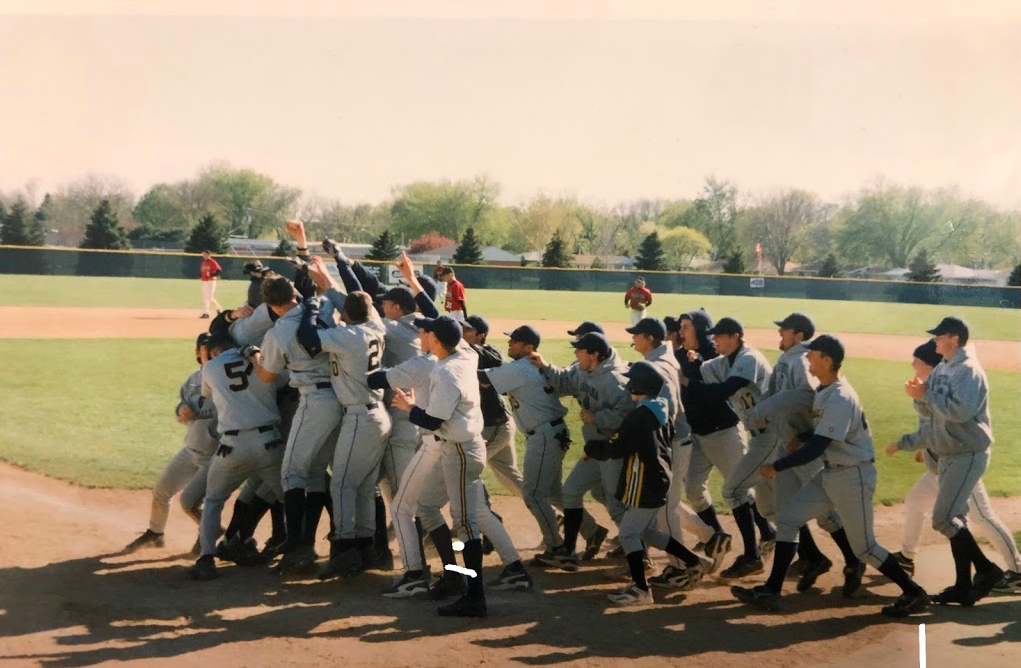
Anyone that played for Coach knows that he has a terrible habit of yelling out really lame phrases after the opponent did something good. The best/worst example of this was when an opposing team would hit a home run.

As the hitter was still rounding the bases, Coach would shout, “Just lets us score more!” The mere memory makes me shutter. It was such a Little League coach thing to say.

I hate to admit it, because – again, so lame – but the sentiment was right. Coach was shoving us into competing in the next moment, even while the last moment had yet to finish. He was friendly, but he didn’t care about being your friend, or being cool; he cared about you. He was a dork, but he’d kick your ass when it came to competing. He was always pushing you to the next moment, and we competed to win the next inning, never doubting he had our best interests in mind.

I think about how Coach would have handled that blowout when Ricky and Joe pondered the importance of every play, and I think about what Garrido tells his players after a loss – “This isn’t about some goddamn game. This is about our lives. Don’t you get it?”

I agree with Garrido. It is about our lives. Joe and Ricky are talking about a game, but long after the games are over, will they compete at work, will they make the hustle plays in their relationships? I wonder if they would’ve heard Garrido’s wisdom if he was screaming it at them, but I know they’d hear it coming from Coach. – PAL

Up next: Part IV – “An Insider’s Account of An All-Star Selection Meeting”

Footnotes:

*For a breakdown of how we lost, check out Part I of the series.

**a positive change will happen to individual stats, but it might take more time and opportunities than a youth season presents

Catchup on the series here: 

Part I

Part II

Week of August 17, 2018


Proving Your Worth

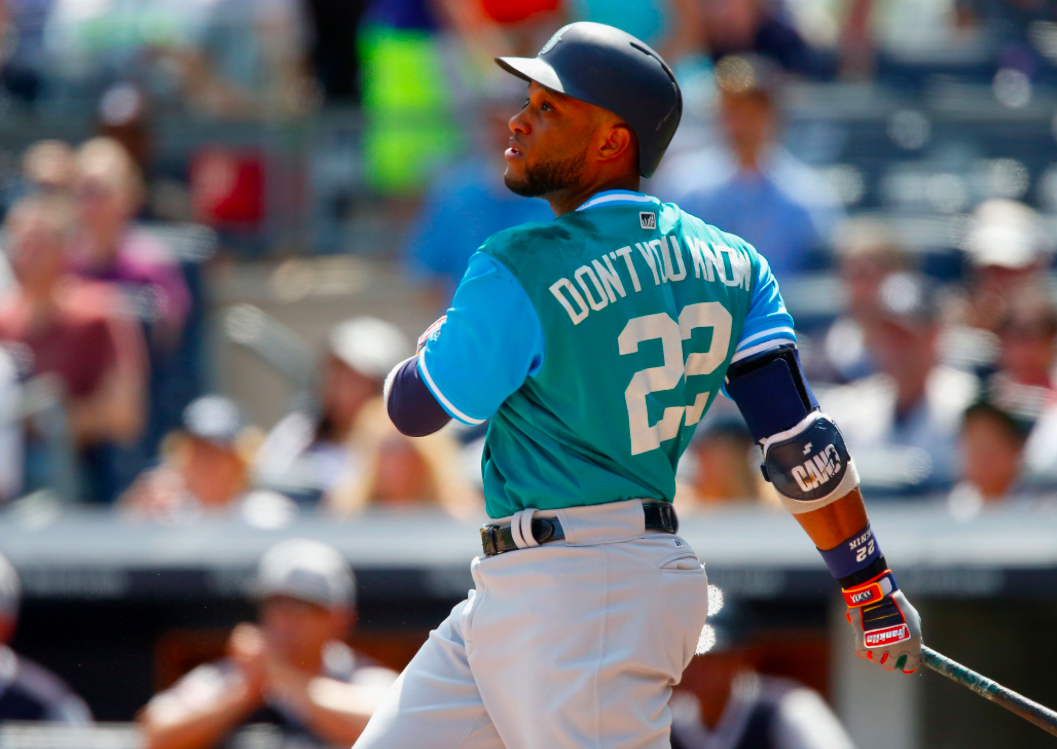
Of all stories about PEDs and baseball, I don’t think I’ve ever come across an article that put forth the explanation Jonathan Tjarks asks us to consider: in some cases PED usage is used to justify of a massive contract and not a tactic to sign a massive contract. With Seattle’s Robinson Canó, the $240MM man, returning this week from an 80-game PED suspension (tested positive for a diuretic used to mask PED) Tjarks walks us through a interesting argument:

The conventional cynical wisdom is that players use PEDs to boost their stats and secure massive contracts, but what if we sometimes have it backward?  In an interview for ESPN with Peter Gammons in 2009, Alex Rodriguez said he first began taking steroids in 2001 after signing a 10-year, $252 million deal with the Rangers. A-Rod put a huge spotlight on himself by signing that deal, which was worth more than what Rangers owner Tom Hicks paid for the franchise. His performance had to be almost superhuman; otherwise, it would be judged a failure.

Baseball’s free agency rules (once players get to the majors, their salaries are controlled for six seasons). No open market until after that sixth year with the big league club. Considering a lot of players spend two, three, or even four years in the minors, we’re talking about team control for eight, nine, or even ten years! This rule makes it very rare for players to hit the open market while still in their prime (which is somewhere between 26 and 28).

Unless a player is a prodigy like A-Rod, who reached the majors at 18, he won’t hit the market until he’s past his prime. Under the current system, Aaron Judge won’t be a free agent until he’s 31. Jacob deGrom won’t be a free agent until he’s 32.

In other words, the Yankees paid Canó 58MM for nine hall-of-fame seasons (a complete bargain), and the Mariners will pay $240MM for not that (a rip-off). These 10-year contracts never work out because the players are simply too old when they are eligible to sign such a deal.

Tjarks went back a generation for another comparison:

Just look at two of the greatest players from the previous generation: Barry Bonds and Ken Griffey Jr. Bonds spent his first seven seasons with the Pirates before signing with the Giants at the age of 28. Griffey spent his first 11 seasons with the Mariners before signing with the Reds at the age of 30. Both were sure-fire Hall of Famers before they signed with their second teams. Both were paid $95 million between the ages of 30 and 38. The difference is that Griffey produced 13.3 WAR over that stretch, while Bonds produced 77.8 WAR.

PED use is why Bonds is not in the Hall of Fame and Griffey is. But would San Francisco fans be willing to trade the second half of his career for Griffey’s? Bonds won back-to-back-to-back-to-back MVP awards and turned the Giants into an elite franchise. The Reds never even made the playoffs with Griffey.

Of course, there is another possible explanation. Players take PEDs for all the reasons: to get into the bigs, to stay in the bigs; to sign a contract for hundreds of thousands of dollars, and to sign a contract for hundreds of millions of dollars. I choose D – all of the above. – PAL

Source: Canó and the Impossible Contract”, Jonathan Tjarks, The Ringer (8/14/18)

TOB: (My response inspired by of one of my favorite memes):

Phil I want to address this issue. You KNOW I don’t care if athletes use PEDs. BUT!

I think this argument is b.s.! I won’t dispute that Robinson Canó, who has a massive contract guaranteeing him huge amounts of money until he’s 41 was not taking PEDs to play for his next contract. It was not “about” making money. HOWEVER! I do not buy that athletes like Canó, A-Rod and (ALLEGEDLY!) Bonds took PEDs out of some selfless need to live up to the expectations created by their massive contracts. It’s ego, bruh. Plain and simple. When Bonds (ALLEGEDLY!) took PEDs, it was (ALLEGEDLY!) in response to the fame garnered by juiceheads McGwire and Sosa during the 1998 home run chase. Bonds, suddenly, wasn’t the biggest name in baseball and he couldn’t take it.

Sidebar: I’d also like to take this opportunity to say that I am surprised everyone so blindly accepts that Griffey was clean, when there is some evidence to suggest he was not. First, he got a lot bigger right after 1998, just like Bonds. Natural aging? Maybe. But no one gives the benefit of that doubt to Bonds. Second, right after he goes to the Reds in 2000, his body starts breaking down. He was only 30, and he suffered repeated and severe soft tissue injuries: pulled and torn hamstrings especially plagued him. As you may know, anabolic steroid use can lead to muscle tears. I’m not saying, I’m just saying.

So, yeah. I don’t care if Canó took PEDs. But I’m also not going to allow Tjarks to let him off the hook for his actions to say it was out of some altruistic need to live up to his paycheck.

PAL: To be clear, I am not suggesting Tjarks is right; I’m just saying he makes a compelling point on Canó’s behalf. The delayed free agency leads to players being at or past their prime when they sign their big contracts, which can lead to the PED use. I have’t heard that one before.


The Birth of College Football

As TOB mentioned to me, it’s frustrating how many great articles and stories are on The Athletic, which doesn’t allow readers any free views in order to sample the goods. I’ll do my best to share big chunks of this story, because it’s a doozy.

Did you know the popularization of college football ban be traced back to WWI, and that it was military bases and academies that brought the game to the masses? I didn’t.

As top college athletes enlisted in the war efforts and universities struggled to find enough bodies to field teams, more players who otherwise wouldn’t have had the opportunity to play at the college level were given a chance to participate. The sport became less of an elitist pastime and more of an everyman’s game.

College football became seen as more “American” as military training camps put together teams to face off against themselves and universities. And when the flu ultimately passed and congregating was again allowed around the country, the communal feel of a football game proved valuable.

Back in 1916, the game was used as a way to keep soldiers healthy…and by healthy I mean STD-free:

The view of football being valuable to World War I military training can be traced to a breakout of venereal disease.

In 1916, national guardsmen who were stationed at Fort Sam Houston, Texas — patrolling territory near the U.S.-Mexico border — suffered from an outbreak of sexually transmitted disease at their camp.

“These young Guardsmen, with nothing to occupy their free time, swarmed into the nearby camp towns to look for fun, but found venereal disease and cheap alcohol instead,” James Mennell wrote in The Service Football Program of World War I: Its Impact on the Popularity of the Game.

With the U.S. creeping closer to involvement in World War I in 1916, the need for healthy, young, STD-free American males became greater. So on the recommendation of War Department Secretary Newton D. Baker, the Commission on Training Camp Activities (CTCA) was created.

With U.S. involvement in WWI seeming more likely by the day, the war efforts became widespread. Many former college athletes were enlisting, and more and more college men were joining the ROTC. However, there was a general concern that the 2-year and 4-year ROTC programs weren’t churning out prepare soldiers fast enough. This lead to the Student Army Training Corps,  a university-driven military training curriculum. At that point, nearly every male student was a part of the SATC; they were eligible for the draft if they weren’t a member. The SATC allowed them to continue their education without a draft hanging over their heads.

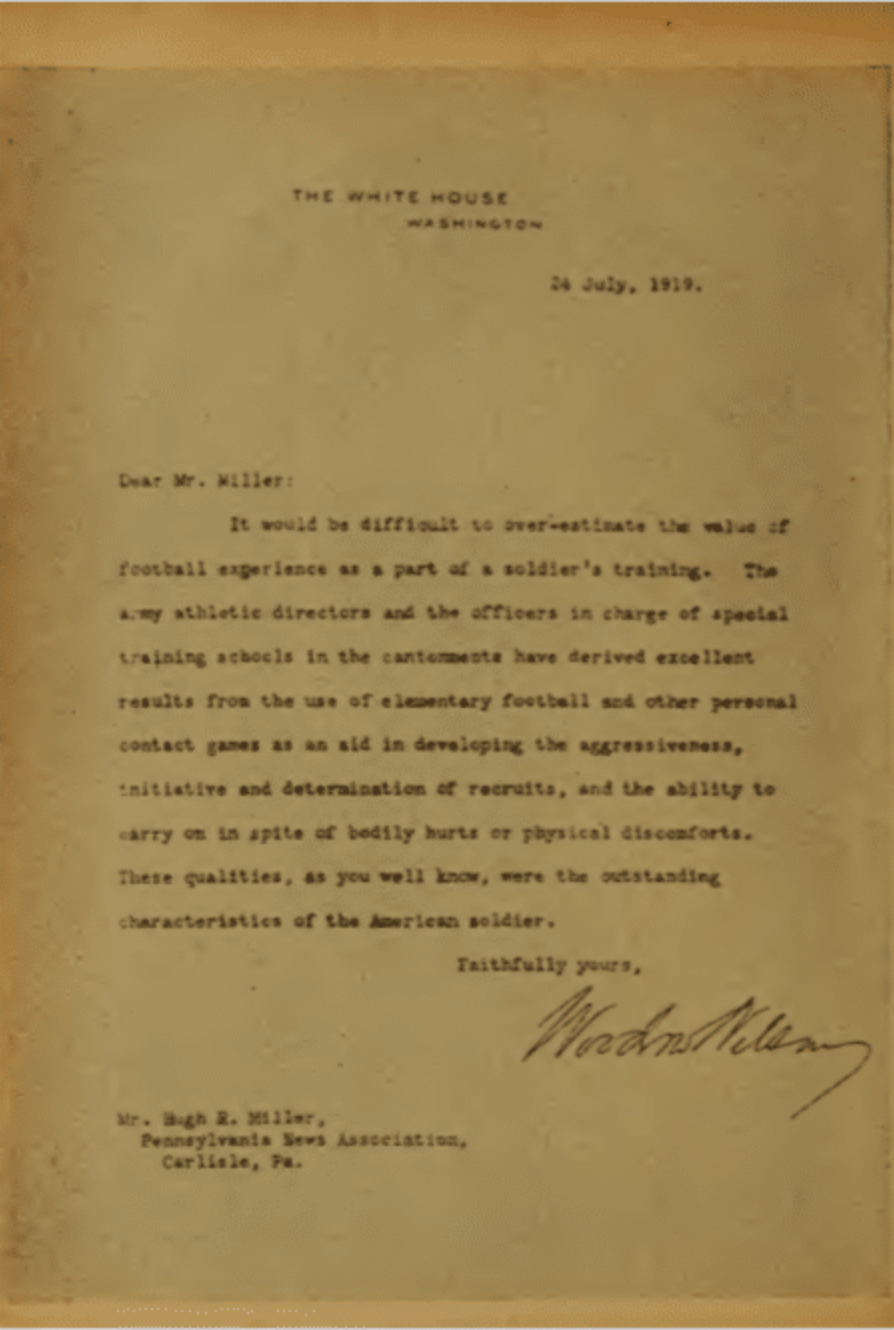
And just like that, you have 400 colleges across the country training soldiers with the military leadership – right up to President Wilson – seeing football as a key component of the soldiers’ training.

And right as the game, made popular on bases and college campuses alike, was gaining national attention, the flu hit. It’s hard to fathom the scale of it all, but this stat rattled me:

More children under 9 died in the United States in 1918 than during the next 25 years combined. In the span of those 12 months, the average U.S. life expectancy dropped almost 12 years.

The result was very few games played in September and October of that year. People missed the game, and in November charity games were set up to raise funds for the United War Work Fund. People came out by the thousands, eager to cheer.  The ceasefire and Armistice was signed on November 11, 1918, and the second wave of the flu was dissipating.

For a nation that had suffered deaths abroad and at home, November football came as a respite. For the American military, it proved to be one of the most useful tools in helping to win the war. And for the future of the sport, the 1918 season proved to be one in which the game was taken up as American and democratized for many.

When you think about the origin of college football, which pre-dates professional football, the modern-day alignment with the military makes a bit more sense. In fact, I’m shocked that I’ve never heard the story of how football spread across the country by way of a war effort. I’m shocked I haven’t read the words of Penn’s Sol Metzger on a bumper-sticker somewhere:

Now our American game of football teaches us nothing if it does not build up our spirit. College spirit, bred of football, is close kin to patriotism. And this spirit of the American forces is nothing more than college spirit of a high and nobler order.

All of this football because some soldiers got VD. Actually, that sounds about right. – PALSource: A season of influenza and influence: How World War I and a pandemic in 1918 changed college football forever”, Chantel Jennings, The Athletic (8/14/18)

TOB: Interesting article. Phil did a good job tying it together, but I had to call attention to this section, where a doctor laments all the deaths due to the 1918 influenza pandemic:

“One can stand it to see one, two or twenty men die, but to see these poor devils dropping like flies sort of gets on your nerves. We have been averaging about 100 deaths per day, and still keeping it up. There is no doubt in my mind that there is a new mixed infection here, but what I don’t know.”

I can’t stop laughing at his nonchalance. Sure, who doesn’t mind seeing twenty people die. But yeah, 100 per day? That sure does get on my nerves, too


Video of the Week


Tweet of the Week

https://twitter.com/corte4/status/1029846486031450114


PAL Song of the Week: Aretha Franklin – “Chain of Fools”


Like what you’ve read? Let us know by following this blog (on the right side, up near the top), or:

Email: 123sportslist@gmail.com

Twitter: @123sportsdigest

Facebook

Instagram: @123__sports


“No, no. AIDS is not funny. Believe me, I’ve tried.”

M. Scott

On The Force or On The Tag: Part II

Read Part I of the series here.

Read Part III of the series here

On The Force Or On The Tag is a 5-part series recounting my season as a volunteer baseball coach in a city league to which I had no prior affiliation. Along the way, I’ll connect my coaching experiences this season to memories from the four best coaches I had growing up. Kent Anderson, Tony Lang (my brother), Jay Rabeni (my brother-in-law), and Jeff Holm continue to influence how I approach my day and my life. They represent the best-case scenario of youth sports, from Little League to college. This is my thank you to them.

The names of the players, coaches, and family members from the team I coached have been changed. 

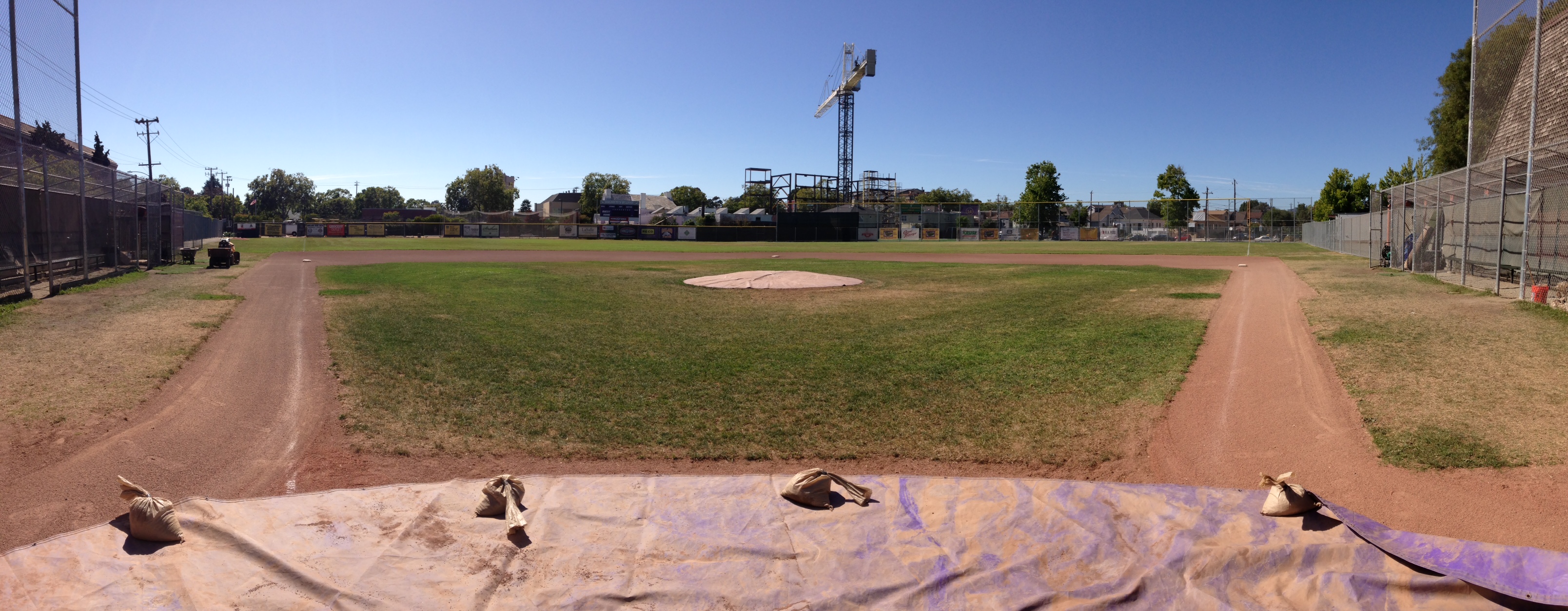
This pic doesn’t do the field justice. Rickey Henderson Field is a treat. 

Goddamn, do I love being on a baseball field. It didn’t take very long into our first practice of the season for that realization to slap me across the face.

There is a rhythm to a baseball practice that folds perfectly into a long summer evening. Its signature characteristic is held in a pause, like that moment before a rocking chair returns forward, when momentum gathers. The pause is in every fundamental phase of the game. You can feel it in the moment between when a pitcher sets and starts his delivery. It’s right there, after an infielder releases a throw across the diamond to first to complete a double play. It’s with the outfielder, too, as he waits for the fly ball to drop after he tracked it down, his feet set to catch and throw back to the infield in one motion.

Once the techniques have been explained and strategy and positioning has become instinct, baseball practices come down to repeating the moments immediately preceding and following these pauses. That’s where the rhythm comes alive. 

But finding this rhythm with a team takes some time together. It takes – you guessed it – practice, and if there was one thing made clear to me when I had met with Glen, the league coordinator and umpire from part 1 of this series, it was that this league wasn’t about practice. Quite plainly, this league was about players getting in the requisite amount of games in order for the best of them to qualify to play in All-Star tournaments. The coach of said All-Star team: Glen.

A ten-game season with no more than a practice or two with fifteen year olds who weren’t playing travel ball (as I understood at the time)?  I hauled the jerseys and equipment bag to the back field at Caldecott, genuinely worried that I was about to coach kids who had no interest in the game but had agreed to play one more season only after their parents insisted that they “had to do something this summer” or get a job.

And what All-Star league were we even talking about here? It’s hard to keep track of all of the leagues in youth baseball. There are leagues named after Babe Ruth and Cal Ripken; there are leagues associated with veteran organizations (the V.F.W., American Legion); there’s AAU and the post-Little League divisions of Little League. And then there’s club ball.

Had I been asked to coach a team, or was about to oversee a five-week tryout?  

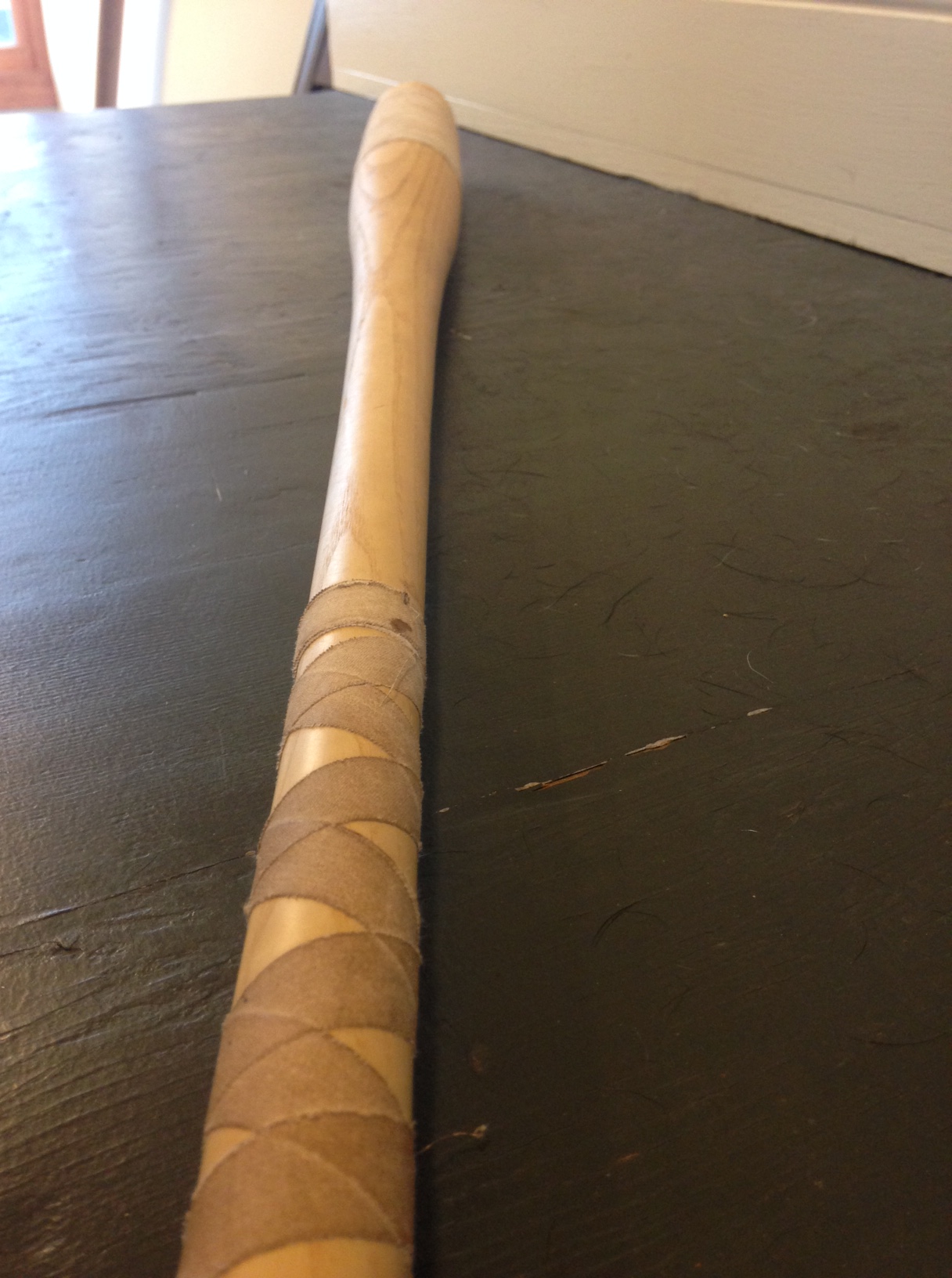
I hung the uniforms on the fence, noting the the absence of uniformity in youth sports. But that was OK, because I also had an unused, homemade fungo bat that a woodworking buddy of mine had given to me.

Hand on the bible – I was as excited to use this new fungo as I was to meet the players. Hitting a grounders and fly balls with a wooden fungo puts the soul at ease. Some garden. Some meditate. Some drink. Give me hitting fungos for my mental health.

As the first of the players meandered back to the field, I knew that I had to make some concessions immediately. I was a stranger – to the players and the league – and this was casual baseball. Five weeks, ten games. We didn’t have time to start from beginning on anything. I wasn’t building a program, but I didn’t just want to only fill in a lineup card either. I would have to find that middle ground as I went.

The view of the San Francisco Bay from up near the Caldecott Tunnel on a summer evening is postcard material. It’s one of those moments that washes away any gripes about the cost of living, the tech soul-sucking, and general superiority complex that come with the Bay Area. The sun inches down into the Pacific and behind San Francisco far off on the horizon, and you fall for the beauty of it all for the ten thousandth time.

The fields at Caldecott, however, were dreadful. They were depressing, dry, deserted landfills of bad hops and knee injuries. There were those little colored flags the power company uses to indicate buried wired littering the outfield. I was told that a water pipe had burst up by the fields, which led to a dispute between I believe Parks & Rec Department and the Utility District. As they argued, every blade of grass on the field had shriveled and died, and every gopher within a 100-mile radius helped tunnel out the entire outfield. The fields were beyond repair. A million dollar view wasted over a busted water pipe.

Beautiful view. Bad photo. Dangerous field. 

It was with that marvel of a backdrop and on that lawsuit of a field where I met six of my players. The Warriors were playing in the NBA Finals that night, so the other eight guys on the team didn’t show. It was an optional practice. Like I said, casual baseball.

  • Larry  (C, P)
  • Ricky (LHP, 1B)
  • Abe (OF, P)
  • Steve (3B, P)
  • Bill (Utility, P)
  • Hank (SS, P)

In their minds they were all pitchers, anyway. They saw the new coach as an opportunity get an inning or two in before I would realize they were imposters. As far as I could tell, we had one pitcher for sure: Ricky, the tall lefty with a whip of an arm*.

It didn’t take long for my concerns about the players’ collective interest to dissipate. I knew we were going to be just fine halfway through our warmup game of catch. These guys knew what they were doing. They weren’t there out of obligation. They enjoyed playing the game – it was evident in how they carried themselves. They knew each other, and they at least knew to play catch in the outfield. I could work with this!

We had one hour, which is 45 minutes after warming up, and we were going to spend it getting as many swings, field as many grounders, and shag as many fly balls as possible.  There were two options of how we could approach the practice: reps or situations, and we simply didn’t have time to work on situational defenses like bunt coverages, first-and-third plays, and tandem cuts. Hell, we needed to review the most obvious signs for bunt (belt), steal (sleeve), and hit-and-run (both sleeves) before we could to worry about middle infield read plays.

I hit fungos with my new bat and threw batting practice in the cage. It was sublime to be back in that paused rhythm – it was in the batting cage and across the infield. 

crack hit a grounder

hop hop hop

field grounder, set

throw then catch

crack hit a grounder

hop hop hop

field grounder, set

throw then catch


Give me a Gatorade, a bag of seeds, and a five-gallon bucket of balls and leave me to it. I’ll throw batting practice until it’s too dark to see.  

I should point out that there were two other volunteer coaches on this team: Jeff and Paul. Like me, they were in their 30s (maybe younger) and had no prior affiliation with the league. Super smart guys and enthusiastic, but I don’t know how much baseball they played growing up. Quite honestly, a they had a hard time throwing a baseball smoothly, they had an even harder time hitting fungos, and I would find out at our first game that neither of them knew how to keep a scorebook. It was never discussed, but I just assumed head coaching duties from the jump.
Paul couldn’t make the first practice, so Jeff (a lefty) and I switched off throwing BP and hitting infield/outfield to the guys. With six players, it worked perfectly: two guys would hit in the cage while the other four players took grounders and fly balls.

I was standing behind the protective L-screen in the cage when I looked over to see Jeff choking halfway up my brand new, homemade fungo. He was hitting balls off the end of the bat. He was hitting handle shots. I was sure that the next swing would be the last and the thin-handled bat would crack, breaking my heart along with it. I would find out at the end of practice that Jeff had popped a blister while using the fungo. His blood was splattered up the handle.

The Matt Scanlan fungo (@scatmanlan), complete with some blood specs up at the top of the taped handle. 

Bleeding blisters and terrible field aside, the practice was a complete success. There was some talent on the team, but I was more encouraged by the personalities amongst those six player. I wouldn’t say any of them were confident – a little cocky, sure, but what fifteen year-old is truly confident? Instead, they wanted to be confident. They weren’t afraid to ask me about the Warriors-Cavs NBA Finals, or crack a sarcastic joke. If guys missed a grounder, they asked for another one before I moved onto the next guy.

I could work with that.

I had come to the practice worried about all the crap outside of the lines. The act of running the most basic of practices reminded me what matters is throwing BP and hitting grounders and, even if for just a moment, finding that rhythm with the players. I also left knowing what I could effectively coach in ten games: I would reinforce that desire in them to be confident, and do so enthusiastically.

***

Coach the practice, manage the game.

Show me a coach yelling out adjustments to the hitter in between pitches and I’ll show you a guy that could never hit or can’t remember what it feels like to be overmatched at the plate. Show me a coach that thinks the secret to getting a kid to throw strikes is to yell at him to throw strikes, and I’ll show you a team that’s tuned out its coach.

As a whole, a baseball game is slow, but it’s won or lost in moments of complex intricacy and bursts of speed. A player has to be loose, quick, and precise at the same time. In other words, baseball is are about reacting. Consider all of the body movement that goes into a pitching delivery. Every part of the body – from toes to fingertips – needs to be in sync in order to hit a specific portion of the strike zone. A pitcher might have a mantra, but he’s not thinking through every speck of his delivery on every pitch

Or consider the timing and hand-eye coordination needed to, as Ted Williams put it, hit a round ball with a round bat squarely. Then imagine trying to do that while the coach yells about watching for the curveball moments before the pitch.  

Someone can’t simultaneously react and think about how to react. The how – the coaching and instruction – takes place before the game. You study before the test. During the game, a coach manages the situation, and players react. Bad coaches coach during the game.

Before our first game, I promised the guys I wouldn’t coach during the game. We could talk situations between innings, but I would not instruct the players on pitching or hitting. I remember calmly making that point, but I was so damn excited.

To begin, Rickey Henderson Field (pictured at the top of this post) was the opposite of our practice field. Some of the real heros of youth baseball are the grouchy maintenance guys or the retired volunteers who make it their daily mission to maintain a beautiful ballfield. These fellas are uptight about things like properly folding a tarp, but one cannot argue with the results. It’s more than worth it in exchange for the joy of playing on a diamond with a lush green infield and a clay mound. Buy your local version of this guy a beer the next time you see him. Get him a nice cigar.

I had seen six of our players at practice the night before, but amongst all of them I had the worst idea of who should play where and bat when in the lineup. These guys had been playing against each other or together for years, so I handed the scorebook to the the first player to show up – Mikey – and told him to fill it out. We won 11-0, so I think Mikey had it right.

We made one error and walked no more than four batters. Five extra base runners is not that bad for a youth team. The other team gave us ten extra base runners – five walks and five errors. 

I didn’t do much in that game. There’s not a ton to manage when you’re up big and your pitchers are throwing strikes. Best thing a coach can do in that situation is grab a handful of seeds, let the guys play, and keep track of a good thing and a thing to work on for each player.  

One player in particular stood out. Bill pitched the first four innings and hit cleanup. His body was growing faster than he could keep up with, and every part of his game had some grunt to it. My kind of player. He went up to the plate to drive something. He toed the rubber to strike the batter out. I was embarrassed that it took me – a lifelong catcher – until the last game of the season to realize this guys was a born catcher. He had the mentality for it, and most guys don’t. 

The second game of the weekend was far less of a lean back affair. We were down to the rich kids with coordinated bat bags until our last at-bat. Strikeouts absolutely killed us, especially with runners on base. You have to make the opponent make a play in the field. Again, the odds of a team fielding a ball, making an accurate throw, and catching that throw in time to get a runner hustling out of the box cannot be more than sixty – maybe seventy percent – in youth baseball.

It was a close game, and I felt my old player juices goings. There was some chirping going on from the other team’s bench as Ricky was dealing, striking out pretty much everyone in his relief appearance. It was remarkable their bench was talking shit while their teammates struck out. Also remarkable was how easily I let this chirping get to me and how quickly I forgot that I was twenty-one years older than the players.

After he ended the inning with another strikeout, I met Ricky at the foul line with a fist bump and more or less told him that’s how you shove it up their asses.

I have no problem with the sentiment of my message to Ricky. That is how you shut up a bench. The way I communicated it was something else – that was me chasing a feeling of being a player. I loved those moments of friction back in the day, but those are the types of games-within-the-game that players own. Coaches need not apply.  

Of course there are times when a coach showing his competitive fire can wake a team up. This was just not one of those times.

It wasn’t until Jim’s two-out, opposite field double off of the fence that we got a run across. It was a 3-1 count, so he sat on fastball. Most impressive is that he didn’t try to pull the outside pitch on a 3-1 count. Not many teenagers are looking for something out over the plate to drive the other way. The other team called timeout after his hit, so we were able to chat quick chat.

I asked “how did that feel?”

He shook his head, smiled, and said “unbelievable!”

Hell yeah, it did.

We ended up winning the game 5-4, scoring three runs in the bottom of the seventh thanks to two errors, two hit batsman, and two walks. You can’t make this up, folks.

I left the field knowing I had a good group of guys. I also left the field shocked. Not one of our players at the first two games knew how to keep a scorebook**. This would not, could not continue. 

Most of all, I left thinking about Tony Lang and Jay Rabeni (my brother and brother-in-law). These guys made coaching look fun.

***

Joy, enthusiasm, and garbage bag jackets. Tony Lang (first coach on the left) and Jay Rabeni (second coach from the right). These two kept the game fun at all times. Yours truly (first row, first on the left) was still mourning the end of of Kirby Puckett’s playing career, as indicated by the ’34’ on my hat. Dave, Sr. is the super tall pitching coach and dad to Big Dog (the super tall kid). John Kurtis (last coach on the right), older brother of Jay (middle row, first from the right) also helped out that year. 

Looking back on it, Tony and Jay were just pups in their mid-twenties when they coached our team for three years growing up (ages 13-15). If wealth was measured in zest, then I haven’t come across wealthier men than Tony and Jay when they coached.

They were great because they loved it as much as us players did. When Tom Stanoch would glide over and make yet another diving play in centerfield, it was all Jay could do to keep himself from running out there and giving him a high five in the middle of the game. When Jay Kurtis and Elmer made another double-play look routine, Tony was pimping it on their behalf from the dugout, saying something along the lines of “too easy.”

I think back to our practices, and it was all about reps. About that rhythm. Infielders would take grounders for half an hour, outfielders would be working on their angles until dusk had turned to just plain night. Hitting was an assembly line of drills. We would alternate between soft-toss, reverse toss, back toss, two-tee drill, and live pitching in the cage. Dave, Sr., the manager and dad to Big Dog, would be concocting his next Tom Seaver lecture/demonstration with the pitchers off on the side. And so it went, the same practice, more or less, for three years. It was the best.

Photo courtesy of Matt Lang. A lot time spent in these cages growing up.

There were a lot of elements that went into making that team the most fun I ever had playing baseball. The parents genuinely liked each other and were swept up in Tony and Jay’s enthusiasm just like us player. The players appreciated each and every guy on the roster. We were’t all best friends, but we were a team. It also helped that we were just young enough so that no one was really worried about the next step. But at the center of this was Tony and Jay’s enthusiasm. Everyone could see how much they loved being there. It was infectious.

But here’s the thing – as passionate and enthusiastic as they were – neither Jay nor Tony ever lost sight of the game’s relative importance. It was always a game. It was game to win, to improve, and to take pride in; but it was always a game.

A couple stories come to mind when I think about them as coaches.

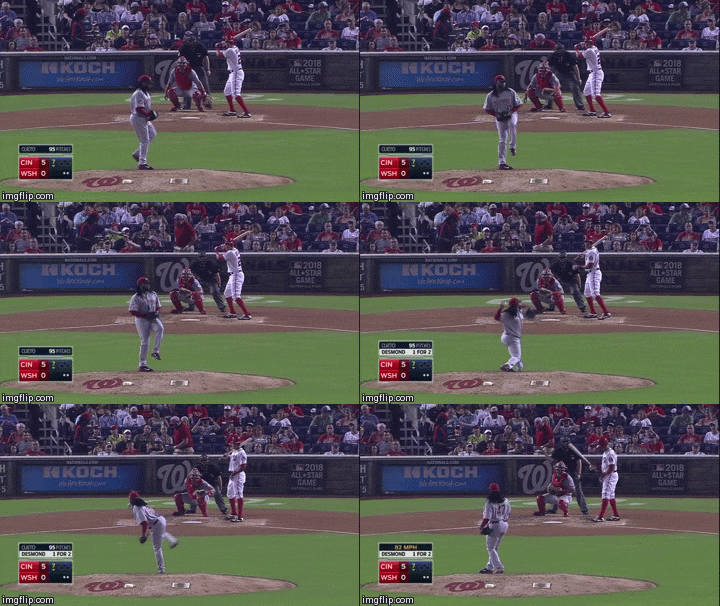
Timmy Fisher is on the mound pitching at Concordia Academy. I’m catching, and I had caught Timmy since we were in Little League on Kent’s team. At that point I know him as a pitcher backwards and forwards. When Tim had it going, he just found outs. For all of you Giants fans, he had a little Johnny Cueto to his game with the variations to the delivery, which is hilarious when you consider Timmy was fifteen.

When Timmy didn’t have it going, he’d let anything distract him, whether it was the umpire’s zone, the state of the mound, a button on his jersey. Timmy also didn’t understand the notion of a filter. He acted on how he felt 100% of the time.

So the game at Concordia is not going well and Timmy’s throwing a bit of a tantrum on the mound. Tony comes out to pull him. Timmy doesn’t even wait for Tony to get to the top of the mound. Instead, he drops the ball and walks off, passing Tony on his way to the dugout. A stern conversation in the dugout no doubt followed, but I remember Tony laughing about it shorty after the incident. It was a such a Timmy reaction, and only he could make that funny. Tony didn’t take it as an affront to his coaching. Timmy disrespected him – yes – but Tony knew it wasn’t about him. Timmy was just pissed off and he hadn’t learned how to sit in that without doing something stupid. 

Jay was the same way, too. He got into Eric Wikstrom one time for not sliding into third on a close call. I mean, Jay was in Wik’s earhole, rated R style, giving him everything he had, but I can’t imagine Wik ever questioning whether or not Jay liked him. Not for a second.

I know they taught us technique and refined our approach, and thinking back on it I am astonished at the amount of time they gave to that team (we must have played 35 games a summer at least), but no specific tips remain as clear as much the joy. The joy we had playing for them and the the joy they had coaching us.

I come across players and parents from that team every now and again when I’m back home. Hell, Jim Sabean, Jesse’s dad, recently knocked on my parents’ door one afternoon while he was working on a power outage down the street. The memories from those summers always come up. They come up quickly, and always with a smile. – PAL 

Read Part I of the series here.

Read Part III of the series here

A couple notes here (as if I haven’t written enough): 

In the overview of this series, I make it a point to call out the importance of my having no prior affiliation with any of the players and the league in which I coached. Obviously, that was not the case with Tony and Jay. You might think I’m cutting it both ways here, but I do think there is something different in an older sibling coaching. What I know is true, and what I know the players and parents from that team will tell you is that Tony and Jay were there for all of the kids.

I also want to call out that Tony and I spent my entire youth in the cage and working on defensive catching drills. Jay would throw to me, and so would my other brother Matt. All of them were so generous with their time, because all I wanted to do was go up to that cage and hit. This series isn’t about the bond of brothers over baseball. Maybe that’s what I should write about next, but this series is about coaching teams, not just me. – PAL

Additional footnotes:

*Ricky told me later in the that he could catch. My response was he had two responsibilities on this team: throw cheddar and hit nukes (this came right after the LSU’s Todd Peterson made headlines by lying to his coach about hitting in high school in order to get an at bat in a key college game)

** Hank, who wasn’t at the first two games, did know how to keep a book and restored a shred of my faith in young baseball players.


Week of August 10, 2018

https://twitter.com/PatrickRenna/status/1022268165223600130


Why Baseball’s Shift Actually Hurts the Defense

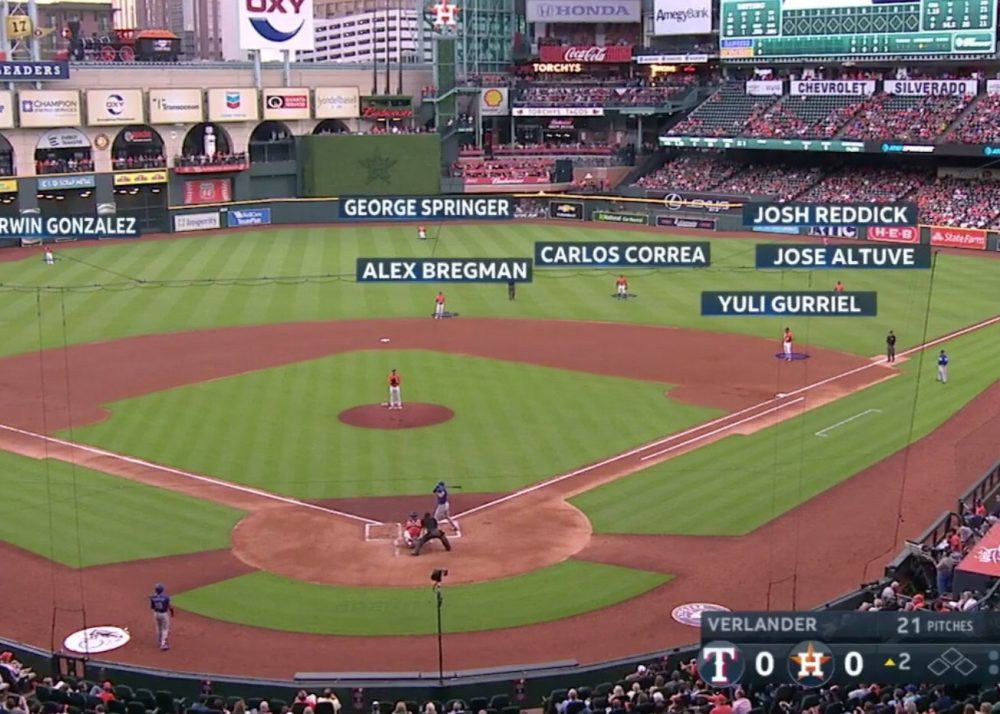
We’ve written a few times about the increasing use of the defensive shift in baseball, as recently as last month. The concept of the shift is simple: For hitters who pull the ball a lot, put more defenders in that area to increase the likelihood of an out. It makes sense, and teams have gone to extremes to use it over the last few years. The story we featured last month involved hitters who face shifts explaining why they insist on trying to hit into/over the shift instead of just slapping a ball to the vacated spot on the opposite side of the infield. Essentially, it’s not as easy as it sounds and it takes the bat out of the hands out of your power hitters.

But, as the use of the shift has soared, so too have the statistics on the shift’s effect. Surprisingly, the shift is actually hurting the defense and increasing scoring, albeit slightly. While the shift does have the effect of reducing BABIP (batting average on balls in play) by roughly 18 points on the most shifted hitters, scoring actually increases when a shift is employed. Two articles I read this week illustrate this.

The math here is pretty interesting, as laid out by Russell Carleton at Baseball Prospectus:

I looked at all hitters who had at least 100 plate appearance without The Shift. If a batter had a .300 BABIP without The Shift, then in the 200 plate appearance that he got in front of The Shift–if The Shift was exactly as good a defense against batted balls as a standard two-right/two-left alignment–we would expect 60 hits from him. If The Shift is a better defense, we’d see fewer than 60. If it’s worse, we’d see more. Now, we know that because of small-sample-size weirdness, you can’t always trust the results you’d get from this sort of analysis on an individual level. But if we sum across the league, we can get a good idea on how The Shift is doing in the aggregate.

We see that the Full Shift “took away” 493 singles, but it somehow gave back 574 walks. It seems that the primary effect of The Shift is to change the way that a batter reaches first base, and it seems that he is standing on first base more often. You can’t throw him out if he gets to walk there.

So why is this happening? A summary from Sam Smith of ESPN:

Even though the shift is good at gobbling up ground balls and line drives, it has the secondary effect of making pitchers throw more pitches out of the strike zone. They don’t appear to be pitching to the shift — by throwing more pitches on the inner part of the plate, for instance — but merely pitching away from contact, nibbling more and throwing fewer fastballs. This all means more balls. More balls mean more walks, and they also mean more hitter’s counts, which means more doubles, more triples, more home runs and fewer strikeouts.

Home runs are also up against the full shift, as the hitter attempts to lift the ball up and over the shift more than he would against a normal defense. Carleton suggests that the issue for pitchers nibbling and issuing more walks is mental, and could be fixed – but until then, he suggests defenses utilize the shift only against the most extreme pull hitters

I find this issue most compelling because of the fact some people around the game, including MLB Commissioner Rob Manfred, have suggested banning the shift in order to preserve offense. This always seemed like an overreaction to me. But the numbers show, at least right now, that the shift isn’t decreasing scoring, but increasing it. Just another example of why it’s good to collect data before reacting. -TOB

Source: MLB Myth-Buster: The Shift Isn’t Curbing Runs; It’s Creating Them”, Sam Smith, ESPN (08/07/2018); Baseball Therapy: How to Beat the Shift”, Russell A. Carleton, Baseball Prospectus (05/22/2018)

PAL: No rules banning positioning of players. The game will correct itself, because there’s a competitive advantage in the truth. I was listening to the Dan Patrick Show this morning while walking Max, and a guest pointed out that the split finger fastball wasn’t popularized until the 1980s. The game had existed for over 100 years, and then something different came about and revolutionized pitching. Guess what, it happened again in the 90s with the popularization of the cutter. The shift will be worked out. Either it will prove ineffective, or hitters will have to evolve. In the long-term, these are the cat-and-mouse games that make sports interesting.


Summer Internship: Cape Cod League Broadcaster

The Cape Cod Baseball League is a wood bat summer league where some of the best college ball players are invited to play. While to the crowd the games might be, as The Ringer’s Bryan Curtis describes it, “a chance to put a capper on a perfectly Rockwellian day”, The Cape League is a serious nesting area for future big leaguers. According to the CCBL, there were 306 Cape Cod alumni in the Majors in 2017. That’s an incredible 25% of all big leaguers after they expand to the 40-man roster.

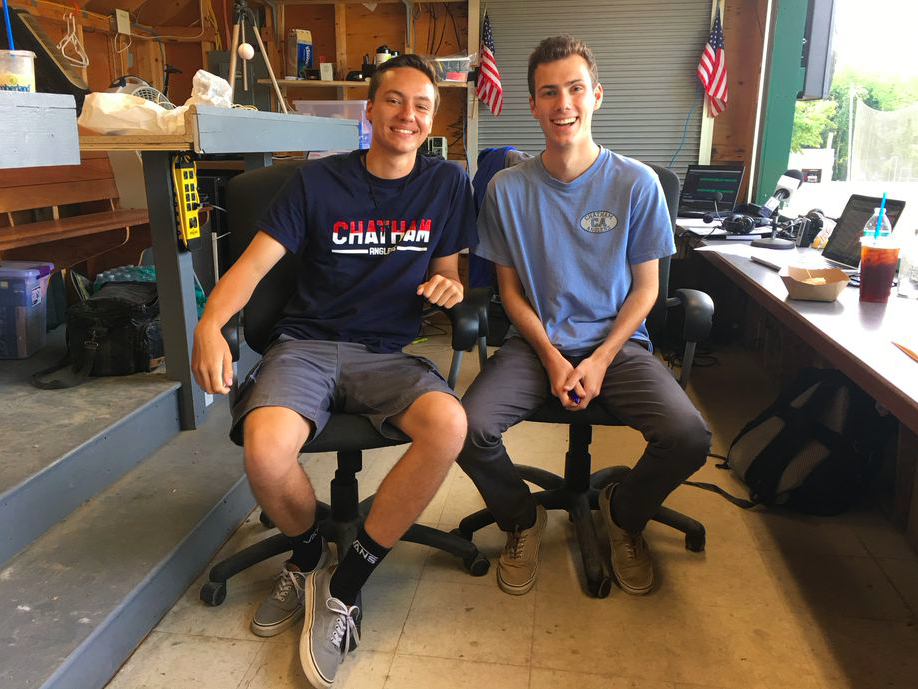
It’s not just a training ground for players. Curtis digs into the broadcasting internships started by the Vegas Knights radio play-by-play announcer, Dan D’Uva. D’Uva started the internship program with a friend when he was in high school back in 2002, and he continues to oversee the internship program to this day.

There’s a lot to like about this story, but I especially enjoyed reading how serious D’Uva and this years interns, Josh Schaefer and Cooper Boardman, take it. This is about teaching a craft. D’Uva and the boys seem to really have a coach-player relationship. When D’Uva’s in town, they go over the game ‘tape’ just like players do, only their classroom is the pressbox. D’Uva asks which of the two pupils wants to go first, then they break down an inning of announcing from the night before. All of this is focused on kicking the habit of mimicry.

When you attend the Cape Cod finishing school for broadcasters, you don’t just submit to daily critiques. D’Uva is waging a war against baseball broadcasting cliché. Young play-by-play announcers’ heads are filled with clichés: “free pass,” “the bump,” “knock,” “new slab of lumber,” “campaign,” “Hi again, everybody,” “Farewell from …” They use these words and phrases because they think that’s how announcers are supposed to sound.

After calling the first inning against Yarmouth-Dennis, Cooper swiveled around in his chair. “I said ‘clubbed’ three times in that inning,” he announced to the press box. “I don’t know why. I don’t say that.”

D’Uva told me: “One thing I’ll say is, ‘Don’t be a pretender. You’re not acting the part of a broadcaster. You are a broadcaster.’”

Other useful notes D’Uva passes onto the boys include:

  • Don’t say ‘just in the nick of time’ when you can say ‘safe’ or ‘out’. Too many words. Your listener is thinking,‘Spit it out.’”
  • Add the detail of how close the play was AFTER you make the outcome clear.
  • When you say ‘big game in the east division’ and tell me Harwich is leading Orleans, I expect you to then tell me what place those two teams are in and how many points separate them from each other and from Chatham.
  • Tell me what happened.

It’s easy for us to sit back, watch games, and make a comment here or there about the defense or the hitter’s recent hot streak, but it is no doubt craft to call a sporting event. Much like the players, the Cape Cod League will be as good as it gets for a few years if Schaefer and Boardman take the next step in their journey to a big league stadium. They will be calling low minor league games in towns like Elizabethton, Tennessee and Pulaski, Virginia. These are a long ways away from the postcard experience that is the Cape Cod Baseball League. – PAL

Source: “The Cape Cod Finishing School for Broadcasters”, Bryan Curtis, The Ringer (8/6/18)

TOB: Good read, and this was a bit of a flashback for me: I was taught many of those same lessons in my first year law school legal writing class: don’t use the passive voice; be thorough but make your point succinctly. Anyways, their summer sounds like a friggin blast.


 The Most New York Times Sports Article Ever Written

Ever wonder where the phrase “out of left field” comes from? Ever wonder why it out of left field and not center field (seemingly furthest “out there”) or right field?

How about “hands down” or “back to square one”? Your lazy wait is over (I mean, you couldn’t looked these phrases up before now if you really wanted to know).

Here are my favorite three idiom explanations, ℅ Victor Mather:

Back to Square One

As with many terms, there is a colorful explanation of the origin and a more prosaic and realistic one, though both originate with competition.

First the colorful one: When soccer was first broadcast on the radio in the 1920s in Britain, there was concern that fans would not be able to visualize the field well. So the field was divided into numbered squares, with charts published in newspapers. That way the announcer could say, “The ball is passed into Square 4, then dribbled into Square 6,” and fans used to watching games in person would understand what was going on. Square 1 was the area with the goalie, so a pass back to Square 1 would be a restarting of an offensive move.

The Oxford English Dictionary deflates that theory though, pointing out that the term’s use really began in the 1950s, some decades after the soccer broadcasting scheme stopped. It suggests the term actually comes from board games like chutes and ladders, in which players can find themselves sent back to the start.

Hands Down

It sounds like it might be from a card game, but it actually comes from horse racing. When a jockey has a race in the bag, he can relax his hold on the reins and stop urging the horse so hard.

Out of Left Field

In 1961, William Safire devoted a Times column to the topic and put forth numerous ideas, including that left field was often deeper than right in early baseball stadiums, that weaker fielders were put in left and that left fielders tended to play farther back.

A more colorful explanation is that behind the left-field wall at the Cubs’ West Side Grounds, in use from 1893 to 1915, was a mental hospital whose patients could sometimes be heard making bizarre remarks during the game.

One other note of importance: don’t sleep Bill Shakespeare when it comes to sports idioms. He’s responsible for two that made the article – there’s the rub and Wild-goose chase. As you go into the weekend and are wondering what the hell to talk about at tonight’s happy hour or cocktail party, casually bring up that you read this delightful little article in The Times about sports phrases. Just make sure you do so with an old fashioned or Manhattan in your hand. Keep it classy. -PAL

Source: We Use Sports Terms All The Time. But Where Do They Come From?”, Victor Mather, The New York Times (8/6/18)


How One of the World’s Best Sherpas Ended Up Working Retail in Manhattan

This is an interesting look into the life of Serap Jangbu Sherpa, one of the world’s best sherpas, who scaled 11 of the 14 highest peaks in the world, including the most dangerous, K2, twice in one year. Serap retired a few years back, and now works unassumingly in a sporting goods store in Manhattan. The story looks at his young life, how he became a “Sherpa” (which is actually the name of the ethnic group), how and why he ended up working retail in Manhattan, still only aged 49, and tells of some of his most harrowing treks. For a taste, here’s one such story:

Just before midnight on May 11, with four other Sherpas and two Koreans, they started up the North Col from the third camp and arrived at the summit at 11 a.m. They remained on the summit for 90 minutes, then Park and Serap started into Nepal. They climbed down in alpine style, connected to each other only by a thin lightweight rope, seven millimeters thick and 50 meters long.

Serap led, even though he’d never come this way before; he’d only ever reached the summit from the north face. They were climbing blind at 29,000 feet. Coming down the Hillary Step at 12:30 p.m., one of Park’s crampons caught an old rope, and he slid to the edge of the exposed rock face. His headlamp flew off, dropping 8,000 feet to Camp Two.

Serap slammed down his ice axe and tied their rope to the handle. If Park fell, Serap would be pulled off with him.

Serap held the rope tightly; anything more than walking at that altitude felt impossible. After half an hour of wriggling to push himself up, an exhausted Park managed to grab onto a rock for support and with his other hand free his crampon.

A good read! -TOB

Source: The Sherpa of New York”, Ryan Goldberg, Deadspin (07/25/2018)


Imagine Being So Rich You Wouldn’t Miss a $150k Deposit

Tommy Fleetwood is a British Golfer. There’s another Tommy Fleetwood who also plays professional golf, and lives in Florida. British Tommy recently earned $150,000 in the British Open. But the European Tour accidentally sent the winnings to Florida Tommy, who had played in some European events in the past. Oops. Here’s a screenshot of Florida Tommy’s banking app.

https://twitter.com/GregThornerGolf/status/1027246829283540992

Florida Tommy was honest, and alerted the proper people of the error (though it is a crime to spend money accidentally deposited into your account), and British Tommy got his winnings.

This is a bit of an unremarkable story that I normally wouldn’t bother writing about, except for this quote from British Tommy:

“I honestly didn’t know anything about it. I wouldn’t even know if I’d been paid or not because I don’t really look.

Oh, goddamnit. What a rich bastard. “Ohh, I’m sooooo rich that I wouldn’t notice not getting paid $150,000.” Screw you, pal. -TOB

Source: European Tour Sent Tommy Fleetwood’s $150K To The Wrong Tommy Fleetwood”, Patrick Redford, Deadspin (08/09/2018)

PAL: Send the money my way. I’ll notice it everyday.


Video of the Week: 121 MPH exit velocity. Holy crap.


PAL Song of the Week: The Avalanches – “Because I’m Me”


Like what you’ve read? Let us know by following this blog (on the right side, up near the top), or:

Email: 123sportslist@gmail.com

Twitter: @123sportsdigest

Facebook

Instagram: @123__sports


And she is a woman. She is a strong, soft, thoughtful, SEXY woman.

-M. Scott

On The Force Or On The Tag: Part I

On The Force Or On The Tag is a 5-part series recounting my season as a volunteer baseball coach in a city league to which I had no prior affiliation. Along the way, I’ll connect my coaching experiences this season to memories from the four best coaches I had growing up. Kent Anderson, Tony Lang (my brother), Jay Rabeni (my brother-in-law), and Jeff Holm continue to influence how I approach my day and my life. They represent the best-case scenario of youth sports, from Little League to college. This is my thank you to them.

The names of the players, coaches, and family members from the team I coached have been changed. 

Read Part II here

Read Part III here

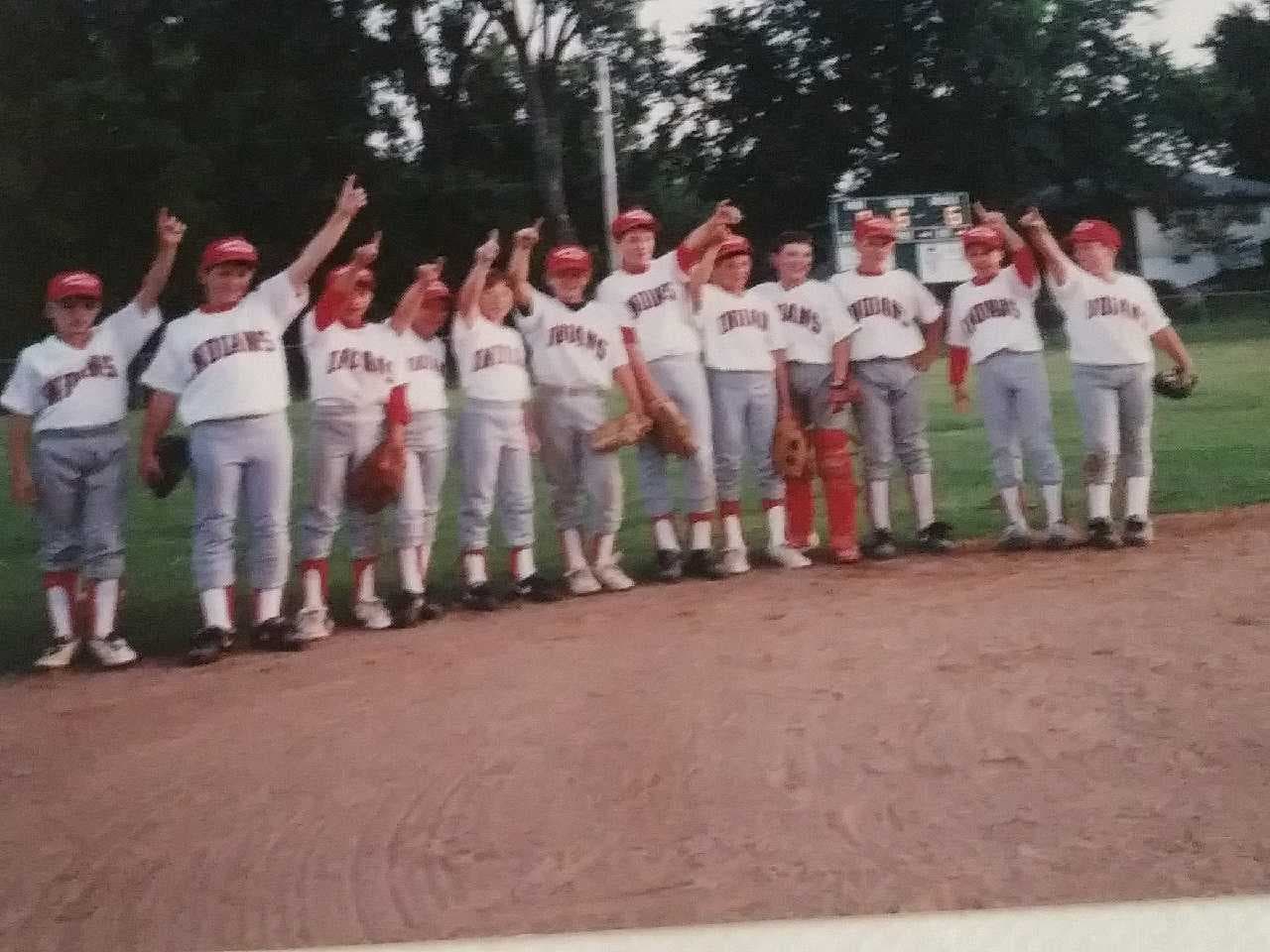
In the third year of Little League, our team changed from the Indians to the Red Sox. Kent Anderson is second from the right in the back row. I am first from the right in the front row.


We had the bases loaded, two outs, and down one run in the bottom of the 7th (the last inning in high school baseball rules). Mike, a utility player with a decent stick, was at the plate. In that moment, there was nothing I wanted more as a coach, as even a baseball fan, than for Mike to experience a walk-off hit.

I wanted him to square up the pitch and send a line drive into the outfield. The ballpark would pause in silence while that ball floated like a satellite. The infielders would only be able to turn, look up, and wait. Mike would be tracking the ball as he glided over first base, knowing that his run meant nothing in the last inning of a one-run game. The other base runners would be crouched, suspended between bases. The home plate umpire would stand up with his mask in his right hand as the blood delayed its return behind his knees. Parents would sit up straight. In that moment everyone, everything, waits for a baseball to skip across the outfield grass. Only then can chaos resume.

That’s the picture I held in my mind standing just outside the coach’s box on the third base side of the diamond as Mike started his at-bat.

There aren’t many feelings in this world as pure and good as that one. Looking up from Yosemite Valley for the first time, realizing you’ve met your future husband or wife, the first moment of parenthood, I assume – I’ll grant you these are bigger, more important feelings. But if we’re only measuring purity, then a walk-off hit is right up there with the best of them. I’ll put my next paycheck on it.

Leading up to Mike’s at bat, this particular game had the tempo of a dirge. No youth game, in any sport, for any reason, should take three hours. Each team had tried to lose several times by donating extra outs and base runners by way of walks, errors, and hit batsman. Goddamn, there is a surplus beanings in youth baseball.

We’d made three errors in the top half of the seventh inning alone – two of which were dropped fly balls with two outs and the bases loaded. The opposing pitcher then proceeded to hit two of our guys and walk two more, which brought us to Mike’s at bat with the tying run on third and the winning run on second.

Mike did not hit that line drive that makes the world pauses, but he did his job. He slapped a grounder between short and third. At the U-15 level, just putting the ball in play is a positive. The chances of a team fielding, throwing, and catching the ball can’t be higher than sixty percent. Maybe that’s not the case in club ball, but it sure was the case in this city youth league.

With two outs, the runners were moving on contact, so even the easiest play for the shortstop on a grounder to his right – the force at third –would be bang-bang, and the already close playwas made more chaotic by our baserunner’s aversion to sliding until the last possible moment.  He hurdled towards third like a puppy, awaiting my instructions on what to do.

What to do was obvious. Slide! “Down! Down! Down!” I shouted, waving both hands at the ground.

There was a bit of a pileup between the runner and the third baseman. They fell over the bag into foul territory at my feet, and the third baseman dropped the ball. He picked it up and tagged the runner for the third out of the inning. Game over. We lost, 11-12.

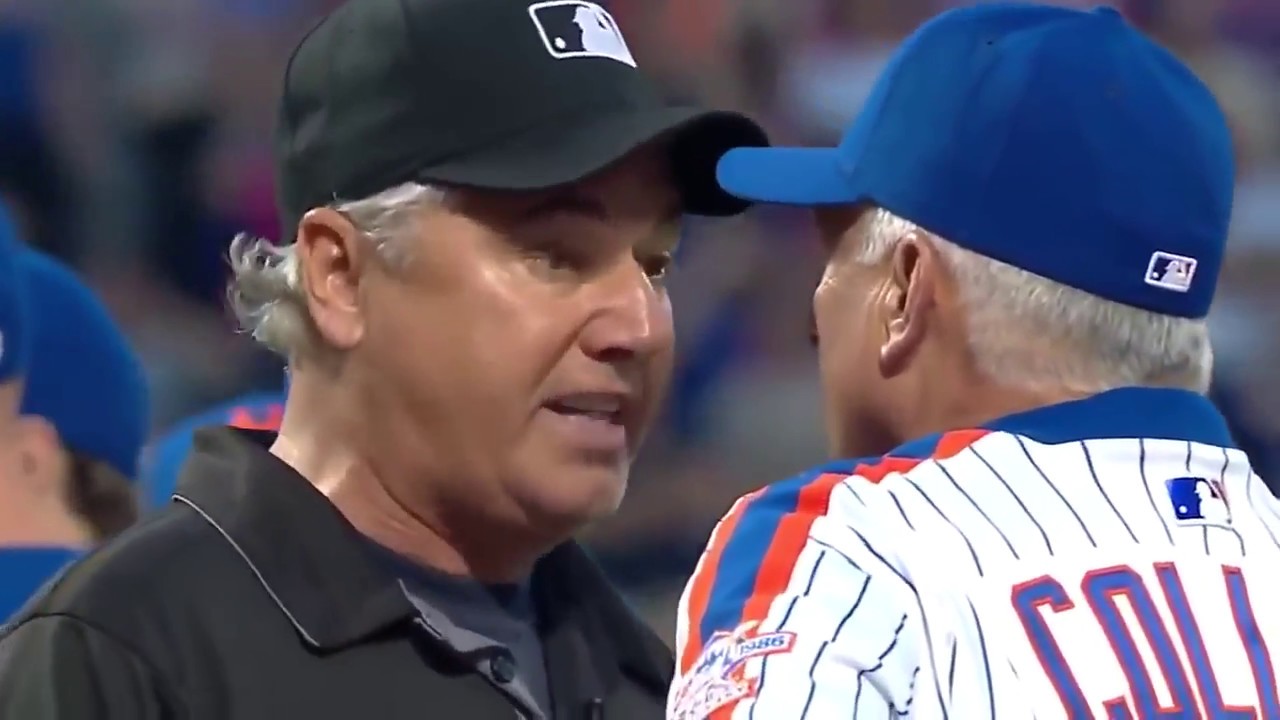
Most folks at Rickey Henderson Field were OK the game was over – the parents, the players, and certainly the awaiting men’s league teams, who had begun trickling onto the field, eager to get their game started. There I was confronting Glen, the umpire who also happened to be a league coordinator and senior division all-star coach.

You, reader, ought to know a couple details before we dig into the argument that is about to unfold:

  1. I may have also given Glen a little business on another bad call at third base earlier in the game.
  2. Our team is undefeated at the time. It’s not everything, but a chance at perfection, no matter how minor, has value. It counts.
  3. It’s a safe bet my recollection of the conversation with Glen has me sound more succinct and stern, and generally quickeron my feet than how it actually played out. I’ll cop to that up front, but that’s the perk of my narrating the story.

“How is he out?” I asked.

“He’s out. Now don’t.”

“How?”

“Come on!”

Both hands are on my hips at this point. “Was he out on the force, or was he out on the tag?”

“He’s out.”

“Third base dropped the ball, Glen. If he’s out on the force, then you’re telling me third base dropped the ball after the play was over.”

The ump shook his head and tried to cut me off. He’d just umpired a three-hour youth game. He was done. I was not.

“Hold on, hold on, hold on. I’m just asking, because if he’s out on the tag after third base dropped the ball, then the force is no longer in effect. He did drop the ball, which is why he tagged my guy. If the force is no longer in play, then the lead runner crossing home plate before the out is recorded counts, and we have a tie ball game.”

I took a breath. “So was it on the force or the tag?”

He stared through me for a moment. “I didn’t see the dropped ball, OK. If you want, I can ask the base ump.”

Players were already packing up and walking off the field to their parents behind the backstop. The paunchy men’s leaguers with too many armbands were already playing catch in the outfield and trying to avoid the inevitable hamstring tweak by jogging across the outfield. There was zero chance I was going to ask the base ump, who I think was maybe fifteen, to weigh in and overturn a call that would restart the game. Did I mention we’d been playing for three hours? We didn’t deserve to win if we left it up to one call on a messy, weird play. I was already late for a going-away-party anyway.

Months later, I think about why I kept on the umpire? Of course I wanted to win the game. More than that, I wanted Mike to know the feeling of a walk-off hit, and that moment was over – impossible to get back – whether or not the game should have been. As a consolation, or perhaps a consequence, I wanted the ump to at least know he was wrong.

The truth is I’d already won. I’d spent the morning coaching a baseball team for the first time in 14 years.  It’s the best.

***

Before we proceed, you should know a few things about baseball and me.

Baseball is the first love that I discovered. I didn’t come from a “baseball family”. Nothing was expected of me within the context of baseball. I found the game, and I loved the game. Simple as that.

There are more moments of perfection in baseball than anything else I’ve come across in my life. That was the case when I was ten, and it remains true. The numb inertia of turning on an inside fastball. The sting of a scab rolling up your elbow on a headfirst slide into second. The smell of pine tar. The lethargic game of catch in shallow outfield before game two of a double-header. The heat and the dust and the smell of cut grass and the distant cigar all swirl around you like a spirit.

The game was everything to me until I accepted I wasn’t enough for it to be everything. I was still a teenager when I knew I was a college baseball player at best. Fast enough, big enough, powerful enough, quick enough. They all matter, and I didn’t possess enough of any of them, but ninety-five percent of baseball is about quickness. Power without quickness is easily neutralized. Speed without quickness doesn’t factor in too much in a game where bases are only 90 feet apart and the ball is always faster than the player. Size without speed, power, or quickness is just someone playing the wrong sport.

I was quick enough defensively, but as a hitter I couldn’t convince my body to wait for my mind to recognize the slider is actually darting eight inches outside of the strike zone. I couldn’t hold off from making an ugly, lunging swing off my front foot. Worse yet, I had just enough hand-eye coordination to put that pitcher’s pitch in play as a weak grounder to second base.

What followed college was a decade when I stashed baseball away like crumpled mementos of relationships past. The metaphor between baseball and life was cliché, and so were the lessons therein. The twenties version of me figured it was time to grow up. Gone was the kid with pictures of Kirby Puckett carefully torn from Sports Illustrated and taped to my bedroom walls.

I was busy writing a (bad) novel. I was playing in a (inexperienced) band. I was a young Minnesota dude living in San Francisco, dammit. There were women to meet, places to be, a life to live that would impress folks back home over the holidays. Baseball wasn’t in the script for this California odyssey.

I was a little up my own ass in my twenties, in case you hadn’t noticed. Me and a good chunk of you readers, but that’s ok.

Photographer most likely Amy Hansen.

From a catcher for the Minnesota Twins to the author of the next great American novel or – because I didn’t want to limit myself as merely the next great American novelist – the next Dylan. I had traded in one cliché aspiration for two somehow less likely clichéd aspirations. Turns out, that is not a terrible approach to enjoy your twenties.

I’m 36 now, and not long ago I came back to baseball. You grow up, and if you’ve lived a charmed life like I have, you are allowed to come full circle. You have the luxury to believe that the kid with Kirby Puckett pictures taped to the wall didn’t vanish after all, even when you realize that Puckett was just some flawed dude that was really good at a game and really bad to women.

Baseball remains the activity I have spent the most time doing in my life, the subject about which I know the most, and the “trade” in which I achieved the highest level of proficiency. But these are not good enough reason to come back to a childhood passion. The real gold lies in the lessons from the game. They translate to everything. This is not revelatory but for the fact that it’s actually not a bullshit line from a youth league registration pamphlet.

Kent Anderson’s Little League mantra – every ball’s coming to me, know what I’m going to do with it – remains the best professional, financial, relationship, and baseball advice I’ve ever come across.

***

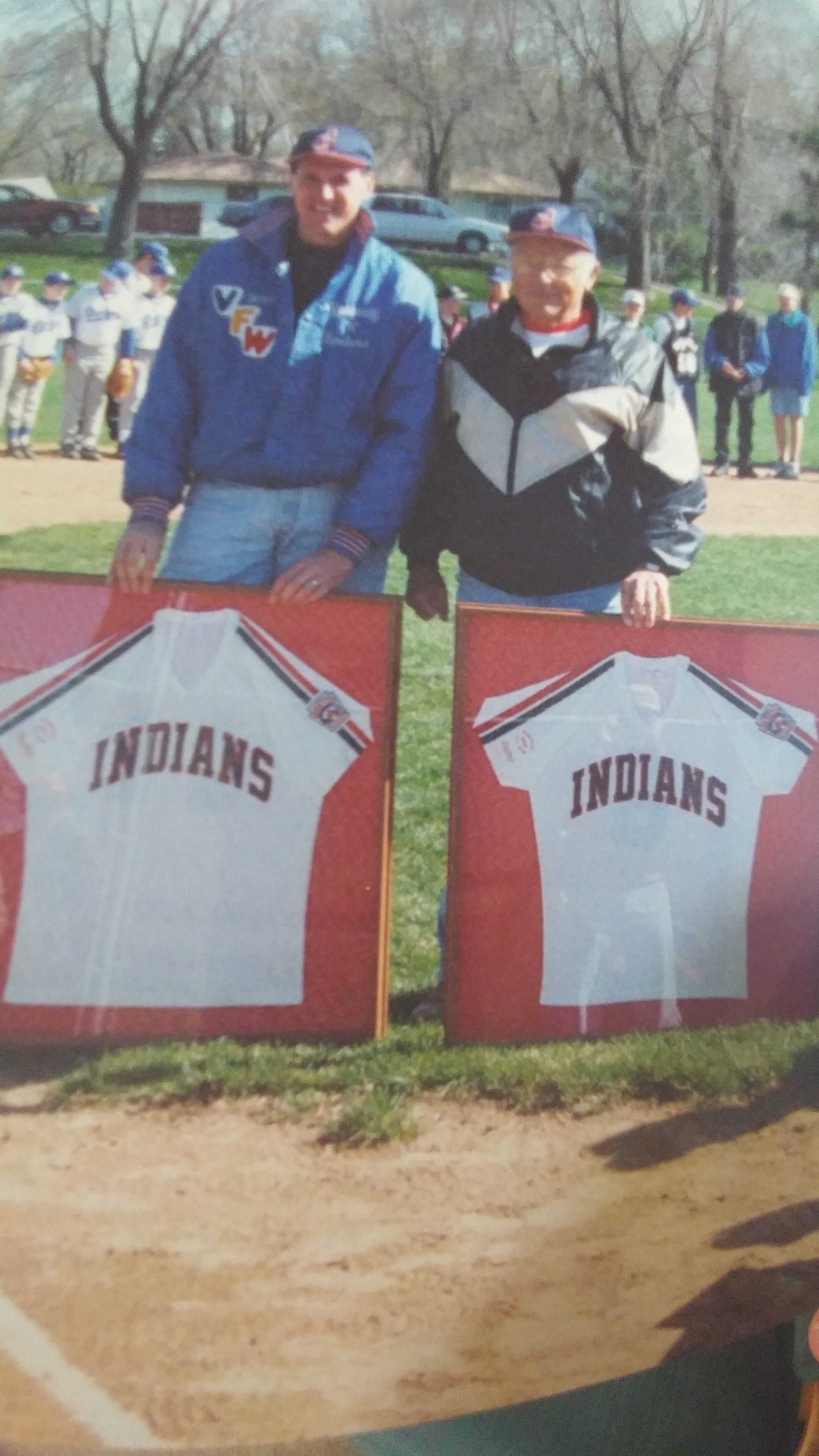
Kent Anderson (left) popping the collar and John Traeger (right). Photo courtesy of Jay Kurtis. 

Kent, Tony, Jay, and Coach – I would not feel the way I do about baseball if it were not for these men. I got lucky with great coaches at pretty much every phase of my baseball life. From Little League through college, I had mentors that knew the game, could communicate the game, and fed my passion. In large part, they are the reason I think about baseball metaphors and axioms when I’m in a conference room listening to fluorescent lights buzz.

That said, I cannot gloss over the other implied truth. I also love the game because I didn’t suck at it when I was eight. More importantly, I was recognized as having some ability, and that recognition at an early age is everything. Think about how many of our interests or lifelong pursuits are launched by an early recognition of ability. A fourth grade teacher says a kid with low self-esteem has a knack for math. A music teacher tells a new trumpet player she has excellent tone. A baseball coach sees some raw talent in a swing and doesn’t over-coach.

There are thousands, if not millions, of solid Little Leaguers who never sniff high school ball, but there aren’t many kids who were terrible in Little League that stuck it out and became a varsity starter. A player must experience some success and recognition early on – even if it’s just one person who sees it – for even the hope of playing high school baseball.

Kent was the first coach to see it in me. We had a catch behind the batting cages at Bruce Russell field on Roselawn Avenue in Roseville, Minnesota. I was there with what felt like hundreds of other kids trying out for the Majors division, the competitive 6-team league for kids between ten and twelve years old. It being April in Minnesota, I remember it being grey and wet and blowing on my fingers to get some grip and circulation. And I remember the lines.

There were lines of kids strewn about the field – one wrapping around the batting cage, another in left field waiting on dads to hit decent fly balls so the kids could track down a deep one, spin, and throw a strike to the cut-off man. There was a line at shortstop for coaches to get a look at how kids fielded a grounder. Three pop-ups, three grounders, and ten swings in a batting cage. Sixteen opportunities to determine if you were one of the two dozen kids picked to play in the good league with real jerseys, a grass infield and a snack shack; if not, your destiny was all-dirt infields and t-shirt jerseys. Such is life.

What if the guy running the pitching machine spent six pitches adjusting the location during your turn? What if you got a bad hop fielding grounders? There is a fair amount of chance when you’re dealing with a sample size as small as a Little League tryout.

But there’s little left to chance in playing catch, a fact I’m sure wasn’t lost on Kent when he asked me to have a catch behind the batting cage. I’d guess we threw for five minutes. He asked me…hell, I don’t know what he asked me; I was excited. The coach of the best team in the league – the younger, non-dad coach who drove a red BMW convertible – was playing a real game of catch with me. He wasn’t looping them into me – he was throwing left-handed darts. I was catching with two hands, moving my feet, focusing on the center of his chest and trying to make the perfect throw on a line every time.  Kent was a lanky guy with a big frame surrounding his floppy glove. It was impossible to miss his target.

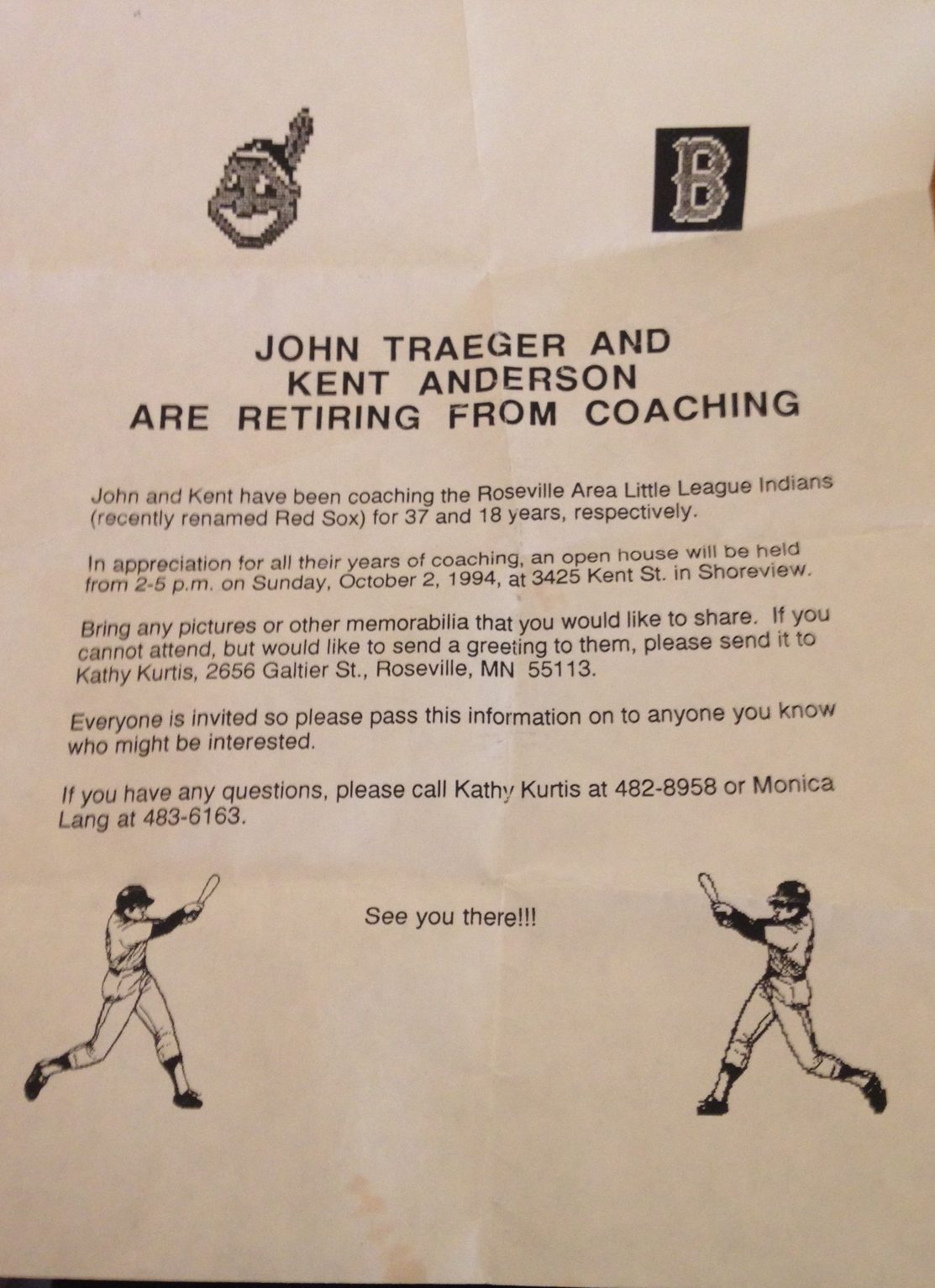
Kent drafted me to play on the Indians, which became the Red Sox when folks spoke up about the name. Kent and John Traeger’s team should’ve been the Yankees, as the Indians dominated the league for the better part of two decades. I am almost certain Kent and Traeger drafted me in part as result of that catch with Kent. It’s plain to me now why it was as important as any other part of the tryout.

When you play catch—the most fundamental component of the game—you can make all of the important assessments about a ten year-old’s ability to play and improve. How do the feet move? What’s the attention to detail and the ability to focus? Is the throwing motion natural? Does the kid catch the ballor stop the ball with his glove?  Is there a semblance of eagerness, of urgency? All of these questions can by answered just by playing catch with a kid.

You can coach a kid up in a lot of ways. You can teach him how to stay down on a grounder and throw a slurve. You can even teach hitting to a certain extent. But you can’t teach a kid to throw, and you can’t coach someone into caring about a game of catch.

Kent and Traeger’s Retirement Party invite from my mom and Kathy Kurtis. Note the lack of area codes on the phone numbers. A combined 55 years of coaching Little League. 

Kent coached Little League for eighteen years. His most reliable tools were simplicity, repetition, and clarity. In his quiet, stoic demeanor, he expected us to succeed and then we expected to succeed, and then—guess what—we succeeded. For a ten year-old to have that mindset rewarded with tangible results is a positive experience not easily forgotten. In my case, that mindset was rewarded time and time again throughout my baseball life. It’s no longer just a memory about making a great play or getting a clutch hit as a kid. That Little League lesson has come to define how I approach my day, my life.

My expectations haven’t changed since I was ten. I expect to succeed, for good things to happen to me. It’s astounding when I pause to think about it.

Twenty-six years later, I want Mike to know that same feeling. That’s why it matters if the runner at third was out on the force or on the tag. – PAL 

Photo c/o Jay Kurtis (third from the left, and one hell of a shortstop). I am the short kid next to Jay. I played outfield when I was ten and eleven. After that, it was only the tools of ignorance for me. 

Read Part II here


Week of July 27, 2018

Dustin Johnson knows the pecking order in his family. 


The Best Game I Ever Watched

Jack Morris is getting inducted into the Baseball Hall of Fame this week, and it’s about time. It’s also a great excuse to revisit his legendary performance in Game 7 of the 1991 World Series by way of Dan Haye’s oral history of the event over on The Athletic. I will be adding a lot of bits from the story and sprinkle in some commentary since people that aren’t subscribers can’t click on the story.

To the uninitiated, let me start by telling you that Jack was a bad man in the 80s and 90s. He won more games in the 80s than any other pitcher. He has 3 World Series rings – ‘84 with the Tigers, ‘91 with the Twins, and ‘92 with the Blue Jays. The guy had a great, long career, but he’s remembered for Game 7 of the Twins-Braves classic. Morris went 10 innings in a complete game shutout and the Twins won 1-0 on a Gene Larkin “single” (the outfield was playing in and his medium-deep fly ball fell over their heads).

As Hayes puts it, “To this day, the Smoltz-Morris showdown is considered one of the greatest Game 7s in World Series history. Though only one run crossed home plate at the Metrodome on Oct. 27, 1991, the contest was teeming with dramatic moments and volatile momentum swings.”

Morris: I went to the bullpen and threw longer than most guys. I would throw 20 minutes in my warmup and throw 60, 70 pitches. I always wanted to go longer because I’d rather be tired than too fresh. My control wasn’t as good as when I was fresh and that helped me get over that adrenaline rush.

PAL: 60-70 pitches? That is insane to me. Then he went out and threw another 127 pitches. Include the warm-ups between innings and Morris threw way over 200 pitches that night.

Braves starting pitcher John Smoltz (PAL: a young stud at the time): You know it’s going to be the loudest place you’ve ever been in because of the dome and Game 7. The walkup to any start is usually pretty unique on its own. I had previously pitched in Game 7 in Pittsburgh (in the NLCS). I had faced it already, had faced that kind of hostile crowd, walked to the bullpen. This (bullpen) was on the side of the stands, so you’re really in the open space. I really vividly remember. Couldn’t wait for it. Wanted it. Dreamt about it. But then seeing (7-year-old Jacqueline Jaquez sing the national anthem), I turned to Leo and said, ‘If she can do that, I can do this.’ It lived up to all the expectations I had as a kid, the hype.

Twins catcher Brian Harper: A lot of the game plan when Jack was pitching was how Jack was pitching when he was on. The biggest thing for Jack when he had his angle on his fastball, when he was throwing downhill, it was pretty much over for the other guys. You could tell right away that he was locked in and he had really good angle and a really good fastball. He was working on three days’ rest for a third straight time, but he was locked in right from the get-go.

Twins bench player Gene Larkin: Smoltz was dominating. There’s no other word. Both pitchers were dominating. In a certain amount of respect, Smoltz was dominating earlier in the game than Jack was.

Kent Hrbek: In the playoffs, all the pitchers are good. They were all good against me because I couldn’t hit my ass with both hands. So much gets talked about Jack being so good that you don’t think about the job (Smoltz) did. He stuck it up our butt as Jack did with them. Not too many talk about his performance, which was as good as Jack’s.

5th Inning

With runners on the corners and two outs in the fifth inning, Morris throws a forkball in the dirt. Harper doesn’t block it as much as it bounces off of him and rolls out between home and the mound. Lemke at third comes halfway down the line and barely gets back to third on a nice play by Morris. Then Morris strikes out Ron Gant on a called third strike and does…whatever this is:

Braves infielder (PAL: and complete pest the entire series) Mark Lemke: We couldn’t ask for anything more. It’s just Jack put the pitch right where he wanted it. My goodness. I remember the fist pump. I said, ‘Oh boy. He’s stealing it.’

6th Inning:

As CBS went to break, play-by-play announcer Jack Buck said, “Folks, this game is gonna be decided late … isn’t it?”

Smoltz: Luckily, we played in the era we did because you could see matchups like this. You’re not going to see them ever again. This is what we were supposed to do as pitchers. If your stuff was good enough, you didn’t have anybody even close to coming in the game. At the end of the year it’s a little different story, too. You’ve pitched your 240, 250 innings. You’re at the max and you just know and you were prepared. You were mentally prepared to do this. There was not a fatigue factor you allowed to enter your mind.

8th Inning – The Deke

Morris: Lonnie wasn’t deked on the play. He was off to second base and when he looked up he couldn’t find the ball. He looked over at the third-base coach and he was still watching the ball and didn’t get a sign. So he’s wondering if the ball is popped up and has to slow down before second base. That’s all it took for him not to score.

Harper: The real deke was Dan Gladden acting like he was going to catch it. And in Lonnie Smith’s defense, with no outs you don’t even take a gamble of being thrown out at home plate. With Lonnie Smith and (third-base coach) Jimmy Williams, with no outs you’re going to be super cautious. It was running the bases the right way. If there was one out you’d gamble a little bit more. I think Gladden deked him that he was going to catch it and the ball hit the wall and he got it in real quick. It was a good play. It looked on the film like the infielders deked him, but Lonnie said he was looking right at Gladden acting like he was going to catch it.

Braves bullpen coach Ned Yost: Lonnie Smith got on. Terry Pendleton did a hit-and-run and Lonnie got deked a little at second. That would have been the run that scored if he hadn’t of hesitated. Ended up second and third and nobody out. I think, ‘OK, we’ve got Ronnie Gant, David Justice and Sid Bream coming up. We’re going to score a run here. Here we go.’

The Twins walked Justice, and Sid Bream hits into the huge double-play the Twins were hoping for, 3-2-3.

Hrbek: I knew where I was going. I wanted the ball. That’s why I was playing in. Knew what I was going to do. There was already a conversation between myself and Harper that I was coming home. We did it a million times in spring training the last 10 years. You practice that play just because it might happen at some time or another. I was prepared and ready. A lot of times guys aren’t prepared and ready, they don’t know which way to go. I knew what I was going to do with it before it was hit to me.

Harper: We got the rare 3-2-3 double play. I’ll tell you what, there were some nerves making that throw to first base. You’ve got the runner kind of in the line. You’ve got to make sure you’re out of the way. You’ve got the runner from third coming at you and he’s trying to hit you as he slides and so you’re trying to get rid of it. The first baseman is moving toward first. My whole thought process was, ‘Don’t screw up.’

The Twins come up in the bottom half of the inning and threaten as well. They too were undone an unconventional, unassisted double-play.

Twins reliever Carl Willis: I remember how ecstatic we all were (in the bullpen) and then in the bottom of the eighth inning, we had the bases loaded and one out, and we were thinking, ‘Hey, we’re going to do it. We’re going to win this thing.’ And the same thing happened (to us). They ended up getting out of it. We went from low to high back to low. It was the craziest inning, emotionally, I can ever remember of any game.

Bottom of the 9th (all of this is pulled directly from the story)

With nine innings in the books for Morris, Kelly was preparing to turn the game over to ace closer Rick Aguilera in the 10th.

Harper: There was at no point until the ninth that TK was going to take out Jack. Jack got us out of the ninth inning and Tom Kelly walked up to him and said, ‘Great job, we’re going to bring Aggie in to pitch the 10th.’ And I’m sitting in my catcher’s gear watching this and going, this is going to be really interesting how it gets handled. Jack’s like, ‘I’m not coming out. I’m not coming out.’ TK’s going, ‘Hey, 120 pitches, three days’ rest, Jack, unbelievable job. We’ve got Aggie warmed up. He’s coming in.’ Jack sat there and said, ‘I’m not coming out of the game. I’m not coming out.’ He said a few other choice words.

Mazzone: Good luck with that.

Bush: Literally in exasperation, Tom Kelly turned to (pitching coach) Dick Such and said, ‘Tell him he’s done, Suchy. Tell him he’s done.’ Suchy with the great line said, ‘He’s going pretty good, Skip.’

Kelly: That’s true.

Harper: Tom Kelly walks down kind of toward the middle of the dugout where Jack is and he looks at Jack and says, ‘Go get him, big guy. Go get him,’ and walked away.

PAL: How good is that? I love the pitching coach breaking ranks. It’s like a scene out of a movie.

TOB: I literally LOL’d at that one. Also, I mean it worked out – but I must point out that the “You’re not taking me out” is a really selfish move. If he blows it in the 10th because he wanted to finish the game, he’s a bad teammate who cost his team the World Series. It’s also an interesting move because, if the Twins don’t score in the 10th…how long did would he insist on pitching?

The 10th Inning

PAL: Morris retires the side in eight pitches. M-effing eight pitches.

TOB: I guess he was going pretty good.

PAL: The Twins get a lead-off, hustle double from Gladden. Knobluach finally gets Twins bunt down, and the Braves walk Puckett and Hrbek to load the bases with one out. The twins send pinch-hitter Gene Larkin to the plate.

Larkin: When TK (manager Tom Kelly) called my name out, I was as nervous as a human being can be in an athletic situation from the on-deck circle to the batter’s box, my knees were shaking. People were standing in the stands just going nuts. The moment hits you right there that you can help your team win Game 7 of the World Series or if you don’t get the job done you’re going to feel bad. If your team doesn’t win because of that, you’re going to feel bad about that for the rest of your life. Whether people believe that or not, that’s in your mind that if you had just driven in that run, we would have won the game.

Hrbek: All I was kept thinking about was if there was a ball hit to the outfield don’t get caught up running the bases. Make sure you go back and tag. But if you look, you’ll see, Puck doesn’t go back and tag. Puck is running around the bases. The guy could have caught the ball and threw Puck out at second base. He was way off the base. That was my thought was, ‘If there’s a play at the plate, I better be sure I’m tagging up. Watch out for the line drive. Don’t get too far off because my run is not important. Don’t get picked off. Stay here as close as I can. But if it’s a double-play ball, I’ve got to get down there as fast as I can.’ There was a lot of things going through my head other than what Geno was going to do.

Larkin waists no time. He gets a fastball up and sends it over Brian Hunter’s head in left field. Twins Win, 1-0.

3rd Base Coach Ron Gardenhire: I did one of those dumb baseball moves where instead of going down the line with Gladden and being in all the pictures I ran over to the commissioner to shake his hand. The commissioner and I had been having a conversation back and forth from his seats.

Gladden: After the celebration, Wayne Terwilliger and I went up in the training room and grabbed a pack of cigarettes and a six-pack of beer and turned on the TVs and watched the celebration. I was so tired.

Leo Mazzone (Braves pitching coach): At the end, I didn’t feel like crap. I was just a part of one of the greatest World Series in the history of baseball. Sure, you have that immediate emotion of losing. But once you sit back and think about it a little, you’re proud to be a part of it.

Morris: My son was crying and I was worried if someone had knocked him down (during the celebration). I asked him why and he said, ‘Dad, that was so cool.’ It was so amazing to share something so personal with him.

PAL: After reading this I realized that moments from this series have mashed together, and it’s hard to separate the less iconic plays, e.g., the 3-2-3 double play ball, game by game. I just remember being so damn happy. That is my team. Specifically, that 1991 roster are the players and coaches I picture when I think of a baseball team.

Source:An oral history of Game 7 of the 1991 World Series: The night Jack Morris was unbeatable”, Dan Hayes, The Athletic Ink (7/25/18)

TOB: While Kirk Gibson’s home run is my earliest baseball memory, and I watched the Giants’ run through the ’89 NLCS and into the World Series, the 1991 World Series is I think when baseball really got its claws into me. It was such a visual and audible spectacle – Minnesota with the white hankies whipping around, and the insane noise. Atlanta with the tomahawk chop and chant. It was mesmerizing.

I’ll never forget this game because I didn’t even get to see the end. Late in the game, my parents made me go to bed. Not wanting to miss the end, I managed to find the game on the radio of my alarm clock. I pulled the covers over my head and the radio to muffle the noise, and I drifted off to sleep, I believe, before the game ended. I woke up in the morning to music still playing, having incorporated the song that was playing into my dream.


Sports & Flags

This story is as powerful as anything I’ve read this year.

Awhile back, Natalie and I were walking Max the Dog up in the fancy Piedmont neighborhood (we call it the Fantasy Tour), and one of us commented on the the American flags waving outside some of the mansions. Natalie wasn’t a fan. I didn’t mind it, noting that what makes America great to me isn’t the same as what might make it great to someone else, and I won’t acquiesce the symbolism of the flag. Patriotism is apolitical. I got where she was coming from, and that conversation has stuck with me over the past 19 months or so.

Every sporting event presents a challenge in this regard. The flag genuflection is disingenuous. We didn’t always have flags the size of football fields, and camo jerseys haven’t always been a thing. This all came in the wake of 9/11, and Howard Bryant’s segment on WBUR (Boston Public Radio) is a sobering look at commercialized patriotism from the perspective of veterans who are sick of it. You must read the story, but here some of the most compelling bits:

Retired Air Force lieutenant colonel Bill Astore on flyovers:

I think, at first, there’s a sort of thrilling feeling. I’m like all the other fans: a big plane goes overhead — ‘Wow!’ That’s kind of awe inspiring. But at the same time, to me, it’s not something that I see should be flying over a sports stadium before a baseball game or a football game. You know, these are weapons of death. They may be required, but they certainly shouldn’t be celebrated and applauded.

Some of you know this (I know we’ve written about it), but it’s worth repeating: We are paying sports teams for all that celebration of America.

…[T]axpayer-funded contracts between the Pentagon and virtually every pro sports league. In 2012, the New York Army National Guard paid the Buffalo Bills $250,000 to conduct on-field re-enlistment ceremonies. In 2014, the Georgia National Guard paid the Atlanta Falcons $114,000 to sing the national anthem. In 2015, the Air Force paid NASCAR $1.5 million in part for veterans to shake hands with racing legend Richard Petty. Your tax dollars. At work.

In one simple sentence, Astore crystallizes a major issue I have with the choreography of it all. “Patriotic displays, they mean a lot more to me when they’re spontaneous,” he says. Exactly.

Nick Francona, son of Indians manager Terry Francona and grandson of Tito Francona, enlisted in the Marines while a student at Penn. He saw a baseball friend of his leading a life of meaning while Nick was playing online poker and hitting the bars. Before he was even deployed, the Red Sox – the team for which his dad managed – wanted to make the manager’s son a military hero.

“They were having Marine Week in Boston, and it was a pretty big deal,” Nick says. “They had wanted me to throw out the first pitch at Fenway during one of the games. It would’ve been a good story of having the manager’s son being a Marine and throwing out a first pitch at Fenway. But I was horribly uncomfortable with that and didn’t think I had done anything to deserve that and gave them a firm pass on that one.”

MLB is happy to sell a camo hat for $40, but guess how many vets make up the league’s 5,000 employees are vets? 10.

Where do sports go from here? I asked one baseball executive, who told me his sport promotes the military not out of patriotism but out of fear — the fear of being called unpatriotic.

The fear of seeming unpatriotic…that right there is a weapon that buries us. It ain’t a bomber or a fighter jet. – PAL

Source: Veterans Speak Out Against The Militarization Of Sports”, Howard Bryant, WBUR (7/21/18)

TOB: It’s just so gross, especially coming from the side of the political spectrum who claim to advocate for small government. *ZAP* Sorry, sorry. Anyways, another story told by Nick Francona shows just how contemptible this whole thing is:

Working with the Mets, one moment defined his frustrations. He created a Memorial Day program where he matched players with Gold Star families from similar backgrounds. The players recorded videos that told the stories of the fallen.

Players, he says, were emotional learning the stories of the dead soldiers from America’s wars. They wore bracelets naming soldiers they were matched with. It was authentic and personal, appropriately respectful of a day commemorating sacrifice.

“So I’m on the flight back, and I get an email from someone with the Mets asking, like, ‘Oh, great job. Now we need to get all the families to sign these waivers, to waive the rights as licensees for the bracelets that these guys wore.’ And I’m, like, ‘Whoa, whoa, whoa, we’re not … like, absolutely not.’

“They referred to them as ‘license holders.’ The families. And I’m, like, ‘I think you mean parent of dead Marine or soldier.’ Patently offensive. And there was no way I was going to have them sign that and refused to do so. I wanted to know exactly whose bright idea this was and was going to give them a piece of my mind. And that ended it pretty quickly. And the next day was my last day there.

“They called me in and said, ‘You’ve done a great job here, really had a huge impact. You’ve also had a big impact on the veteran stuff with Major League Baseball, but your comments aren’t compatible with having a career in baseball. So we’re going to have to part ways.’ “

The Mets fired him. Nick Francona is now out of baseball.

Gross.


Why Do Women Subject Themselves to Co-Ed Sports?

This is a really good article on the problems women face playing adult co-ed sports, which are very popular in the age 20-30 demographic. In my late 20s, I played a few seasons in a co-ed basketball league here in the city. It was fun! I also liked to go watch my now-wife play in her co-ed soccer league. She had fun! But both experiences also gave me a first-hand look at the issues women face when playing sports with men. I mostly enjoyed playing in co-ed leagues. As opposed to men’s leagues, the presence of women seemed to tone down the guys’ aggression. It was still competitive, but you saw a lot less arguing and near-fighting than you do in men’s leagues.

But there were problems, too. As this article discusses, some guys didn’t want to pass to the women, which of course was frustrating. More than once I had the women on our team come to me, as team manager, and complain that they weren’t getting the ball enough. And they were right (this was especially frustrating to me because two of the women on our team had played college basketball, and were really frigging good). When I’d watch my wife’s soccer games, she would often be wide open with a chance at goal, and the guys wouldn’t even look her way. Instead, they’d either try (and fail) to take on the entire defense themselves, or try (and fail) to make a difficult pass to a covered male teammate. I would get very frustrated for her, and more than once tried to help her find an all-women’s league.

Most co-ed sports leagues have a requirement for a certain number of women to be on the court/field at all times. This makes sense, sadly, as many men would otherwise leave them on the bench. Some leagues even instituted rules to get men to pass to women more – for example, a goal by a woman counts as 2 points. But as the article discusses, this kind of treatment makes many women feel like a handicap. Another issue facing women is that some men are overaggressive idiots and they plow into the women, injuring them. Other times, the men get angry and fight each other, creating a toxic environment for everyone.

The article discusses how the numbers are dropping, in part due to these problems. Men outnumber women in these leagues 2-to-1, and women are less likely to show up to games, and more likely to leave leagues completely, and considers why. And her answer: “Women don’t play co-ed intramural sports because it’s not fun for us. In fact, it sucks.”

And it makes sense. Why subject yourself to that kind of treatment? I did end up finding my wife a women’s league. And I think women playing co-ed should band together and form their own women’s leagues. In my estimation, many men play co-ed simply because they don’t have enough men to form a team of only men. They use women to fill out the roster, in their view, as a necessary evil. As the author says, “Co-ed social sports leagues aren’t really co-ed. They’re men’s leagues, where women are required to be present for the game to happen.” So screw ’em, ladies. -TOB

Source: Why Co-Ed Sports Leagues Are Never Really Co-Ed“, Catherine LeClair, Deadspin (07/25/2018)


Video of the Week: 


Tweet of the Week

https://twitter.com/ColinHauck/status/1021158706921328640


PAL Song of the Week: Ray Davies – “Waterloo Sunset”


Like what you’ve read? Let us know by following this blog (on the right side, up near the top), or:

Email: 123sportslist@gmail.com

Twitter: @123sportsdigest

Facebook

Instagram: @123__sports


Yeah, Serenity by Jan is kicking ass and taking names. You remember last week when that girl went missing? Guess whose candles they used for the vigil?

-Jan Levinson

Week of July 20, 2018

Name that future star. I’m still laughing.


There’s No Game, and That’s a Shame

Most kids I knew growing up liked to play Madden. Every year, they’d buy the game and play for hours. I liked Madden ok. I bought it every few years if I read about a game innovation that was enticing enough. But I was a much bigger college football fan back then, and so my football video game of choice was NCAA Football.

I got the very first EA Sports college football game – Bill Walsh’s College Football for the Sega Genesis. I saved my allowance and got the next three versions when they each came out – Bill Walsh’s College Football 95 and College Football USA 96 and 97. Man, I played those games for hours. As I got older, every three years or so, I’d get the newest version and spend an embarrassing amount of time over the next few years creating the best Cal players, and amassing Heismans and National Titles. I was so good I had to create mini challenges for myself. It was a failure if I didn’t score 100 points or more. Every time the other team scored, I did as many pushups as points they had in the game.

I wasn’t the only one who loved those games. The games came with players with fake names, but characteristically they generally matched the real life rosters. Every year I’d find a message board where people would team-up to rename the players to the names of players actually on the roster. There were around 50 players per roster, and 120 or so teams. And it was not very quick to change a single name. It was an incredible amount of work. Then, they’d make them available and you could download the file to your XBox or PS3, and upload it to the game to use. It was incredibly dorky, but also fun.

But then the NCAA was sued by Ed O’Bannon for the use of his likeness in the EA Basketball game (as in the football game, it wasn’t “Ed O’Bannon”, but it was the 1995 UCLA team with a player who sorta looked like him, had his number, equivalent skills, etc.). In response, the NCAA revoked its license to EA to use NCAA trademarks (school names, logos, etc.). Without this, EA didn’t see the point of making the game. Just weeks after releasing NCAA 14 with Denard Robinson on the cover, they announced there would be no future versions.

Not that people don’t still play. Hell, it’s almost a collector’s item. On Gamestop right now, it’ll cost you $40 to get NCAA 14, a game 5 years old. By comparison, you can get Madden 17, a game just two years old, for $7. And you can still find the faithful updating rosters every summer for use on NCAA 14. I still download the roster every season and try to play at least a season of games, late at night when the rest of the family is asleep. And every time, there’s Denard Robinson. For college football fans, he will become an icon – the last NCAA Football video game cover boy. -TOB 

Source: Denard Robinson’s ‘NCAA 14’ Cover Legacy, and the One He’s Building Beyond FootballCody Stavenhagen, The Athletic (07/13/2018)


Golf Hero: Big Mama

Friday mornings are fun. Cup of coffee, take a little extra time before getting into work, refine the week’s post, and find the perfect quote for the week. It’s a good way to lead into the weekend. But sometimes that feeling only lasts for a few minutes, because you find new story that definitely would’ve made the post. That is the case with this story.

JoAnne Carner, a.k.a. Big Mama, has long been a legend on the LPGA tour. She’s a more successful, less depressing version of John Daly. She likes her cigarettes, she’s not afraid of a beer or three, and she could really hit it.

Last week, at age of 79, Big Mama shot her age at the U.S. Open, a feat made even more impressive when you consider she hasn’t walked a course since 2004!

The story is more of a headline, but it included this great documentary short about Big Mama that I thoroughly enjoyed:

My favorite anecdote is that she would go to gym where the other competitors were working out, put her beer in the cup holder on stationary bike, and b.s. with the ladies. – PAL

Source: A 79-Year-Old Nicknamed “Big Mama” Just Shot Her Age At The U.S. Senior Women’s Open”, Barry Petchesky, Deadspin (7/13/18)


Serena Lost, and That’s Ok

Serena Williams is the greatest women’s tennis player of all-time. She has won 23 Grand Slams – second only to Margaret Court’s 24. Serena would have likely already passed Court, but she missed the final three majors last year, and the first one this year, because she gave birth in September 2017. But she has returned to the court just a few months later. What’s most amazing is that Serena, at age 35, won the 2017 Australian Open while eight weeks pregnant. I asked my wife, who has twice given birth about that fact, and she deemed it “mindblowing.”

After losing early in the French Open, Serena looked more like herself during the recent Wimbledon. She entered the final with a chance to tie Court, losing just one set on her way to the finals. And then she lost 3-6, 3-6, to Angelique Kerber. Many were disappointed. We wanted history! We wanted Serena, just a few months after giving birth, at age 36, to win the damn thing.

The loss must be painful for Serena, who noted she missed her ten-month old daughter’s first steps while away competing. As Katie Baker points out, for her entire career, Serena Williams has been the best, and thus always has to face opponents giving their best to beat her. During the tournament, Madison Keys, another player, noted that this fact “must suck.” Serena appreciated Keys acknowledging this, saying “That’s what makes me great. I always play everyone at their greatest. So I have to be greater.”

But Baker makes a really great point:

A Wimbledon victory on Saturday for Williams would have been like the 73-9 Golden State Warriors closing out the 2016 NBA Finals in five games, or the 2007 Patriots going 19-0 with a Super Bowl win. It would have been too perfect, too stunning, too broad and borderline-incomprehensible a caricature of success. (What’s worse, it definitely would have inspired people to opine that “women really can have it all!”) What happened instead serves to emphasize just how challenging Williams’s latest quest is, and it adds one more layer of intrigue and nuance to a career that has always been elevated by both.

After tarnishing that 73-9 record, the Warriors went on to win the next two (and counting) titles. After losing the Super Bowl at 18-0, the Brady/Belichick Patriots won two more (and counting) Super Bowls. Serena, too, needs just two more to become the most decorated tennis player, man or woman, in history. What she almost did this month was incredible; I’m betting that Serena takes this loss, uses it as fuel, and once again shows why she’s the greatest of all-time. At least twice. -TOB

Source: Serena Williams’s Latest, Greatest Quest”, Katie Baker, The Ringer (07/15/18)


Exhibition Wins

I love stories that unveil a part of a game that I’ve hardly considered. A lot of folks like to rail on the exhibition of All-Star Games (myself included), but ESPN’s Sam Miller has officially changed my mind with his story. He’s right. I was wrong, and I love how he constructs his story.

He starts with a bunch of teenagers playing a game on a summer afternoon, and the reader is led to believe that it’s just a bunch of friends playing a pickup game at the park. No one’s keeping score, afterall.

These kids were playing not for fun but because there were dozens of scouts and major league execs watching them at a showcase event. Those scouts weren’t all that interested in this game — they were there to see the 17-year-olds — but the teenagers were still trying to stand out. The pitchers were trying to light up radar guns, the batters were selling out for power, the fielders were overthrowing cut-off men to show off their arms, every baserunner was trying to steal. Nobody was keeping score, but this all counted, and it counted mostly to the extent that it would affect some major league team’s chances of winning a World Series someday. The stands were full, and nobody cheered.

“The stands were full, and nobody cheered.” That’s a hell of a visual, and the image is the perfect juxtaposition to look at great moments in baseball that had nothing to do with winning a Major League baseball game.

Barnstorming didn’t count, but it built the Babe Ruth legend across the country during a time when folks didn’t have televisions.

“If you were a pretty good baseball player in the twenties, professional or amateur, big-city or small-town, the chances were pretty good that you played against Babe Ruth at least once in your life,” biographer Leigh Montville wrote in “The Big Bam.” “He had played between 200 and 250 games every year, 154 of them in big-league parks, but the rest in the Dyckman Ovals of America.

And then there’s Willie Mays playing stickball. As Miller notes, we’ve all seen the picture of Mays playing stickball, but I didn’t know he played all of the time. Before games, after games. Hell, he was almost late for a real game when he lost track of time playing stickball.

There are more current examples in the story, too. Definitely worth the read. Miller is right – baseball’s legacy isn’t only built on professional championships. Some of the best stories from the game are about legends connecting with the rest of us, like Willie playing with the neighborhood kids. – PAL

Source:The Home Run Derby and the beauty of baseball that doesn’t count”, Sam Miller, ESPN (7/16/18)

TOB: I loved that Willie Mays story, too. After I read it earlier this week, I even used it as a bedtime story to my oldest – the latest in a line of bedtime stories about great athletes or teams or games. We had gone to the Giants game a couple days before, and I had even pointed out the Willie Mays statue, so he had some context. I had always figured that image of Mays was a one-off, maybe even a photo-op. The reality is too great. Imagine how many people out there can honestly claim they played stickball with one of the greatest baseball players that ever lived. I now know the number is a lot higher than I would have expected.


What’s Worse than Permit Patty or Karen From HR? Calling the Police After a Hard Screen in Pickup Basketball

I mean, christ. What the hell. If you missed this, you’re in for…well, not exactly a treat. A minor-sounding altercation broke out this week during a pickup basketball game at an L.A. Fitness in Virginia. The story unfolded slowly during the week, beginning with this tweet:

The tweet went viral, and the internet rightly clowned on this dude for calling the cops after a foul in a pick-up basketball game. The best that can be pieced together is that one player, the guy on the right in the picture below, pushed the player on the left. The player on the left retaliated with either a body check or a hard screen. The player on the right got upset, left the court, made the gym staff call 9-1-1, and then threw a hissy fit to the police. By Wednesday, we had the officer’s body cam footage. It’s hilarious.

WHAT A CLOWN. He should NEVER show his face at that gym again. Every time he did, he should be clowned like the clown he is. I wish I could see him so that I could boo him right in his clown face. BOOO! -TOB

Source: Virginia Man Calls Cops After ‘Hard Screen’ In Pickup Basketball”; “Here’s The Police Body-Cam Footage After The Pickup Basketball 911 Call”, Giri Nathan, Deadspin (07/17/18; 07/18/18)

PAL: My favorite part of this is when the employee – pictured on the right in the video – handles the absurd situation as calmly as anyone could hope and suggests that either the two players put the issue to bed and stay at the gym, or they can both leave for the day. GET YOUR SWOOSH ON then complains, “How’s that fair to me? I’m the aggrieved party here.” You know this dude doesn’t re-wrack the weights or wipe down the stationary bike.


84-Year Old Woman Can Talk Basketball Better Than Most Bay Area Dads

The Warriors are obviously really good, and very popular in the Bay Area. They are, thus, a major topic of conversation among Bay Area Dads. Every time I go to an event with other dads, talk inevitably turns to the Warriors and the greater NBA. I’m often amazed at how bad the takes are – the dads like to discuss the Warriors, but most have little idea what they’re talking about (excepting you, Ted).

So it was with great amusement I read this article by Craig Fehrman about his 84-year old neighbor, Iris Clawson. Iris likes puzzles, and her garden, and children. But as Fehrman says, “One day this spring, though, Iris startled me by asking if I’d caught last night’s Warriors-Rockets game.”

Recently Fehrman asked Iris her opinion on the NBA offseason moves, and hers are all the correct ones:

LeBron joining the Lakers? Not a surprise. “He has a mansion out there,” she points out, “so that’s probably why he wanted to go.” Still, she didn’t expect Lance Stephenson to follow. “How will they get along?” she asks. “I guess he’ll have more chances to blow in LeBron’s ear.”

DeMarcus Cousins joining the Warriors? Not a big deal. “They’re in their heyday,” she says, “but they’ll get older, and they’ll fall behind. Nothing lasts forever.”

Technically, Iris cheers for the Pacers. (She still prefers Frank Vogel over Nate McMillan, and Rick Carlisle over either.) But her favorite team to watch is Golden State. “I can’t figure out how Steph can be so small and so good,” says Iris, who, stooped over her cane, is barely over five feet herself. She adores his crazy shot-making, but thinks Klay Thompson and his quick release might be even better. “The ball hardly touches his fingers and it’s headed in the other direction,” she says.

Iris also admires KD, and understands why he left the Thunder. “Durant wasn’t getting the ball enough with Westhead, Westpaul …Westbrook. I had every ‘West-’ but the right one. That’s old age. But I think that’s why he left.”

She finds fears about the Warriors ruining basketball to be absurd. Even if they do grab a third straight title, the NBA is about more than just who wins the championship. How will Blake Griffin and Jimmy Butler adjust in their second seasons with new teams, she wonders. Another question Iris has been mulling this offseason: “How come the Sacramento Kings can’t do anything right?”

“College basketball is too slow,” she says. What she likes about the NBA, and especially the Warriors, is the pace. She roots for ball movement, for rebounds above the rim, for scoring of all kinds. “I like to see the action.”

All of those are the good and correct opinions to have! Which makes sense: Iris is no new-jack fan. She began following the NBA in the 1960s, and her favorites include Jerry West and Dr. J. And more recently Larry Bird, Reggie Miller, and Tim Duncan. I appreciate that, unlike some older people, she can cherish memories of the players of the past while also recognizing the greatness of modern players.

I also love that Iris appreciates actually watching games:

The games really are the thing. Iris doesn’t watch SportsCenter, and she doesn’t get a newspaper or own a computer. Sometimes smaller transactions elude her. (She asked me if Seth Curry had landed with a good team.) She learned about LeBron’s signing from the Indianapolis evening news. But she watches more basketball than ever. Part of it is the Warriors. Their style of play encapsulates everything she loves about the sport.

Iris has trouble seeing the score these days, but she’s going in for an eye exam in August, and hopes to improve her viewing experience. As Iris says, “Basketball will be back in October, and I’ll be watching.” I hope to see as much basketball in my life as she has. Cheers to you, Iris!

Source: “My 84-Year-Old Neighbor Has The Only Good NBA Takes”, Craig Fehrman, Deadspin (07/17/2018)


A Fan in Despair

When you love a sports team, and they suck year in, and year out – you start to wonder why you care. “This is so stupid. They suck. Every year they suck. I need to stop caring.” When the Kings traded DeMarcus Cousins, I swore them off – but that was a lie. I almost immediately talked myself into Buddy Hield, the main piece they got back from the Pelicans. And Hield has been…pretty good. Fine. Not bad! When the Kings jumped all the way up to the #2 pick in the draft this year, and then passed on a potential superstar in Luka Doncic, and instead took (another) power forward with red flag in Marvin Bagley, I immediately began talking myself into Bagley into the next Amar’e Stoudemire. Just two games into his first Summer League, it was clear that this comparison was beyond laughable.

Getty Images/Ringer illustration

And so it was with great empathy that I read this article by Mallory Rubin, a lifelong Baltimore Orioles fan, written after the Orioles dealt homegrown superstar Manny Machado to the Dodgers. Rubin writes about the years of despair she felt at as an Orioles fan, and the hope (and success!) young Manny brought the team.

All-Star Games don’t matter, but since that draft night in 2010, I’ve longed to see Manny start one at shortstop, smile on his face, cartoon bird on his cap. It felt more important than it was—some sort of confirmation, a declaration that the next great era of Orioles baseball really had arrived. In reality, it marked the end. Manny sauntered down the red carpet, hair slicked back, shades on, chest bare. He looked ready made for Hollywood, like someone who was always just passing through.

It killed me. It feels important to note that there are much more pressing things happening in the world—real problems, real stakes, real distress and pain. I know that it’s all relative, that a sports trade is a dust mite in the fabric of the universe’s misery. I know that to some, I sound ludicrously self-indulgent and out of touch. But I also know that fandom isn’t rational, and that sometimes, it can seem impossible to separate what’s logical from what’s in your heart.

There was joy in Manny’s heart on Tuesday night. He answered trade questions diplomatically, conducting himself calmly and respectfully, displaying the maturation the organization long craved to see. He also slipped into speaking about his time in Baltimore in the past tense, his rumored future in L.A. as a guarantee. He took a selfie with Matt Kemp during the game. Every interview question, every comment on the broadcast, every tweet reeked of trade talk and pennant races, blockbusters and California dreams. I felt robbed of the day I’d waited for, bitter that Manny felt more famous after one day under the Dodgers halo than he ever did in the orange and white. I also felt grateful for everything he’d given me, and so desperately sad that I’d never get it again.

Man. I’ve been there. Sports are great. Sports are terrible. Long live sports. -TOB

Source: It Keeps Getting Harder to Believe in Oriole Magic“, Mallory Rubin, The Ringer (07/18/2018)


Video of the Week


GIF of the Week

Click here for more.


Tweet of the Week


PAL Song of the Week – The Zombies – ‘This Will Be Our Year’


Like what you’ve read? Let us know by following this blog (on the right side, up near the top), or:

Email: 123sportslist@gmail.com

Twitter: @123sportsdigest

Facebook

Instagram: @123__sports


Negotiations are all about controlling things. About being in the driver’s seat. And make one tiny mistake, you’re dead. I made one tiny mistake. I wore women’s clothes.

-M.G.S.

Week of July 13, 2018

You get to go nuts when your grandson get a big hit.


Why Baseball Players Try to Hit Over the Shift

In the last few years, defensive shifts have become very popular in baseball. Hitters tend to hit to their pull-side, and so defenses are shifting a middle infielder to that side to make it harder to get a ground ball through. It sometimes looks like this:

This is a fairly extreme shift. Usually the third baseman stays closer to his spot to prevent a double down the line. But even that normal set up leaves a gaping hole at shortstop. Fans clamor for the hitter to just lay down a bunt or slap a ball to the vacated shortstop position, and then get very frustrated when players hit right into the shift and fail.

So why do players hit into the shift? Why don’t they slap a single the other way every single time? If you check twitter during a game, fans think the hitters are stupid or stubborn or unable. Perhaps there’s some of truth in all of that. But three hitters who face shifts constantly – Daniel Murphy, Kyle Seager, and Matt Carpenter – provide a good explanation.

Here’s Murphy on why slapping a single the other way isn’t all that helpful to his team:

“It’s really difficult to get three hits in one inning. If you hit three singles, it’s one run. If you get a walk and a double, you might get one run. If you get a double and a single, you might get one run. So my goal is to touch second base every single time I step to home plate….I haven’t really stolen bases for five or six years. If I drop a bunt down, what am I gonna do? I’m stuck at first base, so what I’ve done is ask our ballclub to get two more singles, or I’ve asked someone else to hit a double.”

Seager says almost the same thing:

“It goes back to the question of ‘How can I help the team the most?’ Am I going to help the team the most over the course of the season hitting weak ground balls to shortstop [for a single]? I’m not a guy who steals a bunch of bases, so you’re relying on a few hits to score me. If I try to drive the ball and I hit a double, it only takes one hit to score me.”

Carpenter agrees, noting that slapping the ball the other way takes the power out of a team’s best hitters, and adds that it’s not as easy to just slap the ball the other way like fans seem to think:

“Think about which hitters teams shift against. They shift on guys who drive the ball. By trying to hit a ground ball to short — which is the one spot on the infield where you would be able to beat the shift — that’s exactly what they want you to do.

“There’s this whole narrative of ‘Why don’t guys just hit ground balls to short?’ The answer is: (a) It’s not that easy and (b) it’s the complete thing you’ve taught yourself your entire baseball career to avoid. If a guy has a chance to hit a homer and a double, and he goes up there trying to slap a ground ball to short, the other team is perfectly fine with that.”

Carpenter adds that the fan argument that slapping the ball the other way will keep defenses from shifting next time is simply not true:

“As defenders, when a guy comes up and hits a ground ball to short [to beat the shift], we still go to the same place the next time. It doesn’t change anything.”

Frankly, they’ve convinced me. Brandon Belt is one of the best first baseman, both with the glove and the bat, in baseball. Giants fans get on him for not slapping the ball to short to beat the shift. But he’s also the Giants’ best power hitter, leading the team in home runs, RBI, batting average, and more tellingly OPS, Slugging, Isolated Power and OPS+, all by a large margin. If he’s slapping the ball the other way, he becomes Buster Posey (sorry, Buster) or Joe Mauer (not sorry, Joe). So, keep trying to hit dingers, Brandon. Dingers are good. -TOB

Source: MLB Hitters Explain Why They Can’t Just Beat the Shift”, Jerry Crasnick, ESPN (07/10/2018)

PAL: Seager and Murphy mention that a single doesn’t do that much for their team. Murphy says he’s always trying to get to second. Seager says you still need multiple hits to score him from first. It all makes sense, but it makes be wonder if they are undervaluing the power of not making an out?

All of the guys mention how hard it is to aim a batted ball. We assume they can place a hit wherever they want, but all three dudes remind us that hitting a big league pitcher is hard enough without aiming it. Carpenter sums it up like this:

Just think about this: When there’s a runner on third base and less than two outs and the infield is playing back, every hitter in baseball knows that all you have to do is hit a ground ball anywhere, and you score the run. And that success rate is still super small. That play is easy, and it gets screwed up all the time. Guys can’t hit a ground ball when all they have to do is hit a ground ball to score a run.

He’s not lying. Check out this from Fangraphs on scoring runners from third with less than two outs:

Great read!


We Are All Animals

I don’t know about you, but in this era of robots, self-driving cars, and pet-cloning i am reassured when a story reminds us that we’re all just animals trying to survive. That basic instinct hasn’t left us, and one need not look further than the World Cup for proof.

Why do players from all corners of the globe have the exact same reaction when they fail? Why are these reactions essentially the same between sighted and congenitally blind athletes? According to Psychologists Jessica Tracy’s work, the “display behaviors of pride and shame are innate and universal.”

That is such a profound concept, isn’t it? I mean, I may have had a shitty week at work and I may be a little off right now, but I find this assertion about the universality of pride and shame oddly comforting.

Another anthropological explanation that makes sense to me comes by way of Berkeley professor Dacher Keitner (so you know TOB’s on board). “When people get startled unexpectedly, their hand will sort of move up to their head almost in a protective motion. The oldest kind of behavioral intention in that class of behaviors is to protect your head from blows.”

So England’s Harry Kane misses point blank in the semifinal. He feels shame, and – let’s be honest – in that moment at least a tiny portion of him fears for his safety after failing to convert on such a prime opportunity. Think of the hooligans! His hands go to his head. It all makes sense. In that moment of failure I understand Harry Kane. We’re just living life and trying to protect our heads. – PAL

Source: Why Does Every Soccer Player Do This?”, David Gendelman, The New York Times (7/10/18)

TOB: It’s really quite fascinating. And it’s not just players. You even see it in fans:


Amateur Baseball Is Crazy And I Love It

I’m putting the story link right here so you go read it.

As my Minnesota people know, amatuer baseball is a big deal up there. They get a little nutty about it, and this Patrick Reusse tale captures the quaint craziness of the town ball legacy. Any good town ball story has a good amount of ancestry, takes place in a small town, and features plainspoken but boiling feuds over a game.

This story takes place in Milroy, MN (pop. 243). It’s about the Yankees and the Irish. After every Dolan in town (and there were a lot of them) played for the Yankees since World Ward II, there was a bit of a dustup after a bad season. Joe Dolan lost in on his (adult) players and was out as manager of the Yankees. What did he do? Well, he started a second amateur team in Milroy – The Irish.

Bob spent five years formulating the plan to start a team. He chose the name “Irish,” suggesting it was the pre-Yankees nickname used for Milroy baseball. More likely, it was never an official nickname, but rather a reference to a team with all those Dolans.

Either way, Bob’s new team started by playing a limited number of home games at Southwest Minnesota State’s field in Marshall in 2009. A year later, neighbors Jim and Kathy Zwaschka gave Bob the bargain price of $1,000 per acre for 6 acres on a gravel road near Hwy. 19.

This is their story. Read it! Reusse is a bit of a legend in MN, and these small town stories are his sweet spot. – PAL

Source: Family spat leads to two town ball teams in little Milroy, Minn.“, Patrick Reusse, Star Tribune (7/9/18)

TOB: Look, this was a good read, but I got SO angry at the end when it was revealed the two teams have never played each other. COME ON. That’s crazy.

But, town baseball sounds cool as hell. It reminds me a little of my first road trip as a freshman football player. We drove 250 miles or so to the small town of Winnemucca, NV, population maybe 5,000. It was a Thursday night game, and the JV and Varsity did not play until Friday night. At most freshman games, the parents showed up. Maybe a friend or two, or people waiting for the next games to start. But in the small town of Winnemucca? Damn near the entire town showed up for a Thursday night freshman football game. I love living in the city, but if I lived in a small town, I hope it’d be one that has town ball.

Also, I loved this part:

[Pat] became chiefly responsible for maintaining the legacy of the Dolan double-play combination, playing 22 seasons (1969-90) for the Milroy Yankees, primarily at shortstop. “There was a good reason I stayed at shortstop to the end,” Pat said. “I also was the manager and wrote the lineup.”

Reminds me of someone…


LA Sequel: Wilt and LeBron

Did you hear that Lebron James is now a Laker? I wasn’t particularly interested in this news at first. For one, I was at the cabin last week, but I’m also burnt out on basketball. Then I stumbled upon this Ringer piece, and – goddamn I enjoyed it.

The premise is pretty simple: this is far from the first time a big-time star joined the Lakers, but LeBron is far more than a star; rather, he’s a once in a lifetime player. He’s in the most rarefied of air of all in that he’s the player of a generation (or two). The Lakers have experience with this. They signed Shaquille O’Neal, but even more incredibly, the Lakers were able to acquire Wilt Chamberlain in his prime before the free agency era. Back then players remained under team control, even after a contract had expired, because of the “Reserve Clause”.

The Ringer’s Haley O’Shaughnessy kicks so much ass in writing this story, but I think she does an especially great job reminding us folks under 50 how big of a deal Wilt was and the parallels between him and LeBron (emphasis mine):

Some players are anticipated entering the league; Wilt was predetermined for superstardom. (Sound like any white-suited-up 2003 draft pick you know?) In the book 24 Seconds to Shoot, Leonard Koppett wrote that the league prepared for his rookie season by lengthening the schedule by three games (making it 75), while NBC expanded its coverage into the weekends. This was a 7-foot-1, 23-year-old Harlem Globetrotter out of the University of Kansas playing for his hometown Philadelphia Warriors, with higher expectations and a higher salary. (At a reported $65,000 figure, Wilt was making more as a rook than any player at that time, including established stars like Baylor, Bob Cousy, Bill Russell, and Bob Pettit.)

Before the Lakers, Chamberlain played for the 76ers. The half owner, Ike Richman, was extremely close with Chamberlain. When Chamberlain threatened to retire, Richman promised his star center ¼ ownership of the team upon his eventual retirement. Clearly against league rules, this was a verbal agreement that became messy when Richman died of a heart attack shortly thereafter

The following season, Wilt and Philly finally passed Russell and Boston clear out of the East. And after Philly beat the San Francisco Warriors, he finally brought a championship to his hometown. But there was other losing to account for; Kosloff said he had no knowledge of Richman’s promise for 25 percent ownership and wasn’t going to honor it.

Surprise surprise, this wasn’t going to work for Chamberlain, so he and the other owner struck a new deal. The owner would tear up the last 3 years of the contract in exchange for a one-year deal with Wilt (preventing him from sitting out). The single year deal also had no reserve clause.

You can see how this plays out, but I implore you to read the story. So fun. – PAL

Source: Wilt Chamberlain’s Trade to Los Angeles, 50 Years Later”, Haley O’Shaughnessy, The Ringer (7/9/18)


Video of the Week: 


PAL Song of the Week: Cahalen Morrison & Eli West – “Livin’ In America”


Tweet of the Week: 


Like what you’ve read? Let us know by following this blog (on the right side, up near the top), or:

Email: 123sportslist@gmail.com

Twitter: @123sportsdigest

Facebook

Instagram: @123__sports


Toby is in HR, which technically means he works for corporate, so he’s really not a part of our family. Also, he’s divorced, so he’s really not a part of his family.

– M. Gary Scott


Week of July 6, 2018

Phil enjoying the 4th.


On “In the Jackpot”

A few weeks back, we were briefly treated to a terrific video, with the umpire’s audio of a 2016 argument between Mets manager Terry Collins and umpire Tom Hallion. It’s not clear why it surfaced recently, but MLB did its best to take it down wherever it could find it.

If you did/do not have the chance to see it, Hallion memorably tells Collins, “If I do that, I’m gonna put my ass in the jackpot.” Viewers were amused and confused. What exactly does this peculiar phrase mean, and where did it come from? Deadspin’s Timothy Burke did some top-notch sleuthing, and this week presented his findings.

Burke notes that it was used in the movie Homicide, based on the TV series and book of the same name:

Tim Bayliss: DID I TAKE A BULLET FOR YOU? I take a bullet for you, and you take a bullet for me – now THAT is square business, Frank!

Frank Pembleton: This is not taking a bullet for you, this is you wanting me to toss your ass in the jackpot! You’re confessing to a murder, Tim, do you understand that?

Tim Bayliss: So you want someone else should take me in? Someone else should bust me…

It also appears in an episode of The Wire.

Burrel: Lieutenant. A moment, please. What happened out there? Did you know they were in the high-rises without backup?

Daniels:  If I tell you yes I screwed up. If I tell you no I’m putting my men in the jackpot. Do you still want me to answer? I screwed up, sir.

Homicide (both the book and the show) and The Wire are, of course, all written/created by David Simon, who wrote them after reporting on the crime beat for years in Baltimore. Burke also found the phrase in blog posts and books by a sociologist, Peter Moskos, who wrote his doctoral dissertation after serving for two years as a Baltimore police officer. Moskos told Burke he’d only heard it within Baltimore police circles, though Burke found it published in a handful of publications not having to do with the Baltimore P.D. As it turns out, Hallion’s father was a police officer in Saugerties, NY. So it would appear to be some sort of passed down cop lingo.

But this doesn’t really explain the origin of the phrase, so Burke kept digging. He eventually stumbled upon what he believes is the answer:

The October 27, 1926 edition of the Baltimore Sun discusses the uncovering of a series of vaults along that city’s Water Street during an excavation. Under the headline “ROMANCE SUGGESTED IN FINDING OF VAULTS,” their purpose is articulated: “Southern planters,” it euphemizes, who were in the paper’s words “a gay lot,” used the pens to house slaves, according to a Civil War general named John R. King who worked at the hotel under which the vaults were discovered.

The master of the slave, according to the story, had put him in the jackpot, a part of the poker game. If the master won, the slave remained his property. If he lost, the Negro became the property of the winner of the pot.

It is not hard to extrapolate from the idea of being housed in an underground vault, your future in the hands of a poker game, to the broader concept of being stuck in a bad situation; it would certainly explain why “jackpot,” usually a word with positive associations, here connotes trouble.

Oh. As Burke puts it, “when Tom Hallion told Terry Collins that “they” had his ‘ass in the jackpot,’ he was drawing on a long, somewhat law enforcement–tinged history that traces itself back to the time that human beings were not only treated as property, but as currency. Sorry if this ruined it for you.” Hm, I don’t think I’ll be using that phrase. -TOB

Source: On The Origins, Use, And Meaning Of “Ass In The Jackpot“, Timothy Burke, Deadspin (07/05/2018)


This Is So Stupid: After a Blunder, The Nathan’s Hot Dog Eating Contest May Go Electronic.

Nathan’s annual 4th of July hot dog eating contest is unquestionably stupid. I find myself watching it (almost) every year, though, for that exact reason. It’s dumb, and the coverage is over the top, but either the announcers are in on the joke and that’s funny, or they aren’t and they’re serious and that’s funnier.

It is quintessential Americana – excessive, bloated, disgusting, but all in good fun. The process, for decades, has been simple: put plates of hot dogs and buns in front of the competitors, start the clock, and they eat the dogs. But as its popularity has surged since first Kobayashi and then Joey Chestnut pushed the winning totals to unstomachable heights, the contest has gotten more and more hectic. Look at that picture. There are WAY too many people on that stage.

This year, the inevitable happened. When the contest finished, Joey Chestnut had won his 11th contest in 12 years, by eating 64 hot dogs and buns. But instead of being happy, he immediately looked at his scorekeeper and claimed the count was off – he thought he had 74. The second place finisher, Carmen Cincotti, had it even worse – his score read 45, but it turned out he actually ate 64. How a judge can be off by that many is hard to fathom. But the contest wants to ensure it does not happen again, and they have made rumblings this week of moving to some way to electronically measure the number of hot dogs eaten, perhaps by weighing the plates. This would also have the positive secondary effect of decluttering the stage.

But still – it seems contrary to the spirit of the event, which tries to give off a nostalgic feel. Will they lose something by doing this? It’s the only competitive food eating event that gets any mainstream attention. Will this kill that magic? I don’t know. I’ll probably still take ten minutes out of my holiday to watch a guy stuff 74 hot dogs and buns down his gullet. It’s mesmerizing. -TOB

Source: MLE mulls change to electronic tech for Nathan’s Hot Dog Eating Contest”, Darren Rovell, ESPN (07/05/2018)


Video of the Week

https://twitter.com/AugustineMLB/status/1014841124370944000

If you’ve ever wondered why a hitter will sometimes take a terrible swing that makes him look like he can’t play baseball, this might give you an idea: pitch tunneling.


PAL Song of the Week

Phil is out of pocket this week, so TOB gets to choose. Boom. Enjoy!


Like what you’ve read? Let us know by following this blog (on the right side, up near the top), or:

Email: 123sportslist@gmail.com

Twitter: @123sportsdigest

Facebook

Instagram: @123__sports


“Bob Vance, Vance Refrigeration. Bob Vance, Vance Refrigeration.”

-Bob Vance, Vance Refrigeration.

Week of June 29, 2018


One out away and a lifetime ago. Arkansas loses the the CWS. 


One of the Best Game Stories You’ll Ever Read

For a beat writer, a game story is kind of a pain. Games end late and you have a tight deadline to make the morning’s paper. Most begin writing their gamers, as they’re known, while the game is still ongoing. When a game changes late, the gamer changes, too. Beat writers today must really hate gamers as they are increasingly irrelevant given the social media landscape. How many genuine sports fans wake up in the morning, open the sports section, and are surprised to learn of the outcome of their team’s game from the previous evening? Whatever the number is, it’s shrinking by the day.

I rarely read gamers anymore, because I either watched the game or followed along on Twitter. But last Sunday night there was something about this tweet that made me click on the Chronicle’s gamer by long-time Giants beat writer Hank Schulman:

Boy, am I glad I did. In the game, an aging and struggling Hunter Pence stepped up in the bottom of the 11th inning, the Giants down a run, with the bases loaded and one out. The moment screamed double play, as the once great Pence has rolled over so many balls the last couple years I couldn’t begin to count. And, sure enough, Pence lunged at an 0-2 fastball that was low and away. He made weak contact toward first base, and at least one out seemed assured. But baseball is a beautiful and weird game that always surprises. Eric Hosmer, the Padres’ first baseman, was playing well off the line. The ball snuck by him. The Giants scored two. The game was over. Pence was a hero.

It was a great moment for Pence, his teammates, and Giants fans. Hank Schulman took the opportunity to produce one of the best gamers you’ll ever read. Here’s how his story began:

The mass of people who have not, and cannot, understand the rush of a high-level athlete in the arena still have an avenue to understand how Hunter Pence must feel to have his skills decline, being forced to outrun the calendar, listening to the couch surfers and microphone jockeys advising him to get lost.

Haven’t most people had one of their passions taken from them, by physical decline or life’s circumstances? Isn’t that sting universal to the famous and ordinary?

Pence is not blind. He knows it’s coming, be it this year, next year or soon enough. He is 35 and hitting below the Mendoza Line. His accolades and World Series rings cannot buy him more at-bats. Only success on the field can.

Now, Hank is a great Twitter follow and a really good sports writer. But that is some next level beat writing. Gamers don’t usually have sports-as-life metaphors. As I said above, there’s not enough time. Maybe in October. But in June?

You should know that Hank was diagnosed a couple years back with cancer. As far as I know, he is in remission. But I can’t help but wonder how much Hank was thinking of his own journey when he wrote that, which makes it all the more affecting. I can’t recall ever feeling compelled to thank a writer for any story, let alone a game story. But I did when I read that. -TOB

Source: Giants Stun Padres on Pence’s 11th-Inning Walkoff Hit”, Hank Schulman, SF Chronicle (06/24/2018)

PAL: I wish I had more to add. I loved it, too.


Athletes and Aging

How do humans age? Why? What happens to our bodies as they slowly break down, year after year, over the course of decades? How is it measured? ESPN’s Sam Miller tells the story, with both science and the anecdotal evidence of five of the best baseball players in the game, all at different stages of their careers. Man, this is a great article.

23-year old Shohei Ohtani:

Thirty-three feels so far away, but it’s already happening. The 23-year-old’s lean body mass peaked sometime in the preceding five years. His bone-mineral density too. He’s at the age when the body begins producing less testosterone and growth hormone. His body, knowing it won’t need to build any more bone, will produce less energy. Male fertility peaks in the early 20s, the same time as pitch speed and exit velocity. Athleticism is, crudely speaking, about showcasing what a body looks like when it’s ready to propagate a species. The 23-year-old’s machine works as it was designed to. It is undamaged, unsmudged, and every circuit in it is trained to carry on his family’s tradition of survival. When you’re 23, the 32-year-old Mark Trumbo says wistfully, “performance is the only thing holding you back.” To watch a 23-year-old athlete is to see the perfect machine running perfectly.

26-year old Mike Trout:

He’s the best player in baseball, but he has, technically speaking, lost a step: When he was a 20-year-old rookie, he might have been the fastest runner in the sport. Now he’s merely fast. As a rookie, he made four home-run-robbing catches; now, at 26, he hasn’t made one in almost a season and a half. Yet he has not yet begun to decline as a baseball player. He’s having, by most measures, the best season of his career, and he’s the easy front-runner for American League MVP. It’s an odd quirk of aging patterns that ability declines before performance does: Exit velocity declines years before home runs do; speed declines years before stolen bases do. Bone density might peak around 20, but ballplayers, most aging curve studies have concluded, peak in their mid- to late 20s.

30-year old Clayton Kershaw:

A year ago, he was considered, more or less unanimously, the best starting pitcher in the world, with a stretch of more than 1,300 innings — the equivalent of six full seasons! — with an ERA below 2.00. Now he’s probably not, and he might rank as low as fifth or sixth. He allows too many home runs; his velocity has been dropping; and he keeps missing time with lower back issues. (Early byproduct of aging: loss of water content in the spongy lower back disks, leading to herniation and other problems.)…The 30-year-old pitcher throws a curveball for strike one, then he throws a fastball for strike two. It’s 87.9 mph. In a start just 363 days earlier, his fastball averaged 94 mph, but today the average is 89. Less than 24 hours after this game, in fact, he will return to the disabled list, the lower back again.

35-year old Justin Verlander:

It’s the seventh inning, the score is 4-0 and the pitcher throwing the shutout is 35. He’s been an ace for most of this decade, but in the past few years, his peers have been disappearing. Jered Weaver and Matt Cain retired last year, at 34 and 32, respectively. Tim Lincecum, 34, was in Triple-A this year until he got released. Felix Hernandez, at 32, now throws in the high 80s and carries an ERA in the mid-5s.

There was a point a few years ago when the man on the mound feared he might be approaching such a fate. He’d thrown an 88 mph fastball in a game, and he thought his career was ending. Now, though, at 35, he might once again be the best pitcher in the game. “Rather than stability, we have lifelong flux,” wrote the authors of the StarCraft study. “Our day-to-day performance is, at every age, the result of the constant interplay between change and adaptation.”

We know, or can speculate on, some things about this pitcher’s body: His mitochondria — the little factories in the cells that produce energy — probably don’t work as well as they used to. His muscles are probably losing elasticity; his tendons and ligaments are stiffer from having less water content; his bones are more prone to fractures or stress injuries. He doesn’t produce as much testosterone or growth hormone as he did in his early 20s, and it’s therefore harder for him to add muscle mass.

38-year old Albert Pujols:

The 38-year-old at the plate used to do everything: one of the best defensive first basemen ever, a valuable baserunner and a multidimensional hitter who mastered the strike zone and homered nearly as often as he struck out. One by one, the systems have broken down: He’s a DH more often than he plays the field; it hurts to watch him run; he almost never walks; and he sets career highs in strikeouts and career lows in almost everything else. His career survives mostly on the basis of one home run per week.

There’s a way of looking at the data to conclude we will all die — 100 percent of the people who came before us did. But there’s also a way of looking at the data to conclude that, in fact, I never will. I’ve been alive for a billion data points and I haven’t died once.

To watch the 38-year-old these days is to see these two arguments smash into each other. It is to watch a dignified man walking alongside, but not yet into, the end. It’s to see an athlete who was once the very best in the world fail, repeatedly, in public, and to see that it’s OK — not at all shameful — to get worse. It’s to see the smiles and the ovations among it all. It’s to see that, ultimately, this isn’t life and death. Just a metaphor for it.

One of the best articles I’ve read this year. -TOB

Source: What Happens as Ballplayers Age?”, Sam Miller, ESPN (06/27/2018)

PAL: “They stop being young sooner than you think.” What a great line, man.

TOB’s right; fascinating read. When we get deep into the weeds, it seems to all break down to the following:

Ballplayers first notice it in the short, explosive moments. “To get to a 97 mph fastball that’s up in the zone, you know you can get it there,” 31-year-old veteran catcher Caleb Joseph says. “It just isn’t as readily available anymore. When you’re 22, it’s always on. You’re like, ‘Do I need to get a lighter bat? Is this how it’s gonna be?’ ”

He laughs, then pauses, deciding which kind of story he’s telling. “I went down an inch this year. I’m still hitting .150.”

Is it that he’s not as strong? That his brain doesn’t pick up the pitch as fast? It could be, but it could also be that the nervous system moves slightly slower as we age, says Corey Dawkins of Baseball Injury Consultants. Joseph could identify the pitch just as quickly, decide to swing just as confidently, swing just as powerfully as he ever did — but the signal from brain to muscles takes a fraction of a microsecond longer to travel.

There’s nothing you can do but get a little older and a little slower. In a game of decimal points, a little is a lot.


Messi & Argentina:

The very first sentence of this Messi World Cup article made me stop. “He’s not having any fun at this World Cup, that much is obvious.”

Shocker. No one will argue that Messi is anything less than an all-time great, and some will argue he’s the best ever, but at 31 years old Messi has still has one unchecked box on his career – winning a World Cup. This might not be his last chance, but it’s certainly is last chance as all-time great player.

Since when is greatness about having fun? In fact, I’m guessing players like Gretzky, Bonds, Jordan, Jim Brown, Woods would choose 3 adjectives to describe their time on the ice/court/field/course before any of them used the word ‘fun’.

The relationship of Messi and Argentina is an odd one, and I’m not sure ‘fun’ has any place in it. While Messi was born in Argentina, he and his family moved to Barcelona when he was 10 or 11 years old. He was already a prodigy, but the club team in Argentina reneged on paying the $1,000/month treatment he needed, and another team in Buenos Aires couldn’t help out due to the economic collapse. Enter Barcelona. Messi had family in Catalonia. A trial was set up. The rest is history.

Messi was considered a dual-national (Argentina and Spain), so he was eligible to play for either national team. Once a player plays a game for one national team, then they’ve made their claim and can’t play for another team. Argentina went so far as to scheduled two matches for the U20 team to prevent Messi from changing his mind. Perhaps they were paranoid – it has always been Messi’s dream to play for La Albiceleste.

So there’s always been controversy around Messi and Argentina. The greatest player of his generation is from Argentina, and yet his entire life from 10 years old on has been rooted in Spain. So it’s not hard to imagine the criticism when Messi and Argentina loses 1-0 to Germany in the 2014 final with the greatest scorer coming up empty, or when they again lost to Germany in 2010 quarter finals 4-0.  He has six goals in 18 World Cup matches. That ranks him tied for 38th all-time. That’s a problem.

All of this has lead folks to question his level of commitment to national team.

Don’t even think about suggesting Messi lacks love for his homeland or pride in being the captain and talisman for its national soccer team. That’s not the case, but the truth is that he doesn’t much like playing for Argentina because it causes him nothing except pain.

He has felt the burden of being anointed as a national treasure at a young age and still carries the weight of his country’s World Cup hopes — no, demands — as much as he ever did. It is a payload that gets heavier with each passing year, every fresh disappointment or missed opportunity.

I read this, and I think about LeBron before he got Cleveland that title. While James was the fulcrum for a city that hadn’t won in 5 decades, Messi was that for an entire country obsessed with one team, one sport. Those forces seem heavier than what James felt in Cleveland. He feels the weight no matter which way things teeter

And Messi’s experience at Barcelona reminds me of the Warriors – a team of stalwarts that in part allows him his moments of genius. He’s Steph Curry. And in that role, he’s won everything. Success breeds success.

It is easier to play with that kind of freedom when you have accomplished everything, and there are no boxes to be ticked for Messi at Barca, where he has won everything worth winning, multiple times, while also collecting a glut of individual accolades

He’s great at being Steph, but can he be LeBron? We’ll see. This article was written before Argentina snuck out of pool play. Messi still has a chance to grow his legend and make his mark on the World Cup, but he will have to do it while carrying the weight of a Argentina on his back. – PAL

Source: “Why Lionel Messi Hates Playing for Argentina in World Cup”, Martin Rogers, USA Today (06/24/2018)


Grief and Football

This week, Sports Illustrated published an excellent piece on the January suicide of Washington State quarterback Tyler Hilinski. The story focuses mostly on the aftermath – the pain and guilt his family feels because of Tyler’s death, and what they could have done differently. It’s a very good article and you should read it.

The story reveals that the Mayo Clinic determined Tyler had Stage 1 chronic traumatic encephalopathy (“CTE”). Stage 1 CTE is the lowest level, but is associated with depression, and Tyler’s brain reportedly resembled that of a 65-year old man. For a 21-year old who had not played much college football, and at that had played the relatively protected position of quarterback, the news was fairly surprising. While Tyler did play linebacker in youth football, this made people realize if it could happen in this situation, it can happen to anyone at any level of football, and much quicker than people have assumed.

The story is sad, as you’d imagine a story dealing with a family’s reaction to the suicide of a young person would be. But what I find so troubling is that the family either refuses to blame football, or doesn’t care. This might not matter, but the Hilinski family has another son, Ryan. Ryan is also a quarterback, and a very good one. He will graduate high school next year. After receiving offers from programs like Ohio State, LSU, and Georgia, Ryan decided he’d play college ball at South Carolina.

I never like to tell someone how to raise their child. As a parent, I know we’re all doing the best we can. It’s just not my business, and especially for a family like the Hilinskis, it’s hard to know how grief and guilt are affecting them. They say they do not blame football. But…why? Do they not want to blame football, because doing so would mean they played some part in his death by allowing him to play? Tyler’s older brother, Kelly, also played quarterback in college:

Kelly says scared isn’t exactly the right word to describe the family’s relationship to football now. Kelly views the sport as a welcome distraction from Tyler’s death. He says that when he has kids—if he has a son, he’ll name him Tyler—he will let them play football, without hesitation. He wants the boy to learn lessons best gleaned in shoulder pads, to find pain and overcome it.

Can’t your kids learn those same lessons playing other sports that don’t have brain trauma as a core part of its gameplay? And while Kelly says he’d let his kids play football, at the same time he’s worried about Ryan:

“I’m worried,” Kelly admits. “I’m worried Ryan might face the same signs and symptoms that Tyler had and he won’t be the same person that he was.”

That is just baffling to me. I realize the odds are low. Many kids play football each year and don’t suffer those injuries. And yes, kids can be hurt or worse in countless ways and you can’t ever guarantee their safety. But shouldn’t you do your best to limit the unnecessary dangers? And isn’t it possible that the family has some genetic marker that makes them more susceptible to CTE with less brain trauma than other people?

For his part, Ryan says, “I just don’t give a f—. I don’t care. I love this sport. This is not what hurt [Tyler].” This is more or less what you might expect a 17-year old kid to say. And his parents raise the good point that he’s almost 18 at which point he can make these decisions on his own. But, man. I just can’t understand that, after already losing one son, they are not doing everything in their power of losing another. If Ryan develops CTE and becomes depressed like Tyler did, even if the family is better equipped to see the signs they missed with Tyler, preventing his death is not the end. He’d still be a person changed for the worse.

I feel terrible for this family, and I hope my tone here is not judgmental, because that is not why I am writing this. The Hilinski family will never read this, anyways. But as someone who still watches football, though with less glee than I used to, it’s a reminder to myself. Because, at times, I’ll catch myself thinking, “I dunno, maybe I’d let my kids play high school football.” So I need reminding: no. Just don’t do it. Or this could be me:

Instead, upon landing, [Tyler’s mother] steeled herself for meetings with medical examiners and detectives, learning that Tyler had left behind a note. Maybe, the Hilinskis thought, he had explained his decision, told them not to worry, absolved them of their guilt. Then they read the short message he had written and that only made them feel worse. That note—the Hilinskis do not want to publicly reveal the contents—offered no explanation, no I love you, no goodbye.

If you or someone you know is struggling with thoughts of suicide, reach out to the National Suicide Prevention Lifeline 1-800-273-TALK (8255). -TOB

Source: A College QB’s Suicide. A Family’s Search for Answers”, Greg Bishop, Sports Illustrated (06/27/2018)


Video of the Week

https://twitter.com/FIFAWCGoals/status/1010613720584740864


PAL Song of the Week – George Harrison – “What Is Life”


Tweet of the Week


Like what you’ve read? Let us know by following this blog (on the right side, up near the top), or:

Email: 123sportslist@gmail.com

Twitter: @123sportsdigest

Facebook

Instagram: @123__sports


You couldn’t handle my undivided attention.

-D. Schrute