Week of November 9, 2018


Google’s New Chess Champion Computer Plays Like a Human

Uh, are we screwed? We’re probably screwed. This week, Google’s chess computer, AlphaZero, beat StockFish, an open-source computer engine that had previously been the world’s computer chess champion, over the course of 100 matches. This would not be a noteworthy event, with one major exception: AlphaZero taught itself and plays chess like a human, not like a computer.

As many of will remember, IBM’s Deep Blue beat world chess champion Garry Kasparov in 1997, over the course of a six-game series. Deep Blue did so with what is known in the computing chess world as “brute force”. DeepBlue could analyze 200 million moves per second. Kasparov, conversely, could only analyze two moves per second. Kasparov was at a severe computing disadvantage, and in hindsight it’s no surprise DeepBlue won.
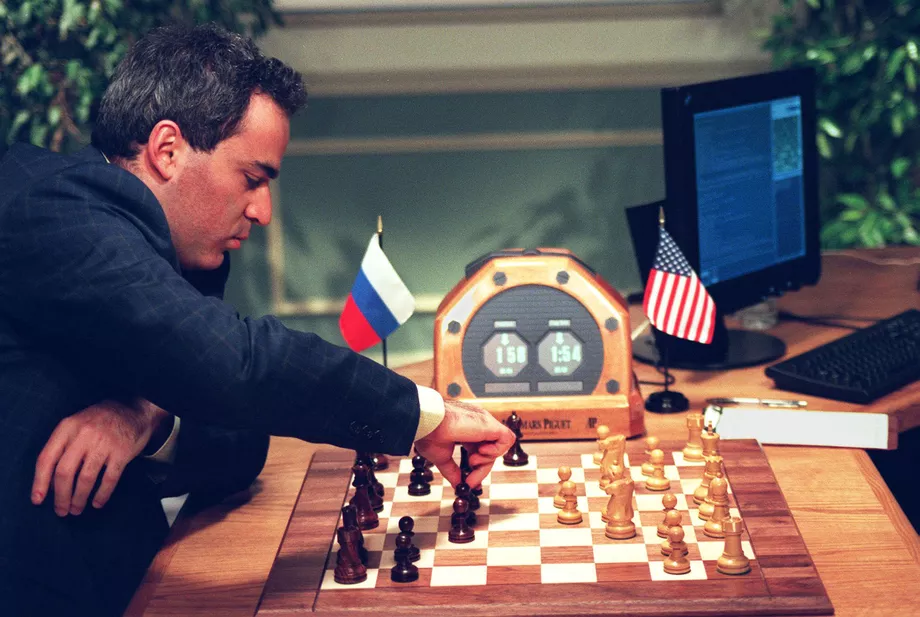
Similarly, StockFish uses brute force, analyzing 70 million moves per second. But AlphaZero does not use brute force, relatively speaking. AlphaZero analyzes just 80,000 moves per second. So how did AlphaZero win?

After being given the rules, it played itself over and over, essentially reinventing the history of chess through millions of self-played games. Through what’s known as reinforcement learning, the machine took note of the behavior and patterns that led to a win, then incorporated that information into its blossoming style, over and over and over.

AlphaZero taught itself to play, through trial and error, just like a human. Though in only four hours. As one researcher says, “[AlphaZero] is just learning in the exact same way that a human would learn to play chess. That’s what humans do to learn: You play chess, you play games against each other, and you learn over time. So it’s learning very analogously to how humans learn, and it’s able to do it much quicker and much better.”

So, why are we screwed? The same researcher puts it this way:

“This is where AI is meeting creativity. Beforehand, it was just really, really fast at thinking. Now it’s able to be creative, it’s able to hit on things that humans used to think were intuition. That’s kind of like the humans’ last flagpole of hope, that computers can’t do intuitive things. No computer would be able to invent Mozart or do anything creative, but when you look at AlphaZero, it’s bordering on creativity, it’s bordering on intuition.”

Among chess grandmasters, the AlphaZero news was met quite differently than the fear twenty years ago when DeepBlue beat Kasparov. Many grandmasters, having grown up with computers more powerful than DeepBlue in their pockets, were not alarmed but instead intrigued by AlphaZero’s potential to expand what we understand about the game of chess.

If you’re interested, the article then explores the future of AI, including its potential to create art and music, or play video games and sports, and think consciously. Interesting read. -TOB

Source: Deep You”, The Ringer, Kevin Lincoln (11/08/2018)

PAL: The comparison of music and chess throughout the article is fascinating.

Chess and music share something in common, even if we don’t fully understand what that is. At the very least, we can recognize that there is a knack for patterns, an understanding of arrangement and progression, that unites human achievement in both disciplines, and that ability to recognize patterns—an inherently human trait—is what makes AlphaZero’s achievement so startling. What Steiner’s prepubescent virtuosos lack in intellectual and emotional maturity—the socialization and acculturation that we experience as we grow older—they made up for in this innate understanding of patterns.

To an extent, the same could be said of AlphaGo and AlphaZero, which cannot do anything other than play either chess or Go but seem to exhibit genuine creativity and ingenuity within those realms. For example, during the second game of AlphaGo’s match against Go master Lee Sedol, the machine made a move so unprecedented and idiosyncratic that observers used a very un-mechanical word to describe it: beautiful.

Of course, what AIs still can’t do is first, of their own volition and according to their own values, choose to play chess or compose music; and second, do so in a way that lacks precedent. Instead, they must be told to do so by people, and once they’ve been told to do so, they will perform those tasks within a few unbreakable parameters. AlphaZero is incapable of making an illegal move, and while that doesn’t have much significance in a game of chess, which consists of only legal moves, it’s hugely important in music, where all sounds are fair game.

“One of the most limiting things about AI right now is you need to optimize something. AlphaZero was optimizing for the number of wins and the number of losses, and almost every single artificial intelligence algorithm right now is an optimization algorithm in some way,” Ginn said. “There would be no way to tell an AI, ‘Create me a brand-new song that you think is nice,’ because there’s no objective measurement of that.”

This topic is not usually my thing, but Lincoln writes the hell out of this story. Fascinating and accessible read.


The Day Jackie Mitchell Struck Out Ruth and Gehrig
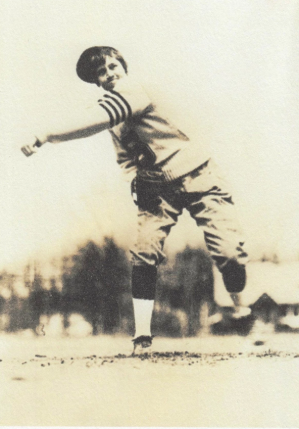
 

“Overlooked” a pretty cool idea from The New York Times. The series is an acknowledgement that the paper’s obituary section has been “dominated by white men since 1851”, so now the paper is sharing stories of people it overlooked in their time.

I happened upon the story of Jackie Mitchell this week. When Mitchell, a left-hander, was seventeen she struck Babe Ruth and Lou Gehrig in an exhibition game on April 2, 1931. Of course, it was never known whether or not the strikeouts were arranged between the owner of the Chattanooga Lookouts and the Yankee sluggers. Ruth was never opposed to making an extra buck here and there, and Lookouts owner Joe Engel needed to fill the stands during the Depression. It’s also notable that Mitchell was brought in as a relief pitcher in the first inning, struck out Ruth and Gehrig, and was replaced thereafter.

But also of note that Mitchell was throwing a sinker from the left side against two left-handed hitters, and Mitchell grew up near Hall of Famer Dazzy Vance who taught her the “drop ball”, and that Gehrig was no Ruth – he supposedly played it straight all the time.

All of it arguments fall perfectly on either side. Just enough for you to wonder if maybe, just maybe, the seventeen year-old struck out Ruth and Gehrig legit.

“Overlooked” is a great idea, and this was the perfect story for those of us lamenting that baseball is gone and daylight savings has wiped the last tannins of summer from our glasses. – PAL

Source: Overlooked No More: Jackie Mitchell, Who Fanned Two of Baseball’s Greats”, Talya Minsberg, The New York Times (11/7/18)


Kids These Days!

This is a funny one. Bjorn Borg played in an era very different from today, but he’s still one of the greatest tennis players to ever live. He has a 15-year old son, Leo, who is a top tennis prospect. You’d think growing up the son of Bjorn Borg would give you a leg up on the commission. You might watch a lot of your dad’s great matches, ask him questions about how or why he did something. You have a built in great coach. Not so, for Leo Borg. Why? Because Leo Borg is an ungrateful little shit!

Leo’s favorite player to watch is not his dad. No, of course not. It’s Rafael Nadal. OF COURSE. In fact, Leo claims he’s never watched a single one of his dad’s matches. Not one! Worse, his dad, Bjorn Freakin Borg, once tried to offer him some advice. Here’s how Leo’s mom tells the story:

“You tried once, when he was small,” she said to her husband. “You told him, like, ‘Go more forward.’ And Leo was like: ‘Ugh! You don’t know anything about tennis!’ And Bjorn said, ‘O.K., I will never say anything about tennis.’ ”

You, Father, Bjorn Freakin Borg, don’t know anything about tennis. Who is this spoiled child? Why are kids so god damn ungrateful? And when will they stop growing up so quickly? No, I’m not crying. You’re crying!  -TOB

Source: Leo Borg Steps Into His Father’s Shadow”, Andrew Keh, New York Times (11/07/2018)

PAL: This was a funny read for another reason. To learn of the challenges that come with being a sponsored athlete at fifteen while also being the son of a all-time great athlete. I really felt the sympathy for the family when they had to struggle the prospect of young Leo playing his father in a feature film, or that time they had to fly back a day later after learning that the in-flight entertainment would be the movie her son acted in, as the younger version of his father.

Or how about that time when we was competing in a juniors tournament that was sponsored by the clothing line BORG? 
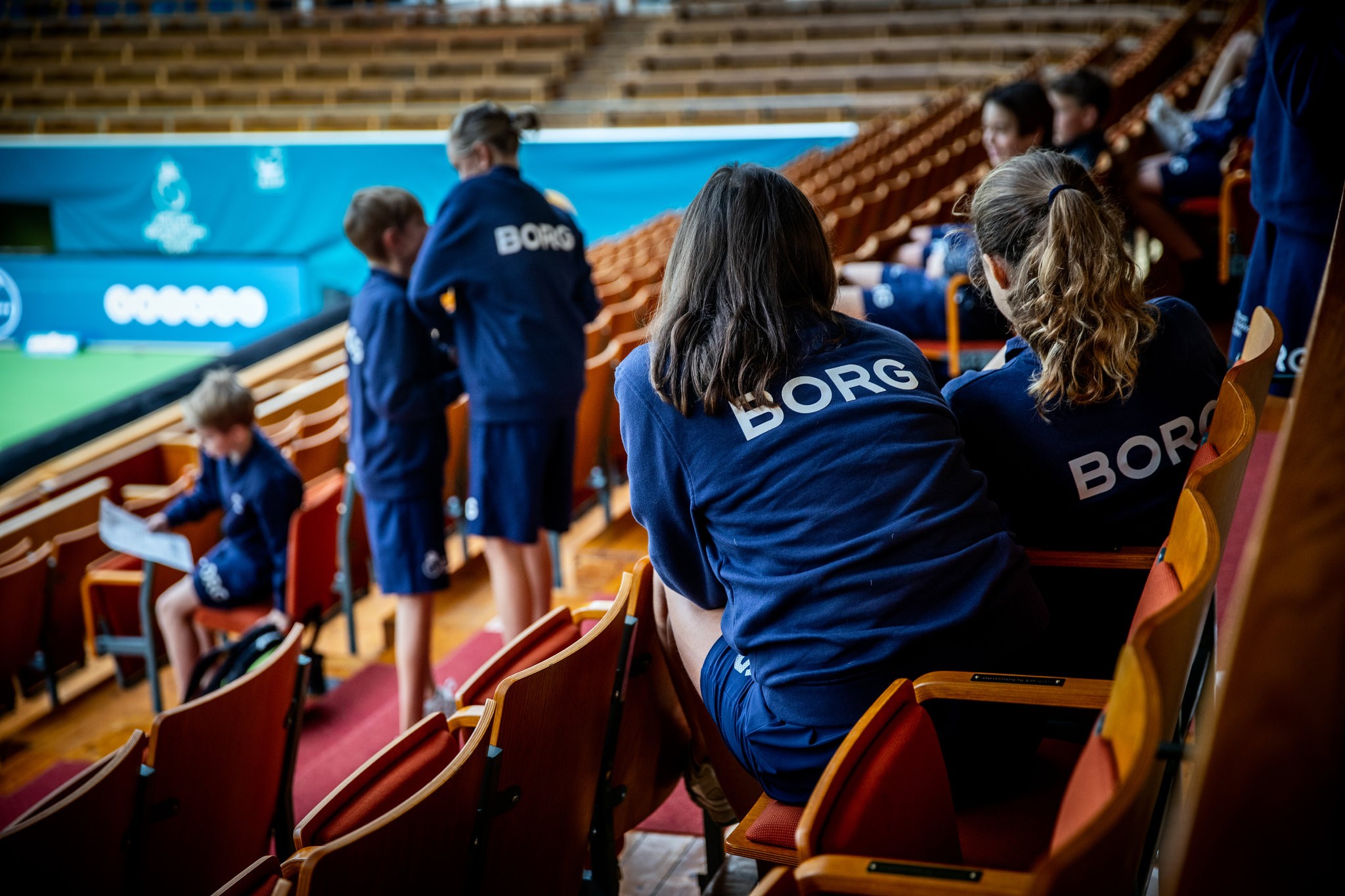
In all seriousness, it sounds like the mom, dad, and son are nonplussed, which is about the best thing I could say.


Friday Night Lights: 2018
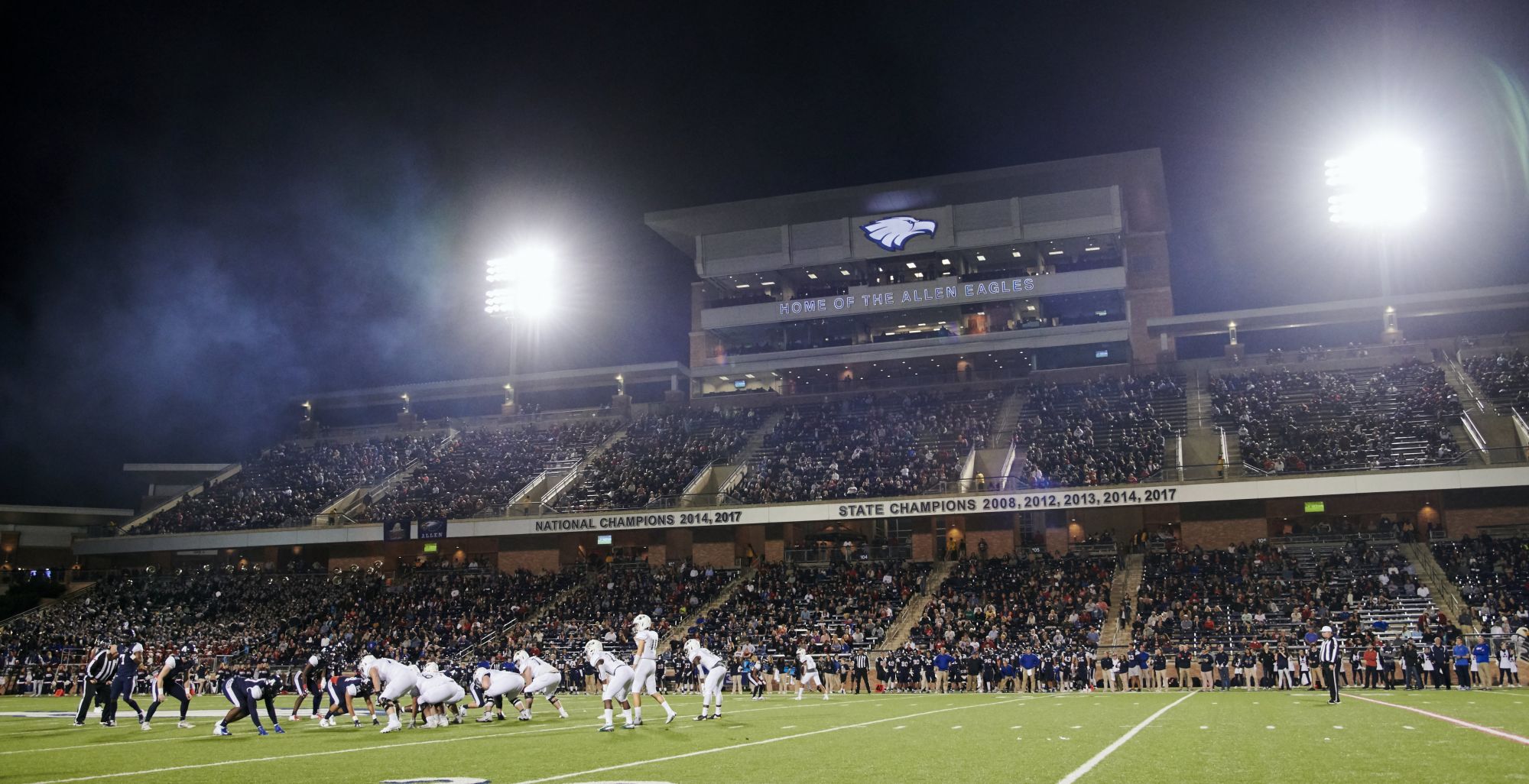
I share this article from the Wall Street Journal as an invitation to join me in my stunned reaction at some numbers. The writing is solid, but there’s no real story, other than to say, Texas is really serious about high school football, which we already knew. Consider these facts from writer Jason Gay’s trip to Allen, Texas:

  • The town of 106K has a single high school with an enrollment over 6,000
  • 9,000 season ticket holders
  • 740 students are in the marching band
  • The stadium – a high school football field – holds 18,000 spectators and cost over $60MM. 

My favorite bit of Gay’s writing is actually a parenthetical, which seems to happen somewhat often. Perhaps it’s a sign the writer found his/her real topic too late.

(A quick aside: Whenever I am in Texas and see how crazed the region is for football, it underlines what a crime against humanity it is that the Dallas Cowboys are so continuously mediocre. Dallas having mediocre professional football is the equivalent of New York City having mediocre pizza. It is an insult to the natural balance of the universe and needs to be immediately fixed.)

Tim Riggins would do some serious damage in Allen, Texas. – PAL

Source:An East Coast Schlub at Friday Night Lights”, Jason Gay, The Wall Street Journal (11/08/2018)

TOB: While I subscribe to the philosophy of never yuck another’s yum, this $60 million to build a freaking high school football stadium is outrageous. Look at the concession stand.

What happened to a good ol’ fashioned snack shack? This is nicer than the concession stands for probably every pro and college football stadium I’ve ever been to. That is serious insanity.


Video(s) of the Week: 2 Parents killing it.

https://twitter.com/Bucks/status/1059194331007979525?ref_src=twsrc%5Etfw%7Ctwcamp%5Etweetembed%7Ctwterm%5E1059194331007979525&ref_url=https%3A%2F%2Fdeadspin.com%2Fajax%2Finset%2Fiframe%3Fid%3Dtwitter-1059194331007979525%26autosize%3D1


Tweet of the Week


PAL Song of the Week: Maggie Rogers – “Fallingwater”


Like what you’ve read? Let us know by following this blog (on the right side, up near the top), or:

Email: 123sportslist@gmail.com
Twitter: @123sportsdigest

Facebook


You know the message you’re sending out to the world with these sweatpants? You’re telling the world, ‘I give up. I can’t compete in normal society. I’m miserable, so I might as well be comfortable.

-Jerry Seinfeld

Week of October 26, 2018

There might be nothing better in sports than a hot Steph Curry.


Don’t Forget To Leave A Tip

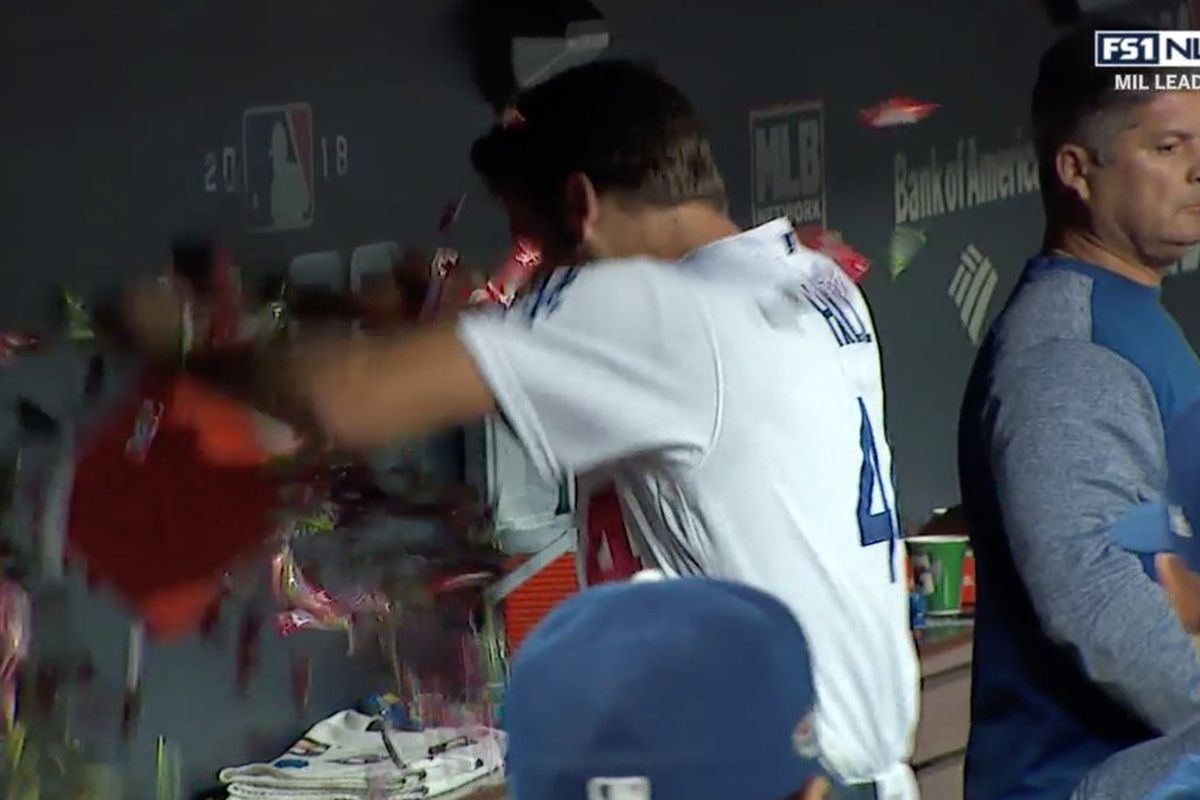
Rich Hill’s reaction to tipping pitches

One thing that’s struck me while watching the baseball playoffs over the past few years is how many guys are throwing upper 90s regularly. You’ve no doubt noticed this year: teams pulling starting pitching after less than five innings to get to the bullpen, which is a stable of flame-throwers.

But velocity is only one factor at play. Hitting is about timing. Pitching is about upsetting that timing. So it’s a big deal when word gets out about a pitcher tipping pitches, especially in the playoffs (smaller sample size), because hitters have a better chance to lock into the timing when they know whether a 97 M.P.H fastball is coming or a 83 M.P.H. curveball is coming.

Danny Knobler’s story was posted before the World Series started, but is still a great read. He details pitchers in recent history who had been tipping pitches in huge moments (Andy Petitte in Game 5 of the 2001 World Series, Craig Kimbrel in the ALCS this year), and wily vets who are the masters of finding a pitcher’s tip (Chase Utley, Alex Cora, Pete Rose, Eduardo Perez, Carlos Beltran).


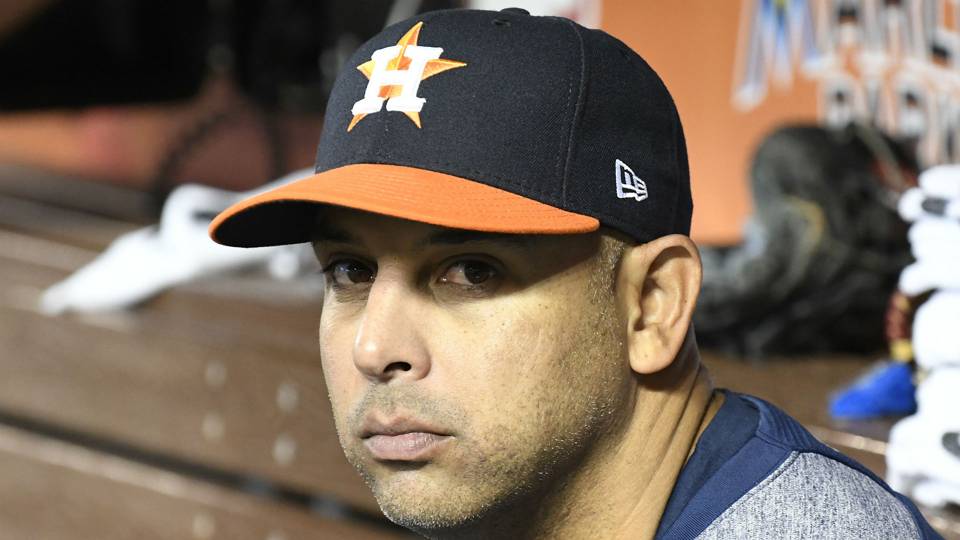
Before he was managing the Red Sox, Cora was the resident pitch-tipping wizard as a bench coach for the World Champ Astros.

The story isn’t just about recognizing a pitcher’s pattern that associates with a type of pitch, e.g. the hands come set at the chest for a curveball and they come set at the waist for a fastball, but the surprising challenge pitchers face when they realize they are tipping pitches. Muscle memory can be hard to break in front of 45,000 fans in a tight ball game.

Knobler harvests a bunch of grin-worthy anecdotes from recent history, so go read the full story, but I’ll leave you with my favorite: this little Will Clark nugget from Texas Rangers pitching coach Doug Brocail:

Brocail speaks from experience. In September 1992, the San Diego Padres called him up from Triple-A. His first start would be against the San Francisco Giants at Candlestick Park, and before the game he saw Giants first baseman Will Clark in a tunnel outside the clubhouse.

“You the kid pitching tonight?” Clark asked.

“Yes, I am,” Brocail said.

“Hey, just so you know, you tip all your pitches,” Clark told him.

“I thought he was messing with me,” Brocail said. But he wasn’t. The Giants knocked Brocail out in the fourth inning. Clark walked and doubled.

“We got looking at the video,” Brocail said. “Sure enough, I was coming to a set by my chest when I threw a fastball and by the waist when I threw the curve. I’d been doing it all year in Triple-A and no one picked up on it.”

Of course there are some pitchers that are so dominant that it didn’t matter if the hitter knew what was coming, which is absolutely mind-blowing. Randy Johnson tipped his pitches all the time. Hitters knew when Johan Santana was going to throw his devastating change-up and still couldn’t hit it.

Santana’s change-up got him two Cy Young awards. Big leaguers couldn’t hit it, and they knew it was coming.

Great read. – PAL

Source: How Do You Win a World Series? It Helps If the Pitcher Tells You What’s Coming”, Danny Knobler, Bleacher Report (10/22/18)

TOB: Any time I hear a pitcher is tipping pitches, I’m shocked it doesn’t happen more. Pitching is so hard, and I can’t imagine how difficult it must be to make a slider look like a fastball look like a curveball look like a changeup. And, as we wrote about here a few months back, now pitchers are tunneling pitches (trying to get their fastball and their breaking ball to stay on the exact same flight path until just before it gets to the plate)? Crazy.


Basketball: The Original Cage Fighting

I’ve been watching ESPN’s 10-part documentary on hoops, entitled, “Basketball: A Love Story”. It’s been at times very good, at others a little boring (they really didn’t need nearly 20 hours). I’ve learned a lot, had my memory refreshed on a lot, and been annoyed at a glaring historical inaccuracy on another (more on that later).

But one thing kept piquing my curiosity. The series’ first few episodes focuses largely on the 1950s and 1960s, and utilized a lot of contemporaneous newspaper clippings to help illustrate the story being told. And, on countless occasions, the newspaper used the term “cage” to refer to the sport of basketball or “cagers” to refer to the players. As in, “Five Cagers Implicated in Point Shaving Scandal.” I can’t say I’ve never heard this term for basketball before, but I don’t think I realized how ubiquitous it once was. The term kept appearing – over and over and over.

I remarked to my wife about this historical tidbit and she suggested I investigate and report my findings on this here blog. I thought that was a fine idea. And then it took me 0.5 seconds to find the answer, in this 1991 article from Sports Illustrated. Entitled, “When the Court Was a Cage”, it explores the origins of the term:

A scant five years [after basketball was invented in 1891 by Dr. James Naismith], in 1896, the first acknowledged professionals took the floor in Trenton, N.J. Their court, in a social hall, was enclosed, literally, in a cage, a 12-foot-high wire-mesh fence set along the endlines and sidelines.

At the time, the cage made good sense. Front-row spectators sat even closer to the court than they do today, and Naismith’s original rules said that when the ball went out of bounds, the first player who got to it could throw it back in. Obviously, it would have been disastrous to allow players to wrestle in the laps of paying customers for possession of the ball. With the cage the rule was moot—the ball never went out of bounds.

The out-of-bounds rule was changed in 1902 to eliminate sideline scrimmages, but by that time the early pros were wedded to the cage. The thinking was that the game was faster and more entertaining in a cage because there were no delays to return the ball to play, and because the ball and the players could bounce off the wire mesh.

That is kinda wild. Cages were used into the 1930s in some areas, and then the use died out. But the term stuck. For a while, anyways. I’m still surprised how literal the term was. -TOB

Source: When the Court Was a Cage”, Sports Illustrated (11/11/1991)

PAL: SI is having some financial issues recently, but they should still employ a copywriter. There’s a crucial typo in the first line of the damn story!

Here’s a pop quiz for today. A eager is:…

The story is about cage basketball. A “Cager” not “a eager” is a basketball player. Come on, Sports Illustrated!

TOB: It occurs at least one more time in the article. I’m pretty sure it was some sort of autocorrect/scanning error when they digitized the article.

Ok so now I’d like to discuss my historical error that really dug in my craw. As many readers know, I am a big Cal sports fan. As many readers likely don’t know, there was a time when Cal basketball was a powerhouse. In 1959 and 1960, Cal won the national title and finished runner-up, respectively. In 1959, the Bears beat Oscar Robertson’s Cincinnati squad in the Final Four, and then beat Jerry West’s West Virginia team in the finals. In 1960, the Bears again beat Oscar Robertson in the Final Four, and then lost to Jerry Lucas and Ohio State in the championship.

The Bears’ coach in those days was Pete Newell. Basketball: A Love Story begins their segment on the 1960s/1970s UCLA dynasty under John Wooden by accurately discussing how Pete Newell and the Cal Bears had beaten the pants off of Wooden’s UCLA squad for much of the 1950s. Wooden arrived at UCLA in 1948 and immediately started winning conference titles.

Newell arrived at Cal in 1954, and by 1956 had turned the Cal program around, winning the conference four straight years by the end of that 1960 season. In doing so, Cal beat UCLA 9 straight times dating back to the 1956-57 season.

For the most part, Basketball: A Love Story covered all of that fairly. But then the series strongly suggested that, after the 1960 season, Wooden and his staff invented the 2-2-1 defensive press to beat Newell and the Bears, did so, and never looked back as their dynasty blossomed. It makes for quite the story.

Except it’s not at all true. After losing the 1960 title game, Newell coached the 1960 Olympic team to the gold medal and then retired, apparently believing the stress of coaching was going to kill him. He was only 44 years old, and he never coached a competitive game again. Instead, he spent the next five decades tutoring NBA and college big men, including hosting his annual Coach Newell Big Man Camp. NBA greats like Bill Walton, Shaq, and even Hakeem attended that camp.

What’s worse, this LA Times Article from 2008 says that Wooden didn’t introduce the 2-2-1 zone press until 1964, the year he won his first national title, and that he stole it from Newell.

This inaccuracy shouldn’t bug me so much. I’m sure Phil rolled his eyes at least once while reading this. But the Wooden stuff grates on me. He looked the other way while boosters paid his players. Most people know about it now, and he’s still deified anyways. And now you’re going to pretend like Wooden invented a single defensive scheme and suddenly started beating the pants off the man many old-time basketball people consider the greatest coach of all-time? No, dang it. I won’t take that silently. Wooden sucks, and he’s lucky Newell retired, or he’d have coached circles around him for the next two decades.

PAL: You and Bobby Knight should start a Wooden fan club.


How Golden State’s Team Ended Up In Oakland

Anyone who’s been around San Francisco’s Dogpatch neighborhood recently has seen it, and anyone that lives in Oakland can feel it: the Warriors new arena getting closer and closer to being finished, and so is the team’s time in Oakland. Next year, the team will head over to the fancier side of the Bay. In a couple years, Oakland will have lost the Raiders to Vegas and the Warriors to San Francisco. The A’s might not be too far behind.

Rather than wade into the politics and business reasons for the teams leaving town, Part I of Bruce Jenkins’ Warriors history deep dive focuses on how the team ended up in Oakland in the first place. The story is an enjoyable reminder of days when professional sports franchises represented startups playing it fast and loose more than the stodgy billion dollar companies they’ve become today.

Get this: the mid-60s San Francisco Warriors played most of the team’s ‘home’ games away from their home courts in San Francisco. Bakersfield, Las Vegas, San Diego, San Jose, Richmond. In fact, the team’s name changed from ‘San Francisco Warriors’ to ‘Golden State Warriors’ because owner Franklin Mieuli had the idea that the team would alternate home games in cities throughout the state. Obviously that never panned out, and it was too late to change the name again by the time the lease was signed in Oakland. The idea of a rover team splitting home games across a state or region is still an interesting concept, but that’s just me. 

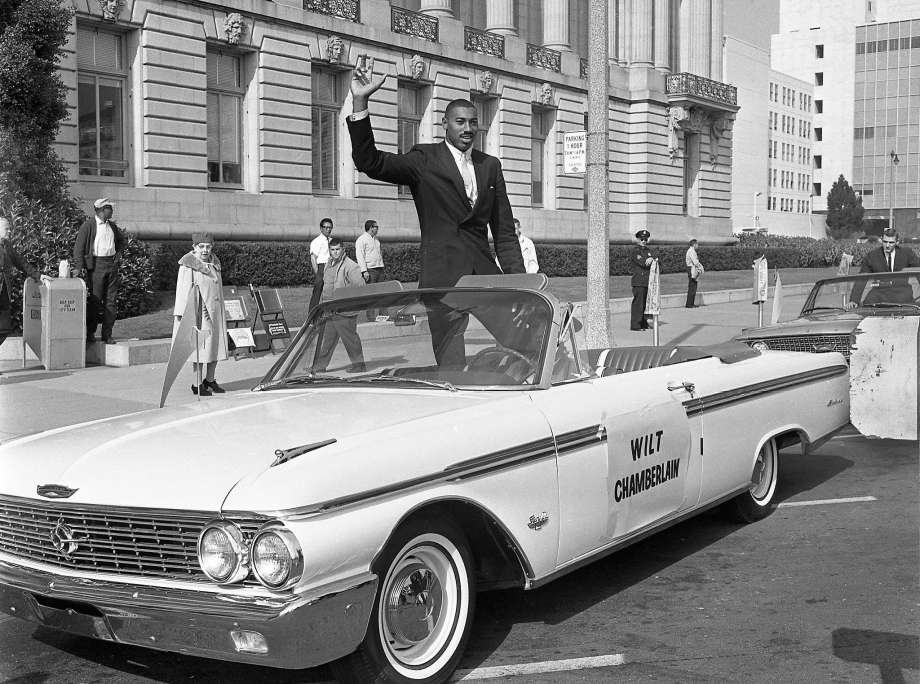
All of this took place while the team saw a collection of all-time NBA greats put on the Warriors jersey. Wilt Chamberlain, Rick Barry, Nate Thurmond. The team won it all in 1975.

I understand this story is more appealing to Bay Area folks, but it’s likely that your favorite team has some wild and interesting stories from the early years, too. Pro sports were pretty funky in the early days. – PAL

Source: Crossing the Bridge: When the Warriors took root in Oakland”, Bruce Jenkins, San Francisco Chronicle (October, 2018)


A Baseball Stadium Is a Series of Microclimates

This is really interesting. The writer, an atmospheric scientist, interviewed John Farley, the Chief Technology Officer for Weather Applied Metrics (WAM). WAM “quantifies weather impacts on baseball (and sports in general) using Computational Fluid Dynamics (CFD) modeling, standard trajectory physics, and other meteorological analysis.”

So, what the hell does that mean? For one, it means WAM analyzes how a batted ball is affected by the very unique wind patterns within a baseball stadium. As Farley notes, fans and announcers often look at the flags that fly atop the stadium in an attempt to know which way the wind is blowing, but those flags tell us very little about how wind impacts a fly ball. As Farley puts it:

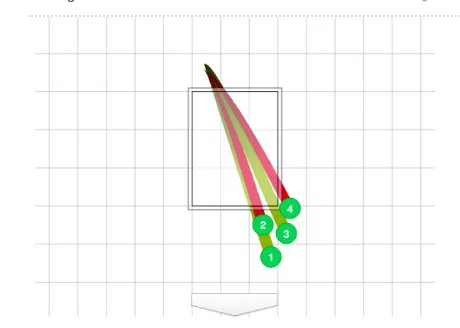
[T]here is a lot of vertical wind inside stadiums, which has a significant impact on the flight of the ball over its entire trajectory. Prevailing winds (see graphic below) blowing over a stadium in one direction, but the winds at field level doing the exact opposite, and there’s a lot going on in between. We model the wind field down to each square foot over the entire area where a ball could fly. Then we use those winds for our 3D-Trajectory model with increments of 0.001 seconds.

I’ve always understood that weather can affect a fly ball, but Farley helps put it into perspective:

A headwind, combined with a downdraft, can shorten a fly ball hit to the wall by as much as 60 feet. A tail wind, combined with an updraft can lengthen it by as much as 45 feet. Since baseballs absorb moisture from the air (they are hygroscopic), the difference in distance between very dry air and very wet air is roughly 50 feet. That’s because a wet ball is slightly heavier and spongier, so it doesn’t come off the bat as fast. On a hotter day the air is less dense and so a ball can travel as much as 30 feet farther, compared to a cold day. Air pressure affects density directly. So balls hit at high altitude travel considerably farther.

Farley provides this graphic for a specific example of how wind direction on the field affects a ball.

Farley reports that they installed their real-time analysis system at one major league stadium this June, and I’d fall over in shock if it wasn’t the Giants. Given their tricky weather and stadium, they need every bit of information they can get. Plus, they’re local, as WAM is based out of Silicon Valley. And if it’s not the Giants, get it together, Larry! -TOB

Source: “Understanding The Meteorology Of A Fly Ball May Help Baseball Teams“, Marshall Shepherd, Forbes (10/23/2018)

PAL: So interesting. Brother-in-law Jay Rabeni, who’s currently cuddled up with a Red Sox 2-0 lead in the series, will love this, as he’s a weather dork. It really is a significant amount of distance we’re talking here. Great pull, TOB.


This One Goes Out To Mr. & Ms. 5K (You Know Who You Are) 

Rowe & Suze, I just read an article about why the 5K is better than the marathon. I have found your people.

Danielle Zickl starts out her article capturing an exchange we’re all familiar with: “Anytime I tell someone I’m a runner, they never fail to ask the same question: Have you run a marathon? In the past, I’ve answered this with some variation of ‘Not yet, but probably soon.’ The truth is that I’m a bald-faced liar.”

The assumption that longer = greater challenge is simply untrue. In order to run a sub 20:00 5K requires similar training, speed work, tempo runs as would be required for someone to run a 3:10:00 marathon. And while the marathon distance allows for time to find your race pace and – if needed – make up some time, the 5K requires all-out effort from the start.

Interesting read and a good opportunity to remind folks that no one cares about the marathon your training for (even if they ask). Everyone’s just being polite. – PAL

Source: “Why the 5K Is Better Than the Marathon” (print title), Danielle Zickl, Runner’s World (November/December issue)


Video of the Week:


Tweet of the Week:

https://twitter.com/BoringEnormous/status/1055195652563652608


PAL’s Song of the Week: Seu Jorge – “Life On Mars?” (David Bowie)


Like what you’ve read? Let us know by following this blog (on the right side, up near the top), or:

Email: 123sportslist@gmail.com
Twitter: @123sportsdigest

Facebook

Instagram: @123__sports


Sometimes when I blow my nose I get a boner. I don’t know why. It just happens. 

– Andy Dwyer


Week of October 19, 2018


Spotlight: Aaron Hernandez

I’ll keep this short, because there’s simply too much to say. If you’re reading this, you know the story of Aaron Hernandez – the football star turned convicted murderer who committed suicide in prison, and was posthumously diagnosed with CTE. But there’s so much more to his story – where he came from, the family he came from, how he went from football star to murderer, why, and what those around him thought as his life spiraled out of control. This week, the Boston Globe’s Spotlight team (as in the Best Picture Oscar winning movie, Spotlight about the paper’s investigation into the Catholic Church’s cover-up of widespread sexual abuse by priests) released their six-part story on Hernandez.

I think the saddest thing about his story, having read this, is how many people with the power to help him looked the other way and did nothing, often to protect themselves or their own reputation. I’m looking at you, Urban Meyer, and even a little at you, Bill Belichick.

The series is incredibly well researched and very thorough, and I highly recommend you read all six parts (you’ll need to get creative in order to get beyond the Globe’s two free story per month paywall, or you can throw them a couple bucks – it’s worth it). -TOB

Source: “Gladiator: Aaron Hernandez and Football Inc.”; Part I: “The Secrets Behind the Smile”, Part II: “Lost in the Swamp”; Part III: “Running For His Life”; Part IV: “A Killer in the Huddle”; Part V: “A Room of His Own”; Part VI: “A Terrible Thing to Waste”, by Bob Hohler, Beth Healy, Sacha Pfeiffer, Andrew Ryan, and editor Patricia Wen, The Boston Globe (10/13/2018 – 10/19/2018)

PAL: This was a terrifying, terrified man. Aaron Hernandez is the worse case scenario in so many ways, all of which were looked over because he was a great football player. A victim of physical, emotional, and sexual abuse as a child, Spotlight’s description of Hernadez reads to me like he had no true identity. This guy needed extensive therapy. Instead, he banged his brain around for a decade. Very few people he crossed path with in his life seemed to care about him outside of what he could provide them. This is why “Gladiator” is the perfect title for this series. He was valued on the field of battle and how he entertained the crowd. 

All of this, of course is not an excuse for what he did; rather, it might be a roadmap. Again, simply terrifying.


Kroenke’s Quest and Arsenal’s Loss

Stan Kroenke, of Columbia, MO, is a very rich man. He’s worth billions, and his wife – Ann Walton Kroenke (yep, that Walton) is pretty rich, too. Between them, they own the following professional sports teams (among others):

  • LA Rams
  • Denver Nuggets
  • Colorado Avalanche
  • Arsenal (English Premier League)

Recently, Kroenke bought out a big chunk of Arsenal shares from some Russian oligarch, giving him control of over 98.82% of an exceedingly valuable sports club. There are so few shares remaining outside of his control, that he’s legally allowed to take them for a price.

Those remaining shares are in the possession of common fans. This New York Times story, by Rory Smith, allows some of the minority owners to speak, and in their words I recognize the challenge of being a fan in an era in which the business side of sports is impossible to ignore.

Martha Wilcott bought her single Arsenal share in 2004. Jeffery Freeman’s stock broker purchased ten shares for Freeman in 1965, and Freeman remembers walking with his father to see the team play in an alternate stadium in 1945 because the team’s stadium was bombed. Lindsay Rawling’s grandfather and his brothers worked at the stock exchange when the team first offered shares. The shares have been passed down three generations.

Wilcott describes to the shareholder/fan relationship as “custodianship”. What a beautiful way to think of your team, and so I understand these folk’s sadness when they are required to defer to some billionaire who forces them to see what the club is to him instead of what it mean to them. – PAL

Source: Their Arsenal.Their Shares. For Now”, Rory Smith, The New York Times (10/17/18)


Win or Lose, Craig Counsell Made Me Laugh

Heading into crucial Game 5 of the NLCS this week, the Brewers named left-hander Wade Miley the starter. This was technically true. In response, the Dodgers started a right-handed heavy lineup, including David Freese and Austin Barnes. I said before that the Brewers’ naming Miley the starter was technically true, because Miley did start. He threw five pitches, with which he walked Cody Bellinger, and was then yanked for right-handed pitcher Brandon Woodruff. HAAAA:

“That’s what we were going to do all along,” Counsell said after the game, explaining that the Brewers conceived of this plan as soon as they won Game 3 to guarantee that there would be a Game 6 for Miley to start. “They’re trying to get matchups; we’re trying to get matchups. They’re a very tough team to get matchups against.”

Counsell tricked the Dodgers, sorta:

As a manufactured effort to create those advantageous matchups, the ploy paid off, but again, only kind of. Because Miley was starting, the left-handed Max Muncy was hitting fifth, below his usual spot in the order, and righty David Freese, who typically doesn’t face same-handed pitchers, was hitting third. Had the Dodgers been caught more unawares, Counsell’s trick would have resulted in an unqualified strategic success, regardless of the game’s result—L.A. has already run out of bench players twice in this series, so manager Dave Roberts could ill afford to accelerate his bench usage.

But Muncy and Bellinger, who usually sit against left-handed pitchers, were both in the lineup, and Matt Kemp, who serves as a strict platoon batter like Freese, wasn’t. Ken Rosenthal reported that L.A. suspected what was coming, which is why they made those lineup decisions rather than bench Muncy and Bellinger and start Kemp, as they did against Miley in his Game 2 start. As it turned out, Freese batted just once, with two runners on in the first inning, and Woodruff struck him out swinging. Before his second at-bat, Freese was removed for—of course—a left-handed hitter, so all the tomfoolery, which apparently lasted multiple days and involved multiple parties, carried the ultimate outcome of burning Freese, perhaps the Dodgers’ least important position player.

Interestingly, Counsell may have drawn inspiration from the Washington Senators pulling the game trick against the New York Giants, way back in 1924. It worked, as the Senators won and clinched the World Series. As I write this, the Brewers lead 1-0 early in the game. Whether Counsell’s gamesmanship pays off remains to be seen. It sure as hell was hilarious, though.

Post-script: The move worked well, as Woodruff kept the Dodgers hitless for a few innings, but then things fell apart and the Dodgers took a 3-2 series lead. -TOB

Source: The Brewers Tried to Fool the Dodgers With a Pitching Trick From a Century Ago”, Zach Kram, The Ringer (10/17/2018)

PAL: Hey, I’m all for a little gamesmanship. Let’s mix it up, right? You know what’s more effective: a starting pitcher going seven strong innings (Kershaw was pretty good in that game for the winning team). The Brewers’ starting pitching is meh at best, but they have a killer bullpen, so I get the need to be crafty.

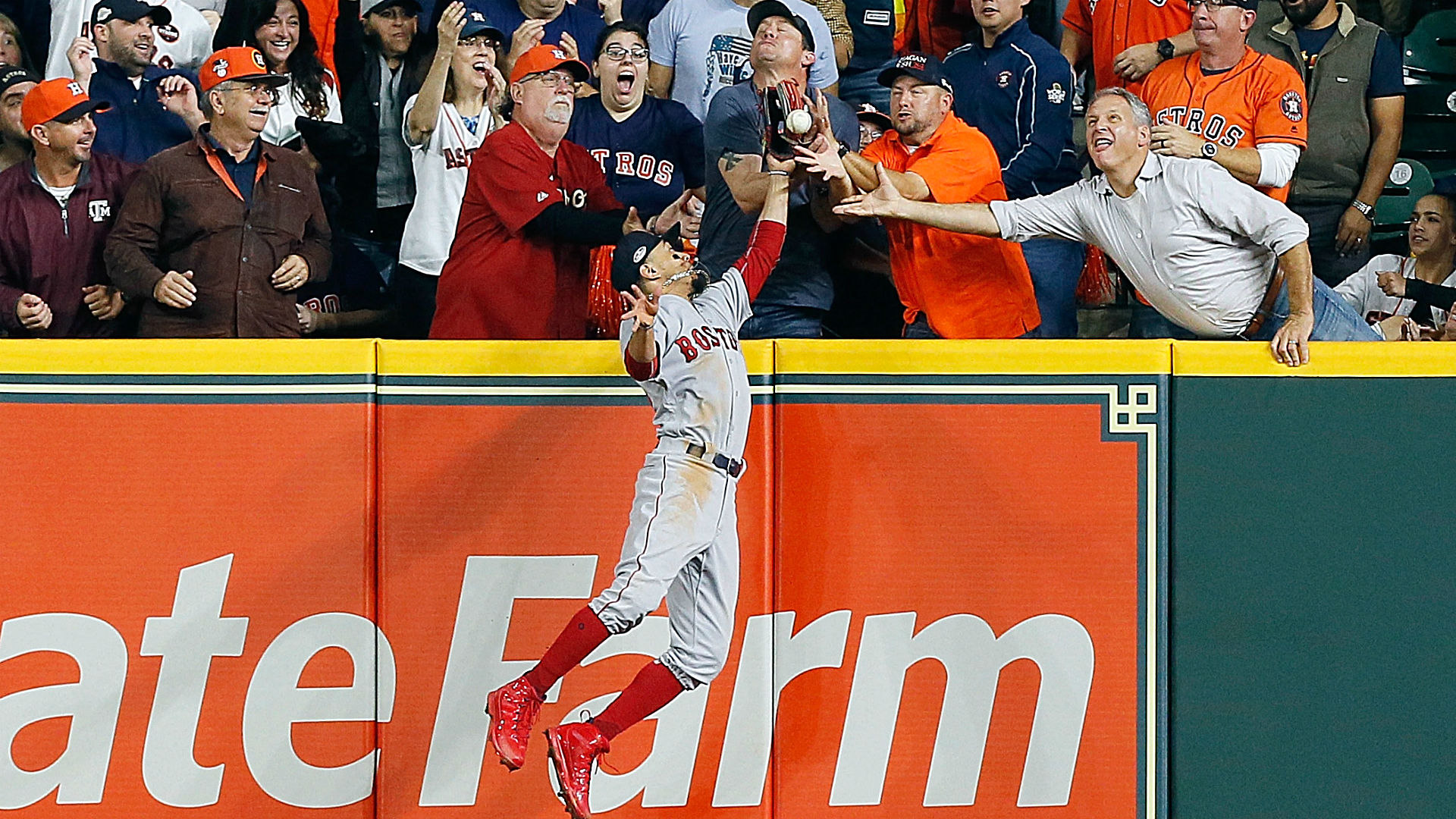
I watched the tremendous Astros-Sox game on Wednesday, and that was a perfect reminder that these games are decided by moments more than matchups…or at least it feels that way; I don’t know anymore. Mookie Betts made an incredible play to throw out Tony Kemp who made the inexcusable decision to try to take the extra bag down by three runs with no outs in the bottom of the eighth!

And then, in the bottom of the ninth, Andrew Benintendi makes a mental error and dives for a sinking liner in left field. If the ball gets by him, then three Astros might score, giving them the win. The smart play is to let the ball fall and keep it in front of you. Benintendi gambles big and comes up lucky.

So two dumb decisions lead to two great plays, and they both went the Red Sox way. That doesn’t feel like matchups. It came down to those plays (and a fan interference call). Zach Kram says as much at the end of his article: “Sometimes the smart strategy doesn’t work because a baseball game involves hundreds of other factors, and luck and execution and weather and ballpark dimensions get in the way.” 


Video(s) of the Week:


Ever wonder how umpire ‘Cowboy’ Joe West got his nickname? Watch below.


Tweet of the Week: 


PAL Song of the Week: Ty Segall – “I’m A Man” (Spencer Davis Group cover)


Like what you’ve read? Let us know by following this blog (on the right side, up near the top), or:

Email: 123sportslist@gmail.com
Twitter: @123sportsdigest

Facebook

Instagram: @123__sports


I’m one of the few people who looks hot eating a cupcake. 

– Kelly Kapoor

Gary Livingston: Baseball Memories

Earlier this week I found an email from my Uncle Gary. In it he shared his baseball memories, and I think this is a really great way to extend the On the Force or the Tag series. Please feel free to send me your baseball stories and pictures, and I’ll be sure so add it to the page. – PAL

Gary Livingston in the vintage jersey. 

Blogger and nephew, Phil, has inspired me to recollect my youth and past baseball memories. Unlike Phil, I was marginally talented. Like Phil, I loved the game and I knew the game.

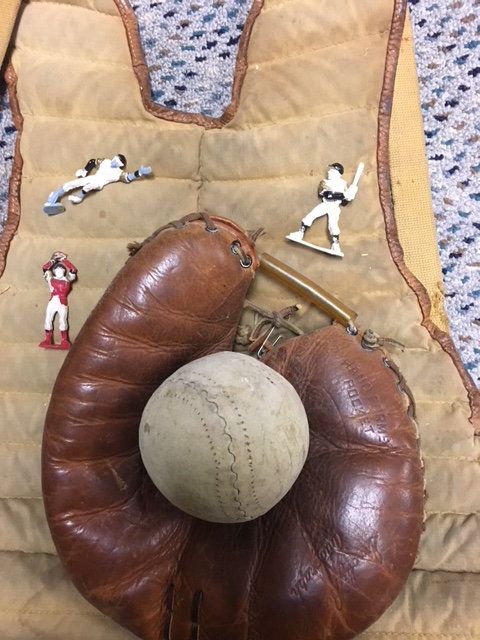
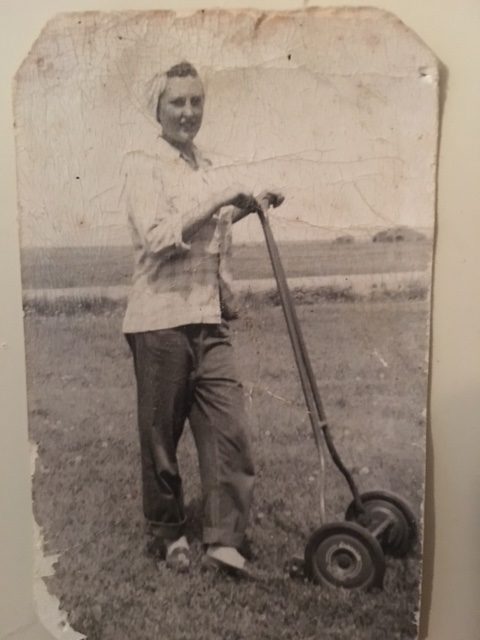
My first memories of playing catch are with my mom. I later learned she was a small-town farm girl legend as the tomboy who could play ball. In her day she played kitten ball. I still have the kitten ball she gave me. She had a great arm and I never had to worry about throwing too hard to her. Phil captures the essence of who has the game in their blood, when he writes that when the simple game of catch is enough to entertain for hours—you know they love the game.

I grew up in a working class neighborhood in which moms stayed home and kids played outside until supper. We had a group of 3 “big” kids who dictated our play. They were four years older and wiser. I was among the 6-10 little kids. The big kids decided the sport—baseball, football—how—waffle ball, left-handed—where—street, yard, sandlot. They decided rainy day activities—chess, trivia, and the king of indoor games of our youth—Little Baseball.

Little Baseball consisted of each player picking a major league team. We had little plastic baseball players from cereal boxes as players and found the bakery sold plastic players to be used as cake decorations. We each painted and named our players from the MLB team. I remember the detail and pride we took in painting our players: the black and gold of the Pirates, the number on their back to the color of their skin.

We made a game board from a 4’x4’ sheet of plywood or sheetrock. The players took the field and guarded circles with hits labeled in each. We pitched the ball/marble by rolling down a ramp and the hitter would strike with a wooden dowel bat. We kept score, statistics, played a whole season, which included an All-Star game and World Series. Each year was a new season and brought more sophistication to game. Dave, a big kid with creative talent, helped turn our boards into works of art including lights, spectator bleachers, and scoreboards. The Big kids were their league of choice—usually American—and we little kids would be the National. I still have my Cardinals Curt Flood and Vada Pinson and Pirate- Roberta Clemente as I painted them 50+ years ago. Remarkably, our favorite players would perform the best in our board game. We could hole up for hours playing in the basement and at night compile batting averages and ERA’s.

The Kitten ball and the hand-painted figurines.

My organized baseball began with T-Shirt league at the local park. I was a Tiger in Little League. Dick Wilder was my coach. I remember him as knowledgeable, kind, and always encouraging. Everything you want in a youth coach. Looking back, I was a shy, skinny kid, unsure of himself on hard ground balls and overmatched against hard throwing pitchers, yet coach let me play second base and admired my good eye and bunting ability to find a way to get on base. As a teen I tried out and did not make the cut to play Babe Ruth. That hurt; I remember the 5-mile walk home from the practice I was cut at. I cried and did not want the ride home with the coach. Kids are resilient. I was asked if I wanted to play Minor League. It consisted of kids who had not played the game seriously. The coach was a dad who had limited knowledge of baseball. The coach recognized I played the game and asked if I wanted to run practice, make line-ups, pitch, play shortstop. I knew this was not high quality baseball, but I had fun.

My real baseball experience as a kid was playing with friends. I can’t say an adult, besides my mom, or coach taught me to play the game, or any game for that matter. We all learned to develop an intuition for all sports by playing with friends. I’m befuddled by major laagers with limited baseball sense—not knowing what base to throw to or not knowing when to take the extra base. Summer days were a game in the morning, lunch, and double-header in the afternoon, supper, backyard wiffle baseball. The games were designed around the number of players, location. Some fields dictated we all bat left-handed. Advantage Tony-the only lefty.

I do not remember any adults having input in our play. We just had to be home for supper. One summer, I guess 1966; we had the idea to involve the girls of the neighborhood. We were 13-14 and discovered that having the girls around was a good idea. The Big kids took the girls ages 13-14 and coached them to play the game while we “little” kids took the new little boys ages 8-10 and prepared them to play the older girls. We discovered what I think we already knew; the girls were athletes.  We enlisted Tom, a mild Downs teen, to ump the big game. I don’t remember the outcome; it doesn’t matter. I don’t think it mattered then. This is years before Title 9. I’m impressed by the insight of these kids. Over the years I have come to conclusion that adults are much too involved with kids play. Kids left to their own devices are wise and creative. Kids today have become dependent on adults to dictate their play, their thinking, their creativity. Youth sports has become more about the adults.

As a group of friends we played baseball, basketball and touch football through our teens. As young adults we joined local rec leagues to play touch and softball. It was always more about playing with friends than the game, though we were competitive and took the game seriously. Sometimes I regret we did not play baseball versus softball, but there were not the adult opportunities that exist today to play hardball. That said, the athletes I played with and against were truly great athletes and the play was high caliber ball.

As part of my softball experience I became a certified softball ump. My first lessons about umpping came through the director of Brooklyn Center Parks & Rec. I was the organizer and captain of our softball team and attended the organizational meetings. Director Arnie made it clear that arguing with umpires was not tolerated. He was an ump and a good one. He finished every meeting with the reminder that unless you were perfect in bed with your wife don’t expect perfection from umpires.


I understood from my experiences that umps/refs make mistakes. Players, coaches, parents make mistakes; unless you are perfect expecting perfection from others is unreasonable. I am distressed when I hear a young person blame a loss on poor officiating. This is learned from adults. In the rare instance when a game is decided by an officiating error, I wonder if every single player can look back at that game or any game and say they played the perfect game—there was not an instance where they could have changed the outcome with better play. I always taught players, students, parents—“The ump/ref is always right, even when they are wrong.” Once again I blame the over-organizing of youth sport for the inability for kids to self regulate their own play, settle their own differences and arguments. They have been taught to rely on adults to organize and officiate their play.

My baseball life became complete when the Twins won the ’87 World Series and again for frosting on the cake in ‘91. Like most Minnesota sports fans, we had never experienced the thrill of being the champs. A baseball fan highlight was attending the welcome back Twins homecoming at the Dome in the evening after defeating Detroit and earning the right to play the Cardinals in the World Series. Unexpectedly, the building was filled with true fans starved for a chance to celebrate. It brings a tear to my eye to this day. Now if the Gophers can get to the Rose Bowl before I die.

I am 65. Sports are in my DNA. I was a sports rube; I lost sleep with Viking/Twins loses. Minnesota teams are in my DNA, but today there are many more important things in my life then if a team wins or loses. I just don’t care that much about who does what any more. Sporting contests have become events and big business. Baseball games have become too long. I do not enjoy the angst displayed with every pitch, every play. That is what has made the games so long. The deep breaths, adjusting of the glove, the manager examining his analytic card, players with analytic cards, finding the perfect matchup or pitch—it drives me crazy—just play the game. This lack of interest carries over into watching my grandkids play ball. Maybe I am a bad grandparent, but I do not feel a need to watch all their games, and I hope they do not feel a need to play in front of me or anyone for that matter. Play the game for the joy of playing, not for performing for adults. Truth be told, I find the games boring. I just hope the kids have fun; and I am able to play catch with them as my mom played catch with me.

Gary Livingston


Week of October 12, 2018

Alex Honnold climbing El Cap with no ropes. Who’s coming to see the doc, Free Solo, with me? 


The Yankees/Red Sox 9th Inning Is Why We Love Baseball

During the bottom of the 9th inning of Game 4 of the Yankees/Red Sox division series, which Boston won 4-3 to win the series, I texted some buddies, “This is so good. Playoff baseball is the best.” I don’t particularly care about either team. Sure, I rooted for Boston back in 2003 and 2004. They were the underdogs then. They’re not now. Both teams spend a lot and win a lot and have obnoxious fans (my dad, excepted). And for the first time (ever?) I found myself pulling for the Yankees. They actually seemed like the underdog. And my multi-year keeper fantasy baseball team has a glut of young Yankees on it, including Miguel Andujar, Gleyber Torres, and Aaron Hicks, with more on the way.

But there’s still something about Yankees/Red Sox playoff baseball that sucks me in. It feels like an event. October baseball in Yankee Stadium or Fenway Park sure feels right. Even before the Red Sox closed this out in 4 on Tuesday, I was feeling cheated that this was a best-of-five and not best-of-seven series.

And then the game started and it looked like Boston would cruise to victory. Up 4-0 and then 4-1, they brought in their ace, Chris Sale, to pitch the 8th and presumably close it out. Sale pitched a clean sheet, but then the Sox brought in closer Craig Kimbrel, one of the best and most annoying pitchers of all time. Seriously, why does he stand like this before the pitch?

Kimbrel is great, and it seemed the Yankees’ fate was sealed. And then…a walk to Judge. A soft single by Gregorious. Giancarlo did Giancarlo things and struck out. Voit drew a four pitch walk, on four terrific pitches:

Suddenly the tying run is at the plate. Is Kimbrel rattled yet? Uh, his next pitch hit Neil Walker. 4-2, bases loaded, only one out. Up came Gary Sanchez, with the chance to win it. He hit a ball so high I thought it was a pop out to short stop. But it kept going, and going, and the left fielder kept going back…and finally made the catch well into the warning track. Run scored; 4-3.

It was down to Torres. A single would tie it, anything more could win it and send the series back to Boston. Torres hit a slow roller that former Giant Eduardo Nunez made an amazing play on to just beat Torres. Exhale.

Grant Brisbee’s excellent look at that inning includes this fantastic close:

The game was over. The series was over. It was 14 minutes of perfect, hilarious, dumb baseball, unless you cared about the Yankees or Red Sox, in which case it was the worst 14 minutes of your life*.

* Objectively worse for Yankees fans, when it’s all said and done

But this is it. This is the baseball experience. You build up the energy over 162 games, and you store it and hope for the best, and the radiation becomes too much, and now the parakeet is dead. Great. Except that’s exactly what you want. You want the release after 162 games, the progressive jackpot paying off.

Baseball is a ponzi scheme, except it really does pay off occasionally, and when it does, you get everything that you promised.

How do you sell it? How do you convince fans that baseball is worth it?

You just have to hope it happens organically, I guess. You have to hope they’re watching Game 4 of the Yankees-Red Sox and understand the context. You have to hope they’re at the right game, the one where the people are on their feet and screaming like idiots.

Eventually, I promise, they’ll get to one of those games. And it is absolutely transcendent and addicting.

Hope that someone who was on the fence about baseball saw the end of that Yankees-Red Sox ALDS. It wasn’t the greatest series, but it had one of the greatest 15-minute stretches of the last few years of postseason baseball. It had everything, from hope to despair and everything in between.

It was the best commercial that baseball had to offer. Not everyone might have seen it, but that’s OK. Think of it like the Velvet Underground.

“I was talking to Lou Reed the other day, and he said that the first Velvet Underground record sold only 30,000 copies in its first five years. Yet, that was an enormously important record for so many people. I think everyone who bought one of those 30,000 copies started a band!”

If you saw it, you understood. This was the release of endorphins that you had been promised, and it was all worth it. Either you get it or you don’t, but with games like this, more people will get it. They’ll just have to watch hundreds of hours of lesser baseball to get there.

The Red Sox defeated the Yankees. Some stuff happened. Lots of people watched. But it was so much more than that. It was boring until it wasn’t, and it was so much more than that.

It was a fine day at the ol’ yard. You should have been there. It was a pip of a ninth inning, I hear. And it kind of justified the whole sport.

-TOB

Source: The Red Sox Advanced to the ALCS After One of the Most Thrilling Ninth Innings of the Season”, Grant Brisbee, SB Nation (10/10/2018)

PAL: Brisbee has his fastball going in this column. I got home and flipped on the TV and thought, there’s got to be a playoff game on, and watched the last half of this game. It had juice as soon as Kimbrel walked Judge on 4 pitches. And then, as Brisbee lays out, baseball got great in a way that only baseball can get great. I’m far from the first to say it, but the baseball season is the novel, and the payoffs like we saw in this game have so much weight because they take so damn long to develop. For a 162-game season, plus a Wild Card game (for the Yankees), plus four more playoff games to come down to a bases loaded, bottom of the ninth situation…that can’t be faked, so stop reading my response and go read the story. 


The Ultimate Assistant: RIP Tex Winter

There are countless unsung heroes and innovators in sports, each with his or her own fascinating story, which is why I enjoyed reading about Tex Winter’s life upon his recent death at the age of 96. You might remember Winter as Phil Jackson’s right-hand man in Chicago and Los Angeles, but Winter, the mastermind behind the triangle offense Jackson used to win all those titles, had been a college coach for 30 years before that. He was also an NBA head coach well before the Jordan Bulls.

There are so many stories about the prodigy, the natural, the supremely talented; reading about Tex Winter, a man to whom I’ve held no real interest or appreciation, is a reminder there are incredible success stories in sports about folks you’d pass by on the street without taking a second look. It’s reassuring.

If none of this does if for you, consider this, The New York Times wrote an obit that was the top story on its sports page for an assistant coach. – PAL

Source: “Tex Winter, Brain Behind Basketball’s Triangle Offense, Dies at 96”, Richard Goldstein, The New York Times (10/10/18)


Sidle Up: How the Best NBA Writers Get Their Best Scoops

This is a fun read, about how the best NBA writers get their best scoops – after years of developing relationships and trust with players, they simply “sidle up” to the player and get an informal exclusive interview. There’s some good imagery in this one:

Last week, Yahoo reporter Chris Haynes walked into the Lakers locker room and spotted LeBron James sitting alone. “LeBron is a different cat …” Haynes said later. “He’s got his headphones on. He’s playing music. He comes off like he doesn’t want to be bothered.”

“Man, I don’t care about that shit,” Haynes continued. “I walk over there. He takes his headphones off. We start chopping it up, talking in front of everybody.”

But any writer can’t simply sidle up to any player. For that reason, sidling also shows the NBA writer pecking order:

“You know when you get to the airport gate and you see the premium people line up and you’re jealous of that?” said Bleacher Report’s Tom Haberstroh. “That’s how you feel with Howard Beck and Stephen A. Smith and Brian Windhorst. Man, I wish I could get to that status—premium first class.”

The art of the sidle is just as fascinating:

“You don’t want to look like you’re standing there planted and waiting,” said Bleacher Report’s Jonathan Abrams. “At least, I don’t.” When he wants to sidle with a player who’s about to leave a locker room, Abrams will strike up a second conversation that can be ended quickly when his quarry makes for the door.

The standard question that opens a sidle is: “Got a minute?” Once, Bryant turned to Adande and said, “No, I don’t have a minute, J.A.”—a line that Tony Kornheiser and Michael Wilbon (mis)quoted on TV for years.

If the player does have a minute, what he tells a reporter falls into the gray zone between on and off the record. “Typically, the default is off the record,” said Windhorst. “But you may ask a player, ‘Can I use that?’” Thompson said players rarely demarcate what is and isn’t on the record, and a reporter’s ability to anticipate a player’s desires is part of what entitles him to sidle in the first place.

The sidle, of course, is helpful to the players, too.

At its most basic level, a sidle is a player’s safe space. Last season, The Athletic’s Jason Quick noticed that Damian Lillard was putting his arm around center Jusuf Nurkic during timeouts and dead balls. “I waited until everyone left after a game and I asked him about it,” Quick said. “That’s when he revealed, ‘Yeah, I’m doing what I was wish LaMarcus Aldridge had done with me.’ Which was gold.”

Lillard probably wouldn’t have revealed his motives to a bunch of reporters in a scrum, but he trusted Quick to write the piece.

I like these how-the-sausage-is-made stories. Good stuff. -TOB

Source: The Art of the Sidle: The Slickest Move in NBA Media“, Bryan Curtis, The Ringer (10/11/2018)


The Winningest Football Coach of All-Time

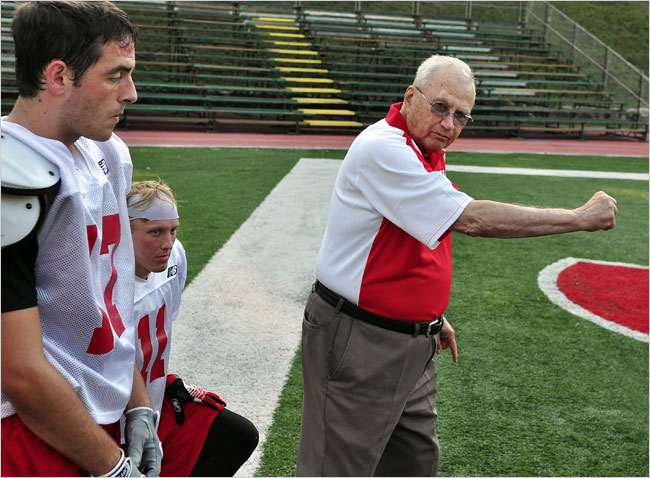
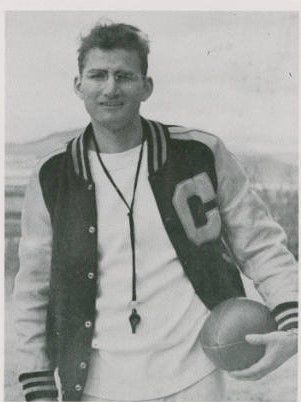
Even if you’re a football fan, or a college football fan, there’s a good chance you’ve never heard of John Gagliardi (unless you’re from Minnesota, or were was as crazy about college football as a kid in the 90s as I was). Gagliardi coached D-III St. John’s University in Collegeville (LOL), Minnesota. He won 489 games, the most wins in college football history, at any level. He won those 489 games over a career that spanned an unfathomable SIXTY FIVE seasons – from 1949 until 2012. He coached the Johnnie’s for most of that time, beginning there in 1953, until his retirement.

Gagliardi circa 1953

Gagliardi died this week at the age of 91. I heard the news and noted it was sad, and moved on. Other than a mid-90s ESPN Gameday story about Gaglliardi that stuck in my brain for some reason, I didn’t know much about him other than his wins record. But Deadspin’s Drew Magary wrote a nice tribute that I’m glad I read. Funny enough, Magary learned of Gagliardi the same way I did – through that Gameday piece. But I learned a lot about Gagliardi in Magary’s story, and boy does Gagliardi seem like my kind of coach:

Gagliardi famously had no playbook. He never used a whistle. He never recruited. He insisted on being called “John” instead of coach. He banned tackling from practice (the next time a Gruden or a Harbaugh bitches about being hamstrung by practice restrictions, point them to Gagliardi’s record). He held no meetings. Team stretches were strictly a parody of OTHER team’s stretching routines, with players doing the “Head Shoulders Knees & Toes” dance instead of barking out calf stretches at one another. Every senior on the team was named captain. He famously kept a running list of Nos to adhere to, one of which—No Slogans—I would like printed out and stapled to Mike Lombardi’s ******* head.

Oh, and he never yelled. That’s the thing that threw me when I first saw that Cyphers report. Cyphers asked Gagliardi about yelling at players and Gagliardi responded, “No no no, that’s insanity.” When I was growing up, all of my coaches yelled. It didn’t even occur to me that they might NOT yell. Yelling was coaching, as far as I was concerned. And yet here was one of the most decorated men in the sport, laughing at its uselessness. Calling it outright crazy. It took me a very long time to understand just how right he was about that.

If you coach, strive to be a coach like “John”. I know I will. -TOB

Source: John Gagliardi Was the Only Good Coach“, Drew Magary, Deadspin (10/11/2018)


Gary Livingston: Baseball Memories (On the Force or the Tag submission)

Earlier this week I found an email from my Uncle Gary. In it he shared his baseball memories, and I think this is a really great way to extend the On the Force or the Tag series. Please feel free to send us your baseball stories and pictures, and I’ll be sure so add it to the page. – PAL

Email: 123sportslist@gmail.com Twitter: @123sportsdigest

Gary Livingston in the vintage jersey. 

Blogger and nephew, Phil, has inspired me to recollect my youth and past baseball memories. Unlike Phil, I was marginally talented. Like Phil, I loved the game and I knew the game.

My first memories of playing catch are with my mom. I later learned she was a small-town farm girl legend as the tomboy who could play ball. In her day she played kitten ball. I still have the kitten ball she gave me. She had a great arm and I never had to worry about throwing too hard to her. Phil captures the essence of who has the game in their blood, when he writes that when the simple game of catch is enough to entertain for hours—you know they love the game.

I grew up in a working class neighborhood in which moms stayed home and kids played outside until supper. We had a group of 3 “big” kids who dictated our play. They were four years older and wiser. I was among the 6-10 little kids. The big kids decided the sport—baseball, football—how—waffle ball, left-handed—where—street, yard, sandlot. They decided rainy day activities—chess, trivia, and the king of indoor games of our youth—Little Baseball.

Little Baseball consisted of each player picking a major league team. We had little plastic baseball players from cereal boxes as players and found the bakery sold plastic players to be used as cake decorations. We each painted and named our players from the MLB team. I remember the detail and pride we took in painting our players: the black and gold of the Pirates, the number on their back to the color of their skin.

We made a game board from a 4’x4’ sheet of plywood or sheetrock. The players took the field and guarded circles with hits labeled in each. We pitched the ball/marble by rolling down a ramp and the hitter would strike with a wooden dowel bat. We kept score, statistics, played a whole season, which included an All-Star game and World Series. Each year was a new season and brought more sophistication to game. Dave, a big kid with creative talent, helped turn our boards into works of art including lights, spectator bleachers, and scoreboards. The Big kids were their league of choice—usually American—and we little kids would be the National. I still have my Cardinals Curt Flood and Vada Pinson and Pirate- Roberta Clemente as I painted them 50+ years ago. Remarkably, our favorite players would perform the best in our board game. We could hole up for hours playing in the basement and at night compile batting averages and ERA’s.

Click here to read the rest of Livingston’s baseball life.


Video(s) of the Week: 


Tweet of the Week: 

https://twitter.com/maxwellpearce/status/1049811500679004160/video/1


PAL Song of the Week: Todd Snider – “Waco Moo”


Like what you’ve read? Let us know by following this blog (on the right side, up near the top), or:

Email: 123sportslist@gmail.com

Twitter: @123sportsdigest

Facebook

Instagram: @123__sports


Right. And, and to cover my nervousness I started eating an apple, because I think if they hear you chewing on the other end of the phone, it makes you sound casual.

-Georgie Boy Costanza

Week of October 5, 2018


What if the Steroid Era Wasn’t Really Caused by Steroid Use?

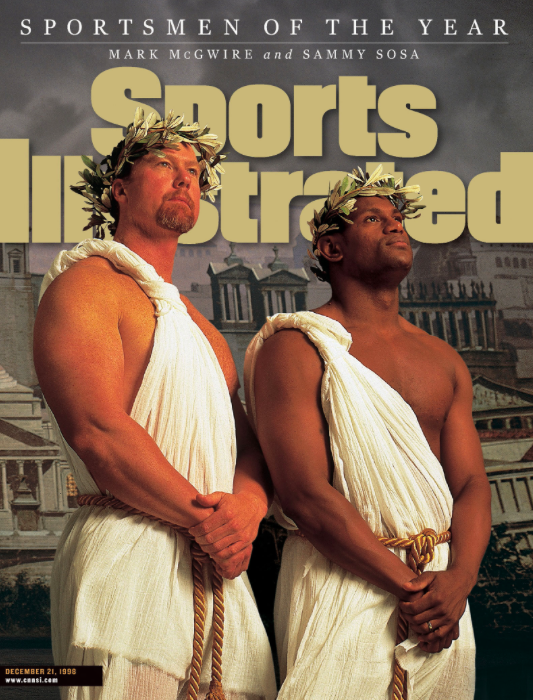
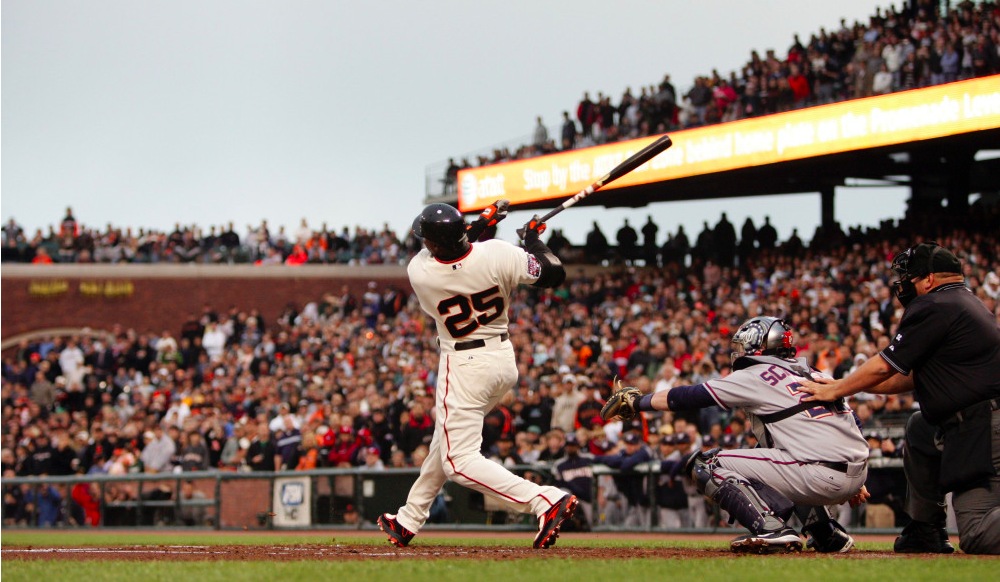
So goes this convincing article from The Ringer’s Ben Lindbergh, who argues (1) the Steroid Era, and specifically the 1998 home run chase between Mark McGwire and Sammy Sosa, is over-credited with bringing fans back to baseball after the 1994 strike; (2) steroids are over-credited for the Steroid Era boom.

First, he attacks the “fans returned to baseball theory” and disposes of it with some simple numbers:

Per-game attendance recovered much more in 1996 (+6.5 percent) and 1997 (+4.5 percent) than in 1998 (+2.9 percent). In 1999, with the memory of a thrilling record chase fresh in fans’ minds, it barely budged (+0.3 percent). Per-game attendance actually dropped (as did the economy, which might have more to do with attendance) in 2001, and again in 2002 and 2003. Not until 2006—well into the testing era—did MLB bounce all the way back to its 1994 attendance pace (which probably would have tailed off had the ’94 schedule been completed).

Well, huh. Certainly, attendance isn’t the only measure of fan interest. But that is still pretty compelling, because fans show the most intense interest by spending their time and money going to games.

Next, Lindbergh looks into how much we really know about how steroids even caused the 1990s offensive boom. First, he notes that it wasn’t only hitters taking steroids:

[Nate Silver, now of FiveThirtyEight] also noted [in his 2006 essay, “Baseball Between the Numbers”] that 36 of the 76 pro players suspended for PEDs in 2005—the first year that MLB players were subject to suspensions, and also the year that minor league violators’ names were publicly disclosed—were pitchers, and he tentatively concluded that among hitters, “the average performance improvement from steroid use is detectable but small.”

So what other factors could have caused the offensive surge?

In [] 2012…Jay Jaffe investigated several forces that could have caused or contributed to the so-called steroid era’s home run rates, including the ball, and wrapped up his inquiry by writing, “To suggest that the numbers of the era have been entirely distorted by the use of steroids would appear to be a stretch given the number of other factors in play.”

So why did the Steroid Era become known as the Steroid Era? Simply, steroid use was easy to see and thus easy to blame:

The standard sabermetric line may have hewed to the scientific method, but reserving judgment and downplaying the link between PEDs and dingers was an impossible sell to most fans. Everyone who was watching baseball in the ’90s saw some sluggers get bigger; everyone saw some of those same sluggers post unprecedented stats; and everyone read the revelations about what they were ingesting (or injecting). The availability heuristic did the rest: Steroids were the most scandalous and memorable hallmark of the era, and thus they were held responsible for the sky-high home run rate.

In fact, the current offensive boom is even stronger than 1998:

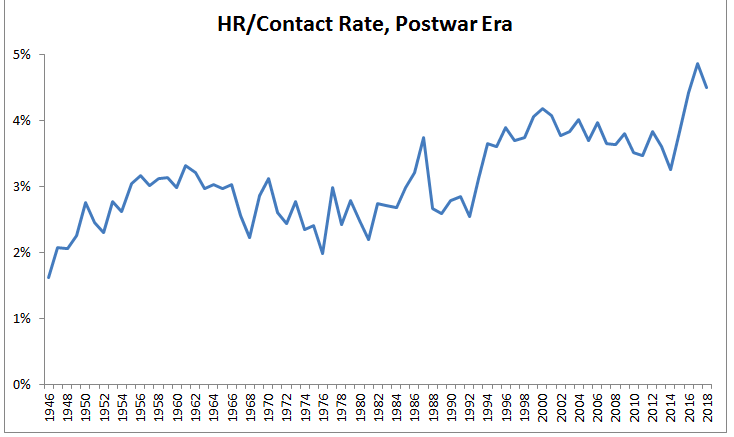
But recent events should reframe the narrative. In the past three seasons, MLB’s home run rate—expressed as the percentage of balls in play that turn into home runs—has dwarfed its previous peak, which it reached in 2000. Even with home runs on contact down slightly from last season, the 2018 home run rate is about 8 percent higher than it was at any point during the steroid era, and 20 percent higher than it was in 1998.


As we’ve discussed on this blog before, home run rates have also skyrocketed the last few seasons, and scientific testing has fairly strongly confirmed that the ball was changed at the 2015 All Star Break. As Lindbergh argues:

Using camera- and radar-derived Statcast data that didn’t exist in all ballparks until 2015, researchers determined that the new balls were flying farther because of decreased drag, although they couldn’t establish with certainty which physical properties of the ball were reducing the drag.

In other words, we know now that a subtle change in the ball is sufficient to explain an even more dramatic rise in home run rate than we witnessed in the ’90s. That doesn’t prove that steroids played no significant role in the previous spike, but it does demonstrate that steroids aren’t necessary to explain the earlier increase. It really could have been the ball.

I find this fascinating. Lindbergh next turns to Eric Walker, one of the people responsible for the Oakland A’s’ late-90s sabermetric revolution. Walker argues that arguing the 1990s boom was due to steroids doesn’t even make sense because, as in the recent boom, the numbers surged practically overnight:

[A] steroid-related explanation for the sudden, dramatic increase in offense of the sort that occurred in ’93 and ’94 would have required a combination of extremely widespread, simultaneous PED adoption and drugs that were capable of producing a probably-implausible per-player improvement. “The crux, the evidence that seems blindingly obvious but which so many people just gloss over like a police inspector in a Sherlock Holmes story, is the suddenness of the change: a large step jump from one stable, self-consistent era to another such over a single season,” Walker says. “There is no other possible explanation than a change in the baseball.” It’s certainly suggestive that the seasons with the largest year-over-year increases in home run rate on contact are, in order, 1977 (when MLB changed ball manufacturers, from Spalding to Rawlings); 1969 (when the mound was lowered and the strike zone shrunk); 2016 (the first full season with the reduced-drag ball); and 1993, followed by 2015 (the season in which the reduced-drag ball made its first appearance).

However, Lindbergh does acknowledge steroids do appear to have contributed to older players remaining productive longer.

Also, today we see fewer extreme outliers at the top:

Compared to the steroid era, today’s home runs are much more evenly distributed. Everyone is hitting more homers, but elite home run hitters haven’t made the greatest gains. Instead, more and more hitters are putting up mid-tier totals, and no one is getting to 60, let alone 70 (or this year, perhaps, even 50).

As Silver wrote in 2006, “There may have been a few players for whom steroids represent a ‘tipping point,’ allowing a relatively minor gain in muscle strength, bat speed, or recovery time to translate into a dramatically improved performance.” Regardless, it’s reductive and likely misleading to say that steroids saved baseball. And if we blame PEDs for retroactively ruining an era, we’re probably giving them too much credit for making it fun in the first place.

This was a great article. Five stars. -TOB

Source: How Much of a Role Did Steroids Play in the Steroid Era?”, Ben Lindbergh, The Ringer (09/28/2018)

PAL: Excellent read. Classic case that more than one idea can be true. Here’s the the most logical line from the story:

We’ll never have the data to determine precisely how the ball behaved two decades ago, or who was taking what, when. We can say, though, that every other home run spike of the magnitude of the one that preceded the 1998 home run race was accompanied by a change in the ball or the mound and strike zone.


Hometown Hero – Assessing Joe Mauer’s Twins Career

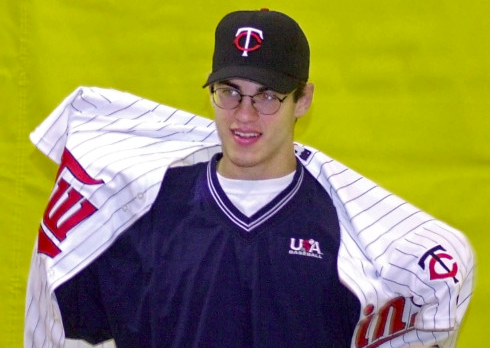
Joe Mauer very likely played his last game as a Minnesota Twin this past week. For those of you who don’t know, Mauer is the living embodiment of the childhood dream: he grew up in St. Paul, he was a three-sport star in high school (Gatorade national football player of the year and a Florida State commit), he was drafted number one overall by his hometown Minnesota Twins, and actually lived up to the hype. 6x All-Star, 3x Gold Glove Winner, American League MVP, and – oh, by the way – the only catcher in MLB history to win 3 batting titles (and the only American League catcher ever to win a batting title). Add to all of this, he is by all accounts a model citizen.

I know many of you will laugh at this, but Joe Mauer has more than a little in common with LeBron James (I KNOW, LeBron won a title).

Number 7 will be retired in Minnesota, but ask anyone from from Minnesota and they’ll tell you that Mauer, and his $184MM contract has long been a contentious topic in my home state.

In 2009, Mauer had one of the greatest offensive seasons ever by a catcher: .365, 28 HR, 30 doubles, .444 OBP, 96 RBI. Oh, and he also won a Gold Glove. At that point in time, Mauer was the biggest free agent available. A sure-fire Hall of Fame catcher in his mid-late twenties who had just won his third batting title. If Mauer goes to New York with the short porch in right or Fenway to bounce opposite field flies off the monster, god knows where his career ends up.

Instead, Mauer signed an eight year, $184MM contract with his hometown team. The Twins move into a new stadium with “Baby Jesus” leading all the disciples, and, as SI’s Gabriel Baumgaertner details,  Mauer’s career returns to earth. He never hits more than 11 home runs again, and following a concussion in August 2013, Mauer is never the same hitter for average he was prior to that.

Half of the fans remains loyal to Baby Jesus (including my mom), while the other half felt like he was earning too much dough for the the team to be that bad, for him to get mysterious injuries (bilateral leg weakness), and for him to be a singles hitter.

Mauer brings out the worst in us.

“In Minnesota, we’re hardworking people and don’t like it if you’re being paid and you’re not out there performing,” says former baseball writer Andy Rennecke. Let’s pause to appreciate how stupid this cliche is. You know where else hardworking people live, Andy? Literally everywhere else!

Other critics like to point to that contract as the reason the Twins have had such little success since Mauer signed it. This, of course, is ludicrous. 26 players made over 22MM this year. Aaron Gleeman, Editor-in-Chief of Baseball Prospectus, had this to say:

I think this is true of all sports and all fans in that they will very often side with the billionaires over the millionaires. In Minnesota every dollar is treated as not another player, perception that $23 million has kept them from signing others when the team has not filled their payroll base. The family that owns the Twins are multi-billionaires who own huge businesses around Minnesota. I don’t want them to go nuts, I just want them to spend 51% of their revenue. They don’t do that.

Mauer is an unequivocal success – a story too perfect for even the movies. And yet, he made it hard to fully embrace him as our hero. You gotta win something. You gotta at least make a run, and the Twins simply didn’t, even when Mauer was at his best. The Twins went an astonishing 0-10 in playoff games over Mauer’s tenure (he wasn’t on the 2004 playoff roster), and Mauer had a single playoff RBI.

This a really good read about a hometown hero written from a national writer’s perspective. I think that space and perspective is needed when we’re assessing one of our own. Solid read about a guy we should celebrate, even when his teams didn’t give us much to cheer. – PAL

Source:The $23 Million Question: Why Do Some Twins Fans Despise Hometown Hero Joe Mauer?”, Gabriel Baumgaertner, SI.com (9/25/18)

TOB: Yeesh. 0-10!? I had no idea. I’d love to give Joe Mauer some truth serum and ask him if he regrets re-signing with the Twins. As you note, he would have hit a lot of dingers in New York, and they wanted him. I’m sure he felt a lot of pressure to stay. And maybe he would have felt more pressure in NY. But it’s kind of a Sliding Doors moment; or like Jim Belushi’s character in Mr. Destiny: how is Mauer’s life different if he leaves the Twins in 2009? How is baseball history different? How is Phil’s life different? How is my life different? Consider. The following season, the Yankees lost the ALCS in six games to the Rangers. In that series, Yankees’ catcher Jorge Posada, at the tail end of his career, went 5 for 19 with no homers and 1 RBI. What if that’s peak Mauer instead? Does the series change? Do the Giants beat the Yankees? Who knows. So, thanks Joe, for being loyal to your hometown.

On a tangent, I went to check out the list of Gatorade National Players of the Year for football. It’s a fascinating list, filled with not just NFL busts but college busts. Over the last fifteen years, guys like Tate Martell, Jacob Eason, Justin Worley, Andrew Brown, Max Browne, Garrett Gilbert, Mitch Mustain, Kyle Wright, Brock Berlin, Chris Lewis, Jeff Byers. All were or are barely passable as college starters. Some never even started consistently, if at all. Some are absolute no names. Some ring vague bells in my brain, and I follow college football. Some were complete busts. Maybe they need someone new in charge of selecting the winner for that award (the guys in the 80s and 90s was killing it: Jeff George, Emmitt Smith, Robert Smith, Peyton Manning, for example). This says nothing of my opinion of Mauer, just something I found interesting.


Burn High-Level Amateur Basketball to the Ground and Start Over

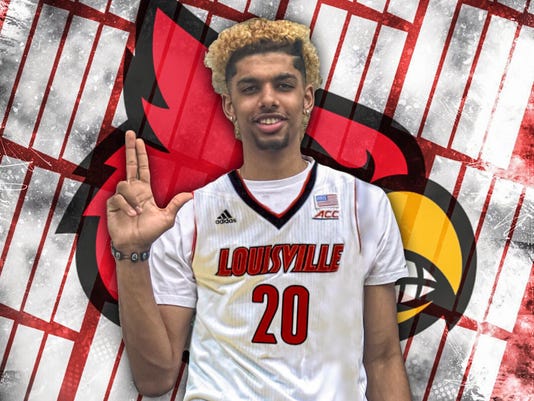
This week saw the beginning of the trial of agent Christian Dawkins, Adidas executive James Gatto, and former Adidas operative Merl Code. The three are accused of committing felony wire fraud as part of the FBI’s larger investigation into corruption in basketball recruiting. On Thursday, Brian Bowen Sr. testified. You may recall us writing about Brian Bowen, Jr. about a year ago when he was ruled ineligible after reportedly receiving $100,000 to commit to play basketball at Louisville.

His father’s testimony was…eventful:

According to Bowen Sr., Dawkins told him that Arizona assistant coach Joe Pasternack offered $50,000; Oklahoma State assistant coach Lamont Evans offered $150,000 cash, $8,000 for a car and additional money to buy a house; Texas assistant coach Mike Morrell offered to “help me with housing”; and Creighton assistant coach Preston Murphy offered $100,000 and a “good job, a lucrative job.”

Earlier in the week there was testimony that Washington paid current 76er Markelle Fultz, and that Utah paid current Laker Kyle Kuzma. I thought this stuff was going on, but Creighton? Utah? This is all crazy. As Deadspin’s Chris Thompson points out:

The numbers are illuminating. They’re impressive if imagined as a layer of banded stacks of crisp bills inside a briefcase, but in exchange for a year of work from a highly skilled and widely recruited worker whose services will soon be worth tens of millions of dollars in guaranteed money, they’re not much!

Which is what makes this trial kind of ridiculous. Amateur basketball needs to start over. Players should be paid so that these under the table deals don’t occur. Perhaps the craziest thing  it’s not just at the college level either:

Bowen Sr. told the jury that he received $2,000 per month from Shane Heirman for Bowen II to attend La Lumiere School in LaPorte, Indiana. Heirman was the head coach of La Lumiere at the time, and is now an assistant coach at DePaul.

Bowen II began his high school career playing for Dawkins’ Dorian’s Pride AAU program, but moved to the Michigan Mustangs on the Adidas circuit after Adidas program director T.J. Gassnola offered Bowen Sr. $25,000 for his son to play for the Mustangs.

AAU teams playing players is obvious. But high schools are paying for players, too? Yeah, I don’t know how you fix that one.

Source: “Brian Bowen’s Dad Describes Black Market Payments For Top Recruits At Every Level Of “Amateur” Basketball”, Chris Thompson, Deadspin (10/04/2018)

PAL: I hate the idea of paying college players, but I don’t see another solution with the athletic companies so entwined in the sport. But does paying them in college stop the jockeying for position in high school and the AAU circuit? Do we let children sign shoe deals? If he decides to go to college, can he then be contractually obligated to only go to a school that has a deal with his shoe maker? At that point, to what degree would the shoe companies essentially running college programs? How much are they already running college programs right now?

TOB: They already are. At least this would be out in the open. I think allowing players to sign endorsement deals is the easiest fix. In every other sport, this isn’t a problem: golf. skiing. tennis. They all sign sponsorships in order to afford equipment, travel, cost of living. It keeps the colleges out of it, solves a lot of the headaches colleges claim, and keeps things above board.


Video of the Week: 


PAL Song of the Week – Mogwai – ‘Helicon 1’


Like what you’ve read? Let us know by following this blog (on the right side, up near the top), or:

Email: 123sportslist@gmail.com
Twitter: @123sportsdigest

Facebook

Instagram: @123__sports


And I knew exactly what to do. But in a much more real sense, I had no idea what to do.

-Michael Scott

Week of September 28, 2018

Watch out for the A’s in October, folks. Do us all a favor and take the Yankees out, boys.


Da Birth of Da Bears 

How about a light, fun sports story this week, eh? It’s one of the most iconic Saturday Night Live sketches of all-time – “Bill Swerski’s Super Fans”:

Of course it was hilarious, and of course it gave us some vintage Farley moments, but the recurring sketch represented more than a couple laughs. In this enjoyable deep dive, The Ringer’s Aln Siegel goes beyond the heart attacks and gets the origin story of Robert Smigel’s brainchild that took over the nation.

Little did Smigel know that he’d created an archetype. His now 30-year-old characters remain the only-slightly-exaggerated embodiment of America’s obsession with sports. Every depiction of a comically devoted fan over the past three decades owes a debt to Smigel’s portly, mustached diehards.

The inspiration for sketch came not at a Bears game, but at a Cubs game.

It was a surreal Chicago moment, one of many Smigel has experienced since his first game at Wrigley back in the early ’80s. That afternoon, when he heard people in the bleachers shouting, “Left field sucks!” and “Right field sucks” at each other, and watched home run balls being thrown back onto the field, he was smitten. “In Chicago, the best seats in the house are the shitty seats,” he said. It’s a lesson that served him well when he created the Super Fans. The irrationally positive, thick-accented men squeezed into Bears jerseys were funny enough to transcend provincialism. After all, every city has a version of those guys.

As with most any great cultural moment, a bunch of seemingly insignificant and unrelated factors coalesced. Chicago teams were having a moment in the 80s (Cubs, Bears, White Sox to a lesser extent) and that was followed with the Bulls run in the 90s. A writer’s strike in ‘88 gave Smigel and fellow SNL writer Bob Odenkirk some time to try some wackier stuff at a stage revue over the summer (Conan O’Brien’s “In The Year 2000” bit came from this same revue). Lastly, the idea of sport reporters sitting around talking about sports as a TV show was just taking off.

There’s so much more in this story, and it’s a treat to read. Loved it! – PAL

Source: Da Story of Da Bears: How an ‘SNL’ Sketch Defined Sports Fandom”, Alan Siegel, The Ringer (9/27/18)

TOB: Loved this! Nice find, PAL.


Another Way to Consider Tiger’s Comeback

Some of you might be aware that TOB and I made a friendly bet before the Masters this year. I said Tiger would win at least one major before next year’s final major – the British Open (the PGA is moving to April next year). Without Tiger, I might watch the back nine of the US Open and the Masters; with him (and our bet), I’ve been locked in. He makes golf matter to the general public. No one moves the needle in his or her sport like Woods.

He’s obviously played much better this year. I thought I was going to win the bet at the British Open and Brooks Koepka was a beast holding him off at the PGA Championship, too. So I wasn’t surprised that he won this past week, but I should be very surprised. Four back surgeries. Four knee surgeries. Setting aside the rehab and personal issues, I have no friggin’ idea how someone swings a golf club like this after repeated back and knee surgeries:

As Josh Planos writes on fivethirtyeight, there’s a different way of contextualizing Woods’ turnaround: strokes gained. As Planos describes it, strokes gained is “a metric that measures each shot a player takes based on how much it reduces his expected score on a hole relative to the field average.”

In other words, I CANNOT wait to be at Pebble Beach next year (1-2-3 Already got the tickets!) to watch Tiger win the U.S. Open amongst a sea of people going bananas, turning to TOB, and simply holding out my hand. – PAL

Source: How Tiger Woods Finally Put It All Together Again”, Josh Planos, fivethirtyeight (9/24/18)

TOB: When Phil asked me for this bet last December, I felt extremely good about it. I gave him 20-1 odds, but only let him bet $5. I figured it was an easy beer he could buy me. But over the last seven months, I am feeling far less confident. Now, I’d probably go no higher than 5-1.

Hell, at the PGA Championship last month, I was half rooting for Tiger on Sunday, as Phil was whoopin’ it up next to me. This was not a very rational thing for me to do, considering it would have cost me $100. Such is Tiger.


The Truth Behind Nike’s Kaepernick Campaign

As I said a few weeks ago, Nike’s Kaepernick campaign, while powerful and I believe Good (capital G), was also a business decision by a billion dollar corporation. This week, some of the details behind how this ad came to be, and, unsurprisingly, I should have been even more cynical than I was.

The ad is powerful, and Nike drew wide praise (and criticism) for it. But as the New York Times reports, it almost didn’t happen.

In the summer of 2017, a debate raged in Nike’s headquarters in Beaverton, Ore., over whether to cut loose the controversial, unemployed quarterback — and the company very nearly did.”

Ultimately Nike decided the ad would gain “credibility the company would gain with the young, urban market it has long targeted,” and thus “made good business sense despite the risk of angering the N.F.L.”

Worse yet, the decision to actually run the Kaepernick campaign, more than a year after he last played a snap in the NFL, came only after Kaepernick’s lawyers argued that Nike’s decision to “keep him within its stable of sponsored athletes without using him” left Nike in violation of its contractual obligations.

The play seems to have worked. Nike’s stock closed last week at an all-time high of $85. -TOB

Source: “Nike Nearly Dropped Colin Kaepernick Before Embracing Him”, Julie Creswell, Kevin Draper and Sapna Maheshwari, New York Times (09/26/2018)


Video of the Week:


PAL Song of the Week: Khruangbin – “Lady and Man”


Like what you’ve read? Let us know by following this blog (on the right side, up near the top), or:

Email: 123sportslist@gmail.com

Twitter: @123sportsdigest

Facebook

Instagram: @123__sports


Alright. Jim, to be fair, the conversation wasn’t about planets. At first we were talking about introducing a line of toilet paper. And what part of the human body does one use toilet paper upon? So you draw a line from there to the other planets… and I think by the end we learned a little bit about how small we are.

-M. Gary Scott

Week of September 21, 2018

Who’s ready for the weekend?


Thank God for Golf Digest

Max Adler had been writing a human interest column for Golf Digest titled “Golf Saved My Life”, when he received a letter from Attica Correctional Facility. It was from Valentino Dixon. Since 1991, he’d been serving a murder sentence.

To pass the time, Dixon borrowed issues of Golf Digest from a cellmate and use the images of golf courses as references for his artwork. Dixon had never played golf in his life. After a long time of drawing the holes he saw in the magazine, Dixon began reading Adler’s column, and decided to share his version of the “Golf Saved My Life” prompt. Here’s an excerpt, but please do yourself a favor and read the entire letter here.

I’ve never hit a golf ball. I’ve never set foot on a golf course. Everything I draw is from inside a 6-by-10 prison cell. The first course I ever drew was for warden James Conway. He would often stop by my cell to ask how my appeal was going and to see my drawings. Before he retired, the warden brought me a photograph of the 12th hole at Augusta National and asked if I could draw it for him.

I spent 15 hours on it. The warden loved it, and it was gratifying to know my art would hang in his house. Something about the grass and sky was rejuvenating. I’d been getting bored with drawing animals and people and whatever I’d get out of National Geographic. After 19 years in Attica (N.Y.) Correctional Facility, the look of a golf hole spoke to me. It seemed peaceful. I imagine playing it would be a lot like fishing.

Of course, Adler read the submission. And, as an Art major, he also appreciated Dixon’s work. Eventually, he would hear Dixon out. Dixon told him he was innocent (like everyone else), but Dixon was telling the truth.

After spending twenty-seven years in prison for a murder another person confessed to, Dixon finally walked out this week, thanks in large part to a Golf Digest story.

Many folks were instrumental in getting Dixon out, but it’s pretty incredible to think that a submission to Golf Digest got the wheels turning. As Adler tells it, despite the evidence, it takes a tremendous amount of work from a lot of inspired people to get an innocent man out of prison.

It was kind of five years of an abyss. Just, like, nothing happened. I was probably naive [thinking the] presentation of his case would get him out of jail. It just seemed so obvious to me. But of course it didn’t. It required so much.

What I realized yesterday in Buffalo [where the court released Dixon] was that it was such a cumulation of so many different people. Myself. Golf Digest. Golf Channel, who then picked it up. All the other media that then covered his story. The students from Georgetown University Prison Reform Project. Valentino’s attorneys, Donald Thompson and Alan Rosenthal.

It took so much for the bough to finally break. After five years, I kind of gave up hope.

This is the best and worst kind of story. It’s the best when when coincidence leads to what seemed like an impossible conclusion. It’s the worst because I guy who didn’t commit the crime sat in a prison for over a quarter century. – PAL

Source: How Golf Digest Started A Movement To Free A Man Wrongfully Convicted Of Murder”, Dan McQuade, Deadspin (09/19/2018)


Real Story or SNL: Red Sox Fans

I love this. I love this story so much. Oh, these two idiots. I can’t even. The hair, the accents, the star tattoo on the elbow. This is so rich.

As Deadspin’s Samer Kalef calls out, the best from the video is:

“We wanna give it back to them because it belongs to them, and it doesn’t belong to us,” Iacuzzi said. “But in reciprocation, we would like, you know, to maybe go to a nice playoff game or—we’re looking for something. We don’t want to just hand it over to them. We need to negotiate here.”

What’s more, these two choir boys are now accused of stealing the banner, which they deny. Also, we’re talking about a 2018 divisional banner. This isn’t Ted William’s cryogenically frozen melon, you know what I’m saying? Funniest story I’ve read this year. – PAL

Source: These Massholes Found The Missing Red Sox Division Banner, And They’re Willing To Negotiate“, Samer Kalef, Deadspin (09/20/2018)

TOB: LOLOLOLOLOLOLOL. The ol’ “it fell off a truck” defense. But my favorite part is their threat to show up to Fenway when the duplicate banner is unveiled as if everyone will be shocked when they reveal the real banner. Also:

A top notch internet comment.


Stephen Jackson: Old, Not a Bum; Andrew Wiggins: Young, No Heart

This week, Jimmy Butler, who is awesome and good, asked to be traded from the cold hellscape that is Minnesota (kiddin, y’all!). In an apparent response, the older brother of Jimmy’s teammate Andrew Wiggins, who seems like he should be awesome and good but you can watch an entire Wolves game and barely notice him, said “Hallelujah!” on social media. The obvious interpretation is that Jimmy and Andrew don’t like each other, but the deeper analysis is that they don’t like each other because Jimmy plays hard as hell and Wiggins is soft as Charmin.

It would have probably ended there, but Stephen Jackson weighed in on Wiggins’ brother’s tweet with the following video (note: Captain Jack sadly pulled his videos from his Instagram. Someone did save them and upload them to YouTube, so stop the first video here at 1:07 so as not to spoil the second:

Jackson is funny as hell and I’ve always been a big fan, so I choose not to ask why he is involving himself in this. Instead, I choose to appreciate the beef it has created. In response, Wiggins posted the following on social media (having previously deleted a nearly identical post in order to be clear he was responding to Jackson):

Captain Jack is Captain Jack, though, and he could not let that stand. While conceding he is 40 and thus old, he could not allow Wiggins to call him a “bum ass”, and took some more shots at Wiggins in the process (skip to 1:07):

What’s weird here, other than Jackson inserting himself into this is the first place, is Wiggins’ complete lack of self-awareness. The man is a former #1 overall pick and is as talented as players come, and yet he is a classic good stats/bad team guy who plays zero defense. Jackson played fifteen years in the NBA, won a title as a key player, was once declared by Tim Duncan to be Duncan’s best teammate ever, spurred the We Believe Warriors of 2007, and was heavily involved in one of the most infamous moments in NBA history (the Malice at the Palace). Who’s the bum ass, Wiggins? -TOB

Source: Timberwolves Drama Turns Into Spicy Internet Beef Somehow Featuring Stephen Jackson”, Chris Thompson, Deadspin (09/19/2018)

PAL: It’s not a good look for ex-players to be inserting themselves into these middle-school, social media ‘beefs’. That said, I do like Jackson’s instruction to Wiggins the next time they cross paths: “Keep your hands straight.” That’s a cool line.


You’re Going to Pay Me How Much to Do What?

The Clippers made an interesting move recently, hiring Lee Jenkins from Sport Illustrated to be the team’s “executive director of research and identity”…wait, is there an episode on Silicon Valley playing the background? Director of research and identity? Huh?

Jenkins, as many of you know, is famous for his athlete feature writer at SI. He’s best known for his NBA profiles of LeBron James, Kevin Durant, Kobe Bryant. Players and their people trust Jenkins to tell their story, and the Clippers see value in Jenkins’ talent even if he’s unclear what the the hell he’s supposed to do.

“Let’s all acknowledge the fact of how incredibly talented he is and his ability to tell stories, connect the dots, highlight the personalities of our players, and what it is going to highlight about the Clipper experience,” Frank said.

Jenkins will report to Frank and Michael Winger, the general manager, and will not have any employees under his purview but will be assisted by the entire front office.

“My hope is that I learn a lot early on especially fast, and I figure out where I can help and where I fit in,” Jenkins said.

There’s also the point that his most recent employer, SI, has been taking on water for quite some time.

Jenkins’s departure comes as Sports Illustrated faces stiff financial setbacks. It has had several rounds of layoffs, and reduced the frequency of its publication to 27 issues a year, from a high of 51 as recently as 2015. Its parent company, Time Inc., was acquired by the Meredith Corporation last year, and Sports Illustrated has been on the auction block for the better part of 2018. Time magazine was bought for $190 million over the weekend, and Sports Illustrated could have a new owner in a matter of days.

Jenkins is well known enough to get paid a good chunk of money to write for any number of sites (I wonder if The Athletic made a run at him), so I’d be surprised if SI’s situation was a deciding factor in this. My bet is he wanted to try something different for a year. As Draper points out, 2019 free agency is going to be loaded, and the Clippers have space to sign two superstars. My guess is Jenkins wants to see it from the inside and write a book from inside the war room.  – PAL

Source: The Los Angeles Clippers Signed a Big Star. From Sports Illustrated.”, Kevin Draper, The New York Times (9/18/18)

TOB: That’s a really good point at the end, and I hadn’t considered it. The entire time reading this I was thinking it was a pure money grab by Jenkins. A journalist going in-house makes him just a PR guy, ya know? But if he’s allowed to write a book about this on the back-end, I can see how this makes sense for him.


Video(s) of the Week: 


PAL Song of the Week: Florence + The Machine – “Hunger”


Like what you’ve read? Let us know by following this blog (on the right side, up near the top), or:

Email: 123sportslist@gmail.com
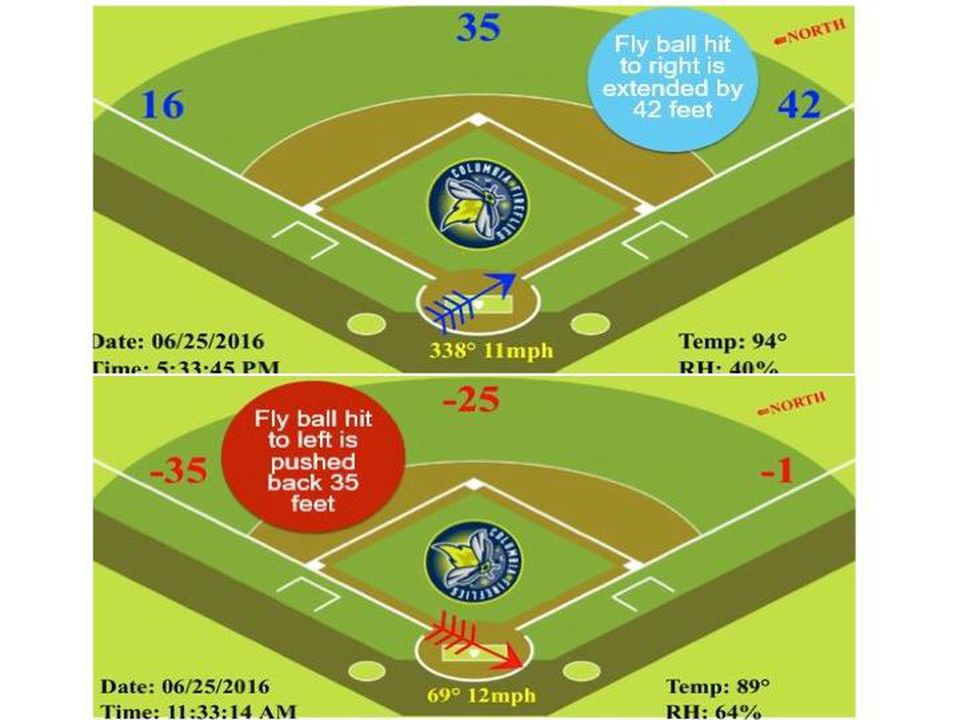
Twitter: @123sportsdigest

Facebook

Instagram: @123__sports


You know I always wanted to pretend I was an architect. 

-G. Costanza

On the Force or the Tag: Part V

On The Force or the Tag is a 5-part series recounting my season as a volunteer baseball coach in a city league to which I had no prior affiliation. Along the way, I’ll connect my coaching experiences this season to memories from the four best coaches I had growing up. Kent Anderson, Tony Lang (my brother), Jay Rabeni (my brother-in-law), and Jeff Holm continue to influence how I approach my day and my life. They represent the best-case scenario of youth sports, from Little League to college. This is my thank you to them.
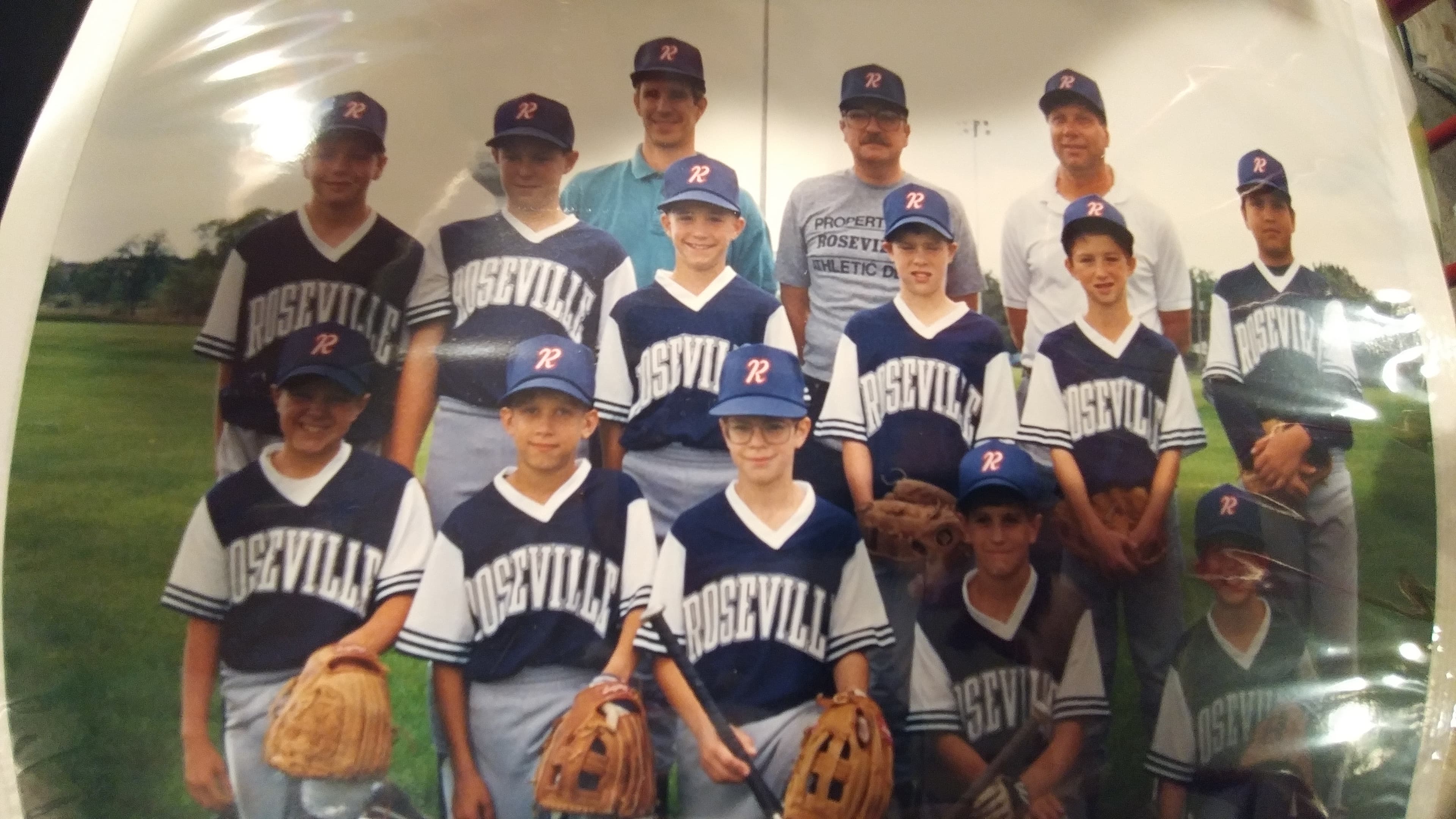
The names of the players, coaches, and family members from the team I coached have been changed. Read earlier sections:

The dugout in which the meeting with Calloway happened. 


Memory is Duct tape. It’ll hold together bits of truth well enough for us to get on with the day.  

The season ended abruptly. My fiance and I had scheduled a trip to Denver on what was to be the final weekend of games. It was not a good look for the coach to be absent, but the last weekend of games were cancelled anyway. They couldn’t find any umpires.  

Following the previous game – what become our last – I told the fellas how much I enjoyed coaching them. I encouraged them to call if they ever wanted me to throw batting practice or hit fungos. There were a few thank yous from parents and players in the parking lot, but no one was pretending the season was more than it was. In total, I coached eight games, one practice, and one batting practice session with Zack.

Regardless of the brevity of the season, these are my guys now. That’s how this coaching gig works. My wish for them is that they find a calling, they work very hard to master that calling, and they feel the buzz of success regularly. If they need me, I hope they know I’ll answer the call.

I enjoyed every player on the team – truly – and they seemed to like me enough, too. If fate would have it so, it would be a welcome surprise to bump into any of my guys in five or ten years and get an update on how things are going.

My account of this season and the relationships forged with these players is just that: one account. In truth, there is a high likelihood that at least one player on this team did not like me. Someone felt that I had picked favorites, and he wasn’t one of them, and that I didn’t know squat about baseball. I would bet these were the topics of conversation at that monument of adolescence – the car ride home from a game with a parent.

Some portion of that story occured. How can I be so sure? Everyone who has ever played a sport at any level has had at least one coach who didn’t mesh, whether the coach knew it or not. My coach was Chris Calloway.  

I framed this series as a thank you to the great coaches throughout my baseball life. What I haven’t mentioned is I’ve spent as much time thinking about Calloway (not his real name), as any other coach I ever had.

I end with Calloway because baseball’s ultimate lesson is failure.

***

The high school field at Roseville. They can keep leveling and re-edging that field until the end of time, but it will always be a crap field. In the background you can see the hill and Highway 36 where we’d have to shag foul balls.

Calloway played the part of a coach convincingly. While he was no tactician, he was pigeon-toed and sauntered across the infield like a coach. He’d yell odd phrases from the dugout – Get foul, you communist whore! –  that sounded gruff, coach-like, but he also tried to pass off obvious objectives of the game as wisdom – you gotta throw strikes, hit the ball hard. He’d chew leaf tobacco and work hopelessly on our p.o.s. high school field during the summer while his dog ran along the fence line. His aura dripped baseball coach, but it wasn’t the real thing.

To Calloway, my enthusiasm for the game was a book picked up, thumbed through, and never read. I was another player to him, and that did not work for me. I worked hard to be more than just another player, and every other coach prior to him had encouraged me. Calloway didn’t care how much I cared. I grew to hate him for that, flatout. I resolved to prove him wrong and extract his respect without ever knowing what evidence would be sufficient proof I’d succeeded.

The goal was a D-I college baseball scholarship. I’d mapped out a plan in detail. 200 swings a day on the tee in the basement. Long-toss three times a week throughout the year. Blocking drills, framing, working out in the gym. I quit hockey – in Minnesota! –  to focus on doing everything I could to reach this goal. These were not sacrifices; I enjoyed every bit of it. I was fifteen, and because high school baseball is played during the spring, that meant I would likely need a scholarship offer after the summer season (Legion ball) of my junior year. I had two years. Not much time.

I started out ahead of schedule. Calloway asked me to join the varsity tryouts during my freshman year. In exchange for catching bullpens, I was allowed to practice with the upperclassmen. There was no chance I was going to make the varsity roster as a freshman – I knew that – but with that time I was able to assess the catcher pecking order in the program up close.

Jack Rose was the senior left-handed cleanup hitter with a cannon arm. Quick hands and a big ass. Borderline all-state catcher. Rose was graduating, and he gave me rides to the tryouts in his wagon. He was not my concern. Nico Roll was my concern.

Roll was one year ahead of me. A three-sport athlete with all of the physical ability to be good-to-great in just about any sport. He was a running back, a winger, and a catcher. He could hit, he could throw, and he could run. These are the measurables that show in a tryout. Nico also thought about Wu-Tang Clan far more consistently than he thought about baseball. That was not something that showed in a tryout. If anything, a lack of interest can be easily misread as an ‘even-keel approach’ in the short time frame of a tryout.

The following year, my task was quite plain coming into tryouts. In order to stay on schedule for a D-I scholarship, I had to beat out Roll at catcher. I was more consistent defensively, a left-handed hitter, and cared about nothing but baseball. I’d been working at it every day since the gym tryouts the previous year.

Roll was a more powerful hitter, and I already mentioned the speed. His best was pretty damn good, but he rarely showed it. Catcher is a position that will make a mess out of a guy if his head isn’t in it. The catcher is the captain on the field, the only one that has the entire field in front of him. To put it in Kent Anderson terms – every ball’s coming to me, know what I’m going to do with it – the catcher needs to know what every player on the field is supposed to do in every situation. Simply too much happens all of the time for someone with an occasional interest in baseball to play the position.

It was hard to tell who had the edge, and I waited for Calloway’s announcement. I finally had to ask. We were walking out by the loading docks in the back of the gym. Roll was going to start. Calloway seemed unsure why he even had to say it out loud.

It was the first moment in my life in which I encountered another’s talent that outweighed my desire. All things weren’t equal. Hard work had not paid off on my expectation, and I’d lost to a guy that didn’t care. Worst of all, Roll was a junior, meaning I’d sit behind him for two years. By the time my senior year would come I would miss most any chance to get a scholarship. This was not the plan.

And then, without warning, Roll was caught dipping in class before the season opener. Mandatory two week suspension. There I was, starting a varsity game as a sophomore playing against Cretin at their legendary diamond in St. Paul. I hit the ball hard a couple times that game, and I remember a walk-off hit against Coon Rapids. After the Coon Rapids game Calloway referred to my hit as something along the lines of a ground ball with eyes.

Cretin-Derham Hall. High school field of Joe Mauer and Paul Molitor. 

I don’t remember much else from those two weeks other than being extremely happy and feeling like I was where I was supposed to be. I played well, I think, and it wasn’t crazy to hope that I’d continue catching after Roll’s suspension. Who knows if the stats would prove my memory correct or not. Memory is Duct tape.

Roll served his suspension and was back into the lineup shortly thereafter. I was the designated hitter for a couple games, and then I was on the bench taking my turn shagging foul balls along Highway 36. I hated shagging foul balls at that field. You had to walk behind parents and students to climb over the chainlink fence and search for a baseball in high grass along the highway as cars and semis blew by. Put on an orange vest, and it’d be difficult to distinguish a bench player from a minimum security prisoner doing highway cleanup.

I was certain Calloway had it out for me and was going out of his way to screw me. He was drawn to athletes over ballplayers. In Minnesota, that meant he liked the hockey players that also played baseball. I’d quit hockey to become a ballplayer.

He liked Roll. Calloway once brought Roll a Sport Illustrated article about the Pirates catcher Jason Kendall. The story is about the two sides of Kendall: the surfer bum and the hard-nosed, always dirty, win-at-any-cost ballplayer with a huge wad of tobacco poking out of his cheek. Roll had the laid back portion of Kendall down (and the tobacco*), but he wasn’t hard-nosed. He wasn’t a ballplayer.

Calloway was trying to inspire Roll. In retrospect, I understand Calloway trying to jumpstart a player, but you can’t coach a kid to care. Kent, my Little League coach, could tell that from a game of catch with a ten year old. Still, it hurt to see Calloway try with Roll and wonder why he wouldn’t try with me.

The easy answer would be that I didn’t need it. That I already had the drive. That, of course, is disingenuous bullshit. I was a teenager, not a monk. How about an ‘atta boy’ every now and again?

At one point, I even had a meeting with Calloway to try to figure out what I could do differently. In a moment I’ll always regret, I had my older brother, Matt, join us in the dugout. I cried. I was failing, and I didn’t know how handle it. That moment remains utterly embarrassing and emasculating.

***

In the end – what do you know – it worked out. It took me a long time before it sunk into my teenage brain that I couldn’t control Calloway. What I could do was keep up with the daily 200 swings off of the tee and keep taking one more step back on the long toss.

You win by outlasting them. You care more for longer, and eventually the people between you and what you want quit. It’s not always the cinematic moment, the walk-off hit. In many ways, success is attrition.

I don’t think Roll even finished his senior year of baseball. What’s more telling – I can’t remember.  

I didn’t get that D-I scholarship, but I got some money to play at Augustana College, a D-II school (2018 D-II National Champs!). We played damn good ball for Coach Holm, and the team rode buses across Iowa, Kansas, Missouri, Arkansas, Nebraska playing baseball in decaying minor league stadiums and through spring time snowstorms. We caravanned across the gray, wet belly of America on a diet of Euchre and orange peanut-butter crackers.

About to ride back from Greeley, Colorado with a NCC conference championship. Left to Right: Bergie, Wally, Kroeger, Schultzy, O-Dog, yours truly in the headphones, Walzy in the background with the looooooong cargo shorts, and Sammy’s chest far right. 

I was lucky to play a bunch all four years, to be captain two of those years, and to help win the first conference championship in the program’s history. My grandpa, my dad, my brothers got to see me play college baseball. Mom, too. She’d sit watch like a sentinel in that Sioux Falls wind galloping across the Dakota plains.  

I also spent my time sending writing samples to authors, drinking beers with teammates who would become lifelong friends, learning to play the guitar, and streaking across the quad. I read Tim O’Brien, John Fowles, and Steinbeck with a pen in hand and slipped terrible love letters into the shadows beneath dorm room doors.

After all those great times, why do I still think of those days with Calloway? Why do I still want to extract that goddamn, worthless respect out of him? Why does a part of me still need him to know I wasn’t a phony?

What bothered me as a teenager and what bothers me now are different points. As a kid, I wanted to play, to be great, and be recognized for it. As I saw it, Calloway wouldn’t allow that to happen, which of course isn’t entirely true. If I was an obvious D-I scholarship player, I would’ve taken Roll’s starting spot at some point.

As an adult, Calloway’s wasted opportunity bothers me as much as anything. He coached with no joy. It offends me that he held that Varsity Baseball Coach job for years, keeping it away from a coach who could’ve been to other players what Kent, Tony, Jay, and Holm were to me. It also bothers me at how quickly I panicked when Roll was given the starting gig. It took me too long to toughen up and deal with the situation by simply controlling what I could control, which was my effort and attitude.

But If I’m going to write about it like this, if I’m going to critique a man twenty years later, then I need to unwrap the Duct tape and examine all of the bits of truth that remain, not just the ones that fit within my emotional truth.

For as uninterested as I remember him to be, Calloway gave me a key to the baseball storage closet so we could get in the old gym and take B.P. anytime we wanted. That was our practice space throughout the winter, during the time the coach couldn’t be working with the players.

He also must have recommended me for a fall wood bat league that ultimately allowed me to catch the attention of my college coach. He spoke well enough about me to have Augustana offer me a scholarship. Without his endorsement, it is highly unlikely that happens. That is a huge detail I’d overlooked until writing this.

And we need to leave room for one other consideration. When we think of coaches, we let the title stand in for the entire person. We don’t think of them sitting at a cubicle the eight hours before they go to the field, and we can’t imagine them in the role of spouse, parent, son, or daughter. We have no idea what people carry on their shoulders on any given day, month, decade, or lifetime.

I have the right to share this story – my story – but I don’t want to be so self-centered as to not even acknowledge that Calloway was more than a coach, and there were parts of his life I didn’t see that impacted our relationship. These are not excuses, but it’s not always about us. Maybe it’s even rarely about us, and we need to leave space to remember that.

So it’s OK if some of the guys I coached this summer didn’t like me, but I hope they believe I care about them. I hope they work hard so they compete and expect to succeed in the moments when real life is at stake, whether that success comes as a cinematic moment or as the invisible victories of persistance. Kent, Tony, Jay, Holm – that’s what they gave me, and that’s about as big of a gift as it gets.

I also hope they know I will throw them B.P. and hit them fungos until it’s too dark to see. I’ll do it because I love to coach, but I’ll also do it because there’s no place I’d rather be than on a baseball field. – PAL

FOOTNOTES:

*I’m realizing now that tobacco is at the root of this chapter. Calloway chewed while working on the field, Roll was suspended for dipping in class. Kendall always and wad in his cheek, and I took up the nasty habit early in college (and have since quit).

A huge thank you to TOB for reading and editing these five chapters. Over the several years we’ve been doing 1-2-3 Sports!, I’ve come to love his writing and trust his opinion immensely. Also, a big thank you to Jay Kurtis for digging up some vintage pics from Little League, and to my mom and dad for digging up old team photos from cardboard boxes in the basement.


On the Force or the Tag: Part IV

On The Force or the Tag is a 5-part series recounting my season as a volunteer baseball coach in a city league to which I had no prior affiliation. Along the way, I’ll connect my coaching experiences this season to memories from the four best coaches I had growing up. Kent Anderson, Tony Lang (my brother), Jay Rabeni (my brother-in-law), and Jeff Holm continue to influence how I approach my day and my life. They represent the best-case scenario of youth sports, from Little League to college. This is my thank you to them.

The names of the players, coaches, and family members from the team I coached have been changed. Read earlier sections:

Photo c/o Jay Kurtis (third from left, back row of players). Youth All-Star teams leave an amusing footprint. At least six of the players from my ten year-old “All-Star” team (if you can even call it that at such a young age) didn’t play baseball by the time they were in high school. I’m first from the left, front row.


The league coaches were to meet at a cafe after our Sunday game – game eight of the season – to discuss all-star selections. Despite there being a vintage sports bar with the sturdy name George & Walt’s no more than half a mile away, we were to meet at a cafe at four in the afternoon. Is there anything more Berkeley than that?

After a close win earlier that day, our team had improved to 7-1 on the year. Larry, our catcher, even hit a no-doubter home run to left. I couldn’t have been happier with the players. They were starting to pick up on how I managed a game – always the aggressor, always putting the pressure on the other team to make plays – and guys were seeing the same opportunities I saw. Hank didn’t need to be told to try to drop down a bunt for a hit. Abe would give me a look while he took his lead from second base, as if to say “They ain’t holding me, coach…” I’d give him a quick nod and he’d steal a bag.

We were getting to know each other’s tendencies just as the season was coming to an end. I was also just getting a sense of where the guys was as a players – what their strengths were and how I could help their weaknesses. I wish we had ten more games and a dozen practices. I walked to the cafe with best guesses on all-star selections and no understanding of the inner workings and politics of the league. At least I had the latter.

By the grace of god, the cafe was closed. We found an Italian restaurant with a circular table in the front corner and ordered a round of beers. The Five Families, it was not. Glen, the ump from Part I, coach of the green team, and coach of the all-star team, was running the show. There was Bobby, the coach of the grey team and local high school athletic director, and two other dads that helped with the All-Star Team. I can’t remember meeting them prior to the all-star selection.

The great thing about sport is that it’s a meritocracy. That’s the bullshit line they feed you. In reality, there is nepotism, politics, and cliques at every level of baseball (and every other sport), from coach pitch all the way to the professionals.

There was a dad up the cul-de-sac from where I grew up that stacked a coach-pitch team. I was nine. Brothers, fathers, relatives of elite players magically find jobs within organizations or take up roster spots in the minor league system. Jake Mauer, older brother of Joe Mauer, was drafted in the 23rd round by the Minnesota Twins the same year Joe was the number one overall pick coming out of high school. Jake was an excellent D-III player, but hit .256 with 0 home runs and 82 RBI in over 1,000 minor league at bats spread across five seasons. Was another team really going to draft a D-III position player in the middle rounds? In basketball, does Austin Rivers get as long of a leash in the NBA if his dad isn’t Doc Rivers, his coach and GM? We all know the reality here.

And yet I walked into the selection meeting holding onto this cliche – sport is a meritocracy.

Glen started the meeting by informing us what positions were already filled unless we had any objections. He had this tick where he’d nod along to his own words when he spoke, and he always had this matter-of-fact tone that would trick me into almost agreeing with him. He could say something like, “You know, the Mazda Miata is a hell of a sports car,” and for a fraction of a second, because I wasn’t really listening in the first place, I’d start to nod before catching myself.

To be fair, he was coaching the team and he had the final say, but it was the exact opposite tone that ought to be set for a meeting like that. I barely knew my team; I was not going to start cutting down players from other teams.

Glen also also found a way to work into the conversation that this group of all-stars was one win away from the World Series last year.

I heard “World Series” and my instinct was to think that must be good, but I caught myself.

I finally realized he was talking about capital ‘L’ Little League. Our players were 14 and 15 – they were are a couple years removed from the games ESPN airs from Williamsport. Turns out Little League has divisions all the way up to 16 year-olds.

As I mentioned in previous sections, after the traditional Little League (10-12 year olds) there are a bunch of leagues teenagers play in. Club teams also really start proliferating at this age, so I didn’t know whether or not the team’s previous success was impressive. Was it the equivalent of the NIT, the NCAA, or a made up tournament that’s an excuse to get 16 teams from across the country to fly to some random town for a week and stay at a Holiday Inn with a water park next to it*. I couldn’t be exactly sure where this league fell on the competition spectrum, but there was zero chance it represented anything close to top tier baseball for 14 and 15 year olds. There were some solid players, but there was just no way.

I will give Glen credit; the dude was not afraid. At one point pretty early on he told Bobby plainly that Bobby’s son wasn’t going to make the team. At first, Bobby agreed, saying that it was his kid’s fault anyway. He had struggled with his grades and hadn’t played ball until the league started.

It was a refreshing response that quickly soured. Within twenty minutes Bobby had pivoted his son’s lack of playing from a weakness to an untapped potential. He sprinkled in his case for Junior to make the team as the conversation meanered between roster decisions and last year’s team being, you know, one game away from the World Series.

If AJ was going to be the shortstop, then Junior might actually not be a bad choice at second since they played together already. They turn a nice double play.

He really is  just getting into form and was surely going to be better in the all-star tournament.

He does better against better pitching.

I’ll say one thing – you won’t be hearing from his dad if he’s sitting on the bench.

I sat back and enjoyed the show, noting that not one guy questioned whether or not Glen’s son was in fact the best catcher in the league. Glen’s son was a perfectly fine player, but I’d seen Bill (not our usual catcher) catch three innings for us in the game earlier that day and it was clear he was already a better catcher than Glen’s son, who also happened to be left-handed**.

In that moment, I failed. I should’ve asked the table, “Are we sure Glen’s son is the best catcher?” For all of the parents who spend their summers watching the coach’s kid hit lead-off, for all the kids who take their turn sitting out innings while the coach’s son somehow avoids it in all the meaningful games, for the grandparents who drive to god-knows-where to some god-awful tournament to watch their little lamb of love get two at-bats all tournament – for all of them, I should’ve asked.

I wimped out, and before long it was my turn to make a case for my guys. Maybe that’s the tax we pay the moms and dads that volunteer all of their extra time to coaching.

“Right off the bat, these are the guys on my team that I think earned it,” I said. “I’m not looking at what positions are up for grabs. These guys played best in the eight games I’ve coached.”

“OK, but we have specific needs.” Glen nodded along to his own words. “Honestly, we’re just looking to fill a couple spots.”

“I’m going to tell you who played well, and you can do what you want with that.”

I made my selections.

“How the hell is Larry not even up for a nomination?” Glen asked.

I knew it was coming. Larry’s home run earlier that day guaranteed this was coming. The kid made solid contact for the third time all season and all of a sudden I am an idiot for not nominating him for the all-star team.

As a catcher, he was passable in all areas but didn’t stand out in any. Glen’s left-handed son was a bit better than Larry behind the plate. Again, this was an assessment based off of 8 games and one practice, so I’m not saying Larry didn’t have talent or the ability to be a very good catcher. I’m just saying I hadn’t seen it at that point.  

There were the obvious choices – Ricky, Bill, Abe – and then there were the secondary guys – Jim, Hank, Steve.  I also nominated Mikey, a clear second tier guy. He was a versatile player that could give some innings on the mound, play multiple infield positions, and he’d always battle at the plate.  

Glen was surprised, then said flatly, “that’s great to hear.” He hemmed and hawed, and the imminent ‘but’ hung like a rain cloud ready to burst.

“We just had some problems with Mikey’s dad in previous years.”

There it was.

“What kind of problems?” I asked. The smell of bullshit was as strong as a bag of rotten lettuce.

“You know, wanting to know if his kid was going to play in a particular game. Complaining about playing time. Stuff like that.”

“I couldn’t tell you who Mikey’s dad is,” I said. “So no issues this year, for what it’s worth.”

Bobby jumped in. “I don’t have time for parents like that. Life’s too short.”

Was it a coincidence that Mikey could play second, just like Bobby’s son, as well as pitch?

“Plus, he’s not available from July 9-13, and that’s the first week of our tournament games, so…”

I conceded that it was Glen’s team, but I reiterated that Mikey could play a versatile role on a team that would be playing a bunch of games in a short amount of time, and that other players being considered would be missing time as well.

“What about Zack?” Glen asked.

Zack was a left-handed hitter who always wore an Orioles t-shirt under his jersey. You could see all the tools and the mentality to be a key player on a solid team, and he was the only one to show up for a voluntary batting practice session earlier that week, but there was no way around it – he couldn’t hit water if he fell out of a boat in the month we’d been playing. His hitting was obviously correctable – he wrapped his bat on the load and landed on a straight front leg on his stride –  but there was simply no way he earned a spot on an all-star team this season.

His father, a really nice guy who saved my ass by keeping the book during the games, just so  happened to be the on the league board.

I articulated Zack’s struggles at the plate and his lack of a distinct position. Glen told me he could see Zack play the same role he did on last year’s team (the team that was one game away from the World Series) as a pinch bunter and runner for late-game situations.

I held back a laugh. I came into the meeting confident it would be some measure of a farce, but it was at this moment – the moment when I was being sold the merits of a pinch bunter on an all-star team – when I realized exactly how much of a waste of time this was.

It wasn’t long after when the waiter came by and asked if anyone needed another beer. The group hesitated.

“I’d love another Lagunitas,” I said. The other dads, looking for an excuse to say yes, joined in. If I was going to sit through this meeting, I might as well have another beer while it happens.

Pic c/o Jim Lang. The Lions Club All-Star Tournament was an honor. A self-contained weekend tournament at the Chaska Athletic Park in Chaska, MN (one of the best fields in the entire state, pictured below). If you look closely, you’ll see a bleach job under my cap. 


No, baseball is not a meritocracy, but it has the same shape as one.

Here’s the truth: baseball is a meritocracy for Tier One players. Their skills outshine the politics, cliques, and all other forms of youth sports poison. There’s never a debate about Tier One players like Ricky, Bill, Abe.

The meritocracy crumbles when we get to those Tier Two players – Mikey, Hank, Jim, Zack, Steve. Adults start pulling up bullshit about parents (not the kids) or thin rationale like pinch running or bunting ability. It’s pathetic to hear an adult use flawed logic to crap on a kid.

What about putting Mikey on the team based on how he played this season instead of keeping him off the team because of what his dad did in previous seasons?

Put in the right situation, Tier Two players make good teams great. Put in the wrong situation, Tier Two players quit before high school.

Hovering above all of this is a universal sports truth people forget all of the time. Tier One kids rarely stay Tier One throughout their teenage years. Tier Two players can become Tier One over the course of a single season. Kids fizzle. They grow at different times. Their interests change. Coaches – good and bad – will label a kid, and that will stick to him far longer than it should.

I was lucky enough to be taught the expectation of success when I was ten years old. If I did my job, then I’d be in a moment to succeed. We would practice those moments, and success would come more times than not. This is the single most valuable piece of baseball I carry with me to this day. When parents and coaches start horsetrading for a meaningless all-star team, they are messing with that equation of success for the Tier Two guys, and that’s where meritocracy is most needed***.

The selection meeting was an odd way to cap an otherwise great week. Joe pitched his ass off for four innings in a close game. To see a young lefty like that pitch backwards – using his off-speed stuff to get ahead early in the count, then freeze hitters with a well-placed, two-strike fastball – is uncommon. He knew he had something special going, and it was a treat to cheer him on as his dad watched from over my shoulder.

I was able to work one-on-one in the cage with Zack for an hour on Friday and actually coach. Before that hitting session I had wondered if Zack was losing interest in the game and going through the motions a bit, but I learned that he was just down because he was struggling at the plate. He was there to get better, and he left the cages with a much improved swing that day.

I got to see Bill catch, and immediately realized he was supposed to be catching all along.

Those were the moments that mattered to me. Those are the reasons you want to coach, but I know that making the all-star team mattered to the kids, and that’s why that meeting was the worst part of coaching this past summer.  

***

Larry hit a bomb to left on the sandlot-esque field in the game before all-star selections. Guess who’s name came up at the all-star meeting? Talk about recency bias. 

Let’s assume for a moment that this season started differently. Instead of receiving a roster a few days before the first game, let’s pretend there was a tryout, and I filled the role of Kent Anderson playing catch with kids. What kind of players would I look for? How would I assemble a team at the fourteen and fifteen year-old level?

First off, I would need a small roster. Give me twelve players, then everyone – players, coaches, parents – knows that all the players are going to get plenty of time on the field. I eliminate a source of stress and awkward conversations right away. If the kid makes the team, the kid’s going to play a lot. I never understood having a big roster at the youth level.

I’d put together a team of guys that can pick it in the field and pitch over guys who can swing it. A team can manufacture more than enough runs to win at the high school level. I want a team that takes away hits, extra bases, and runs.

I’d look for versatile players, which is obvious when you consider I’d only have three guys on my bench. I’d coach them to be very good at one position and at least know what’s going on at a second position. Substitutions are way overused in the youth game (no doubt due in part to rosters that are too big). It is so often the case that baseball players get locked into one position at an early age and never learn how to play somewhere else. Just because a kid caught when he was eleven does not mean he should be the de facto catcher when he’s fifteen. This rigidity has never made sense to me. This also makes for a more interesting summer for players. Specialization in youth sports is boring and absurd.  

Aside from starting pitching, I’d need five or six kids that can throw strikes and give me an inning here or there. Give me a guy with a live arm and we can teach him to spot a fastball and mix-in a changeup. 

My three best defensive players would play catcher, shortstop, and centerfield, regardless of where they played in previous seasons. I also would not stick a liability at first base. A first baseman can save a lot of extra bases at the high school level.

We would be the aggressors in all phases of the game, especially on the basepaths. We would make the other team execute under pressure.

At the high school level (call it ages 14-18), the game’s currency is bases. A walk equals an extra base (more if there are already base runners) for the offense and against the defense. An error, a missed cutoff, taking the wrong angle on a ball in the gap – these all lead to extra bases. Sure, there are teams out there that can rip at the plate, but the vast majority of games are won in part due to the giving or preventing of extra bases.   

With that in mind, I’d keep track of the following stats:

  • Team, Individual On Base Percentage (OBP)
  • Team, Individual Fielding Percentage
  • Team, Individual Strikeouts (hitters)
  • Walks + Hits / Innings Pitched (WHIP)
  • Team +/- (think of it like hockey or basketball)
    • Team Extra Bases Given (errors, walks, missed cut-offs, etc.)
    • Team Extra Bases Taken

In practices, I would channel Tony and Jay and we’d get into the rhythm of reps: double-plays in the infield, tracking fly balls in the outfield. Tee work, soft toss, cage work. I’d like for each player to get fifty swings and fifty defensive reps every practice. I’d channel Kent and drill team defense until it became a choreographed dance with all nine players moving based on where the ball is hit. We’d also make sure to take BP on the field at least once a week and crank the tunes loud, because there is nothing better than a pocket full of sunflower seeds, jamming to some tunes and shagging batting practice.

Practices would never be longer than ninety minutes.

And in the games, I’d take Coach Holm’s lead and trust my players. I’d manage the game, but I’d enjoy the hell out of having a an up close view of them taking control of a ball game.

Maybe it was dumb luck, or maybe Glen was nice to the new coaches afterall, because if I was able to put together a team, it wouldn’t look all that different from the team I was able to coach this year. – PAL

Read Part V: “The Other Coach”

Footnotes:

* Per the Little League site: “The culmination of the International Tournament is the Senior League Baseball World Series, featuring teams from around the world. All expenses for the teams advancing to the World Series (travel, meals and housing) are paid by Little League International.”

**Here’s a great article that attempts to explain why there are zero left-handed catchers in Major League Baseball.

***Our team had 6 players play on the All-Star Team. Mikey was not one of them. Larry and Zack did make the team, which won the Northern California tournament before losing out in the Western Regional.

****After reading Part II (link below) Jay texted Tony and me the following:

..I would literally be staring at the clock in my  office willing time to move faster so I could bolt out a 5:00 and get to practice or a game. Loved every second I coached that team. Loved the way Tony managed a game and prepared practice to maximize time. One of my favorite memories was bribing you guys to be better bunters using Big Macs in concentric circles with $1, $5, $10 distances to get you guys to focus. Will never forget going to McDonald’s with Tony to order 22 Big Macs…

Catch up on the previous sections: 

Part I, Part II, Part III