
Week of August 20, 2021

Quite a sight.

A Trip to Williamsport is in Our Future

The first Little League World Series I can recall watching was the first year of the back-to-back years Long Beach won it – 1992. The team was led by future major leaguer Sean Burroughs. Burroughs was a star, man. A huge kid, with in retrospect very hilarious hair. He hit bombs and threw gas (in the 1993 LLWS, he threw two no-hitters).

Watching Burroughs and his crew, I wanted to go to the LLWS. But for a kid, I think the window for attendance is small. You need to be old enough to care, but you can’t be too old. No teenager wants to go to the LLWS to see kids younger than them. 

When I discovered the LLWS, I was ten, which is just about the perfect age. The players are only a year or two older than you. You’re close enough in age that the dream of making it to Williamsport feels so much more attainable than making it to the big leagues, even if it’s just as unlikely. Heck, mathematically, it’s probably less likely.

So, I think ages 7-10 is the sweet spot, which my kids are rapidly approaching (currently 7 and just about 5). So it is with great relish that I read articles like this one from Tim Kurkjian, where Tim and MLB players, managers, and broadcasters talk about what a great time it is to attend the LLWS. In the article, Todd Frazier (an MLB all-star, and the star of the Toms River, NJ team that won it all in 1998) advises to book your hotel at least a year early and stay for 4-5 days. Noted. In two years, I’ll be booking our trip for 2024. -TOB

Source: “Why the Little League World Series is ‘All That is Good About Baseball’,” Tim Kurkjian, ESPN (08/18/2021)

PAL: I’d pay to see TOB at the gift shop at the LLWS with Jack and Nate in tow. 

Yes; the LLWS represents everything that’s good about the game I love, but I learned something this week that’s all wrong about the LLWS. Incredibly, something that’s been going on in the LLWS since 2008: video replay. No, no, no, no. I can’t believe video replay is used in Little League. More on that in the coming days.


Freedom, in 900 Words

Great story to read in the wake of the Olympics. This article, “Into The Mist,” from David W. Chen, and an installment of a broader NY Times project. This summer, they gave sportswriters 900 words to explore a single theme: freedom. I’ve enjoyed all of the stories so far, especially “A Shot to the Jaw,” and “Into The Mist”. 

There are a lot of events in the Olympics dominated by very young people: gymnastics, women’s swimming, skateboarding, figure skating. Before reading this story, I would often think about the athletes and what follows after they reach the top of the mountain at such a young age. With my nieces and nephews deep into youth sports, I wonder, too, of where the line is between working hard to be exceptional at something—a really important lesson to learn—and risking burning out at a young age. Obviously, that line is drawn by each individual, but I think about that quite a bit. 

Vinny Marciano was on an Olympic path. As a youth swimmer, he broke national records regularly. As a high school freshman, he missed out on the 2016 U.S. olympic trials by .27 seconds in the 100-meter backstroke. Per Chen, “He was a prodigy, mentioned in the same breath as Michael Phelps and Ryan Murphy.”

By 2017, he entered zero races. No college commitment. Nada. Where did Marciano go? To find a little freedom, of course. 

Marciano knew his motivation had evaporated, however, when he went to Ithaca, N.Y., for a meet with his club team and didn’t look up any times beforehand. So when he was told that he got a best time in the 50 freestyle, he didn’t feel much joy. After that, he only competed in high school meets, mostly to be around friends.

“I saw a never-ending ladder — no matter what I did, there was always going to be something I was expected to achieve,” he said.

The next year, Marciano visited Zion National Park with his father. He was mesmerized by people climbing walls and buttresses. So he headed for the rocks.

Marciano has become obsessed with a sport for which there is no clock and no lane. Fitting, especially when his parents still hold onto what might have been. 

Marciano’s parents are a little more circumspect. In an upstairs office, they keep a shadow box filled with ribbons and articles, highlighted by a July 2012 Swimming World Magazine profile with a smiling Marciano, braces and all. A 45-gallon plastic bin overflows with trophies and national age-group certificates.

“He was once the fastest in the world, at 10 and under, in the 50-meter backstroke,” his mom, Patricia, wistfully recalled.

Good story about making a change for the right reasons. – PAL

TOB: As a parent, I find his parents’ reactions extremely interesting. Obviously, we all want our kids to be happy. We want to see them succeed. But you also have dreams for them and you make sacrifices for them. I’m sure Marciano’s parents spent tens of thousands of dollars and thousands of hours on his swimming. When he told them he wanted to quit, I am sure it was a punch to the gut. All that money, all that time, and all those dreams – gone. And while I’m guessing there was more to the conversation, I thought their response was incredible, given the circumstances:

They were supportive, but also told him: “You shouldn’t make this decision in haste.”

That’s a perfect response by a parent, in my opinion. But I also get that they hold onto those trophies and those memories and “wistfully recall” that he was once the fastest ten-year old swimmer in the world. That’s not an easy thing to let go.

Source: Into The Mist,” David W. Chen, The New York Times (08/18/21)


Draymond, KD and the Importance of Listening to the Question Answered

This week, Draymond Green (of whom I am an unabashed fan), released the first video in his new interview series, “Chips.” In episode 1, he interviews former teammate Kevin Durant. To promote the series, Bleacher Report released a 4 minute video wherein Draymond asks Kevin Durant about how their public argument early in the 2018-19 season affected KD’s decision to leave the Warriors at the end of that year. Take a watch here.

The video quickly made the rounds because KD and Draymond take turns throwing Warriors head coach Steve Kerr and, in particular, Warriors GM Bob Myers under the bus. Both blame Myers and Kerr for the aftermath, which KD and Draymond contend was handled poorly and led to an uncomfortable season. As Draymond is still on the team, that’s pretty incendiary, ya know?

But when I watched it, something jumped out at me immediately. There’s an adage among lawyers – if you don’t like the question asked, answer the one you wish was asked. I think that came into play here. Watch again, but listen carefully to Draymond’s question. Here’s what he asks:

Draymond: “How much did our argument against the Clippers drive you to ultimately leave the Warriors?

This is a question of how much the argument caused KD to leave. It is, essentially, an empirical question. The answer should have been, “a lot,” or “a little,” or “not at all,” or “completely,” or “50%,” or “100%,” or any other answer that explains how much that argument weighed into KD’s decision. 

But KD doesn’t say anything like that. Instead of answering the question asked, he answers the question he wants to answer: what really pissed him off about the whole situation, which allows him to air his grievance at how the organization responded. 

That’s fine, but contrary to most reporting on this interview, we still don’t actually know what role the organization’s response played in his departure. What about his desire for a new challenge? A new city? Business opportunities in NYC? A desire to play with Kyrie? A desire to not play with Steph? A desire to be The Guy amongst the fanbase? All of these factors may or may not have had a role – we don’t know. The only thing we do know is that KD didn’t actually blame Kerr and Myers for his decision to leave, though that is the impression everyone seems to be taking. As Ray Ratto wrote:

“…but for those around the team, the assumption was already well cemented in place even before the season began that Durant would leave for a new team at the end of the season no matter what. In other words, this was a beef without much meat, and frankly still is.

This is a good point. Remember, Draymond complained during the argument that KD was being evasive about his plans at the end of the season. And he was evasive, as Ratto says, because he was always going to leave. So while the argument and the aftermath may have helped him feel better about his decision, it did not cause him to leave. And that is why he didn’t answer Draymond’s question and instead did what he (and Draymond) wanted to do – complain about their boss/former boss, and bait some clicks. -TOB

Source: Draymond Green And Kevin Durant Squeeze The Last Bit Of Juice From Their Old Argument,” Ray Ratto, Defector (08/19/2021)

PAL: This is the exact type of story Ratto has mastered. He is positively allergic to hype, and since this story is all hype, he’s the perfect dude to dispense it as bullshit. My favorite part: I literally sighed a second before reading the following. Seriously. 

It’s just, and we’ll break while you drop a heavy sigh here, Draymond being Draymond. There are 21 minutes of other information in the pod, some of it interesting, but in taking the bait yet again, we have perpetuated the notion that their argument had some lasting effect on anything except our gullibility. 

More evidence that we’ve long since passed the point of too many podcasts.


A Quaint No-Hitter

I know; it was the 8th no-hitter of the season. How special can Tyler Gilbert’s no-no be? As Ben Lindbergh details, pretty damn special.

Lindbergh puts it this way:

I know you know this was improbable. Every no-hitter is. I also know you know a no-no is especially far-fetched for a 27-year-old, nearly unknown pitcher who’s making his starting debut. But no matter how slim you think Gilbert’s chances were, you’re probably underselling the statistical unlikelihood of what transpired on Saturday.

And later: 

In his historic start, Gilbert relied almost entirely on cutters, sinkers, and four-seamers, all of which had average velocities that started with an “8.”

No triple digits for Gilbert. Not even close. And before you go the “crafty” route, consider this:

En route to his no-hitter, Gilbert allowed 10 batted balls above the 95 mph threshold that MLB defines as “hard hit” (plus a pair at 94.7 and 94.6). His no-hitter was one of 135 starts this season in which a starter allowed 10 hard-hit batted balls. The cumulative batting average allowed on those hard-hit balls in the other 134 outings was .495.

Check out all 27 outs: 

It was the 27-year-old’s first major league start, against a really good hitting team made up of hitters that were not fooled by a soft-throwing lefty. Perhaps the rarest of no-hitters is the one when the pitcher doesn’t have no-hit stuff. It’s happened before. Check out this quote from Bill Veeck’s autobiography about another unlikely no-no back in 1953

Big Bobo went out and pitched against the Athletics, the softest competition we could find, and everything he threw up was belted. And everywhere the ball went, there was a Brownie there to catch it. It was such a hot and humid heavy night that long fly balls that seemed to be heading out of the park would die and be caught against the fence. Just when Bobo looked as if he was tiring, a shower would sweep across the field, delaying the game long enough for him to get a rest. Allie Clark hit one into the left field stands that curved foul at the last second. A bunt just rolled foul on the last spin. Our fielding was superb. The game went into the final innings and nobody had got a base hit off Big Bobo. On the final out of the eighth inning, Billy Hunter made an impossible diving stop on a ground ball behind second base and an even more impossible throw. With two out in the ninth, a ground ball was rifled down the first base line—right at our first baseman, Vic Wertz. Big Bobo had pitched the quaintest no-hitter in the history of the game.

Veeck As In Wreck, Bill Veek & Ed Linn, 1962

– PAL 

Source:Tyler Gilbert’s Historic No-hitter Was Improbable in More Than One Way,Ben Lindbergh, The Ringer (08/16/21) 


Outfield Heckling

I really enjoyed this article from Eno Sarris about the art of heckling an outfielder. Lots of funny stories from outfielders about good and bad heckling and how they deal with it. My highlight was Josh Harrison talking about the Giants’ fans’ “He’s a bum!” chant. Classic. Also, the video of Tony Gwynn, Jr. mocking the fans by pulling the Ace Ventura butt talk gag. LOL.  -TOB

Source: Carne Asada Fries, Pizza and Bird Legs: Turning Jeers to Cheers, and Other Outfield Fan Interactions,” Eno Sarris, The Athletic (08/19/2021)

PAL: Tony Gwynn, Jr. definitely has the best response. Sarris touched on it a bit in this story, but, as a fan, how bad does it stink to sit next to an unoriginal heckler who won’t shut it down after an inning or two? Can you imagine sitting next to the dude going at Gwynn, Jr. in that video for nine innings? You just spend a good chunk of change on tickets and a $15 beer, and now you need to sit next to the guy workshopping a couple terrible heckler bits all night? No thanks.

TOB: We sat in the bleachers last weekend with the boys. Dickerson was playing left and Alex Wood was on the mound. Some dumbass yelled, “Hey Dick, how do you like Alex’s wood?” Brutal, not clever. And worse, when he got no reaction he didn’t take the hint and said it again a few minutes later. Bro, stop.


Other Good Stuff

Song of the Week

Jungle – “Bonnie Hill”


Like what you’ve read? Follow us for weekly updates:

Email: 123sportslist@gmail.com

Twitter: @123sportsdigest

Facebook


I had to find a new dojo after sensei Ira and I parted ways. My new sensei, sensei Billy, thought I had more than enough training to take the test. Turns out, sensei Ira was a bit of a shyster. Sensei Billy says most students don’t spend $150,000 over 20 years to get their black belt.

-Dwight K. Schrute

Week of August 13, 2021


Is This Heaven?

By the time you read this, the Yankees and White Sox will have played a game in Dyersville, Iowa. You likely know the place by a different phrase: Field of Dreams. If that doesn’t ring a bell, then I’ll give you one more descriptor – MLB is playing a game “at” the field from that movie your husband always cries to when Kevin Costner plays catch at dusk with the ghost of his father.

Let’s get the tears out of the way (and—yep—I tear every damn time I watch this clip. The friggin’ score, man!)

The Yankees-White Sox game is the perfect opportunity for Tyler Kepner to revisit the 1989 movie and why it became an unlikely classic (it’s my favorite baseball movie, with Moneyball in second). As Kepner points out (with help from movie critic Richard Roeper), what sets Field of Dreams apart from most sports movies is the plot has nothing to do with a particular game; rather, it is about the timeless nature of baseball, and how often the things we miss the most are the simplest forms of connection, like playing catch with your dad. 

But baseball has never been pure, and that’s a major plot point in the movie. Who first shows up to play on Kevin Costner’s gleaming ball field? Shoeless Joe Jackson and seven White Sox teammates who were banned for life for conspiring to throw the 1919 World Series.

Losing on purpose is a ballplayer’s worst possible sin. Costner’s character, Ray Kinsella, offers redemption. It’s not just the overtone that’s religious, it’s right there in the dialogue; multiple characters wonder aloud if this is heaven. “Field of Dreams” is a different kind of movie, and that is why it stands apart.

“In ‘Rocky’ and ‘Hoosiers’ and ‘The Natural,’ those all have the big game at the end; we’re leading up to the big game, that’s what sports movies are about,” said Richard Roeper, The Chicago Sun-Times critic who succeeded Gene Siskel on “At the Movies” with Roger Ebert. “We don’t really get that in ‘Field of Dreams.’ This is more about the timeless nature of baseball.”

That’s the part of this movie that’s absolutely perfect – the odyssey on which Ray embarks – as flawed and sappy as it can be at times – is to give him one more opportunity to play catch with his dad.  Redemption. So often a fantasy, but a beautiful one. 

Here’s one other nugget from Kepner’s piece that I didn’t know until now:

Dwier Brown, the actor who played Ray Kinsella’s father, lost his own father a month before filming began in 1988, giving extra emotional heft to the role. When the movie was finished, Brown found himself and his co-stars weeping as they watched the screening for the cast.

Good read. If you are the one person who hasn’t seen the movie, grab a box of tissues and get on it! 

Update: The game just finished. Not one, not two, but three dramatic, 9th inning home runs into the cornfields didn’t hurt. The game and field looked just spectacular on TV, although I can pass on Kevin Costner meandering about the field like a kid who can’t find his parents at the state fair.

I’m sure the novelty will wear off at some point, but I’m glad MLB is making this an annual event. Yes, it is all over-the-top, and overly sentimental, and (don’t do it, don’t do it) corny, but dammit it works. – PAL 

Source: Shoeless Joe Won’t Be There. Aaron Judge Will.Tyler Kepner, The New York Times (08/11/21)

TOB: First, great write up by Phil. I’ll never forget the first time I saw the movie. I was probably in middle school, maybe early high school. I watched it with my parents in their room. And when Ray and his dad played catch, I remember being bewildered that my dad was crying. I remember my mom making some comment about, “This movie always makes your dad cry.” I can’t say I had ever seen him cry before that, but perhaps that is wrong. So it did surprise me, though it shouldn’t have. 

More than most, my dad had a good reason to cry at that scene: his father died when my dad was only 4 years old. It’s hard for me to really fathom that. There are a lot of remarkable things about my dad. But the fact he was and is an excellent, loving, and affectionate father, despite all odds and with every reason to be just the opposite, is the most remarkable of all. I love you, Dad!


Field of Dreams, and Ads

Ok, ok. Now that we’ve covered the good, let’s discuss MLB’s execution of the game. 

When they announced this game last year, I was excited. Then the build up this week was so immense – it was everywhere – I started to sour. But by Wednesday night I decided I had to tune in and man…they were so close. They really almost nailed it. But here’s where they lose me:

First, I don’t understand the location decision. The field where the movie was filmed still exists as a tourist destination. They could have used that. Throw in some more bleachers and bam, a small crowd but it would have been magic. Instead, they wanted to pack the fans in because…money. So they decide to build what ended up being akin to a very nice minor league or college stadium. But they did it RIGHT NEXT to the existing Field of Dreams field. It’s SO weird to me. Look at this picture.

In the foreground is the original, from the movie. You can see the house and the bleachers where Karen almost died, and the backstop. It’s quaint, cool. Then in the background is the behemoth MLB built. So, fine, you wanted something bigger – something ready to host a TV crew. But why put it right next door? It ruins the magic of a baseball field in the middle of a cornfield in the middle of nowhere when there are suddenly two of them.

Second, the ads. Oh god, the ads. Yes, there were fewer ads around the stadium than in every MLB game but ugh. Here’s Tim Anderson rounding first after his walk-off yam…and a Budweiser ad prominently behind him, along with some other ad on the tarp cover:

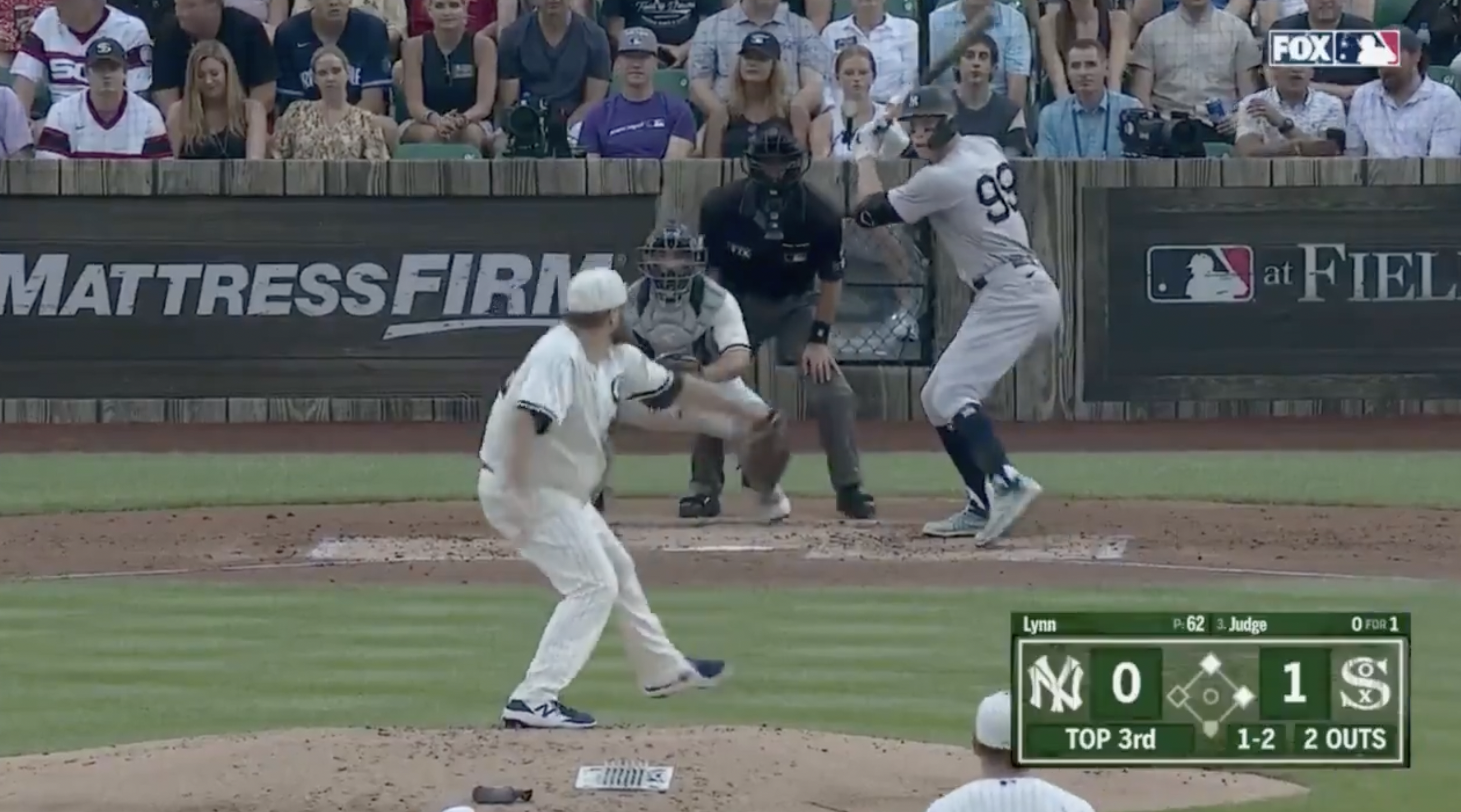
Here’s Aaron Judge, about to hit a dinger into the corn, with a friggin Mattress Firm ad behind him. That panel of course rotated (very period accurate!) and also had a GEICO ad, and I’m sure others. Again, they couldn’t get over their greed to let a good idea be perfect – they had to scrape every last penny possible.

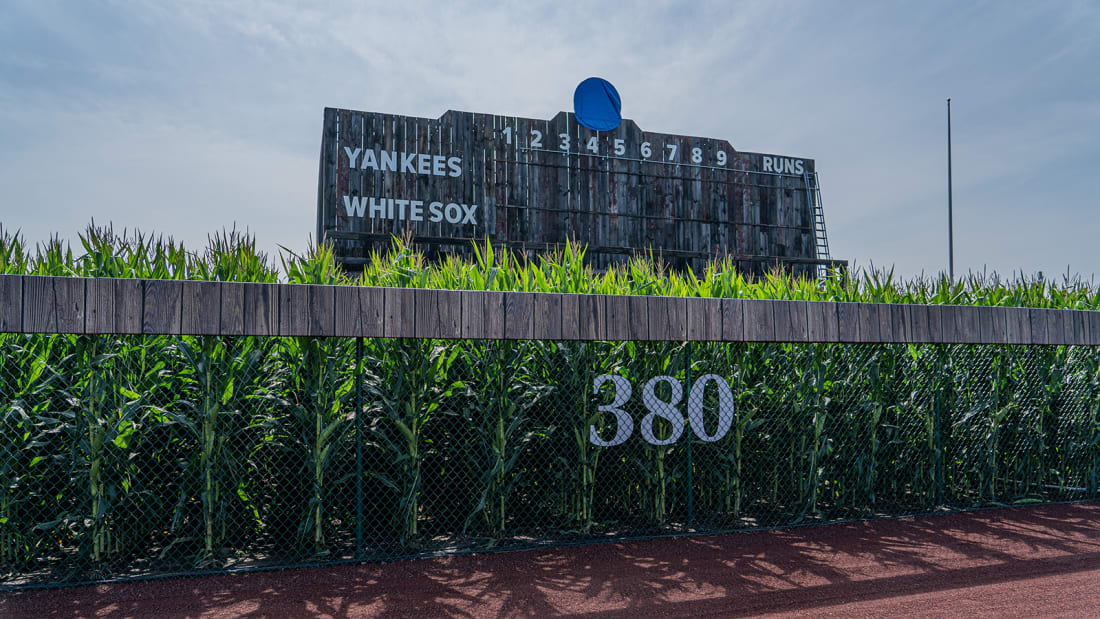
Finally, my biggest gripe. The outfield wall. 

There’s no need for the fence, man! Just hit into the damn corn. I’m very upset about this. Ray Liotta is going to walk out of that corn, look at the chain link fence, and walk right back to baseball purgatory. Outrageous.

Otherwise, the uniforms: sweet. The vibes, wonderful. I hope the Giants get invited some year. -TOB

PAL:  That’s a great line, TOB: “Ray Liotta is going to walk out of that corn, look at the chain link fence, and walk right back to baseball purgatory.”

I am pretty sure there are requirements for a field and facility to be used in an official MLB game, and meeting those requirements would have messed up the original field where the movie was shot…which would dilute the tourist novelty of the original. I think Toronto had to make upgrades and adjustments to the field it played on when they spent time in a minor league park because of the pandemic.


The Fitzmagic Odyssey 

Ryan Fitzpatrick is slated to start as QB for Washington this season. It will be his ninth team during his 17-year NFL career. Most of you readers probably know his story: Harvard dude, 7th-round draft pick, has become known as the steady vet who backs up, then takes over for, high draft picks. This year might be different. The high draft pick for Washington already flamed out last year, and now a playoff team brought in Fitzpatrick to take over. 

The part about this story that I found most intriguing is the idea of leadership. For a guy who never imagined he’d last all that long in the NFL (the framed mini-camp check in his office for $273.63, the first check he received as a pro, is a replica, because “I sure as hell cashed that thing.”), he’s been in a lot of locker rooms with hundreds of teammates, dynamics, and expectations. Above all, Fitzpatrick has learned that leadership requires connections, and that takes honest-to-goodness time. 

“Being on a new team every year, it’s not the system and learning it,” Fitzpatrick said. “That stuff is gonna take care of itself. Meeting the guys and having this human connection with these guys is such an important aspect of playing QB and being part of a team. A lot of that is time. You have to put the time in. You have to have conversations. You have to ask questions. There are no shortcuts to building relationships.”

He is universally loved by teammates from all of his stops to a degree that is uncommon. How about this: when he was holding out for a respectful contract  (we’re talking like backup money) after leading the Jets to a 10-6 record, two of his receivers considered holding out, too, as an act of solidarity. 

Of course, him taking time to get to know his teammates wouldn’t amount to a story if Fitzpatrick didn’t deliver with some regularity, and he does, which has been a bit of a double edged sword when he has backed-up to franchise QB in waiting (Geno Smith for the Jets, Jameis Winston for the Bucs, Tua for Miami). He’s better than the high-end picks, and everyone on the teams love him. It’s not long before the majority of the players want him starting instead of a raw and mistake machine that is most every rookie QB. 

The other portion that stood out is the sheer logistics of moving nine times for a job. Fitzpatrick and his wife have seven kids (no wonder he keeps playing…he’s got to feed those twerps!). They found out the hard way that it doesn’t work for the family when the QB leaves them behind somewhere else, so every new team means a new house, new schools, new everything. They’ve refined the process over the years: 

Over time, the Fitzpatricks have developed a system for each new move. They’ll start by studying the area to identify the best public schools, and use that initial search to build a list of seven to 10 houses. On his own, Fitzpatrick flies out and makes the final decision. Not long after, Liza will follow with all the kids in tow.

Solid read. – PAL 

Source: Nine teams, hundreds of teammates and a lifetime of stories: Ryan Fitzpatrick is a ‘next-level leader’”, Robert Mays, The Athletic (08/12/21)


Video of the Week

Who did it better? Who can say?

Tweet of the Week

Song of the Week

Loudon Wainwright III – “Fathers And Sons”


Like what you’ve read? Follow us for weekly updates:

Email: 123sportslist@gmail.com

Twitter: @123sportsdigest

Facebook


All you need is love? False. The four basic human necessities are air, water, food and shelter.

-Dwight K. Schrute
Week of August 6, 2021


An Olympic Thesis

I’m not a big Olympics guy. I know, as my friend Joanna said last weekend: that is very much not on-brand for me. I have written a sports blog for seven years, for goodness sake. But I don’t have a ton of free time and I want to spend it doing the things I want to do. I can’t pretend to get excited about a sport like beach volleyball, for example, once every four years. Especially when I’d rather watch my favorite team continue to be the best team in baseball, ahem.

However. though I have not watched more than perhaps 45 seconds of the ongoing Olympics*, I do have a gripe with some of the sports that are in the Olympics. After some thought, I came up with a simple two-step test on what should and should not be an Olympic sport. It is as follows:

  1. The sport should be otherwise underexposed. 
  2. There must be some novelty to the competition. That is to say, the Olympics cannot simply be another event on the calendar. We must be seeing the sport in a way that we otherwise do not.

To illustrate:

Golf: NO. Why is this an Olympic sport? It’s a wildly popular worldwide sport and there is no differentiation between its weekly events and its Olympic presentation. Get it out!

Basketball: YES. It’s popular, yes. But it’s generally not played country vs. country as it is in the Olympics. Quite novel!

Tennis: NO! God no. See: golf.

Got it? Ok, let’s do this.

  •  Artistic swimming:
    • Yes.
    • PAL: saw it, started making fun of it for 5 seconds, then was completely impressed and captivated. YES.
  •  Diving
    • Yes.
    • PAL: Yes
  •  Marathon swimming
    • I don’t know what this is, yes.
    • PAL: sure
  •  Swimming
  •  Water polo
    • Yes.
    • PAL: Hell yes. Great watch. 
  •  Archery
    • Yes.
    • PAL: Yes, but I’m not as impressed if I run into an archery Olympian.
  • Badminton
    • Yes.
    • PAL: Yes
  • Baseball
    • Yes.
    • PAL: Meh
  • Softball
    • Yes.
    • PAL: Yes
  • Basketball
    • Yes.
    • PAL: Sure
  • 3×3 basketball
    • Leaning NO here. It doesn’t fail the tests but it’s also not really played as a sport anywhere. Completely contrived for the Olympics.
    • PAL: So dumb. No.
  • Boxing 
    • This probably fails the tests, but I’ll make an exception here because it’s still an amateur Olympic sport. Like, Canelo isn’t allowed in the Olympics. Once they let pros, it’s out.
  • Canoeing
    • Sure.
    • PAL: Yes
  • BMX freestyle
    • No. Underexposed, but I think this fails prong two: it’s just another event in the same format that we can see year-round.
    • PAL: Nononono. 
  • BMX racing
    • No. See above.
    • PAL: God no.
  • Mountain biking
    • No. See above.
    • PAL: nah.
  • Road cycling (4)
    • No. See above.
    • PAL: God no.
  • Track cycling 
    • I think this is again a no, but I’m not sure.
    • PAL: Watched it today. Loved it. Seems to check both of your boxes. 
  • Equestrian
    • I believe this fails prong two but I’m not sure. Are there international competitions? If not, and they are regional or national only, this is allowed.
    • PAL: Sure. Who cares. The most compelling equestrian story of the Olympics is that Bruce Springsteen’s daughter was on the U.S. team. 
  •  Fencing 
    • See equestrian.
    • PAL: Yes, but they could make it really interesting by bringing in real swords. Just sayin. 
  •  Field hockey
    • Yes.
  •  Football/Soccer
    • Women’s: Yes. See basketball.
    • Men’s: Yes. This also passes because they have implemented a rule that I endorse to ensure this doesn’t just become a repeat of the World Cup: all but three players on each team must be under 24. This creates even more novelty.
    • PAL: But that age rule makes me care a bit less or makes it mean a bit less. 
  •  Golf
    • NO, NEVER AGAIN.
    • PAL: No…how long is this friggin list? 
  •  Gymnastics
    • Yes.
    • PAL: Y
  • Handball
    • I think this makes it but see equestrian.
    • PAL: Hard yes. 
  •  Judo
    • Again, see equestrian.
    • PAL: Don’t know. 
  • Karate
    • Again, see equestrian.
    • PAL: I
  •  Modern pentathlon
    • Yes.
  •  Rowing
    • Yes.
  •  Rugby sevens
    • Yes.
  •  Sailing
    • Yes.
  •  Shooting
    • Sure.
    • PAL: I’ll say it…is this a sport?
  •  Skateboarding
    • No, get out. Fails the golf test.
  •  Sport climbing
    • Underexposed, but I think fails the golf test. 
  •  Surfing
    • No, fails the golf test.
  •  Table tennis
    • Fairly certain this fails the golf test.
  •  Taekwondo
    • See equestrian.
  •  Tennis
    • Again no. NO.
  • Track and Field
    • Yes.
  •  Triathlon
    • Underexposed, but again I think it fails the golf test.
  •  Volleyball
    • Yes.
  • Beach volleyball
    • This has gotten so popular that I think it fails the golf test.
  •  Weightlifting
    • Perhaps fails the golf test but exempt as a quintessential Olympic sport.
  •  Wrestling
    • Yes.

So, there you have it. The definitive list of sports are or are not appropriately played in the Olympics.

*I wrote this before, in a moment of weakness, I watched the second half of the US/Australia men’s basketball semifinal.

-TOB

PAL: My favorite line from TOB: “Though I have not watched more than perhaps 45 seconds of the ongoing Olympics, I do have a gripe with some of the sports that are in the Olympics.” Hahahaha!

I don’t hate your rationale—I’ve been watching water polo, track, rowing, softball, and I’ve been a hard pass on skateboarding and climbing (and I really enjoy climbing!)— but, man, I am a sucker for the Olympics. What a great break from the same old same old (NFL, NCAA football, NBA, baseball)l. The Olympic athlete stories are inspiring, and every couple of years (winter and summer games) I love learning about an athlete that isn’t constantly in the public eye.

Having said that, I have one more gripe to add to TOB’s hot take (seriously, who the hell is anti-Olympics?): why the hell is olympic softball being played on a baseball field?

Damn. These are the best softball players in the world, and they are treated like a non-tryout youth team. I was stunned when I watched USA-Canada in pool play. With the amount of money spent on the Olympics, you would think they could have built at least two turf softball fields. 

Did a little internet sleuthing and found the following as a possible reason. Per Larry Brown: “Well, as you probably guessed, this is a cost-saving measure. NBC Sports’ softball announcers said that baseball and softball agreed to share the venue as part of an effort to get back into the Olympics. This is the first year softball and baseball are back in the Olympics since 2008.”

Just a bad look to have an Olympic women’s sport played on a men’s field.  

TOB: AND ANOTHER THING. Michael Phelps is overrated! His medal count is inflated because his sport has an insane 4 strokes, multiple lengths, and relays and medley and all other kinds of crap. 


EXACTLY. This has bugged me for over a decade and I am finally ready to say it aloud. Thank you.


Hal Higdon

I was meaning to share this story a few weeks ago before we went on vacation. It’s a bit evergreen, so—what the hell—I’ll share it this week. 

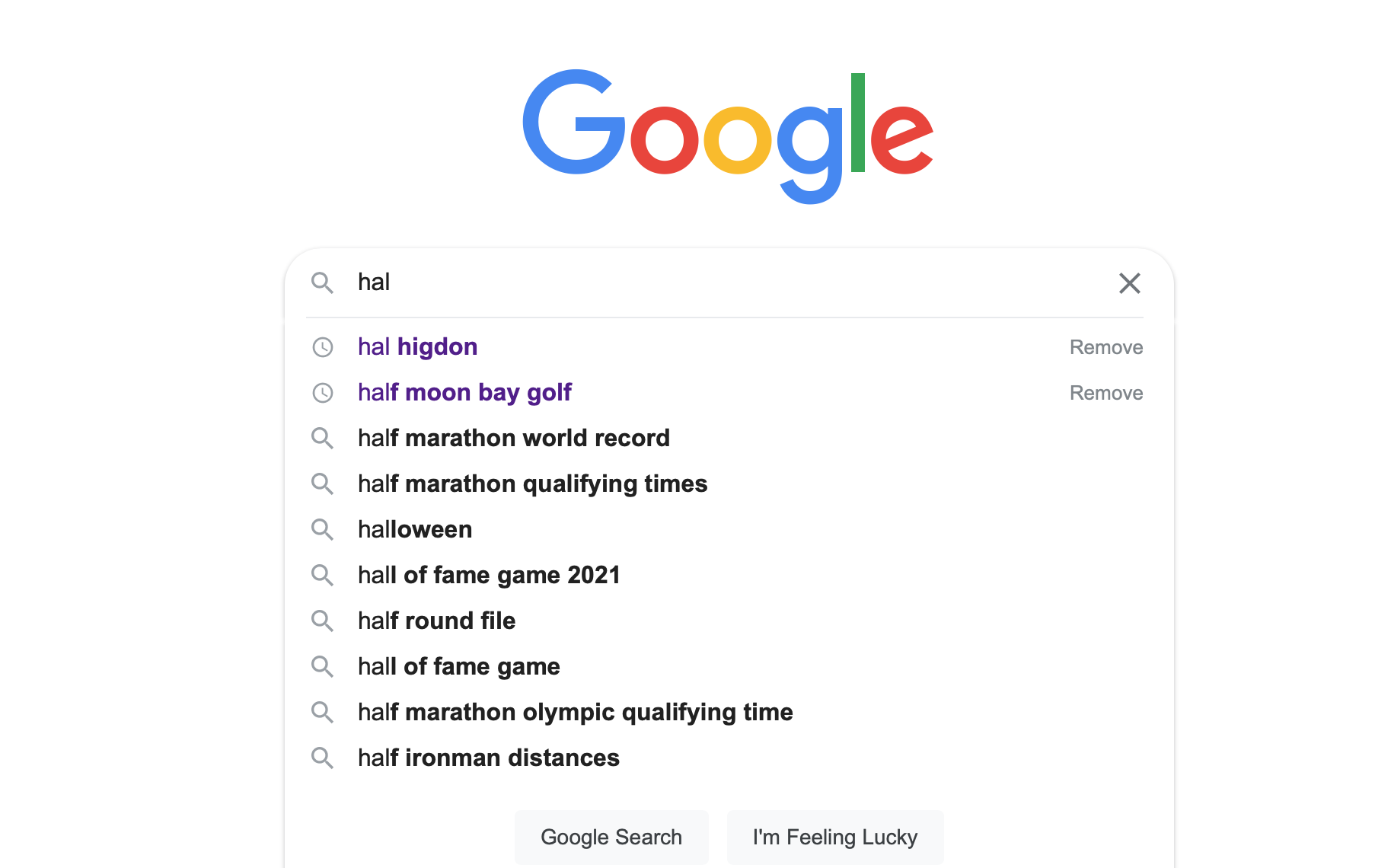
Most everyone I know who’s trained for a marathon or half marathon has typed in the name “Hal Higdon” when looking for a training plan. It is free, it is detailed, it will get a first time runner across the finish line if they stick to the training plan. In a fitness world of personalized plans, coaches, and enough gadgets to fill a container ship, Higdon’s plans remain the standard. 

A few weeks ago, the NY Times went a little deeper on the 90 year-old “internet king of running plans”.

Per Talya Minserg:

Higdon started running in high school, and began researching different ways to train for races while a student-athlete at Carleton College in the late 1940s. “I was a perky little freshman and sophomore who came up with training ideas of my own,” he said in a telephone interview. He honed his expertise as an elite runner both in the youth and master divisions, taking his family along with him for the ride.

Before races had water stations, his family would stand on the side of courses with cups of water. His children fondly remember spaghetti dinners before marathons. So, too, do they remember having marathon greats like Bill Rodgers stop by the family home for a meal or two.

In those days, Higdon made a living from freelance writing on a variety of subjects. But the through line remained working with athletes and writing for runners. It wasn’t until 1990, when a high school friend recruited him to design plans for Chicago Marathon runners, that he began crafting training plans for a larger audience.

When I read about Higdon, it reminded me of another name synonymous with sports training. My brother-in-law recently gave me the golf training book Harvey Penick’s Little Red Book. Pretty much any golfer will have heard of it. In Higdon and Penick, you have two men who became passionate about a sport decades before each caught on with the masses. Both men also pay as much attention to the complete amatuer and the experts. 

While Penick died in 1995, before the age of internet golf training (my god, YouTube, IG, SnapChat are full of tutorials), Higdon embraced social media as a way to communicate with folks going through his training plans. Apparently, through the help of grandkids and other family members, Higdon remains the person behind the response to questions and comments across social media.

A fun story about a the guy behind a name that I’ve known for 20 years. – PAL

Source: “Hal Higdon Has Trained Millions of Runners. At 90, He’s Not Slowing Down.”, Talya Minsberg, The New York Times (07/18/21)


Is the USMNT For Real?

The U.S. Men’s National Soccer team has had quite the summer: First, in June, their A-squad beat Mexico’s A-squad in the Nation’s League final, in one of the most exciting soccer games you’ll ever see.

Then, last weekend, their B or C-squad beat the Mexico A-minus squad on a late goal to win the Gold Cup. It was quite the turnaround from four years ago when they shockingly failed to qualify for the 2018 World Cup.

But as soccer analysts will tell you, it’s not just that the U.S. won these tournaments, beating their archnemesis in the process. It’s how they won, with style and panache, with young talent providing so much promise for the future (seriously, buckle up for World Cup 2026, which the U.S. will host). For the first time ever, USMNT fans have hope that their squad will soon be able to compete with the elite squads across the globe. And while the upcoming, talented generation has a lot to do with it, so does the team’s coach, Greg Berhalter, as Leander Schaerlaeckens writes. 

Berhalter has succeeded in creating a culture that players want to be part of and making the USMNT a destination for top soccer talents who could have chosen to play for other national teams. This is an interesting look at Berhalter – where he came from, what he’s doing, and where he hopes to go. If you’re a fan of international soccer, you’ll enjoy this one. -TOB

Source: Gregg Berhalter’s Plan for American Men’s Soccer Is Working,” Leander Schaerlaeckens, The Ringer (08/02/2021)


Actually, Revenge is Pretty Good When Hot and Fresh, Too

In my fantasy baseball dynasty league, I have been on a hunt for a longterm solution at third base all season, ever since Vlad Guerrero, Jr. lost his 3B status and left me with Vlad and Pete Alonso to fill my 1B/DH spots. I cycled through some guys, and traded for Moustakas who was on my roster for a week before missing the last three months with a heel injury. I’ve used Wilmer Flores and Joey Wendle and others, when they were on hot streaks. I even scooped up an injured Evan Longoria and stashed him on my IL.

But I’ve been keeping an eye out for a young guy, and this week I came across someone named Abraham Toro (what an elite name), who went on a tear after being traded from Houston to Seattle last week. So I did some digging to see who he is and came across the incredible story of how he got traded.

You know that scene in Moneyball when the A’s trade for Ricardo Rincon? When he was traded, Rincon was playing for Cleveland, who were in Oakland to play the A’s. So Rincon had to simply walk down the hall to join his new team. That is a true story, and while Toro’s is similar, I think Toro’s story is even better. Here’s the AP’s Chris Talbott with the story:

Toro was taking his pregame swings for Houston when he learned about the deal. The infielder walked to the other dugout, put on his new uniform and went back to the batting cage.

I mean, that is incredible on its own. The dude is taking BP, is told he’s traded, goes to his new dugout, gets his new jersey, and goes back out to the field to continue getting ready. And the cherry on top of it all? The day before he was traded Toro hit a dinger for the Astros, against the Mariners. The day he was traded? He hit a dinger for the Mariners, against the Astros. Per Elias, “Toro is the first player in major league history to homer for one team and against that team in consecutive games.” That is some serious, “Eff you,” energy. 

And if you’re curious, Toro is still on a tear. In 8 games with Seattle, he’s hitting .429/.500/.857 for an OPS of 1.357. -TOB

Source: Abraham Toro Homers Late for New Team, but Astros Hold on to Win,” Chris Talbott, Houston Chronicle (07/28/2021)


Tweets of the Week

Song of the Week

The New Basement Tapes – “When I Get My Hands On You”

Kind of a cool project from a few years back. A supergroup with super duper producer T Bone Burnett took a bunch of Bob Dylan lyrics from his Basement Tapes time with the band – lyrics that were never turned into song (at least that we know of) – and took a crack at putting them into songs. This song is my favorite from the album. Anyone with an upcoming wedding: this song would be a damn good first dance song. – PAL


Like what you’ve read? Follow us for weekly updates:

Email: 123sportslist@gmail.com

Twitter: @123sportsdigest

Facebook


“Debbie told my son he looked like Tom Petty in a negative way.”

– Catherine

Week of July 16, 2021

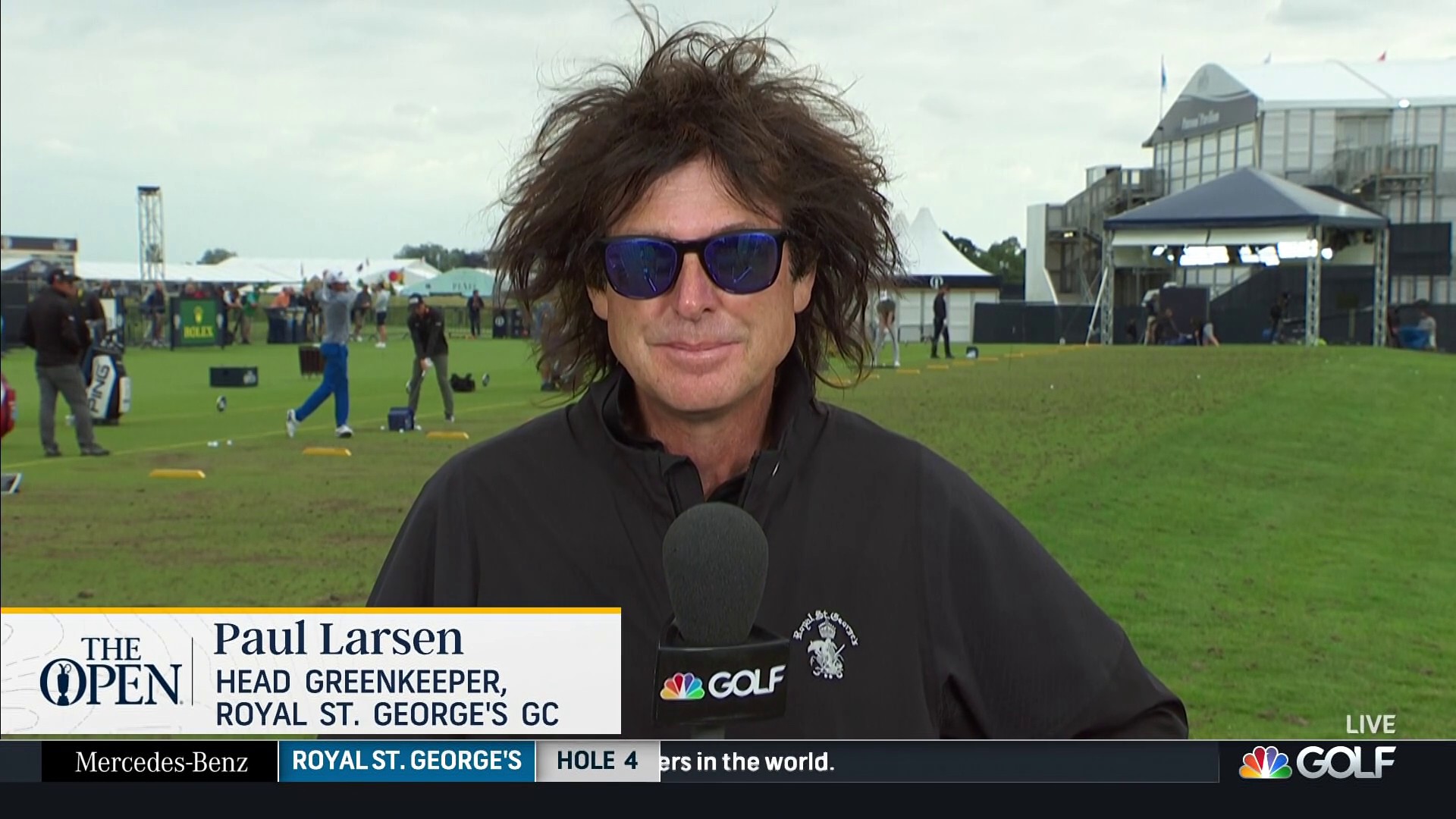
Greenkeeper, but also: bassist in a Cheap Trick tribute band

The Dirty, Underhanded World of College Recru…Sorry, What’s That? Oh. Chess? Ok, the Dirty World of Chess.

The New York Times published a wild and, frankly, shocking story this week about match fixing in chess. The short: achieving the rank of Chess Grandmaster is very lucrative and so people are willing to shelve out big dollars to ensure the rank. Far from the meritocratic sport it seems to be, chess has a match-fixing problem. But it does not stop at match-fixing. It includes winning non-existent tournaments: 

Mikhail Zaitsev, who achieved the rank of International Master and is now a chess coach, estimated that of the world’s roughly 1,900 living grandmasters, at least 10 percent have cheated one way or another to acquire the title. Shohreh Bayat, one of the leading arbiters in chess, describes such arrangements in the plainest terms. “Match fixing,” she said, “is cheating.” Some hopefuls didn’t even have to play a game of chess to get the points they needed: Some tournaments, she said, took place only on paper.

None of this is lost on the sport’s frustrated leaders “We have a dog called Pasquales,” said Nigel Short, the vice president of FIDE.

“I believe it is possible that if I went to the effort, I think I could get my dog a grandmaster’s title.”

The article centers around a story from a tournament in 2002, when then 12-year old Sergei Karjakin became the world’s youngest Grandmaster:

For nearly 60 moves, Karjakin posed subtle and challenging problems to Irina Semyonova, his opponent. Each time, she had an answer, a counter. Karjakin kept pressing, but the game ended in a draw.Suddenly, all of what had been close enough to touch — the label, the fame, the history — was slipping away. But the aspiring grandmaster and his team still had one audacious move left.

With Karjakin’s title as the world’s youngest grandmaster slipping away after his unexpected draw with Semyonova, Karjakin’s father, Aleksandr, approached several players to whom his son had lost points and offered them money to replay their games. Firman said he was among those to receive an offer of cash for an arranged draw.

Malinin, who had points to spare, agreed to replay his game with Karjakin. He said he did so for free and therefore did not consider it cheating. The two replayed a game that normally would have taken up to six hours; in the replay, Malinin said, it was played “in a blitz” — a high-speed variant of chess. Karjakin won.

Minutes later, the newly crowned grandmaster ran into the tournament’s main hall, radiant and proud as “a peacock,” according to Areshchenko, who was present.

This is surprising, but the more you read the less surprising it is: achieving the title of grandmaster means a lifetime of perks. 

More recently, Karjakin lost his status as the youngest to achieve grandmaster, when Abhimanyu Mishra bested him by about two months. While there is no evidence yet of match-fixing, Mishra’s achievement is also very dubious:

Mishra’s father, Hemant, had a lot at stake in seeing his son claim the title. He said he spent more than $270,000 on making his son the world’s youngest grandmaster, and he had been collecting donations online to make their chess dream come true. The small advantages that the money could buy — in scheduling, in opposition, in timing — began to add up as he closed in on his final norm.

Mishra, who described Karjakin as his idol, played in five so-called norm tournaments in Charlotte, N.C., in the fall of 2020 and spring of 2021 but did not achieve a single norm. With the deadline to beat Karjakin’s record bearing down, he and his father next traveled to Budapest, where Abhimanyu Mishra played eight tournaments in a row.

At these tournaments, norm-seekers paid the organizers, who in turn paid grandmasters to show up, a legal and common arrangement in professional chess. But the quality was not the same; the average rating of Mishra’s opponents in the Budapest events was nearly 50 points lower than it had been in Charlotte.

In an interview, Arkady Dvorkovich, the president of FIDE, said that there is little sportsmanship at such tournaments. That is partly because the grandmasters, often aging players long past their prime, often lack the motivation to work hard to beat their opponents. “The motivation was quite low for me,” said Vojtech Plat, one of the grandmasters who played.

Again, it all makes sense. Give awful parents a chance to game the system for their kids and they will squeeze through every nook and cranny to do it. But…I gotta admit that I had no idea this goes on in chess. Great read. -TOB

Source: The Dark Side of Chess: Payoffs, Points and 12-Year-Old Grandmasters,” Ivan Nechepurenko and Misha Friedman, New York Times (07/13/2021)

PAL: Heads up: it’s a NY Times kind of week. The next time I meet a serious chess player will be my first, but you can take it to the bank that I will ask where he/she earned norm points. If the answer is “Sardak” then we have some problems. 

Absolutely fascinating look into a game about which I know very little. I like the part about the old grandmasters past their prime taking the money and agreeing to draw so some dad can live vicariously through his 12 year-old. 


 2B: LG

This picture from Bob Levey is supposed to represent our old-standing idea of a what a second baseman looks like (Jose Altuve of the Houston Astros, 5-foot-6, 166 pounds) and the direction the position is heading (D.J. LeMahieu of the Yankees, 6-4, 220). While LeMahieu is playing first base in this pic (look at the glove), he plays the majority of his time at second. Credit…Bob Levey/Getty Images

We’ve posted a ton of baseball stories in recent weeks. Obviously, TOB and I love the game, but there’ve also been a lot of great baseball stories recently. Throw in the The All-Star break (a great time to publish the think piece with no games to report on at the moment), and it makes sense we get a good story from Joe Lemire.

I can’t help but wonder if, to some extent, the number of smart baseball stories is also the result of a game that has undergone such a shift over the last 10-20 years. A wave crested over the past couple of seasons by way of general acceptance of shifting defense, all-or-nothing approach at the plate, and the commonplace of pitchers throwing over 97 M.P.H.. Perhaps we were destined for this ever since sabermetrics became the standard of how organizations assess players and positions.  

Naturally, there’s been a shift in how the game is played, which – as Lemire examines – impacts something as fundamental as the prevailing height and weight of a position. 

Take this stat from Lemire’s story: 

For 50 years, from 1948 until 1998, there was never a time when more than one regular second baseman stood at least 6 feet and weighed at least 200 pounds. In 2019, the last full season, 29 such players took the field, according to Baseball Reference.

I’m going to stop you before you think, bigger, stronger, faster, because this stat indicates something much more interesting. This is a story about what skills are more valued at today’s version of second base, how the positioning of the player impacts the skillset needed to play 2B, and finding a soft spot on the defensive side of things to plug another big bat. 

Historically, 2B is a position where you need a defensive player that, although he lacks the range (and arm strength) of a shortstop, can turn a double play and be a plus defensively. A good infielder with a strong arm would typically play on the left side of the infield.

Front office executives are getting more inventive generally with roster construction, but a confluence of leaguewide trends is making experimentation at second more appealing. Strikeouts rates are at an all-time high and, with fewer balls in play, no position has seen a greater reduction in total chances than second basemen, who are fielding 20 percent fewer batted balls per game than they were in the mid-2000s.

There are discernible reasons for the change. Pitchers are throwing more four-seam fastballs at the top of the strike zone, rather than sinking two-seamers at the knees, leading to more airborne batted balls. Better advanced scouting information is informing more precise positioning, which has led to a preponderance of shifts, and cover for players with reduced range.

Farewell Dustin Pedoria and Joe Morgan. Hello D.J. LeMahieu. Instead of needing an agile guy who can turn the double-play (a less frequent occurrence in today’s game); second base has become a place to stash boppers. Hate the trend, but a great read. – PAL 

Source: Where Have You Gone, Dustin Pedroia,” Joe Lemire, The New York Times (07/14/21)


Aftermath

You’ve seen the video:

Here’s a story about what happens to a kid after he makes a stupid, stupid, stupid decision like you saw Emmanul Durón do in that video. What happens when a kid’s lowpoint becomes a viral video and the topic of sports talk across the country? What’s he do after all the bluster and outrage has been applied to the next video of someone doing something stupid. 

Or, in Jeré Longman’s words:

When a young athlete commits an egregious act, where should punishment intersect with compassion? Does the athlete deserve a second chance? And how does a teenager begin again after facing nationwide disgust and cancellation?

One detail stuck out over the others. After Durón hits the ref, and after he’s been booked in jail for assault, at his lowest most alone moment, guess where his coaches, administrators, teachers?

“No Edinburg coaches or school officials visited him in jail, Durón said. Nor did any coaches speak to him, he said, when he briefly returned to school to take state assessment exams.”

Maybe they didn’t know how long he’d be there, maybe no one thought of it in the chaos of the night, maybe the kid was an absolute jerk (that is not the feeling I got from this story), but—damn—where’s all that talk of team and loyalty when a player really needed some support?

We are obsessed with the meltdown, the lowlights; this story is about the aftermath, and I think it’s actually an important read for kids and parents alike. We are not our respective worst moments (and we aren’t our best moments either). – PAL 

Source: “‘I’m Just a Kid Who Did Something Wrong’,”Jeré Longman, The New York Times (07/12/21) 


BP Pitchers Always Get It In, Part II

Back in May, we wrote about batting practice pitchers, the “unsung heroes who keep sluggers in the zone.” Well, I’m back with a quick one because never is the importance of a good BP pitcher more on display than at the Home Run Derby, which was held on Monday. 

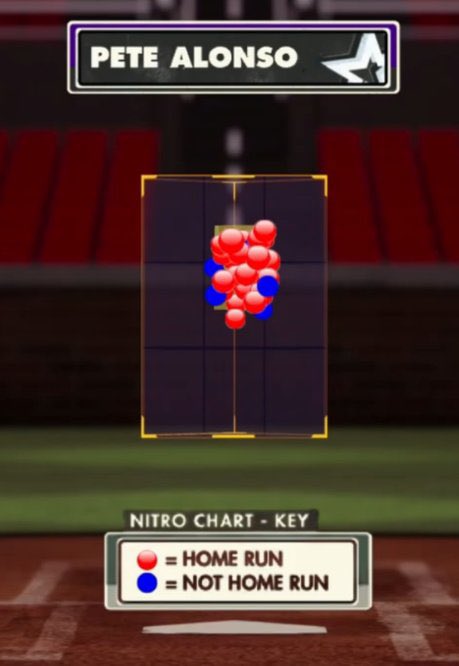
For the second straight time, the Mets’ Pete Alonso walked away with the crown. But the real winner was his BP pitcher, Dave Jauss. Here’s Jauss’ pitch chart:

That’s real dang good. Look at that precision. Here’s an overlay of 4 consecutive pitches:

I was the pitcher for my son’s coach-pitch team this year. There were days I was very much in and very much out of the zone. But my best skill, IMO, was putting it where each hitter wanted it. At 7 years old, most kids do not know how to adjust their swing. They just have a groove swing. A few games into the season one of the other coaches told me he realized I am throwing to the bat and that he was very impressed. I was very proud. I felt then like Dave Jauss must feel now. A BP king. -TOB

PAL: My dad has a coach-pitch highlight that’s worth sharing. The scouting report on 8 year-old me was pretty simple: leftie, dead pull. We were playing a team coached by a portly fella who lived up the cul-de-sac . In a game earlier in the season, portly dad put the shift on me. I was 8. If I’m remembering correctly (keep me honest, coach TOB), coach pitch employs four outfielders (right, right-center, left, left-center, left). This guy had every player on his team on the right side of second base. 

Prior to a second meeting against the team, my dad wants to practice something different with me. He tells me not to do anything different. He tells me something like, “No matter where the ball is, just swing the same.” We end up practicing his pitches to the outside corner. 

Game time: Neighbor guy puts on the shift. My dad tosses a pitch on the outside corner, I hit one to leftfield and make it home easily. My dad could barely contain himself. Little victories, baby. Sweet little victories can get you through the day.

TOB: Awesome.


Hot Take: Giannis is NOT Funny

I’ve been biding my time on this one. For a couple years now, I’ve seen tweets and instagram videos showing Giannis Antetokoumpo (pretty sure I got that without looking it up) making corny, worse-than-dad jokes while everyone falls all over to say how funny he is. Well, I feel like Shooter McGavin here when Doug says everyone is coming around on Happy Gilmore, because I’M NOT, DOUG.

Don’t get me wrong – he’s an incredible player. But he’s NOT funny. Here’s an example:

Title: Funniest man in the league. Almost 2 million views. But that is NOT funny. The jokes are BAD and corny and BAD. Ten years ago, Dwight Howard had this same awful sense of humor and got KILLED for it, rightfully so. 

I was finally compelled to be brave and declare that Giannis is not funny when this week, after Game 4 of the NBA Finals, he was asked why he left the bench for a few minutes during the game. His response?

YUK YUK YUK. This went viral. NBA reporters breathlessly reported it right after he said it, with a general feeling of, “Oh that hilarious rascal!” But, nah, man. That’s not funny. That’s funny for a 4-year old, maybe. But he’s a grown ass man and this stuff is not funny. 

So, if you’re with me, don’t be afraid to stand up and say: Giannis is not funny. Stop acting like it. -TOB

PAL: TOB when someone talks about Giannis’ sense of humor:


Cold Take: Giannis is Really Friggin Good at Basketball

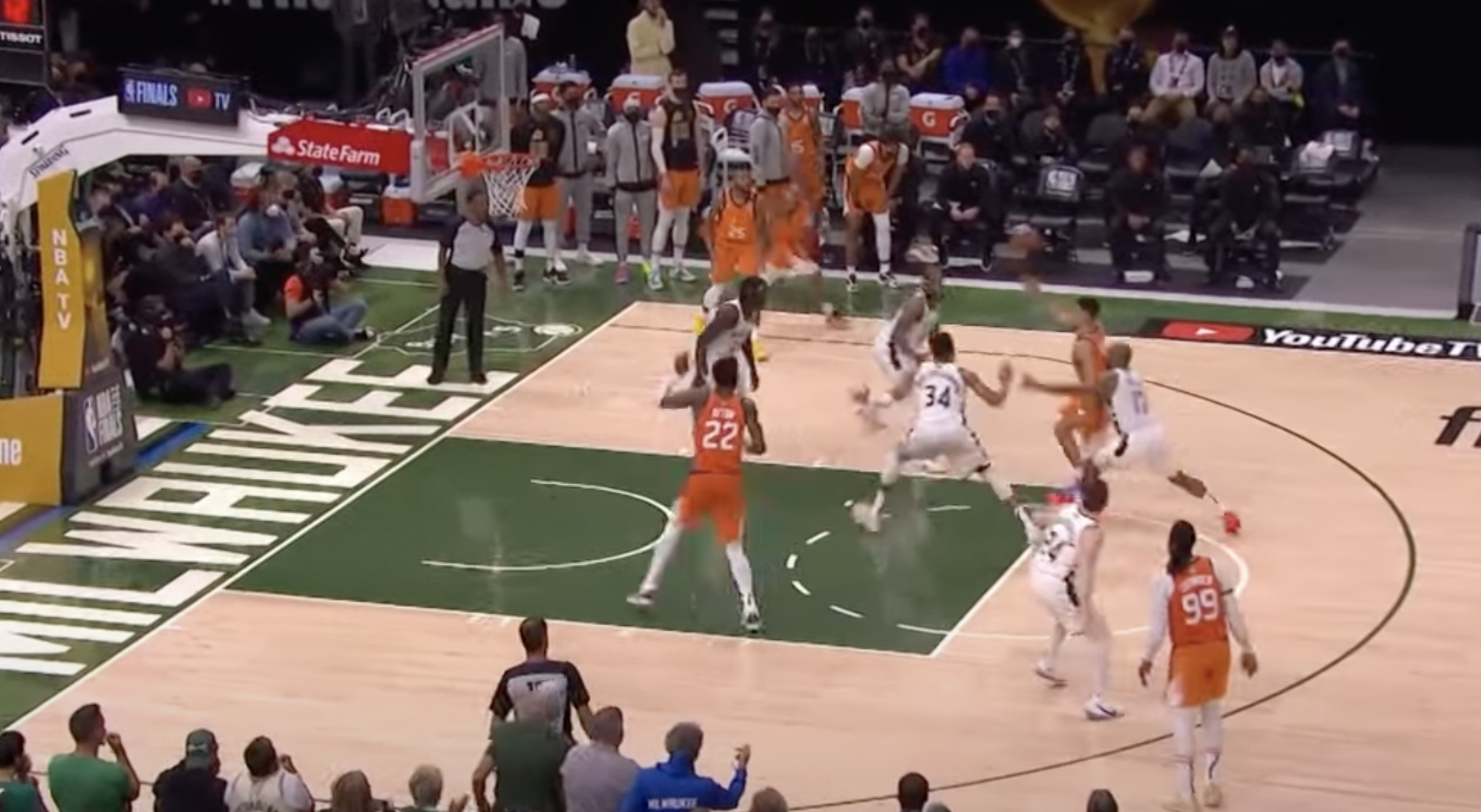
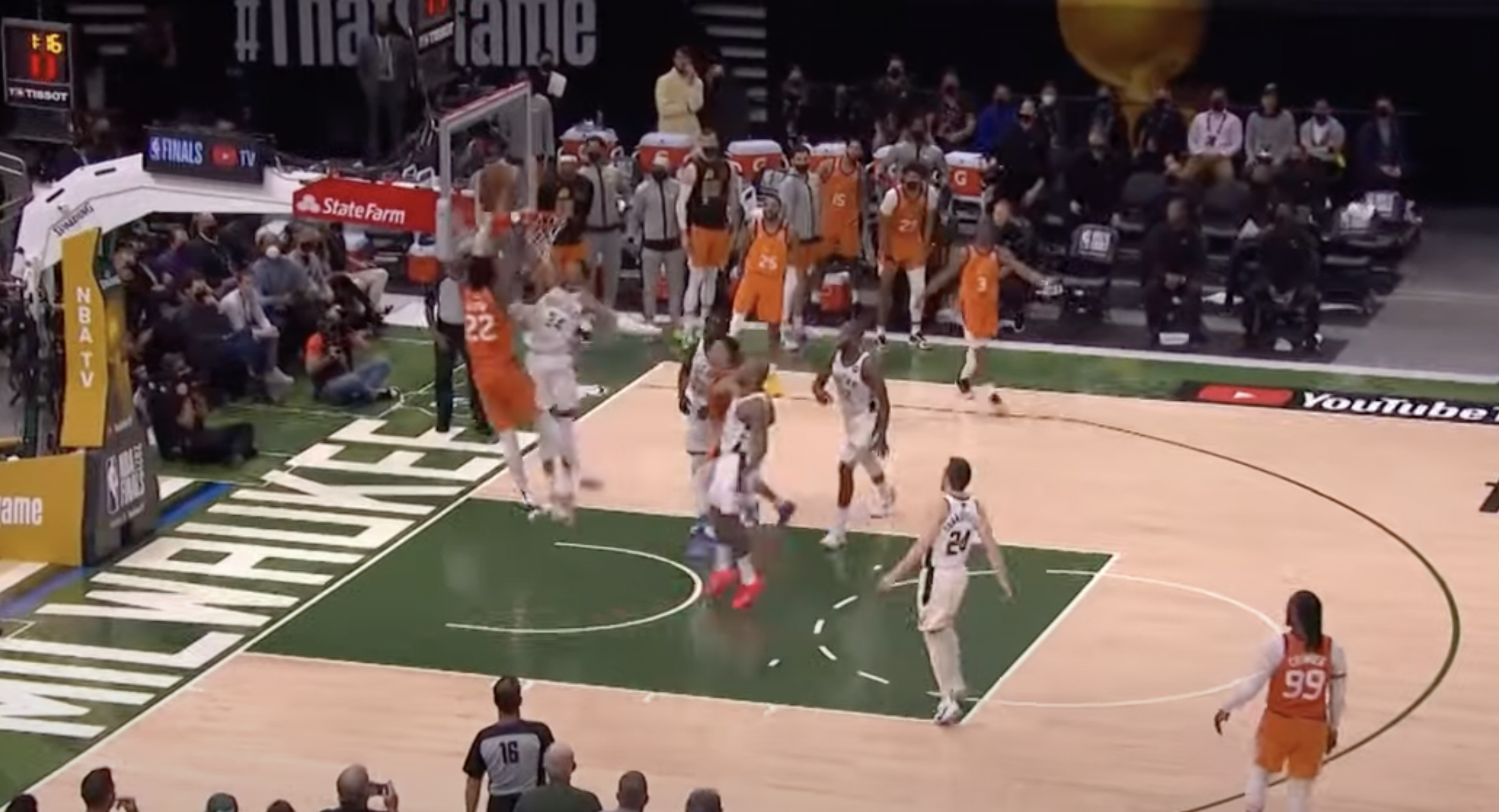
Ok, so he’s not funny. We can’t all be everything. Because while Giannis is not the best basketball player I’ve ever seen (Jordan or LeBron) and not the most exciting basketball player I’ve ever seen (Steph), he is perhaps the most shocking basketball player I’ve ever seen. He does things that just seem impossible. To illustrate, here’s a play from Game 4 of the Finals:

I watched that live and I absolutely howled. That just didn’t seem possible. I read a really good article from Tom Ley that put it in perspective. 

Who else can you imagine making exactly that play, under those exact conditions? I’d argue that nobody else in the league fits the bill, not because nobody else in the league is as big or as talented as Antetokounmpo, but because his entire development arc as a player was leading to this point. 

This block [is] a short, authoritative story capturing everything about what makes Antetokounmpo who he is. He’s the guy who just goes, very quickly, in a particular direction or to a particular spot on the floor, and then when he gets there he just does it, because his body allows him to.

He’s right. Giannis may not be funny, but he is a singular talent, in the truest sense of that term, in the history of the NBA. -TOB

Source: Giannis Antetokounmpo Has His Career Highlight,” Tom Ley, Defector (07/15/2021)


Video of the Week

Tennis players are incredible. Playing against Djokovich must be soul crushing. That dude had 2-3 perfect shots in that sequence and still lost the point.

Tweet of the Week:

Song of the Week: Guided By Voices – “Game Of Pricks”

Like what you’ve read? Follow us for weekly updates:

Email: 123sportslist@gmail.com

Twitter: @123sportsdigest

Facebook


Ah, yes I know. I shat where I ate. And I shall now eat where I shat.

L.D.

Week of July 9, 2021


Papa Guinn

With the baseball draft kicking off this Sunday (the first time it’s been during the All-Star break), here’s a great story about a prospect who grew up in Oakland. 

Rickey Henderson was a 3-sport star at Oakland Tech High School, which stands about a 9-iron away from the balcony I’m sitting on at this moment. He loved football, but J.J. Guinn, a full-time Berkeley police officer and part-time baseball scout, saw a different future for the young athlete. More importantly, Guinn made the winning pitch to Henderson’s mom: less injuries in baseball. Once Bobbie, a single parent, made up her mind, there was no changing it. Rickey went to his room and cried. 

The decision went against the views of many of the people who had watched Henderson. Football coaches praised Henderson’s physique and lauded his speed. But in baseball, he found less reassurance. Some scouts were concerned with his arm, his crouched batting stance, and the fact that he batted right-handed but threw left-handed.

Those scouts focused on Henderson’s flaws. Guinn focused on his strengths: Henderson’s speed, athleticism and lateral range. Where others saw impediments, Guinn saw possibility.

Only two M.L.B. teams were present for an American Legion game at Bushrod Park on that day in 1976: the Athletics and the Los Angeles Dodgers. After Henderson struck out in his first two at-bats, the Dodgers scout stood up. “I’ve seen enough,” Guinn recalled him saying. “I have a plane to catch.”

Henderson homered in his next two at-bats and Guinn feverishly typed out a report to his scouting director. His advice: Sign Rickey Henderson “right away.”

We know how this ended up for Henderson. Guinn’s story is perhaps more interesting. Part-time scout, full-time officer, respected and revered in Berkeley and Oakland.  

From Monday through Friday, 8 a.m. to 3 p.m., Guinn would walk some of Berkeley’s most crime-ridden streets looking to connect with the residents he was charged with protecting. Few of them had seen a Black police officer.

“Most people think these kids on the street are dumb, but they’re not,” Guinn said. “They know if they can trust you. I had to instill that trust. But because I was raised in Berkeley, if I didn’t know them, they knew my children, or I knew their parents. They knew I was for real.”

Rickey and Guinn got together a couple weeks ago. The location: Rickey Henderson’s suite at the Oakland Coliseum. They reviewed Guinn’s original scouting report from 1976. More than an assessment, that report is now a time machine. 

Henderson sat back and listened, smiling as Guinn recited his strengths, and cackling as he recited his weaknesses. The words transported both men back to Bushrod Park in North Oakland, on a warm April afternoon, two months before that year’s draft.

A heartwarming read. – PAL 

Source: After 45 Years, a Cop Still Looks After His Favorite (Base) Thief,Alex Coffey, The New York Times (07/09/21)

TOB: Love Rickey. I randomly saw this tweet this morning and had to add to it:


Ominous Ohtani

As TOB has touched on many times on this blog (and I have been  a skeptic to a degree that approaches unfun), Shohei Ohtani is doing something unseen in the last century of baseball. The dude has hit 30 home runs before the all-star break…and is a starting pitcher, a pretty good one with electric stuff. He throws 101, and he hits 450-foot lasers. 

Before we go any further, let’s break for TOB to tell me “I TOLD YOU” while I eat crow:

TOB: *cracks knuckles*

Pull up a chair, this is a life lesson: When you want to believe and you choose to believe, then you will get to revel in the fruits of that belief. When I wrote about him 14 at bats into his career, sure I could have “taken it easy,” as my friend suggested. But no. NO, dangit. Where is the joy in that, I ask you? This week I saw an article suggesting Ohtani is “breaking baseball.” I saw another saying he is “pushing MLB’s boundaries.” I saw another discussing how he is the first half AL MVP, and it’s not close because what he is doing hasn’t been done since Babe Ruth. I wanted to believe we could see the next Babe Ruth and by god we are seeing it. If Ohtani stunk, I wouldn’t care. But no. Here I am. Rubbing Phil’s nose in the dirt as a good friend should. Today, we celebrate Ohtani. But we also celebrate ME.

OK, back to the story.

Here’s some context for Ohtani’s season from Neil Paine, writing for the data-driven fivethirtyeight:

As I wrote in May, this is a modern Babe Ruth season. But that might be understating what Ohtani has been doing. According to Baseball-Reference.com’s wins above replacement, Ohtani is on pace for 11.7 total WAR per 162 games this year, including 6.7 as a position player and 5.0 as a pitcher. That would be an astronomical tally — none of teammate Mike Trout’s seasons have reached that level; in fact, it hasn’t been done since Barry Bonds in 2002. But even more remarkably, no player in AL or NL history has even come close to producing 5 WAR on both sides of the ball in the same season. Ruth’s best two-way year saw him put up 6.0 WAR as a batter and 3.0 WAR as a pitcher in 1918, one of his last seasons before becoming a full-time outfielder.

And yet, as I first heard Monday from Bill Simmons and Ryen Russillo, the Ohtani season doesn’t feel like it’s as big of a deal as it would’ve been if it had happened 10-20 years ago. While it’s written about, I don’t know if my dad—a casual baseball fan— would recognize the name. And I haven’t heard that a nephew of mine has begged his parents to go to a game when the Angels come through town.

That should scare the hell out of MLB. How this guy hasn’t moved the needle on a national level is beyond me. There was a lot of hype, then injury, and now he’s living up to the hype, albeit a couple seasons later. We have the most incredible story of my lifetime, and it seems to be flying a bit under the radar. What does that say about the future of the game? 

Podcast embedded below (jump to the 66:00 mark)

We’ve typed up and shared a bunch of stories about what’s ailing baseball. Here we have what’s fun and great about the game—a charismatic dude from another country upending all modern expectations—and no one seems to pay it much mind. That’s a bad sign for baseball. – PAL 

Source: “Only One Player Has Ever Been As Good As Shohei Ohtani,” Neil Paine, fivethirtyeight.com (06/30/21); The Bill Simmons Podcast (07/07/21)

TOB: This is anecdotal, but I think Simmons Russillo (and the two of us) – white, baseball fans – cannot appreciate the affect what Ohtani’s reach might be for non-baseball fans and people of color. My oldest has a best friend who loves sports. But they are not a baseball family. The dad is not originally from the U.S. – he loves soccer, NFL, and golf, but not baseball. But when the Angels were in town to play the Giants and A’s earlier this year, he texted me and asked if we wanted to go to see Ohtani pitch. Again, this is anecdotal. But I would be interested to see if there’s something to that.


Ichiro Stories

The Athletic did an oral history of Ichiro’s career. Here are the funniest anecdotes:

FIRST IMPRESSIONS

Bret Boone, Mariners teammate: Opening Day, 2001. I’m taking my position at second base, and there was a veteran umpire out there, a guy that’s been there forever. He comes up to me and goes, “Boonie, what’s up, how are you doing?” And he goes, “What the hell’s up with your right fielder?” I said, “What are you talking about?” He goes, “He runs by me and I say to him, ‘Hey, Ichiro, welcome to America.’” And Ichiro looks at him and says, “What’s happening, home slice,” and keeps running to his position.

Brian McCann, Yankees teammate: One of the first series when I went to New York, I went in to get batting gloves or something out of my locker in like the eighth inning. Ichiro was in full cleats, and he was doing sprints in the clubhouse. In cleats, dead sprints, 40 years old, to go play defense in the ninth.

Young: He got on second base and I was playing second base. At this point, I had no idea if he even spoke English. We were in Texas in the middle of the summer. It was just blistering down there, and I go, “What’s up, man?” He looks at me with a straight face and says, “It’s hotter than rats fucking in a wool sock.”

SPEECHES

CC Sabathia, Yankees teammate: Ichi gave the best speeches at the All-Star Game.

Randy Winn, Mariners teammate: This is 2002. I’m at the All-Star Game and Joe Torre is the manager. Joe brings us all in and says something very nice, very professional, very Joe Torre, very even and monotone.

Sweeney: You could hear a pin drop as Joe Torre’s speaking to us.

Winn: After he finishes, he goes, “All right, Ichiro, what do you have to say?” I was like, “Wow, why is he calling Ichiro? Of all people to say something …”

Jim Leyland, Tigers manager: All of the sudden he pops up: “Let’s kick their fucking fat asses.”

Michael Young, Rangers second baseman: As loud as he could.

A.J. Pierzynski, Twins catcher: And that was it.

Winn: I was like, “Wait, what?” And everybody cheered like, “Yeaaaaah!”

Rick Griffin, Mariners trainer: By the time we got to 2010, he’d added a few more lines to it and had added some more F-bombs.

Young: Every year, whenever the manager said, “Does anyone have anything to add,” everyone would point both their fingers at Ichiro.

Sweeney: It was almost an unwritten rule: Ichiro would always have the last word.

Young: Every year the decibel level would go up a little more to create a different effect. But every year it was the same thing: “Let’s go kick their fucking fat asses.”

Griffin: He dropped many, many F-bombs in many different varieties and different forms. Just screaming and yelling and hopping up and down — and then he walked away and sat down like nothing happened.

Winn: Like nothing happened.

FOOD

Bryant: He literally ate those [chicken wings] every home game for 10 years. Except on a day game he would change it up and he would have a corndog, of all things. He would have two corndogs. These were the cheap, Costco corndogs, and they could not be microwaved. They had to be baked in the oven so they would get crispy.

Chamberlain: During the game, he would only eat plum balls made by his wife. Plum balls.

Griffin: He knew where every single California Pizza Kitchen was in every city that we stayed in. And whether it was five minutes away or 45 minutes away, he had lunch at California Pizza Kitchen. He had double cheese, extra sauce and lightly cooked. Every time.

Griffin: He would come in every day when he got to the ballpark, and he would weigh himself. … And if he weighed 171.8 then he would eat a little more so the next day he would come in and weigh 172. If he weighed 172.3 then the next day he would eat a little bit less so he would weigh 172.

Bryant: He actually started out with nine wings. He came in one year and said, “Chef J, I’m gaining weight, so I can only have seven wings.” And then he did seven wings for a while. And then by the end he was only doing five because he was thinking he was gaining weight.

Bryant: I went up to Ichi and said, “Hey, what do you think of selling these wings out in the stands?” And he goes, “Let me think about it.” I’m not even exaggerating: Four years go by. I get a call from his interpreter in the offseason. He goes, “Chef J, I just wanted to let you know. Ichiro said go ahead with the wings idea.”

SELF CONFIDENCE

Strange-Gordon: If Ichi makes a really nice play, like he throws somebody out or gets a big hit, you’d say, “That atta boy Ich!” And he’d literally go, “It’s obvious.”

Winn: It’s myself, Ichiro, Bret and Edgar (Martinez). Bret said something like, “Ichiro, how do you do it?” And Ichiro, without missing a beat, turns to him, stone-faced, and goes, “It’s obvious.”

Chamberlain: That should literally be the title of your article: “It’s obvious.”

Strange-Gordon: He had just signed with the Marlins, and we hit every day. You know me: I’m just watching everything. I go, “Ichi, question. At the beginning of the second half last year, they told me they wanted me to walk more, so I started taking pitches, but I started to strike out.” He said, “No, no, no.” I said, “So how do I walk?” He said, “You rake first, then they’ll walk you.”

Sele: His first year, in spring training, guys were taking BP, and I believe that he was hitting with Jay (Buhner) and Edgar. They were cranking line drives all over the place, no big deal. Ichiro was just staying inside the ball and just flipping the ball to left field with no real impact. Lou (Piniella) starts to get on him, saying something like, “Son, you’ve got to get behind the ball. Drive the ball.” Ichiro puts his finger to his lips and says, “Shhhhhh. I’ve got a plan.”

McLaren: Lou asked him, “Son, do you ever turn on a ball? Do you ever pull the ball?” He just nodded his head and said, “Sometimes.” And Lou goes, “OK, well, I’d like to see it. I’d just like to see you turn on a ball.” So we start the game that night, and he hits one to right field way back on the berm. I mean, he crushed it. So he comes back to the dugout and he’s getting ready to go down the steps and he stops and he looked at Lou and he says, “Is that turn on ball, Lou?”

-TOB
Source: Untold Stories of Ichiro: Wrestling with Griffey, All-Star Speeches and ‘Ichi Wings’,” Corey Brock, Rustin Dodd, Jayson Jenks, The Athletic (07/06/2021)

Ok, Maybe We Should Pump the Brakes on Robo-Umps

But also, doesn’t the ump have the ability to overrule the roboump? I thought they did. Also, nice work by the song guy. -TOB


Video of the Week

Tweet of the Week

Song of the Week: JJ Grey & Mofro – “Every Minute”


Like what you’ve read? Follow us for weekly updates:

Email: 123sportslist@gmail.com

Twitter: @123sportsdigest

Facebook


I wish there was a way to know you’re in “the good old days”, before you’ve actually left them.

-Andy Bernard

Week of June 25, 2021

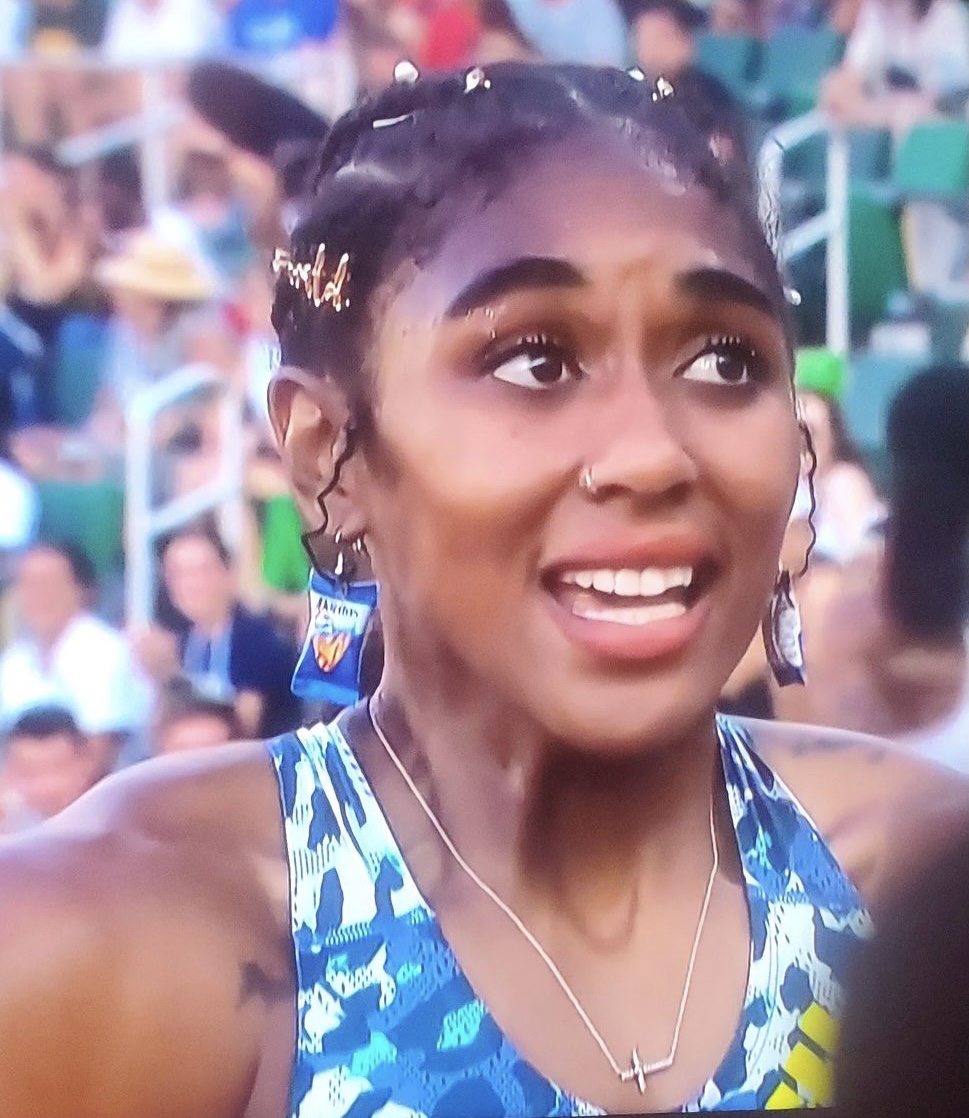
Oooh girl. Look at those Cool Ranch Earrings. Fire.

Baseball’s Sticky Issue, Explained

I know Phil covered this two weeks ago, but I have been wanting to write about this story for a few weeks. However, with each passing day came new developments, and I felt like I needed to wait until there was some resolution before putting it all together. Well, there hasn’t exactly been a resolution, but enough has happened that it does seem like it’s time to recap it all, before it gets too big to boil down to a few hundred words (if we’re not already there). So hold onto your butts – here we go.

Back on May 7, just one month into the baseball season, we wrote about the insane strikeout rate across MLB. April 2021 saw over 1,000 more strikeouts than hits. For context, before May 2018, there hadn’t been a single month in MLB history with more strikeouts than hits. In fact, before 2020 (a two month season), there had never been an MLB season with 1,000 more strikeouts than hits. Again: this year, we saw that in the month of April alone. 

There had been rumblings over the last year or two, if you were interested in finding it, that the increased strikeout rate was largely due to an increase in both velocity and spin rate. And if you were really paying attention, you’d have seen articles like this one last fall, from friend of the blog Eno Sarris, suggesting the increased spin rate and thus the increased strikeout rate were due to the increasing usage of “sticky” stuff by MLB pitchers. 

Officially, the use of a foreign substance by a pitcher violates MLB Rule 8.02. Unofficially, MLB didn’t seem to care (once again creating their own crisis, ahem steroids) until this week. As a result, the use of grip enhancements over the last few years exploded. From an article by Eno last year:

A large majority of big league pitchers right now are using some sort of extra-grip substance to impart more spin — and therefore more movement — on the ball. That’s the consensus of nearly 20 major league hitters, pitchers and pitching coaches who spoke to The Athletic in the last month. The median answer was more than three-quarters of the league, but five respondents thought the portion was much closer to 100 percent.

“Almost everyone is using something,” said a coach with experience in several major league organizations.

“My guess on total MLB players using some sort of grip enhancement … 99.9 percent,” said another coach who has worked with multiple major leaguers.

The use of grip enhancements, and their effect on spin rate and thus a pitcher’s effectiveness have been an open secret in baseball for years. In 2018, Gerrit Cole and Jason Verlander saved and resurrected their careers, respectively, when they were traded to the Houston Astros. Cole’s college teammate Trevor Bauer very publicly called out the Astros, and thus Cole and Verlander, for their sudden increased spin rate. 

Bauer is not really wrong about what happened to Cole’s spin rate when he got to Houston:

Cole’s four-seam spin rate went from 2,164 rpm in 2017 in Pittsburgh to 2,379 rpm in 2018 in Houston — a difference of 215 rpm. It increased again to 2,530 rpm in 2019, and has averaged 2,552 rpm in 2021.

As Eno notes, Bauer commented publicly about grip enhancements repeatedly that year:

“For eight years I’ve been trying to figure out how to increase the spin on my fastball because I’d identified it way back then as such a massive advantage,” Bauer himself wrote in a piece for The Players’ Tribune. “I knew that if I could learn to increase it through training and technique, it would be huge. But eight years later, I haven’t found any other way except using foreign substances.”

It wasn’t for a lack of experimentation.

“I’ve tested all sorts of different stuff in the lab up at Driveline,” Bauer told Jordan Bastian in 2018. “I sat down with a chemical engineer to understand it. At 70 mph, when we were doing the tests, spin rates jumped between 300-400 rpm while using various different sticky substances. The effect is slightly less pronounced at higher velocities — more game-like velocities — but still between 200-300 rpm increase. So, that’s a lot of the research we’ve done. We’ve done it with multiple test subjects. … And those are the results we found.”

For his part, Bauer seemed to see that there would be no enforcement of rule 8.02 and decided if he couldn’t beat ‘em, he’d join ‘em. As noted by the Athletic:

Bauer’s own fastball spin rate has increased by about 400 rpm since 2019. He won the NL Cy Young award in 2020 and signed a three-year, $102 million contract with the Dodgers ahead of the 2021 season.

Curious, huh. The connection between spin and strikeouts is fairly conclusive. Here are two charts from Eno’s article:

Basically, the sticky substance allows a pitcher to grip the ball better and spin it harder. The more a ball spins, the more it breaks. The more it breaks, the harder it is to hit. The harder it is to hit, the more swings and misses, the more strikeouts – and, thus, fewer balls in play. 

Grip enhancement has always been used in some form – scuffing, rosin mixed with either sweat or sunscreen. But the newest technological enhancements created stuff that was stickier than ever before, the most notorious of which in recent weeks was a product called Spider Tack.

Two weeks ago, Phil covered an article Eno wrote about Spider Tack in April. Eno set up an experiment where a former major league pitcher tested various grip substances. When the pitcher used Spider Tack, his spin rate jumped twenty five percent compared to using a sunscreen and rosin mixture. That is a lot. 

As Phil also noted, Spider Tack was developed by a former Strongman competitor who, until a reporter recently called him, had no idea his product was being used by MLB pitchers. It was developed to help Strongman competitors carry gigantic friggin boulders. Here’s a promotional photo for Spider Tack:

Now, look, I love baseball. But strikeouts are rarely exciting, at least en masse. We want to see hits. We want to see good defense. We want to see running. We want action. Dudes waving blindly at pitches they have no chance to hit is not great. The game is moving ever closer to the three true outcomes: home run, walk, strikeout. That’s kinda boring. And boring is bad for business. So, as the strikeout rate hit never before seen levels this year, and as more and more reporters discussed the use of grip enhancements, there was suddenly an outcry to ban this stuff. Players, like Gerrit Cole, were being asked after games if they used the stuff. Cole stammered and didn’t answer, thereby seemingly admitting his use.

So, this month, MLB moved quickly, announcing that by this past Monday, the rule would be enforced:

Under the new guidelines, any pitcher who possesses or applies foreign substances in violation of the rules will be ejected from the game and automatically suspended in accordance with the rules and past precedent. Suspensions under Rule 3.01 are 10 games. Starting pitchers will have more than one mandatory check per game, and relievers must be checked at the end of the inning when they entered the game or when they are taken out of the game, whichever comes first. Typically, the inspections will take place between innings or during pitching changes to give the umpires ample time to perform a thorough check without delaying the game.

Many pitchers were furious. The Rays’ Tyler Glasnow, for example, blamed an injury to the lack of grip enhancement – without the enhancement he had to create more torque in his arm, and he partially tore his UCL (which usually means Tommy John surgery). And he has a point – MLB didn’t enforce this rule and he has pitched for multiple seasons with grip enhancement. Then suddenly, mid-season, they pulled the rug out from under pitchers with very little warning. Glasnow doesn’t seem unreasonable in asking that they had been given an offseason to prepare for Life After Spider Tack.

As for what the lack of grip enhancement will do to the game, it’s too early to tell. We don’t have enough data yet to draw big conclusions. But following the announcement, and even before the enforcement, there have been many reports of pitcher spin rates dropping drastically. It remains to be seen if pitchers will find a way around this. Notably, most hitters who have discussed the topic publicly said that they’d like pitchers to use something to ensure control and thus hitter safety. 

On the other hand, as The Ringer’s Michael Baumann theorizes, maybe the rule enforcement does nothing:

More likely, pitchers will continue to operate as usual, and offenses will continue to suffer. Pitchers aren’t dominating solely because they’re rubbing the inside of a watermelon rind before every inning; foreign substances are just one component of a deliberate leaguewide developmental program. Technological advances and engorged modern bullpens allow teams to teach any Tom, Dick, and Harry they pull off a Big 12 mound how to throw 98 miles an hour and unleash a devastating slider with iffy command for 60 innings a year. And when such effort results in torn elbows and shoulders, that pitcher can be discarded and another plucked off the vine. In the land where every pitcher is José Alvarado, the GM with the most José Alvarados is king. Cleaning pitchers’ fingers won’t solve all those structural issues.

One thing we can say is that the new pitcher checks have given us some high comedy – most notably from Max Scherzer and Sergio Romo, both of whom looked for a second like they were about to take their pants down in an exaggerated effort to show compliance with the umpire check. Here’s Romo’s:

I’m saving Scherzer’s episode for Video of the Week but I implore you to scroll down and watch it, because it gets the Jomboy treatment and when I watched Scherzer demanding that the umpire rub his hair to show that he had nothing in it but sweat, I howled laughing so hard that my wife texted me from down the hall to ensure I was ok because she was worried about me.

Also, this Tweet had me chuckling.

One other interesting twist. I had wondered last week whether the use of substances like Spider Tack had a negative effect on home run rates due to increased drag on the ball. I asked Eno Sarris on Twitter, but he didn’t have an answer. As it turns out, my hunch may have been correct:

So, not only might the elimination of grip enhancements reduce the swing and miss rate, it may increase the distance a given batted ball travels. The effects of the enforcement of this rule are unknown, and that’s pretty exciting.

*exhale*

Ok, I think I covered it all. I hope you enjoyed the trip. I will be on the lookout for articles collating the data on all of this and will report back once we have some ideas on the real effects. -TOB
Source: ‘Almost Everyone is Using Something’: Getting a Grip on How MLB Pitchers are Cheating,” Eno Sarris, The Athletic (11/09/2020); Spider Tack is the Stickiest Stuff in Baseball’s Foreign-Substance Controversy. Its Inventor Had No Idea,” Stephen J. Nesbitt, The Athletic (06/07/2021); What Will Happen After MLB’s Sticky Stuff Crackdown?Michael Baumann, The Ringer (06/17/2021)


Disc Golf Is The Future

For athletes on the fringe, at least. 

So much of my time and energy, as it relates to sports, focuses on the most popular and well-known sports and athletes. Football, Basketball, Baseball, Hockey. Yes, I’m curious about fringe sports, too, but my viewing basically comes down to those four (of course, add soccer to that list for international popularity). Odds are, you’re the same, which is why professional athletes in these sports make so much money: the general public accept these sports and their respective stars as part of mainstream culture. 

But, in today’s world of social influencers, there’s money to be made for the fringe (and amateur) athletes. You only have to look to Paul McBeth. He plays disc golf. He recently signed a $10M endorsement deal, guaranteed. Again, the dude plays disc golf. 

Let’s start here: McBeth dominates his sport. A “Tiger Woods of…” type dominance. Not only has he won a bunch of tournaments that I’m told are important (how the hell would I know what constitutes a major in disc golf?). McBeth has won over $500K playing disc golf. Not too shabby.

More importantly—and worth of the Tiger comp—the size of the prize purse has increased 5x. 

But that’s just a piece. Per David Gardner in his story from The Ringer: 

But except to a subset of hardcore frisbee fans, his more impressive accomplishments have come away from the course. In February, disc golf manufacturer Discraft announced it had extended McBeth’s endorsement deal to a guaranteed $10 million over 10 years. McBeth also has sponsors for other disc golf gear, such as grip equipment and bags, and owns part of a company called Foundation Disc Golf that produces both products and content. He has deals outside of disc golf equipment too, with the likes of Adidas and Celsius energy drink. According to 2019 data from the athlete marketing platform Opendorse, only about 70 athletes in the world make at least a million dollars a year in endorsement deals. McBeth’s endorsement income from Discraft alone puts him on par with Bears linebacker Khalil Mack, Jazz guard Mike Conley Jr., and Astros pitcher Justin Verlander.

McBeth has carved out a lucrative career in a niche sport, in part as an athlete and in part as an influencer. He isn’t alone in using this blueprint. Competitors in sports ranging from bowling to lacrosse have been able to amass riches by building their brands—and growing the games they love along the way. 

McBeth has about 93K subscribers to his YouTube channel, plus an additional 172K on instagram. He posts tons of videos, many of them with over 100K views. Most importantly, he’s also selling products – discs, hats, clothes. The following video is boring. I encourage you to not finish it, but I share it to notice what they are doing – filling orders and running through inventory and filling orders. They are running a small business.

In my assessment, social media is primarily a shitty addition to society (or maybe we’ve used it in a primarily superficial and shitty way) but this is an example of it bringing something fun and interesting to the table. McBeth, and so many other athletes from fringe sports, can find an avid and sizeable following on Instagram, TikTok, YouTube, etc.. Take it from someone who works in the marketing arm of a company: people with 6-figure followings can earn 5-figure checks for posting about a brand or product. And while that might sound lame, it’s actually pretty powerful for McBeth, Olympic athletes, or even ‘amatuer athletes’ in college who can/will be able to make money off of their name and likeness. 

While you and I definitely do not know Jason Belmonte (bowler) or Chloe Mitchell (NAIA volleyball player), they’ve amassed some serious followings on social media, and that can mean real money from brands trying to connect with that all-powerful 18-24 demographic (or even younger).

 “To millions of kids, TikTok and YouTube are mainstream entertainment. They don’t watch TV,” says Taylor Lorenz, who covers social media, Gen Z, and influencers for The New York Times. “Sometimes you need to get onto TV to get credibility with boomer CEOs. But for individuals, you can often monetize better on your social media.”

This was a great read that helps explain where sports are heading, especially for college athletes. Simply follow the money, as they say. It’s interesting to see new inroads of cash flow in the sports universe. A great read. – PAL 

Source: The Rise of the $10 Million Disc Golf Celebrity”, David Gardner, The Ringer (06/21/21)


Joey Votto Continues to Rule, A Story in Three Tweets

One:

Two: 

Three: 

Lol, that’s the good shit. -TOB

Source: Abigail’s Mom on Twitter (06/20/2021)


The Playoffs, In Four Shots

Just jumping into the NBA Playoffs? Then you’ll be surprised to learn all of the favorites are gone and your next champion will be one of the following: Clippers (0 titles), Suns (0), Hawks (1, in 1958), Milwaukee (1 in 1971). 

Don’t sweat it, though. Ben Cohen has done something very smart and easy to digest in his article: he’s highlighted one shot each team has to make in order to have a chance to win. For the Bucks, Giannis has to hit his free throws. I don’t mean that like the dude at the bar yellin “gotta hit your free throws” at the TV. I mean, the defense the Hawks can play against the Bucks is dependent upon Giannis’ free throw percentage. 

Cohen writes: 

More important is what happens when the ball finally leaves Antetokounmpo’s hands. He was a 68.5% foul shooter this season—in his previous two MVP seasons, he shot 72.9% and 63.3% from the line—but he’s dipped to 53.8% in the playoffs. At that rate, the Bucks yield 1.08 points per possession when Antetokounmpo gets fouled, which is lower than their average offense in the regular season and playoffs. To put it another way, fouling him is smart defense. 

It’s how the Hawks can take the best player on the other team and diminish him to his worst skill. 

For the Hawks, it comes down to Trae Young and his floaters. If he’s hitting that shot between the foul line and the basket, then a rim-running Clint Capella becomes a much bigger threat on offense. For The Suns, it’s the ugly step-child of the modern NBA: the mid-range jumper (turns out, it’s not a bad shot after all, as long as you have dudes that can make ‘em). For the Clippers, it’s the…uh, it’s the Clippers; no one cares. 

In all seriousness, I really liked this breakdown of one shot per team and how making it unlocks other aspects of the game, making the team much harder to defend. Good stuff. – PAL 

Source:Alley-Oops, Free Throws and the Biggest Shots of the NBA Playoffs,” Ben Cohen, The Wall Street Journal (06/23/21)


Videos of the week

PAL: This brought joy to my morning. It’s the perfect Eddie Rosario clip.

Tweet of the Week

Song of the Week: George Harrison – “Behind That Locked Door”


Like what you’ve read? Follow us for weekly updates:

Email: 123sportslist@gmail.com

Twitter: @123sportsdigest

Facebook

Instagram: @123__sports


Week of June 11, 2021

Tom Ammiano earned this varsity letter in 1958 and received it 50+ years later. Read why it matters so much that he received it here.


Pulling for Smooth

Earlier this week, Giants play-by-play announcer, Duane Kuiper, released a statement saying he would be missing some games as he undergoes chemotherapy for an unspecified illness. I was surprised by how the news stopped me. Friends and family, people we actually know and love dearly get sick all of the time; why did the play-by-play guy’s illness leave me dazed?

After a moment, it’s obvious, right? These announcers are voices in our lives nearly every day for six months. We do know them. They are in our family rooms most every night, stuck with us in traffic, the background conversation at any true sports bar that will have the audio on with the game. 

Duane Kuiper, a.k.a. ‘Smooth’, and Mike Krukow have been here with me since I moved to San Francisco in the summer of 2004. They are, without question, they best baseball broadcast duo I’ve ever heard. There’s so much I could say about the nuance to the mastery of them calling a game together, but the best compliment I can give is this: My wife loves them and so do I. The two of us watch Giants games very differently, and yet these guys somehow have the perfect tone for a very casual viewer in her and someone that has an in depth understanding of the gamer. They are the very rare combo where both the play-by-play and color commentator are former players.

While it comes as no surprise, I was nodding along as I read Bruce Jenkins’ column, which included a handful of fans trying to summarize why they love Kruk and Kuip so much.

Constance Prodromou, acupuncturist and energy healer at the Marin Health Empowerment Center (of course she is): 

But they’re just the best in baseball with their wit and wisdom, always sharing great stories about the game and explaining things beyond the play-by-play. I feel like I know so much about them from their work. If I ever got to meet them, I could talk to them as longtime friends.

Ann Walsh, a retired schoolteacher/PG&E employee: 

There’s just something about the chemistry between Kruk and Kuip, they cover all of the bases. Even when I’m at the games, I bring my earphones in case there’s something I need explaining. Problem with that is, people around you think you’re the bible (laughs). Like, ‘What did Duane say? Do you agree with him?’

I couldn’t agree more with bartender Nick Shapiro when he says, “That’s one of the great things for me — they are the perfect combination of being homers, yet objective. You know where their heart lies, but they call it straight.”

There’s a massive fanbase sending good vibes Duane Kuiper’s way. Join us! – PAL

Source: “‘I know Duane feels it’: Mike Krukow, Giants community rallying behind Kuiper”, Bruce Jenkins, San Francisco Chronicle (06/08/21)


The Great Substance Debacle in MLB

Let’s get you up to speed: Pitchers in MLB are using this stuff called Spider Tack to increase the grip and, more importantly, revolutions on the baseball. It makes a huge difference. Imagine a batting glove that allowed a hitter to increase good contact by 25%. That’s pretty much what’s happening with pitchers and spider tack: a 25% improvement.

Pitching is dominating baseball this year. I mean, did you read TOB’s summary about the 6 no-hitters that have already taken place this season, or did you check out that Jayson Stark story I wrote about a few weeks ago detailing how hitters are striking out at a historic rate, and singles and doubles are disappearing from the game?

Offense other than home runs is quickly fading away from the game, and MLB baseball is not a great product these days. Some can blame the prevalence of defensive shifts. Or there’s launch angle for hitters and the general ambivalence they have to striking out? And then there are pitchers throwing damn near unhittable stuff. 

Baseball knows it has a problem, because they are experimenting with all sorts of crazy solutions in the minors (moving the mound back one foot, banning spider tack, regulating shifts to name three experiments taking place). They’ve taken even a step further, attempting to now regulate Spider Tack use in MLB – mid-season. For a couple of baseball junkies, this is a big story, so I wanted to share a few of the more interesting reads on the topic. 

For a general overview of what the actual hell is going on with pitchers using substances (which they’ve done forever), check out this story from Ken Rosenthal and Eno Sarris. It breaks down how Spider Tack is a departure from the usual grip suspects and why it matters so much. It’s a meat & potatoes story on what’s going on and why it’s important. Here’s one nugget:

This revelation has a chance to help baseball navigate this difficult space. For pitchers who are truly just looking to grip the ball and avoid hitting batters, there’s a de facto grip substance that cannot be policed and is readily available. For pitcher looking to increase their spin rate by 500 RPM and their breaking ball stuff by a third, baseball can provide the fines and suspensions it takes to reduce the steady advancing march in league spin rates.

Baseball doesn’t need to do a thing about sunscreen and rosin to arrest this trend, it turns out. Just getting rid of the highly engineered tacky substances might very well be good enough.

And for Spider Tack origin story (spoiler alert: invented by a strongman competitor to help keep a grip on those atlas stones), check out this piece from Stephen Nesbit. Here’s a fun bit:

A little amateur sleuthing leads to a LinkedIn profile, then another, then an address, then a phone number, and then I’m cold-calling a pharmaceuticals lab on the outskirts of Denver. The woman who answers the phone patches me through to the lab’s president and CEO, Mike Caruso. He is willing to talk. He is a retired strongman, once one of the strongest men in America. At 40, he’s still so muscular he looks like he could crush a baseball with his hands.

This is the man who invented Spider Tack.

And he is confused about why I’m calling. When I ask Caruso what he thinks about his tacky — that’s the term among strongmen and strongwomen — becoming the talk of baseball, he answers cautiously.

“This is news to me,” he says. “I had no idea it was popular in baseball.”

Of course, there are other variables at play besides Spider Tack. As Hall of Famer Rod Carew outlines in this podcast summary, hitters are reluctant to strategically respond to the defensive shifts (other than try to hit homers). Yes; Carew sounds a bit old in this approach – because it’s not like teams are playing 3 infielders on the one side of the infield when speedsters like Byron Buxton or Billy Hamilton hit – but the broader point is correct. Hitters do need to counter the defensive strategies of the day, but it has to be said that is one hell of a task.

Hitters react to what the pitcher throws; pitchers and defense dictate the terms of engagement so to speak. Carew talks about too much guessing going on. And he’s probably right, but I have to wonder if that’s because these dudes are all throwing 100 with nasty off-speed that’s moving a third more than usual, thanks to that spider tack.

Carew:

I think the shift is overrated, and I’m disappointed in the players who don’t try to take advantage by making adjustments to go the other way. So many kids in today’s game are guessers. They’re guessing what the pitch is going to be instead of learning how to track the ball and then having an idea of what they want to do with it. I learned how to track the ball by trying to pick the ball up out of a pitcher’s hands and reacting to that instead of trying to guess along.

So there you have it; an abbreviated guide to what’s cooking with this spin rate spider tack story in baseball. – PAL

Sources: How the difference between sunscreen and advanced grip substances could help MLB navigate tricky enforcement landscape”, Ken Rosenthal & Eno Sarris, The Athletic (4/21/21); “Spider Tack is the stickiest stuff in baseball’s foreign-substance controversy. Its inventor had no idea”, Stephen Nesbit, The Athletic (06/07/21); “Rod Carew: Pitchers have always cheated; hitters need new approach”, Michael Rand, Star Tribune (06/09/21)


Pick A Winner

Love the premise of this story from Tyler Kepner: of all the thousands of prospects selected in the Major League Draft, which player turned out the best for his team? 

For the purposes of his story, Kepner uses WAR as his measurement (Wins Above Replacement accounts for hitting, baserunning, defense. It also takes into account position, era, and ballpark). And by that measure, Mike Schmidt (30th pick)was the best selection in the history of the draft (the first amatuer draft was held in 1965, with Rick Monday going to the Cubs).

It helps, of course, that Schmidt played all 18 years with the Phillies while amassing 3 MVPs, 10 Gold Gloves, 500+ home runs and over 1500 RBI (and a lot of strikeouts, but we’ll give him a pass).

Kepner’s story then goes on to share the legend of the scout who discovered Schmidt: Tony Lucadello. 

And while Kepner describes Lucadello as a scout who would’ve  “fit well in the early scenes of ‘Moneyball,’ where graying scouts talk about “the good face” and the sound of the ball off the bat”, he also signed 52 players who would make it to the bigs over his career. At the time, in 1980, that was more than all of the other Phillies’ scouts combined. 

I have no feelings about Mike Schmidt one way or the other. He was just before my time as a baseball nut, but I liked the idea of the story, and the details of how Mike Schmidt was discovered. Good read. – PAL

Source: The Greatest Draft Pick Ever”, Tyler Kepner, The New York Times (06/06/21)

Video of the Week

Tweet of the Week

Song of the Week: Steve Forbert – “Romeo’s Tune”


Like what you’ve read? Follow us for weekly updates:

Email: 123sportslist@gmail.com

Twitter: @123sportsdigest

Facebook

Instagram: @123__sports


Week of June 4, 2021

Looking for an alternative to a game of only strikeouts or homers? college softball and baseball are pretty great alternative to the MLB game. Unseeded James Madison just pulled off a huge upset over #1 Oklahoma in the College World Series. 


Where Do You Fall On Coach K?

News broke this week that the upcoming college basketball season will be Mike Krzyzewski’s last at Duke. That will be his 47th season coaching college basketball, which means he’s been a sports figure for my entire life and then some. In fact, I remember watching Laettner hit the buzzer beater against Kentucky in the 92’ Elite Eight with my future brother-in-law and all his college friends that road tripped to Minnesota from Omaha for a U2 concert.

We know he’s won more than any other men’s college basketball coach. The 12 Final Four appearances, 97 NCAA tournament wins, 5 national titles, and a winning percentage north of 75% for about a half century makes for an unparalleled resume. 

What’s perhaps equally incredible is how ‘Coach K’ built a wholesome, moral reputation of the student athlete line of crud when, at least for the second half of his career, he’s basically followed the same path less desirable coaches and recruited players who were never going to stay for the full college experience like Laettner and Bobby Hurley (Grant Hill, of course, left early), or even for a full academic year. It was a transactional relationship on the players’ way to the NBA, and that would be fine if he didn’t feel the urge to pontificate about the way things ought to be/the way things were back in his West Point days under the choker Bobby Knight. 

So he was incredibly successful. Iconic in a way only coaches can attain in college sports, and he lectured journalism students about why their questions sucked…that’s why you have these two headlines posted in the days after his announcement: 

From The Ringer: “Coach K Built A Basketball Empire”

And from Defector: “See You Later To The Butthead”

I thought it would be fun to pull two selects from these articles trying to encapsulate the same legend.

Michael Baumann (The Ringer):

In achievement and longevity, Krzyzewski transcends his contemporaries and should be regarded as a figure of world-historical sporting import. He’s in a class with Roy Williams and John Calipari, yes, but also Pat Summitt and John Wooden, and the likes of Bill Belichick and Sir Alex Ferguson. These are epoch-spanning, history-bending figures, viewed in their own corners of sporting history as fathers of empire, like George Washington or Charlemagne.

Albert Burneko (Defector)

He is also, inarguably, the greatest self-promoter in the college game’s history, a thin-skinned and viciousbully, a sanctimonious scold, and petty soreloser who has (mostly) successfully portrayed himself as a humble and principled educator and molder of honorable men over the nearly half a century during which he reaped fortune and acclaim beyond measure off the work of unpaid laborers. 


I’ll leave you with this: I am very skeptical of anyone that announces a retirement before his/her last season, thereby welcoming a farewell tour. It’s such a lame and thirsty move. – PAL


Sources: Coach K Built A Basketball Empire”, Michael Baumann, The Ringer (06/02/21); “See You Later To This Butthead”, Albert Burneko, The Ringer (06/03/21)


The Playoffs Are Now LeBron-less

The Suns eliminated the Lakers in the first round of the playoffs, and for what seems like the first time in my adult life, LeBron James will not be playing in the NBA Finals. The Lakers weren’t a playoff team in 2018 – the rebuild was still in process for LeBron’s first year. Other than that, LeBron teams have shown up to the Finals every year since 2011. Incredible. 

Last year, he and Anthony Davis, the most talented sidekick LeBron’s ever had, blitzed through the bubble playoffs, but injuries to both Davis and LeBron proved too much this go round, especially . 

At 36, LeBron is 18 seasons into his career. Tack on the equivalent of 3.24 seasons in playoffs games played to that, too. What he’s done to stay as healthy and athletic as he has over that amount of time, wear and tear is far more impressive to me than Tom Brady standing in the pocket playing QB at age 43.

After a first round loss, the first time in his career a LeBron team hasn’t advanced past the first round, folks are dying to write the “Father Time is undefeated” story about LeBron. Few writers are as perfectly equipped as Ray Ratto is to handle such a tired storyline and make it actually stand out as worthy to share. Ratto does a nice little trick here: he writes the father time story, but warns people about being too quick to put LeBron in that category. Smart. He’s saying LeBron’s not there…yet, so he can write about the athlete being passed his prime without saying he’s passed it. 

Ratto starts with the following: “The end of the LeBron James era has been prophesied for years, which is the main reason it has been so remarkable—the sheer number of years that everyone has been wrong.”

LeBron’s was still one of the five best players in the league this year – so smart, so strong, so athletic (still), but in an era when all contenders have multiple all-NBA players, LeBron can no longer get by with anything less that top tier talent sharing the load. Anthony Davis was a force in the playoff run last year, but he’s an injury magnet. He went down with another (aggravated a recent injury) within minutes of this game, and the Suns pounced. 

Gone are the games in LeBron’s career when he can pretty much beat a great opponent by himself. Instead of looking to the future, as Ratto does, this Suns loss has me appreciating even more how incredible it was to watch a 2018 LeBron bully his way to 51 points against the stacked Warriors (Curry, Durant, Klay Thompson, Draymond Green), nearly stealing the first game of the series against one of the best teams ever assembled.

Look at that. He’s going schoolyard on the Warriors. Forcing his way to whatever shot he wants. Dominant. 

So while it makes sense to ponder what comes next for LeBron after the Suns loss, I am less interested in that than I am interested in remembering how incredible he’s been. – PAL 


Source: Rome Didn’t Fall In A Day”, Ray Ratto, Defector (06/04/21)


Video of the Week

Tweet(s) of the Week:

Song of the Week: Flamin’ Groovies – “Shake Some Action”

Like what you’ve read? Follow us for weekly updates:

Email: 123sportslist@gmail.com

Twitter: @123sportsdigest

Facebook

Instagram: @123__sports


Holly is sweet, and simple. Like a lady baker. I- would not be surprised to find out that she had worked in a bakery before coming here. She has that kind of warmth. I’m pretty sure she’s baked on a professional level.

-Michael Scott

Week of May 15, 2021

They won’t chase her down: Olivia Fehringer (PAL’s niece) gritting her teeth to a district championship in the 800 (2:28:50) and the 1600 (5:39:30). Photo c/o Nate Tenopir

Breaking Rules Pays Out

File this under “Did you know?” While I’m sure some of our esteemed readers understand the rules of betting on a horse race, I did not, so I was fascinated to learn more once the news broke about the Kentucky Derby winner, Medina Spirit, testing positive for betamethasone. The results from a second test (taken at the same time) are still pending. Also, horses can have betamethasone (for swelling in joints), just not within 14 days of a race. 

So what happens to all those bets placed on Medina Spirit (12/1 odds) or, more interesting to some, the second place finisher, Mandaloun (27/1 odds) or all the parlays? 

Short answer: once the race is called official at the race, the money starts exchanging at the track and all over the internet. There’s no going back. Regardless of the second test result, according to the betting world, Medina Spirit paid out as the winner. 

Some historical context from Victor Mather: 

The only other time a Derby winner was disqualified, the result for bettors was different. In 2019, Maximum Security crossed the line first but — importantly, before the results were announced as official — was ruled to have interfered with several other horses.

Normally a race is declared official in a few minutes. Even when the stewards look at a possible infraction it usually takes only five or 10. That year, perhaps because of the importance of the Derby, there was a 22-minute delay while the incidents involving Maximum Security were looked at from every angle. In the end, Maximum Security was disqualified for coming off the rail and impeding the path of the horses chasing him. Country House was declared the winner.

This is an odd one. It makes complete sense why the bet pays out, and yet – the winning horse (a bit of a longshot at 27/1) will very likely not pay out as a winner.

Make to click on the link to read more historical context from Mather.  – PAL


Source: A Derby Winner’s Drug Test Won’t Affect Any Bets. Here’s Why.”, Victor Mather, The New York Times (05/10/21)


Tim Duncan’s Bank Shot

Duncan was inducted into the basketball hall of fame last night, which was no surprise to anyone who’s even had a passing interest in the game in the last 30 years. Duncan was first team All-NBA (top player at his position) 10 times. Add to that 3 Finals MVP awards, 2 league MVP awards, and – oh yeah – 5 NBA titles.

His Spurs coach, Gregg Popovich summed it up more succinctly to The Ringer’s Yaron Weitzman:

“No Duncan, no championships,” Popovich said when asked to summarize Duncan’s career. To this day, he added, he and his coaches kick off team dinners by raising their glass to Duncan. “Thank you, Timmy,” they say.

Duncan’s signature offensive weapon was the bank shot. In short, the shot had fallen out of fashion by the time Duncan came to the league as a prized prospect from Wake Forest. He used it, and he abused defenders with it, starting in training camp with NBA MVP and future hall of famer David Robinson. 

“We really couldn’t believe what we were seeing,” Avery Johnson, the Spurs’ starting point guard at the time, said in a phone interview. “Tim dominated David, who I thought was a pretty good defender.” Johnson chuckled. “It got to the point where Pop had David spend the rest of training camp on Tim’s team.”

That scrimmage against Robinson was the beginning of 18 years of Duncan brilliance, earning admiration from his peers along the way. 

About the bank shot, Al Horford said this:

“You knew he was going to take it, but there was nothing you could do about it,” Horford said. “It was like Kareem [Abdul-Jabbar’s] skyhook.’’ But it was more than just Duncan’s trademark shot—it represented everything that made him great.”

And Brian Scalabrine pointed out another strength of Duncan and his bank shot: it could put a stop to an opposing team going on a run.

“It was different. He’d only score 25 but it would feel like 40. Anytime you’d go on a run, Pop would call for the ball to go to Tim in the post and they’d always get a bucket. It was just impossible to build any momentum against them.”

Weitzman does a really good job mixing the origin story of Timmy’s bank shot with his broader impact on his team with this piece. A fun read about a unique athlete. – PAL 

Source: Take It to the Bank”, Yaron Weitzman, The Ringer (05/13/21)


Further Update: Drew Robinson Goes Deep

Man, I love this story. -TOB


Video of the Week

I love this – Jomboy giving some love to an umpire who had one hell of a game.


Tweet of the Week


Song of the Week: Bob Dylan – “Main Title Theme (Billy)


Like what you’ve read? Follow us for weekly updates:

Email: 123sportslist@gmail.com

Twitter: @123sportsdigest

Facebook

Instagram: @123__sports


I can’t stand your water! I don’t even know what to say. It’s like I a took a straw and put it into a frog’s ass! It makes me sick. I want to barf every time I get near it. I can’t stand the smell, I can’t stand the color, and I cannot stand the taste. I can’t take it anymore!

-Marty ‘Funkman’ Funkhouser

Week of April 23, 2021

To quote the legendary Duane Kuiper, “Am I hallucinating, or is that a rabbit at the game?”

Peak Steph Curry 

Steph Curry is the first player I ever saw who made me question everything I ever thought about basketball. His ability to create space and splash a three, or do so when he didn’t even have space, was unparalleled and was incomprehensible. If I had to guess, I’d say he’s the player I’ve written about most in the seven years we’ve been writing this blog. 

But the last few weeks Curry took things to another level – determined to get this undermanned squad, which might be the worst in the NBA if he was not on it, into the playoffs has him going full supernova. The numbers are staggering – in one five game stretch he hit ten 3-pointers four times. He’s his ten 3-pointers more times than anyone in history and second place is Klay Thompson, with five. In his career. Curry did it four times in a week!

But as Dan Devine puts it, it’s never about the numbers with Steph. 

It’s in the Houdini-ass ability to escape straitjackets with a live dribble, to squeeze through barely there openings like smoke through a keyhole to create the space to rise up. It’s in the fact that everybody in creation knows what’s coming—that Steph coming off a screen to pull is a certainty—and yet he still keeps getting to that shot.

In May 2018, as the Kevin Durant–era Warriors were on their way to a second straight NBA championship, Jared Wade described the difference between Golden State’s two iconic talents like so: “KD will put 8 points on you every quarter forever in his sleep. Steph, in under five minutes, will have you questioning the reason you ever decided to play basketball.”

I missed that line about KD and Steph but goddamn if it’s not perfect. Steph Curry is a national treasure, and he is, somehow, underappreciated. Nothing in sports is better than Steph Curry on fire. Nothing. -TOB

Source: There’s Nothing Quite Like the Magic of Steph Curry,” Dan Devine, The Ringer (04/20/2021)

PAL: How about this: I am shaping my Friday night around watching a regular season NBA game of a team that has a losing record. Curry is shooting as well as he did when he led the 73-win team. 

He led the league in scoring only once before: in the 2015-16 season, when he propelled Golden State to an NBA-record 73 wins and made history as the first player to unanimously win Most Valuable Player honors. Five years later—at age 33, without Klay riding shotgun, with Draymond Green having lost a step, without the Iguodalas and Livingstons and Barbosas and Boguts who helped make those Warriors go—Steph is producing at nearly that exact same level

He has no real help, he’s shooting more, and there’s a very slim chance the Warriors win if he doesn’t have a big night. And yet, the percentages are damn near the same. 

TOB says there’s nothing better in sports than Curry on fire. I agree, and I love how Devine puts it: 

Nothing else feels like it does when Steph becomes wreathed in flames and just starts experimenting, exploring the studio space to see how far he can push the boundaries of what we understand to be true about how the ball finds the net. It’s what we’re searching for night after night—the moment that makes you leap out of your seat and start speaking in tongues, the fleeting glimpse of forever we hope against hope we might catch every time we tune in.


Patrick Marleau Surpasses Gordie Howe

The previous record of games played in the NHL was held by Mr. Hockey, Gordie Howe. 1,767 NHL games. This week, the legend was surpassed by Patrick Marleau. Bay Area folks recognize Marleau, a long-time Sharks player, but I’m guessing many of you won’t recognize the name Marleau. 

In this story, Scott Burnside shares quite a collection of tales from former coaches, players, and friends. By all accounts, the quiet kid from rural Saskatchewan is loved and respected by pretty much everyone. Hell, even his wife admits that the kids would say he’s the nicer of the two. 

I liked this story because, while Marleau has been a very good player for over 20 years, he’s never been a star. I know the Ripken comparisons came to mind for me, but Ripken won 2 MVPs, was a 19-time All-Star, has over 3,100 hits and 400 home runs; he was a better baseball player than Marleau is a hockey player. But that’s kind of the draw to this story. I enjoyed reading about a very good player (but not great) surpasses a legend like Howe in some way. 

He first played in the NHL when he was 18 with the Sharks. He lived with Kelly Hrundley and his family. Hrundley was 37 and winding down his career. Marleau became the older brother to Hrundley’s daughters. Hrundley described having the kid in his home and looking out after him as “one the highlights of my last years in the NHL.”

After home games, the two would drive home together and Hrudey’s wife, Donna, would make a late meal of sandwiches or warmed-up leftovers.

“And we might sit up till 2 or 3 or 4 in the morning,” Hrudey said. “We just learned everything about each other.”

That season, Marleau and Hrudey were up on Christmas Eve putting together a Barbie camper, complete with stickers and all the tiny pieces, to make it just so. And a basketball hoop outside. And there was a gift from Marleau to the entire family, a DVD player, under the tree as well.

The Hrudeys weren’t charging Marleau any rent and he wanted to show his appreciation with an appropriate gift, one that included a DVD of a live Fleetwood Mac concert that he knew would be appreciated by Donna and Kelly.

That’s just one of many great anecdotes from Burnside’s piece. It’s a feel-good read for sure. – PAL

Source: ‘I’m just playing. I keep playing’: Understated Patrick Marleau is breaking an unbreakable record”, Scott Burnside, The Athletic (04/19/21)

TOB: Like Donny, I am out of my element here. But I want to push back on your assertion that Marleau was not a star. There is certainly some Bay Area bias here. Well, bias isn’t the right word. But even as a non-hockey fan, I know the name Patrick Marleau very well, by proximity, so I was surprised to read you say he’s not a star. So I put my research pants on and here is what I have to offer:

  • Marleau has the second most goals among active players.
  • Marleau is 23rd all time in goals. 
  • Marleau has the 4th most points among active players.
  • Marleau is 50th all time in points. 

Hockey Dash Reference Dot Com lists his most similar player, by the numbers, as Joe Nieuwendyk. That’s Hall of Famer Joseph Nieuwendyk to you, Phil. Other players on his “Most Similar” list include Hall of Famers Ron Francis, Dave Andreychuk, and Adam Oates. 

Now, I am an admitted Cal Ripken, Jr. Hater. I’m a charter member of that club, in fact. Never liked him. Selfish. Overrated. Cared about his streak more than his team. Spent 2/3 of his career as a league average or worse hitter. Spent almost his entire career as a below to well below average defensive shortstop and refused to move to third. 

With that being said, you can take the two Ripken MVPs and shove ‘em. In 1991, it should have been Frank Thomas. In 1983, it should have been George Brett. Ripken had just THREE seasons in the AL’s OPS top 10. Meanwhile, Marleau had two seasons in the top 10 of goals per game.

So, I think your initial comparison was spot on. Two very good players who enjoyed incredibly lengthy and healthy careers. One of them was and is severely overrated. The other is severely underrated. 

For the record, I would have also accepted a Derek Jeter comparison.

PAL: Marleau has been an All-Star 3 times in a 20+ year career. I’ll concede the stat comparison w/ Ripken wasn’t the right approach – because both dudes are going to collect the stats playing 20+ years – but consider this: the closest Marleau got to winning the Hart Trophy (NHL MVP) was 9th.

When we talk about stars, there’s a popularity element to that. A collective recognition of that guy. It’s clear Marleau is revered by players and coaches, but a star he is not. 

TOB: Back to the topic at hand – I had no idea that Marleau was about to pass Howe’s record, or that anyone would ever come close. Congrats, Patrick!


Why the Controversial “Super League” Made Many American Sports Fans Shrug

On Sunday, twelve of the biggest, richest, and most successful soccer teams in Europe announced the formation of the so-called Super League: Arsenal, Chelsea, Liverpool, Manchester City, Manchester United, Tottenham, Atletico Madrid, Barcelona, Real Madrid, AC Milan, Inter Milan, and Juventus. By its name, I assumed they were actually leaving their domestic leagues and forming one big league where the best teams would play each other year round. This didn’t sound altogether terrible to me. When Barcelona plays Manchester City, I might tune in. When Barcelona plays Seville, I’ll find something else to do. However, my assumption was wrong.

Instead, the Super League’s intent was to supplant the Champions League, whereby the top teams from each European league from the previous year play a tournament throughout the course of and on top of their domestic league season. There’s a group stage, followed by a knock out tournament, and at the end the champion of champions is crowned. It’s fun!

What I soon learned, after reading quite a lot, is that the Super League does not improve on the Champions League. Instead it was a cynical power and money grab by the top teams attempting to ensure they remain on top, while minimizing their effort to do so. Here’s Defector’s Billy Haisley explaining:

This format follows the logic of the foundational principle of the soccer pyramids the world over, which is the idea of promotion and relegation. The best teams earn the right to compete with the best teams by beating their competitors, thereby either gaining promotion to the next higher league or maintaining their position in the highest tier, while the worst-performing teams are sent to the next league down to make way for the newly promoted ones. Almost everything in soccer is built around this principle that competition alone determines any given club’s place in the pyramid. The Champions League adheres to this logic by conditioning inclusion in the field with some tangible form of on-the-pitch success; every team in the field must earn its place. This is what makes the tournament so prestigious, so popular, and so lucrative, and it is why the winner can rightfully call itself the best team in Europe.

The Super League’s “qualification” process is much different. “Qualification” for the 20-team Super League won’t be based on on-the-pitch success, won’t be earned every season with blood, sweat, and goals; instead, it will be guaranteed to the 15 signatory clubs that will found it, with five other teams selected by some as-of-yet-unexplained qualification mechanism.

So, basically, the best and richest teams want to guarantee themselves a place in the Champions League instead of having to work for it, and to do so they want to start a new tournament where they write the rules and those rules give them a berth in the tournament, no matter what.

Both Haisley and the Ringer’s Michael Baumann connected the dots fromwhat the Super League was attempting to do to the American sports model, which does not have the promotion/relegation pyramid. Here’s Baumann:

Arsenal and Milan were once near-automatic Champions League participants; now, neither club has qualified since 2016-17, costing tens of millions of dollars per year in prize money, and even more in lost prestige.

That’s not what the American owners of Arsenal, AC Milan, and Manchester United signed up for. Stan Kroenke, the American billionaire owner of the L.A. Rams, Denver Nuggets, Colorado Avalanche, and Colorado Rapids, began a takeover bid of Arsenal in 2007. At that time, the Gunners were at the intellectual vanguard of the sport, three years removed from an undefeated Premier League campaign and just a year and change removed from an appearance in the Champions League final.

Some 14 years later, Arsenal have gone from world power to bougie Newcastle United; Arsenal currently sit ninth in the Premier League table, not only out of reach of Champions League qualification but likely to miss out on the less lucrative Europa League as well. In every American sport, an inferior on-field product isn’t a reason for billionaire owners to make less money—why should soccer be any different?

Haisley argues, however, that the Super League is far worse for competition than even the American sports model.

The Super League is almost like if the Knicks, the Lakers, the Celtics, the 76ers, the Bulls, and the Clippers found it intolerable that they were not guaranteed deep runs in the playoffs every season because other, less historically important teams have done better on the court, and so they were breaking away from the NBA playoffs to form a new postseason, called the Super Finals. The six Super Finals teams promise to still compete in the NBA regular season, but come playoff time, they would be taking themselves, their players, and their fans to the Super Finals, which they claim is now the true determiner of the world’s best basketball team. Also, they are no longer beholden to the NBA’s salary cap, and have first right of refusal to sign the new class of rookies ahead of the NBA Draft. Good luck to the NBA though!

But Baumann doesn’t exactly blame the American owners for bringing the American model to Europe. Instead, he sees the Super League as simply the next step in a 30-year evolution that began with the Champions League, and even the creation of the English Premiere League.

Maybe Europeans are more primed to resist further stratification of sports, but the masterminds of the Super League weren’t completely wrong to think they had a chance at forcing more of it through. They’ve got 30 years’ worth of evidence that European soccer fans will accept it.

The Premier League, as a business entity, came into existence in 1992 so that the richest and most successful clubs can siphon off as much money as possible from broadcast fees—to hell with the rest of the hundreds of clubs in the Football League. UEFA’s club competitions—formerly known as the European Cup and the Cup Winners’ Cup—used to pit domestic league and cup champions against each other on equal footing. Starting with the implementation of the Champions League in 1992, however, national federations have been allowed to enter multiple teams, with richer, bigger leagues sending more clubs to the tournament. And over the past 20-odd years, the format has been continuously tweaked to give bigger clubs a greater advantage and greater share of the loot. (Liverpool made the Champions League final four times from 2005 to 2019, winning twice, while simultaneously being champions of absolutely fuck-all at the domestic level.)

Given that recent history, Baumann was not surprised the world’s soccer powers attempted to pull this off. He is surprised, however, that it failed. Fans across the world, even those of the twelve charter Super League members, came out in numbers to fight the Super League and it worked almost immediately.

By mid-week, the Super League was dead. That’s pretty cool and very European – where protests still work to effect change. -TOB

Source: Why The European Super League Is Evil,” Billy Haisley, Defector (04/19/2021); “The European Super League Never Stood a Chance,” Michael Baumann, The Ringer (04/21/2021)


Who Can You Beat One-on-One, and When: A Fourth Dimensional Discussion

If you’re reading this, you likely know about my now almost 20-year old belief that I could then and could now score one bucket in ten tries on Mike Bibby (remember: Bibby is playing defense just as hard as he did in the NBA, and not extra hard to avoid the embarrassment of me scoring on him – this is an important factor).

Of course, I’m not the only person who thinks I can score on an NBA player – but importantly, I don’t think I can beat Mike Bibby. I just think I can score on him one time in ten. This tells you more about my confidence in both his indifference on defense and my pull up midrange jumper (I got references, just ask), than it does anything else. But the prevalence of cell phones and social media now lets us see that plenty of weekend warriors run into former NBA players at the gym and get their ass handed to them on a regular basis. See, e.g., this viral video involving a high school player getting smoked 11-0 by Brian Scalabrine.

That video inspired a fun NYT article on this phenomenon and you should read it. It explains how hard a scrub like Scalabrine had to work to stay in the NBA so long, and why that means you can’t beat him. As Scalabrine relayed, “Joakim Noah said it best,” ‘Scal, you look like you suck, but you don’t suck.’”

That’s true. He doesn’t suck at basketball. Although I gotta say, while 11-0 is 11-0, Scal basically pulled some ugly bully ball on the guy. He never once made the kid look foolish; he mostly banged his large body into a high schooler and then flipped up an ugly finish. I give Scal a 2 out of 10 for style points. 

So, ok, regular guys can’t beat former NBA guys. I likely can or maybe cannot score on Bibby. But the much more interesting question is this: when does that stop? When is Scalabrine so old that you, at your age right now, could beat him one on one? Before I answer this question I must say that I have adapted it from Lauren Thiesen’s tweet about LeBron, which I saw close in time with this NYT article:

I hemmed and hawed over that one and finally landed on 65-75, with 72 or so being the real over/under. 

But back to Scal. Scal is 43 at present. For the purpose of this question I’m going to assume my back is feeling great. I have watched that video above a few times. Studied it. Watched his moves. Considered his skill. Considered his size. Imagined the toll an NBA career will have on his body as he ages. Imagined the toll his size will have on his body as he ages. Thought about taller, bigger, older players I’ve played against. Finally, I landed on 57. It would be close. 57-year old Scal would score on 39-year old me with some ease, but I also think I would be running circles around him and his creaky knees. 


Source: Why the Worst N.B.A. Player Is (Probably) Still Better Than You,” Sopan Deb, New York Times (04/19/2021)

PAL: Favorite Scal quote from Deb’s story: 

“People don’t understand how a little bit nuts you have to be to sustain an N.B.A. career,” Scalabrine said. “Especially when you’re not that talented. You have to be ready. You have to be up for the fight. You have to be like that every day. And if you’re not, you lose your livelihood.”

For the record, in all the years we’ve had the Bibby debate, I don’t recall the qualification that limited Bibby’s defensive effort. 


Where Do NBA Fines Go?

You could ask that question about every sport. But this article happens to be about the NBA, and it’s a good read. Before we go into where they go, I’d like to take a moment to acknowledge the oft-fined Draymond Green, one of my favorite players, who had this to say about the mystery of where his fine money goes:

“For years we’ve all been told, ‘Yeah, the fine money goes to charity,’ but we don’t hear anything about these charities, we don’t have any say so about these charities. Nor do you ever hear, ‘Oh your fine money went to said charity.’ Maybe that is an opportunity to build a relationship with said charity?

I felt like Wee Bey when I read that. 


Dray is right. This is a real missed opportunity for the NBA to send the money somewhere and say, “This $50,000 to the Boys and Girls Club of Chicago’s South Side is courtesy of Draymond Green, who kicked Steven Adams in the balls.” Draymond arises to applause, steps up to the mic and doubles his own fine. All the people stand and cheer. It’s a really nice scene. 

That daydream aside, though, really – where does it go? 

The Athletic sought to find out. After a player is fined, where does the money actually go, beyond the blanket word, “charity?” Who is helped? Are there children fed, and clothed, or homes rebuilt? Are scholarships awarded?

Through dozens of interviews and data-driven reporting, The Athletic found numerous, flesh-and-blood examples of people who are a little better off because the NBA docked a player’s pay. But when it came down to answering Green’s question — where, exactly, did his money go? — the system is set up specifically to prevent any tracing of an individual fine all the way to an individual charity.

NO. Read the article – the concerns are dumb and Draymond’s idea is smart, IMO. But the answer to the ultimate answer is that the charities are varied and widespread and honestly that’s all that matters. Keep kicking dudes in the balls, Dray. -TOB

Source: ‘I Would Have Never Been in College’: NBA Fines, from Kyrie Irving to Draymond Green, Have a Story to Tell,” Joe Vardon, the Athletic (04/22/2021)

PAL: What a great idea for a story. I never considered where the money went. Never entered my mind until I read the opening. Might I suggest a donation to The Human Fund?


Got Seven Minutes? Treat Yourself and Read This Oral History of Rob Gronkowski’s Time in College

That should be all I have to tell you, but let me add this:

You know how hot it is in Arizona in August. We didn’t have an indoor facility, and it’s 120 every day and this big, huge kid is just like a lap dog. He’d go run these routes and come back panting, his tongue hanging out. We’d shoot a little water in his mouth and he’d line up and do it all over again.

Gronk is basically a golden retriever, and how can you not love a golden retriever? Especially one that turns his apartment into a beer/soap fueled slip and slide and shows his position coach…actually, I’ll stop there. Just read the article. -TOB

Source: “The ‘Monster’ From Club G: An Oral History of Rob Gronkowski’s Arizona Years,” Doug Haller, The Athletic (04/22/2021)


Video of the Week

Tweet of the Week

Song of the Week: David Bowie – “Sound and Vision”


Like what you’ve seen here? Spread the word!

Email: 123sportslist@gmail.com

Twitter: @123sportsdigest

Facebook

Instagram: @123__sports


“I want a decent sock that’s comfortable and will stay on my foot!”

-Justin Pitts