Week of August 10, 2018

https://twitter.com/PatrickRenna/status/1022268165223600130


Why Baseball’s Shift Actually Hurts the Defense
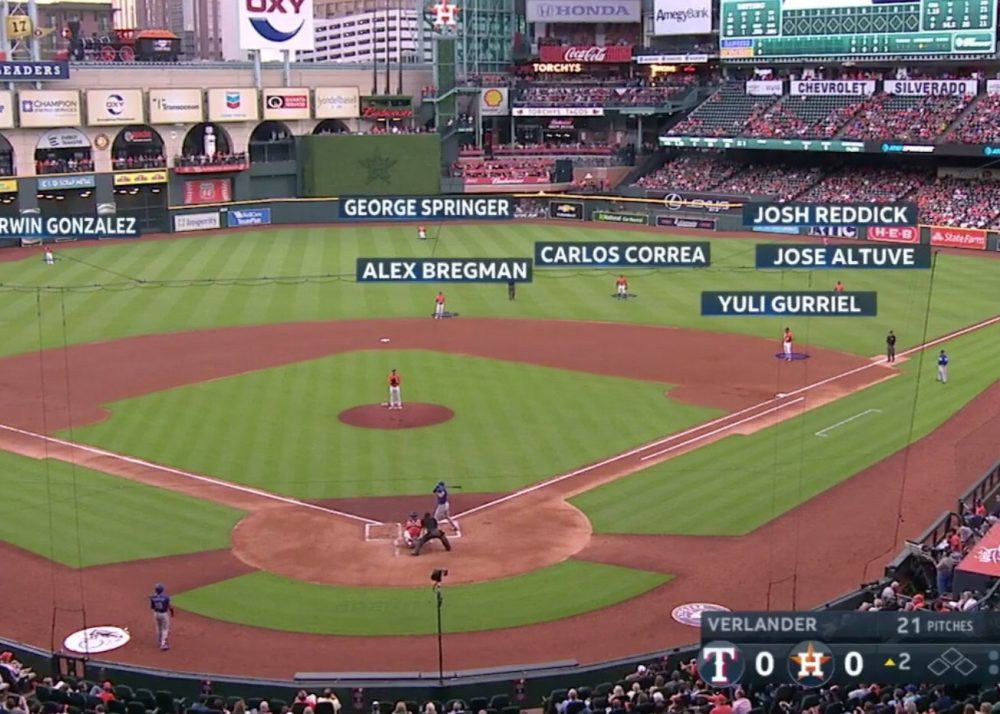
We’ve written a few times about the increasing use of the defensive shift in baseball, as recently as last month. The concept of the shift is simple: For hitters who pull the ball a lot, put more defenders in that area to increase the likelihood of an out. It makes sense, and teams have gone to extremes to use it over the last few years. The story we featured last month involved hitters who face shifts explaining why they insist on trying to hit into/over the shift instead of just slapping a ball to the vacated spot on the opposite side of the infield. Essentially, it’s not as easy as it sounds and it takes the bat out of the hands out of your power hitters.

But, as the use of the shift has soared, so too have the statistics on the shift’s effect. Surprisingly, the shift is actually hurting the defense and increasing scoring, albeit slightly. While the shift does have the effect of reducing BABIP (batting average on balls in play) by roughly 18 points on the most shifted hitters, scoring actually increases when a shift is employed. Two articles I read this week illustrate this.

The math here is pretty interesting, as laid out by Russell Carleton at Baseball Prospectus:

I looked at all hitters who had at least 100 plate appearance without The Shift. If a batter had a .300 BABIP without The Shift, then in the 200 plate appearance that he got in front of The Shift–if The Shift was exactly as good a defense against batted balls as a standard two-right/two-left alignment–we would expect 60 hits from him. If The Shift is a better defense, we’d see fewer than 60. If it’s worse, we’d see more. Now, we know that because of small-sample-size weirdness, you can’t always trust the results you’d get from this sort of analysis on an individual level. But if we sum across the league, we can get a good idea on how The Shift is doing in the aggregate.

We see that the Full Shift “took away” 493 singles, but it somehow gave back 574 walks. It seems that the primary effect of The Shift is to change the way that a batter reaches first base, and it seems that he is standing on first base more often. You can’t throw him out if he gets to walk there.

So why is this happening? A summary from Sam Smith of ESPN:

Even though the shift is good at gobbling up ground balls and line drives, it has the secondary effect of making pitchers throw more pitches out of the strike zone. They don’t appear to be pitching to the shift — by throwing more pitches on the inner part of the plate, for instance — but merely pitching away from contact, nibbling more and throwing fewer fastballs. This all means more balls. More balls mean more walks, and they also mean more hitter’s counts, which means more doubles, more triples, more home runs and fewer strikeouts.

Home runs are also up against the full shift, as the hitter attempts to lift the ball up and over the shift more than he would against a normal defense. Carleton suggests that the issue for pitchers nibbling and issuing more walks is mental, and could be fixed – but until then, he suggests defenses utilize the shift only against the most extreme pull hitters

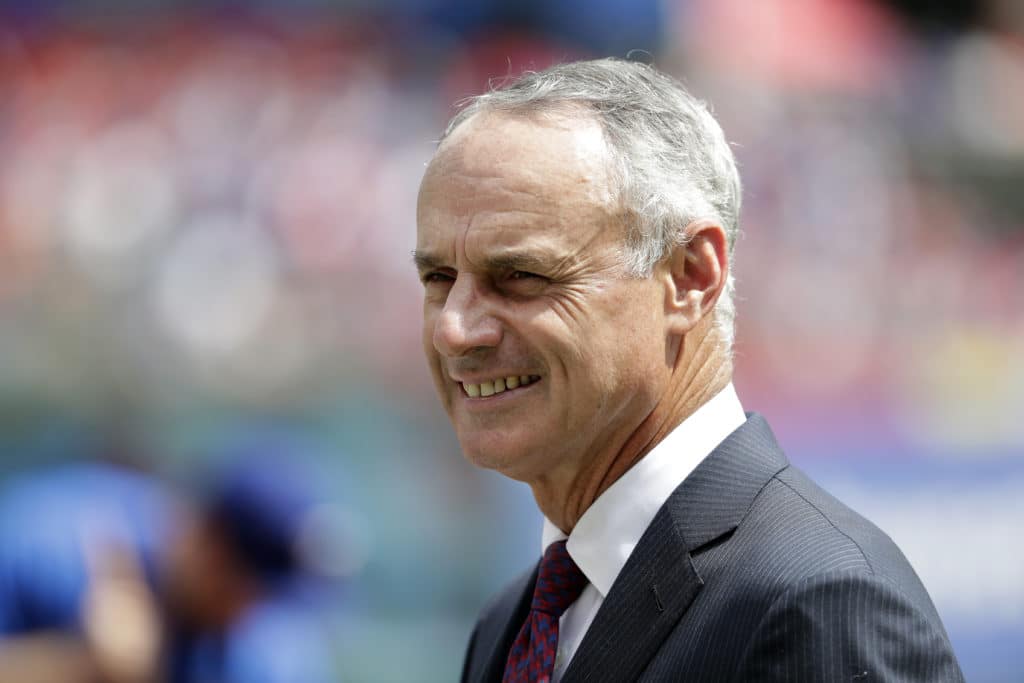
I find this issue most compelling because of the fact some people around the game, including MLB Commissioner Rob Manfred, have suggested banning the shift in order to preserve offense. This always seemed like an overreaction to me. But the numbers show, at least right now, that the shift isn’t decreasing scoring, but increasing it. Just another example of why it’s good to collect data before reacting. -TOB

Source: MLB Myth-Buster: The Shift Isn’t Curbing Runs; It’s Creating Them”, Sam Smith, ESPN (08/07/2018); Baseball Therapy: How to Beat the Shift”, Russell A. Carleton, Baseball Prospectus (05/22/2018)

PAL: No rules banning positioning of players. The game will correct itself, because there’s a competitive advantage in the truth. I was listening to the Dan Patrick Show this morning while walking Max, and a guest pointed out that the split finger fastball wasn’t popularized until the 1980s. The game had existed for over 100 years, and then something different came about and revolutionized pitching. Guess what, it happened again in the 90s with the popularization of the cutter. The shift will be worked out. Either it will prove ineffective, or hitters will have to evolve. In the long-term, these are the cat-and-mouse games that make sports interesting.


Summer Internship: Cape Cod League Broadcaster
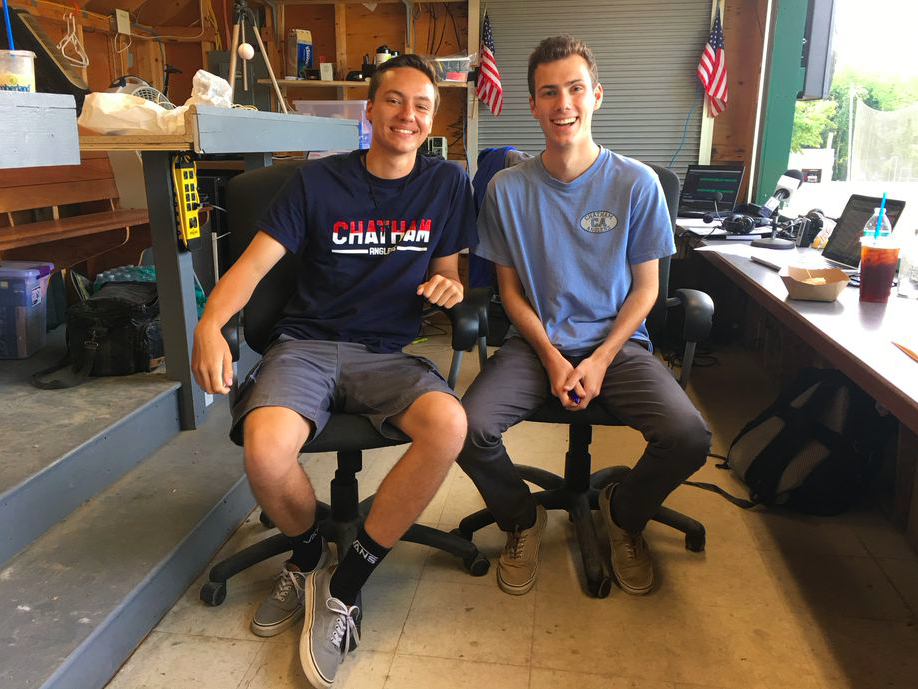
The Cape Cod Baseball League is a wood bat summer league where some of the best college ball players are invited to play. While to the crowd the games might be, as The Ringer’s Bryan Curtis describes it, “a chance to put a capper on a perfectly Rockwellian day”, The Cape League is a serious nesting area for future big leaguers. According to the CCBL, there were 306 Cape Cod alumni in the Majors in 2017. That’s an incredible 25% of all big leaguers after they expand to the 40-man roster.

It’s not just a training ground for players. Curtis digs into the broadcasting internships started by the Vegas Knights radio play-by-play announcer, Dan D’Uva. D’Uva started the internship program with a friend when he was in high school back in 2002, and he continues to oversee the internship program to this day.

There’s a lot to like about this story, but I especially enjoyed reading how serious D’Uva and this years interns, Josh Schaefer and Cooper Boardman, take it. This is about teaching a craft. D’Uva and the boys seem to really have a coach-player relationship. When D’Uva’s in town, they go over the game ‘tape’ just like players do, only their classroom is the pressbox. D’Uva asks which of the two pupils wants to go first, then they break down an inning of announcing from the night before. All of this is focused on kicking the habit of mimicry.

When you attend the Cape Cod finishing school for broadcasters, you don’t just submit to daily critiques. D’Uva is waging a war against baseball broadcasting cliché. Young play-by-play announcers’ heads are filled with clichés: “free pass,” “the bump,” “knock,” “new slab of lumber,” “campaign,” “Hi again, everybody,” “Farewell from …” They use these words and phrases because they think that’s how announcers are supposed to sound.

After calling the first inning against Yarmouth-Dennis, Cooper swiveled around in his chair. “I said ‘clubbed’ three times in that inning,” he announced to the press box. “I don’t know why. I don’t say that.”

D’Uva told me: “One thing I’ll say is, ‘Don’t be a pretender. You’re not acting the part of a broadcaster. You are a broadcaster.’”

Other useful notes D’Uva passes onto the boys include:

  • Don’t say ‘just in the nick of time’ when you can say ‘safe’ or ‘out’. Too many words. Your listener is thinking,‘Spit it out.’”
  • Add the detail of how close the play was AFTER you make the outcome clear.
  • When you say ‘big game in the east division’ and tell me Harwich is leading Orleans, I expect you to then tell me what place those two teams are in and how many points separate them from each other and from Chatham.
  • Tell me what happened.

It’s easy for us to sit back, watch games, and make a comment here or there about the defense or the hitter’s recent hot streak, but it is no doubt craft to call a sporting event. Much like the players, the Cape Cod League will be as good as it gets for a few years if Schaefer and Boardman take the next step in their journey to a big league stadium. They will be calling low minor league games in towns like Elizabethton, Tennessee and Pulaski, Virginia. These are a long ways away from the postcard experience that is the Cape Cod Baseball League. – PAL

Source: “The Cape Cod Finishing School for Broadcasters”, Bryan Curtis, The Ringer (8/6/18)

TOB: Good read, and this was a bit of a flashback for me: I was taught many of those same lessons in my first year law school legal writing class: don’t use the passive voice; be thorough but make your point succinctly. Anyways, their summer sounds like a friggin blast.


 The Most New York Times Sports Article Ever Written

Ever wonder where the phrase “out of left field” comes from? Ever wonder why it out of left field and not center field (seemingly furthest “out there”) or right field?

How about “hands down” or “back to square one”? Your lazy wait is over (I mean, you couldn’t looked these phrases up before now if you really wanted to know).

Here are my favorite three idiom explanations, ℅ Victor Mather:

Back to Square One

As with many terms, there is a colorful explanation of the origin and a more prosaic and realistic one, though both originate with competition.

First the colorful one: When soccer was first broadcast on the radio in the 1920s in Britain, there was concern that fans would not be able to visualize the field well. So the field was divided into numbered squares, with charts published in newspapers. That way the announcer could say, “The ball is passed into Square 4, then dribbled into Square 6,” and fans used to watching games in person would understand what was going on. Square 1 was the area with the goalie, so a pass back to Square 1 would be a restarting of an offensive move.

The Oxford English Dictionary deflates that theory though, pointing out that the term’s use really began in the 1950s, some decades after the soccer broadcasting scheme stopped. It suggests the term actually comes from board games like chutes and ladders, in which players can find themselves sent back to the start.

Hands Down

It sounds like it might be from a card game, but it actually comes from horse racing. When a jockey has a race in the bag, he can relax his hold on the reins and stop urging the horse so hard.

Out of Left Field

In 1961, William Safire devoted a Times column to the topic and put forth numerous ideas, including that left field was often deeper than right in early baseball stadiums, that weaker fielders were put in left and that left fielders tended to play farther back.

A more colorful explanation is that behind the left-field wall at the Cubs’ West Side Grounds, in use from 1893 to 1915, was a mental hospital whose patients could sometimes be heard making bizarre remarks during the game.

One other note of importance: don’t sleep Bill Shakespeare when it comes to sports idioms. He’s responsible for two that made the article – there’s the rub and Wild-goose chase. As you go into the weekend and are wondering what the hell to talk about at tonight’s happy hour or cocktail party, casually bring up that you read this delightful little article in The Times about sports phrases. Just make sure you do so with an old fashioned or Manhattan in your hand. Keep it classy. -PAL

Source: We Use Sports Terms All The Time. But Where Do They Come From?”, Victor Mather, The New York Times (8/6/18)


How One of the World’s Best Sherpas Ended Up Working Retail in Manhattan

This is an interesting look into the life of Serap Jangbu Sherpa, one of the world’s best sherpas, who scaled 11 of the 14 highest peaks in the world, including the most dangerous, K2, twice in one year. Serap retired a few years back, and now works unassumingly in a sporting goods store in Manhattan. The story looks at his young life, how he became a “Sherpa” (which is actually the name of the ethnic group), how and why he ended up working retail in Manhattan, still only aged 49, and tells of some of his most harrowing treks. For a taste, here’s one such story:

Just before midnight on May 11, with four other Sherpas and two Koreans, they started up the North Col from the third camp and arrived at the summit at 11 a.m. They remained on the summit for 90 minutes, then Park and Serap started into Nepal. They climbed down in alpine style, connected to each other only by a thin lightweight rope, seven millimeters thick and 50 meters long.

Serap led, even though he’d never come this way before; he’d only ever reached the summit from the north face. They were climbing blind at 29,000 feet. Coming down the Hillary Step at 12:30 p.m., one of Park’s crampons caught an old rope, and he slid to the edge of the exposed rock face. His headlamp flew off, dropping 8,000 feet to Camp Two.

Serap slammed down his ice axe and tied their rope to the handle. If Park fell, Serap would be pulled off with him.

Serap held the rope tightly; anything more than walking at that altitude felt impossible. After half an hour of wriggling to push himself up, an exhausted Park managed to grab onto a rock for support and with his other hand free his crampon.

A good read! -TOB

Source: The Sherpa of New York”, Ryan Goldberg, Deadspin (07/25/2018)


Imagine Being So Rich You Wouldn’t Miss a $150k Deposit

Tommy Fleetwood is a British Golfer. There’s another Tommy Fleetwood who also plays professional golf, and lives in Florida. British Tommy recently earned $150,000 in the British Open. But the European Tour accidentally sent the winnings to Florida Tommy, who had played in some European events in the past. Oops. Here’s a screenshot of Florida Tommy’s banking app.

https://twitter.com/GregThornerGolf/status/1027246829283540992

Florida Tommy was honest, and alerted the proper people of the error (though it is a crime to spend money accidentally deposited into your account), and British Tommy got his winnings.

This is a bit of an unremarkable story that I normally wouldn’t bother writing about, except for this quote from British Tommy:

“I honestly didn’t know anything about it. I wouldn’t even know if I’d been paid or not because I don’t really look.

Oh, goddamnit. What a rich bastard. “Ohh, I’m sooooo rich that I wouldn’t notice not getting paid $150,000.” Screw you, pal. -TOB

Source: European Tour Sent Tommy Fleetwood’s $150K To The Wrong Tommy Fleetwood”, Patrick Redford, Deadspin (08/09/2018)

PAL: Send the money my way. I’ll notice it everyday.


Video of the Week: 121 MPH exit velocity. Holy crap.


PAL Song of the Week: The Avalanches – “Because I’m Me”


Like what you’ve read? Let us know by following this blog (on the right side, up near the top), or:

Email: 123sportslist@gmail.com
Twitter: @123sportsdigest

Facebook

Instagram: @123__sports


And she is a woman. She is a strong, soft, thoughtful, SEXY woman.

-M. Scott

Week of July 20, 2018

Name that future star. I’m still laughing.


There’s No Game, and That’s a Shame

Most kids I knew growing up liked to play Madden. Every year, they’d buy the game and play for hours. I liked Madden ok. I bought it every few years if I read about a game innovation that was enticing enough. But I was a much bigger college football fan back then, and so my football video game of choice was NCAA Football.

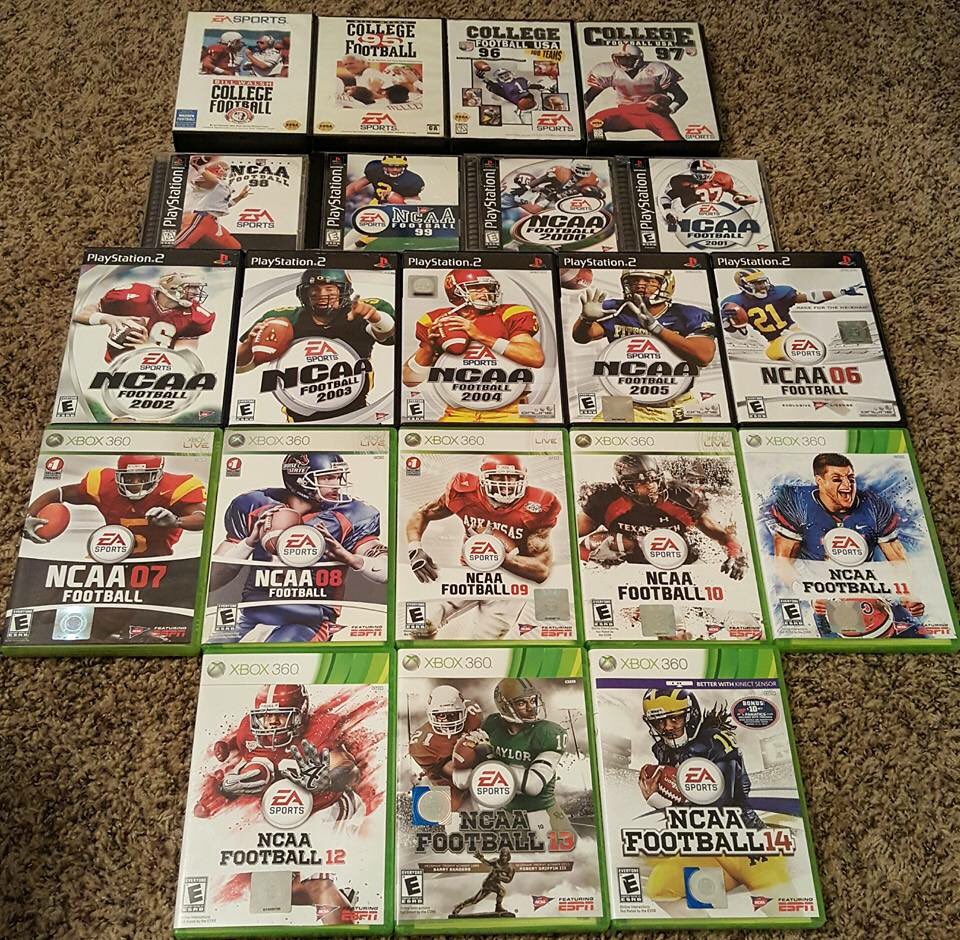
I got the very first EA Sports college football game – Bill Walsh’s College Football for the Sega Genesis. I saved my allowance and got the next three versions when they each came out – Bill Walsh’s College Football 95 and College Football USA 96 and 97. Man, I played those games for hours. As I got older, every three years or so, I’d get the newest version and spend an embarrassing amount of time over the next few years creating the best Cal players, and amassing Heismans and National Titles. I was so good I had to create mini challenges for myself. It was a failure if I didn’t score 100 points or more. Every time the other team scored, I did as many pushups as points they had in the game.

I wasn’t the only one who loved those games. The games came with players with fake names, but characteristically they generally matched the real life rosters. Every year I’d find a message board where people would team-up to rename the players to the names of players actually on the roster. There were around 50 players per roster, and 120 or so teams. And it was not very quick to change a single name. It was an incredible amount of work. Then, they’d make them available and you could download the file to your XBox or PS3, and upload it to the game to use. It was incredibly dorky, but also fun.

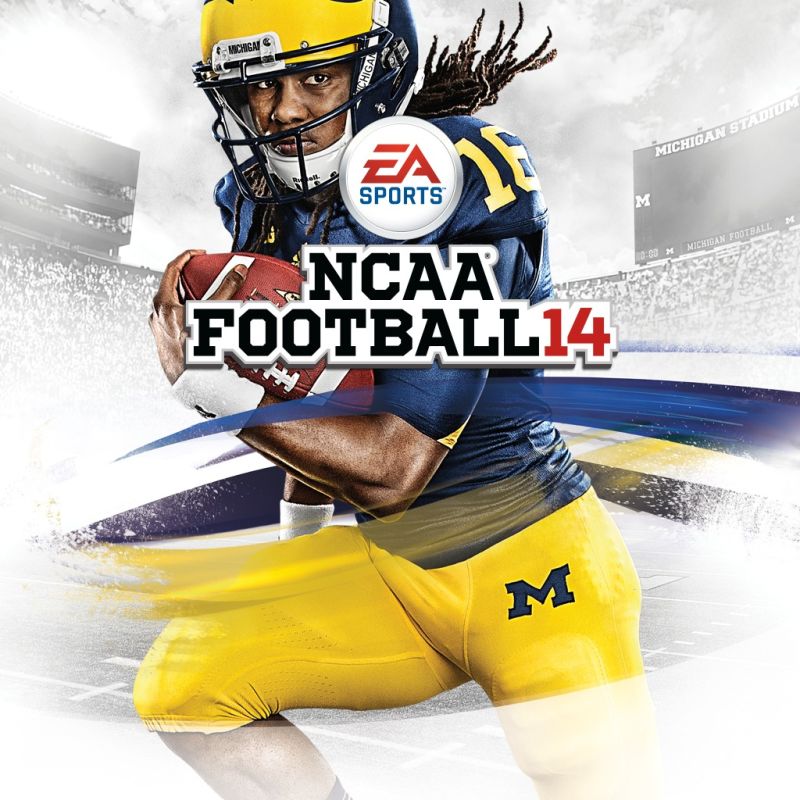
But then the NCAA was sued by Ed O’Bannon for the use of his likeness in the EA Basketball game (as in the football game, it wasn’t “Ed O’Bannon”, but it was the 1995 UCLA team with a player who sorta looked like him, had his number, equivalent skills, etc.). In response, the NCAA revoked its license to EA to use NCAA trademarks (school names, logos, etc.). Without this, EA didn’t see the point of making the game. Just weeks after releasing NCAA 14 with Denard Robinson on the cover, they announced there would be no future versions.

Not that people don’t still play. Hell, it’s almost a collector’s item. On Gamestop right now, it’ll cost you $40 to get NCAA 14, a game 5 years old. By comparison, you can get Madden 17, a game just two years old, for $7. And you can still find the faithful updating rosters every summer for use on NCAA 14. I still download the roster every season and try to play at least a season of games, late at night when the rest of the family is asleep. And every time, there’s Denard Robinson. For college football fans, he will become an icon – the last NCAA Football video game cover boy. -TOB 

Source: Denard Robinson’s ‘NCAA 14’ Cover Legacy, and the One He’s Building Beyond FootballCody Stavenhagen, The Athletic (07/13/2018)


Golf Hero: Big Mama

Friday mornings are fun. Cup of coffee, take a little extra time before getting into work, refine the week’s post, and find the perfect quote for the week. It’s a good way to lead into the weekend. But sometimes that feeling only lasts for a few minutes, because you find new story that definitely would’ve made the post. That is the case with this story.

JoAnne Carner, a.k.a. Big Mama, has long been a legend on the LPGA tour. She’s a more successful, less depressing version of John Daly. She likes her cigarettes, she’s not afraid of a beer or three, and she could really hit it.

Last week, at age of 79, Big Mama shot her age at the U.S. Open, a feat made even more impressive when you consider she hasn’t walked a course since 2004!

The story is more of a headline, but it included this great documentary short about Big Mama that I thoroughly enjoyed:

My favorite anecdote is that she would go to gym where the other competitors were working out, put her beer in the cup holder on stationary bike, and b.s. with the ladies. – PAL

Source: A 79-Year-Old Nicknamed “Big Mama” Just Shot Her Age At The U.S. Senior Women’s Open”, Barry Petchesky, Deadspin (7/13/18)


Serena Lost, and That’s Ok

Serena Williams is the greatest women’s tennis player of all-time. She has won 23 Grand Slams – second only to Margaret Court’s 24. Serena would have likely already passed Court, but she missed the final three majors last year, and the first one this year, because she gave birth in September 2017. But she has returned to the court just a few months later. What’s most amazing is that Serena, at age 35, won the 2017 Australian Open while eight weeks pregnant. I asked my wife, who has twice given birth about that fact, and she deemed it “mindblowing.”

After losing early in the French Open, Serena looked more like herself during the recent Wimbledon. She entered the final with a chance to tie Court, losing just one set on her way to the finals. And then she lost 3-6, 3-6, to Angelique Kerber. Many were disappointed. We wanted history! We wanted Serena, just a few months after giving birth, at age 36, to win the damn thing.

The loss must be painful for Serena, who noted she missed her ten-month old daughter’s first steps while away competing. As Katie Baker points out, for her entire career, Serena Williams has been the best, and thus always has to face opponents giving their best to beat her. During the tournament, Madison Keys, another player, noted that this fact “must suck.” Serena appreciated Keys acknowledging this, saying “That’s what makes me great. I always play everyone at their greatest. So I have to be greater.”

But Baker makes a really great point:

A Wimbledon victory on Saturday for Williams would have been like the 73-9 Golden State Warriors closing out the 2016 NBA Finals in five games, or the 2007 Patriots going 19-0 with a Super Bowl win. It would have been too perfect, too stunning, too broad and borderline-incomprehensible a caricature of success. (What’s worse, it definitely would have inspired people to opine that “women really can have it all!”) What happened instead serves to emphasize just how challenging Williams’s latest quest is, and it adds one more layer of intrigue and nuance to a career that has always been elevated by both.

After tarnishing that 73-9 record, the Warriors went on to win the next two (and counting) titles. After losing the Super Bowl at 18-0, the Brady/Belichick Patriots won two more (and counting) Super Bowls. Serena, too, needs just two more to become the most decorated tennis player, man or woman, in history. What she almost did this month was incredible; I’m betting that Serena takes this loss, uses it as fuel, and once again shows why she’s the greatest of all-time. At least twice. -TOB

Source: Serena Williams’s Latest, Greatest Quest”, Katie Baker, The Ringer (07/15/18)


Exhibition Wins

I love stories that unveil a part of a game that I’ve hardly considered. A lot of folks like to rail on the exhibition of All-Star Games (myself included), but ESPN’s Sam Miller has officially changed my mind with his story. He’s right. I was wrong, and I love how he constructs his story.

He starts with a bunch of teenagers playing a game on a summer afternoon, and the reader is led to believe that it’s just a bunch of friends playing a pickup game at the park. No one’s keeping score, afterall.

These kids were playing not for fun but because there were dozens of scouts and major league execs watching them at a showcase event. Those scouts weren’t all that interested in this game — they were there to see the 17-year-olds — but the teenagers were still trying to stand out. The pitchers were trying to light up radar guns, the batters were selling out for power, the fielders were overthrowing cut-off men to show off their arms, every baserunner was trying to steal. Nobody was keeping score, but this all counted, and it counted mostly to the extent that it would affect some major league team’s chances of winning a World Series someday. The stands were full, and nobody cheered.

“The stands were full, and nobody cheered.” That’s a hell of a visual, and the image is the perfect juxtaposition to look at great moments in baseball that had nothing to do with winning a Major League baseball game.

Barnstorming didn’t count, but it built the Babe Ruth legend across the country during a time when folks didn’t have televisions.

“If you were a pretty good baseball player in the twenties, professional or amateur, big-city or small-town, the chances were pretty good that you played against Babe Ruth at least once in your life,” biographer Leigh Montville wrote in “The Big Bam.” “He had played between 200 and 250 games every year, 154 of them in big-league parks, but the rest in the Dyckman Ovals of America.

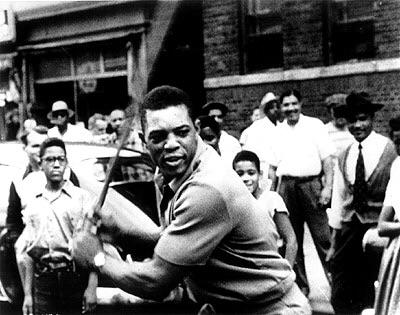
And then there’s Willie Mays playing stickball. As Miller notes, we’ve all seen the picture of Mays playing stickball, but I didn’t know he played all of the time. Before games, after games. Hell, he was almost late for a real game when he lost track of time playing stickball.

There are more current examples in the story, too. Definitely worth the read. Miller is right – baseball’s legacy isn’t only built on professional championships. Some of the best stories from the game are about legends connecting with the rest of us, like Willie playing with the neighborhood kids. – PAL

Source:The Home Run Derby and the beauty of baseball that doesn’t count”, Sam Miller, ESPN (7/16/18)

TOB: I loved that Willie Mays story, too. After I read it earlier this week, I even used it as a bedtime story to my oldest – the latest in a line of bedtime stories about great athletes or teams or games. We had gone to the Giants game a couple days before, and I had even pointed out the Willie Mays statue, so he had some context. I had always figured that image of Mays was a one-off, maybe even a photo-op. The reality is too great. Imagine how many people out there can honestly claim they played stickball with one of the greatest baseball players that ever lived. I now know the number is a lot higher than I would have expected.


What’s Worse than Permit Patty or Karen From HR? Calling the Police After a Hard Screen in Pickup Basketball

I mean, christ. What the hell. If you missed this, you’re in for…well, not exactly a treat. A minor-sounding altercation broke out this week during a pickup basketball game at an L.A. Fitness in Virginia. The story unfolded slowly during the week, beginning with this tweet:

The tweet went viral, and the internet rightly clowned on this dude for calling the cops after a foul in a pick-up basketball game. The best that can be pieced together is that one player, the guy on the right in the picture below, pushed the player on the left. The player on the left retaliated with either a body check or a hard screen. The player on the right got upset, left the court, made the gym staff call 9-1-1, and then threw a hissy fit to the police. By Wednesday, we had the officer’s body cam footage. It’s hilarious.

WHAT A CLOWN. He should NEVER show his face at that gym again. Every time he did, he should be clowned like the clown he is. I wish I could see him so that I could boo him right in his clown face. BOOO! -TOB

Source: Virginia Man Calls Cops After ‘Hard Screen’ In Pickup Basketball”; “Here’s The Police Body-Cam Footage After The Pickup Basketball 911 Call”, Giri Nathan, Deadspin (07/17/18; 07/18/18)

PAL: My favorite part of this is when the employee – pictured on the right in the video – handles the absurd situation as calmly as anyone could hope and suggests that either the two players put the issue to bed and stay at the gym, or they can both leave for the day. GET YOUR SWOOSH ON then complains, “How’s that fair to me? I’m the aggrieved party here.” You know this dude doesn’t re-wrack the weights or wipe down the stationary bike.


84-Year Old Woman Can Talk Basketball Better Than Most Bay Area Dads

The Warriors are obviously really good, and very popular in the Bay Area. They are, thus, a major topic of conversation among Bay Area Dads. Every time I go to an event with other dads, talk inevitably turns to the Warriors and the greater NBA. I’m often amazed at how bad the takes are – the dads like to discuss the Warriors, but most have little idea what they’re talking about (excepting you, Ted).

So it was with great amusement I read this article by Craig Fehrman about his 84-year old neighbor, Iris Clawson. Iris likes puzzles, and her garden, and children. But as Fehrman says, “One day this spring, though, Iris startled me by asking if I’d caught last night’s Warriors-Rockets game.”

Recently Fehrman asked Iris her opinion on the NBA offseason moves, and hers are all the correct ones:

LeBron joining the Lakers? Not a surprise. “He has a mansion out there,” she points out, “so that’s probably why he wanted to go.” Still, she didn’t expect Lance Stephenson to follow. “How will they get along?” she asks. “I guess he’ll have more chances to blow in LeBron’s ear.”

DeMarcus Cousins joining the Warriors? Not a big deal. “They’re in their heyday,” she says, “but they’ll get older, and they’ll fall behind. Nothing lasts forever.”

Technically, Iris cheers for the Pacers. (She still prefers Frank Vogel over Nate McMillan, and Rick Carlisle over either.) But her favorite team to watch is Golden State. “I can’t figure out how Steph can be so small and so good,” says Iris, who, stooped over her cane, is barely over five feet herself. She adores his crazy shot-making, but thinks Klay Thompson and his quick release might be even better. “The ball hardly touches his fingers and it’s headed in the other direction,” she says.

Iris also admires KD, and understands why he left the Thunder. “Durant wasn’t getting the ball enough with Westhead, Westpaul …Westbrook. I had every ‘West-’ but the right one. That’s old age. But I think that’s why he left.”

She finds fears about the Warriors ruining basketball to be absurd. Even if they do grab a third straight title, the NBA is about more than just who wins the championship. How will Blake Griffin and Jimmy Butler adjust in their second seasons with new teams, she wonders. Another question Iris has been mulling this offseason: “How come the Sacramento Kings can’t do anything right?”

“College basketball is too slow,” she says. What she likes about the NBA, and especially the Warriors, is the pace. She roots for ball movement, for rebounds above the rim, for scoring of all kinds. “I like to see the action.”

All of those are the good and correct opinions to have! Which makes sense: Iris is no new-jack fan. She began following the NBA in the 1960s, and her favorites include Jerry West and Dr. J. And more recently Larry Bird, Reggie Miller, and Tim Duncan. I appreciate that, unlike some older people, she can cherish memories of the players of the past while also recognizing the greatness of modern players.

I also love that Iris appreciates actually watching games:

The games really are the thing. Iris doesn’t watch SportsCenter, and she doesn’t get a newspaper or own a computer. Sometimes smaller transactions elude her. (She asked me if Seth Curry had landed with a good team.) She learned about LeBron’s signing from the Indianapolis evening news. But she watches more basketball than ever. Part of it is the Warriors. Their style of play encapsulates everything she loves about the sport.

Iris has trouble seeing the score these days, but she’s going in for an eye exam in August, and hopes to improve her viewing experience. As Iris says, “Basketball will be back in October, and I’ll be watching.” I hope to see as much basketball in my life as she has. Cheers to you, Iris!

Source: “My 84-Year-Old Neighbor Has The Only Good NBA Takes”, Craig Fehrman, Deadspin (07/17/2018)


A Fan in Despair

When you love a sports team, and they suck year in, and year out – you start to wonder why you care. “This is so stupid. They suck. Every year they suck. I need to stop caring.” When the Kings traded DeMarcus Cousins, I swore them off – but that was a lie. I almost immediately talked myself into Buddy Hield, the main piece they got back from the Pelicans. And Hield has been…pretty good. Fine. Not bad! When the Kings jumped all the way up to the #2 pick in the draft this year, and then passed on a potential superstar in Luka Doncic, and instead took (another) power forward with red flag in Marvin Bagley, I immediately began talking myself into Bagley into the next Amar’e Stoudemire. Just two games into his first Summer League, it was clear that this comparison was beyond laughable.

Getty Images/Ringer illustration

And so it was with great empathy that I read this article by Mallory Rubin, a lifelong Baltimore Orioles fan, written after the Orioles dealt homegrown superstar Manny Machado to the Dodgers. Rubin writes about the years of despair she felt at as an Orioles fan, and the hope (and success!) young Manny brought the team.

All-Star Games don’t matter, but since that draft night in 2010, I’ve longed to see Manny start one at shortstop, smile on his face, cartoon bird on his cap. It felt more important than it was—some sort of confirmation, a declaration that the next great era of Orioles baseball really had arrived. In reality, it marked the end. Manny sauntered down the red carpet, hair slicked back, shades on, chest bare. He looked ready made for Hollywood, like someone who was always just passing through.

It killed me. It feels important to note that there are much more pressing things happening in the world—real problems, real stakes, real distress and pain. I know that it’s all relative, that a sports trade is a dust mite in the fabric of the universe’s misery. I know that to some, I sound ludicrously self-indulgent and out of touch. But I also know that fandom isn’t rational, and that sometimes, it can seem impossible to separate what’s logical from what’s in your heart.

There was joy in Manny’s heart on Tuesday night. He answered trade questions diplomatically, conducting himself calmly and respectfully, displaying the maturation the organization long craved to see. He also slipped into speaking about his time in Baltimore in the past tense, his rumored future in L.A. as a guarantee. He took a selfie with Matt Kemp during the game. Every interview question, every comment on the broadcast, every tweet reeked of trade talk and pennant races, blockbusters and California dreams. I felt robbed of the day I’d waited for, bitter that Manny felt more famous after one day under the Dodgers halo than he ever did in the orange and white. I also felt grateful for everything he’d given me, and so desperately sad that I’d never get it again.

Man. I’ve been there. Sports are great. Sports are terrible. Long live sports. -TOB

Source: It Keeps Getting Harder to Believe in Oriole Magic“, Mallory Rubin, The Ringer (07/18/2018)


Video of the Week


GIF of the Week

Click here for more.


Tweet of the Week


PAL Song of the Week – The Zombies – ‘This Will Be Our Year’


Like what you’ve read? Let us know by following this blog (on the right side, up near the top), or:

Email: 123sportslist@gmail.com
Twitter: @123sportsdigest

Facebook

Instagram: @123__sports


Negotiations are all about controlling things. About being in the driver’s seat. And make one tiny mistake, you’re dead. I made one tiny mistake. I wore women’s clothes.

-M.G.S.

Week of July 13, 2018

You get to go nuts when your grandson get a big hit.


Why Baseball Players Try to Hit Over the Shift

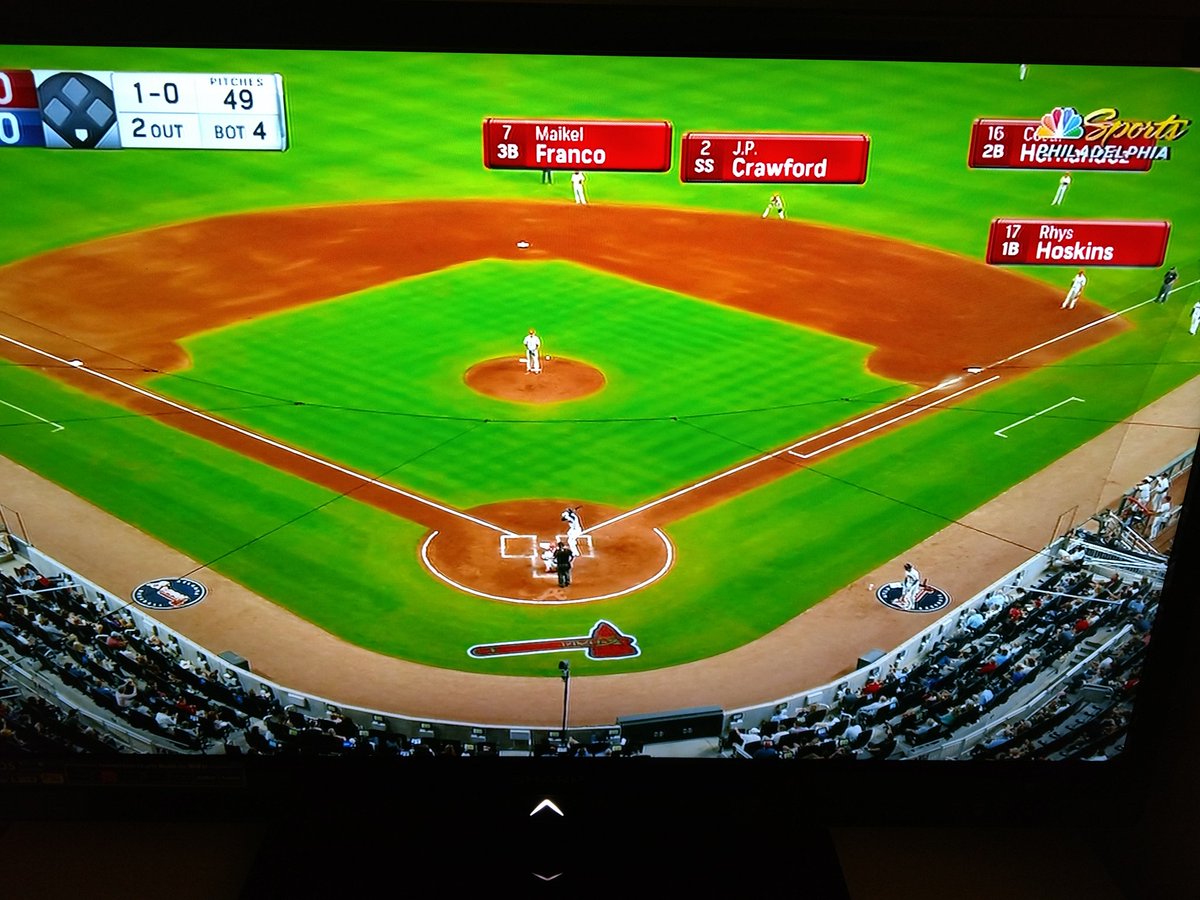
In the last few years, defensive shifts have become very popular in baseball. Hitters tend to hit to their pull-side, and so defenses are shifting a middle infielder to that side to make it harder to get a ground ball through. It sometimes looks like this:

This is a fairly extreme shift. Usually the third baseman stays closer to his spot to prevent a double down the line. But even that normal set up leaves a gaping hole at shortstop. Fans clamor for the hitter to just lay down a bunt or slap a ball to the vacated shortstop position, and then get very frustrated when players hit right into the shift and fail.

So why do players hit into the shift? Why don’t they slap a single the other way every single time? If you check twitter during a game, fans think the hitters are stupid or stubborn or unable. Perhaps there’s some of truth in all of that. But three hitters who face shifts constantly – Daniel Murphy, Kyle Seager, and Matt Carpenter – provide a good explanation.

Here’s Murphy on why slapping a single the other way isn’t all that helpful to his team:

“It’s really difficult to get three hits in one inning. If you hit three singles, it’s one run. If you get a walk and a double, you might get one run. If you get a double and a single, you might get one run. So my goal is to touch second base every single time I step to home plate….I haven’t really stolen bases for five or six years. If I drop a bunt down, what am I gonna do? I’m stuck at first base, so what I’ve done is ask our ballclub to get two more singles, or I’ve asked someone else to hit a double.”

Seager says almost the same thing:

“It goes back to the question of ‘How can I help the team the most?’ Am I going to help the team the most over the course of the season hitting weak ground balls to shortstop [for a single]? I’m not a guy who steals a bunch of bases, so you’re relying on a few hits to score me. If I try to drive the ball and I hit a double, it only takes one hit to score me.”

Carpenter agrees, noting that slapping the ball the other way takes the power out of a team’s best hitters, and adds that it’s not as easy to just slap the ball the other way like fans seem to think:

“Think about which hitters teams shift against. They shift on guys who drive the ball. By trying to hit a ground ball to short — which is the one spot on the infield where you would be able to beat the shift — that’s exactly what they want you to do.

“There’s this whole narrative of ‘Why don’t guys just hit ground balls to short?’ The answer is: (a) It’s not that easy and (b) it’s the complete thing you’ve taught yourself your entire baseball career to avoid. If a guy has a chance to hit a homer and a double, and he goes up there trying to slap a ground ball to short, the other team is perfectly fine with that.”

Carpenter adds that the fan argument that slapping the ball the other way will keep defenses from shifting next time is simply not true:

“As defenders, when a guy comes up and hits a ground ball to short [to beat the shift], we still go to the same place the next time. It doesn’t change anything.”

Frankly, they’ve convinced me. Brandon Belt is one of the best first baseman, both with the glove and the bat, in baseball. Giants fans get on him for not slapping the ball to short to beat the shift. But he’s also the Giants’ best power hitter, leading the team in home runs, RBI, batting average, and more tellingly OPS, Slugging, Isolated Power and OPS+, all by a large margin. If he’s slapping the ball the other way, he becomes Buster Posey (sorry, Buster) or Joe Mauer (not sorry, Joe). So, keep trying to hit dingers, Brandon. Dingers are good. -TOB

Source: MLB Hitters Explain Why They Can’t Just Beat the Shift”, Jerry Crasnick, ESPN (07/10/2018)

PAL: Seager and Murphy mention that a single doesn’t do that much for their team. Murphy says he’s always trying to get to second. Seager says you still need multiple hits to score him from first. It all makes sense, but it makes be wonder if they are undervaluing the power of not making an out?

All of the guys mention how hard it is to aim a batted ball. We assume they can place a hit wherever they want, but all three dudes remind us that hitting a big league pitcher is hard enough without aiming it. Carpenter sums it up like this:

Just think about this: When there’s a runner on third base and less than two outs and the infield is playing back, every hitter in baseball knows that all you have to do is hit a ground ball anywhere, and you score the run. And that success rate is still super small. That play is easy, and it gets screwed up all the time. Guys can’t hit a ground ball when all they have to do is hit a ground ball to score a run.

He’s not lying. Check out this from Fangraphs on scoring runners from third with less than two outs:

Great read!


We Are All Animals

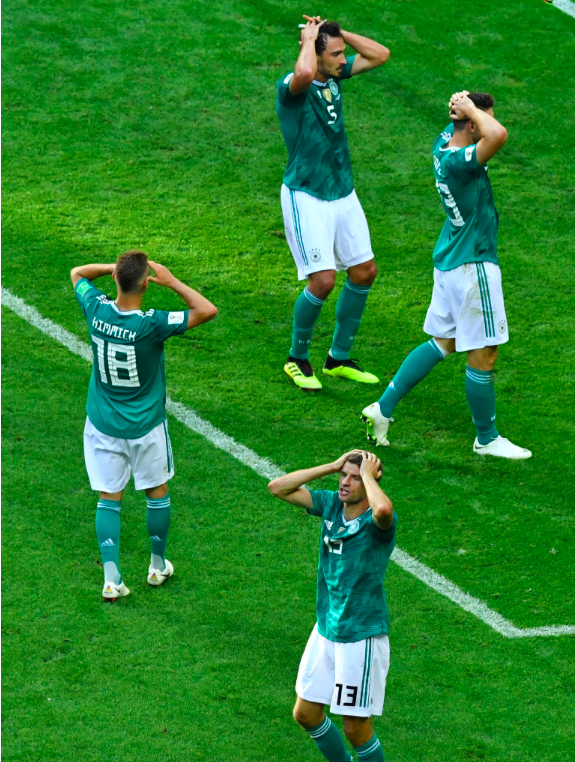
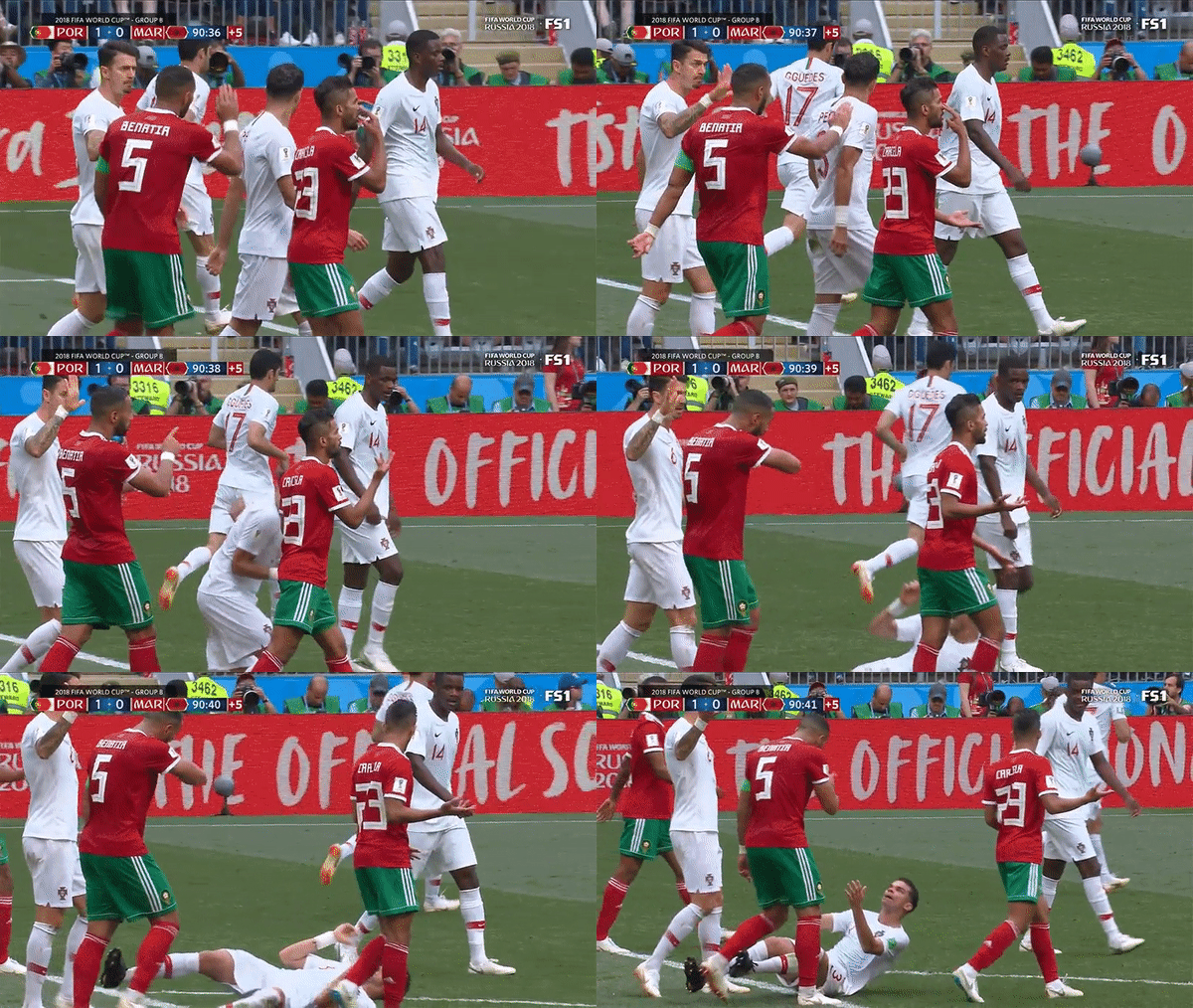
I don’t know about you, but in this era of robots, self-driving cars, and pet-cloning i am reassured when a story reminds us that we’re all just animals trying to survive. That basic instinct hasn’t left us, and one need not look further than the World Cup for proof.

Why do players from all corners of the globe have the exact same reaction when they fail? Why are these reactions essentially the same between sighted and congenitally blind athletes? According to Psychologists Jessica Tracy’s work, the “display behaviors of pride and shame are innate and universal.”

That is such a profound concept, isn’t it? I mean, I may have had a shitty week at work and I may be a little off right now, but I find this assertion about the universality of pride and shame oddly comforting.

Another anthropological explanation that makes sense to me comes by way of Berkeley professor Dacher Keitner (so you know TOB’s on board). “When people get startled unexpectedly, their hand will sort of move up to their head almost in a protective motion. The oldest kind of behavioral intention in that class of behaviors is to protect your head from blows.”

So England’s Harry Kane misses point blank in the semifinal. He feels shame, and – let’s be honest – in that moment at least a tiny portion of him fears for his safety after failing to convert on such a prime opportunity. Think of the hooligans! His hands go to his head. It all makes sense. In that moment of failure I understand Harry Kane. We’re just living life and trying to protect our heads. – PAL

Source: Why Does Every Soccer Player Do This?”, David Gendelman, The New York Times (7/10/18)

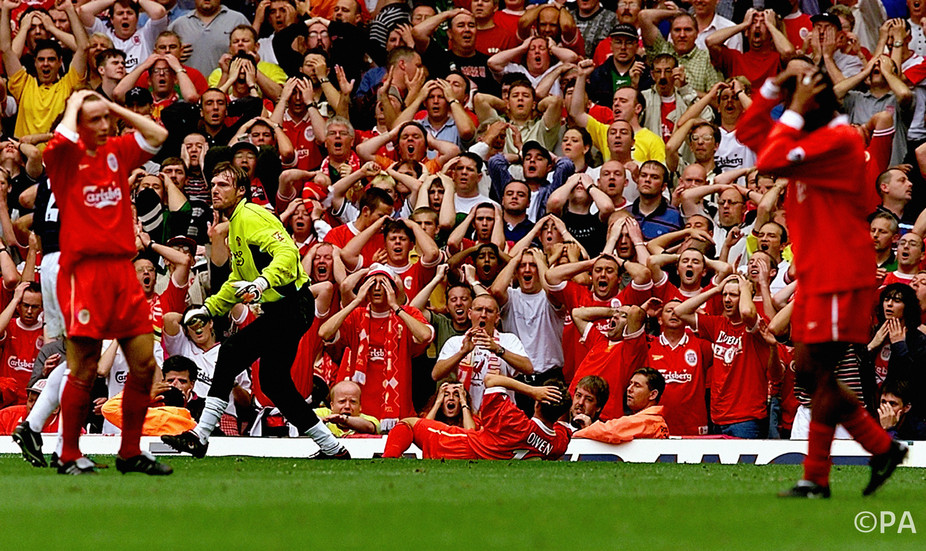
TOB: It’s really quite fascinating. And it’s not just players. You even see it in fans:


Amateur Baseball Is Crazy And I Love It

I’m putting the story link right here so you go read it.

As my Minnesota people know, amatuer baseball is a big deal up there. They get a little nutty about it, and this Patrick Reusse tale captures the quaint craziness of the town ball legacy. Any good town ball story has a good amount of ancestry, takes place in a small town, and features plainspoken but boiling feuds over a game.

This story takes place in Milroy, MN (pop. 243). It’s about the Yankees and the Irish. After every Dolan in town (and there were a lot of them) played for the Yankees since World Ward II, there was a bit of a dustup after a bad season. Joe Dolan lost in on his (adult) players and was out as manager of the Yankees. What did he do? Well, he started a second amateur team in Milroy – The Irish.

Bob spent five years formulating the plan to start a team. He chose the name “Irish,” suggesting it was the pre-Yankees nickname used for Milroy baseball. More likely, it was never an official nickname, but rather a reference to a team with all those Dolans.

Either way, Bob’s new team started by playing a limited number of home games at Southwest Minnesota State’s field in Marshall in 2009. A year later, neighbors Jim and Kathy Zwaschka gave Bob the bargain price of $1,000 per acre for 6 acres on a gravel road near Hwy. 19.

This is their story. Read it! Reusse is a bit of a legend in MN, and these small town stories are his sweet spot. – PAL

Source: Family spat leads to two town ball teams in little Milroy, Minn.“, Patrick Reusse, Star Tribune (7/9/18)

TOB: Look, this was a good read, but I got SO angry at the end when it was revealed the two teams have never played each other. COME ON. That’s crazy.

But, town baseball sounds cool as hell. It reminds me a little of my first road trip as a freshman football player. We drove 250 miles or so to the small town of Winnemucca, NV, population maybe 5,000. It was a Thursday night game, and the JV and Varsity did not play until Friday night. At most freshman games, the parents showed up. Maybe a friend or two, or people waiting for the next games to start. But in the small town of Winnemucca? Damn near the entire town showed up for a Thursday night freshman football game. I love living in the city, but if I lived in a small town, I hope it’d be one that has town ball.

Also, I loved this part:

[Pat] became chiefly responsible for maintaining the legacy of the Dolan double-play combination, playing 22 seasons (1969-90) for the Milroy Yankees, primarily at shortstop. “There was a good reason I stayed at shortstop to the end,” Pat said. “I also was the manager and wrote the lineup.”

Reminds me of someone…


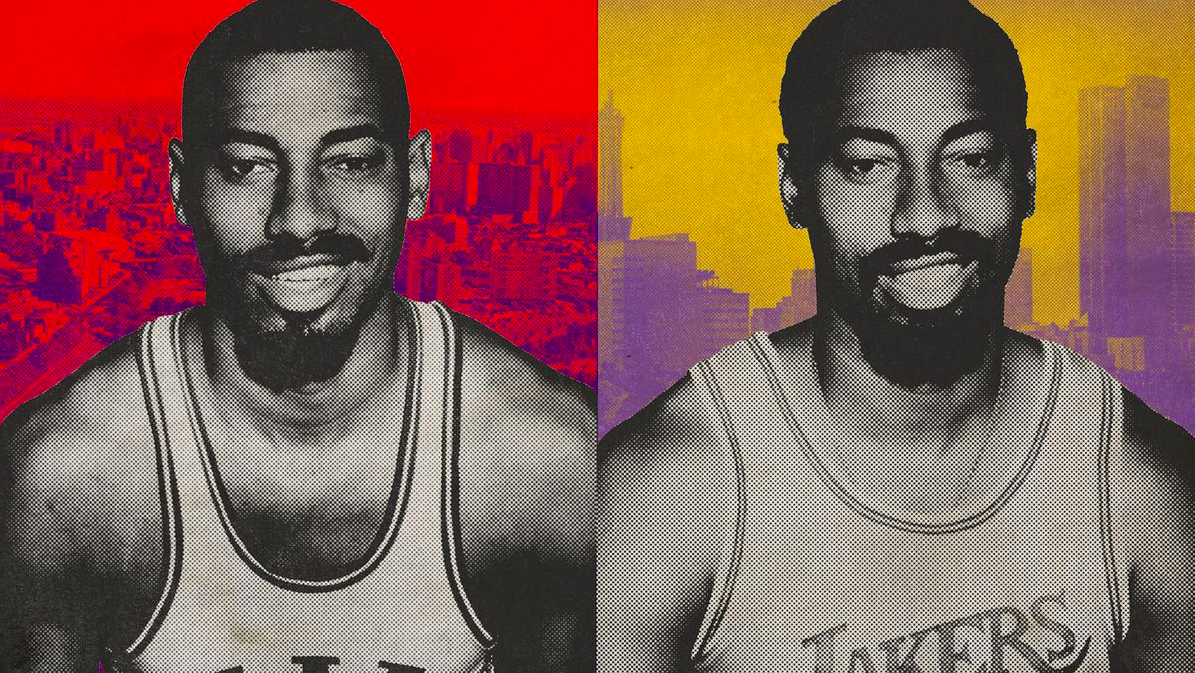
LA Sequel: Wilt and LeBron

Did you hear that Lebron James is now a Laker? I wasn’t particularly interested in this news at first. For one, I was at the cabin last week, but I’m also burnt out on basketball. Then I stumbled upon this Ringer piece, and – goddamn I enjoyed it.

The premise is pretty simple: this is far from the first time a big-time star joined the Lakers, but LeBron is far more than a star; rather, he’s a once in a lifetime player. He’s in the most rarefied of air of all in that he’s the player of a generation (or two). The Lakers have experience with this. They signed Shaquille O’Neal, but even more incredibly, the Lakers were able to acquire Wilt Chamberlain in his prime before the free agency era. Back then players remained under team control, even after a contract had expired, because of the “Reserve Clause”.

The Ringer’s Haley O’Shaughnessy kicks so much ass in writing this story, but I think she does an especially great job reminding us folks under 50 how big of a deal Wilt was and the parallels between him and LeBron (emphasis mine):

Some players are anticipated entering the league; Wilt was predetermined for superstardom. (Sound like any white-suited-up 2003 draft pick you know?) In the book 24 Seconds to Shoot, Leonard Koppett wrote that the league prepared for his rookie season by lengthening the schedule by three games (making it 75), while NBC expanded its coverage into the weekends. This was a 7-foot-1, 23-year-old Harlem Globetrotter out of the University of Kansas playing for his hometown Philadelphia Warriors, with higher expectations and a higher salary. (At a reported $65,000 figure, Wilt was making more as a rook than any player at that time, including established stars like Baylor, Bob Cousy, Bill Russell, and Bob Pettit.)

Before the Lakers, Chamberlain played for the 76ers. The half owner, Ike Richman, was extremely close with Chamberlain. When Chamberlain threatened to retire, Richman promised his star center ¼ ownership of the team upon his eventual retirement. Clearly against league rules, this was a verbal agreement that became messy when Richman died of a heart attack shortly thereafter

The following season, Wilt and Philly finally passed Russell and Boston clear out of the East. And after Philly beat the San Francisco Warriors, he finally brought a championship to his hometown. But there was other losing to account for; Kosloff said he had no knowledge of Richman’s promise for 25 percent ownership and wasn’t going to honor it.

Surprise surprise, this wasn’t going to work for Chamberlain, so he and the other owner struck a new deal. The owner would tear up the last 3 years of the contract in exchange for a one-year deal with Wilt (preventing him from sitting out). The single year deal also had no reserve clause.

You can see how this plays out, but I implore you to read the story. So fun. – PAL

Source: Wilt Chamberlain’s Trade to Los Angeles, 50 Years Later”, Haley O’Shaughnessy, The Ringer (7/9/18)


Video of the Week: 


PAL Song of the Week: Cahalen Morrison & Eli West – “Livin’ In America”


Tweet of the Week: 


Like what you’ve read? Let us know by following this blog (on the right side, up near the top), or:

Email: 123sportslist@gmail.com
Twitter: @123sportsdigest

Facebook

Instagram: @123__sports


Toby is in HR, which technically means he works for corporate, so he’s really not a part of our family. Also, he’s divorced, so he’s really not a part of his family.

– M. Gary Scott


Week of July 6, 2018

Phil enjoying the 4th.


On “In the Jackpot”

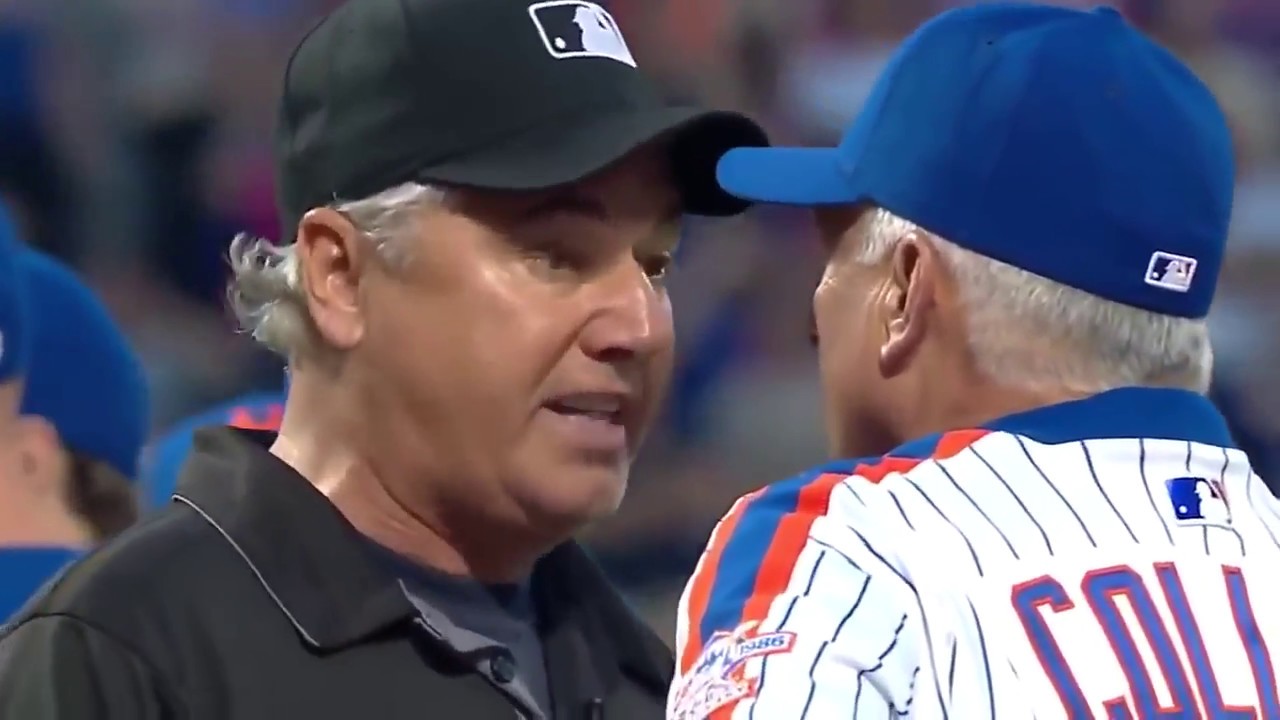
A few weeks back, we were briefly treated to a terrific video, with the umpire’s audio of a 2016 argument between Mets manager Terry Collins and umpire Tom Hallion. It’s not clear why it surfaced recently, but MLB did its best to take it down wherever it could find it.

If you did/do not have the chance to see it, Hallion memorably tells Collins, “If I do that, I’m gonna put my ass in the jackpot.” Viewers were amused and confused. What exactly does this peculiar phrase mean, and where did it come from? Deadspin’s Timothy Burke did some top-notch sleuthing, and this week presented his findings.

Burke notes that it was used in the movie Homicide, based on the TV series and book of the same name:

Tim Bayliss: DID I TAKE A BULLET FOR YOU? I take a bullet for you, and you take a bullet for me – now THAT is square business, Frank!

Frank Pembleton: This is not taking a bullet for you, this is you wanting me to toss your ass in the jackpot! You’re confessing to a murder, Tim, do you understand that?

Tim Bayliss: So you want someone else should take me in? Someone else should bust me…

It also appears in an episode of The Wire.

Burrel: Lieutenant. A moment, please. What happened out there? Did you know they were in the high-rises without backup?

Daniels:  If I tell you yes I screwed up. If I tell you no I’m putting my men in the jackpot. Do you still want me to answer? I screwed up, sir.

Homicide (both the book and the show) and The Wire are, of course, all written/created by David Simon, who wrote them after reporting on the crime beat for years in Baltimore. Burke also found the phrase in blog posts and books by a sociologist, Peter Moskos, who wrote his doctoral dissertation after serving for two years as a Baltimore police officer. Moskos told Burke he’d only heard it within Baltimore police circles, though Burke found it published in a handful of publications not having to do with the Baltimore P.D. As it turns out, Hallion’s father was a police officer in Saugerties, NY. So it would appear to be some sort of passed down cop lingo.

But this doesn’t really explain the origin of the phrase, so Burke kept digging. He eventually stumbled upon what he believes is the answer:

The October 27, 1926 edition of the Baltimore Sun discusses the uncovering of a series of vaults along that city’s Water Street during an excavation. Under the headline “ROMANCE SUGGESTED IN FINDING OF VAULTS,” their purpose is articulated: “Southern planters,” it euphemizes, who were in the paper’s words “a gay lot,” used the pens to house slaves, according to a Civil War general named John R. King who worked at the hotel under which the vaults were discovered.

The master of the slave, according to the story, had put him in the jackpot, a part of the poker game. If the master won, the slave remained his property. If he lost, the Negro became the property of the winner of the pot.

It is not hard to extrapolate from the idea of being housed in an underground vault, your future in the hands of a poker game, to the broader concept of being stuck in a bad situation; it would certainly explain why “jackpot,” usually a word with positive associations, here connotes trouble.

Oh. As Burke puts it, “when Tom Hallion told Terry Collins that “they” had his ‘ass in the jackpot,’ he was drawing on a long, somewhat law enforcement–tinged history that traces itself back to the time that human beings were not only treated as property, but as currency. Sorry if this ruined it for you.” Hm, I don’t think I’ll be using that phrase. -TOB

Source: On The Origins, Use, And Meaning Of “Ass In The Jackpot“, Timothy Burke, Deadspin (07/05/2018)


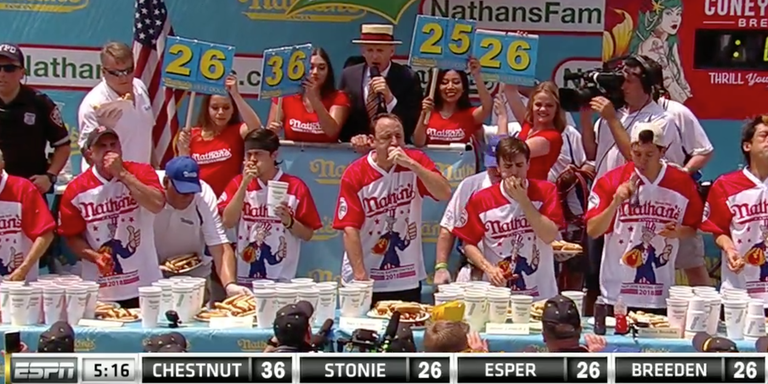
This Is So Stupid: After a Blunder, The Nathan’s Hot Dog Eating Contest May Go Electronic.

Nathan’s annual 4th of July hot dog eating contest is unquestionably stupid. I find myself watching it (almost) every year, though, for that exact reason. It’s dumb, and the coverage is over the top, but either the announcers are in on the joke and that’s funny, or they aren’t and they’re serious and that’s funnier.

It is quintessential Americana – excessive, bloated, disgusting, but all in good fun. The process, for decades, has been simple: put plates of hot dogs and buns in front of the competitors, start the clock, and they eat the dogs. But as its popularity has surged since first Kobayashi and then Joey Chestnut pushed the winning totals to unstomachable heights, the contest has gotten more and more hectic. Look at that picture. There are WAY too many people on that stage.

This year, the inevitable happened. When the contest finished, Joey Chestnut had won his 11th contest in 12 years, by eating 64 hot dogs and buns. But instead of being happy, he immediately looked at his scorekeeper and claimed the count was off – he thought he had 74. The second place finisher, Carmen Cincotti, had it even worse – his score read 45, but it turned out he actually ate 64. How a judge can be off by that many is hard to fathom. But the contest wants to ensure it does not happen again, and they have made rumblings this week of moving to some way to electronically measure the number of hot dogs eaten, perhaps by weighing the plates. This would also have the positive secondary effect of decluttering the stage.

But still – it seems contrary to the spirit of the event, which tries to give off a nostalgic feel. Will they lose something by doing this? It’s the only competitive food eating event that gets any mainstream attention. Will this kill that magic? I don’t know. I’ll probably still take ten minutes out of my holiday to watch a guy stuff 74 hot dogs and buns down his gullet. It’s mesmerizing. -TOB

Source: MLE mulls change to electronic tech for Nathan’s Hot Dog Eating Contest”, Darren Rovell, ESPN (07/05/2018)


Video of the Week

https://twitter.com/AugustineMLB/status/1014841124370944000

If you’ve ever wondered why a hitter will sometimes take a terrible swing that makes him look like he can’t play baseball, this might give you an idea: pitch tunneling.


PAL Song of the Week

Phil is out of pocket this week, so TOB gets to choose. Boom. Enjoy!


Like what you’ve read? Let us know by following this blog (on the right side, up near the top), or:

Email: 123sportslist@gmail.com

Twitter: @123sportsdigest

Facebook

Instagram: @123__sports


“Bob Vance, Vance Refrigeration. Bob Vance, Vance Refrigeration.”

-Bob Vance, Vance Refrigeration.

Week of June 29, 2018


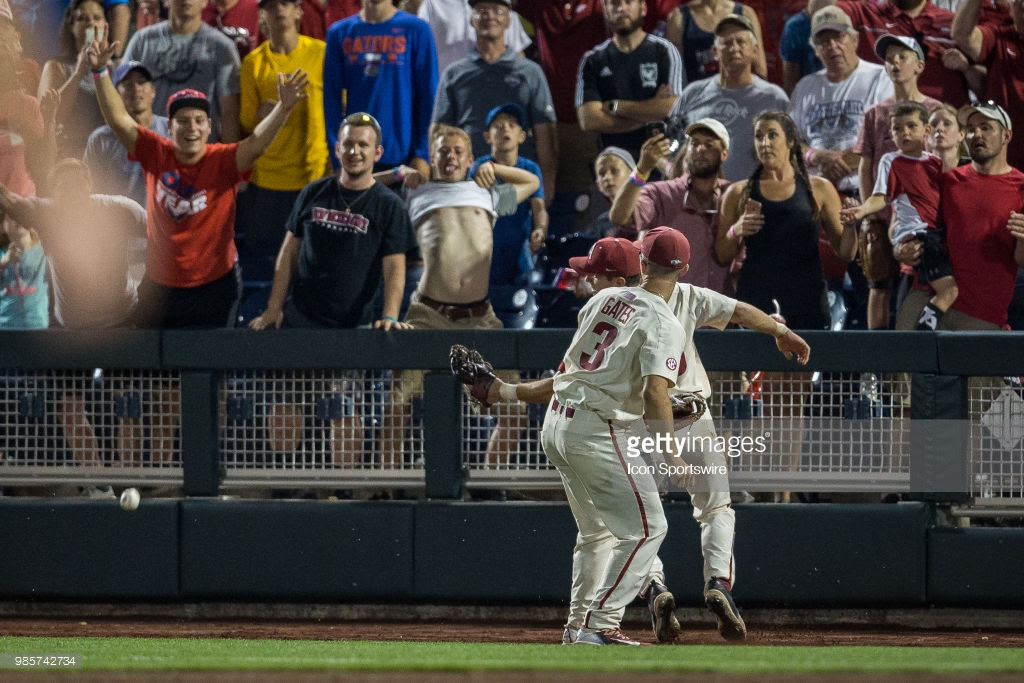
One out away and a lifetime ago. Arkansas loses the the CWS. 


One of the Best Game Stories You’ll Ever Read

For a beat writer, a game story is kind of a pain. Games end late and you have a tight deadline to make the morning’s paper. Most begin writing their gamers, as they’re known, while the game is still ongoing. When a game changes late, the gamer changes, too. Beat writers today must really hate gamers as they are increasingly irrelevant given the social media landscape. How many genuine sports fans wake up in the morning, open the sports section, and are surprised to learn of the outcome of their team’s game from the previous evening? Whatever the number is, it’s shrinking by the day.

I rarely read gamers anymore, because I either watched the game or followed along on Twitter. But last Sunday night there was something about this tweet that made me click on the Chronicle’s gamer by long-time Giants beat writer Hank Schulman:

Boy, am I glad I did. In the game, an aging and struggling Hunter Pence stepped up in the bottom of the 11th inning, the Giants down a run, with the bases loaded and one out. The moment screamed double play, as the once great Pence has rolled over so many balls the last couple years I couldn’t begin to count. And, sure enough, Pence lunged at an 0-2 fastball that was low and away. He made weak contact toward first base, and at least one out seemed assured. But baseball is a beautiful and weird game that always surprises. Eric Hosmer, the Padres’ first baseman, was playing well off the line. The ball snuck by him. The Giants scored two. The game was over. Pence was a hero.

It was a great moment for Pence, his teammates, and Giants fans. Hank Schulman took the opportunity to produce one of the best gamers you’ll ever read. Here’s how his story began:

The mass of people who have not, and cannot, understand the rush of a high-level athlete in the arena still have an avenue to understand how Hunter Pence must feel to have his skills decline, being forced to outrun the calendar, listening to the couch surfers and microphone jockeys advising him to get lost.

Haven’t most people had one of their passions taken from them, by physical decline or life’s circumstances? Isn’t that sting universal to the famous and ordinary?

Pence is not blind. He knows it’s coming, be it this year, next year or soon enough. He is 35 and hitting below the Mendoza Line. His accolades and World Series rings cannot buy him more at-bats. Only success on the field can.

Now, Hank is a great Twitter follow and a really good sports writer. But that is some next level beat writing. Gamers don’t usually have sports-as-life metaphors. As I said above, there’s not enough time. Maybe in October. But in June?

You should know that Hank was diagnosed a couple years back with cancer. As far as I know, he is in remission. But I can’t help but wonder how much Hank was thinking of his own journey when he wrote that, which makes it all the more affecting. I can’t recall ever feeling compelled to thank a writer for any story, let alone a game story. But I did when I read that. -TOB

Source: Giants Stun Padres on Pence’s 11th-Inning Walkoff Hit”, Hank Schulman, SF Chronicle (06/24/2018)

PAL: I wish I had more to add. I loved it, too.


Athletes and Aging

How do humans age? Why? What happens to our bodies as they slowly break down, year after year, over the course of decades? How is it measured? ESPN’s Sam Miller tells the story, with both science and the anecdotal evidence of five of the best baseball players in the game, all at different stages of their careers. Man, this is a great article.

23-year old Shohei Ohtani:

Thirty-three feels so far away, but it’s already happening. The 23-year-old’s lean body mass peaked sometime in the preceding five years. His bone-mineral density too. He’s at the age when the body begins producing less testosterone and growth hormone. His body, knowing it won’t need to build any more bone, will produce less energy. Male fertility peaks in the early 20s, the same time as pitch speed and exit velocity. Athleticism is, crudely speaking, about showcasing what a body looks like when it’s ready to propagate a species. The 23-year-old’s machine works as it was designed to. It is undamaged, unsmudged, and every circuit in it is trained to carry on his family’s tradition of survival. When you’re 23, the 32-year-old Mark Trumbo says wistfully, “performance is the only thing holding you back.” To watch a 23-year-old athlete is to see the perfect machine running perfectly.

26-year old Mike Trout:

He’s the best player in baseball, but he has, technically speaking, lost a step: When he was a 20-year-old rookie, he might have been the fastest runner in the sport. Now he’s merely fast. As a rookie, he made four home-run-robbing catches; now, at 26, he hasn’t made one in almost a season and a half. Yet he has not yet begun to decline as a baseball player. He’s having, by most measures, the best season of his career, and he’s the easy front-runner for American League MVP. It’s an odd quirk of aging patterns that ability declines before performance does: Exit velocity declines years before home runs do; speed declines years before stolen bases do. Bone density might peak around 20, but ballplayers, most aging curve studies have concluded, peak in their mid- to late 20s.

30-year old Clayton Kershaw:

A year ago, he was considered, more or less unanimously, the best starting pitcher in the world, with a stretch of more than 1,300 innings — the equivalent of six full seasons! — with an ERA below 2.00. Now he’s probably not, and he might rank as low as fifth or sixth. He allows too many home runs; his velocity has been dropping; and he keeps missing time with lower back issues. (Early byproduct of aging: loss of water content in the spongy lower back disks, leading to herniation and other problems.)…The 30-year-old pitcher throws a curveball for strike one, then he throws a fastball for strike two. It’s 87.9 mph. In a start just 363 days earlier, his fastball averaged 94 mph, but today the average is 89. Less than 24 hours after this game, in fact, he will return to the disabled list, the lower back again.

35-year old Justin Verlander:

It’s the seventh inning, the score is 4-0 and the pitcher throwing the shutout is 35. He’s been an ace for most of this decade, but in the past few years, his peers have been disappearing. Jered Weaver and Matt Cain retired last year, at 34 and 32, respectively. Tim Lincecum, 34, was in Triple-A this year until he got released. Felix Hernandez, at 32, now throws in the high 80s and carries an ERA in the mid-5s.

There was a point a few years ago when the man on the mound feared he might be approaching such a fate. He’d thrown an 88 mph fastball in a game, and he thought his career was ending. Now, though, at 35, he might once again be the best pitcher in the game. “Rather than stability, we have lifelong flux,” wrote the authors of the StarCraft study. “Our day-to-day performance is, at every age, the result of the constant interplay between change and adaptation.”

We know, or can speculate on, some things about this pitcher’s body: His mitochondria — the little factories in the cells that produce energy — probably don’t work as well as they used to. His muscles are probably losing elasticity; his tendons and ligaments are stiffer from having less water content; his bones are more prone to fractures or stress injuries. He doesn’t produce as much testosterone or growth hormone as he did in his early 20s, and it’s therefore harder for him to add muscle mass.

38-year old Albert Pujols:

The 38-year-old at the plate used to do everything: one of the best defensive first basemen ever, a valuable baserunner and a multidimensional hitter who mastered the strike zone and homered nearly as often as he struck out. One by one, the systems have broken down: He’s a DH more often than he plays the field; it hurts to watch him run; he almost never walks; and he sets career highs in strikeouts and career lows in almost everything else. His career survives mostly on the basis of one home run per week.

There’s a way of looking at the data to conclude we will all die — 100 percent of the people who came before us did. But there’s also a way of looking at the data to conclude that, in fact, I never will. I’ve been alive for a billion data points and I haven’t died once.

To watch the 38-year-old these days is to see these two arguments smash into each other. It is to watch a dignified man walking alongside, but not yet into, the end. It’s to see an athlete who was once the very best in the world fail, repeatedly, in public, and to see that it’s OK — not at all shameful — to get worse. It’s to see the smiles and the ovations among it all. It’s to see that, ultimately, this isn’t life and death. Just a metaphor for it.

One of the best articles I’ve read this year. -TOB

Source: What Happens as Ballplayers Age?”, Sam Miller, ESPN (06/27/2018)

PAL: “They stop being young sooner than you think.” What a great line, man.

TOB’s right; fascinating read. When we get deep into the weeds, it seems to all break down to the following:

Ballplayers first notice it in the short, explosive moments. “To get to a 97 mph fastball that’s up in the zone, you know you can get it there,” 31-year-old veteran catcher Caleb Joseph says. “It just isn’t as readily available anymore. When you’re 22, it’s always on. You’re like, ‘Do I need to get a lighter bat? Is this how it’s gonna be?’ ”

He laughs, then pauses, deciding which kind of story he’s telling. “I went down an inch this year. I’m still hitting .150.”

Is it that he’s not as strong? That his brain doesn’t pick up the pitch as fast? It could be, but it could also be that the nervous system moves slightly slower as we age, says Corey Dawkins of Baseball Injury Consultants. Joseph could identify the pitch just as quickly, decide to swing just as confidently, swing just as powerfully as he ever did — but the signal from brain to muscles takes a fraction of a microsecond longer to travel.

There’s nothing you can do but get a little older and a little slower. In a game of decimal points, a little is a lot.


Messi & Argentina:

The very first sentence of this Messi World Cup article made me stop. “He’s not having any fun at this World Cup, that much is obvious.”

Shocker. No one will argue that Messi is anything less than an all-time great, and some will argue he’s the best ever, but at 31 years old Messi has still has one unchecked box on his career – winning a World Cup. This might not be his last chance, but it’s certainly is last chance as all-time great player.

Since when is greatness about having fun? In fact, I’m guessing players like Gretzky, Bonds, Jordan, Jim Brown, Woods would choose 3 adjectives to describe their time on the ice/court/field/course before any of them used the word ‘fun’.

The relationship of Messi and Argentina is an odd one, and I’m not sure ‘fun’ has any place in it. While Messi was born in Argentina, he and his family moved to Barcelona when he was 10 or 11 years old. He was already a prodigy, but the club team in Argentina reneged on paying the $1,000/month treatment he needed, and another team in Buenos Aires couldn’t help out due to the economic collapse. Enter Barcelona. Messi had family in Catalonia. A trial was set up. The rest is history.

Messi was considered a dual-national (Argentina and Spain), so he was eligible to play for either national team. Once a player plays a game for one national team, then they’ve made their claim and can’t play for another team. Argentina went so far as to scheduled two matches for the U20 team to prevent Messi from changing his mind. Perhaps they were paranoid – it has always been Messi’s dream to play for La Albiceleste.

So there’s always been controversy around Messi and Argentina. The greatest player of his generation is from Argentina, and yet his entire life from 10 years old on has been rooted in Spain. So it’s not hard to imagine the criticism when Messi and Argentina loses 1-0 to Germany in the 2014 final with the greatest scorer coming up empty, or when they again lost to Germany in 2010 quarter finals 4-0.  He has six goals in 18 World Cup matches. That ranks him tied for 38th all-time. That’s a problem.

All of this has lead folks to question his level of commitment to national team.

Don’t even think about suggesting Messi lacks love for his homeland or pride in being the captain and talisman for its national soccer team. That’s not the case, but the truth is that he doesn’t much like playing for Argentina because it causes him nothing except pain.

He has felt the burden of being anointed as a national treasure at a young age and still carries the weight of his country’s World Cup hopes — no, demands — as much as he ever did. It is a payload that gets heavier with each passing year, every fresh disappointment or missed opportunity.

I read this, and I think about LeBron before he got Cleveland that title. While James was the fulcrum for a city that hadn’t won in 5 decades, Messi was that for an entire country obsessed with one team, one sport. Those forces seem heavier than what James felt in Cleveland. He feels the weight no matter which way things teeter

And Messi’s experience at Barcelona reminds me of the Warriors – a team of stalwarts that in part allows him his moments of genius. He’s Steph Curry. And in that role, he’s won everything. Success breeds success.

It is easier to play with that kind of freedom when you have accomplished everything, and there are no boxes to be ticked for Messi at Barca, where he has won everything worth winning, multiple times, while also collecting a glut of individual accolades

He’s great at being Steph, but can he be LeBron? We’ll see. This article was written before Argentina snuck out of pool play. Messi still has a chance to grow his legend and make his mark on the World Cup, but he will have to do it while carrying the weight of a Argentina on his back. – PAL

Source: “Why Lionel Messi Hates Playing for Argentina in World Cup”, Martin Rogers, USA Today (06/24/2018)


Grief and Football

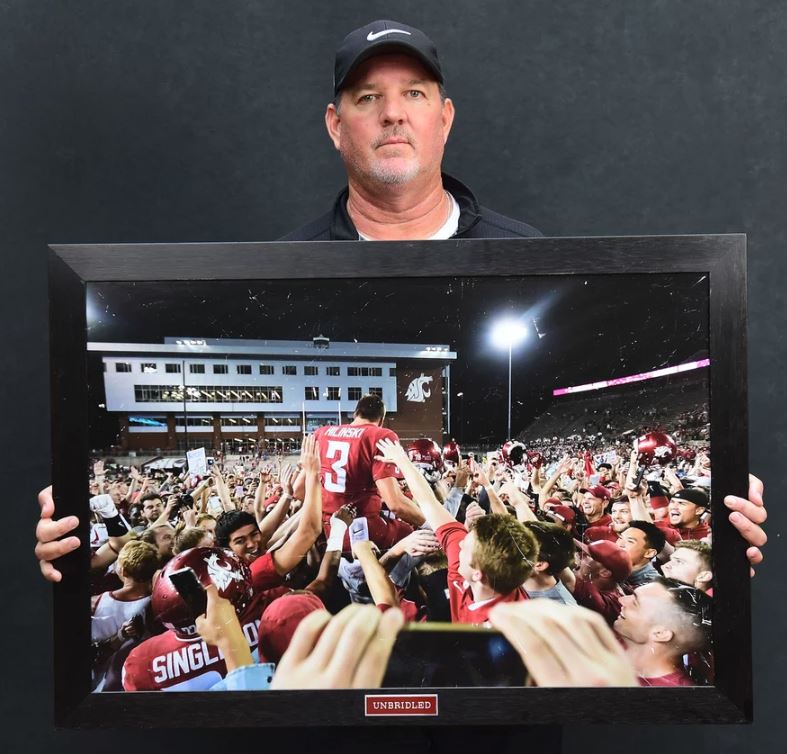
This week, Sports Illustrated published an excellent piece on the January suicide of Washington State quarterback Tyler Hilinski. The story focuses mostly on the aftermath – the pain and guilt his family feels because of Tyler’s death, and what they could have done differently. It’s a very good article and you should read it.

The story reveals that the Mayo Clinic determined Tyler had Stage 1 chronic traumatic encephalopathy (“CTE”). Stage 1 CTE is the lowest level, but is associated with depression, and Tyler’s brain reportedly resembled that of a 65-year old man. For a 21-year old who had not played much college football, and at that had played the relatively protected position of quarterback, the news was fairly surprising. While Tyler did play linebacker in youth football, this made people realize if it could happen in this situation, it can happen to anyone at any level of football, and much quicker than people have assumed.

The story is sad, as you’d imagine a story dealing with a family’s reaction to the suicide of a young person would be. But what I find so troubling is that the family either refuses to blame football, or doesn’t care. This might not matter, but the Hilinski family has another son, Ryan. Ryan is also a quarterback, and a very good one. He will graduate high school next year. After receiving offers from programs like Ohio State, LSU, and Georgia, Ryan decided he’d play college ball at South Carolina.

I never like to tell someone how to raise their child. As a parent, I know we’re all doing the best we can. It’s just not my business, and especially for a family like the Hilinskis, it’s hard to know how grief and guilt are affecting them. They say they do not blame football. But…why? Do they not want to blame football, because doing so would mean they played some part in his death by allowing him to play? Tyler’s older brother, Kelly, also played quarterback in college:

Kelly says scared isn’t exactly the right word to describe the family’s relationship to football now. Kelly views the sport as a welcome distraction from Tyler’s death. He says that when he has kids—if he has a son, he’ll name him Tyler—he will let them play football, without hesitation. He wants the boy to learn lessons best gleaned in shoulder pads, to find pain and overcome it.

Can’t your kids learn those same lessons playing other sports that don’t have brain trauma as a core part of its gameplay? And while Kelly says he’d let his kids play football, at the same time he’s worried about Ryan:

“I’m worried,” Kelly admits. “I’m worried Ryan might face the same signs and symptoms that Tyler had and he won’t be the same person that he was.”

That is just baffling to me. I realize the odds are low. Many kids play football each year and don’t suffer those injuries. And yes, kids can be hurt or worse in countless ways and you can’t ever guarantee their safety. But shouldn’t you do your best to limit the unnecessary dangers? And isn’t it possible that the family has some genetic marker that makes them more susceptible to CTE with less brain trauma than other people?

For his part, Ryan says, “I just don’t give a f—. I don’t care. I love this sport. This is not what hurt [Tyler].” This is more or less what you might expect a 17-year old kid to say. And his parents raise the good point that he’s almost 18 at which point he can make these decisions on his own. But, man. I just can’t understand that, after already losing one son, they are not doing everything in their power of losing another. If Ryan develops CTE and becomes depressed like Tyler did, even if the family is better equipped to see the signs they missed with Tyler, preventing his death is not the end. He’d still be a person changed for the worse.

I feel terrible for this family, and I hope my tone here is not judgmental, because that is not why I am writing this. The Hilinski family will never read this, anyways. But as someone who still watches football, though with less glee than I used to, it’s a reminder to myself. Because, at times, I’ll catch myself thinking, “I dunno, maybe I’d let my kids play high school football.” So I need reminding: no. Just don’t do it. Or this could be me:

Instead, upon landing, [Tyler’s mother] steeled herself for meetings with medical examiners and detectives, learning that Tyler had left behind a note. Maybe, the Hilinskis thought, he had explained his decision, told them not to worry, absolved them of their guilt. Then they read the short message he had written and that only made them feel worse. That note—the Hilinskis do not want to publicly reveal the contents—offered no explanation, no I love you, no goodbye.

If you or someone you know is struggling with thoughts of suicide, reach out to the National Suicide Prevention Lifeline 1-800-273-TALK (8255). -TOB

Source: A College QB’s Suicide. A Family’s Search for Answers”, Greg Bishop, Sports Illustrated (06/27/2018)


Video of the Week

https://twitter.com/FIFAWCGoals/status/1010613720584740864


PAL Song of the Week – George Harrison – “What Is Life”


Tweet of the Week


Like what you’ve read? Let us know by following this blog (on the right side, up near the top), or:

Email: 123sportslist@gmail.com
Twitter: @123sportsdigest

Facebook

Instagram: @123__sports


You couldn’t handle my undivided attention.

-D. Schrute

Week of June 22, 2018

No comment.


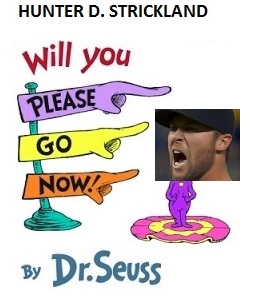
So, a quick recap of the career of the Giants’ resident idiot, Hunter Strickland:

  • As a rookie, Hunter Strickland gave up six home runs in eight innings in the 2014 postseason. That’s not good, but it happens, and the Giants overcame it to win the World Series.
  • Two of those homers came off the bat of Bryce Harper, who is pretty darn good. Harper didn’t pimp the homers too hard.

But Strickland apparently took great offense. Hold onto that thought. We’ll get back to it.

  • In the World Series that year, Strickland gave up two home runs. After one of them, Strickland cried like a baby and yelled at Salvador Perez, who didn’t even hit the homer but scored on the play, leading both benches to clear.

  • In the 2016 postseason, Strickland gave up the season-losing hit to Javier Baez in the 9th. Strickland stared him down. Are we seeing a pattern here? Apparently it’s a crime against Strickland to do something good.
  • Remember that thought you held onto? Strickland certainly does, because on Memorial Day 2017, Strickland, somehow still holding a grudge against Harper from three years prior for…doing his job, plunks Harper with a 98 mph fastball, causing the benches to clear. To show you how little he cares for Strickland, Posey didn’t even attempt to slow Harper down as he charged the mound. And by the way, Giants’ outfielder Michael Morse suffered a concussion in that game, effectively ending his career a few months early.

  • In 2018, Strickland had pitched pretty well, compiling a 2.84 ERA and 13 saves in 16 tries. Not elite, but well enough. There were lots of articles written about how he’d learned from his past mistakes and knew how to keep his cool on the mount.

Which brings us to the events of the last few days. Last week, the Giants went into a 4-game series in Miami, one of the worst teams in baseball, and lost 3 of 4. They blew quite a few leads in that series, and Marlins’ rookie Lewis Brinson, who had been hitting .160, played a big role. He was a little excited about it, and apparently Strickland didn’t like that. When the Marlins arrived in SF this week, Strickland apparently wanted to teach Brinson a lesson. Entering Monday’s game in the 9th with a 2-run lead, Strickland went walk, double, walk, and the score was 4-3. On his first pitch to Brinson, Strickland threw 98 mph at his head. Nice. Brinson bailed and avoided getting his face smashed, dusted himself off, and got a base hit to tie the game. The next batter also got a base hit, the Marlins took the lead, and Brinson ended up on third. Strickland got yanked, and Strickland went all Strickland on him, walking toward third base instead of the dugout, barking at Brinson the whole way.

The Giants lost, btw. Good job, Hunter. Strickland claimed after the game that he overreacted and blah blah blah. Oh, he also punched a door and broke his hand and now he’s out two months. What a meathead.

To compound matters, the Giants somehow thought this was someone else’s fault, and… beaned Brinson on Tuesday. It was soft, and on the thigh. But, of course, the Marlins retaliated and hit Posey just below the shoulder, a dangerous pitch that could have been worse. If I’m Posey, I’m pretty pissed off at Strickland. And if I’m the Giants, I’m wondering why I keep putting up with this hot-headed moron. It’s not fun when you realize the team you are rooting for is the bad guy in a given beef, as Strickland and the Giants are here. I wish they’d get rid of him. I don’t like having to root for him to succeed. I wish he’d just go. -TOB

PAL: Dude isn’t nearly good enough to put up with his wanna-be tough guy schtick. His antics are selfish. When he beans a guy, it’s about a personal beef. It’s not about protecting or standing up for a teammate. Ship him out!


Athletes and Reporters: Work Spouses

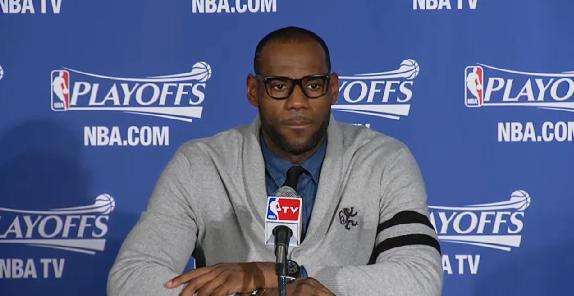
This is a great read on the daily interactions between athletes and beat writers. Specifically: LeBron James and the guys who cover him every day, and how LeBron has cultivated those relationships. In doing so, LeBron has flipped the media narrative early in his career that he was “unsophisticated about the NBA media game” and “out of touch”, and into a guy that reporters enjoy covering, give the benefit of the doubt, and a guy they can talk to about life beyond basketball. For example:

James understands how beat writers can be friends but also compete for scoops. He knows the value of giving a reporter personal attention. In 2015, James caught McMenamin’s eye when the ESPN reporter was interviewing Joe Harris. James knew McMenamin had worked in L.A. and asked whether he was still commuting back and forth. No, McMenamin said, I moved here to cover you.

James pointed at his chest and said, “Miami.” He pointed at J.R. Smith, who was sitting at his right, and said, “New York.” He pointed at McMenamin and said, “Los Angeles.” Then James said, “I guess we’re all in this together.”

McMenamin was touched. It was the rare instance when a superstar bothers to understand how and why a reporter came to cover him. “I always appreciated that moment,” McMenamin said, “because he was trying to put himself in my shoes.”

James has also done so by understanding the media – they are people who are just doing their jobs and doesn’t get angry if they ask him an uncomfortable question:

But among his beat writers, James rarely balks at tough questions. The flip side of the intimacy McMenamin talks about is that the writers feel they can ask James whatever they want.

Vardon—who got the honor of asking James why he unfollowed the Cavs on Twitter in 2016—will often approach James after a presser to explain a tough question. James will inevitably wave him off. “He goes into almost any room thinking people want things from him,” Vardon said. “He appreciates people who are there to do their job.”

“It’s never about, Oh, you’re the one who’s going to protect me,” said Nichols, who has been interviewing James one-on-one since he was 17. “It’s understanding those questions are going to come and that he’d rather do it in an environment where he can actually answer.”

Yes, I’ve long been a LeBron stan, but I think any sports fan will find the inner-workings of the athlete/reporter relationship interesting.

Source: How LeBron James Mastered the Media”, Bryan Curtis, The Ringer (06/20/2018)

PAL: Agreed. A well-written piece about the relationship at the heart of how we consume sports and sports stories.

A secondary point I found interesting was the idea that the nature of a lot of NBA stories (I would add NFL to this, too) have become GM-centric. Potential trades, contract stories, building a roster for the future. Curtis chalks this up to, at least in part, so many players being inaccessible. The writers still need to write a story, and they’ll go to a source who will talk to them.

More central to the point of the story is a basic understanding of the nature of the reporter-player relationship. Perhaps LeBron was reluctant to be himself on the record during the early stages of his career, but he gets it now.

As ESPN’s Joe Vardon puts it, “It’s very simple. If a reporter has access to a person, if this person’s willing to talk to them, it’s easier for their viewpoint to show up in the writing. LeBron has always understood that.”

And finally, I liked that Curtis didn’t focus on the relationship between player and media while only looking at what the players bring to the table. ESPN’s Rachel Nichols offered this:

“There’s a continued culture shift in who’s doing the sportswriting. Is it older white males and how they see younger black athletes? Or has there been a more diverse group of people in media who bring more diversity of thought?

“That is not to say every older white male has the same opinion. But a diversity of thought in sportswriting creates a different cauldron of reaction than if you have the same drumbeat.”

NBA fan or not – this is a great read.


This Is How The Work Culture Changes

She’ll never say it, but Teresa Resch is a big deal. She’s the Vice President of Basketball Operations and Player Development for the Toronto Raptors. About 18 years ago (yikes) we were both freshman at Augustana College (now Augustana University, home of the 2018 baseball National Champions) in Sioux Falls. She had come from Lakefield, MN to Augie to play on their outstanding volleyball team. I had driven across I-90 to play baseball. We’ve been friends ever since.

I’ve had the pleasure of following her career after Augie. I knew great things were waiting for her, but she’s already outdone herself. Here’s how Raptors President Masai Ujiri described Resch at a recent Women in Sports and Events banquet:

“That right there is the Toronto Raptors, right there,” Ujiri said, pointing to Resch as the audience clapped for her. “We talked about lifting women, we talked about believing in women, and when we went out and made a lot of hires, we did not hire them because they were women. We hired them because they were the best. They were the best candidates for the job, and that’s what they serve as, and they stand up tall, and they lead the Toronto Raptors. And we listen to them. Teresa is the chief of staff. Everything she says goes.”

First of all, how cool is that? Second, Teresa’s always been the chief of staff in any room. Third, she’s part of a very exclusive group of women changing the face of the NBA, and I’m incredibly proud of her for that. In order for cultural shifts to happen within an organization – like more women taking leadership roles in a male-dominated workplace – the people before need to pay it forward. We all know this, but it’s always worth calling it out when it’s taking place.

In Resch’s case, that person was Ujiri. And for Ujiri that person was Kim Bohuny, NBA’s Senior Vice President of International Basketball Operations.

“Kim is the reason I’m here, OK?” Ujiri said while choking up. “So, 15 years ago, I got a phone call from Kim Bohuny, and she asked me to come to be director of Basketball Without Borders. My life changed. Today, I’m the President of the Toronto Raptors. I was an unpaid scout when I got that call from Kim Bohuny, so here are some women that are changing lives, and changed this life right here.”

The 47-year-old Ujiri was born and raised in Nigeria, and it was Bohuny who helped the unpaid Orlando Magic scout with an opportunity. By 2013, he became the only non-American to be awarded NBA Executive of the Year while with the Denver Nuggets and was then hired by the Raptors. Toronto has since made five straight playoff trips.

To be sure, Resch has earned opportunity that’s come her way, but people need the opportunity to “earn it”. It’s cool to see that come to life in the the NBA amongst two women (Resch and Bohuny) and a guy born and raised in Nigeria (Ujiri).

Also, I happened upon this article by going through my usual sport story browsing. That’s a cool feeling to see your college friend pop up in your morning news. – PAL

Source: “How a Woman Changed Masai Ujiri’s Career and Why He Has Entrusted Other Women with Raptors Front Office Roles”, Michael Scotto, The Athletic (6/15/18)

TOB: Agreed, great story. Masai deserves credit for not just giving workplace diversity lip service, but actually putting it in action and trusting that he sees talent in people that others in the sports world would be afraid to act on.

I had the pleasure to meet Teresa a few years back. In addition to very generously getting us seats behind the Raptors’ bench, she graciously let me pick her brain about how an NBA front office works. In fact, after she found out I’m a Kings fan, she asked me my opinion on Kings’ guard Greivis Vasquez. A few weeks later, the Raptors took Vasquez as part of the Rudy Gay trade. I have joked that I helped make that trade happen, but the reality is that successful people seek input from a variety of sources, and she was probably just seeing if I had seen something in Vasquez that would help her analysis. It sounds like she’s continued to rise in the time since. Congrats to Teresa!


The One Place Sponsors Won’t Advertise At The World Cup

The World Cup got underway last week, and I found myself sipping on coffee last Sunday watching Germany and Mexico play. Late in the game, with Mexico clinging to a surprising 1-0 lead over the defending champions, history was made when Rafa Márquez entered the game. He became only the third player to ever play in 5 World Cups.

One would think this would be cause for celebration. At very least a post-game interview. But very little was made of this accomplishment. The reason might surprise you.

“Márquez, 39, is on a United States Treasury Department blacklist of people it says have helped launder money for drug cartels. His inclusion on the list prohibits American individuals, businesses and banks from having anything to do with him.”

They aren’t joking around with this. He can’t drink from branded water bottles, he wont be selected as a “Budweiser Man of the Match”, and he will earn no money. Why no payment? The banks FIFA used to wire each team money to prepare for the World Cup have U.S. affiliations. Different flights had to be booked for his trip to Russia. His practice jersey displays no sponsors.

One would wonder if it’s worth it for Mexico’s national team to carry Márquez as a sub. Obviously, they think it’s worth it. Not only did he make his record appearance, but he’s the team captain of a squad that upset a world power in Germany.

Márquez has denied any involvement with the cartels.

I would ask how long it might be before they make a movie out of this, but I’m guessing the U.S. Treasury might have an issue with that. I guess it will have to be a foreign film. – PAL

Source: Mexico’s World Cup Captain Is on a U.S. Blacklist”, Tariq Panja, The New York Times (6/18/18)

TOB: Yeah, it’s pretty wild. And Mexico is going to great lengths to ensure they don’t run afoul of the sanctions, so it’s not like they don’t take this seriously. The decision to include an aged player with this kind of baggage is puzzling. Also, your last line made me LOL.


Save Mike Trout

On Monday night, I saw this excellent video on ESPN, from Keith OIberman, about how Mike Trout is amazing and the Angels are terrible.

http://www.espn.com/video/clip?id=23822919

Mike Trout is already, at 26 (!), one of the best and most productive players in baseball history. He’s played only 1,000 games. He’s just off Pete Rose’s pace for hits in his first 1,000 games. He’s just off Hank Aaron’s pace for total bases in his first 1,000 games. He’s way out in front of Bonds’ pace for home runs in his first 1,000 games. He has a higher career WAR, right now, than any of the following players did their entire careers: Willie Stargell, Big Papi, Harmon Killebrew, Vlad Guerrerro, Yogi Berra, Sammy Sosa. The list goes on. 

He’s currently on pace for the greatest season of all time, measured by WAR.

And get a load of this:

https://twitter.com/DrewGROF/status/1009196660361027584

But Mike Trout has been stuck on a terrible team that keeps managing to compound its mistakes. He has played in exactly three playoff games his entire career. He currently leads the league in home runs (23), runs (60), walks (62), on-base percentage (.464), OPS (1.152) OPS+ (217), and total bases (176). Last weekend he hit four home runs in two games, and his team got swept. The Angels are barely over .500 and will need to get red hot to make the playoffs. 

So, to the Angels: Please, baseball fans beg of you: Trade this man! If you love him, set him free! He will be a free agent after the 2020 season, at the age of 29, and he would be absolutely insane to re-sign with you. So, get something in return. You could get the greatest haul in trade history and fix your entire screwed up roster. Please? -TOB

Source: Mike Trout Doesn’t Deserve This Shit”, Tom Ley, Deadspin (06/19/2018)


Video of the Week

Father of the Year: Dad runs on the track to pull his son out of a burning race car, even goes back in to turn on the fire suppression system.

https://twitter.com/Jesse__Foster/status/1009628884025868293?ref_src=twsrc%5Etfw&ref_url=https%3A%2F%2Fdeadspin.com%2Fajax%2Finset%2Fiframe%3Fid%3Dtwitter-1009628884025868293%26autosize%3D1


PAL Song of the Week – TV On The Radio – “Family Tree”


Like what you’ve read? Let us know by following this blog (on the right side, up near the top), or:

Email: 123sportslist@gmail.com
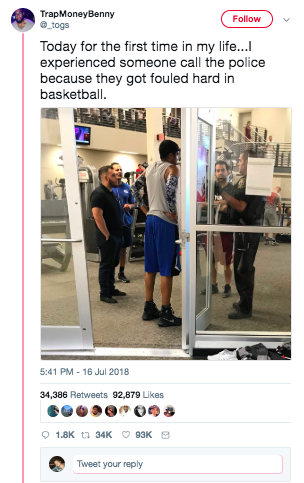
Twitter: @123sportsdigest

Facebook

Instagram: @123__sports


In my family you don’t really go out and get things. If you want something you write it on a list, and then the housekeeper goes out and gets it, on Wednesdays and Fridays. So, I dunno. I guess you could say this job is on my list, and we’ll see what Rosa comes back with.

-Drew Bernard

Week of June 15, 2018

Mike Bibby has been working out, obviously in anticipation of his one-on-one matchup with TOB.


6 Astros Combine for a Rare Unlikely of Baseball Occurrences: The Combined No-Hitter

On June 11, 2003, 6 Houston Astros combined to no-hit the Yankees. There have been 12 combined no-hitters in baseball history. For reference, there have been 23 perfect games. It’s one thing for a single pitcher to be electric and lucky for nine innings (and more impressive, I’d say), but it’s more rare for a handful of guys to have near perfect nights on the same night.

Sweeny Murti deep dives into the Astros no-no for the The Athletic in an inning-by-inning breakdown. Roy Oswalt’s strained groin forced him out of the game in the 2nd inning, kicking off the series of unlikely events.

The Astros had a stacked bullpen in 2003. Brad Lidge, Octavio Dotel, and Billy Wagner were throwing high 90s (with Wagner regularly hitting triple digits). They shortened a game for sure.

Also, don’t sleep on the fact that this was an interleague game before interleague play was so pervasive (began in ‘97). The Yankees had never seen Lidge, Dotel, or Wagner.

The notion of the combined no-no becomes more plausible with a bullpen like that. When the Astros made it through 5 innings, then this became far more possible.

Some of my favorite bits:

A lot of guys on the team didn’t know what was going on or at stake until after the game was over! Hell, the catcher, Brad Ausmus, didn’t even know until the 6th inning when Brad Lidge entered the game. “Part of the reason it didn’t cross my mind was because there seemed to be a lot of traffic earlier in the game. There was so much going on on the bases, it didn’t even dawn on me that it might be a no-hitter.”

Nathan Bland was a reliever that had been 1 pitch away from getting into the game. If Pete Munro walks Posada on 4 pitches in the 3rd inning, Bland is pitching at Yankee Stadium in what turns out to be an 8 week major league career. When closer Billy Wagner gets up to close out a 9-0 game, Bland is pretty ticked.

Bland had made his major-league debut only one month earlier. He was perplexed — even a bit perturbed — not to be able to pitch in a game his team led by eight runs in the ninth inning.

“I honestly did not realize it was a no-hitter at the time,” Bland says. “I’m sitting there going, ‘Why are they putting Billy Wagner in?’ I don’t understand this. Is there something I’m not getting? And I turned to Ricky Stone and said, ‘Why are they putting Billy in? This isn’t a save situation!’”

Stone stared at Bland.  

“You don’t know?” he asked.

“What are you talking about?” Bland asked, staring back.

Stone wasn’t jinxing it, not now.

“I’m not saying a word,” he replied.

Bland turned away.

“A few pitches later I looked up at the scoreboard and was like — Ohhhhhh!”

After Wagner catches the final out on a grounder to Bagwell at first, the no-hitter is complete, yet the celebration is, well, muted. Also, it’s hilarious.

There was no dogpile at the mound and nobody tried lifting anyone on their shoulders. There were a few pats on the back and some high fives, but it seemed to be something in between a regular win in June and a typical no-hitter celebration.

“It was awkward is the best way to say it,” Lidge says.

And that’s because even as that last out was made, some of the players on the field didn’t know what just happened.

“I know Bagwell and Kent, those guys were clueless,” Wagner said.

And perhaps the most surprising discovery from this entire, lengthy piece: who is the winning pitcher in a no-hitter when the starter doesn’t go 5 innings. The Astros scored in the top of the first inning, so Oswalt enters the game with a lead.

Are you ready to have your mind blown? Are you? Here we go.

In any ordinary game in which the starter fails to go five innings, as Oswalt did here, the designation of “winning pitcher” becomes the decision of that game’s official scorer. It is based on who he alone deems to be the most effective relief pitcher in the game. In any ordinary game, this is fairly simple and rarely controversial. This was no ordinary game.

The official scorer gave it to Lidge that night, and I can promise you he dangles that factoid over the other guys just about every time they see each other (the epilogue indicates many of the pitchers still see each other on fishing/hunting trips and over the holidays). Lidge went two innings and entered the game with a 4-0 lead.

The scorer gave him the W (“he had the cleanest appearance” was his rationale), and now Lidge’s hat is in Cooperstown as the winning pitcher in a no-hitter.

It’s probably not the worst thing. Kirk Sarloos, who entered in the 4th, may have had a little extra help that day. “I had a little pine tar underneath the bill of my cap and that might not have been good sitting in the Hall of Fame.”

Lastly, this absolute gem. After the game the equipment manager comes into the clubhouse to get the game ball from Wagner.

“Drayton wants the ball,” Laborio said to Wagner, referring to Astros owner Drayton McLane, who was in attendance at Yankee Stadium that night.

“Well he’s not getting the ball,” Wagner told him.

Laborio wasn’t going to go back to the owner empty-handed. So Wagner walked over to a ball bag, grabbed a batting practice ball, and handed it to Laborio.

“Hey, there it is,” Wagner said.

The stories behind the historic moments are endlessly enjoyable. The pitcher who has a cup of coffee in The Show getting pissed that Billy Wagner (400+ saves) is going into a 9-0 game without knowing the circumstances, the rarely used rule giving the official scorer the dictatorial power to grant a historic win, the employee thumbing his nose at ownership. I will be happy searching and finding baseball nuggets like these for the rest of my life, thanks to writers doing the kind of work Sweeny Murti’s does on this story. – PAL

Source: “’You Dumbass, We Just Threw a No-Hitter’: The Behind-the-Scenes Story of How Six Astros Pitchers No-Hit the Yankees”, Sweeny Murti, The Athletic (June, 2018)

TOB: Damn, what a stacked bullpen.

BTW, I did know that tidbit about the winning pitcher when the starter goes less than 5 innings. It was a pretty controversial wrinkle of Game 7 of the 2014 World Series. The Giants’ starter, Hudson, struggled and Affeldt came into a 2-2 games in the bottom of the 2nd with 2 out and men on 1st and 2nd. He got a groundout to get out of the inning, then went single/double play/ground out in the 3rd and hit by pitch/double play/groundout in the 4th. Bumgarner then entered, shut down the Royals and sealed the World Series win. Controversially, the scorer gave the win to Affeldt and not Bumgarner.

Also, the two lesser-known relievers in this story demonstrate some supreme baseball player logic. The win was given to Lidge, who went 6 up, 6 down. Munro complains he should have gotten the win because he got two more outs – but he also three walks. Sarloos pitched only one inning but claims he should get the win, because he pitched the fifth and that’s the threshold the starting pitcher must meet to get the win – which is so illogical it’s hard to believe he said it with a straight face.

Finally, like Phil, my favorite part is Wagner sticking it to owner Drayton McLane.


Crawford’s So Hot, Scherzer’s Blue Eye Turned Brown

I feel a small kinship with Max Scherzer. For one, he and my son both have heterochromia iridum, though my boy does it better.

For two, the better Scherzer is, the easier it is for me to point to him when someone tries to argue Clayton Kershaw is the best pitcher in the league. But when Scherzer faces the Giants, he’s an absolute menace and I hope he dies like a dog.

Last weekend, the Giants split the first two games of their series against the Nats in D.C. and headed into Sunday with Derek Lastname facing Scherzer.

That matchup did not sound like a recipe for success, but somebody forgot to tell Scherzer about Brandon Crawford. The Giants’ shortshop has been en fuego the last six weeks. He was hitting .190 heading into May, but after going 4-for-4 against the Nats on Sunday, was sitting at .338 for the season, after hitting .412 in May and (thus far) .539 in June. The dude hit .412 for a month and nearly halfway through the next month is hitting more than 125 points better! Uh, holy cow?

Among Crawford’s four hits were three off Scherzer, including a double and a 2-run homer in the fourth that proved to be the game’s only runs in a 2-0 Giants win.

The Athletic did a fantastic pitch-by-pitch breakdown of that at-bat, showing how a locked in Crawford was able to take the game’s best pitcher deep. Another great article this week from the Athletic was Eno Sarris’ look at why Madison Bumgarner has not been up to his usual standards in his first two starts of the year. The answer: His cutter is not boring in on the hands of right-handed hitters, and he’s not getting the same extension as he usually does, thus releasing his fastball farther away from home plate than he has in the past and allowing hitters more time to recognize and put the bat on it. Or perhaps you’d prefer Jayson Stark’s article on likely MLB expansion and how that could mean a drastic (and I mean drastic) realignment. All three articles are really good, and I highly suggest you shell out a few bucks and check them out, as this is the kind of great stuff you routinely get from the Athletic. -TOB

Source: Brandon Crawford Remains Red-Hot at the Plate – Even Against Max Scherzer”, Julian McWilliams, The Athletic (06/11/2018); What’s Missing for Madison Bumgarner So Far? Let’s Take a Close Look”, Eno Sarris, The Athletic (06/12/2018); How MLB Expansion Could Lead to Realignment, a New Playoff Format, a Universal DH and More”, Jayson Stark, The Athletic (06/13/2018)

PAL: How the hell does Crawford lay off that 1-2 change-up? That is a perfect pitch.

Starts over the middle of the plate, then falls off the outside corner. How you spit at that change from a guy who throws 97 is incredible.

Crawford is in his seventh full year in the majors. He’s hit over .260 just one year, which shouldn’t surprise me but it still does. He always seemed like a .300 hitter in waiting. The swing and timing has always looked consistent. He’ll cool off this season, but maybe he’s unlocked a couple components at the plate and has a .300 / 20 HR / 90 RBI year as the Giants make a run at the division title.


Annie Savoy and the Female Baseball Fan

Bull Durham came out 30 years ago this week (sheesh), and that’s a good enough reason to read Kelsey McKinney’s solid story on female baseball fans.

Her assertion:

Annie Savoy, played by Susan Sarandon in the 1988 classic baseball movie Bull Durham, is the best representation of female fandom in any sport—not because, mind you, she sleeps with players, but because she has a deep knowledge of and undeniable love for the game. There are, of course, plenty of women who worship in the Church of Baseball. But all too often, we are ignored in popular representations of the sport.

Reading this has me agreeing with McKinney. More than anything else in this movie, Savoy is active fan of a crummy, minor league team. While she takes on a player to be her lover every season, they are just side pieces. Her main squeeze in baseball. She’s more than a romantic interest of Nuke and Crash. She’s a great baseball mind, and well-read, and well-dressed, and in control and beautiful.

No wonder McKinney heaps such high praise on what Savoy represents. As an avid baseball fan, she’s lived in a world where real women fans don’t receive the respect the team and other fans give to Savoy.

At one game, I sat in front of a crew of men pretending to know what they were talking about. “Scherzer’s great and all,” one of them said to his friend referring to our three-time Cy Young winner, “but I just can’t respect a pitcher with only two pitches.” Inadvertently, I laughed. Max Scherzer has five solid pitches: a four-seam fastball, a changeup, a cutter, a curveball, and a slider. “Something funny, sweetheart?” he asked. It had been rude of me to laugh, but now engaged, I told him why. His friends laughed at him, made fun of him for being shown up by me, a woman.

I could tell dozens of these stories: about men who have relentlessly hit on me because I keep a boxscore, about men who have brushed off my opinions about the team at parties, about fellow fans who have treated me as a tourist in their home country, someone who doesn’t belong. Of course, there are exceptions. But they are exceptions, not the rule.

Bull Durham is a classic baseball movie – one of the best to be sure – but I’ve never considered one of the main reasons it’s great is the nuanced representation of the female baseball fan. McKinney’s dissection of Sarrandon’s performance as Annie Savoy is definitely a main reason why this remains a great baseball movie. – PAL

Source: Bull Durham’s Annie Savoy Is The Patron Saint Of Female Baseball Fans”, Kelsey McKinney, Deadspin (6/12/18)


A Horse Racing Triple Crown Or Other Things, from the Ground

Premise: A writer walks amongst the drunken masses of the Kentucky Derby/Indy 500/the Preakness/the Daytona 500 or the (insert your event here) and reports on the bewildering spectacle of thousands getting drunk all day under the hot sun. I am a sucker for these stories. Perhaps he didn’t do it first, but to me the best of this genre was David Foster Wallace’s 2003 article for Gourmet magazine, “Consider the Lobster”, about the 2003 Maine Lobster Festival. This year I’ve already read two good ones, one on the Indy 500 and the other on the Belmont Stakes. Here are my favorite passages from each.

First, the Indy 500:

The Indy 500 is a tale of two events. Some of its traditions are of the genteel sort that give goosebumps to enthusiasts of the 500-mile, 200-lap sprint: the singing of “Back Home in Indiana,” the public address call of “Drivers, start your engines,” the winner drinking from a glass bottle of milk, even the awkward celebrity appearances. And then there are the far less decorous customs of the Snake Pit, the general-admission interior of the Indianapolis Motor Speedway, where thousands get mind-numbingly wasted in the oppressive heat of a Sunday afternoon—helped along by the wildly permissive policy that allows ticket holders to stream into the venue with coolers brimming with beer and liquor.

“For lots of people,” observed a middle-aged man seated contently in the grandstands, “Indy is just a party that happens to have a race surrounding it.” Depending on which side of the Speedway’s inside wall one happens to be on, the event is either the Greatest Spectacle in Racing or the Greatest Spectacle in Drinking. The latter phrasing appeared on a T-shirt worn by a woman in the Snake Pit as she cheered on a friend willingly taking on a warped sort of ice-bucket challenge. Two men held the woman upside down by the ankles, completely submerging her head in the freezing water of a cooler for several seconds. Dazed and gasping for breath upon surfacing, she immediately shotgunned a beer before staggering backward and falling into a kiddie pool filled with still more ice and beer.

And the Belmont:

The horses disappear in the spectacle of it; very few physical feats are made more viscerally satisfying by the addition of almost 100,000 people. What you end up feeling is just the experience of being in a large, drunk crowd. That is fun enough, and made more interesting by the costume element of it all, but the Belmont Stakes isn’t even really equestrian-themed. If anything, it’s candy-colored fruit-themed and almost everyone is here for the acceptable levels of unhealthy behaviors. The horses might as well be slot machines.

Enjoy! -TOB

Source: Hell Is Real, And It’s The Infield Of The Indy 500”, Jake Malooley, Deadspin (05/29/2018); A Day at the Belmont Stakes”, Hannah Keyser, Deadspin (06/11/2018)

PAL: The Indy article basically describes my nightmare. The most unsettling part of it the article comes from spectator/drinker George Hauser: “There are six gears in Indy cars. People also have gears. When you come to the Indy 500 infield, these are a bunch of gear-six people.”

No. No. No.


Breaking Down the Tape: Umpire Tom Hallion and The New York Mets

Pretty bad language on the following video. Put some headphones on.

Found this via Deadspin, which sets up the context of the argument and the recent history between the two teams.

Utley’s notorious takeout slide in Game 2 of the 2015 National League Division Series nuked the right fibula of Mets infielder Ruben Tejada (PAL note: Chase Utley is the guy Syndergaard throws behind). Utley was suspended for the next two games of the series, and ultimately MLB instituted what has come to be called the Chase Utley Rule, essentially banning (but not eliminating) takeout slides. Syndergaard’s pitch in 2016 was assumed to be an effort at retaliation, even all that time later. Possibly it was just a wild fastball? Either way, as you can imagine, Terry Collins was quite pissed.

My notes:

  • Umpire Tom Hallion is in complete control, but that doesn’t mean he’s unemotional. He isn’t backing down, but he isn’t fanning Collins’ flames. That is such a fine line, and he walks it perfectly.
  • Noah Syndergaard is a giant
  • Terry Collins is so mad that his speech is teetering on incoherent 
  • Favorite line from Hallion: “Our ass is in the jackpot [if] we don’t do something there.” He uses it twice, and I will now aim to use it at least twice a day. I get the gist of it, but I’ve never heard jackpot used as a negative metaphor for a negative. I love this phrase. 

Source: What Do We Think Of This Old Video Of An Umpire Handling An Extremely Pissed Terry Collins“, Chris Thompson, Deadspin (6/12/18)


Videos of the Week


PAL Song of the Week: Lukas Nelson & Promise of the Real – “Find Yourself”


Tweet of the Week


Like what you’ve read? Let us know by following this blog (on the right side, up near the top), or:

Email: 123sportslist@gmail.com

Twitter: @123sportsdigest

Facebook

Instagram: @123__sports


Actually, I didn’t think it was appropriate to invite children, since it’s uh, you know, there’s gambling and alcohol, it’s in our dangerous warehouse, it’s a school night, and you know, Hooter’s is catering, and is that- is that enough? Should I keep going?

-Toby Flenderson, HR

Week of April 20, 2018

The hero the NBA deserves, but not the one it needs right now.


The Perfect Storm: Boston Marathon 2018

The weather for this year’s Boston Marathon was downright miserable, which allowed relatively average runners to have unforgettable days:

Of the top 15 women finishers, 9 of them weren’t even ranked in the top 25 runners leading into race. This means that many of the women at the top of the results are “regulars” – they have full-time jobs like you and me. They did their training by themselves or in running clubs, and then they went out and beat some of the greatest distance runners on the planet. Sara Sellers (pictured above) had only run one marathon before finishing second at Boston. Hell, earlier that week she and her brother went up to Acadia National Park to ride bikes.

While what Sellers did was downright incredible, consider a couple facts:

  • The top runners wanted no part of this race. With conditions as poor as they were, this year’s winning time (2:39) was about 18 minutes slower than last year’s winning time (2:21).
  • While Sellers is an amateur in every respect, she did pace at a sub-6:20 mile. She’s an amateur, but a talented runner to be sure

Still, her old college coach who put together a training plan for her couldn’t believe what he was seeing online.

Her Utah-based coach, Paul Pilkington, who was watching on television, had to hit refresh on his computer to make sure the results were correct. In a telephone interview, Pilkington said he knew Sellers to be “very gritty and tough in adverse conditions.” And yet, “I never thought she’d get second,” he said.

Malika Andrews and Matthew Futterman of The New York Times do a really nice job in this story capturing what’s special about sports or competitions in which us regulars are on the field/course/pitch with the greatest in the world. On the spectrum of elite runners and weekend warriors, they make it feel like Sellers is “one of us”. She’s the nurse anesthetist who trained before and after work, and then she’s finishing second in perhaps the most iconic marathons. While that’s the case in terms of training regimes and a lack of sponsors, Sellers splits reveal a talented runner finding her marathon stride at the perfect time.  – PAL

Source: The Nurse Who Took a Very Different Route to Second Place in the Boston Marathon”, Malika Andrews and Matthew Fetterman, The New York Times (04/17/2018)

TOB: This is pretty incredible. I tried to think of a major-sports comparison. It took me a few minutes, but I got it: Kurt Warner, who went undrafted out of college and worked as a grocery bagger when he couldn’t catch on with an NFL team. It wasn’t until five years later that he got to the NFL and led the Rams to the Super Bowl. Similarly, while an amateur, Sellers was not some chump off the street. She was a very good, but not great, distance runner in college. She didn’t have some out of body, inexplicable performance here, either. She finished the one, (yes one) previous marathon she ran, last September, with a nearly identical time she ran in this race – 2:44:27 and 2:44:04. Unlike everyone else, she just ran her best race, and ignored the weather. Pretty cool. It’d be interesting to see what she could do if he dedicated her time to it.


Was LeBron Acting When He Received Sad News? Or Is He Covering for the Reporter?

During Wednesday’s game between the Cavs and Pacers, news began circulating that Erin Popovich, the wife of Spurs coach Gregg Popovich, had passed away. Erin Popovich’s death came, reportedly, after a long illness that the Popovich family had not publicly disclosed. Obviously, this was and is sad news. Popovich, in particular, is a beloved NBA figure, and many players, coaches, media persons, and fans sent along their condolences upon hearing the news. Kevin Durant was informed of her death and asked about it after the team’s shootaround in San Antonio ahead of Thursday’s Game 3 against the Spurs. His reaction was, appropriately, one of shock and sadness for a person he admires.

Similarly, following the Cavs’ Game 2 win, a game in which LeBron carried his team to a close victory despite his herculean effort, TNT’s Allie LaForce informed LeBron of Erin Popovich’s death during her on-court post-game interview of LeBron. LeBron’s reaction is also one of shock and sadness, and it was an emotional moment of television. I watched it live, and found it so affecting I rewound it to watch it again.

Other viewers, however, found the question to be in poor taste, and LaForce began to take a lot of heat online for the question. Some thought LaForce should not have put LeBron on the spot like that, on live TV, and asked him about such a sensitive subject without warning. I don’t agree, but I can understand the argument that perhaps she should have let him know ahead of time. Of course, things then got even weirder.

LeBron defended LaForce, saying that in fact LaForce told LeBron, off camera prior to the interview, of Erin Popovich’s passing, and clearing the question with him ahead of time. That begs the question, though: Was LeBron’s reaction all an act?

I don’t think so. Watch it again. That doesn’t seem like acting to me. That seems like genuine emotion, shock quickly turning into sadness. If LeBron is telling the truth now, then his reaction is a little odd – there was no need to sound shocked. And if LeBron is telling the truth now, LaForce should have prefaced her question by saying, “As we discussed moments ago….”

No, I think LeBron is covering for LaForce, trying to quash a controversy that shouldn’t have existed, and trying to keep the focus on the Popovich family, not on whether a reporter properly asked LeBron a question about it. As I said, I can understand thinking LaForce should have cleared the question with LeBron first, but I don’t understand getting bent out of shape about it, and turning what should be a sad story into an Internet Outrage Story. -TOB

Source: LeBron James Says He Wasn’t Blindsided By TNT Reporter Asking Him About Erin Popovich”, Laura Wagner, Deadspin (04/19/2018)

PAL: Why couldn’t LeBron just tell the truth? She obviously didn’t clear it with him beforehand, but it’s OK. It’s OK because that’s how important LeBron is to the NBA. He’s not just the face of the league, but one of the very few people that can speak on behalf of the league and/or it’s players. 


Let’s Not Forget How Great Albert Pujols Was

As of 4/19/18, Albert Pujols is 10 hits shy of 3,000 and 78 RBI shy of 2,000 for his career. He also has 617 home runs. Here’s the list of players with 3,000 hits, 2,000 RBI, and 600 home runs:

  1. Hank Aaron
  2. Alex Rodriguez

Short list, eh (also, I’m already forgetting how insanely good Rodriguez numbers are)? No Bonds (just missed on RBI), no Ruth (hits), no Mays (RBI). Maybe it’s just me, but it feels like we’ve been overlooking Pujols as he finishes up his career with the irrelevant Angels. In his prime, there was no other hitter I feared more than Pujols, and that includes Bonds (because they’d never pitch to Bonds).

Jerry Crasnick does a nice job showing us what makes one of the greatest hitters ever tick, and he highlights the reverence other players have for Pujols.

Teammate Ian Kinsler sums up Pujols’ greatness this way:

In my opinion, good hitters make adjustments game to game or at-bat to at-bat. Great hitters make adjustments pitch-to-pitch, and Hall of Famers can make adjustments as the pitch is coming. They might be expecting one thing and see another and make an adjustment and put a really good swing on it.

And then there’s how he performed against (some) of the best pitchers (also, WHAT is Ben Sheets doing on this list?):

Quick side note: I mean, my God. The Angels have a top 15 all-time player on their roster in Pujols, the best player in the world in Mike Trout (who could be a top-15 all-time player before he’s done), and the most interesting player in the world in Ohtani. And has anyone made it a point to find an Angels game on TV? I sure as shit haven’t.

The story loses me a bit at the end when it expands beyond his accomplishments within the batter’s box, and – quite frankly, it all starts to sound a little like “Cardinals’ Way” propaganda when he starts talking about the stats that matter to him (spoiler alert, Pujols doesn’t like “computers” telling him about baseball). Still, worth the read. – PAL

Source: “Inside Albert Pujols’ Path to 3,000 Hits”, Jerry Crasnick, ESPN (04/19/2018)

TOB: I’ve never been a big Pujols fan. He seems boring? And it annoyed me in that 2001-2004 range, when people argued (unsuccessfully) that he should win the MVP over Bonds, when Bonds was putting up some of the very best seasons of all time.

And as Phil alludes to, Pujols is anti-modern stats. WHY? First, those stats will place the first dozen years of his career into rarified air. Second, why do so many people, like Pujols, not understand the argument against the RBI? Yes, of course, you score by hitting your teammates (or yourself) in. But the point is simple: why is a single more important than an identical single when the first one just happened to have a teammate or two in scoring position, but the second had no one on base? The hitter had nothing to do with that. It’s chance. It doesn’t mean RBIs aren’t important, it’s just a little random. If you look at his stats, his RBIs predictably drop along with his batting average and slugging. But there are two recent seasons that really illustrate this.

In 2015, Pujols had 40 home runs and 95 RBIs – meaning he hit only 55 teammates in, and he did so on 147 hits. In 2016, the next year, he hit 31 home runs but had 116 RBIs, meaning he hit 85 teammates in – 30 more than the year before, on just 12 more hits. That makes no sense, but for the fact that teammates on base in front of you is random. In 2015, he deserved way more than 95 RBIs, because they don’t reflect how good his season was. And if a stat doesn’t reflect how good a season is, how useful is it?


Video of the Week


PAL Song of the Week: Kanye West – “School Spirit”


Tweet of the Week

Amanda McCarthy, wife of baseball player Brandon McCarthy, eviscerating a troll. A play in three acts.


Like what you’ve read? Let us know by following this blog (on the right side, up near the top), or:

Email: 123sportslist@gmail.com

Twitter: @123sportsdigest

Facebook

Instagram: @123__sports


“Speaking of pimples…release the bloggers!”

Dwight Schrute

Week of April 13, 2018

Boban makes The Brow look like a normal-sized human.


How Sports Illustrated Stopped Mattering

To those of us over 30, Sports Illustrated is an institution. When I found out a fellow grad student at USF was a writer for SI, I felt cooler by association. As Michael MacCambridge writes for The Ringer, SI made a case that the realm of sports was not a juvenile triviality but instead an important part of the culture, worthy of attention and understanding.”

And for writers, like my fellow USF alumnus, SI was not a stop along the way. It was the mountaintop. As Lee Jenkins told a former boss, “I hate to leave you guys, but, you know–the Yankees just called.”

SI is about to be sold for the second time in a year. It also recently became a biweekly publication…not that many folks noticed. The end of the print version of the magazine feels imminent, even when – get this – the magazine was profitable last year.

The magnitude of the biweekly decision hasn’t even been felt yet, but it will be:

[I]f Tiger Woods had managed to win the Masters this year, it would’ve been perhaps the biggest sports story of 2018, but it would have been old news by the time the next issue of SI came out 10 days later. The same goes for this summer’s World Cup, the final of which will come during an off-week in SI’s publishing schedule. And we haven’t even gotten to football season yet.

This story is not just about the death of print journalism at the hands of the digital revolution. It’s also about the missteps made along the way that put SI and its parent company, Time, in its current predicament. At some point cost-cutting means quality cutting, and then – worst of all – people stop noticing.

As MacCambridge writes, at its best,

SI’s news stories were never about telling you who won, it was about telling you why and how they won, the subtle differences that separated one world-class athlete or team from another, and the endless ways that people revealed their character through competition. Furthermore, what the magazine learned, again and again in the coming decades, was that a sports event being televised only increased interest in those stories. The more people saw of a sport, the more they wanted to read about it. And SI was there, to provide the best story, the deepest understanding, the telling picture, the last word.

You can tell MacCambridge cares deeply about SI. It was a touchstone of his youth, and that passion is needed to make this story resonate with us. I know I’m not the only one of us to tear photos of my favorite players from of the magazine and line my bedroom walls. Best read so far this year. – PAL

Source: Who Can Explain the Athletic Heart?”, Michael MacCambridge, The Ringer (04/12/2018)

TOB: This was great, but sad to read. In many ways, Sports Illustrated changed my life. Or rather, it shaped who I am. That sounds dramatic, but I don’t think it’s an exaggeration. As a kid, from about age 8 until 15, sports were my life. I lived and breathed it. I watched SportsCenter every night; I watched the NBA, college basketball, college football, MLB, and the NFL, every single day. I even watched a lot of hockey back then. I’d watch until I got the itch to run outside and play the game myself. And every single week I’d get Sports Illustrated in the mail, excitedly take it upstairs, and I’d lie on my bed, and read that damn thing cover to cover. I’ll never forget my first issue was Jennifer Capriati, who made the finals of the Virginia Slims tournament at the age of 13.

I have an uncommon amount of sports knowledge in my brain from reading SI, and not just the ones I got weekly. Each time I would visit my grandparents, we’d stay in my uncle’s old room. And each night at bedtime, I’d go into his old closet and sift through the giants stack of Sports Illustrateds from the 70s and 80s, when he was a kid. The magazines were 10, to 20 years old at that point, but I didn’t care.

I think the spirit of Sports Illustrated lives, for Phil and me, in this website. In the article, MacCambridge correctly notes that a perceived problem for Sports Illustrated is that, by the time it hits your mailbox, it seems like last week’s news. When a major story hits, by the time you can read it in SI, many fans have digested all they needed to – on Twitter, or Yahoo, or ESPN.com – three or four or more days prior.

But isn’t that actually the beauty of SI? When we started this website, almost four years ago, our philosophy was to publish once a week because the time allows us a little perspective to digest what has happened, or what we’ve read. Twenty years after I last regularly read SI, life’s realities have reduced my ability to watch hours and hours of sports every day. Getting to sit down for a couple hours and watch a baseball game is a treat. I certainly don’t sit down for two hours a week to read Sports Illustrated. But I think I’m going to start. I hope it’s still good. If so, I’ll be sure to keep the old ones in a basket in the garage, so my kids can stumble on them like I did.


New Kind of Player-Coach

Lindsay Whalen is an all-everything WNBA player from Hutchinson, Minnesota (as small of a town as you’re imagining). She holds every significant women’s basketball record at the University of Minnesota, and even brought the team to a Final Four. After college, she’s dominated the WNBA. 4 titles for her hometown Minnesota Lynx. Oh, and throw in a couple olympic gold medals, too. She’s legit.

It’s no surprise that Whalen was hired as the next women’s basketball coach at the U of M. What is surprising, however, is that she’ll still be playing in the WNBA. Per Marcus Fuller of the Star Tribune:

As part of Whalen’s agreement to become head coach, pending approval from the U’s Board of Regents, she will continue to play for the Lynx, who open the regular season on May 20. The last possible date for the WNBA Finals is Sept. 16 — about two weeks before the Gophers begin fall practice.

I love it. Why wait until she’s done playing. This is the one hire the Gophers women’s basketball team had to make. There is no other Lindsay Whalen for that program, so you do whatever you need to do to make sure she’s a part of that program forever. – PAL

Source: Lindsay Whalen hired by Gophers as women’s basketball coach”, Marcus Fuller, Star Tribune (04/12/2018)


Andre Ingram: NBA Player

Andre Ingram is 32 years old. He’s a math tutor, a father of two, and a graduate of American University. He’s also been in the NBA G-League (formerly known as the D-League) for 10 years. He’s been grinding it out for 10 years waiting for an opportunity. He didn’t want to play overseas because he felt his best chance to achieve his dream was to stay close and be ready should an opportunity arise. This week it finally happened, and Ingram made the most of it.

I don’t think I could’ve fully appreciated this accomplishment as a twenty-something. It’s hard to continue chasing a dream as an adult, and for Ingram to keep pushing while providing for his family on 30K G-League salary + tutoring is just damn impressive. And then to get an opportunity and seize it like that – 19 points on 6-8 shooting – that’s the good stuff.

As if you needed more reasons to root for this guy, check out his post-game interview:

He did it. Andre Ingram is an NBA player, not many people can say that. He’s held the same occupation as LeBron James, Steph Curry, Michael Jordan, Bill Russell. Right now, his shooting percentage is better than all of them, too. – PAL

Source: Andre Ingram Is The NBA’s Best Story”, Barry Petchesky, Deadspin (04/11/2018)

TOB: This was tough for me. My Lakers hate runs deep. But I had to begrudgingly smile at this. I think what put me over the top is how unpredictable this was once you see the highlights. His jump shot looks BAD. He sorta leans forward and jumps awkwardly. If you showed him in warmups, I’d figure he was someone’s brother or maybe a rep of a big sponsor. He doesn’t look like a professional basketball player. He certainly doesn’t look like an NBA player. But, he damn well is one. Congrats, dude.


Ohtani Watch

Last week, I went gaga for Ohtani. Phil suggested I pump the brakes. Well…

Ohtani crushed even harder over the last week. He’s now 2-0 with a 2.08 ERA, 0.46 WHIP, and 18 Ks in 13 innings across two starts. He even took a perfect game into the 7th against Oakland. At the plate, he now has three home runs and and eight RBIs, and is hitting .346/.417.773 (!!!!) in just 22 at bats. We will periodically update you throughout the season. You’re welcome. -TOB

PAL: If he has over 12 home runs at the All-Star break, I’ll take you out to dinner, TOB. If not, you buy me a beer, and that week’s picture is you paying for my beer with the caption: “TOB was over-eager about Ohtani. Phil was right. Just like he was about the Patriots and the Heat. Wow. He seems to be right a lot.”

If he has over 12 home runs and an ERA under 3.5 at the All-Star break, then I’ll cook you and your family dinner. If not, then you buy my ticket, a beer, and a dog for an Twins-A’s game. We post a picture from the game. Same caption as above.

TOB: The stakes do not seem even here; but I agree in principle. We’ll work out the details, including a carve out for an extended Ohtani injury. Otherwise, he might have 12 dingers before June 1!

PAL: What would you know about “steaks” – you don’t even eat red meat! Have you ever had my cooking? Damn right these aren’t even stakes. You’re getting a steal.


Video of the Week

Oh, boy.

Bonus Video


PAL Song of the Week: The Velvet Underground & Nico – “Sunday Morning”


Like what you’ve read? Let us know by following this blog (on the right side, up near the top), or:

Email: 123sportslist@gmail.com
Twitter: @123sportsdigest

Facebook

Instagram: @123__sports


I just want to sit on the beach and eat hot dogs. That’s all I’ve ever wanted.

-K. Malone

Week of April 6, 2018


The Best Kind of Sports Story

The Masters, which started Thursday, is one of those very few dream sporting events. When a kid plays, they imagine themselves being at the plate with the World Series on the line, throwing the Super Bowl winning touchdown, or putting for the green jacket. These are iconic venues and events that few regular folks ever attend, much less compete in, which is why I’ll be rooting for Matt Parziale.

Parziale is a 30 year-old firefighter from Brockton, Massachusetts. He works out of the same station his dad worked out of for 32 years as firefighter and captain. Parziale was a talented player growing up, but no Tiger Woods. As Ian O’Conner puts it:

Matt wasn’t a prodigy. He was a good hockey player and all-around athlete in a rugged working-class town known as the home of shoe factories and a pair of boxing champs who never backed down, Rocky Marciano and Marvin Hagler. Matt ended up at Southeastern, a non-scholarship member of the National Christian College Athletic Association, a group of small bible schools that didn’t exactly feature the level of golf Woods was accustomed to at Stanford.

After years of trying to qualify for the PGA Tour, Parziale figured it was time to fulfill his destiny: become a firefighter alongside his dad. He regained his amatuer golf status, and the odd firefighter hours allowed him to work on his golf game. His breakthrough came this year as he won the Mid-Am (tournament for post-college golfers to try to qualify for The Masters & U.S. Open) with his dad on his bag (his dad will be Parziale’s caddy for The Masters, too).

Parziale knew the implications of the win, and told his fiancee that they needed to move the wedding date.

After opening his personal invitation from Augusta National to play in The Master on Christmas Eve (I mean, come on!), he also found out he was rounding out a Par-3 threesome with Tiger Woods and Fred Couples this past Wednesday, which brings us to my favorite part of O’Connor’s story:

Matt waited and waited on the first tee for Woods to show up for their early Wednesday afternoon nine, looking like a boy worried that Santa Claus might not show. Suddenly, word rippled through the crowd that Tiger was heading to the nearby putting green, and off Matt and Vic marched to join him.

Woods greeted his newfound friend warmly. They chatted, took some practice putts, and then headed together to the first tee along with the third member of their group, Fred Couples, as fans shouted at them from both sides of the roped-off lane.

Parziale was first to put his tee in the ground. He lashed into his drive before two fans who had been poking fun at the sight of Matt waiting on Tiger earlier on.

“Who was that guy?” one asked.

The other replied: “He’s a guy who’s been waiting his entire life to hit that shot.”

Tiger and the firefighter walked off the tee box and down the fairway talking and laughing as if they were lifelong buds, a scene that kept repeating itself across the front nine.

This is a feel-good story that somehow doesn’t read like nacho cheese sentimentality. Enjoy! – PAL

Source: How Matt Parziale went from fighting fires to playing alongside Tiger at Augusta,” Ian O’Connor, ESPN (04/04/2018)


God Damnit, I Knew Ohtani Would Be Good

Shohei Ohtani was the talk of last offseason’s Hot Stove. For one, the new international signing limits meant no one could simply bowl him over with tens of millions of dollars, leaving everyone on equal ground. For two, Ohtani came over expecting to both pitch and hit. Logically, an AL team made sense for him – he could pitch on his start days, and then DH on other days. The book on him was that he was a frontline pitcher, but that his bat was a bit behind. The Giants were finalists for him, and there was a week there where it seemed the Giants might get both Ohtani and Giancarlo Stanton (they did not).

Ohtani’s two-way status makes him more intriguing than any MLB player debut in recent memory, and with the Giants’ near miss, I was especially incentivized to keep an eye on him this Spring. He did NOT do well. At the plate, he went just 4-for-32 (.125 BA), with no extra-base hits, and 10 strikeouts. On the bump, it was a small sample size, but he gave 8 runs, including 3 home runs, in just 2 ⅔ innings of work. Yikes. I was hopeful that the Giants missing out on him was a blessing in disguise.

Nope. Ohtani began his regular season career by pitching very well on Sunday in Oakland, touching up to 100 mph with his fastball, and getting 18 swings and misses, many with his splitter. He struck out 6 over 6 innings, giving up 3 runs, all on one swing. He followed that on Tuesday, playing DH, with a no doubter 3-run bomb in his first at bat. He hit another home run on Wednesday, a 400-foot shot to dead center off Corey Kluber, one of the best pitchers in the game.

He’s now hitting .429 with an OPS of 1.286. That’s real good. And numbers aside, he certainly looks like he belongs, and is hitting the ball very hard. I guess his bat isn’t behind, and I am once again very angry that he did not choose the Giants. -TOB

Source: It’s Impossible to Overreact to What Shohei Ohtani is Doing”, Zach Kram, The Ringer (04/04/2018)

PAL: And Joe Panik is on pace to break the single season home run record. Ohtani has 14 at bats and 1 start as of Thursday afternoon. I’m pulling for him, but let’s all just take it easy.


MLB Could Pay Minor Leaguers a Living Wage for just $6M Per Team

https://s3-us-west-2.amazonaws.com/wp-media-theathletic-production/app/uploads/2018/04/04150805/AP_18088725998669-1024×683.jpg

This is an interesting interview with MLB commissioner Rob Manfred. MLB has been making negative headlines lately for how much it pays minor leaguers. Here’s what minor leaguers are paid:

AAA: $2,150/month in their first year, $2,400/month in second year, $2,700/month in third, for a 5.5-month season.
(Total: ~$11,825-$14,850 per year.)

AA: $1,700/month, goes up by $100/month in additional years.
(Total: ~$9,350+ per year)

High-A, Low-A: $1,100-1,500/month, goes up by $50 per year in additional years.
(Total: ~$6,050-8,400 per year)

Note, that’s what they are paid each month during the season. In the offseason, they aren’t paid. Manfred ties himself into knots trying to justify both the low pay and the fact players aren’t paid year round. He doesn’t address the fact that minor leaguers are not paid at all during Spring Training. As the interviewer notes: “If you’re required by your employer to do something — anything, really—that is optional in name only, and not doing it will cost you your job, that constitutes working.”

The kicker comes at the end. The cost to each MLB team to pay all minor leaguers $40,000 per year would be just over $6M per team, per year. They throw $6M at the bottom of the barrel major leaguers. They can afford this! Pathetic, Manfred. -TOB

Source: On Minor-League Pay, MLB’s Stance Doesn’t Line Up With the Facts”, Levi Weaver, The Athletic (04/04/2018)

PAL: “To be fair, there are also bonuses. The top 64 picks last year all received a bonus of over $1,000,000 before taxes,but roughly 40% of players signed for one-time bonuses of $10,000 or less. The subsequent contracts can keep them in the minor leagues for as long as seven seasons with no way to leave for a higher bidder.”

It’s the last part of this that’s b.s. – a player’s rights are controlled for 7 years! That’s just absurd, especially considering the disparity of league minimum for big league players is $507K. If one team thinks a guy is a big leaguer and the team that hold the player’s rights isn’t quite sure, then that’s a potential difference of over $490,000!


Video of the Week

Sergio Garcia ends his Masters on Day 1: with FIVE shots into the drink on 15.


PAL’s Song of the Week: Willie Nelson – “Me And Paul”


Like what you’ve read? Let us know by following this blog (on the right side, up near the top), or:

Email: 123sportslist@gmail.com
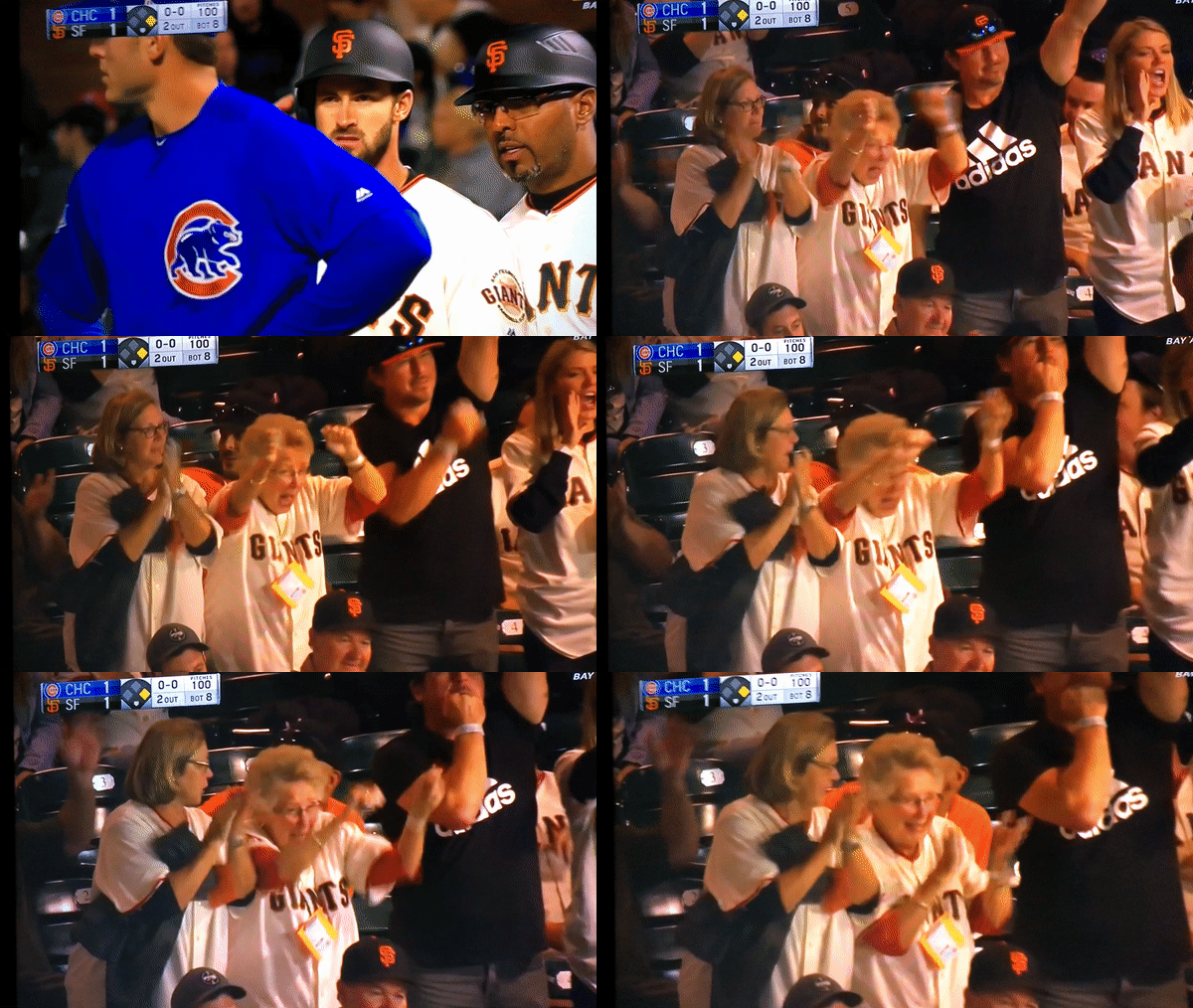
Twitter: @123sportsdigest

Facebook

Instagram: @123__sports


“Every day is black tie optional.”

– Dwight Schrute